
WordPress has a reputation for being the default choice, the CMS nobody gets fired for picking. It still runs 40.3% of all websites, and no other platform comes close. But the trend line points the other way. WordPress held 65.2% of sites with a known CMS in January 2022 and 58.8% on 10 September 2026, while Shopify, Wix and hosted builders took the difference. That is the backdrop for this Top 20 WordPress Development Companies in USA guide, and it changes what a buyer is actually hiring for.
The core software is rarely the weak point. The server underneath it and the plugins on top of it are. About 63% of WordPress sites run a PHP version that will be out of security support by 1 January 2027, and 91% of the 11,334 WordPress vulnerabilities found in 2025 were in plugins, not core.
So the useful question is not which agency builds the nicest homepage. It is which one will still be patching plugins, upgrading PHP and answering the phone in year three.
This guide covers the twenty firms, what they charge, and what you must own before the final invoice: the repository, the hosting account and the premium licence keys.
Key takeaways
- 58.8% of sites with a known CMS run WordPress, down from a 65.2% peak in January 2022 (W3Techs).
- 63% of WordPress sites run PHP 8.2 or older, and PHP 8.2 loses security fixes on 31 December 2026 (WordPress.org).
- 5 hours is the median time from disclosure to mass exploitation for heavily targeted WordPress flaws, and 46% of vulnerabilities had no patch at disclosure (Patchstack).
- $50 to $300 an hour is the published rate range across the top 20 US WordPress firms on Clutch, with a median band midpoint of $124.50 (Brain Station 23 analysis).
- $25,000 is the median minimum project size among the same twenty firms (Clutch, Brain Station 23 analysis).
- $61,364 to $123,925 is what four salary sites report for the same “WordPress developer” title (PayScale, Talent.com).
- 45% of WordPress mobile sites pass all three Core Web Vitals, against 85% on Duda (HTTP Archive Web Almanac 2025).
- 5,000+ digital accessibility lawsuits were filed in the US in 2025 (UsableNet).
WordPress in 2026: still the largest, no longer growing
WordPress is not in trouble. It is in a different phase. For a decade the story was growth, and the buyer’s question was “why not WordPress?” In 2026 the platform is mature, the share is drifting down, and the buyer’s question is “what does it take to keep this running well?”
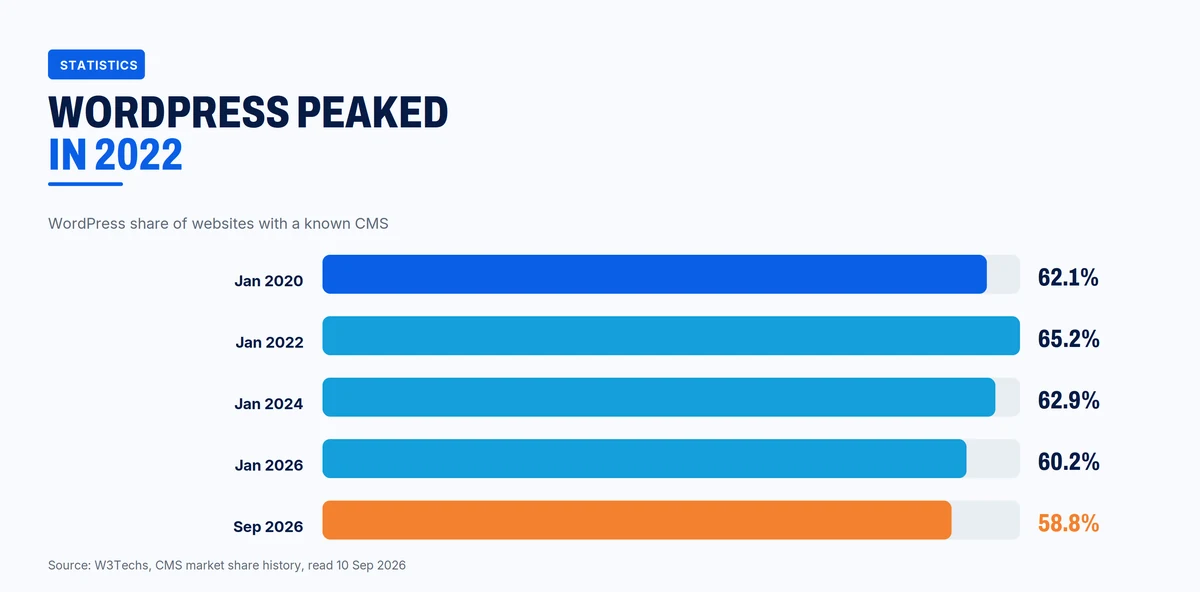
WordPress share of sites with a known CMS, January 2020 to September 2026. Source: W3Techs CMS market share history, read 10 September 2026.
W3Techs measures CMS share by crawling sites and detecting the platform, so the figure undercounts heavily customised or headless builds that hide their stack. Treat the direction as reliable and the decimal point as approximate.
The more useful number for a buyer is how fast the ecosystem updates. Here the picture splits in two. WordPress 7.1 shipped on 19 August 2026, and three weeks later 53% of WordPress sites were already running it. Core auto-updates work.
The server is a different story. PHP 7.4 still runs on about 17% of WordPress sites, nearly four years after it stopped receiving security fixes. Another 11.4% are on PHP 8.1, which lost security support on 31 December 2025. PHP 8.2, the version on about a quarter of sites, follows on 31 December 2026.
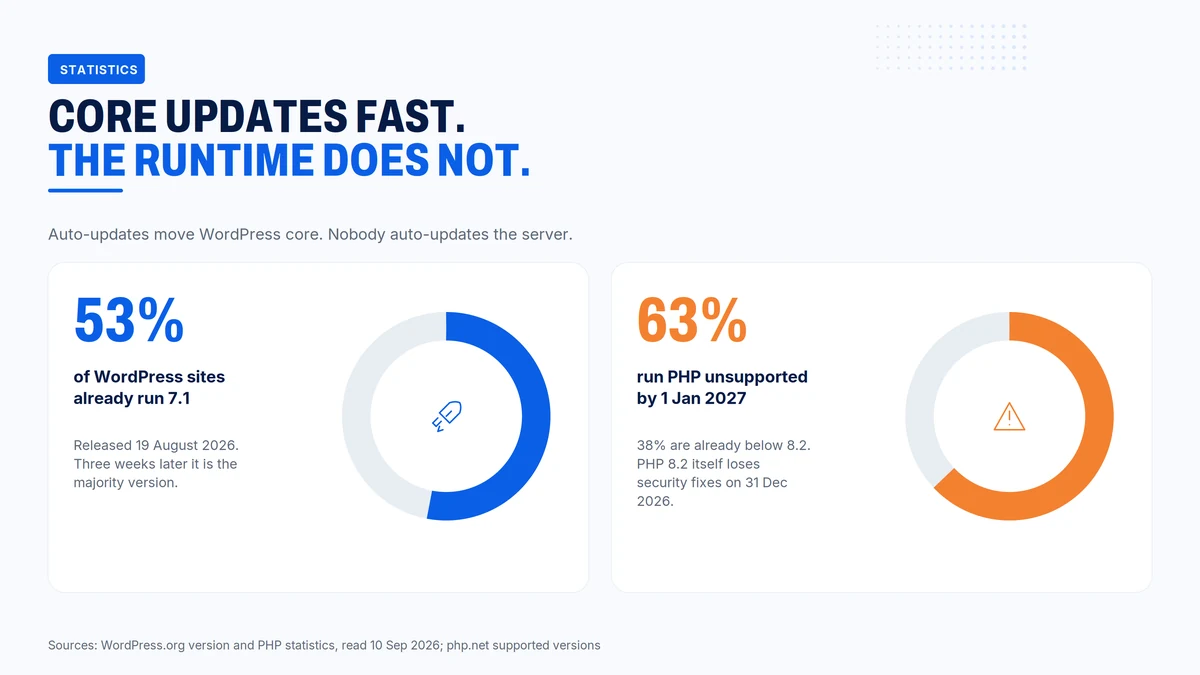
Core version and PHP runtime share across WordPress sites. Sources: WordPress.org statistics, read 10 September 2026; php.net supported versions.
Nobody auto-updates the server. That gap is where most of the work in a WordPress engagement now sits, and it is the first thing to raise with any firm on this list. Ask which PHP version your site runs, when it goes out of support, and who is responsible for the upgrade.
Two more signals shape the brief. Page builders dominate: the HTTP Archive Web Almanac found Elementor on 43% of WordPress sites on mobile, more than double the native Block Editor at 18%. And performance still lags hosted rivals, which the technical section below covers in detail.
What WordPress development costs in the US
There is no honest single number for WordPress work, and the sources that offer one disagree with each other by tens of thousands of dollars. The useful move is to see the spread and then ask what a specific quote includes.
Start with agency rates. Across the twenty firms on this list, published hourly bands run from $50 to $300. Seven firms sit at $150 to $199, six at $100 to $149, five at $50 to $99, and one at $200 to $300. One firm does not publish a rate. The median band midpoint is $124.50 an hour (Clutch profiles, read 10 September 2026, Brain Station 23 analysis).
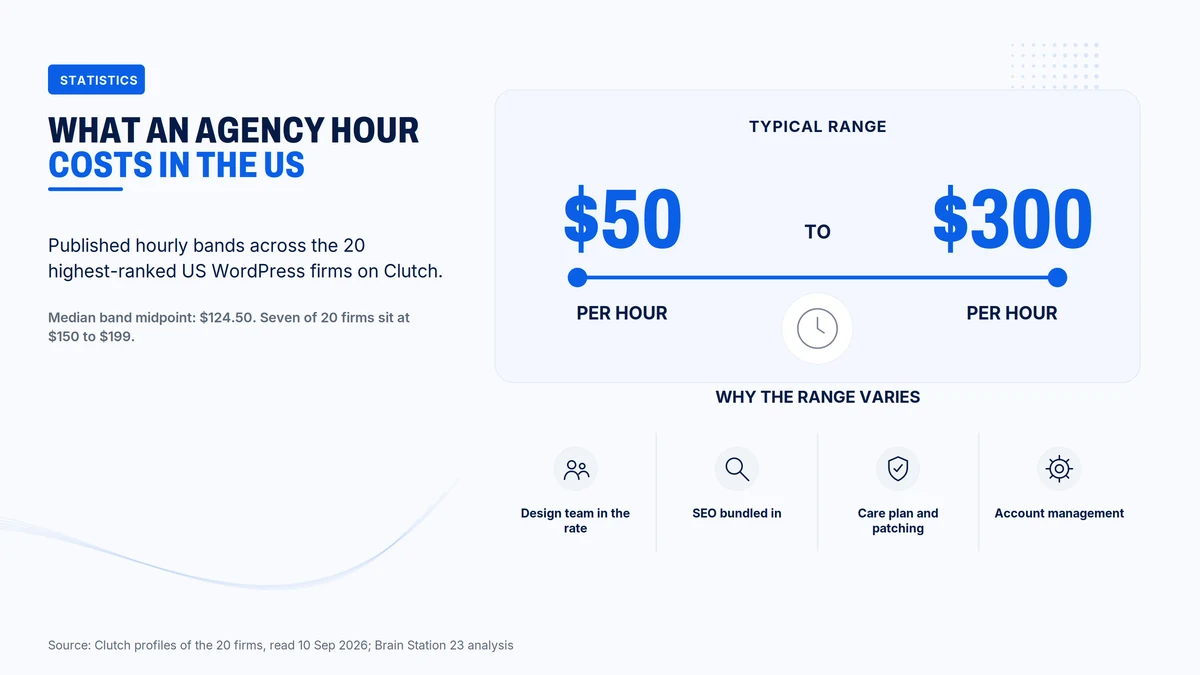
Published hourly bands on the twenty firms’ profiles. Source: Clutch, read 10 September 2026; Brain Station 23 analysis.
The rate alone does not tell you much, because firms bundle different things into the hour. A $175 design studio may include a strategist, a copywriter and a project manager. A $75 engineering firm may bill those separately or not provide them at all.
Wages explain part of the spread. The Bureau of Labor Statistics puts the median US web developer wage at $92,650 in May 2025, with the top 10% above $162,290. Four salary sites, asked about the narrower “WordPress developer” title, add four more answers:
- PayScale: $61,364, base pay from 52 self-reported profiles
- ZipRecruiter: $84,542, estimated from job ads
- Glassdoor: $87,248, reported pay
- Talent.com: $123,925, from job listings
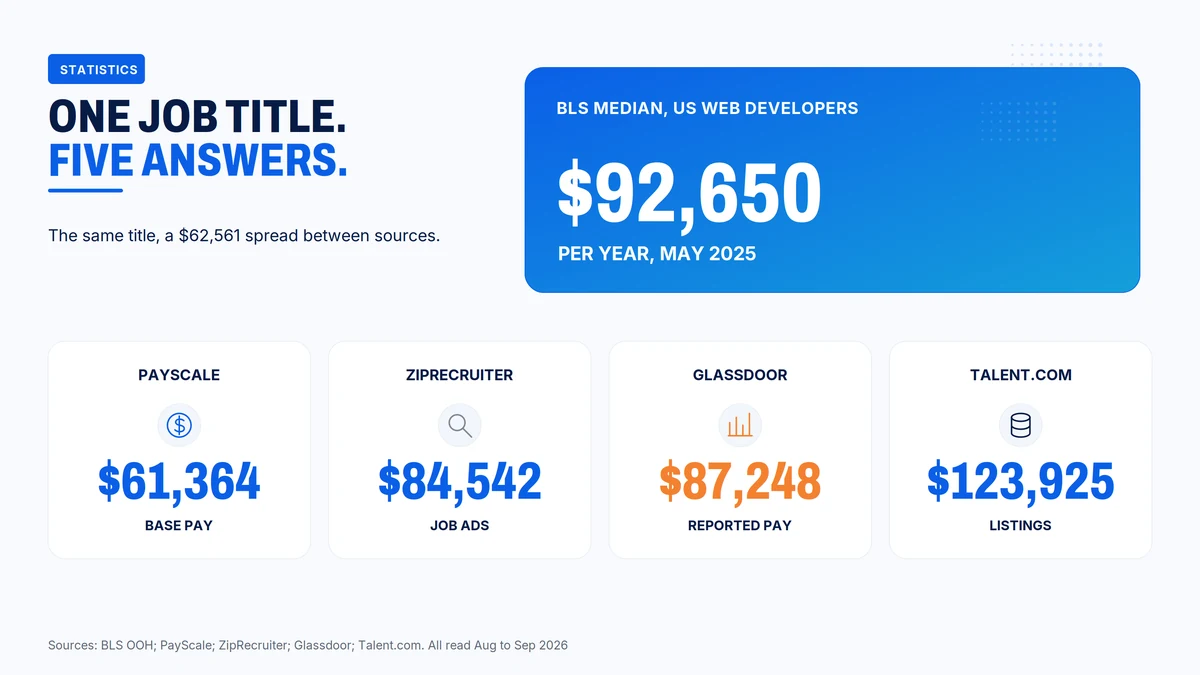
One job title, five figures, a $62,561 spread. Sources: BLS, PayScale, ZipRecruiter, Glassdoor, Talent.com, read August to September 2026.
None of them is wrong. PayScale counts base pay reported by a small sample. Talent.com averages advertised salaries, which skew towards senior roles in expensive cities. The BLS figure covers all web developers, not only WordPress specialists. Quote whichever suits your argument and you will be misleading yourself.
What actually moves a WordPress quote is scope, and seven factors do most of the work.
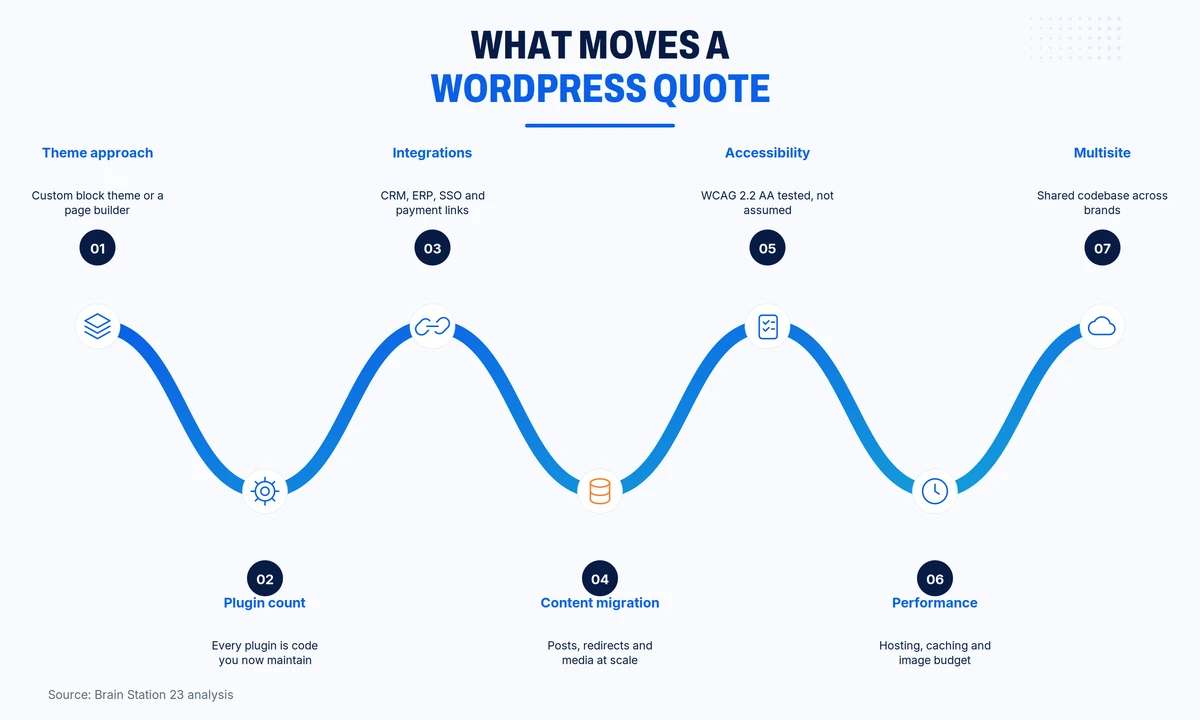
What moves a WordPress build quote. Source: Brain Station 23 analysis.
A custom block theme costs more to build than a page-builder site but less to maintain. Every plugin is code someone must patch. CRM, ERP and single sign-on integrations are where fixed-price quotes go wrong. Content migration is usually underestimated by a factor of two. And accessibility and performance targets only cost money if they are written into the scope, which is exactly why they should be.
The Top 20 WordPress Development Companies in USA, compared
Firms 2 to 21 below are the organic top 20 on Clutch’s US WordPress developers directory, read on 10 September 2026, in the order Clutch ranked them. Two paid “spotlight” listings sit above the organic results on that page; we used only the organic rows. Brain Station 23 is placed first because we publish this article. We are US-headquartered and verified on Clutch, but WordPress is not listed as a separate focus on our profile, so the directory did not place us in its top 20 and we are not claiming it did.
Clutch lists 5,125 WordPress firms in the United States. Nobody reads 5,125 profiles, which is why the ranking matters, and why it is worth knowing what it rewards.
Comparison table
| # | Company | Best For | Team Size | Core WordPress Focus | Key Tech Stack | Industries Served | Engagement Models |
|---|---|---|---|---|---|---|---|
| 1 | Brain Station 23 — brainstation-23.com | Cost-conscious buyers who want a large, certified team for builds and care plans | 250 to 999 | Staff augmentation 60%; WooCommerce in e-commerce split | WordPress, WooCommerce, Laravel, Spring, .NET, Flutter | Retail, healthcare, telecoms, education, financial services | Dedicated team, staff augmentation, project |
| 2 | Social Driver — socialdriver.com | Healthcare and nonprofit organisations rebuilding a mission-driven site | 10 to 49 | Web dev 50%; WP 80% of CMS | WordPress, Drupal, Webflow | Healthcare, nonprofit | Project, digital retainer |
| 3 | LLT Group — llt-group.com | Manufacturers and logistics firms wanting WordPress with e-commerce | 10 to 49 | Web design 45%, web dev 30%; WP 100% of CMS | WordPress, .NET, PHP, JavaScript | Manufacturing, business services, healthcare, logistics | Project |
| 4 | Orbit Media Studios — orbitmedia.com | Mid-market B2B firms that want a site built for content and conversion | 50 to 249 | Web design, development and SEO 25% each; WP 90% of CMS | WordPress, Drupal, HubSpot | Business services, manufacturing, education, financial services | Project, SEO and CRO retainer |
| 5 | HUEMOR — huemor.rocks | Industrial and construction brands wanting a design-led site | 10 to 49 | Web design 40%, web dev 30%; WP 90% of CMS | WordPress, Drupal, PHP, Shopify | Construction, manufacturing, business services, contracting | Project, SEO retainer |
| 6 | Storm Brain — stormbrain.com | Consumer brands wanting WordPress or WooCommerce plus ads under one roof | 50 to 249 | Web design 40%, web dev 20%; WP 100% of CMS | WordPress, WooCommerce, Shopify, PHP | E-commerce, business services, consumer products, financial services | Project, paid media retainer |
| 7 | ChopDawg.com — chopdawg.com | Startups building an app with a WordPress site alongside | 10 to 49 | Mobile apps 80%, web 20%; WP 100% of CMS | WordPress, React, React Native, Node.js | Business services, consumer, education, fintech, healthcare | Project |
| 8 | Ignite Visibility — ignitevisibility.com | Marketing teams that want the site run by their search and paid agency | 250 to 999 | SEO 30%, web dev 10%; WP 100% of CMS | WordPress, Webflow | Automotive, education, franchises, home services, insurance | Marketing retainer, project |
| 9 | Wakefly, Inc. — wakefly.com | Financial and healthcare firms needing WordPress plus .NET integration | 10 to 49 | Web dev 55%; WP 100% of CMS | WordPress, .NET, C#, ASP.NET | Financial services, healthcare, business services | Project, PPC retainer |
| 10 | Bilberrry — bilberrry.com | Enterprises pairing WordPress with React or Adobe Experience Manager | 10 to 49 | Web dev 40%, custom 30%; WP 60% of CMS | WordPress, AEM, React, Node.js | Government, nonprofit, education, financial services | Project, staff augmentation |
| 11 | Simpalm — simpalm.com | Nonprofits and education groups needing a site and an app from one team | 10 to 49 | Mobile 40%, web dev 30%; WP 80% of CMS | WordPress, Drupal, React, React Native | Education, financial services, healthcare, nonprofit | Project, application support |
| 12 | Plego — plego.com | Companies adding AI features or custom apps to a WordPress or Joomla estate | 50 to 249 | AI 45%, custom 30%, web 25%; WP 50% of CMS | WordPress, Joomla, Laravel, React, Rails | IT, real estate, e-commerce, manufacturing | Project |
| 13 | GLIDE® — glidedesign.com | Healthcare and dental practices wanting WordPress with SEO and paid search | 10 to 49 | Web design 35%, web dev 15%; WP 100% of CMS | WordPress, PHP, JavaScript | Healthcare, dental, nonprofit, consumer | Project, SEO and PPC retainer |
| 14 | Perpetual — perpetualny.com | Product teams wanting UX-led WordPress plus Salesforce or Airtable work | 50 to 249 | UX/UI 30%, web dev 20%; WP 67% of CMS | WordPress, Drupal, Webflow, Salesforce, Node.js | IT, advertising, financial services, media, healthcare | Project, low-code |
| 15 | Arbisoft — arbisoft.com | Large custom platforms where WordPress is one part of a bigger build | 250 to 999 | Custom 50%, web 15%; WP 30% of CMS | Wagtail, WordPress, Django, React | Education, hospitality, healthcare, financial services | Project, dedicated team |
| 16 | rtCamp — rtcamp.com | Enterprise publishers and large WordPress estates needing managed services | 250 to 999 | Managed IT, staff augmentation and web 20% each; WP 100% of CMS | WordPress, WooCommerce, Laravel, React, PHP | Media, automotive, advertising, healthcare | Managed services, staff augmentation, project |
| 17 | UPQODE — upqode.com | Small and mid-size businesses wanting a fast WordPress design | 50 to 249 | Web design 80%; WP 61% of CMS | WordPress, Duda, Laravel, PHP | Business services, marketing, legal, retail | Project |
| 18 | Codup — codup.co | B2B distributors connecting WooCommerce to an ERP | 50 to 249 | Custom and e-commerce 30% each; WP 100% of CMS | WordPress, WooCommerce, Shopify, NetSuite, SAP | E-commerce, manufacturing, electrical, HVAC | Project, staff augmentation |
| 19 | ThrillX — thrillxdesign.com | Small e-commerce and B2B brands focused on conversion design | 10 to 49 | Web design 50%, web dev 25%; WP 100% of CMS | WordPress, Webflow, PHP | E-commerce, business services, IT | Project, CRO |
| 20 | SEO Brand — seobrand.com | Small businesses buying WordPress as part of an SEO programme | 10 to 49 | SEO 60%, web dev 10%; WP 100% of CMS | WordPress, PHP, CakePHP | Financial services, legal, healthcare, real estate, retail | SEO and PPC retainer, project |
| 21 | Troy Web Consulting — troyweb.com | Government, energy and healthcare bodies with a custom system behind the site | 10 to 49 | Custom 25%, web dev 20%; WP 100% of CMS | WordPress, .NET, Laravel, React | Energy, healthcare, government, education | Project |
Team sizes, focus percentages, stacks and industries are from each firm’s published Clutch profile, read 10 September 2026. “WP % of CMS” is WordPress’s share of the firm’s CMS work, not of its total business. “Best For” is our reading of that data. Engagement models are inferred from each firm’s published service lines rather than stated by the firm. Founding years appear in the profiles below; certifications are not published consistently, so they are left out of the table rather than guessed.
Certifications in the profiles below are self-published by each firm and unverified by us. Where a firm publishes none, the profile says so.
Publisher’s pick
1. Brain Station 23
We publish this guide, so read this entry as the publisher’s pick, not a ranking. Our Clutch profile does not list WordPress as its own focus area: 60% of our published work is IT staff augmentation, and WooCommerce is 20% of our e-commerce split. What the table shows is price. Our published band is $25 to $49 an hour against a $124.50 median midpoint for the other twenty firms, and our minimum is $10,000. The trade is distance, with US headquarters in Springfield and most engineers overseas, so plan overlap hours in week one. The certifications matter for the repository, licence and patching asks later in this guide. One reviewer wanted better internal coordination and another more proactive recommendations. If you want a local design studio in the room every week, call someone else.
Founded: 2006
US Presence: Springfield, Virginia, plus delivery centres in Bangladesh, the UAE, England, Malaysia and Germany
Company size: 250 to 999 on Clutch; 900+ engineers by our own count
Rating: 4.9 from 21 Clutch reviews
Best for
- Cost-conscious buyers who want a large, certified team for builds and care plans
Certifications and partnerships
- CMMI Level 3
- ISO 27001
- ISO 9001
- SOC 2 Type II
Core WordPress services
- Custom themes
- Plugin development
- WooCommerce
- Migrations
- Maintenance
- Dedicated teams
Industries served
- Retail
- Healthcare
- Telecoms
- Education
- Financial services
- Most delivery is offshore, so agree overlap hours and a named US-hours contact
For mission-driven, healthcare and public-sector sites
2. Social Driver
The top-ranked organic firm splits its published work between web development (50%) and design (40%), with WordPress at 80% of its CMS work. Its 76 reviews describe strong project management and training workshops, and reported project costs run from $9,000 to over $500,000 (Clutch). Two reviewers raised the same point from different angles: it took time to settle the right account contact, and one asked the team to be more direct about deadlines and the cost of missing them. Sort both out on day one.
Founded: 2011
Company size: 10 to 49
Best for
- Healthcare and nonprofit organisations rebuilding a mission-driven site
Certifications and partnerships
- Not published; ask directly
Core WordPress services
- WordPress and Drupal builds
- Web design
- Webflow
- Digital strategy
- Content and video
Industries served
- Healthcare
- Nonprofit
- Name the day-to-day account lead and the rules for change costs at kickoff
11. Simpalm
Mobile apps are 40% of Simpalm’s published work and web development 30%, which makes it a fit when the website and an app share a backend. Reported budgets run from $7,000 to over $500,000, and half its clients are small businesses (Clutch). The critiques in its 64 reviews are about rhythm rather than quality: stretches without timely progress updates, and a wish for faster tweaks after launch. The hourly rate is not published, so ask for it before comparing quotes.
Founded: 2009
Company size: 10 to 49
Best for
- Nonprofits and education groups needing a site and an app from one team
Certifications and partnerships
- Not published; ask directly
Core WordPress services
- WordPress and Drupal sites
- Web design
- Mobile apps
- UX
- Application support
Industries served
- Education
- Financial services
- Healthcare
- Nonprofit
- Media
- Agree an update cadence and a post-launch fix window in writing
13. GLIDE®
GLIDE is a design-first agency: web design is 35% of its focus, with SEO and paid search at 15% each, and WordPress is its only CMS. Healthcare and dental make up 55% of its industry mix (Clutch). One reviewer has run the same WordPress theme with GLIDE for nearly a decade, which says something about build quality. Another said the window between finishing development and launch was too short to fix minor issues. The $50,000 minimum rules it out for small practices.
Founded: 2003
Company size: 10 to 49
Best for
- Healthcare and dental practices wanting WordPress with SEO and paid search
Certifications and partnerships
- Not published; ask directly
Core WordPress services
- WordPress design and builds
- WordPress SEO
- Google Ads
- UX strategy
- AI chatbots
Industries served
- Healthcare
- Dental
- Nonprofit
- Consumer products
- IT
- Build a longer gap between code freeze and launch into the plan
21. Troy Web Consulting
Troy Web is a custom software shop that builds WordPress sites, not the other way round: custom software leads its split at 25%. Its most common project size is over $200,000, and one reviewer’s system reached $1.3 million (Clutch). With only 17 reviews, the evidence is thin but consistent. The one critique came from a client who used other vendors for pieces Troy Web could have handled. Scope the whole system early.
Founded: 2002
Company size: 10 to 49
Best for
- Government, energy and healthcare bodies with a custom system behind the site
Certifications and partnerships
- Not published; ask directly
Core WordPress services
- WordPress builds
- Custom software
- Mobile apps
- UX/UI
- AI features
Industries served
- Energy
- Healthcare
- Government
- Education
- Insurance
- Ask for the full capability list at kickoff so work is not split across vendors
For B2B, industrial and mid-market brands
3. LLT Group
LLT publishes the highest rate on the list, $200 to $300 an hour, and WordPress is 100% of its CMS work. Its 89 reviews praise transparency, and typical projects run from $10,000 to over $100,000 (Clutch). The critiques are specific: one client wanted a realistic launch date within the first month and more short check-ins; another had to help execute the creative concepts; Clutch’s summary notes SEO execution as an area for improvement. Judge the design portfolio carefully.
Founded: 2010
Company size: 10 to 49
Best for
- Manufacturers and logistics firms wanting WordPress with e-commerce
Certifications and partnerships
- Not published; ask directly
Core WordPress services
- WordPress design and builds
- E-commerce
- .NET integration
- SEO
Industries served
- Manufacturing
- Business services
- Healthcare
- Logistics
- Consumer products
- Ask for a realistic go-live date in month one and design samples from your sector
4. Orbit Media Studios
The oldest firm on the list splits its work evenly across design, development and SEO at 25% each, with conversion work at 15%. Typical projects run $50,000 to $200,000, and 65% of clients are mid-market (Clutch). A 5.0 rating across 36 reviews is backed by consistent comments on strategy. The one repeated friction is scope: a reviewer felt “out of scope” came up frequently. That is a scoping discipline as much as a complaint. Write the feature list down.
Founded: 2001
Company size: 50 to 249
Best for
- Mid-market B2B firms that want a site built for content and conversion
Certifications and partnerships
- Not published; ask directly
Core WordPress services
- WordPress builds
- Web design
- SEO
- Conversion optimisation
- HubSpot implementation
Industries served
- Business services
- Manufacturing
- Consumer products
- Education
- Financial services
- Get the scope list in writing, because one reviewer heard “out of scope” often
5. HUEMOR
HUEMOR’s industry mix is unusual: construction, manufacturing and contracting account for 55% of its work, and 80% of clients are mid-market. Projects generally run $30,000 to $200,000 (Clutch). Reviews praise responsiveness and design. The critiques across its 72 reviews include tight timelines, a delayed calculator feature, a project-manager change, and copy for a technical engineering firm that needed heavy rewriting. Plan to own the copy if your product is complex.
Founded: 2011
Company size: 10 to 49
Best for
- Industrial and construction brands wanting a design-led site
Certifications and partnerships
- Not published; ask directly
Core WordPress services
- WordPress design and builds
- Branding
- UX
- Technical SEO
- Site migrations
Industries served
- Construction
- Manufacturing
- Business services
- Contracting
- Healthcare
- If your service is technical, budget time to edit the site copy yourself
9. Wakefly, Inc.
Wakefly has the highest web development share on the list at 55%, and its framework work is entirely .NET, which suits firms whose WordPress site talks to a Microsoft backend. Financial services and healthcare make up 55% of its industries, and reported projects run from $36,000 to $500,000 (Clutch). Reviews credit responsiveness and project management. The review base is smaller than most on this list, so references matter more here.
Founded: 2002
Company size: 10 to 49
Best for
- Financial and healthcare firms needing WordPress plus .NET integration
Certifications and partnerships
- Not published; ask directly
Core WordPress services
- WordPress development
- Custom .NET software
- UX testing
- Conversion reporting
- PPC
Industries served
- Financial services
- Healthcare
- Business services
- Consumer products
- Manufacturing
- With 24 reviews on file, ask for two references in your own sector
For e-commerce and growth marketing
6. Storm Brain
Storm Brain holds a 5.0 rating across 126 reviews, the second-largest review base in the top 20. Design is 40% of its work, and its e-commerce split is 65% Shopify, 35% WooCommerce (Clutch). Reported projects run from $10,000 to $250,000. The reviews contain no repeated criticism, which is unusual at this volume. The practical question is platform fit: a firm this comfortable with Shopify will tell you honestly when WooCommerce is the wrong choice, but ask directly.
Founded: 2007
Company size: 50 to 249
Best for
- Consumer brands wanting WordPress or WooCommerce plus ads under one roof
Certifications and partnerships
- Not published; ask directly
Core WordPress services
- WordPress design and builds
- WooCommerce
- Shopify
- Paid media
- SEO
- OTT advertising
Industries served
- E-commerce
- Business services
- Consumer products
- Financial services
- Healthcare
- Ask whether your store should be on WooCommerce or Shopify, since its e-commerce work leans Shopify
8. Ignite Visibility
Ignite is a performance marketing agency first: SEO is 30% of its work and web development 10%. It has the largest review base on the list at 175, and a 5.0 score for cost (Clutch). Engagements run from $5,000 to over $300,000 a year. One reviewer saw no marked lift in lead-generation paid search despite the effort. The risk with any agency that owns both site and marketing is exit: split the contracts so you can leave one without losing the other.
Founded: 2013
Company size: 250 to 999
Best for
- Marketing teams that want the site run by their search and paid agency
Certifications and partnerships
- Not published; ask directly
Core WordPress services
- WordPress and Webflow builds
- SEO
- Paid search
- Social media
Industries served
- Automotive
- Education
- Franchises
- Home services
- Insurance
- Healthcare
- Separate the site build and the marketing retainer in the contract
17. UPQODE
Web design is 80% of UPQODE’s published work, its minimum is $5,000, and it lists 34 US locations. Typical projects run $5,000 to over $75,000, and 106 reviews praise project management and value (Clutch). The one substantive critique: a client felt the initial layouts and graphics fell short of expectations and put in real work guiding them. Arrive with examples of sites you like. With 34 listed locations, ask where your team actually sits.
Founded: 2015
Company size: 50 to 249
Best for
- Small and mid-size businesses wanting a fast WordPress design
Certifications and partnerships
- Not published; ask directly
Core WordPress services
- WordPress design and builds
- UX research
- Usability testing
- Laravel
- Duda and Wix sites
Industries served
- Business services
- Marketing
- Legal
- Retail
- Healthcare
- Show reference sites at kickoff; one reviewer had to guide the layouts
18. Codup
Codup’s e-commerce split is the broadest here: WooCommerce and Shopify at 30% each, plus BigCommerce, NetSuite SuiteCommerce and SAP. Manufacturing and trade sectors such as electrical and HVAC dominate its industry list (Clutch). That combination suits a distributor whose WordPress store must sync stock and pricing with an ERP. Its 75 reviews are positive, but reported costs run from $1,500 to over $80,000, so large-program experience needs checking.
Founded: 2012
Company size: 50 to 249
Best for
- B2B distributors connecting WooCommerce to an ERP
Certifications and partnerships
- Not published; ask directly
Core WordPress services
- WooCommerce builds
- ERP integration
- Custom software
- App modernisation
- Staff augmentation
Industries served
- E-commerce
- Manufacturing
- Electrical
- HVAC
- Retail
- Most reviewed projects were under $10,000, so ask for a reference at your budget
19. ThrillX
The youngest firm on the list is headquartered in Toronto with a Houston office. Design is 50% of its work and conversion optimisation 10%, and WordPress is its only CMS (Clutch). Reported projects run from $4,000 to $85,000 Canadian, and 39 reviews describe good communication and on-time delivery with no repeated criticism. The relevant check is fit rather than quality: at this size, a large integration project may stretch the team.
Founded: 2021
Company size: 10 to 49
Best for
- Small e-commerce and B2B brands focused on conversion design
Certifications and partnerships
- Not published; ask directly
Core WordPress services
- WordPress design and builds
- Conversion optimisation
- Webflow
- Salesforce integration
Industries served
- E-commerce
- Business services
- IT
- Confirm who staffs US work and which currency the quote is in
20. SEO Brand
SEO is 60% of SEO Brand’s work and web development 10%, so treat it as a search agency that builds sites. It has 109 reviews, and engagements run from $1,200 to $200,000 a year (Clutch). Two critiques are worth noting: changes in team members during an engagement, and a reviewer’s observation that some clients may want more direct access to make WordPress changes. Admin access to your own site should never be a favour.
Founded: 2006
Company size: 10 to 49
Best for
- Small businesses buying WordPress as part of an SEO programme
Certifications and partnerships
- Not published; ask directly
Core WordPress services
- WordPress design and builds
- WordPress SEO
- Local search
- Content
- Google Ads
Industries served
- Financial services
- Legal
- Healthcare
- Real estate
- Retail
- Government
- Confirm you get full admin access to your own WordPress install
For custom builds, integrations and enterprise estates
7. ChopDawg.com
Mobile is 80% of ChopDawg’s work, and its minimum is only $1,000. With 112 reviews, it has one of the deeper review records here, and reported projects run from $10,000 to $350,000 (Clutch). Two critiques are consistent with a studio that changes teams between phases: gaps when a project moved from design to coding, and small bugs that internal QA should have caught before delivery. Ask for a named lead across both phases.
Founded: 2009
Company size: 10 to 49
Best for
- Startups building an app with a WordPress site alongside
Certifications and partnerships
- Not published; ask directly
Core WordPress services
- WordPress sites
- Mobile apps
- React and React Native builds
- Prototypes
- Node.js APIs
Industries served
- Business services
- Consumer
- Education
- Fintech
- Healthcare
- Retail
- Confirm who carries continuity when design hands over to development
10. Bilberrry
Bilberrry’s stack is JavaScript-heavy: React is 53% of its framework work and Node.js 33%, and it splits CMS work between WordPress (60%) and Adobe Experience Manager (40%). Half its clients are enterprises, and projects range from $21,000 to over $1 million (Clutch). A 5.0 rating across 35 reviews comes with no repeated complaint. Headless WordPress is powerful and harder to hand over, so get the hosting and deployment plan in writing.
Founded: 2010
Company size: 10 to 49
Best for
- Enterprises pairing WordPress with React or Adobe Experience Manager
Certifications and partnerships
- Not published; ask directly
Core WordPress services
- WordPress and AEM builds
- Headless React front ends
- REST APIs
- Staff augmentation
Industries served
- Government
- Nonprofit
- Education
- Financial services
- Manufacturing
- Ask how a headless build will be maintained and hosted after handover
12. Plego
AI development is 45% of Plego’s published focus, the highest share on the list, and its CMS work splits evenly between WordPress and Joomla. Projects range from under $10,000 to over $300,000 (Clutch). Two reviewers raised coordination: one wanted a single point of contact across several internal teams, and another noticed developers waiting for status calls before asking blocking questions. Both are fixable with a named PM and an async channel.
Founded: 2002
Company size: 50 to 249
Best for
- Companies adding AI features or custom apps to a WordPress or Joomla estate
Certifications and partnerships
- Not published; ask directly
Core WordPress services
- WordPress and Joomla development
- AI integration
- Custom software
- Laravel
- React
Industries served
- IT
- Real estate
- E-commerce
- Manufacturing
- Media
- Name one project manager across all their work groups
14. Perpetual
UX/UI is Perpetual’s largest service line at 30%, and it pairs WordPress with low-code platforms such as Salesforce Lightning and Airtable. Reported projects run from $2,500 to $500,000, and it holds 97 reviews (Clutch). One reviewer noted communication gaps with offshore resources that improved over the year; another wanted the team to be more vocal with recommendations. Its 4.6 cost rating is the lowest on the list, which is still a good score.
Founded: 2012
Company size: 50 to 249
Best for
- Product teams wanting UX-led WordPress plus Salesforce or Airtable work
Certifications and partnerships
- Not published; ask directly
Core WordPress services
- WordPress and Drupal builds
- UX/UI design
- Webflow
- Salesforce and Airtable apps
- Node.js
Industries served
- IT
- Advertising
- Financial services
- Media
- Healthcare
- Real estate
- Ask which work is done offshore and how handoffs are managed
15. Arbisoft
Arbisoft is a large custom software firm with its US office in Plano and further offices in Lahore, Islamabad and Riyadh. WordPress is 30% of its CMS work, behind Wagtail at 40%, and its most common project size is $200,000 to $999,999 (Clutch). Reviews describe a committed team that adapts well. The main critique asked for more frequent strategic planning sessions. This is a strong choice when the website is part of a platform, and an expensive one when it is only a website.
Founded: 2007
Company size: 250 to 999
Best for
- Large custom platforms where WordPress is one part of a bigger build
Certifications and partnerships
- Not published; ask directly
Core WordPress services
- WordPress and Wagtail builds
- Django
- React
- Mobile apps
- AI development
Industries served
- Education
- Hospitality
- Healthcare
- Financial services
- WordPress is 30% of its CMS work, so confirm the named WordPress lead
16. rtCamp
rtCamp is the most WordPress-specialised firm on the list: WordPress is 100% of its CMS work, WooCommerce is its only e-commerce platform, and PHP is 75% of its language mix. Half its clients are enterprises (Clutch). Its second listed office is in Pune, India. It also appears as a paid spotlight listing above the organic results, which we ignored. The reviews show long partnerships, one of them over three years, but 16 reviews is the smallest base here.
Founded: 2009
Company size: 250 to 999
Best for
- Enterprise publishers and large WordPress estates needing managed services
Certifications and partnerships
- WordPress VIP Agency Partner (rtcamp.com); other certifications not published
Core WordPress services
- Enterprise WordPress
- WordPress VIP
- WooCommerce
- Multisite
- Managed hosting
- Security
Industries served
- Media
- Automotive
- Advertising
- Healthcare
- Financial services
- Only 16 reviews on Clutch, and it also buys a paid listing there, so judge it on the organic data
What we found in the top 20
The comparison table tells you who each firm suits. The tally below covers every firm on this Top 20 WordPress Development Companies in USA list and shows what normal looks like, so you can spot a quote that is out of line.
The median firm is a design and marketing agency that builds WordPress, not a WordPress engineering firm. Web development is 20% of the median firm’s published focus. Web development and web design together reach 47.5%. Seven of the twenty list SEO as a service line, and for two of them it is the largest line (Clutch profiles, read 10 September 2026, Brain Station 23 analysis).
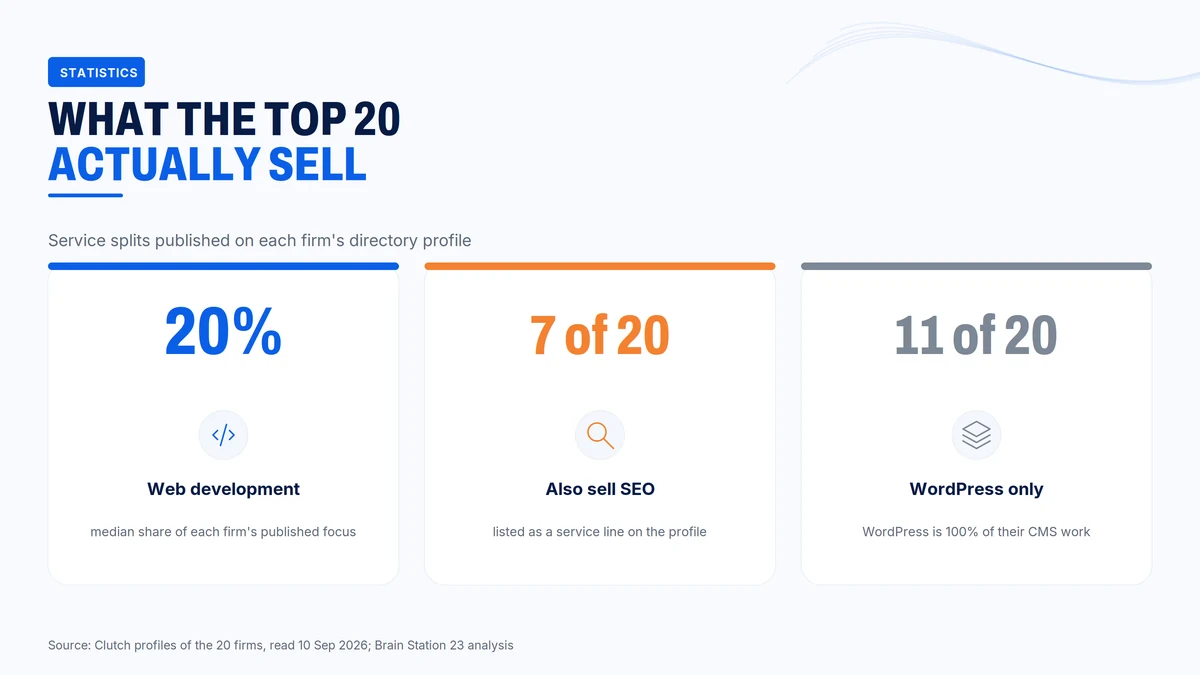
Service splits published on each firm’s directory profile. Source: Clutch, read 10 September 2026; Brain Station 23 analysis.
That is not a flaw in the ranking. Most US WordPress buyers want a marketing site, and design-led agencies are good at marketing sites. It matters when your brief is technical: an ERP integration, a multisite estate, a headless front end. For those, look at the firms whose custom software or web development share is high, not their position in the list.
Eleven of twenty firms are small. They have 10 to 49 staff; six have 50 to 249, and three have 250 to 999. Small is an advantage for senior attention and a risk for continuity, which is why three of the critiques above involve a change of project manager or team.
The minimum project is the fastest filter. Eight firms set their floor at $25,000, which is also the median. Four accept projects from $1,000, one from $5,000, four from $10,000, and three start at $50,000.
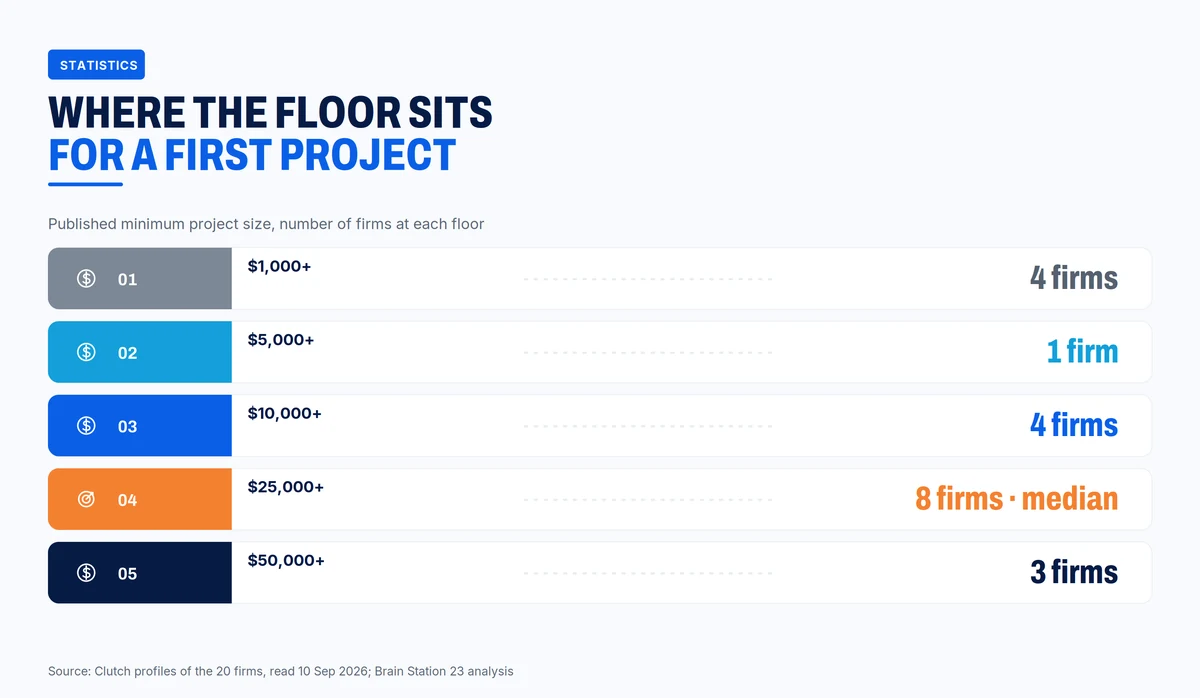
Published minimum project size, number of firms at each floor. Source: Clutch, read 10 September 2026; Brain Station 23 analysis.
Ratings cannot separate these firms. Every one sits between 4.8 and 5.0. Together they hold 1,384 reviews, with a median of 68 per firm and a range from 16 (rtCamp) to 175 (Ignite Visibility). The stars are a floor, not a differentiator. The text of the critiques is where the differences show.
Most are well established. The median founding year is 2009, the oldest dates from 2001, and only one firm, ThrillX, was founded in the last ten years.
How to shortlist a WordPress development company
The order matters. Each step removes more firms than the one after it, so doing them in sequence saves the most time.
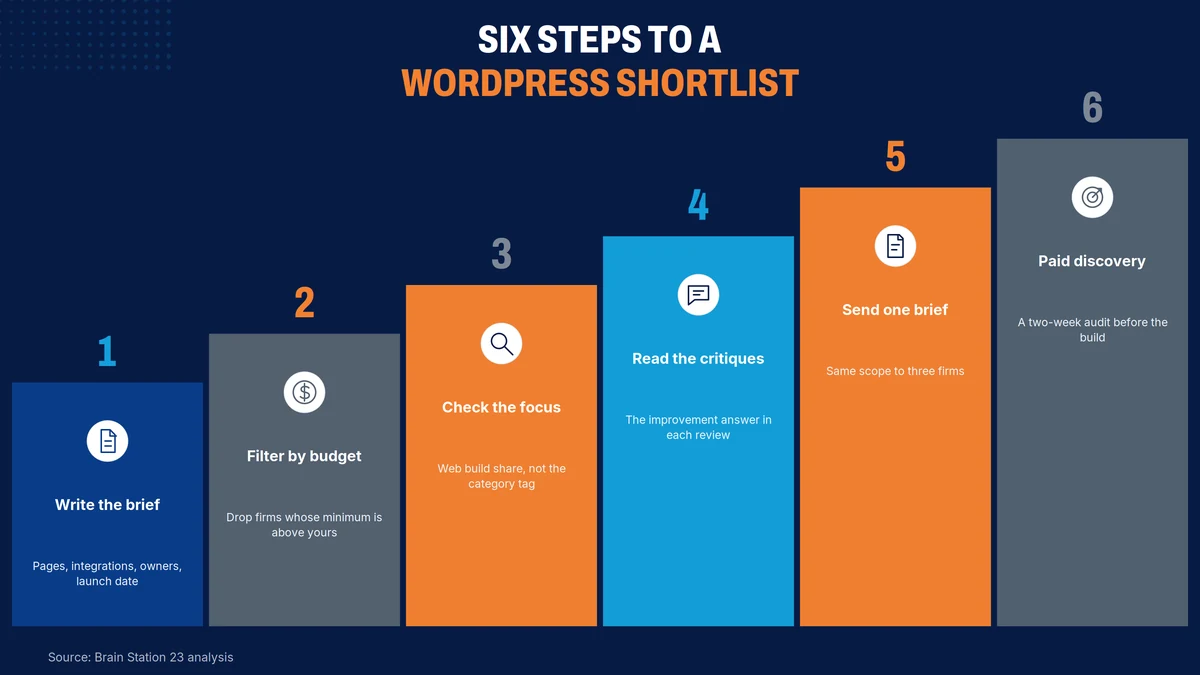
Six-step shortlisting sequence. Source: Brain Station 23 analysis.
Step 1: Write the brief first. List the page templates, the integrations, who will edit content, the launch date and the budget ceiling. One page is enough. Without it, every agency will scope a different project and the quotes will not compare.
Step 2: Filter by budget. Drop any firm whose published minimum is above your ceiling. On this list, a $15,000 budget removes eleven of twenty firms immediately.
Step 3: Check the focus, not the category. If your project is technical, rank firms by web development or custom software share. If it is a marketing site, rank by design share. The directory category is the same for all twenty.
Step 4: Read the critiques. Clutch reviews end with a question about what the vendor could have done differently. Read those answers across a firm’s reviews and look for the repeated one. That is the thing to ask about in the first call.
Step 5: Send one brief to three firms. Same scope, same questions, same deadline. Compare the questions they ask back as much as the price they quote. A firm that asks nothing about your PHP version, hosting or plugins has told you something.
Step 6: Pay for discovery. For anything above about $25,000, a paid two-week audit before the build contract is cheap insurance. It produces a real scope, and it lets you judge the working relationship before committing to it.
How to buy WordPress work
The engagement model decides who pays when the scope moves. Choose it deliberately.
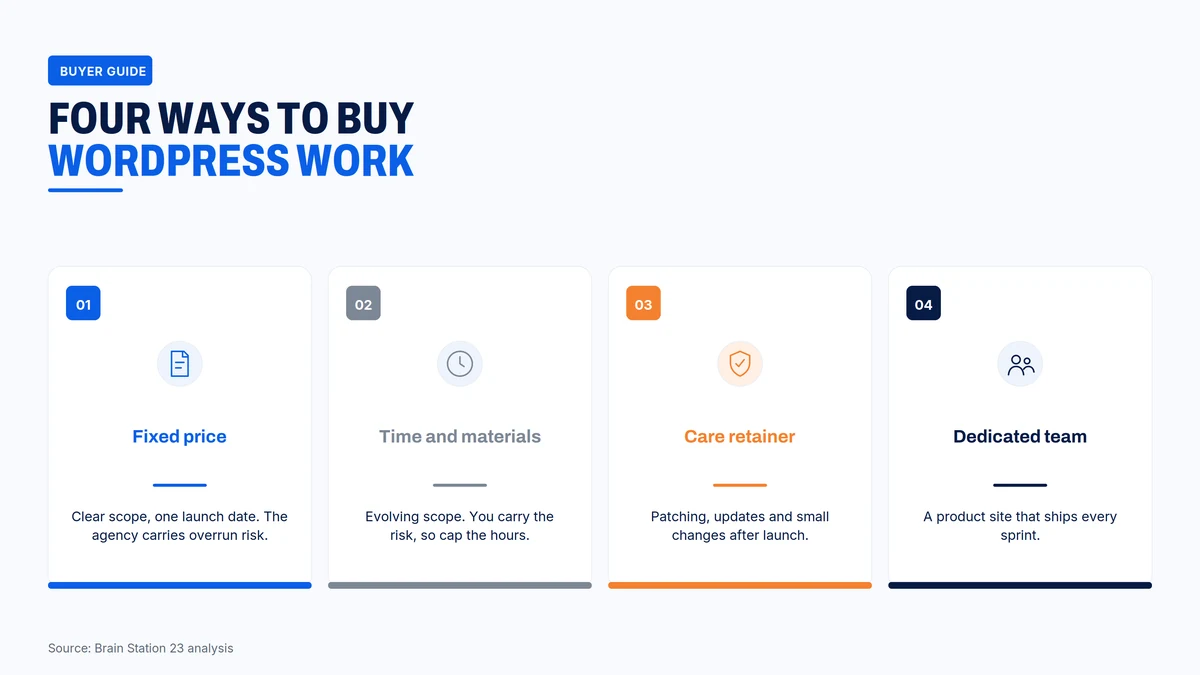
Four engagement models for WordPress work. Source: Brain Station 23 analysis.
Fixed price suits a site with a clear scope and one launch date. The agency carries the overrun risk, so it will price that risk in and will say “out of scope” whenever the brief moves. That is the model working, not a defect.
Time and materials suits projects whose scope is still forming, such as a redesign that will be tested and adjusted. You carry the risk, so cap the monthly hours and review the burn every two weeks.
A care retainer covers the years after launch: plugin and core updates, security patching, backups, uptime monitoring and a bank of small-change hours. It is the model most buyers forget to price, and the one that matters most for a WordPress site. The security section below explains why the response time in that retainer matters more than its monthly fee.
A dedicated team suits a product site that ships every sprint: a publisher, a membership platform, a WooCommerce store with constant changes. You direct the work and pay for capacity rather than deliverables.
Most mid-size buyers end up combining two: a fixed-price build, followed by a care retainer. If you do that, put the retainer terms in front of the agency before you sign the build, because it changes how they will architect the site.
The technical part: PHP, page builders and Core Web Vitals
For a WordPress buyer in 2026, the technical risk sits in three places, and core is not one of them.
The PHP runtime. As the market section showed, about 63% of WordPress sites run PHP 8.2 or older, and 8.2 loses security support on 31 December 2026. A PHP upgrade is usually a small job on a well-maintained site and a large one on a site with abandoned plugins or a custom theme written for PHP 7. Ask every firm on your shortlist to state which PHP version they will deploy, and to include an upgrade path to 8.3 or 8.4 in the build scope.
The plugin count. Patchstack found 91% of 2025’s WordPress vulnerabilities in plugins and 9% in themes, with only six in core, all rated low priority. Premium plugins were worse than free ones: 76% of the vulnerabilities found in premium components were exploitable, and premium components carried three times as many known-exploited vulnerabilities as free ones. Every plugin in the build is code you will maintain. Ask for a plugin budget, and a reason for each one.
Performance. The Web Almanac’s 2025 CMS chapter found 45% of WordPress mobile sites passing all three Core Web Vitals, against 85% on Duda, 79% on TYPO3 and 74% on Wix.
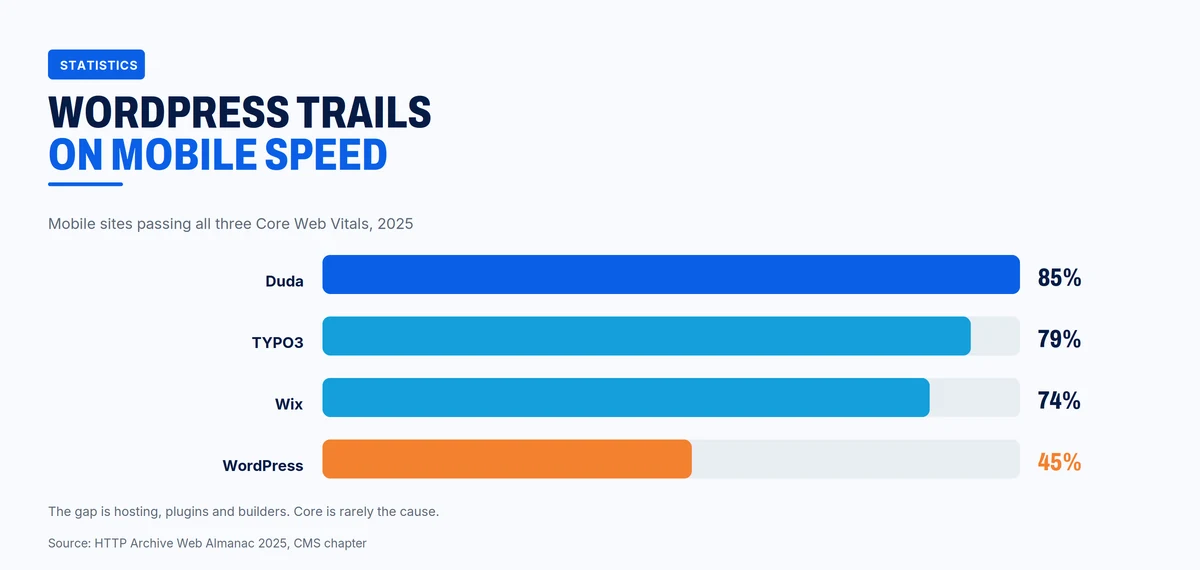
Share of mobile sites passing all three Core Web Vitals in 2025. Source: HTTP Archive Web Almanac 2025, CMS chapter.
The comparison is not quite fair to WordPress. Hosted builders control the hosting, the theme and the plugin set; WordPress sites run on everything from $3 shared hosting to enterprise clouds. The same chapter found that WordPress improved about 4% year over year, while the most tightly managed platforms improved most. The practical reading: a WordPress site is as fast as the hosting, theme and plugin decisions an agency makes for it. Put a Core Web Vitals target in the contract, measured on real-user data after launch, not on a Lighthouse score on the developer’s laptop.
Page builders sit across all three. The Almanac found Elementor on 43% of WordPress sites, down from about 56% a year earlier, while the native Block Editor grew to 18%. Builders make editing easier and add weight. A custom block theme costs more upfront and is lighter to run. Neither is wrong; the agency should explain why it chose one for your site.
The order of an upgrade matters as much as the parts. Audit the plugins first and remove what is abandoned, then upgrade PHP on staging, then update the builder and theme, then core. Doing core first on an old PHP stack is how a routine update becomes a white screen.
Red flags
These are answers that should end a sales conversation, or at least move a firm to the bottom of the list. Each maps to a problem covered elsewhere in this guide.
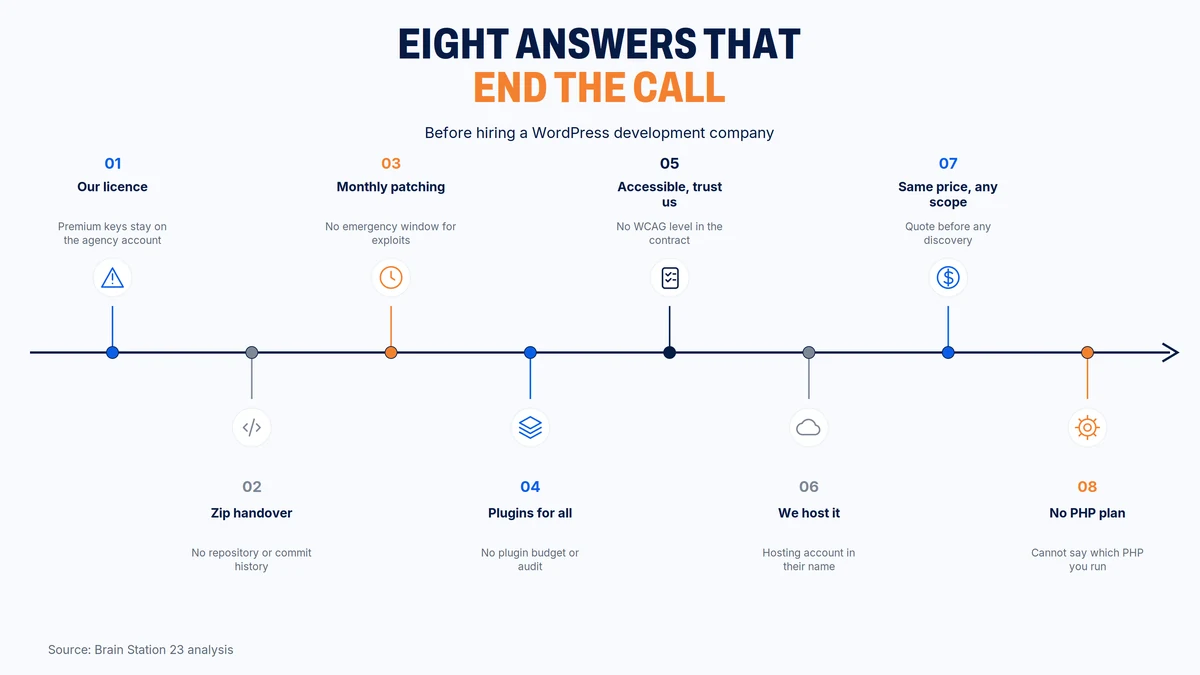
Eight warning signs when hiring a WordPress development company. Source: Brain Station 23 analysis.
“We use our agency licence.” Premium plugins and builders registered to the agency stop receiving updates, including security fixes, the day the relationship ends. Licences should be bought in your name.
“We’ll send you a zip at the end.” A zip file is a snapshot. You want the Git repository with its commit history, so the next developer can see what changed and why.
“We patch monthly.” With a five-hour median time to mass exploitation, a monthly window alone is not a security plan. Ask what happens when a critical plugin flaw lands on a Friday night.
“There’s a plugin for that.” Every time. A firm that reaches for a plugin for every feature is building your maintenance bill.
“It’ll be accessible.” Without a named standard, that sentence means nothing in a dispute. Ask for WCAG 2.2 AA in the contract.
“We’ll host it for you.” Fine, if the hosting account and the billing relationship are in your name. Not fine if they are not.
“Same price, whatever the scope.” A quote issued before any discovery is a guess with a number on it.
“Which PHP version? Not sure.” A WordPress firm that cannot tell you what runtime your site will use has not thought about year two.
After launch: what the build quote leaves out
This is the part most WordPress buyers learn by experience. It covers what to own, what recurs, and which contract terms only matter once something has gone wrong.
What you must own before the final invoice
Make this a checklist, and make the last payment conditional on it.
- The repository, with full commit history, in a Git account you control.
- The domain and DNS, registered in your company’s name.
- The hosting account and its billing relationship, plus server and database access.
- Every premium licence key, bought under your account. Builders, form plugins, SEO suites and backup tools all qualify.
- Third-party accounts: analytics, tag manager, search console, CDN, email delivery, payment gateway.
- Environment configuration for local, staging and production, including how to deploy.
- Design source files, in Figma or whatever tool was used.
- A runbook explaining how to update, back up, restore and deploy the site.
Several of the red flags above exist because one of these items was left with the agency. None of them is expensive to transfer on day one. All of them are expensive to recover in a dispute.
The bill that arrives after launch
A build quote covers the build. Most of the lifetime cost of a WordPress site is not in it.
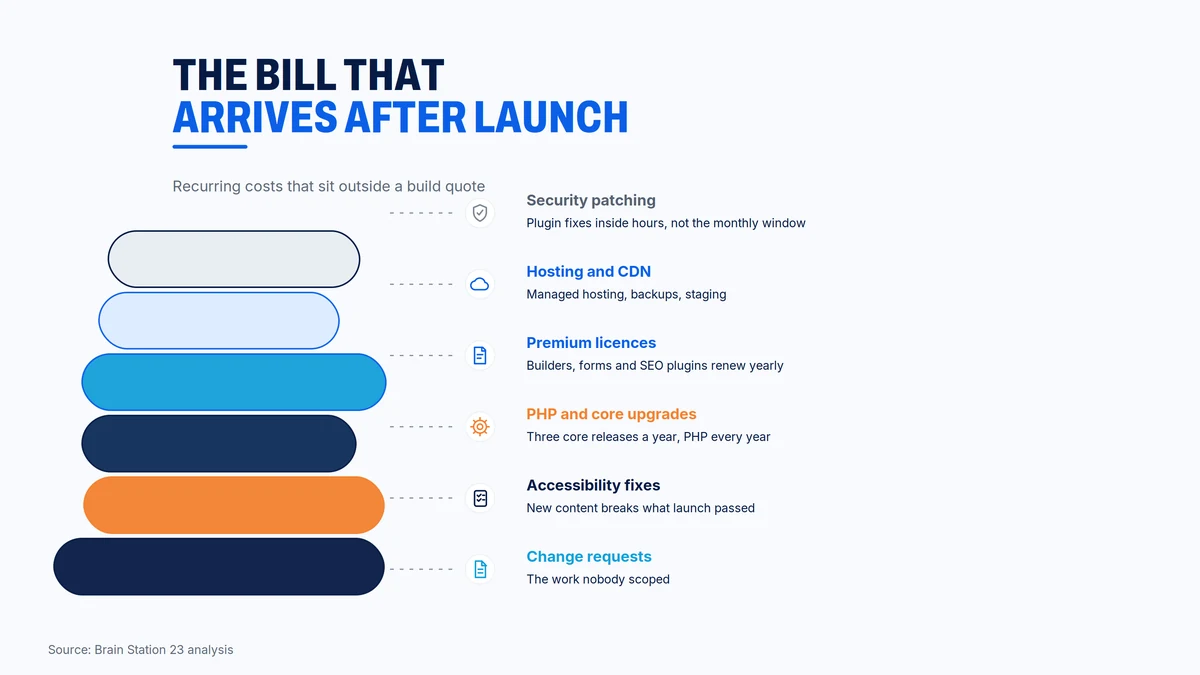
Recurring costs that sit outside a build quote. Source: Brain Station 23 analysis.
Security patching, hosting and CDN, and premium licence renewals recur every year. WordPress now ships several major releases a year, and PHP versions reach end of life on a fixed annual cycle, so upgrades are recurring work rather than one-off projects. Accessibility drifts as editors add content that launch testing never saw. And change requests arrive the week after launch.
Ask for the recurring number before you sign the build, and compare firms on three-year cost rather than build price. A cheaper build with an expensive or vague care plan is often the more expensive option.
Security is a recurring cost
The numbers from Patchstack’s 2026 report change what a maintenance retainer has to do.
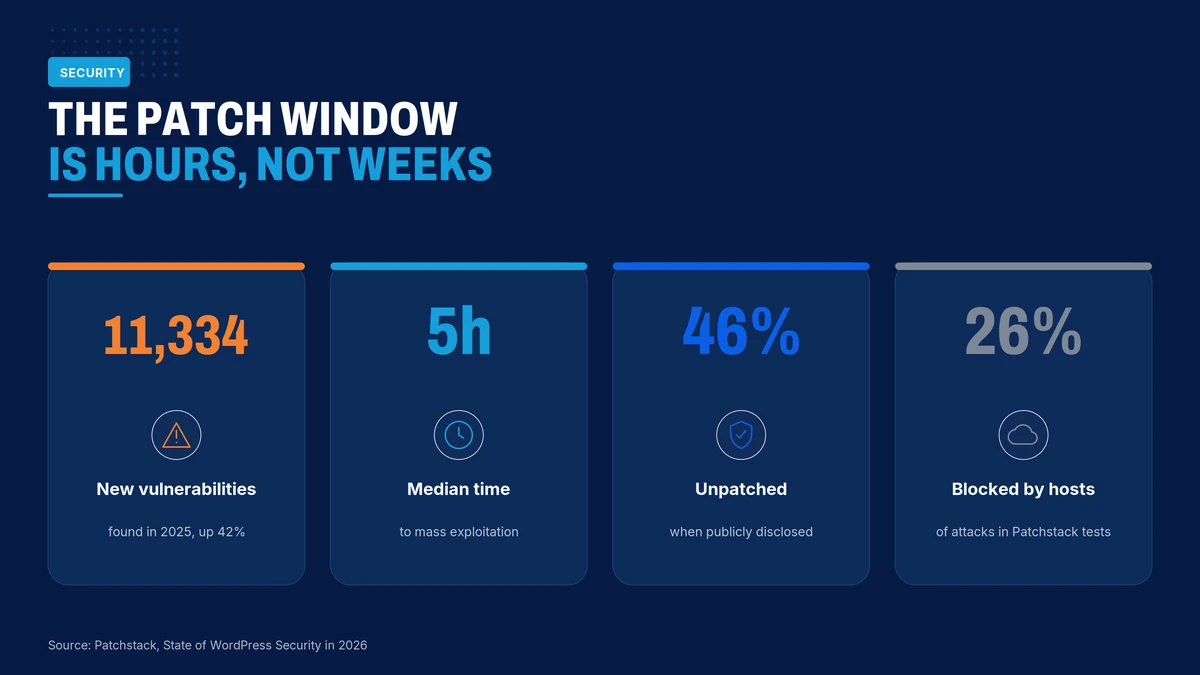
WordPress security in 2025. Source: Patchstack, State of WordPress Security in 2026.
There were 11,334 new vulnerabilities in the WordPress ecosystem in 2025, a 42% increase on 2024. For heavily exploited flaws, the weighted median time from disclosure to first exploitation was five hours. And 46% of vulnerabilities had no fix from the developer when they were made public, which means “keep plugins updated” does not cover the risk.
Hosting does not close the gap either. In Patchstack’s tests of common hosting defences, only 26% of vulnerability attacks were blocked.
If patches go out in a monthly window and exploitation starts within hours, the maintenance agreement does not cover the risk it claims to. Ask for three things in writing: a response time for critical plugin vulnerabilities measured in hours, virtual patching or a web application firewall rule set that covers WordPress-specific flaws, and a named person who is alerted when a vulnerability affects a plugin on your site.
The downside of skipping this is not theoretical. IBM put the average US data breach at $11.5 million in 2026, more than twice the global average of $4.99 million. A marketing site is unlikely to carry that full cost, but a WooCommerce store or a membership site holding customer data can carry a meaningful share of it.
Accessibility is legal exposure
The WebAIM Million 2026 found detectable WCAG failures on 95.9% of the top million home pages, up from 94.8% a year earlier. WordPress home pages averaged 52.8 detected errors, slightly better than the 56.1 overall average. Low-contrast text, missing alt text, unlabelled form fields and empty links cause almost all of them, and all are cheap to prevent at build time.
In court, the numbers are larger. UsableNet counted more than 5,000 digital accessibility lawsuits in 2025, and 1,427 of them targeted companies that had already been sued once. E-commerce accounted for nearly 70%.
Two practical asks follow. Name the standard in the contract: “WCAG 2.2 Level AA,” with the W3C specification attached, rather than the word “accessible.” And be sceptical of overlay widgets offered as a fix; UsableNet’s 2025 year-end report found that widgets did not slow litigation. Accessibility is a build quality, not a plugin.
Contract clauses that surface in month nine
These rarely matter at signing and often matter later. This is not legal advice; have counsel review the final contract.
IP assignment on payment, not on final acceptance. If ownership passes only on sign-off, a disputed last milestone leaves you without rights to code you have mostly paid for.
Transition assistance. A fixed number of hours, at a stated rate, to help a new vendor take over. Negotiate it while relations are good.
Rate escalation caps. For a multi-year care plan, cap annual increases.
Subcontracting. Require disclosure of any subcontractor or offshore team, and approval before one is added. Several reviews in this list mention offshore resources; that is fine when it is known in advance.
Liability cap and insurance. Ask for professional indemnity and cyber cover, and check the cap is meaningful relative to the site’s role.
Non-solicitation both ways. Reasonable protection for both sides, with a clear end date.
How to leave without losing the site
Most WordPress relationships end quietly: a budget change, a new marketing director, a platform move. The ones that end badly are usually missing the ownership items above.
Confirm that you hold the repository, hosting, domain and licences before you give notice. Trigger the transition hours while the relationship is still cordial. Ask the outgoing team to record short walkthroughs of the deployment process, custom plugins and any integrations. On the last day, rotate every credential: WordPress admin accounts, hosting, SFTP, database, API keys and third-party logins.
If that sounds like a lot of work, it is roughly a week. Recovering a site whose licences, hosting and code sit in someone else’s account takes much longer.
Hire in-house or hire an agency
The answer is often both, in a specific split.
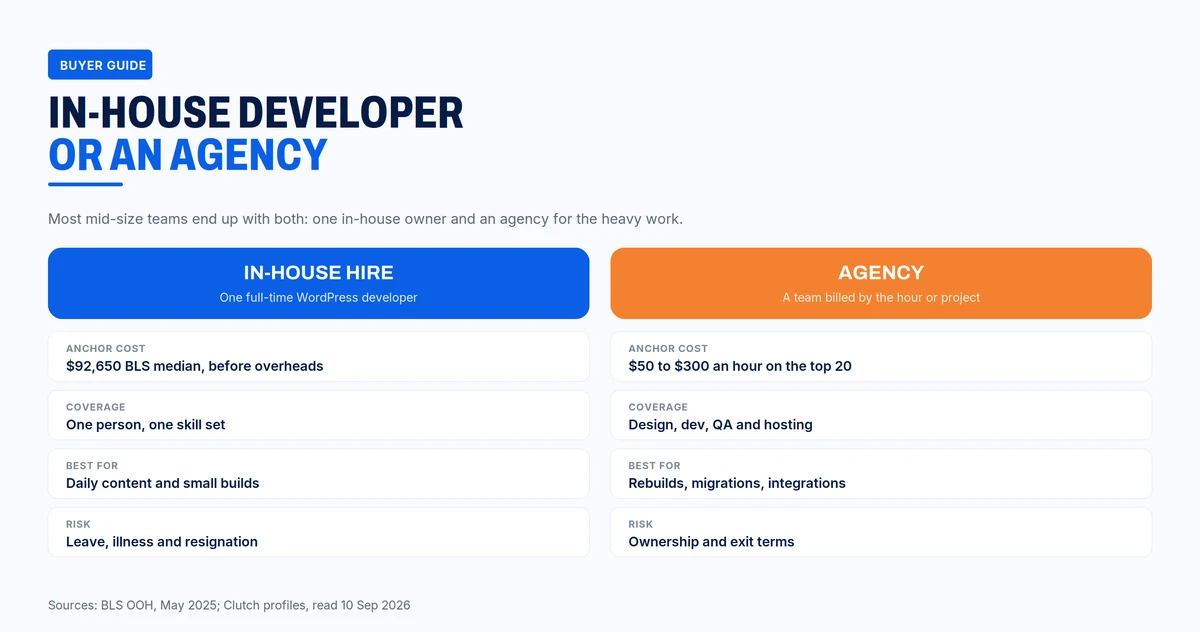
In-house hire compared with an agency. Sources: BLS, May 2025; Clutch, read 10 September 2026.
Hire in-house when WordPress changes daily and someone needs to own it. The anchor is the BLS median web developer wage of $92,650, before benefits, equipment and management time. One person rarely covers design, development, security and hosting well.
Hire an agency for rebuilds, migrations, integrations and anything that needs several skills at once. At the median midpoint of $124.50 an hour, a 400-hour rebuild costs roughly $50,000, about half a developer’s salary, and brings a team.
Do both when the site is central to the business. An in-house owner handles content, small changes and vendor management; the agency handles builds, upgrades and security. The in-house owner is also the person who makes sure the ownership checklist above is complete.
FAQ
How much does WordPress development cost in the US?
Among the top 20 firms on Clutch, published hourly rates run from $50 to $300, with a median band midpoint of $124.50. The median minimum project is $25,000, although four firms accept projects from $1,000. Recurring costs for hosting, licences and security patching come on top of any build quote.
Is WordPress still worth building on in 2026?
For most content and marketing sites, yes. It runs 40.3% of all websites and has the largest pool of developers and plugins. Its share of CMS sites has slipped from 65.2% to 58.8% since 2022, so it is worth comparing against hosted builders when your site is simple and your team is small.
Is WordPress secure?
Core is. Only six of 11,334 vulnerabilities found in 2025 were in core, all low priority. The risk sits in plugins and themes, and in how quickly patches are applied. A care plan with an hours-based response time for critical flaws matters more than the platform choice.
Which PHP version should my WordPress site run?
PHP 8.3 or 8.4. PHP 8.2 loses security support on 31 December 2026, and about 63% of WordPress sites run 8.2 or older. Ask your developer to test on staging before upgrading, because abandoned plugins are the usual cause of failures.
Should I choose Elementor or the Block Editor?
It depends on who edits the site and how much performance matters. The Web Almanac found Elementor on 43% of WordPress sites and the Block Editor on 18%. Builders make editing easier and add weight; a custom block theme costs more upfront and is lighter to run. Ask the agency to justify its choice.
How do I make sure I own my WordPress site?
Before the final payment, confirm that the Git repository, domain, hosting account and every premium licence key are in your company’s name, and that you have full admin access. Put IP assignment on payment, not on final acceptance, in the contract.
Do I need to make my WordPress site accessible?
If you sell or serve the public in the US, the litigation risk is real: more than 5,000 digital accessibility lawsuits were filed in 2025. Put WCAG 2.2 Level AA in the contract, test with real users and assistive technology, and avoid relying on overlay widgets.
Conclusion
WordPress is still the largest CMS on the web, and the firms on this Top 20 WordPress Development Companies in USA list can all build a good site on it. The data says three things about choosing between them.
The directory ranking favours design and marketing agencies, so match firms to your brief by their published focus, not their position. Rates vary by a factor of six and minimums by a factor of fifty, so filter on budget first. And the risks that matter most, PHP end-of-life, plugin vulnerabilities exploited within hours, and accessibility claims, all arrive after launch.
Choose the firm whose answers on ownership, patching and upgrades you would be happy to read aloud in a dispute. The repository, the hosting account and the licence keys should be in your name before the last invoice is paid.
Sources
- https://clutch.co/us/developers/wordpress
- https://w3techs.com/technologies/details/cm-wordpress
- https://w3techs.com/technologies/history_overview/content_management/ms/y
- https://wordpress.org/about/stats/
- https://wordpress.org/download/releases/7-1/
- https://www.php.net/supported-versions.php
- https://patchstack.com/whitepaper/state-of-wordpress-security-in-2026/
- https://almanac.httparchive.org/en/2025/cms
- https://webaim.org/projects/million/
- https://blog.usablenet.com/ada-web-lawsuit-trends-2026
- https://www.w3.org/TR/WCAG22/
- https://www.bls.gov/ooh/computer-and-information-technology/web-developers.htm
- https://www.payscale.com/research/US/Job=WordPress_Developer/Salary
- https://www.ziprecruiter.com/Salaries/Wordpress-Developer-Salary
- https://www.glassdoor.com/Salaries/wordpress-developer-salary-SRCH_KO0,19.htm
- https://www.talent.com/salary?job=wordpress+developer
- https://www.ibm.com/reports/data-breach
- https://rtcamp.com/
- Brain Station 23 analysis of the twenty Clutch profiles: rate bands, minimums, team sizes, service splits, review counts and founding years, 10 September 2026