
Twenty-five.
That is how many of the first fifty rows on Clutch’s US software developers directory are paid placements, counted on 14 September 2026. The organic ranking starts at row 26. Everything above it is an advertising product, labelled by Clutch but easy to mistake for a ranking when you are scrolling. This Top 20 Software Development Companies in USA guide is built from rows 26 to 45 instead, the twenty firms the directory ranked on its own out of 9,200 listed in the United States. Their published data turns out to be more useful than their order. Custom software development is a median of 30 percent of what these firms actually sell. Ten of the twenty run delivery offices outside the country. Their published minimums run from $5,000 to $75,000 for what buyers all call the same service.
Every profile below carries a caution drawn from that firm’s own review feedback. The guide after the list covers what the work costs, how to shortlist, and what you must own before the final invoice.
Key takeaways
- 25 of the first 50 directory rows are sponsored, so the organic top 20 begins at row 26 of Clutch’s US software developers listing, read 14 September 2026.
- The median US software developer earned $135,980 in May 2025, with the bottom tenth under $82,460 and the top tenth over $214,670, according to the Bureau of Labor Statistics.
- Five salary sources put the same job title between $98,200 and $151,554, a $53,354 spread that makes any single “average developer cost” figure useless for budgeting.
- 84 percent of developers use or plan to use AI tools, but only 33 percent trust their accuracy, against 46 percent who actively distrust it, in Stack Overflow’s 2025 survey of 49,000 developers.
- Open source vulnerabilities per codebase rose 107 percent in a single year and 98 percent of audited codebases contain open source, per Black Duck’s 2026 OSSRA report covering 947 commercial codebases.
- A US data breach now averages $11.5 million, more than twice the global figure, in IBM’s 2026 Cost of a Data Breach Report.
- 95.9 percent of the top million home pages had detectable WCAG failures in February 2026, the first regression in six years, per WebAIM, while UsableNet counted more than 5,000 US digital accessibility lawsuits in 2025.
- The 20 firms publish minimums from $5,000 to $75,000, median $25,000, and hourly bands from $25 to $300 (Brain Station 23 analysis of the 20 organic Clutch profiles, read 14 September 2026).
What the US software market looks like going into the hire
Two things changed in the last eighteen months, and both change what you should ask a vendor.
The first is money. Gartner expects worldwide IT spending to reach $6.37 trillion in 2026, up 14.2 percent, with IT services the largest single segment. Budgets are not tight in aggregate. Your quote will not feel that way, because the same AI demand lifting the forecast is lifting salaries for the people who would build your product.
The second is how code gets written. AI assistance is now normal and trust in it is not.
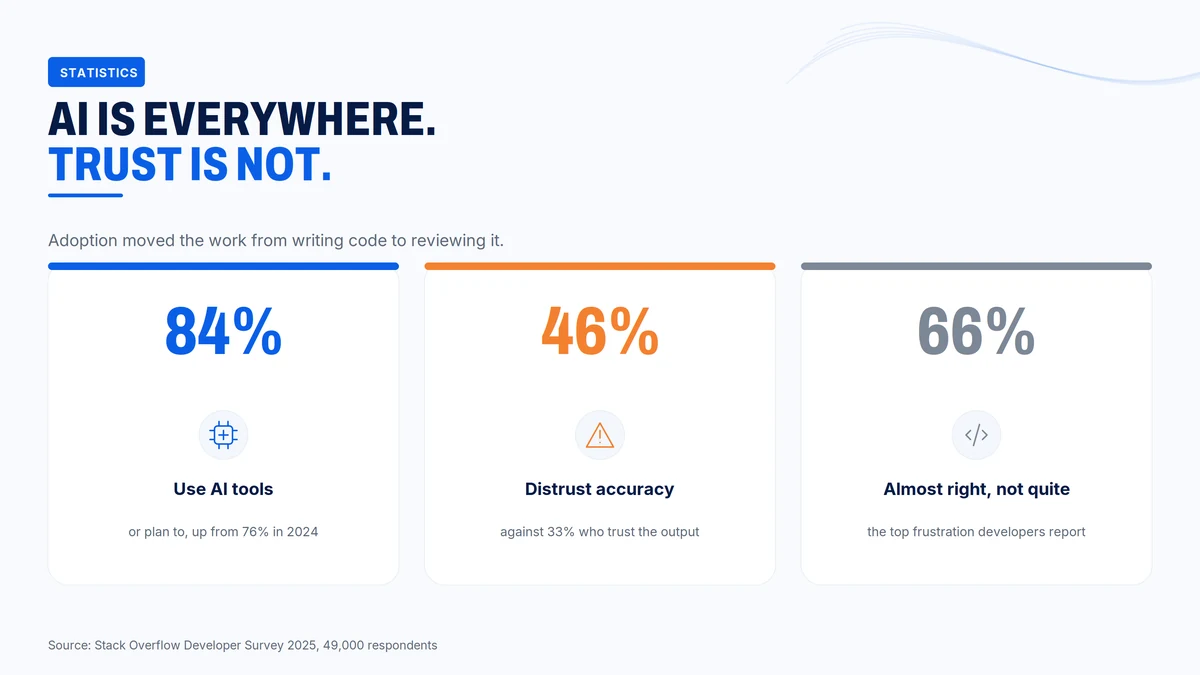
Adoption is near universal, confidence is not. Source: Stack Overflow Developer Survey 2025, 49,000 respondents.
That gap matters commercially, not just culturally. Stack Overflow found 66 percent of developers frustrated by AI output that is almost right but not quite, and 45 percent saying debugging AI-generated code takes longer than expected. The work did not disappear. It moved from writing to reviewing.
The volume of code moved too. Black Duck audited 947 commercial codebases for its 2026 report and found the mean number of files per codebase up 74 percent in a year, open source components up 30 percent, and vulnerabilities per codebase up 107 percent. Ninety-eight percent of those codebases contained open source at all, so nearly every application inherits somebody else’s maintenance schedule.
Sidenote on reading that figure: it comes from codebases submitted for audit, usually during due diligence or a security review, so it is not a random sample of all software. The direction is still unambiguous.
Meanwhile the people remain expensive and available.
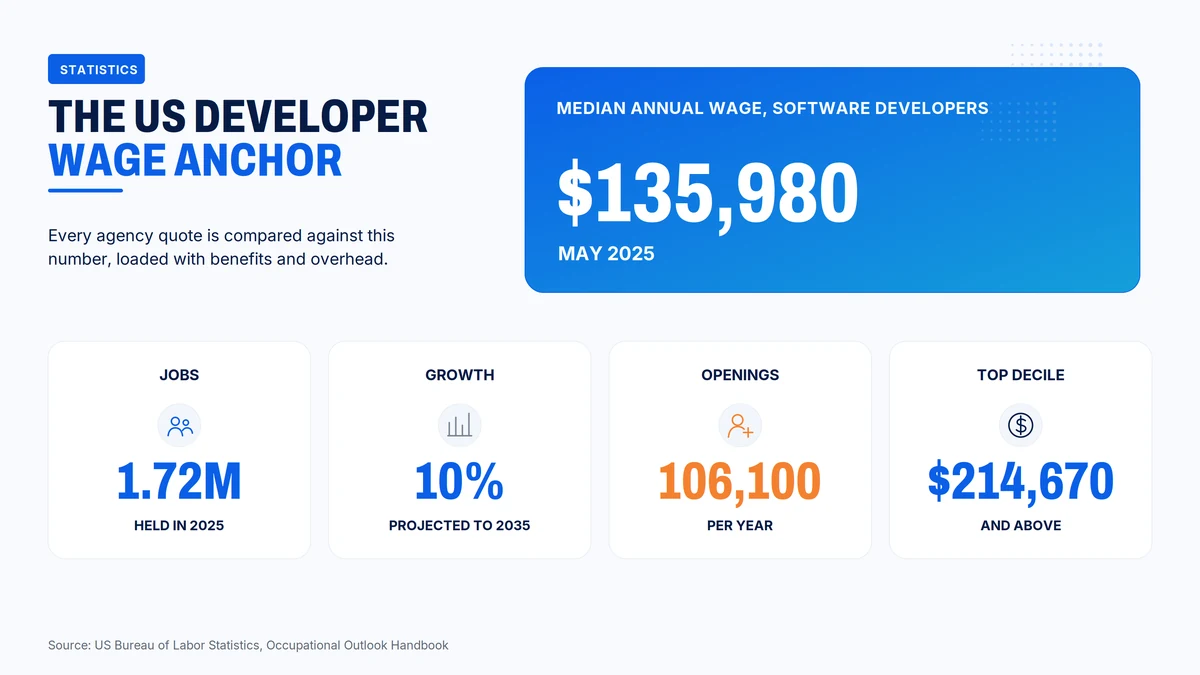
The wage anchor for any in-house comparison. Source: US Bureau of Labor Statistics, May 2025 data published August 2026.
Software developers held about 1.72 million US jobs in 2025, with employment projected to grow 10 percent through 2035 and 106,100 openings a year across the wider developer, QA and tester group. A firm telling you senior US engineers are hard to find is telling the truth. A firm telling you that justifies a 40 percent premium over the published band is making an argument you can check.
What software development actually costs in 2026
Start with the in-house number, because every agency quote is implicitly compared against it.
The BLS median of $135,980 is one developer’s base pay. Loaded with benefits, payroll tax, equipment, recruitment and management, a US employer is realistically past $180,000 for that person before writing a line of code. That is the benchmark. The problem is that nobody agrees what the number even is.
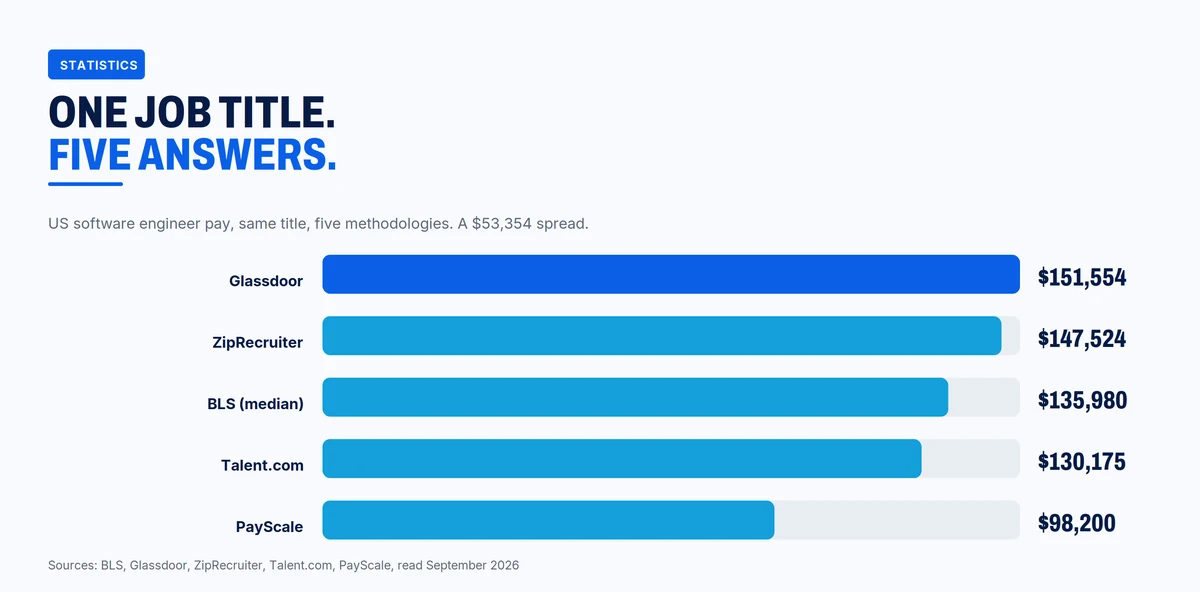
One title, five figures, a $53,354 spread. Sources: BLS, Glassdoor, ZipRecruiter, Talent.com, PayScale, read September 2026.
None of them is wrong. PayScale reports self-reported base pay and lands at $98,200. Glassdoor pools 724,921 submissions and reports $151,554. Talent.com averages advertised salaries at $130,175. ZipRecruiter publishes $147,524. The BLS covers all software developers in the economy, which is the widest and most conservative base. Pick the one that suits your argument and you will mislead yourself.
Agency pricing spreads even wider than salaries do.
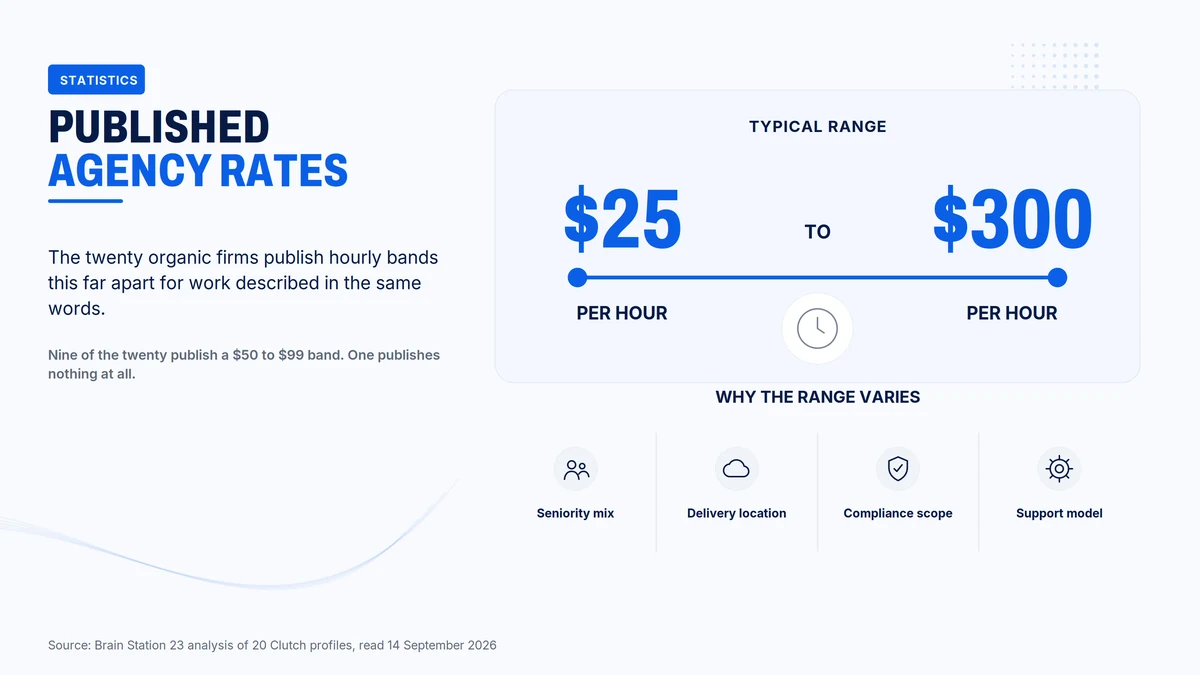
What the twenty firms publish, not what they will quote you. Source: Brain Station 23 analysis of 20 Clutch profiles, read 14 September 2026.
Nine of the twenty publish a $50 to $99 band. Five sit at $100 to $149. Two are at $150 to $199, one at $200 to $300, two at $25 to $49, and one does not disclose. A band is a marketing decision as much as a costing one, so treat it as a filter rather than a quote.
What actually moves the number is scope, and seven factors do most of the work.
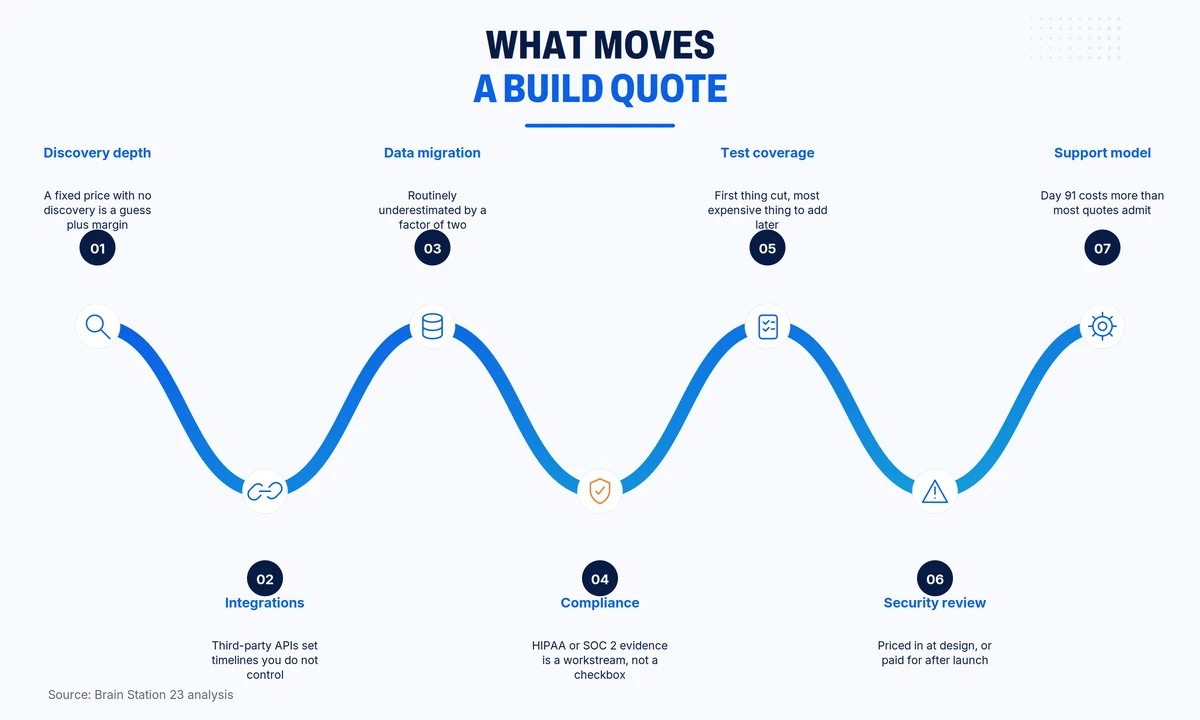
What moves a build quote. Source: Brain Station 23 analysis.
Discovery depth sets everything downstream: a fixed price without a paid discovery is a guess with a margin attached. Integrations are where fixed-price projects fail, because a third-party API you do not control sets your timeline. Data migration is routinely underestimated by a factor of two. Compliance work such as HIPAA or SOC 2 evidence is a workstream, not a checkbox. Test coverage, security review and the post-launch support model are the three most commonly cut and the three most expensive to add later.
The Top 20 Software Development Companies in USA, compared
Firms 2 to 21 below are Clutch’s organic top 20 for US software developers, read on 14 September 2026, in the order Clutch ranked them. The 25 sponsored rows sitting above them were left out. Brain Station 23 is placed first because we publish this article. We are US-headquartered and verified on Clutch, but custom software development is 10 percent of our published focus and staff augmentation is 60 percent, so the directory did not place us in its top 20 and we are not claiming it did.
One more caveat before the table. Every firm here rates between 4.8 and 5.0, so ratings cannot separate them. The columns below are decision columns instead.
| # | Company | Best For | Team Size | Custom Software Focus | Key Services | Industries Served | Offices |
|---|---|---|---|---|---|---|---|
| 1 | Brain Station 23 — brainstation-23.com | Cost-controlled augmentation of an existing engineering team | 250 – 999 | 10% custom software, 60% staff augmentation | Staff augmentation, custom software, AI, e-commerce, app modernisation, managed services | Retail, medical, telecoms, education, financial services | Springfield VA; Dhaka, Dubai, Nottingham, Kuala Lumpur, Germany |
| 2 | Atomic Object — atomicobject.com | Regulated device and medical software with a long lifecycle | 50 – 249 | 50% custom software | Custom software, mobile apps | Medical (65%), supply chain, automotive, insurance | Grand Rapids MI; Ann Arbor, Chicago, Raleigh |
| 3 | Cleveroad — cleveroad.com | Education and fintech platforms at a low published rate | 250 – 999 | 30% custom software | Custom software, web, mobile, AI agents, ERP, APIs | Education (50%), financial services, IT, insurance | New York; Kharkiv, Dnipro, Kraków |
| 4 | Six Feet Up — sixfeetup.com | Python, data and AI work where senior depth beats headcount | 10 – 49 | 50% custom software | Custom software, AI, BI and big data, web | IT (30%), medical, education, energy, financial services | Fishers IN |
| 5 | Saritasa — saritasa.com | Builds that combine software with AR, VR or hardware | 50 – 249 | 40% custom software | Custom software, AR/VR, AI, mobile, web | Spread evenly across nine sectors | Newport Beach CA; New York, Chicago, Tampa |
| 6 | Agency Partner Interactive — agencypartner.com | Healthcare and education products needing design plus build | 50 – 249 | 35% custom software | Custom software, mobile, AI, web design and development | Medical (40%), education, e-commerce, non-profit | Plano TX |
| 7 | Arbisoft — arbisoft.com | Large education and travel platforms on an offshore cost base | 250 – 999 | 50% custom software | Custom software, mobile, web, AI | Education (40%), hospitality, medical, financial services | Plano TX; Lahore, Islamabad, Riyadh |
| 8 | Designli — designli.co | Founder-led mobile products from concept to launch | 50 – 249 | 30% custom software | Mobile apps, custom software, AI, UX/UI | Consumer products, construction, education, financial services | Greenville SC; San Francisco, Dallas, Buenos Aires, Mexico City |
| 9 | Vention — ventionteams.com | Scaling an engineering team across European time zones | 1,000 – 9,999 | 15% custom software | AI, custom software, app modernisation, cloud, DevOps, staff augmentation | Spread evenly across nine sectors | New York; London, Vienna, Vilnius, Berlin, Warsaw |
| 10 | Codup — codup.co | E-commerce back ends and operations software for manufacturers | 50 – 249 | 30% custom software | Custom software, e-commerce, app modernisation, staff augmentation | E-commerce (35%), manufacturing, HVAC, retail | Houston TX; Dubai, Irvine |
| 11 | DOOR3 — door3.com | Enterprise UX where the interface is the problem | 50 – 249 | 33% custom software | AI consulting, custom software, UX/UI | Spread across arts, business services, legal, medical | New York; Barcelona |
| 12 | Sonatafy Technology — sonatafy.com | Nearshore Mexico teams in a US time zone | 50 – 249 | 40% custom software | Custom software, app modernisation, mobile, testing, IT strategy | IT, medical, business services, financial services | Scottsdale AZ; Tijuana |
| 13 | AppMakers USA — appmakersla.com | Consumer mobile apps with AI features | 50 – 249 | 25% custom software | Mobile apps, AI, custom software, UX/UI | Ten sectors at 10% each | Los Angeles; New York |
| 14 | SOLTECH — soltech.net | AI consulting attached to a custom build | 50 – 249 | 25% custom software | Custom software, AI consulting, AI agents, CRM, mobile | Medical, automotive, business services, financial services | Atlanta GA; Key Largo |
| 15 | Miles IT — milesit.com | Software plus the managed IT and security around it | 250 – 999 | 35% custom software | Custom software, IT managed services, web, cybersecurity, AI | Financial services, medical, legal, real estate, retail | Tampa FL; Lumberton NJ |
| 16 | Dualboot Partners — dualbootpartners.com | Funded companies buying an AI-first product team | 250 – 999 | 15% custom software | AI consulting, AI development, custom software, DevOps, cybersecurity | Financial services, manufacturing, medical, utilities | Charlotte NC; Montevideo |
| 17 | BairesDev — bairesdev.com | Enterprise programmes needing hundreds of nearshore engineers | 1,000 – 9,999 | 10% custom software | Web, AI, testing, DevOps, ERP, staff augmentation, IT strategy | IT (25%), financial services, medical, advertising | San Francisco; Buenos Aires, São Paulo, Mexico City, Bogotá |
| 18 | NIX — nix-united.com | Long-running platform work with security and cloud attached | 1,000 – 9,999 | 25% custom software | Custom software, AI, staff augmentation, cloud, cybersecurity | Automotive, education, medical, IT, manufacturing | Tampa FL; Boston |
| 19 | Rubico — rubicotech.com | Non-profit and small manufacturer budgets | 50 – 249 | 40% custom software | Custom software, mobile, web, testing, e-commerce | Non-profit (25%), manufacturing, medical, education | Austin TX; Charlotte |
| 20 | Bluelight — bluelight.co | Brazil-based teams at the lowest published US band | 250 – 999 | 30% custom software | Custom software, mobile, web, AI, staff augmentation, UX/UI | Nine sectors at 10% each | Sacramento CA; Jardim Paulistano |
| 21 | Bilberrry — bilberrry.com | Government and non-profit web platforms | 10 – 49 | 30% custom software | Web development, custom software, APIs, staff augmentation | Government, non-profit, education, financial services | Seattle WA |
Team sizes, focus percentages, industries, services and office locations are from each firm’s published Clutch profile, read 14 September 2026. “Best For” is our reading of that data, not a claim the firm makes. Certifications are not published consistently across these profiles, so there is no certifications column here; each profile below names what its own sources state. Rates and minimums are discussed in the analysis section rather than tabulated, because they date fastest.
Certifications deserve one line of warning before the profiles. Directories do not verify them, and most of these firms publish none at all. Where a profile below says “Not published; ask directly”, that absence is itself useful: it means you should ask for the certificate and its scope, not accept a logo on a website.
1. Brain Station 23
We publish this article and we have put ourselves first, which is the disclosure that should govern how you read this entry. Our published band of $25 to $49 per hour is the lowest on this page alongside two others, and it is the argument: an engineering team at that rate changes what a fixed budget buys. We write IP assignment on payment, rate locks and replacement guarantees into contracts, which is what the red flags section below says to demand. The honest limitation is scale of proof in this category. Our own reviewers have asked for better internal alignment and coordination, and custom software is only 10 percent of our published focus. If you want a US-only delivery team sitting in a single time zone, we are the wrong call and will say so early.
Founded: 2006
Company size: Clutch band 250 to 999; we publish 900+ engineers
Rating: 4.9 across 21 Clutch reviews, HQ Springfield, Virginia
- Cost-controlled augmentation of an existing engineering team
- CMMI Level 3
- ISO 27001
- ISO 9001
- SOC 2 Type II (company-published)
- Staff augmentation
- Custom software
- Enterprise app modernisation
- AI development
- E-commerce
- Mobile
- Managed services
- Retail
- Medical
- Telecoms
- Education
- Financial services
- Manufacturing
- Ask how a Bangladesh-based squad overlaps your working day, and who the named US escalation contact is
For regulated, enterprise and long-lifecycle work
2. Atomic Object
Medical work is 65 percent of the published industry split, the highest single-sector concentration among the twenty, and the $150 to $199 band puts the firm in the top three by price. Reviews describe unusually consistent communication and low ego, and the pattern across them is that clients stay for years. Clutch’s own review summary names cost management as the recurring theme, with clients suggesting clearer initial scoping to prevent budget overruns. Wrong fit if you want an offshore cost base; all four offices are in the United States.
Founded: 2001
Company size: 50 to 249
- Regulated device and medical software with a long lifecycle
- Not published; ask directly
- Custom software
- Mobile apps
- Embedded and device software
- Product design
- Medical
- Supply chain and logistics
- Automotive
- Insurance
- Ask for a written scoping phase with a costed range before signing, and confirm how change orders are priced
4. Six Feet Up, Inc.
At $200 to $300 per hour this is the most expensive firm on the list, and the only one in that band. AI development is 30 percent of published focus against a 10 percent median across the twenty, so the specialism is real rather than a recent label. Reviewers describe careful documentation practice and steady ramp-up, with several noting deliverables that took longer than expected and being told about it early. A ten-to-49-person shop at enterprise rates is a deliberate trade: depth in exchange for limited surge capacity.
Founded: 1999
Company size: 10 to 49
- Python, data and AI work where senior depth beats headcount
- Not published; ask directly
- Custom software
- AI development
- BI and big data consulting
- Web development
- IT
- Medical
- Education
- Energy
- Financial services
- Retail
- With under 50 staff and a $50,000 minimum, confirm who covers your project if a lead developer is unavailable
11. DOOR3
The published split is almost exactly even across AI consulting, custom software and UX, which is unusual and tells you design is not a bolt-on here. Twenty-four years in business and 47 reviews describe steady leadership contact and adaptation as requirements change. Two separate reviewers asked for tighter attention to small details on deliverables, including spelling, and for readier launch materials. Best suited to enterprises replacing an internal tool nobody wants to use, rather than to a first-version consumer product.
Founded: 2002
Company size: 50 to 249
- Enterprise UX where the interface is the problem
- Not published; ask directly
- AI consulting
- Custom software
- UX/UI design
- Enterprise web applications
- Arts and entertainment
- Business services
- Education
- Financial services
- Legal
- Medical
- Ask who proofreads deliverables before they reach you, and what the launch handover pack contains
16. Dualboot Partners
AI consulting and AI development together make 35 percent of published focus, the second-highest AI weighting on the list. Reviews describe responsive feedback loops and problems being addressed in flight rather than escalated. Clutch’s review summary flags initial timeline estimates as the area clients would improve, with better upfront scope understanding named as the fix. The combination of the highest minimum and no published rate makes this the hardest firm on the list to budget against without a conversation.
Founded: 2018
Company size: 250 to 999
- Funded companies buying an AI-first product team
- Not published; ask directly
- AI consulting
- AI development
- Custom software
- DevOps
- Cybersecurity
- IT strategy
- Financial services
- Manufacturing
- Medical
- Construction
- Utilities
- The $75,000 minimum is the highest here and the hourly rate is undisclosed, so ask for a blended rate in writing
5. Saritasa
With 106 reviews this is the most-reviewed firm in the organic twenty, and at 4.8 it carries the joint-lowest rating, which is a reminder of how little a tenth of a star separates anyone here. The industry split is unusually flat, ten percent across nine sectors, so no single vertical dominates the experience base. Reviewers repeatedly say there is nothing they would change, which is pleasant and unhelpful; with a $50,000 minimum, ask instead how scope changes are priced mid-project.
Founded: 2005
Company size: 50 to 249
- Builds that combine software with AR, VR or hardware
- Not published; ask directly
- Custom software
- AR/VR development
- AI
- Mobile apps
- Web development
- Advertising
- Automotive
- Education
- Financial services
- Legal
- Manufacturing
- Media
- Medical
- AR/VR is 30 percent of the published focus, so confirm the assigned team’s recent work is conventional software if that is what you need
For product and design-led builds
6. Agency Partner Interactive LLC
Medical is 40 percent of the published industry split and education another 25 percent, so two thirds of the experience sits in sectors with review cycles and compliance attached. Eighty-six reviews describe fast issue resolution and questions answered as they arise. The one substantive improvement a reviewer named was tightening the feedback and approval process early so decisions finalise faster, which is as much a client-side problem as a vendor one. Single office in Plano, so everything runs on US hours.
Founded: 2010
Company size: 50 to 249
- Healthcare and education products needing design plus build
- Not published; ask directly
- Custom software
- Mobile apps
- AI development
- Web design
- Web development
- Medical
- Education
- E-commerce
- Non-profit
- Ask for a written decision and approval schedule before kickoff, with named approvers on both sides
8. Designli
Mobile is 50 percent of published focus, the clearest single-service concentration among the design-led group, and the $10,000 minimum makes it one of the more accessible starting points here. Eighty-three reviews at a 5.0 rating describe patient work with first-time founders who are learning the vocabulary as they go. Reviewers asked for more accurate time projections and better expectation management, and one advised planning for an overage on a big scope. Delivery runs partly from Buenos Aires and Mexico City.
Founded: 2013
Company size: 50 to 249
- Founder-led mobile products from concept to launch
- Not published; ask directly
- Mobile app development
- Custom software
- AI development
- UX/UI design
- Consumer products
- Construction
- Education
- Energy
- Financial services
- Medical
- Budget a contingency on large scopes, and ask for the estimate’s assumptions in writing
13. AppMakers USA
Mobile and AI together account for 65 percent of published focus, and small business clients make up 60 percent, the highest share of any firm in the twenty. That is a meaningful signal: the delivery model is built around smaller budgets and faster cycles rather than enterprise governance. One reviewer, otherwise positive across 101 reviews, asked for more proactive documentation during the initial planning sprints. If your project needs formal architecture artefacts from day one, say so at the quote stage.
Founded: 2014
Company size: 50 to 249
- Consumer mobile apps with AI features
- Not published; ask directly
- Mobile app development
- AI development
- Custom software
- UX/UI design
- Web
- Ten sectors at roughly 10 percent each
- Including gaming
- Hospitality
- Media and real estate
- Ask what written documentation comes out of the planning sprints, and when
14. SOLTECH
AI services across three line items total 55 percent of published focus, the highest AI concentration in the twenty, against a 10 percent median. Twenty-eight years in business gives it the second-longest track record here. Clutch’s review summary names project management personnel as the improvement area, with clients wanting more consistency and proactive management, and one reviewer asked for more granularity on invoicing and clearer architectural requirements. Priced at $150 to $199, so it is paying for the consulting layer, not just the build.
Founded: 1998
Company size: 50 to 249
- AI consulting attached to a custom build
- Not published; ask directly
- Custom software
- AI consulting
- AI development
- AI agents
- CRM consulting
- Mobile
- Medical
- Automotive
- Business services
- Financial services
- IT
- Non-profit
- Ask for itemised invoicing and a named project manager with a stated replacement process
21. Bilberrry
Government and non-profit together make 30 percent of the published industry split, which is unusual in this group and matters if you need procurement-friendly documentation. All clients are midmarket or enterprise, and there is no small-business share at all. Reviewers describe smooth releases for the size of project. The specific improvement raised was building production environments earlier to leave more breathing room for quality assurance, which is a scheduling fix worth writing into the plan.
Founded: 2010
Company size: 10 to 49
- Government and non-profit web platforms
- Not published; ask directly
- Web development
- Custom software
- API development
- Staff augmentation
- Web design
- Government
- Non-profit
- Education
- Financial services
- Manufacturing
- E-commerce
- Ask when production environments are built in the plan, and who owns them afterwards
For nearshore and offshore delivery at scale
3. Cleveroad
Education is 50 percent of the published industry split, and the $25 to $49 band is the joint lowest on this page. Delivery runs from Kharkiv, Dnipro and Kraków with a New York front office. Reading the 81 reviews, a striking number are written mid-engagement, with reviewers saying the work has been smooth so far but that they are only entering the design or early build stage. Positive early-stage feedback is not the same evidence as a launched system, so ask for the latter.
Founded: 2011
Company size: 250 to 999
- Education and fintech platforms at a low published rate
- Not published; ask directly
- Custom software
- Web development
- Mobile
- AI agents
- Generative AI
- API development
- ERP
- Education
- Financial services
- IT
- Insurance
- Medical
- E-commerce
- Ask for references on completed and launched builds, not only engagements still in progress
7. Arbisoft
Custom software is 50 percent of published focus, joint highest among the twenty, and the client base skews to midmarket and enterprise at 80 percent combined. Delivery sits in Lahore and Islamabad with a Plano head office and a Riyadh presence. Reviewers describe long, stable engagements on platforms with real user scale. The improvements they name are about structure rather than delivery: more frequent strategic planning sessions, and a readier framework for greenfield startup work. The $50,000 minimum rules out small pilots.
Founded: 2007
Company size: 250 to 999
- Large education and travel platforms on an offshore cost base
- Not published; ask directly
- Custom software
- Mobile app development
- Web development
- AI development
- Education
- Hospitality and leisure
- Medical
- Financial services
- Ask for a standing strategic planning cadence in the contract, not just sprint ceremonies
9. Vention
One of three firms here with over a thousand staff, and the published focus is spread across eight service lines with no single one above 20 percent. That breadth is what a large augmentation partner looks like. Across 102 reviews, clients describe daily standups and real-time access to the team. The recurring early friction is candidate matching: more than one reviewer mentions bumps at the start finding the right skill profiles, resolved after a few weeks. Offices run from New York to Warsaw.
Founded: 2002
Company size: 1,000 to 9,999
- Scaling an engineering team across European time zones
- Not published; ask directly
- AI development
- Custom software
- Enterprise app modernisation
- Cloud
- DevOps
- Staff augmentation
- Advertising
- Education
- Financial services
- Food and beverage
- IT
- Medical
- Real estate
- Agree how long profile matching takes and what happens if the first engineers are not right
17. BairesDev
Half the client base is enterprise, the highest enterprise share among the twenty, and the service split is deliberately flat at around 10 percent each across nine lines. Delivery runs from Argentina, Brazil, Mexico and Colombia in US-overlapping time zones. Reviewers rate the engineering highly. The most useful criticism in 63 reviews is specific: one client reported heavy developer churn early in the engagement while the team learned the business, and another said hiring responsiveness dipped when the firm was busy.
Founded: 2009
Company size: 1,000 to 9,999
- Enterprise programmes needing hundreds of nearshore engineers
- Not published; ask directly
- Web development
- AI
- Application testing
- DevOps
- ERP
- IT staff augmentation
- Mobile
- IT
- Financial services
- Medical
- Advertising
- Business services
- Ask for the annual turnover rate on your account team and what the replacement guarantee says
18. NIX
The oldest firm on this list at 32 years, and the only one combining custom software, cloud and cybersecurity each above 10 percent of published focus. Thirty-three reviews put it at 4.8, joint lowest here, which in a band this compressed means very little. Reviewers are largely unqualified in their praise; the sharpest observation is a client noting that sustaining these standards as the firm grows will be the real test. Ask how account teams are staffed as headcount scales.
Founded: 1994
Company size: 1,000 to 9,999
- Long-running platform work with security and cloud attached
- Not published; ask directly
- Custom software
- AI development
- Staff augmentation
- Cloud consulting
- Cybersecurity
- Managed services
- Automotive
- Education
- Medical
- IT
- Manufacturing
- Telecoms
- No minimum project size is published, so get the floor in writing before scoping
For focused scopes and smaller budgets
10. Codup
E-commerce and custom software each take 30 percent of published focus, and the industry mix is concentrated in manufacturing and trades rather than consumer brands. Seventy-five reviews describe reliable delivery against dates. Two specific improvements surfaced: one client wanted clearly defined cost packages so they could choose a service level, and another said the team stayed so focused on deadlines that there was some timeline box-checking, leaving less room to adjust. Delivery involves a Dubai office.
Founded: 2012
Company size: 50 to 249
- E-commerce back ends and operations software for manufacturers
- Not published; ask directly
- Custom software
- E-commerce development
- Enterprise app modernisation
- Staff augmentation
- Mobile
- Web
- E-commerce
- Manufacturing
- HVAC
- Electric
- Retail
- Ask for tiered, itemised pricing packages and confirm there is room to ask questions mid-sprint
12. Sonatafy Technology
The youngest firm here at six years old, and the client base is 95 percent small business and midmarket, the least enterprise-weighted of the twenty. Delivery runs from Tijuana, which is the tightest time zone overlap available among the offshore options on this list. Across 25 reviews clients describe engineers who integrate into existing teams well. Two reviewers wanted more from the opening weeks: one said the team held back more than hoped early on, another said the software design could have been stronger.
Founded: 2020
Company size: 50 to 249
- Nearshore Mexico teams in a US time zone
- Not published; ask directly
- Custom software
- Enterprise app modernisation
- Mobile
- Application testing
- IT strategy
- Web
- IT
- Medical
- Business services
- Consumer products
- Financial services
- Ask for a structured check-in in the first month so early concerns surface rather than sit
15. Miles IT
The only firm here selling custom software alongside managed IT and cybersecurity as standing service lines, which suits a business that has no internal IT function at all. Twenty-nine years old with a $10,000 minimum, so small engagements are viable. The review count is the lowest in the twenty by a distance. The most useful feedback is a client naming scope creep and change orders as the source of delay, and pointing at their own unclear budget as the cause, which is a warning worth taking personally.
Founded: 1997
Company size: 250 to 999
- Software plus the managed IT and security around it
- Not published; ask directly
- Custom software
- IT managed services
- Web development
- Cybersecurity
- AI development
- Financial services
- Medical
- Business services
- Legal
- Real estate
- Retail
- Only 13 reviews are published, so ask for three references in your sector and size band
19. Rubico
The $5,000 minimum is the lowest on this list, and small business is 60 percent of the client base, so this is the entry point for organisations that cannot clear a $25,000 floor. Non-profit work is 25 percent of the published industry split. Reviewers describe a relationship that improved through adjustments over time. Two named issues are worth pricing in: one client wanted clarity on where a page builder was used versus custom code, and another had trouble understanding representatives in online meetings.
Founded: 2003
Company size: 50 to 249
- Non-profit and small manufacturer budgets
- Not published; ask directly
- Custom software
- Mobile app development
- Web development
- Application testing
- E-commerce
- Non-profit
- Manufacturing
- Medical
- Education
- Financial services
- Ask in writing which parts of the build are custom code and which use off-the-shelf page builders
20. Bluelight
At $25 to $49 per hour this is one of three firms in the lowest published band, with delivery from Brazil and a Sacramento head office. Seventeen reviews is the second-smallest sample here, so the 5.0 rating rests on thin evidence. Clutch’s summary names initial miscommunication between sales and delivery teams, resolved professionally. One reviewer volunteered that pricing sits above pure offshore providers and argued the time zone overlap justifies it, which is a fair framing of the nearshore trade.
Founded: 2019
Company size: 250 to 999
- Brazil-based teams at the lowest published US band
- Not published; ask directly
- Custom software
- Mobile
- Web development
- AI development
- Staff augmentation
- UX/UI
- Nine sectors at roughly 10 percent each
- Including education
- Financial services and manufacturing
- Confirm the delivery team, not the sales team, has signed off on scope and timeline before you commit
What the twenty firms have in common
We tallied all twenty organic profiles behind this Top 20 Software Development Companies in USA list rather than reading them one at a time. Four patterns came out, and each one changes a question you should ask.
The directory sells position before it ranks quality. Twenty-five of the first fifty rows are sponsored. That is not a scandal, and Clutch labels it, but it means the first screenful of any directory search is an advertising product. Scroll to row 26 before you start reading.
“Software development company” is a label, not a specialism. Custom software development is a median of 30 percent of published focus across the twenty. Six firms have it at 25 percent or below. The highest is 50 percent, and only three firms reach it. Whoever you hire, most of what they sell is something else.
Half the US top 20 delivers from outside the US. Ten of the twenty list at least one office abroad: Ukraine and Poland, Pakistan, Mexico, Brazil, Argentina, Colombia, Uruguay, Spain, Germany, Lithuania, Austria and the UAE. A US headquarters on a US directory tells you where the contract is signed, not where the code is written.
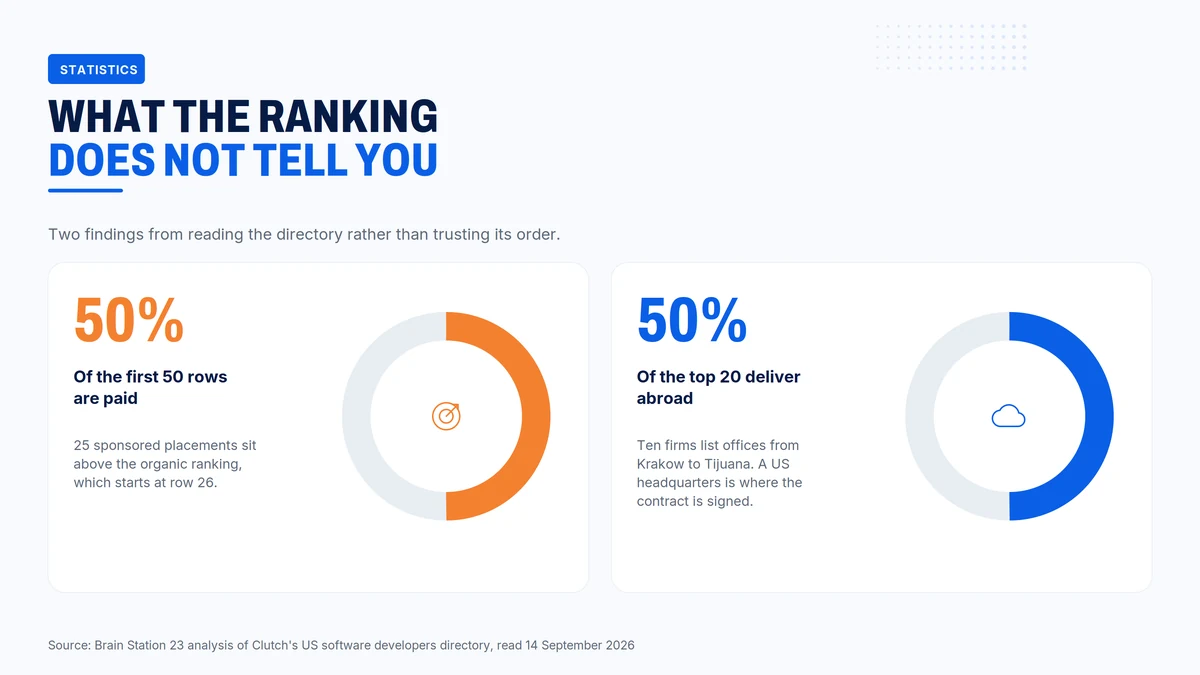
Two things the ranking does not tell you. Source: Brain Station 23 analysis of Clutch’s US software developers directory and 20 profiles, read 14 September 2026.
AI is now a service line almost everywhere. Fifteen of the twenty publish an AI service of some kind. The median AI share is 10 percent, and only two firms are above 30 percent. Most of these firms added AI to the menu recently. Ask what they shipped, not what they list.
The money picture is just as spread out as the service mix.
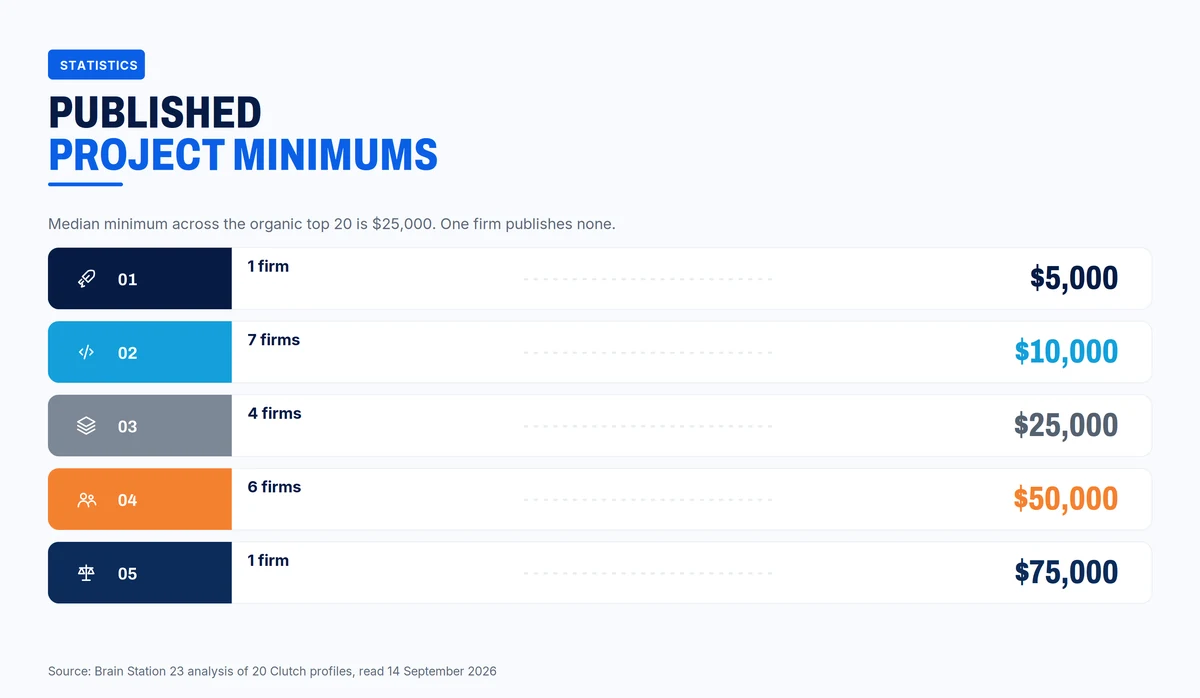
Minimums across the organic top 20, median $25,000. Source: Brain Station 23 analysis of 20 Clutch profiles, read 14 September 2026.
Seven firms publish a $10,000 minimum, six sit at $50,000, four at $25,000, one at $75,000, one at $5,000, and one publishes nothing. Headcount splits the same way: ten firms have 50 to 249 staff, five have 250 to 999, three are over a thousand, and two are under fifty. The twenty carry 1,118 reviews between them, a median of 54 each, and every rating falls between 4.8 and 5.0. Ratings cannot rank these firms. Fit, price band and delivery location can.
How to shortlist without reading 9,200 profiles
Put the cheapest filters first, so that the expensive step, which is talking to people, happens with five firms and not twenty.
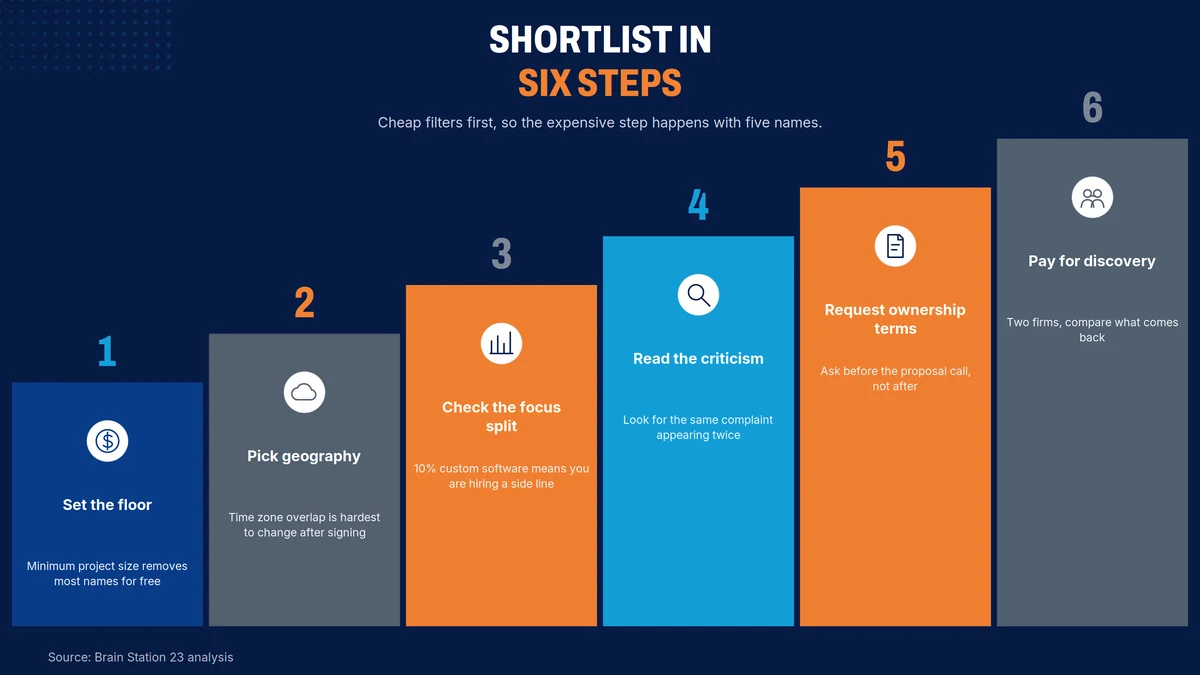
The order matters. Cheap filters first. Source: Brain Station 23 analysis.
Start with the minimum project size, because it removes more names than anything else and costs nothing. Then decide on delivery geography before you fall for a portfolio, since time zone overlap is the single hardest thing to change after signing. Third, check the focus split: if custom software is 10 percent of a firm’s business, you are hiring their side hustle. Fourth, read the criticism in the reviews, not the praise, and look for the same complaint appearing twice. Fifth, ask for the ownership and exit terms in writing before the proposal call, because the answer arrives fastest when nobody has invested time yet. Only then pay for discovery, from two firms, and compare what comes back.
A paid discovery from two vendors costs a few thousand dollars and is the cheapest insurance available on a six-figure build.
How to buy: four engagement models
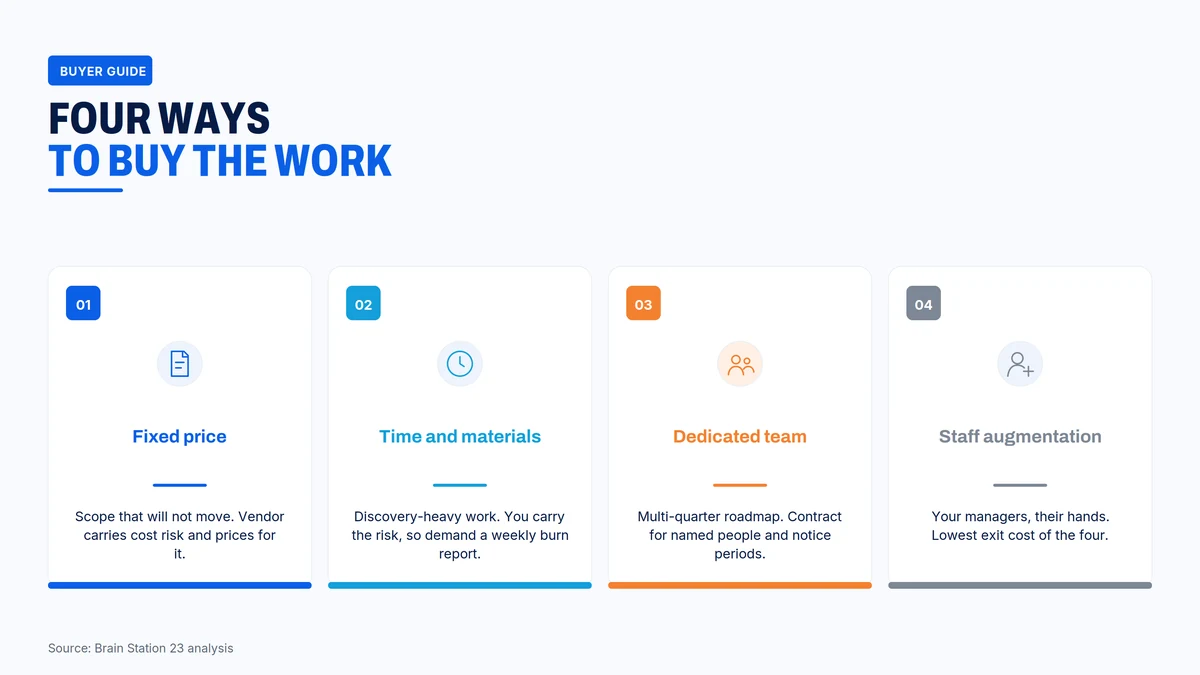
Who carries the risk changes with the model. Source: Brain Station 23 analysis.
Fixed price suits a scope that genuinely will not move: a defined integration, a migration, a compliance deliverable. The vendor carries cost risk, which they price for, and every change becomes a negotiation. If the scope is uncertain, fixed price converts every discovery into a dispute.
Time and materials suits discovery-heavy product work. You carry the cost risk, which means you need a weekly burn report and the right to stop, not a hope that things stay on track.
Dedicated team suits multi-quarter roadmaps. You are renting capacity with continuity, so the contract terms that matter are named people, notice periods and replacement guarantees rather than deliverables.
Staff augmentation suits an existing engineering team that is short of hands. Your managers run the work and keep the knowledge in house. It fails when a client expects augmentation engineers to make product decisions nobody has written down.
Eight of the twenty firms publish staff augmentation as a service line. At Brain Station 23 it is 60 percent of what we do, which is why the model gets an honest description here rather than a sales pitch.
The technical question for 2026: who governs the AI-written code
Every firm on this list will tell you they use AI assistance. The differentiator is not whether they use it. It is what they do afterwards.
The evidence for why this matters is not speculative. Black Duck’s audit of 947 commercial codebases found the average number of files per codebase up 74 percent in a single year and open source components up 30 percent, with vulnerabilities per codebase up 107 percent. In the same period, 92 percent of audited codebases contained components more than four years out of date and only 7 percent of components were on the latest version. More code, older dependencies, faster.
Ask these five questions, in this order.
What is in the repository that you did not write? A software bill of materials should be a deliverable, not a favour. Ask for it in SPDX or CycloneDX format at handover.
How do you review AI-generated code differently? Stack Overflow found 45 percent of developers saying debugging AI-generated code takes longer than expected. A firm that says its review process is unchanged has either not thought about it or is not telling you.
What is your licence policy? Two thirds of audited codebases now contain licence conflicts, the highest rate Black Duck has recorded, and AI assistants can reproduce code under restrictive licences. Ask who checks, and with what tool.
What is the dependency update cadence after launch? Monthly is a policy. Quarterly is a liability. “When something breaks” is not an answer.
Who owns the prompts, the fine-tuned models and the training data? If AI components are part of your product, the IP clause has to name them. Most standard agreements were written before this question existed.
Eight answers that should end the conversation
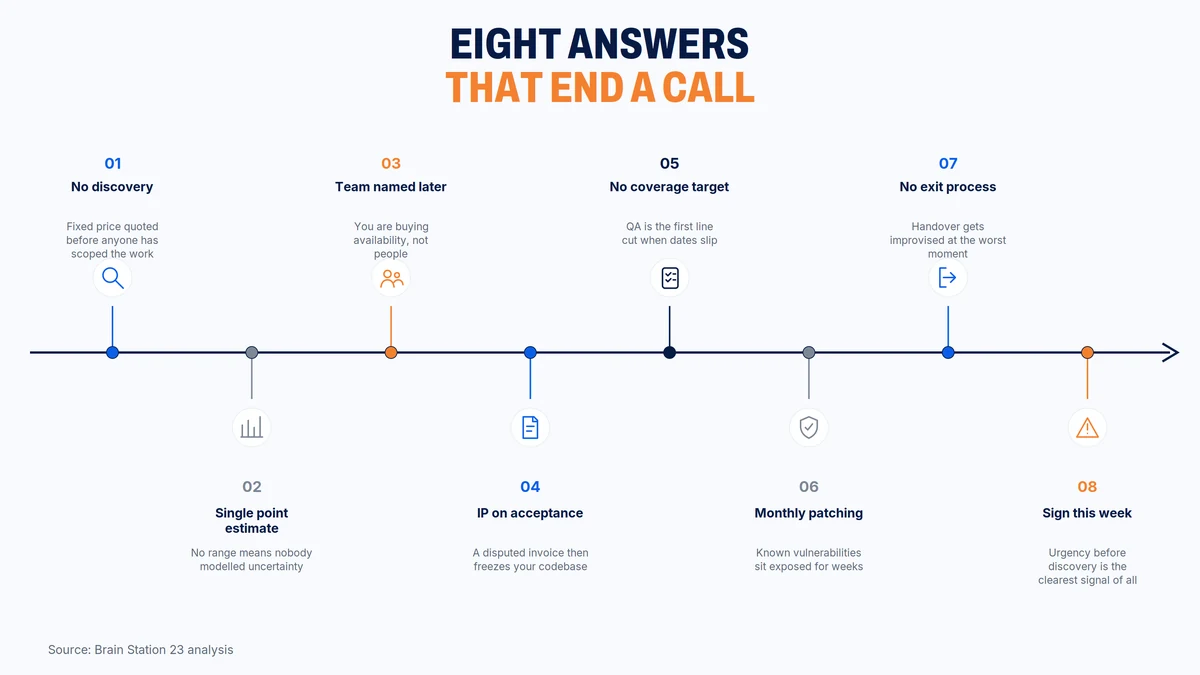
Each of these is a reason to stop, not a reason to negotiate harder. Source: Brain Station 23 analysis.
A fixed price without discovery means the risk premium is buried in the number. A single point estimate with no range means nobody has modelled uncertainty. “We will assign the team after signing” means you are buying availability, not people. IP terms that transfer on final acceptance rather than on payment leave your code hostage to a disputed invoice. No stated test coverage target means QA is the first thing cut. Patching on a monthly cycle means known vulnerabilities sit exposed for weeks. No documented exit process means the handover will be improvised at the worst possible moment. And pressure to sign before a discovery phase is the clearest signal of all.
What you must own before the final invoice
This is the part competitors leave out, and it is where the money actually goes.
Get these in the contract, not in an email:
- The repository with its full commit history, in your organisation’s account, not a zip file at the end.
- Domain and DNS in your company’s name, with registrar access.
- Hosting, server and cloud accounts under your billing relationship, so nothing switches off when a card expires.
- Premium licence keys on your account. Agency-wide licences deliver security patches, and they stop the day the relationship ends.
- Third-party service accounts: payment gateway, email, analytics, error monitoring, CI.
- Environment configuration and secrets, documented and rotated at handover.
- Design source files, not exported images.
- A runbook: how to deploy, how to roll back, what breaks at 2am and who to call.
The bill that arrives after launch
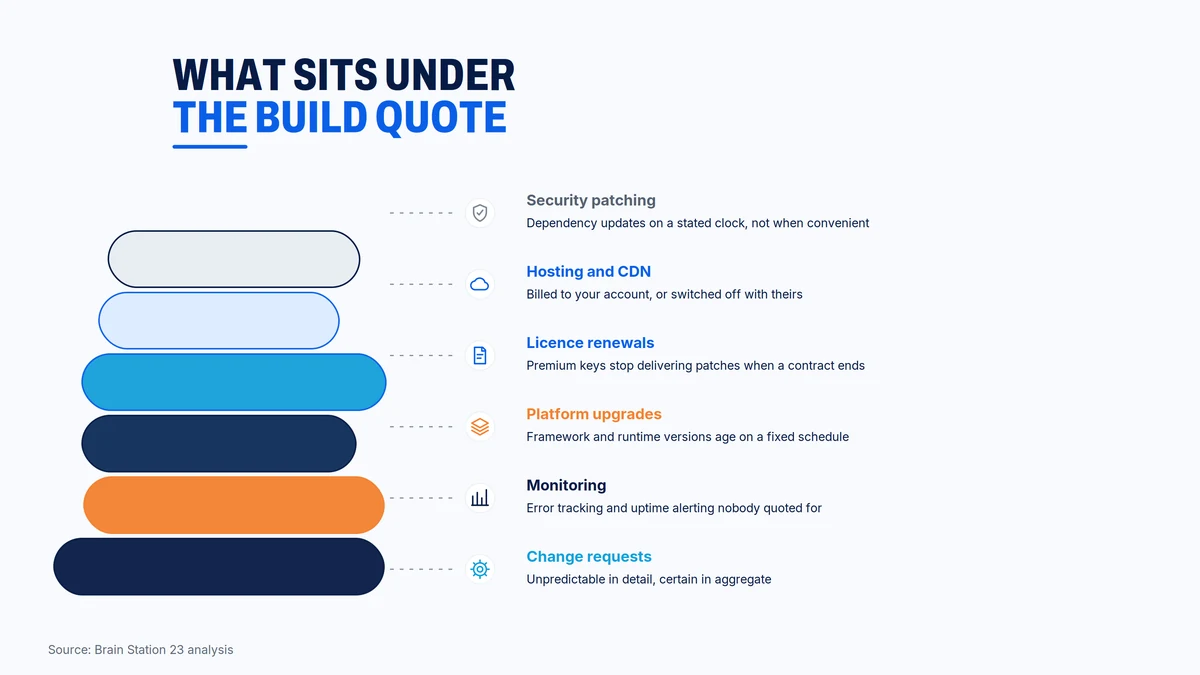
The build quote is the visible part. Source: Brain Station 23 analysis.
Ask every shortlisted firm for a three-year total, not a build price. The recurring lines are security patching and dependency updates, hosting and CDN, licence renewals, platform and framework upgrades, monitoring and error tracking, and the change requests you cannot predict but will certainly have. A build that is 20 percent cheaper and carries a support retainer 40 percent higher is more expensive by month fourteen.
Two of the twenty firms here sell managed services or application support as a standing line. For everyone else, ask what happens on day 91.
Security is a recurring cost, not a launch task
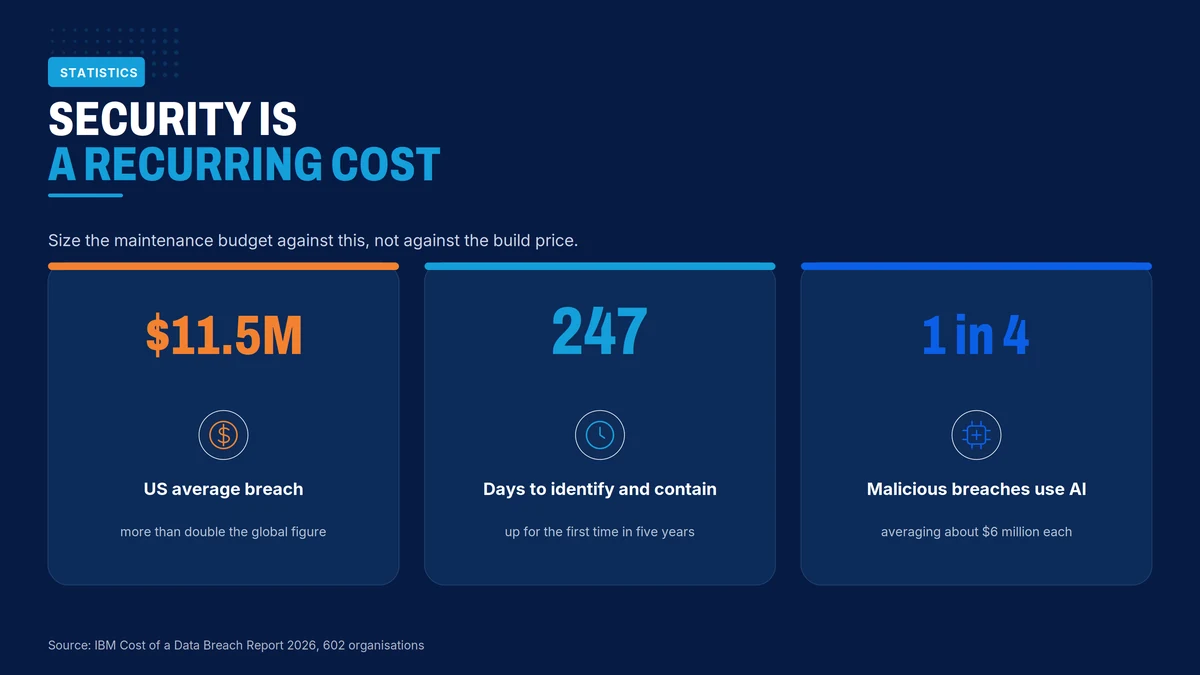
The number that should size your maintenance budget. Source: IBM Cost of a Data Breach Report 2026, 602 organisations.
IBM put the 2026 US average breach cost at $11.5 million against a $4.99 million global figure, and found the mean time to identify and contain a breach rose to 247 days, reversing five years of improvement. One in four malicious breaches now involves AI in some form.
Put that next to the dependency data. If your maintenance agreement applies patches monthly, and 92 percent of audited codebases are already carrying components four or more years out of date, then the agreement is not covering the risk it appears to cover. Write the patch window into the contract in hours for critical severity, not in weeks.
Accessibility is legal exposure with a budget line
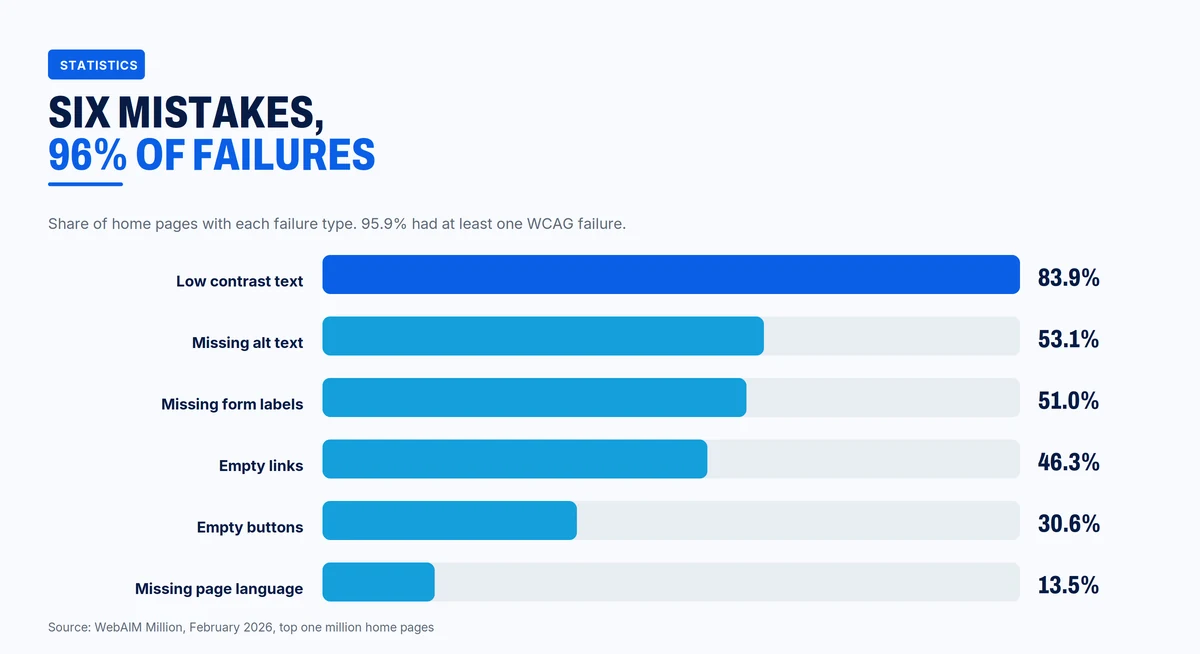
Six ordinary mistakes cause almost all of it. Source: WebAIM Million, February 2026.
WebAIM found 95.9 percent of the top million home pages had detectable WCAG failures in February 2026, up from 94.8 percent, with 56.1 errors per page. That is the first regression in six years, and WebAIM links it to rising page complexity and AI-assisted coding practice. The same six error categories have caused 96 percent of detected failures for seven consecutive years.
Meanwhile UsableNet counted more than 5,000 US digital accessibility lawsuits in 2025. Two practical asks: name a standard in the contract, WCAG 2.2 Level AA, rather than the word “accessible”; and treat overlay widgets with suspicion, because UsableNet’s tracking shows companies running them continued to be sued through 2025.
Contract clauses that surface in month nine
Not legal advice, and your counsel should review anything here. These are the clauses that come up when a relationship goes wrong.
IP assignment on payment, not on final acceptance. Otherwise a disputed invoice freezes your codebase.
Transition assistance hours, quantified, at a locked rate, available for a stated period after termination.
Rate escalation caps. Annual increases tied to a published index, not to vendor discretion.
Subcontracting disclosure. You should know if work moves to a third party, and be able to refuse.
Liability cap and insurance. A cap at the value of fees paid is common; whether it is adequate depends on what the software touches.
Non-solicit both ways, with a buyout figure rather than an absolute prohibition, so hiring the engineer who knows your system stays possible.
How to leave without losing the codebase
Confirm ownership of every item in the list above while relations are still cordial. Trigger the transition hours before you announce the change, not after. Record walkthroughs of deployment, rollback and the three things that break most often. Rotate every credential on the final day, including the ones nobody remembers issuing. Then run one deployment yourself, with the outgoing team watching, before the contract ends.
If that sequence sounds unfriendly, note that a vendor with a documented exit process will not mind, and a vendor without one has just told you something important.
In-house or agency
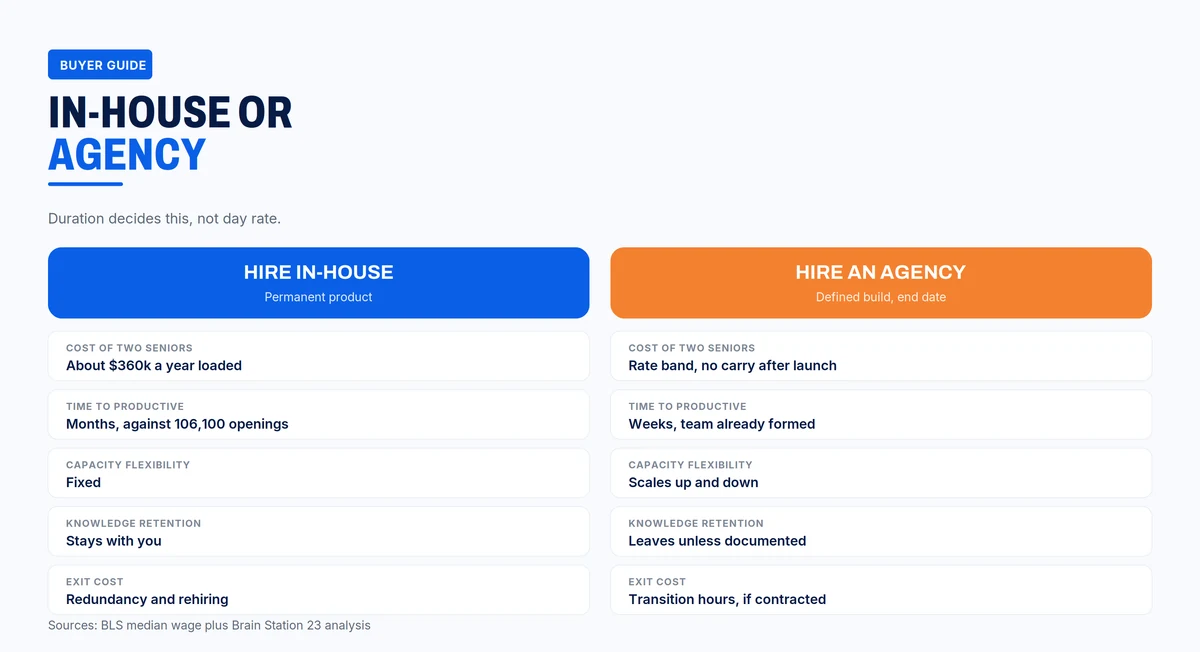
The comparison at the wage anchor. Source: BLS median wage plus Brain Station 23 analysis.
Three cases, using the BLS median of $135,980 as the anchor.
One product, one team, permanently. Hire. Two US developers cost roughly $360,000 a year fully loaded, and the knowledge stays with you. Anything you plan to keep changing for five years belongs in house.
A defined build with an end date. Hire an agency. Recruiting two senior engineers takes months against 106,100 annual openings in a competitive market, and you will be releasing them afterwards.
An existing team that is short of capacity. Augment. You keep the architecture decisions and the domain knowledge, and you buy hands for the sprint backlog. This is the model with the lowest exit cost, which is why it is the one we sell most.
FAQ
How much does custom software development cost in the USA in 2026?
The twenty firms in this guide publish hourly bands from $25 to $300 and minimum projects from $5,000 to $75,000, with a median minimum of $25,000. A defined integration or internal tool typically lands in the low tens of thousands; a multi-platform product with integrations and compliance work runs into six figures. Insist on a three-year total, not a build price.
Is it cheaper to hire developers or an agency?
Depends on duration. The BLS median US software developer wage was $135,980 in May 2025, and loaded cost is meaningfully higher. For work with an end date, an agency is usually cheaper because you are not carrying the role afterwards. For a permanent product, hiring wins on total cost and on knowledge retention.
Do the top-ranked firms on Clutch pay for their position?
Some rows do. On the US software developers directory read on 14 September 2026, 25 of the first 50 rows were sponsored placements, with the organic ranking starting at row 26. Clutch labels them. The rankings themselves are not purchasable, but visibility is.
Are US-headquartered firms actually building in the US?
Often not. Ten of the twenty organic firms list delivery offices outside the country, in locations from Kraków to Tijuana. That is not a problem in itself, and it is usually why a rate is competitive, but you should know it before you sign rather than after.
What certifications should a software development company have?
ISO 27001 for information security and SOC 2 Type II for service controls are the two that most enterprise buyers require. Almost none of these firms publish certifications on their directory profile, so ask for the certificate, the issuing body and the scope statement. Scope matters: a certificate covering one office is not a company-wide control.
How long does a custom software build take?
A focused internal tool takes roughly two to four months. A first version of a customer-facing product with integrations usually takes four to nine. Anyone quoting a firm date before discovery is quoting a guess, and several reviewers across these twenty profiles named timeline estimation as the thing their vendor should improve.
What should be in the contract about AI-generated code?
Name it. Require disclosure that AI assistance is used, a licence-scanning step before delivery, a software bill of materials at handover, and IP assignment that covers prompts and any fine-tuned models built for you. Two thirds of audited codebases now contain licence conflicts, so this is a real exposure rather than a theoretical one.
How often should software be patched after launch?
Critical-severity dependency patches belong on an hours-to-days clock, written into the support agreement. Routine updates monthly. Given that vulnerabilities per codebase rose 107 percent in a year, a quarterly cadence leaves a window most buyers would not accept if it were described to them plainly.
Conclusion
Three things are worth carrying out of this guide. The ranking you are shown first is mostly paid, so scroll to row 26. The label on the tin is broad, because custom software development is a median of 30 percent of what these firms sell. And half of the top 20 software development companies in USA lists deliver from outside the country, which is a fact to price in rather than a reason to disqualify.
The firms above are a reasonable place to start a shortlist. What decides the outcome is narrower than any list: whether the repository, the licence keys and the runbook are in your name before the final invoice clears, and whether the contract says how fast a critical patch gets applied. Ask those two questions on the first call and most of the rest sorts itself out.
Sources
- https://clutch.co/us/developers
- https://www.bls.gov/ooh/computer-and-information-technology/software-developers.htm
- https://survey.stackoverflow.co/2025/ai
- https://www.blackduck.com/blog/open-source-trends-ossra-report.html
- https://www.blackduck.com/blog/ossra-2026-open-source-vulnerability-counts-doubled-year-over-year.html
- https://www.scworld.com/news/open-source-vulnerabilities-per-codebase-surge-by-107
- https://securityboulevard.com/2026/08/how-much-does-a-data-breach-cost-ibms-2026-report-puts-the-us-average-at-11-5-million/
- https://webaim.org/projects/million/
- https://blog.usablenet.com/ada-web-lawsuit-trends-2026
- https://www.gartner.com/en/newsroom/press-releases/2026-07-27-gartner-forecasts-worldwide-it-spending-to-grow-14-point-2-percent-in-2026-totaling-6-point-37-trillion
- https://www.glassdoor.com/Salaries/software-engineer-salary-SRCH_KO0,17.htm
- https://www.ziprecruiter.com/Salaries/Software-Engineer-Salary
- https://www.talent.com/salary?job=software+engineer
- https://www.payscale.com/research/US/Job=Software_Engineer/Salary