
Two companies send out the same brief in the same week. An iOS and Android app, a booking flow, card payments, a launch date in the spring.
One signs with a studio that publishes a $150 to $199 hourly band. The other signs with a firm that publishes $25 to $49. Both firms are on this Top 20 Mobile App Development Companies in USA list, and that split is the market in miniature: 13 of the twenty publish a band under $100, six publish $150 to $199, and exactly one sits in between (Clutch profiles, read 14 September 2026).
Neither buyer has made a mistake yet. The difference shows up later, in who pays when the scope moves and in whose account the app lives. Since 31 August 2026, Google Play has required every new app and update to target Android 16 (API level 36), and Apple has required Xcode 26 builds since 28 April 2026. If you stop maintaining an app, it does not stand still. It loses the ability to ship.
Whichever of those two buyers you are, this guide covers the twenty firms and what the work costs, then the part most roundups skip: whose name sits on your store listing, what recurs every year, and how you leave a vendor without losing the app.
Key takeaways
- 13 of 20 firms publish an hourly band under $100, 6 publish $150 to $199, and only 1 sits between them (Brain Station 23 analysis of Clutch profiles, read 14 September 2026).
- 13 of 15 firms whose four Clutch sub-scores differ have Cost as their lowest or joint-lowest score. The median Quality score is 4.9; the median Cost score is 4.75 (Clutch profiles).
- 9 of 20 have no Clutch review dated in the 12 months to 14 September 2026, and one ranked firm’s newest review is from May 2019 (Clutch profiles).
- 21 paid placements sit on top of Clutch’s default US app developers view, which is sorted by sponsorship and lists 7,762 firms (Clutch).
- $98,636 to $137,329 is what four salary sites report for the same mobile developer role in 2026, a spread of $38,693 (PayScale, Indeed).
- Nearly 60% of iOS apps and 43% of Android apps were vulnerable to personal data leakage in Zimperium’s 2025 research (Zimperium).
- More than 5,000 digital accessibility lawsuits were filed in 2025, and 46% of federal cases involved repeat defendants (UsableNet).
- $11.5 million is the average cost of a US data breach in IBM’s 2026 report, a record (IBM Cost of a Data Breach Report 2026).
Mobile in 2026: two platforms, two deadlines, one framework question
The first decision in a mobile brief is which phones you are building for, and the US answer is less lopsided than it feels.
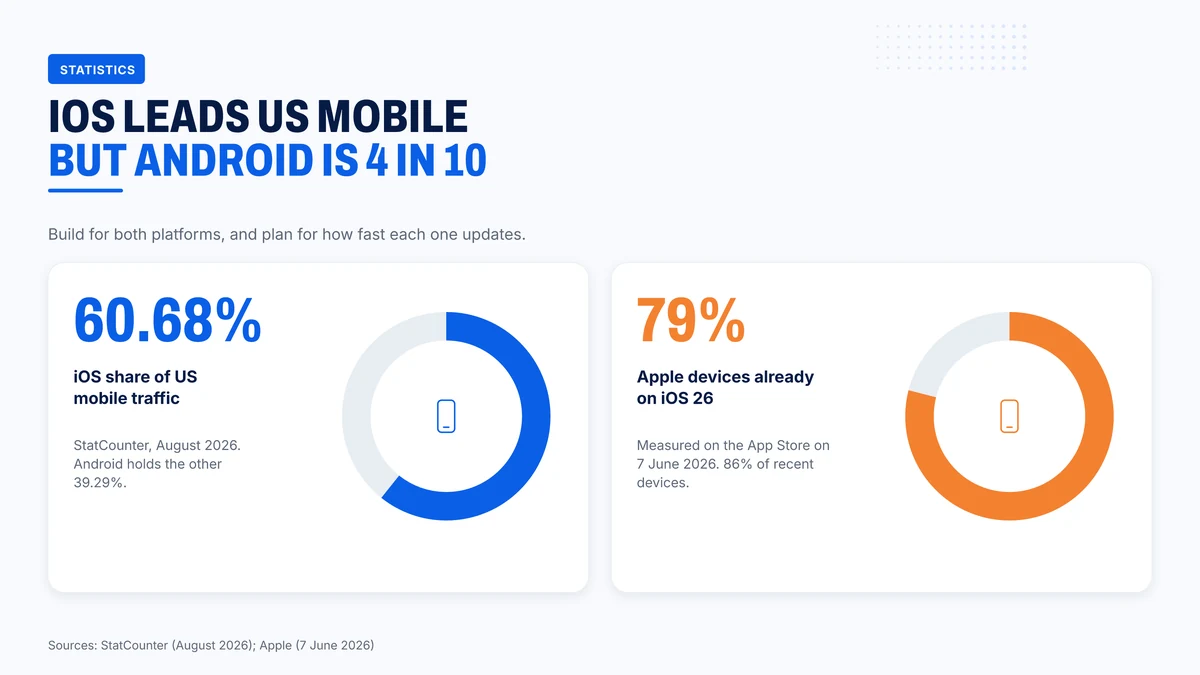
iOS carried 60.68% of US mobile operating system share in August 2026 and Android 39.29% (StatCounter). StatCounter counts page views rather than devices, so treat that as a traffic signal, not a census. It is still enough to say that an iOS-only launch leaves roughly four in ten US mobile visits on the table.
The platforms also age differently. Apple reports that 79% of devices that transacted on the App Store on 7 June 2026 ran iOS 26, and 86% of devices from the last four years (Apple). iPhone users update fast, so a team can drop old versions sooner. Android spreads across more manufacturers and versions, which is where testing time goes.
That split is why cross-platform frameworks exist. In the last Stack Overflow survey to ask, 9.4% of 45,841 respondents used Flutter and 8.4% used React Native (Stack Overflow Developer Survey 2024). The 2025 edition dropped the comparison, so 2024 is the latest clean read.
Among agencies the picture is not close. All twenty firms on this list publish React Native, Flutter or both in their framework split: 17 list React Native and 14 list Flutter (Brain Station 23 analysis of Clutch profiles). A cross-platform proposal is the default you will receive, so the useful question is not whether a firm can do it but which parts of your app it would still write natively.
What mobile app development costs in the US
There is no single honest number for this, and the first place that shows up is salaries.
Four salary sites report four different answers for what is essentially the same job. PayScale puts a mobile applications developer at $98,636 in average base pay (PayScale, updated 1 June 2026). Talent.com says $102,913 (Talent.com). Salary.com gives $106,141 as of 1 September 2026 (Salary.com). Indeed reports $137,329 from 795 job postings (Indeed, updated 6 September 2026).
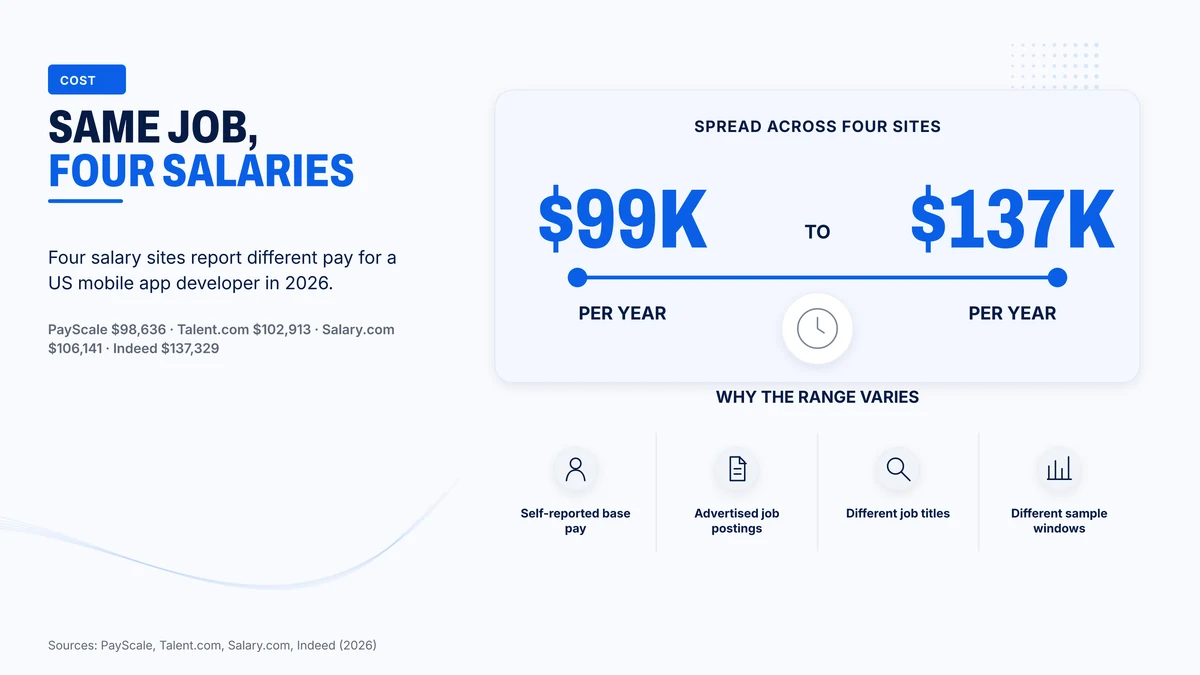
None of them is wrong. PayScale is self-reported base pay. Indeed is what employers advertise in postings. The job titles differ slightly from site to site. The US Bureau of Labor Statistics does not break out mobile developers, but its median for all software developers was $135,980 in May 2025 (BLS), which sits at the top of the aggregator range.
Agency pricing spreads wider still, and we tally it after the list. The hourly band tells you less than it seems, because firms put different things inside the hour. What moves a mobile quote is scope, and eight factors do most of the work.
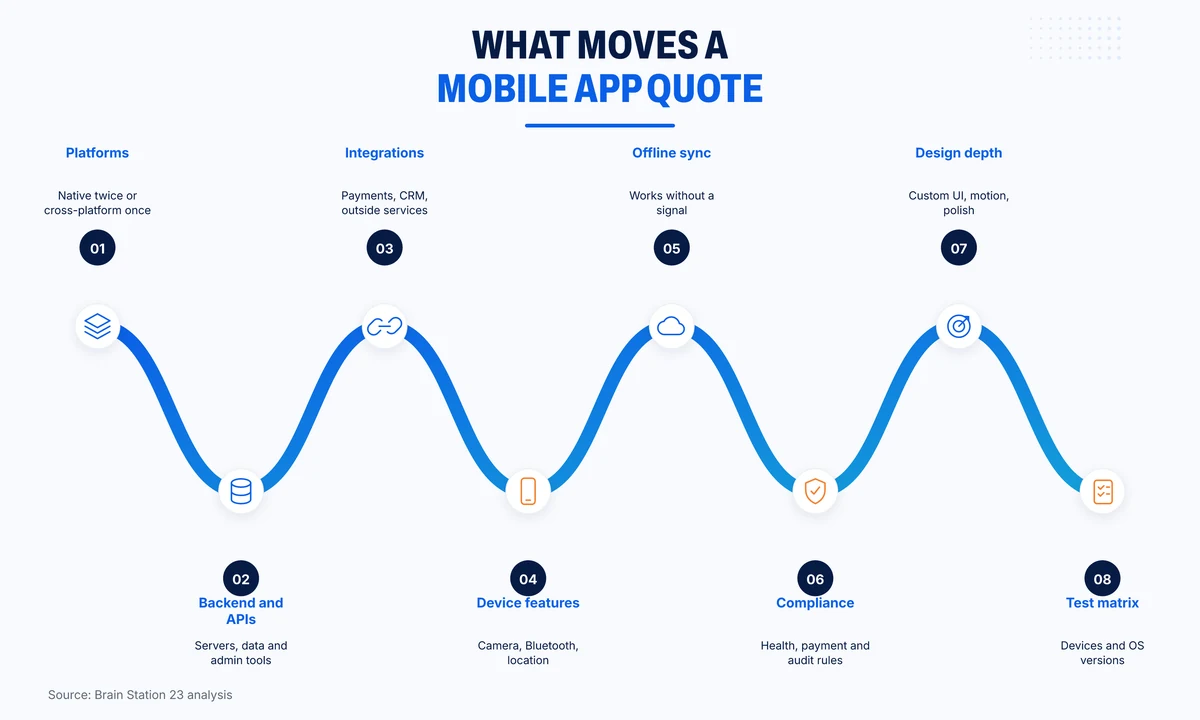
Platform strategy comes first: two native codebases cost more to build and maintain than one cross-platform codebase. The backend and its APIs come next, then third-party integrations, since a payments provider or CRM you do not control sets your timeline. Device features such as the camera, Bluetooth or location add native work even in a cross-platform app, and offline sync adds more. Compliance, design depth and the size of the device test matrix finish the list. Ask every vendor to price those eight lines separately and the quotes become comparable.
The Top 20 Mobile App Development Companies in USA, compared
Firms 2 to 21 below are the top 20 by Clutch Rank on Clutch’s US app developers directory, read on 14 September 2026. That page opens sorted by sponsorship, and its first 21 rows are paid placements. Clutch describes Clutch Rank as “our proprietary organic rank of the best companies”, based on reviews, industry awards and past work, so we sorted by it, left out every firm marked as a sponsor, and took the first 20 that remained.
Brain Station 23 is placed first because we publish this article. We are US-headquartered and verified on Clutch, but mobile app development is 5 percent of our published focus and IT staff augmentation is 60 percent, so the directory did not place us in its top 20 and we are not claiming it did.
Every rating on the list sits between 4.7 and 5.0, so ratings cannot separate these firms. The columns below are decision columns instead.
| # | Company | Best For | Team Size | Mobile Focus | Key Tech Stack | Industries Served | Locations |
|---|---|---|---|---|---|---|---|
| 1 | Brain Station 23 — brainstation-23.com | Adding cost-controlled mobile engineers to a product team you already run | 250 – 999 | 5% mobile, 60% staff augmentation | Flutter, Kotlin, Swift, Java, .NET, Spring | Retail, medical, telecoms, education, financial services | Springfield VA; Bangladesh, UAE, England, Malaysia, Germany |
| 2 | Atomic Object — atomicobject.com | Healthcare and logistics products that need a US-based team for the long haul | 50 – 249 | 50% | React Native, React, Node.js, Ruby on Rails, TypeScript | Medical, logistics, automotive, insurance | Grand Rapids, Ann Arbor, Chicago, Raleigh |
| 3 | Designli — designli.co | Non-technical founders who want a paid discovery phase before a build | 50 – 249 | 50% | React Native, React, Node.js, Swift, Kotlin | Consumer products, construction, education, energy, financial services | Greenville SC +4 |
| 4 | Suffescom Solutions Inc — suffescom.com | Fintech and healthcare builds on a tight hourly budget with offshore delivery | 250 – 999 | 40% | React Native, Flutter, Next.js, Node.js, Kotlin, Python | Financial services, medical, real estate, e-commerce | New York, Wilmington DE, Mohali, Dubai, London, Sydney |
| 5 | Synergy Labs — synergylabs.co | Small businesses that want a Flutter or React Native build from a boutique team | 50 – 249 | 60% | Flutter, React Native, React, Swift, Kotlin | Financial services, food and beverage, government, hospitality | Hollywood FL |
| 6 | Trango Tech — trangotech.com | Buyers who want a broad-service vendor with Gulf and US offices | 250 – 999 | 40% | React Native, React, Angular, Node.js, .NET, Laravel | Automotive, education, financial services, gaming, government | Dubai, Riyadh, Salt Lake City, Chicago |
| 7 | Bolder Apps — bolderapps.com | Small businesses testing an idea on a low minimum | 50 – 249 | 60% | Flutter, React Native, React, Swift, Kotlin | Business services, consumer products, education, financial services | Miami +6 US cities |
| 8 | TekRevol — tekrevol.com | Game and mobile commerce apps from a large team at a low hourly rate | 250 – 999 | 40% | React Native, Flutter, React, Next.js, Laravel | Education, gaming, government, medical, real estate | Houston +4 |
| 9 | Apptechies — apptechies.com | Small businesses buying a first app on a low hourly budget | 50 – 249 | 55% | Flutter, React Native, React, Laravel, Node.js | IT, advertising, business services, education | Greenwood IN |
| 10 | The BHW Group — thebhwgroup.com | Mid-market companies with a React Native build and a budget above $75,000 | 10 – 49 | 60% | React Native, JavaScript, Go | Consumer products, medical, business services, education | Austin +1 |
| 11 | Red Foundry — redfoundry.com | Hospitality, media and consumer brands with a React Native app to maintain | 10 – 49 | 60% | React Native, Node.js, React, Swift, Kotlin | Consumer products, hospitality, arts and entertainment, media | Chicago |
| 12 | Eight Bit Studios — eightbitstudios.com | Founders who want senior attention from a very small studio on a retainer | 2 – 9 | 90% | Flutter, Ruby on Rails, React, .NET | Arts, business services, consumer products, education | Chicago |
| 13 | Surf — surf.dev | Fintech and health apps where Flutter is already the chosen framework | 50 – 249 | 80% | Flutter, Swift, Kotlin, Java | Financial services, medical, business services, e-commerce | Wilmington DE, New York |
| 14 | Zco Corporation — zco.com | Game and consumer apps from a long-established New England firm | 250 – 999 | 40% | React Native, Flutter, Node.js, .NET, React | Business services, consumer products, gaming, manufacturing | Nashua NH, Boston, New York |
| 15 | Roonyx — roonyx.tech | Fintech buyers, especially buy-now-pay-later products | 50 – 249 | 50% | Flutter, React Native, Laravel, Node.js, Elixir | Financial services, real estate, IT, medical | New York, San Francisco |
| 16 | AppIt Ventures — appitventures.com | Mid-sized companies modernising an existing app with a small senior team | 10 – 49 | 50% | React Native, Angular, Flutter, .NET, Kotlin | Business services, consumer products, medical, education | Denver |
| 17 | Rightpoint — rightpoint.com | Enterprise consumer brands with a budget of $250,000 or more | 250 – 999 | 45% | Swift, Java, C++, Ruby, Flutter, React Native | Consumer products, financial services, medical, automotive | Chicago, Boston, Plano, Atlanta |
| 18 | Confianz Global, Inc — confianzit.com | Small businesses that need a mobile app wired into an ERP | 50 – 249 | 60% | Flutter, React Native, React, Angular, Django | Consumer products, retail, IT, manufacturing | Charlotte NC |
| 19 | Geekbears — geekbears.com | Early-stage founders who want discovery and design led by one small team | 10 – 49 | 75% | Flutter, Angular, Node.js | Business services, education, medical, financial services | San Francisco |
| 20 | Orangesoft — orangesoft.co | Health and wellness apps from a Europe-based team at mid-market rates | 50 – 249 | 40% | React, Next.js, Flutter, React Native, Kotlin, Swift | Medical, financial services | Warsaw +1 |
| 21 | Michigan Software Labs — michiganlabs.com | Enterprise teams wanting a small Michigan studio on a contained budget | 10 – 49 | 60% | Swift, React Native, .NET, Node.js, Angular | Automotive, business services, financial services, medical | Forest Hills MI |
Team sizes, mobile focus percentages, frameworks, industries and locations are from each firm’s published Clutch profile, read 14 September 2026. “Best For” is our reading of that data. Engagement models and certifications are not published consistently across these profiles, so we have left them out rather than guess.
Profiles are grouped by the kind of buyer each firm suits, and the numbers match the table. Every profile carries a caution drawn from that firm’s own Clutch review feedback. Certifications are self-published by firms and unverified by us, which is why most profiles say to ask.
1. Brain Station 23
We publish this article and put ourselves first, so read this entry as the publisher’s pick rather than a ranking. The honest gap is focus. Mobile app development is 5 percent of our published Clutch work against a median of 52.5 percent for the twenty firms below, because most of what we sell is engineers embedded in client teams. What we offer instead is price and scale: our $25 to $49 band is the lowest on this page, a band five of the twenty share, against a $74.50 median midpoint. We write IP assignment on payment, rate locks and replacement guarantees into contracts, the asks the red flags section recommends. Our reviewers have asked for better internal coordination, and our delivery centres sit in Bangladesh, the UAE, England, Malaysia and Germany. If you want a US-only studio in your time zone, we are the wrong call.
Founded: 2006
US Presence: Springfield VA
Company size: Clutch band 250 to 999; we publish 900+ engineers
Rating: 4.9 across 21 Clutch reviews, HQ Springfield, Virginia
- Adding cost-controlled mobile engineers to a product team you already run
- CMMI Level 3
- ISO 27001
- ISO 9001
- SOC 2 Type II (company-published)
- Staff augmentation
- Flutter and cross-platform apps
- iOS and Android development
- Mobile commerce
- Field operations apps
- App modernisation
- Retail
- Medical
- Telecoms
- Education
- Financial services
- Hospitality
- Ask how a Dhaka-based squad overlaps your working day and who the named US escalation contact is
For healthcare, enterprise and regulated work
2. Atomic Object
Mobile and custom software each make up half of Atomic Object’s published focus, and medical work is 65 percent of its industry split. Its profile describes an employee-owned, 100 percent US-based team. Reviewers mention communication and project management more than anything else. The pattern Clutch flags is cost: at 4.7 it is Atomic Object’s lowest sub-score, and reviewers suggest clearer initial scoping to prevent budget overruns. It suits buyers who value a stable onshore team over the lowest rate.
Founded: 2001
US Presence: Grand Rapids, Ann Arbor, Chicago, Raleigh
Company size: 50 to 249
- Healthcare and logistics products that need a US-based team for the long haul
- Not published; ask directly
- iPhone and iPad apps
- Android apps
- React Native
- React
- Node.js and Ruby on Rails backends
- Custom software
- Medical
- Supply chain and logistics
- Automotive
- Insurance
- Ask for a costed scoping phase in writing before the build starts
20. Orangesoft
Orangesoft is the most concentrated firm on this list: medical is 90 percent of its published industry split and health and wellness 60 percent of its mobile focus. It appears on the US directory under San Francisco, but its Clutch profile lists Warsaw first and services clients in English and Polish. Reviewers describe a flexible, communicative team and competitive pricing. Clutch’s summary notes occasional design quality concerns, and one reviewer described a slight language barrier on engineering detail. It fits a health product team comfortable with European delivery.
Founded: 2011
US Presence: Warsaw +1
Company size: 50 to 249
- Health and wellness apps from a Europe-based team at mid-market rates
- Not published; ask directly
- iOS and Android apps
- Flutter and React Native
- React and Next.js
- IoT development
- Custom software
- Web development
- Medical
- Financial services
- Confirm which team members sit in which time zone and how design reviews run
17. Rightpoint
Rightpoint publishes the highest minimum on this list and the most enterprise-heavy client mix, 60 percent. Its website says it “has fully integrated into the Genpact brand” (rightpoint.com). Reviewers praise creative design and technical depth, while Clutch’s summary notes that initial scoping sometimes underestimated complexity. The bigger signal is age: the newest of its 20 Clutch reviews is dated May 2019, so the ranking rests on work from 2019 and earlier. Ask for recent references under the current structure.
Founded: 2007
US Presence: Chicago, Boston, Plano, Atlanta
Company size: 250 to 999
- Enterprise consumer brands with a budget of $250,000 or more
- Not published; ask directly
- Native iOS and Android apps
- Swift
- Mobile commerce apps
- IoT development
- UX/UI design
- Web development
- Consumer products
- Financial services
- Medical
- Automotive
- IT
- Retail
- Confirm the contracting entity and delivery team, since Rightpoint now operates under Genpact
21. Michigan Software Labs
Michigan Software Labs reports 65 percent of its clients as enterprises while publishing a $10,000 minimum, an unusual pairing. Reviewers describe strong technical problem-solving and easy collaboration. Its review base is thin, though: nine reviews, the newest from August 2022. Cost is its weakest sub-score at 4.4, the lowest on this list, and one reviewer asked for more transparency about price creep. Treat the rating as a small sample and confirm budget controls up front.
Founded: 2010
US Presence: Forest Hills MI
Company size: 10 to 49
- Enterprise teams wanting a small Michigan studio on a contained budget
- Not published; ask directly
- iOS and Android apps
- Swift
- React Native
- .NET and Node.js backends
- AR/VR development
- Low-code development
- Automotive
- Business services
- Financial services
- IT
- Medical
- Logistics
- Agree a change-control process and a cost ceiling in writing before work starts
For founders, MVPs and consumer apps
3. Designli
Designli has the largest review base of the five firms rated 5.0, with 83 reviews. Reviewers repeatedly mention its two-week solution lab, which produces a prototype before the full build, and Clutch’s summary credits it with MVPs that drew investor interest. The same summary names the recurring issue: timelines that ran past initial estimates. One reviewer on a six-figure build advised planning “on an overage if you have a big scope.” It suits founders who want structure and will budget contingency.
Founded: 2013
US Presence: Greenville SC +4
Company size: 50 to 249
- Non-technical founders who want a paid discovery phase before a build
- Not published; ask directly
- Cross-platform apps
- React Native
- iOS in Swift
- Android in Kotlin
- UX strategy
- MVP development
- AI features
- Consumer products
- Construction
- Education
- Energy
- Financial services
- Manufacturing
- Ask for a timeline range rather than a single date, and what happens when it slips
19. Geekbears
Mobile is 75 percent of Geekbears’ published work and UX/UI design the other 25, with Flutter as its main framework. Its $50,000 minimum is the highest among the eight firms billing $50 to $99 an hour. Reviewers value its discovery process. Clutch’s summary flags internal communication, and one 2024 reviewer described handoffs between teams as “a bit rocky at times.” Clarify how design passes to development before kickoff.
Founded: 2015
US Presence: San Francisco
Company size: 10 to 49
- Early-stage founders who want discovery and design led by one small team
- Not published; ask directly
- Flutter apps
- iOS and Android
- UX/UI design
- Product discovery
- Angular and Node.js backends
- Business services
- Education
- Medical
- Financial services
- Ask who owns the handoff between design and development, and meet both leads
12. Eight Bit Studios
Eight Bit Studios has the highest mobile focus on this list at 90 percent. Its website describes “a two-person app studio” with a developer in Chicago and a designer in Dallas, engaged on “a monthly retainer” (eightbitstudios.com), which the Clutch minimum does not reflect. Reviewers praise the quality of the work and the project management. Clutch flags cost communication, and Cost is its lowest sub-score at 4.5. Its newest review dates from February 2024.
Founded: 2009
US Presence: Chicago
Company size: 2 to 9 on Clutch; the studio describes itself as two people
- Founders who want senior attention from a very small studio on a retainer
- Not published; ask directly
- iOS and Android apps
- Flutter
- Cross-platform apps
- Ruby on Rails and React backends
- Web design
- Retainer-based product guidance
- Arts and entertainment
- Business services
- Consumer products
- Education
- Financial services
- Medical
- Ask what happens to your roadmap if either founder is unavailable for a month
7. Bolder Apps
Bolder Apps publishes the lowest minimum on this list, $5,000, and lists seven US cities. Its rating rests on six reviews, the smallest base of the twenty. Clutch’s summary suggests clients would welcome more proactive guidance after launch on scaling and feature priorities. One oddity is worth knowing: its published service, platform, framework and language splits are identical to those of Synergy Labs, number 5, so the directory data cannot tell the two apart. Judge it on case studies and references.
Founded: 2019
US Presence: Miami +6 US cities
Company size: 50 to 249
- Small businesses testing an idea on a low minimum
- Not published; ask directly
- Flutter and React Native apps
- iOS in Swift
- Android in Kotlin
- AI and generative AI features
- Web development
- Business services
- Consumer products
- Education
- Financial services
- Government
- E-commerce
- Its published focus data matches Synergy Labs line for line, so compare portfolios rather than profiles
5. Synergy Labs
Synergy Labs is the youngest firm here, and 70 percent of its published clients are small businesses. Reviewers most often call it timely and proactive, and all four of its Clutch sub-scores sit at 4.9. Two 2025 reviewers raised process points: one wanted the team to bring a project management tool rather than the client building one, and another described contract back-and-forth before signing. Its focus data is identical to Bolder Apps’, so the profile alone will not show how the two differ.
Founded: 2020
US Presence: Hollywood FL
Company size: 50 to 249
- Small businesses that want a Flutter or React Native build from a boutique team
- Not published; ask directly
- Flutter and React Native apps
- iOS in Swift
- Android in Kotlin
- Smart TV apps
- AI and generative AI features
- Web development
- Financial services
- Food and beverage
- Government
- Hospitality
- IT
- Legal
- Ask which project management tool and reporting cadence the team will use from week one
For cross-platform specialists
13. Surf
Surf lists Flutter as 100 percent of its framework split, and financial services and medical make up 70 percent of its industries. It rates 5.0 across 43 reviews, and reviewers single out unique expertise and a proactive approach. Clutch’s summary notes occasional delays in bug resolution. Its website lists offices in Wilmington, New York and Potomac, Maryland (surf.dev). The newest Clutch review is from May 2024, so ask for current references.
Founded: 2011
US Presence: Wilmington DE, New York
Company size: 50 to 249
- Fintech and health apps where Flutter is already the chosen framework
- Not published; ask directly
- Flutter apps
- iOS and Android
- Low-code development
- Web design
- Financial services
- Medical
- Business services
- E-commerce
- Put response times for production bugs into the support agreement
10. The BHW Group
The BHW Group lists React Native as its only framework, and 70 percent of its clients are mid-market. Its $75,000 minimum is the second highest on this list. Reviewers describe long partnerships, and high-quality work is the trait they mention most. Clutch’s summary notes room for more proactive guidance, and one reviewer wished the team had been more assertive about the implications of technical choices. It suits a buyer who already knows what they want built.
Founded: 2005
US Presence: Austin +1
Company size: 10 to 49
- Mid-market companies with a React Native build and a budget above $75,000
- Not published; ask directly
- React Native apps for iOS and Android
- JavaScript and Go backends
- Web development
- UX/UI design
- Mobile commerce apps
- Consumer products
- Medical
- Business services
- Education
- Government
- Nonprofit
- Ask the team to put its technical recommendations and their trade-offs in writing
11. Red Foundry
Red Foundry is one of only two firms here to list application management and support as a service line, and cross-platform work is 60 percent of its platform split. Reviewers credit strong project management and collaboration. Clutch’s summary is direct about design: some clients cited a lack of originality in UI/UX work, occasionally leading to project halts, and one 2023 reviewer described the design team working from premade templates. Its newest review is from September 2024.
Founded: 2009
US Presence: Chicago
Company size: 10 to 49
- Hospitality, media and consumer brands with a React Native app to maintain
- Not published; ask directly
- React Native and cross-platform apps
- iOS and Android
- Application management and support
- UX/UI design
- Web development
- Consumer products
- Hospitality
- Arts and entertainment
- Financial services
- Media
- Medical
- Review original design work from recent projects and name the lead designer in the contract
18. Confianz Global, Inc
Confianz pairs mobile work, 60 percent of its focus, with ERP consulting for the other 40, and half its mobile focus is productivity apps. Seventy percent of its platform split is cross-platform. Reviewers call it timely and knowledgeable. Its Willing to Refer score of 4.5 is the lowest on this list, and one reviewer said some developers concentrated on a single technology, which slowed the project. The newest review dates from July 2022, so ask for recent references.
Founded: 2008
US Presence: Charlotte NC
Company size: 50 to 249
- Small businesses that need a mobile app wired into an ERP
- Not published; ask directly
- Cross-platform apps
- Flutter
- React Native
- React
- ERP consulting and integration
- Productivity apps
- Consumer products
- Retail
- IT
- Manufacturing
- Education
- Government
- Confirm the named developers cover every technology your app and ERP connection need
16. AppIt Ventures
AppIt Ventures is the only firm on this list in the $100 to $149 band, and its service lines include enterprise app modernisation and application support alongside new builds. Reviewers describe close partnerships and good use of their feedback. Clutch’s summary flags project scope clarity, and one reviewer said the team missed a few deadlines while pushing for quality. Its most recent review is from May 2026. It suits a buyer who wants a US team without a studio’s top rate.
Founded: 2012
US Presence: Denver
Company size: 10 to 49
- Mid-sized companies modernising an existing app with a small senior team
- Not published; ask directly
- iOS and Android apps
- React Native
- Angular and .NET
- Application management and support
- Enterprise app modernisation
- Staff augmentation
- Business services
- Consumer products
- Medical
- Education
- Government
- Nonprofit
- Get scope, exclusions and change pricing written into the statement of work
For larger teams and lower rates
4. Suffescom Solutions Inc
Suffescom has the most reviews on this list, 121, and splits its focus evenly between mobile and web at 40 percent each. Its profile lists offices in New York and Delaware alongside Mohali in India, Dubai, London and Sydney, and it is not Clutch-verified. Reviewers most often call it timely. Clutch’s summary notes that clients wanted more design insight and creative input, and a 2026 reviewer asked for developers aligned to Canadian working hours. Expect delivery discipline and bring your own product design.
Founded: 2013
US Presence: New York, Wilmington DE, Mohali, Dubai, London, Sydney
Company size: 250 to 999
- Fintech and healthcare builds on a tight hourly budget with offshore delivery
- Not published; ask directly
- iOS and Android apps
- React Native and Flutter
- Next.js and Node.js
- AI development
- Blockchain
- Web development
- Financial services
- Medical
- Real estate
- E-commerce
- Education
- Logistics
- Agree working-hour overlap with your time zone before the first sprint
6. Trango Tech
Trango Tech’s profile lists Dubai and Riyadh ahead of its Salt Lake City and Chicago offices, and it does not publish a minimum project size. It is not Clutch-verified. At 4.7 it has the lowest overall rating of the twenty, with Schedule and Cost both at 4.5. Clutch’s summary names faster delivery of minor updates, more detailed documentation and earlier check-ins as areas to improve. Its breadth runs from wearables to ERP, so hold it to a written process.
Founded: 2003
US Presence: Dubai, Riyadh, Salt Lake City, Chicago
Company size: 250 to 999
- Buyers who want a broad-service vendor with Gulf and US offices
- Not published; ask directly
- iOS and Android apps
- Cross-platform apps
- AR/VR
- E-commerce
- ERP consulting
- Wearable apps
- Automotive
- Education
- Financial services
- Gaming
- Government
- Media
- Ask for a documentation standard and a check-in schedule for the first month
8. TekRevol
Mobile game development is 40 percent of TekRevol’s published mobile focus, second only to Zco on this list, and its band is $25 to $49 an hour. Reviewers praise communication and professionalism. Clutch’s summary flags timeline accuracy, and reviewers in 2023 and 2024 asked for more realistic deadlines and more contact with the lead developer. Its Cost sub-score of 4.6 is its lowest. It suits a buyer who will manage dates closely.
Founded: 2018
US Presence: Houston +4
Company size: 250 to 999
- Game and mobile commerce apps from a large team at a low hourly rate
- Not published; ask directly
- iOS and Android apps
- React Native and Flutter
- Mobile games
- AR/VR
- Low-code development
- Staff augmentation
- Education
- Gaming
- Government
- Medical
- Real estate
- Logistics
- Ask how delivery dates are estimated and what buffer is built into them
9. Apptechies
Apptechies scores 5.0 on every Clutch sub-score across 27 reviews and publishes a $25 to $49 band with a $10,000 minimum. Sixty-five percent of its clients are small businesses. It lists a single location in Greenwood, Indiana, and is not Clutch-verified. Clutch’s summary notes that some clients wanted more post-launch guidance, especially for less technical team members. That makes the handover plan the question to press.
Founded: 2018
US Presence: Greenwood IN
Company size: 50 to 249
- Small businesses buying a first app on a low hourly budget
- Not published; ask directly
- iOS and Android apps
- Flutter and React Native
- Laravel and Node.js backends
- Sales and CRM apps
- Business intelligence apps
- Web development
- IT
- Advertising and marketing
- Business services
- Education
- Home services
- Hospitality
- Write post-launch support, handover training and response times into the contract
14. Zco Corporation
Zco is the oldest firm on this list, and mobile game development is 44 percent of its mobile focus, the highest share here. It pairs a $25 to $49 band with US offices in Nashua, Boston and New York. Reviewers highlight project management and responsiveness. One 2022 reviewer rated the visual design phase 7 out of 10 against top marks for everything else. Its newest review dates from April 2024.
Founded: 1989
US Presence: Nashua NH, Boston, New York
Company size: 250 to 999
- Game and consumer apps from a long-established New England firm
- Not published; ask directly
- iOS and Android apps
- React Native and Flutter
- Mobile games
- AR/VR
- .NET and Node.js backends
- Staff augmentation
- Business services
- Consumer products
- Gaming
- Manufacturing
- Medical
- Advertising
- Ask to see visual design work from the team that will staff your project
15. Roonyx
Financial services is Roonyx’s largest industry at 25 percent. Its website now leads with a white-label buy-now-pay-later platform and gives an address in St. Petersburg, Florida (roonyx.tech), while Clutch lists New York and San Francisco. It is not Clutch-verified. Reviewers point to repeat engagements. Clutch’s summary notes delays in resource allocation and onboarding that affected timelines. Its newest review is from March 2024.
Founded: 2010
US Presence: New York, San Francisco
Company size: 50 to 249
- Fintech buyers, especially buy-now-pay-later products
- Not published; ask directly
- iOS and Android apps
- Flutter and React Native
- White-label BNPL platform
- Laravel and Node.js backends
- AR/VR
- Low-code development
- Financial services
- Real estate
- IT
- Medical
- Retail
- Logistics
- Confirm the team still takes custom builds and how people are allocated to your project
What we found in the top 20
We tallied the published data behind all twenty profiles. None of it is a ranking. It is a picture of what normal looks like, so you can tell when a quote is out of line.
The market splits in two, and the middle is nearly empty. Thirteen firms publish a band under $100 an hour, six publish $150 to $199, and one publishes $100 to $149. None publishes above $200. The median band midpoint is $74.50 (Brain Station 23 analysis of Clutch profiles, read 14 September 2026).
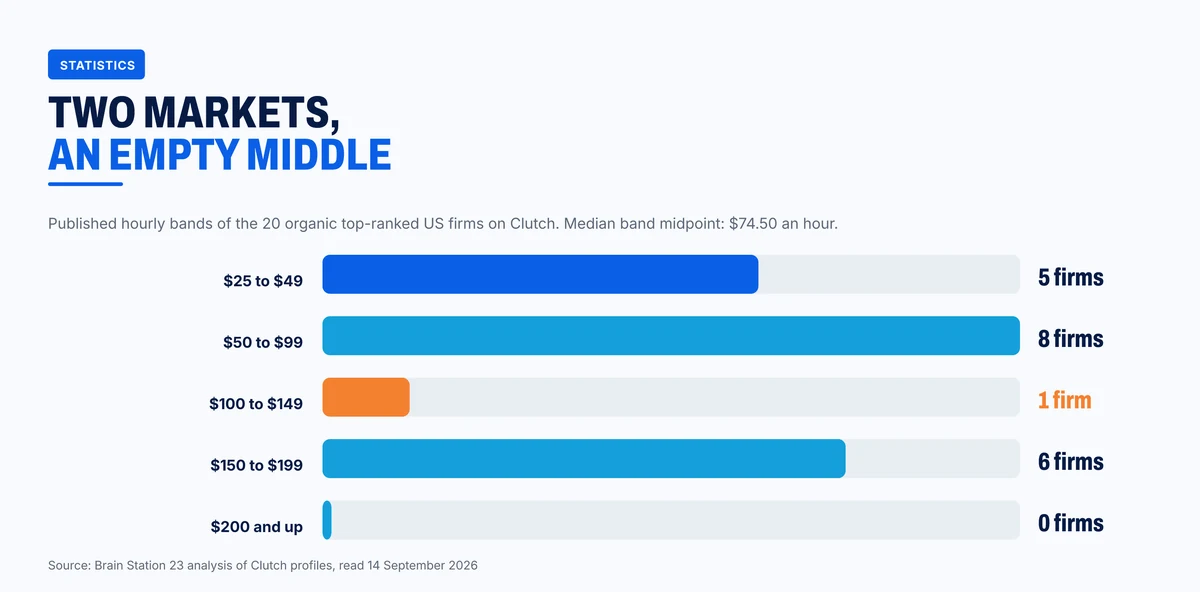
A band is a marketing choice, not a quote, but the gap is useful. If a proposal lands at $120 an hour, it is not typical of these twenty, so ask what sits inside the hour. Five of the six $150 to $199 firms have fewer than 250 staff, while four of the five $25 to $49 firms have 250 or more.
Minimums behave the same way. Nineteen firms publish one, from $5,000 to $250,000, with a median of $25,000. Trango Tech does not publish a minimum.
These are genuine mobile specialists. Mobile app development makes up between 40 and 90 percent of each firm’s published focus, with a median of 52.5 percent. Fifteen of the twenty have fewer than 250 staff.
Stars cannot separate them, but sub-scores can. Every overall rating sits between 4.7 and 5.0. Clutch also scores Quality, Schedule, Cost and Willing to Refer. Five firms score identically on all four. Of the other fifteen, Cost is the lowest or joint-lowest score for thirteen. Only Zco, where Schedule is lowest, and Confianz, where Willing to Refer is lowest, break the pattern. Reviewers are happy with what these firms build and less happy with what it cost to get there.
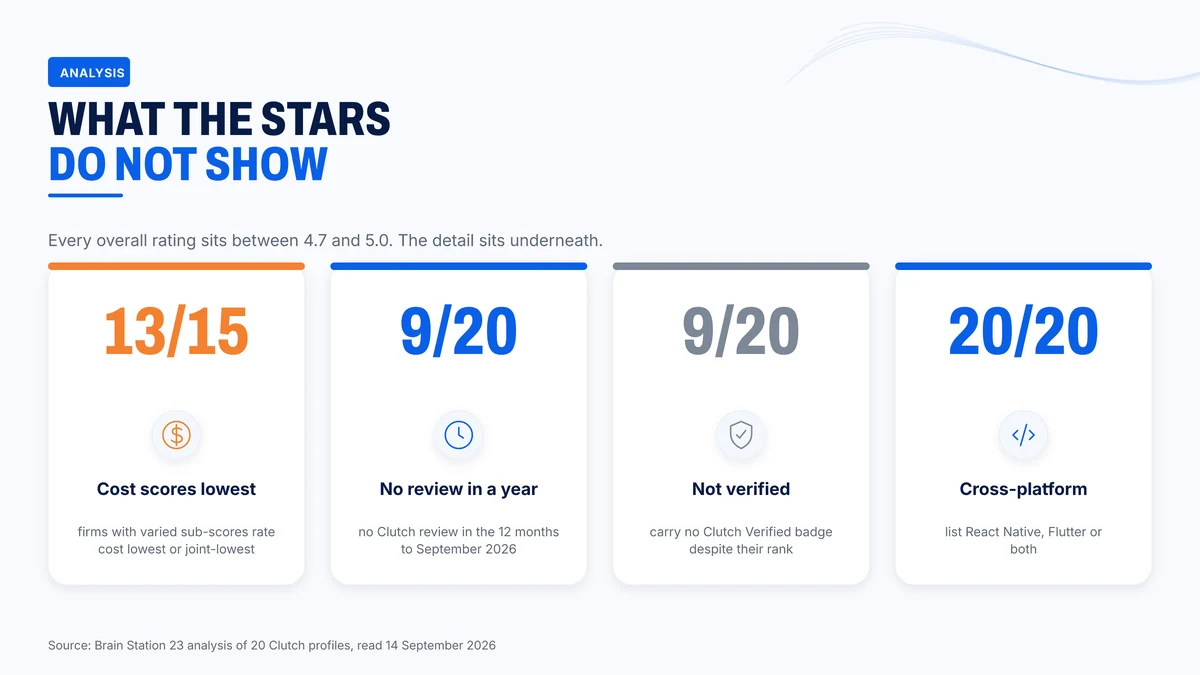
Rank outlasts reviews. Nine of the twenty have no Clutch review in the 12 months to 14 September 2026, and eight have none in 24 months. Rightpoint’s newest is from May 2019. A firm on this Top 20 Mobile App Development Companies in USA list can hold its place on work that predates its current team, so the review date matters as much as the score.
Verification is not a ranking requirement. Clutch says a Verified provider has passed a credit check and had its business entity validated. Nine of the twenty organic top-ranked firms carry no Verified badge, while every one of the 21 sponsored rows on the default view showed one.
Two caveats about the data itself. Focus percentages are self-reported, and they are not always independent: Bolder Apps and Synergy Labs publish identical service, platform, framework and language splits. And location fields can mislead, since Orangesoft sits under San Francisco on the US directory while its own profile lists Warsaw first.
How to shortlist a mobile app development company
With 7,762 firms on Clutch’s US app developers directory, the order of your filters matters more than the filters themselves. Start with the one that removes the most firms.
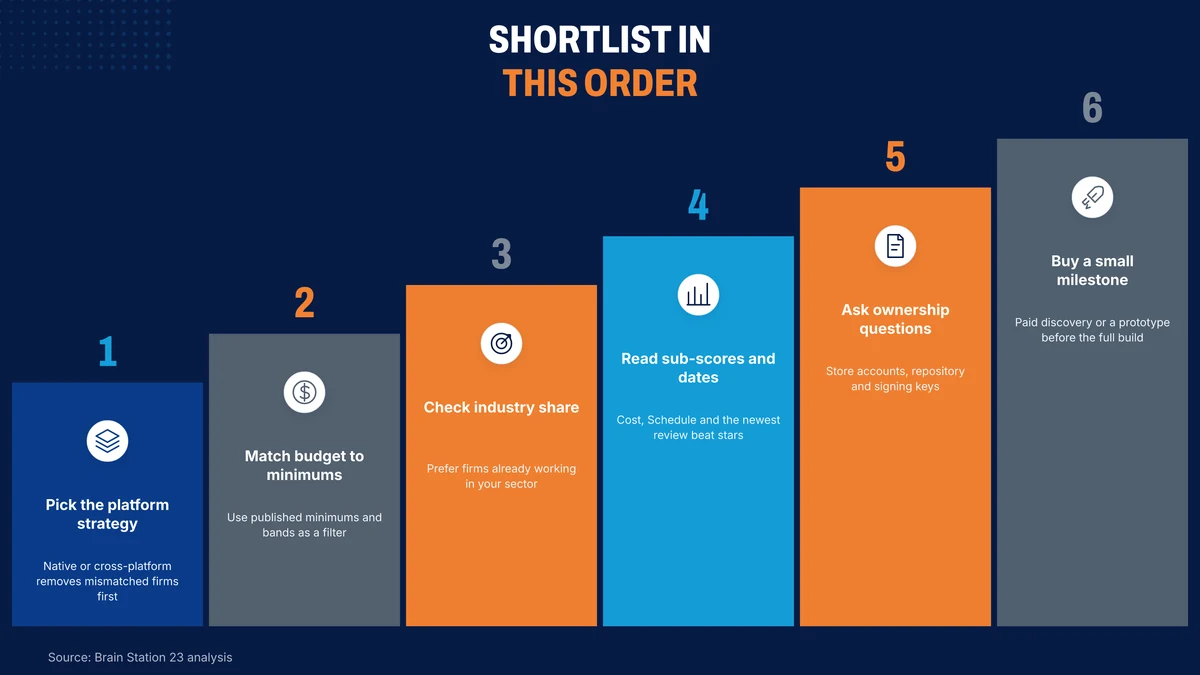
Step 1: Decide the platform strategy. Native Swift and Kotlin, or one cross-platform codebase. This removes firms whose framework split does not match before you read a single review.
Step 2: Match the minimum and the band to your budget. A $250,000 minimum and a $5,000 minimum are different businesses. Use the published numbers as a filter, not a price.
Step 3: Check the industry share. If you are building for healthcare, a firm with medical at 65 or 90 percent of its work has met your compliance questions before.
Step 4: Read the sub-scores and the review dates. Skip the stars. Look at Cost and Schedule, and at when the newest review was written.
Step 5: Ask the ownership questions on the first call. Whose developer account publishes the app, when you get repository access, and who holds the signing keys. The answers separate firms faster than a portfolio.
Step 6: Buy a small first milestone. A paid discovery phase or a prototype tests the working relationship before the full budget is committed.
How to buy mobile app development: four engagement models
The model decides who pays when the scope changes, which in mobile it almost always does.
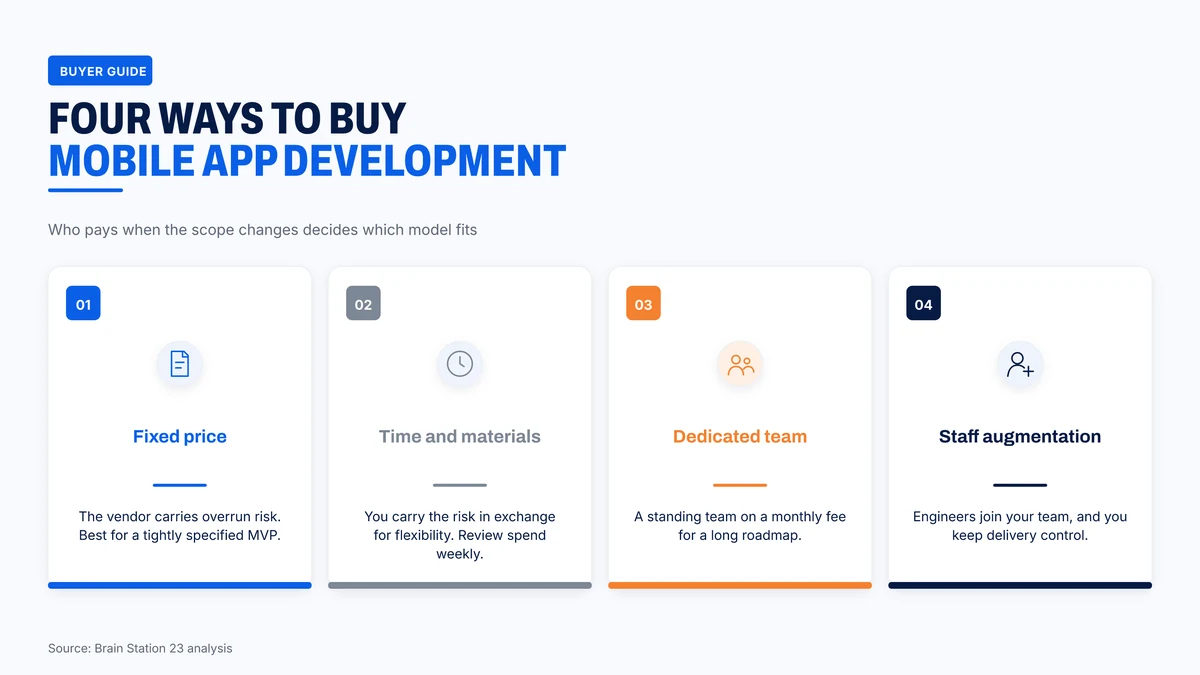
Fixed price. You agree a scope and a price. The vendor carries the overrun risk, so it prices that risk in, and every change becomes a change request. It works for a tightly specified MVP. It fails when the brief is still moving.
Time and materials. You pay for hours used and carry the risk in exchange for flexibility. It works when requirements will evolve with user feedback, provided you review spend weekly.
Dedicated team. A standing team works on your product for a monthly fee. Cost is predictable and knowledge stays with the team. It suits apps with a long roadmap, and it fails when there is not enough work to keep the team busy.
Staff augmentation. Individual engineers join a team you already manage. You carry delivery risk and keep full control. It works when you have a product owner and a tech lead in-house, and fails when you do not.
Given that Cost is the weakest review score across these twenty firms, the safest pattern for a first engagement is a fixed-price discovery phase followed by time and materials, with a monthly cap.
The technical question: store deadlines arrive every year
For PHP the upgrade question is a language version. For mobile it is the stores, and they move on a schedule you do not control.
Apple has required apps uploaded to App Store Connect to be built with Xcode 26 and an iOS 26 SDK since 28 April 2026, and it publishes each new requirement in advance (Apple). Google Play has required new apps and updates to target Android 16 (API level 36) since 31 August 2026, with extensions available to 1 November 2026. Apps that target Android 14 or lower are shown only to devices running that version or older (Google Play Console Help).
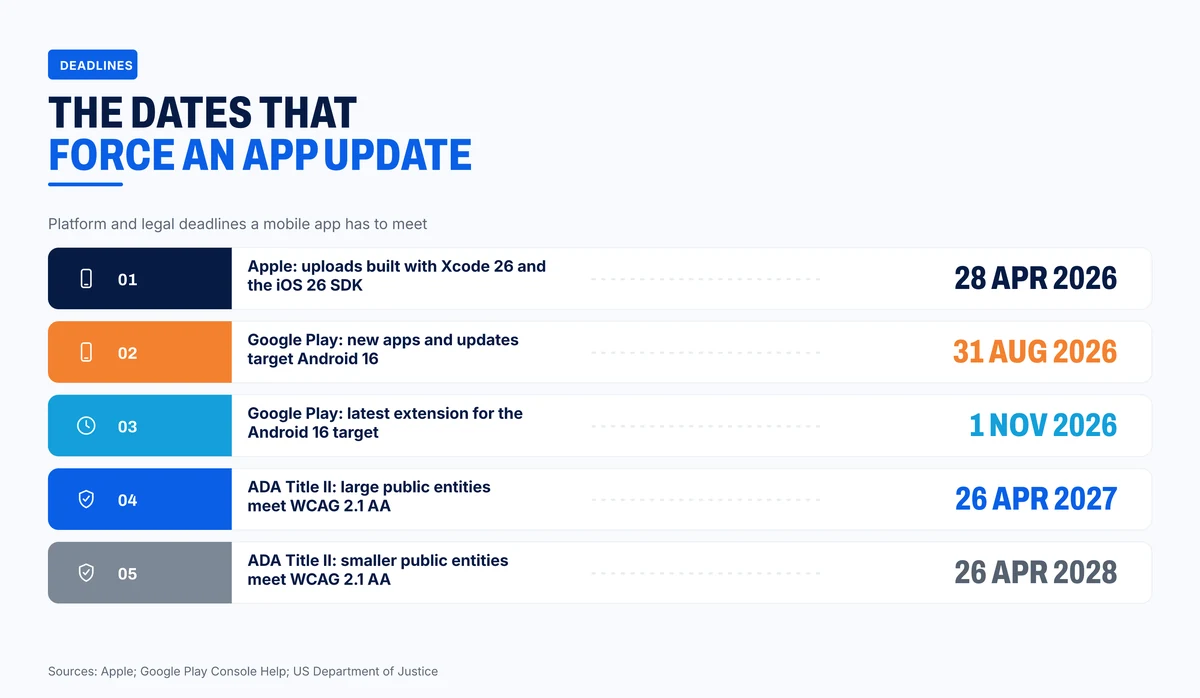
The practical effect is that an app nobody touches for a year stops being able to ship an update, including a security fix. So the maintenance plan has to be written before the build ends, and the upgrade work has an order.
Step 1: Upgrade the toolchain and SDK first. Nothing else can be released until the build compiles against the required version.
Step 2: Update the cross-platform framework and dependencies next. A Flutter or React Native version bump often forces plugin updates, and plugins are where abandoned code hides.
Step 3: Fix deprecated APIs and permission changes. Each OS release retires some behaviour, and permission rules are a common place for it to break.
Step 4: Regression-test on current OS versions. With iOS 26 on 79% of Apple devices (Apple), the newest version is the one your users are on.
Step 5: Submit ahead of the deadline, then build features. Store review adds days you cannot compress, and a feature release on a toolchain that is about to expire is wasted work.
Ask every vendor on your shortlist for the price of this annual cycle in writing, before you sign the build.
Red flags: eight answers to walk away from
Some answers should end a sales call, or at least move a firm to the bottom of your list. Each one maps to a problem later in this guide.
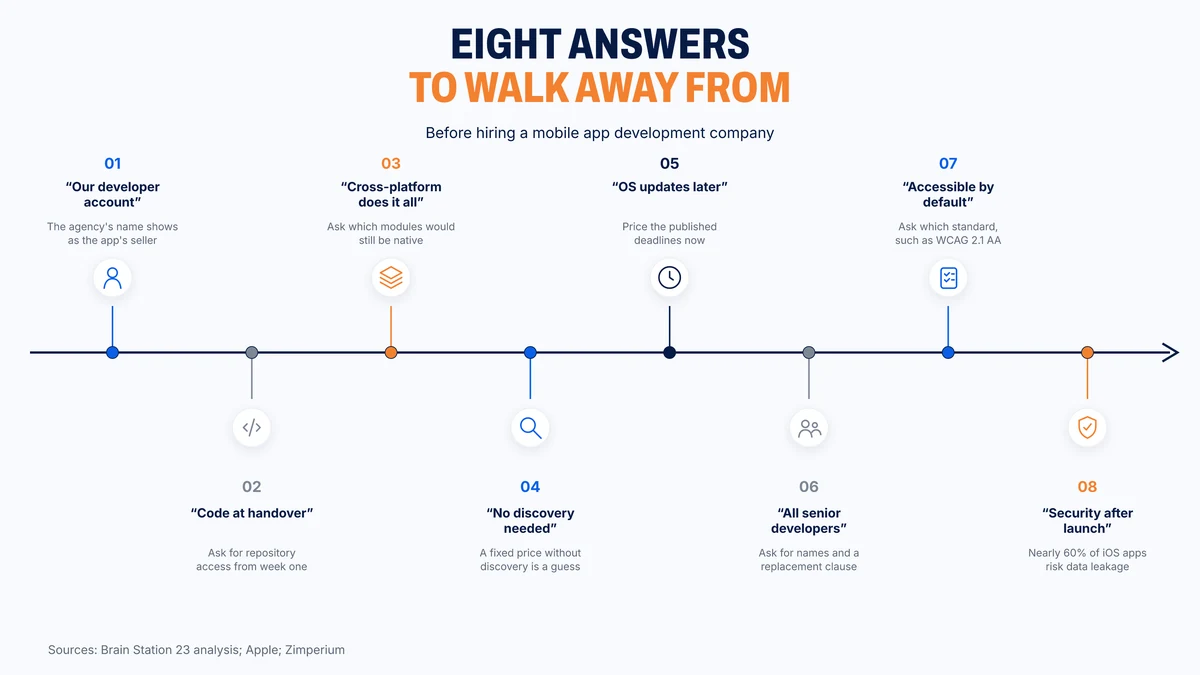
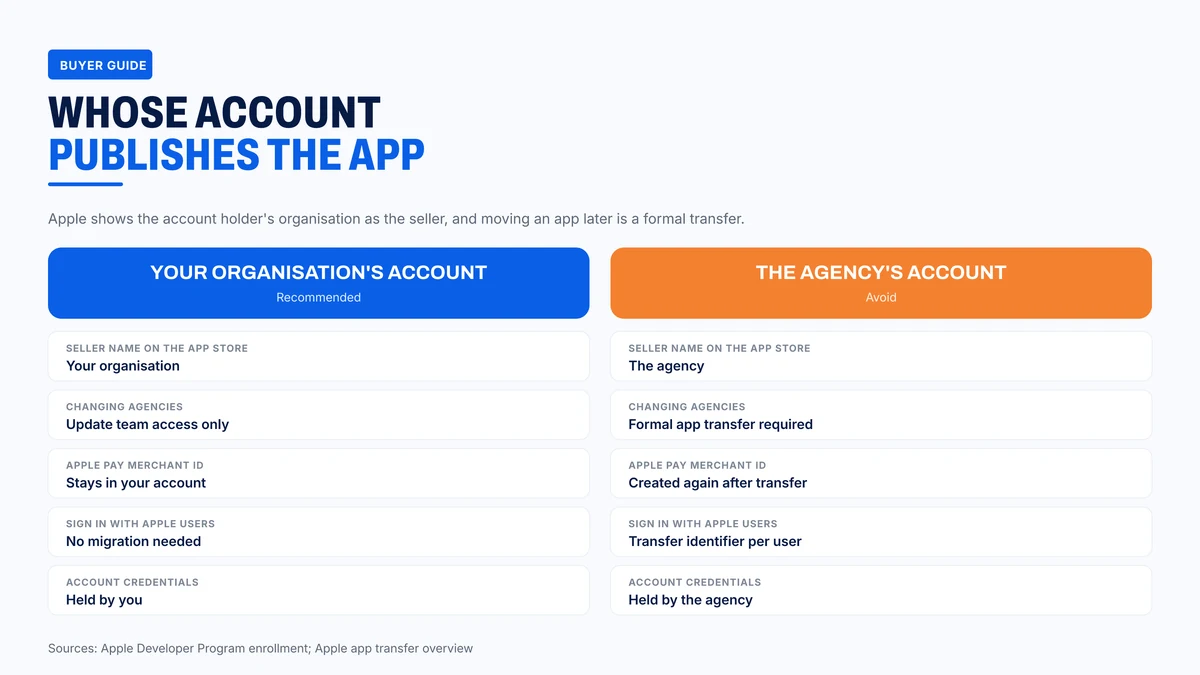
“We’ll publish it under our developer account.” Apple displays the account holder’s organisation name as the seller of the app (Apple). Moving it later is a formal transfer with parts that do not move.
“You’ll get the code when we hand over.” You want repository access with commit history from the first week, not a zip at the end.
“Cross-platform does everything native does.” Ask which modules they would write natively for your app. A firm with no answer has not read your brief.
“We don’t need a discovery phase.” A fixed price without discovery is a guess with a margin attached.
“We’ll handle OS updates when they come.” The deadlines are published. A vendor should price the annual upgrade cycle now.
“All our developers are senior.” Ask for names and CVs of the people who will work on your app, and a replacement clause if they leave.
“Accessibility is built in.” Ask which standard. A contract should name one, such as WCAG 2.1 AA.
“Security testing happens after launch.” Nearly 60% of iOS apps and 43% of Android apps in Zimperium’s research were vulnerable to personal data leakage (Zimperium). Testing belongs in the build.
After launch: what the build quote leaves out
The list tells you who can build the app. This section is about the eighteen months after it ships, which is where most of the regret in reviews comes from.
What you must own before the final invoice
In mobile, ownership starts with the store accounts, and it is the item buyers most often leave to the agency.
Your own Apple Developer Program account. Enrol your organisation, not a person and not the agency. Apple requires a D-U-N-S Number, a legal entity rather than a trade name, and a named account holder with authority to bind the business, and it charges 99 USD a year (Apple). Your organisation name is what shows as the seller.
Your own Google Play developer account, with your payments profile attached if the app sells anything.
The repository with its full commit history, in an organisation account you control.
Signing keys and certificates, and the backend. The credentials that sign your app for release, the cloud or hosting account behind your API, and every third-party account the app depends on: analytics, crash reporting, payments and push notifications.
Design source files and a runbook that explains how to build, sign and submit a release without the original team.
The bill that arrives after launch
A build quote covers the build. Almost everything else recurs.
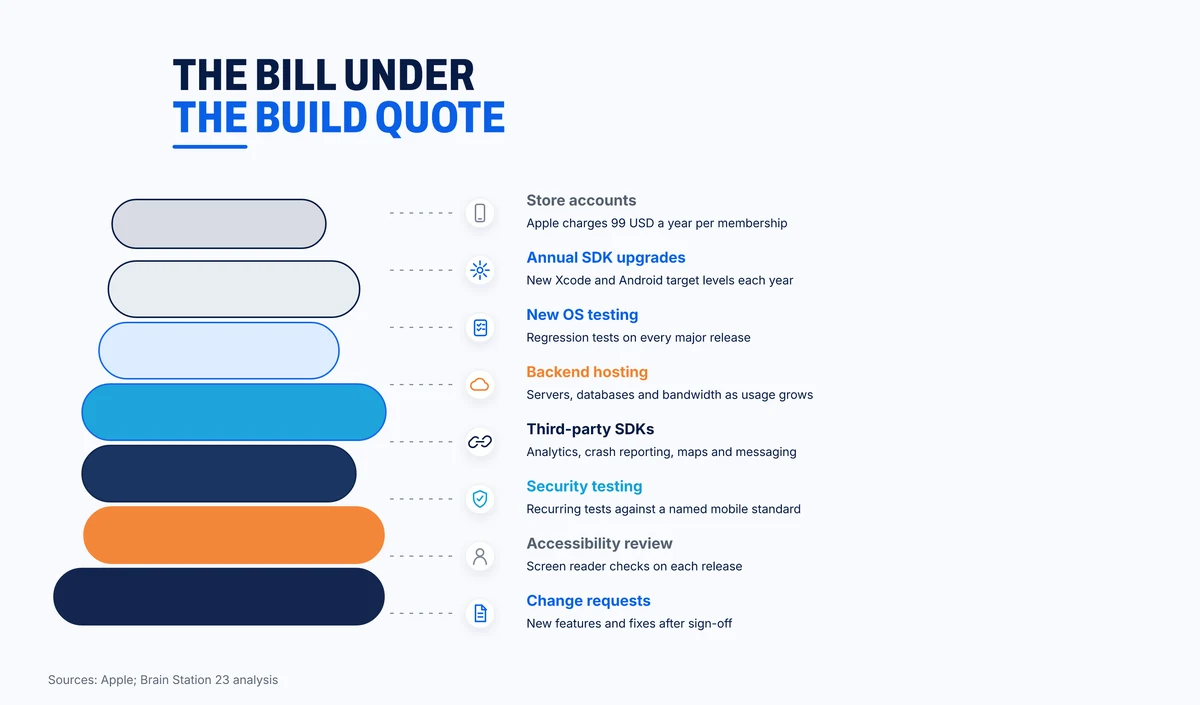
The recurring lines are the store accounts, the annual SDK and target API upgrades, testing against each new OS release, backend hosting, third-party SDK subscriptions, security testing, accessibility review, and change requests. Get the recurring number in writing before you sign the build, and compare vendors on three years of total cost rather than on the launch price.
Security is a recurring cost
Mobile apps leak more than most buyers assume. Zimperium found nearly 60% of iOS apps and 43% of Android apps vulnerable to personal data leakage, and over 60% of iOS apps and up to 34% of Android apps lacking basic code protection (Zimperium 2025 Global Mobile Threat Report).
The timing argument is starker. Google Cloud’s M-Trends 2026 found that the mean time to exploit vulnerabilities fell to an estimated minus seven days, “meaning exploitation is routinely occurring before a patch is even released” (Google Cloud). A support agreement that ships fixes in a monthly release window does not cover that risk, and the store deadlines above mean a neglected app cannot ship the fix at all.
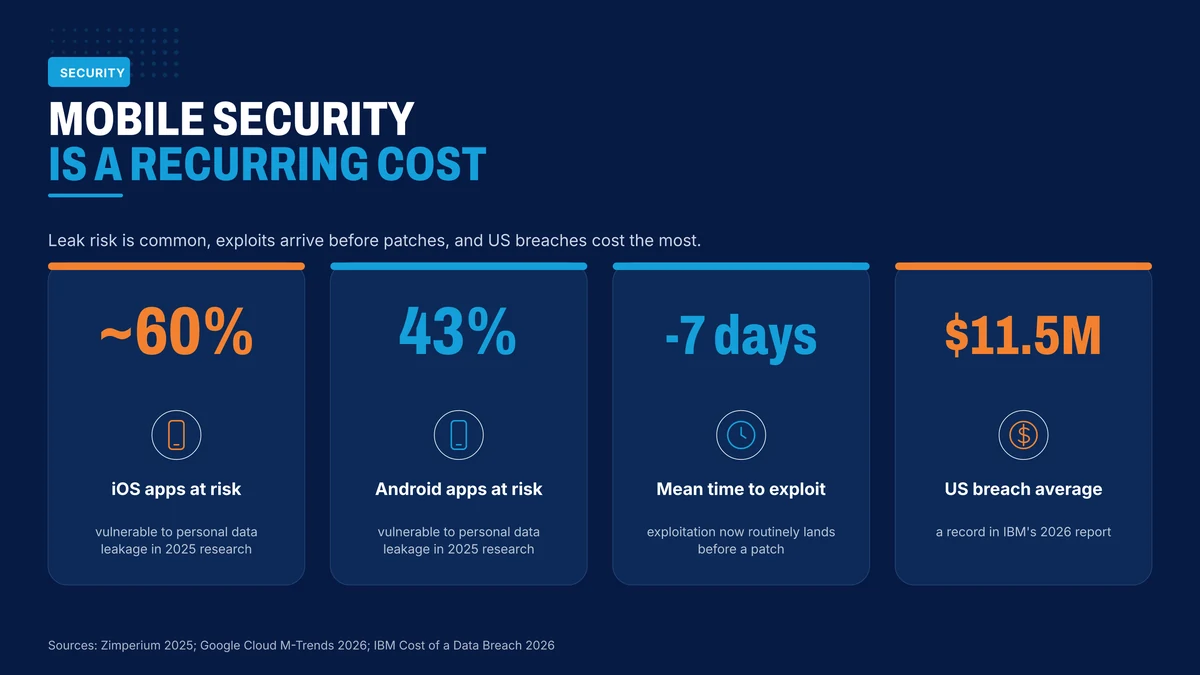
The cost of getting it wrong is not abstract. The average US data breach reached a record USD 11.5 million in IBM’s 2026 report, an 11% rise on the year (IBM Cost of a Data Breach Report 2026). Ask vendors to test against a named mobile standard such as OWASP MASVS, to state their emergency patch window in hours, and to keep dependencies current as a line item.
Accessibility is legal exposure
More than 5,000 digital accessibility lawsuits were filed in 2025, and 1,427 of them targeted companies that had already been sued. In federal court, 46 percent involved repeat defendants, and e-commerce accounted for nearly 70 percent of cases (UsableNet). UsableNet also reports no meaningful drop in lawsuits against sites using accessibility widgets, so an overlay is not a defence.
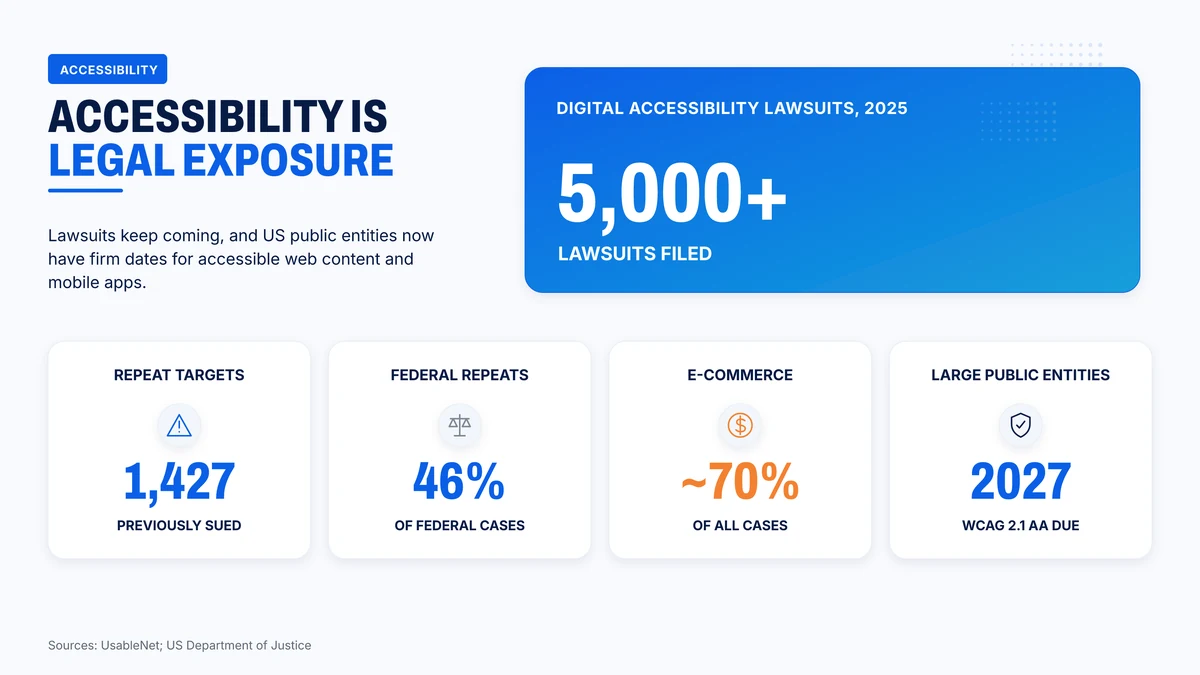
If you build for state or local government, the rule is explicit. The Justice Department’s ADA Title II rule sets WCAG 2.1 Level AA as the standard for government web content and mobile apps, and an interim final rule published on 20 April 2026 moved compliance to 26 April 2027 for entities of 50,000 people or more and 26 April 2028 for smaller ones (US Department of Justice).
Write the standard into the contract rather than the word “accessible”, and ask the vendor to test with VoiceOver on iOS and TalkBack on Android, not only with an automated scanner.
Contract clauses that surface in month nine
These rarely come up in a sales call and often decide the relationship later. This is not legal advice; have your own counsel review any agreement.
IP assignment on payment, not on final acceptance, so a dispute over the last milestone cannot hold the code hostage.
Store account and signing key ownership, stated in the contract, with the agency working inside your accounts.
Transition assistance, a fixed number of hours at an agreed rate if you move to another vendor.
Annual upgrade pricing, so the SDK and target API cycle is a known cost rather than a surprise.
Rate escalation caps for multi-year work, and subcontracting disclosure, so you know where the code is written.
Liability caps and insurance that match the data your app handles, and non-solicitation in both directions.
How to leave without losing the app
Leaving is easier when the accounts were yours from day one. If they were not, the stores have formal transfer processes, and neither moves everything.
On Apple, the current account holder initiates the transfer and the receiving account holder accepts it. TestFlight testing must be turned off and Xcode Cloud data removed first. An Apple Pay Merchant ID has to be created again in the new account, Game Center matchmaking configuration does not transfer, and apps using Sign in with Apple need a transfer identifier for every user (Apple).
On Google Play, the original owner submits the request and the new account approves it. Users, ratings, subscriptions and the store listing move; earnings and payout reports and test groups do not, and support reviews requests within two business days (Google Play Console Help).
Whatever the stores require, trigger your transition hours while relations are still cordial, record walkthroughs of the build and release process, and rotate every credential on the last day.
Hire in-house or hire an agency
The honest comparison starts with the wage. The BLS median for software developers was $135,980 in May 2025 (BLS), before benefits, recruiting and equipment, and one developer cannot cover iOS, Android, backend and design alone.
Hire in-house when the app is the product, you will ship updates every sprint for years, and you can recruit and retain at least a small team. The annual store deadlines are easier to absorb when the people who wrote the code are still there.
Hire an agency when you need a first version quickly, the app supports a business rather than being one, or you need skills you will only use for a few months. Keep the accounts in your name so the choice stays reversible.
Combine the two when you have a product owner and a lead engineer but need capacity. Staff augmentation or a dedicated team adds engineers without handing over control of the roadmap.
FAQ
How much does a US mobile app development company charge per hour?
Among the twenty firms here, 13 publish a band under $100, six publish $150 to $199, and one publishes $100 to $149. The median band midpoint is $74.50 an hour, and the median minimum project is $25,000 (Clutch).
Should I build native or cross-platform?
All twenty firms list React Native, Flutter or both. Cross-platform suits most business apps. Native is worth the second codebase when you rely heavily on device features such as Bluetooth, background location or advanced camera work. Ask a vendor which parts it would still write natively.
Why do Clutch ratings barely vary?
Every firm here rates between 4.7 and 5.0, so the stars cannot separate them. Read the sub-scores instead: Cost is the lowest or joint-lowest for 13 of the 15 firms whose scores differ. Check the date of the newest review, too.
Who should own the App Store and Google Play accounts?
Your organisation. Apple shows the account holder’s organisation name as the app’s seller and requires a D-U-N-S Number to enrol (Apple). The agency should work inside your accounts rather than publish under its own.
What happens if my Android app is not updated for Google Play’s new requirement?
Since 31 August 2026, new apps and updates must target Android 16. Existing apps targeting Android 14 or lower are shown only to devices running that version or older (Google Play Console Help).
Do mobile apps need to meet accessibility standards?
More than 5,000 digital accessibility lawsuits were filed in 2025 (UsableNet). Apps built for state and local government must meet WCAG 2.1 AA under the ADA Title II rule, with compliance dates in 2027 and 2028 (US Department of Justice).
Is a Clutch Verified badge a sign of quality?
It is a sign of identity. Clutch says Verified providers have passed a credit check and had their business entity validated. Nine of the twenty organic top-ranked firms here carry no Verified badge, so the badge and the ranking measure different things.
How do I move my app to a new development company?
Transfer the store listings to accounts you own. Apple requires the current account holder to start the transfer and some items, such as an Apple Pay Merchant ID, to be recreated (Apple). Google Play reviews transfer requests within two business days (Google Play Console Help).
Conclusion
The data behind this Top 20 Mobile App Development Companies in USA list points three ways. The market is split between a large low-rate tier and a smaller studio tier, with almost nothing in between. The reviews behind the stars agree on quality and disagree on cost. And a firm’s rank can rest on reviews that are years old.
Any of the twenty can build the app. What separates a good engagement from a bad one is decided later: whose account publishes it, who prices the yearly store deadlines, and whether you can walk away with everything you paid for.
Sources
- https://clutch.co/us/app-developers?sort_by=ClutchRank
- https://clutch.co/profile/brain-station-23
- https://gs.statcounter.com/os-market-share/mobile/united-states-of-america
- https://developer.apple.com/support/app-store/
- https://developer.apple.com/news/upcoming-requirements/
- https://developer.apple.com/programs/enroll/
- https://developer.apple.com/help/app-store-connect/transfer-an-app/overview-of-app-transfer
- https://support.google.com/googleplay/android-developer/answer/11926878
- https://support.google.com/googleplay/android-developer/answer/6230247
- https://survey.stackoverflow.co/2024/technology
- https://www.bls.gov/ooh/computer-and-information-technology/software-developers.htm
- https://www.payscale.com/research/US/Job=Mobile_Applications_Developer/Salary
- https://www.talent.com/salary?job=mobile+app+developer
- https://www.salary.com/research/salary/listing/mobile-application-developer-salary
- https://www.indeed.com/career/mobile-developer/salaries
- https://zimperium.com/resources/mobile-becomes-the-chosen-attack-vector-for-enterprises-zimperium-researchers-find
- https://cloud.google.com/blog/topics/threat-intelligence/m-trends-2026
- https://www.ibm.com/reports/data-breach
- https://blog.usablenet.com/ada-web-lawsuit-trends-2026
- https://www.ada.gov/resources/2024-03-08-web-rule/
- https://rightpoint.com
- https://eightbitstudios.com
- https://roonyx.tech
- https://surf.dev
- https://michiganlabs.com