
Clutch’s directory of US artificial intelligence companies is mostly advertising at the top.
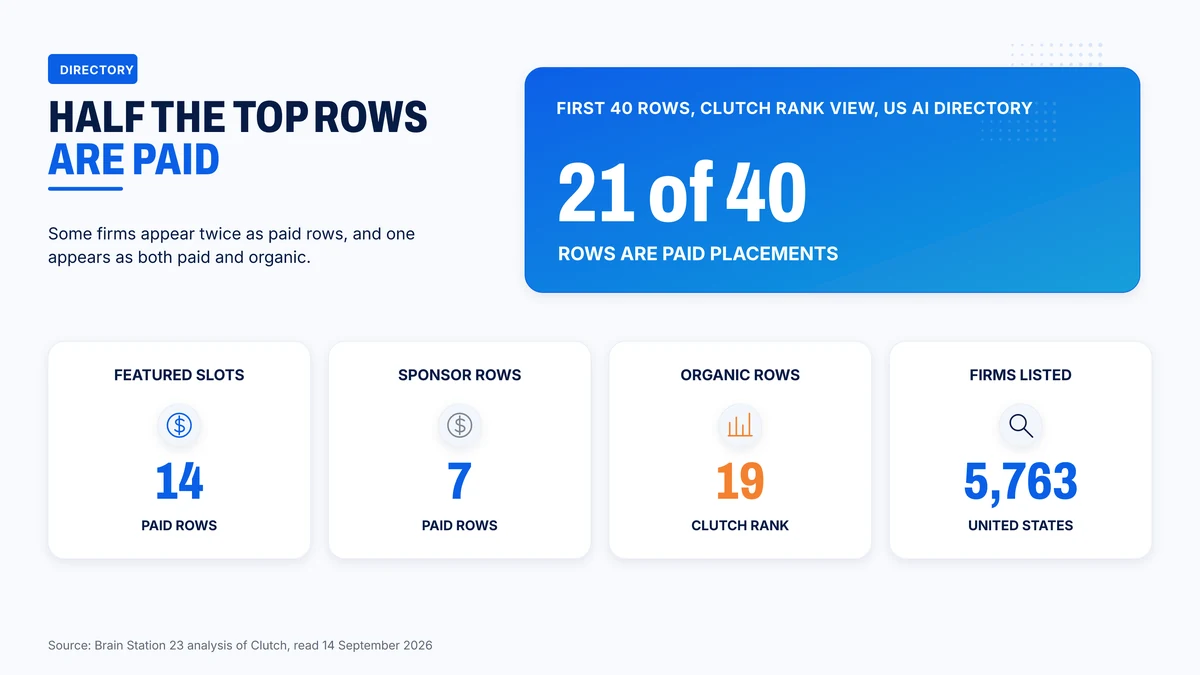
Of the first forty rows in its Clutch Rank view, twenty-one are paid placements: fourteen featured slots and seven sponsor rows, with some firms appearing twice. We read the page on 14 September 2026, set the paid rows aside, and built this Top 20 AI Development Companies in USA list from the organic ranking of 5,763 listed firms.
That matters more for AI than for most categories, because the label is easy to claim. Gartner estimates that only about 130 of the thousands of agentic AI vendors are real, and it expects more than 40% of agentic AI projects to be canceled by the end of 2027.
So we read each firm’s own service split, not its tagline. The guide covers what AI work costs and how to tell a production team from a demo shop. It also covers the questions that decide whether the system is still running in a year: who owns the prompts, the evaluation data and the model keys, what the model provider can retire, and how to leave a vendor without rebuilding the pipeline.
Key takeaways
- 21 of the first 40 rows on Clutch’s US AI directory, in Clutch Rank order, are paid placements (Clutch, read 14 September 2026).
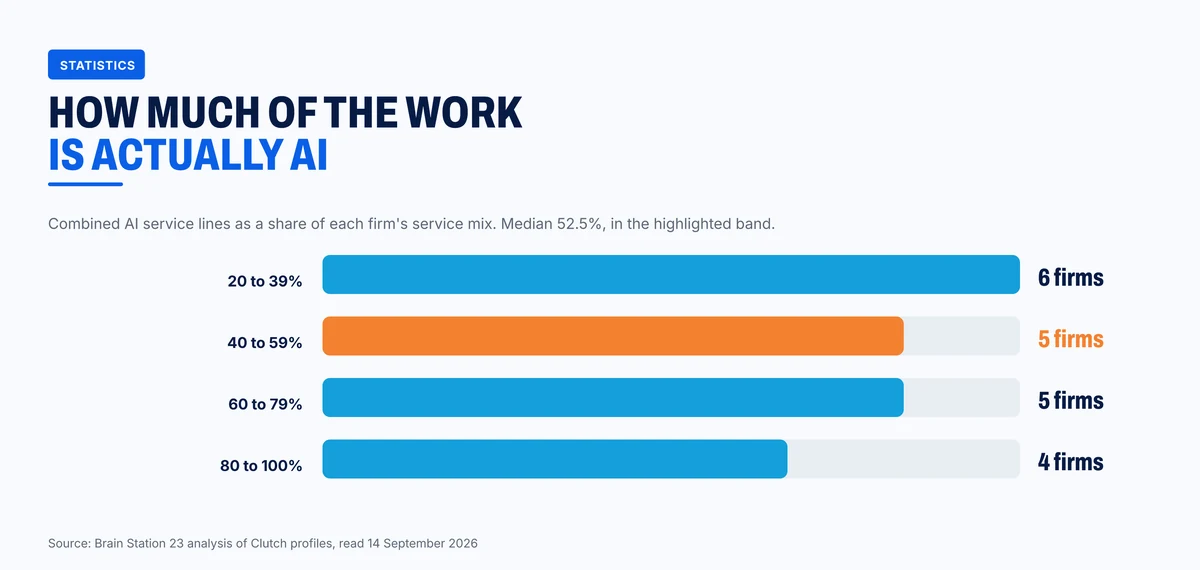
- 52.5% is the median share of AI service lines across the twenty firms’ published service mix; only BotsCrew is AI-only (Brain Station 23 analysis of Clutch profiles).
- 15 of 17 firms whose Clutch sub-scores differ have Cost as their lowest or joint-lowest score (Clutch profiles).
- Over 40% of agentic AI projects will be canceled by the end of 2027, Gartner predicts, citing costs, unclear value or weak risk controls (Gartner).
- 88% of organisations used AI in 2025, and 70% used generative AI in at least one business function (Stanford AI Index 2026).
- $109,924 to $128,769 is what three salary sites report for a US machine learning engineer in 2026 (Salary.com, ZipRecruiter).
- 1 in 4 malicious breaches in IBM’s 2026 study was AI-enabled, costing an average of $6 million (IBM).
- 60 days is the minimum notice Anthropic gives before retiring a public model, after which requests to it fail (Anthropic).
AI in 2026: universal adoption, uneven results
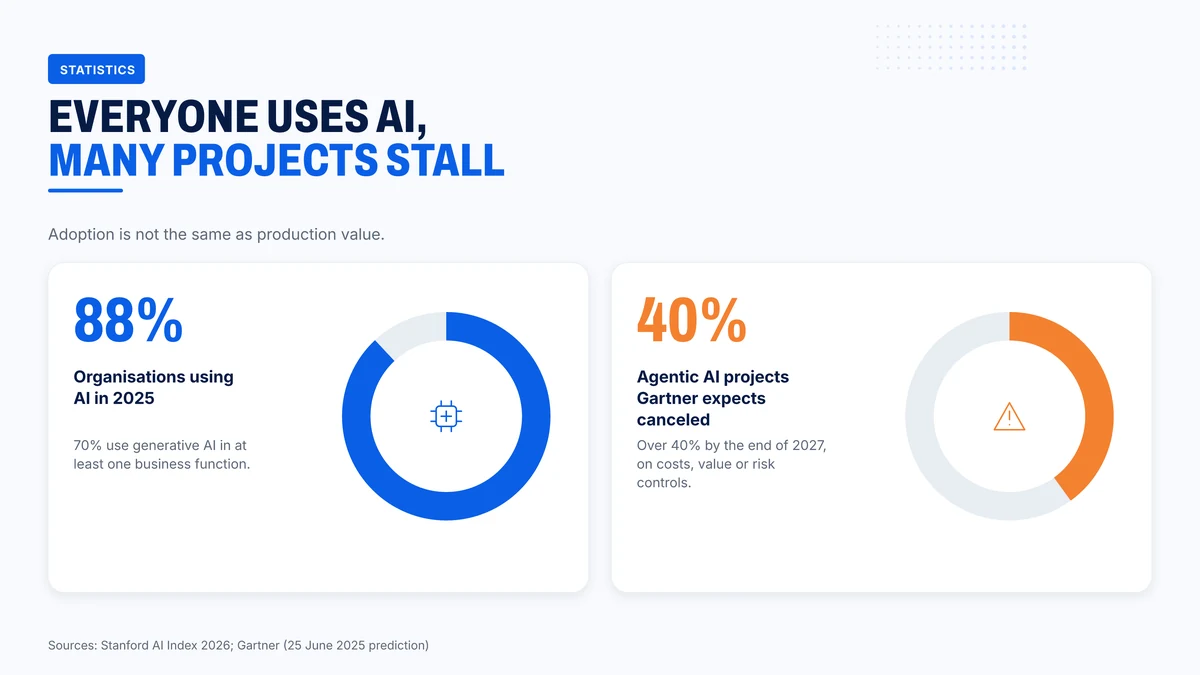
Almost every buyer already uses AI somewhere. The Stanford AI Index 2026 reports that organisational AI adoption rose to 88% of surveyed organisations in 2025, and that generative AI is now used in at least one business function at 70% of them (Stanford AI Index 2026). Private AI investment grew 127.5%, with the United States committing 23 times more than China.
Adoption is not the same as production value. Gartner predicts that over 40% of agentic AI projects will be canceled by the end of 2027 “due to escalating costs, unclear business value or inadequate risk controls” (Gartner). In a Gartner poll of 3,412 webinar attendees, 19% said their organisation had made significant investments in agentic AI and 42% conservative ones.
The same release names the buyer’s problem directly. Many vendors are engaged in “agent washing”, rebranding assistants, robotic process automation and chatbots as agents, and Gartner estimates only about 130 of the thousands of agentic AI vendors are real.
A Gartner prediction is an analyst forecast, not a count of failed projects, so read it as a warning rather than a measurement. The practical point stands: the hard part of AI work is not the demo. It is evaluation, data, integration and the cost of running the system once real users arrive.
What AI development costs in the US
Start with salaries. Salary.com puts a US machine learning engineer at $109,924 as of 1 September 2026, with the middle half earning $101,117 to $119,266 (Salary.com). PayScale reports an average base of $125,537 across 1,061 profiles (PayScale, updated 6 June 2026). ZipRecruiter reports $128,769 as of 14 September 2026 (ZipRecruiter).
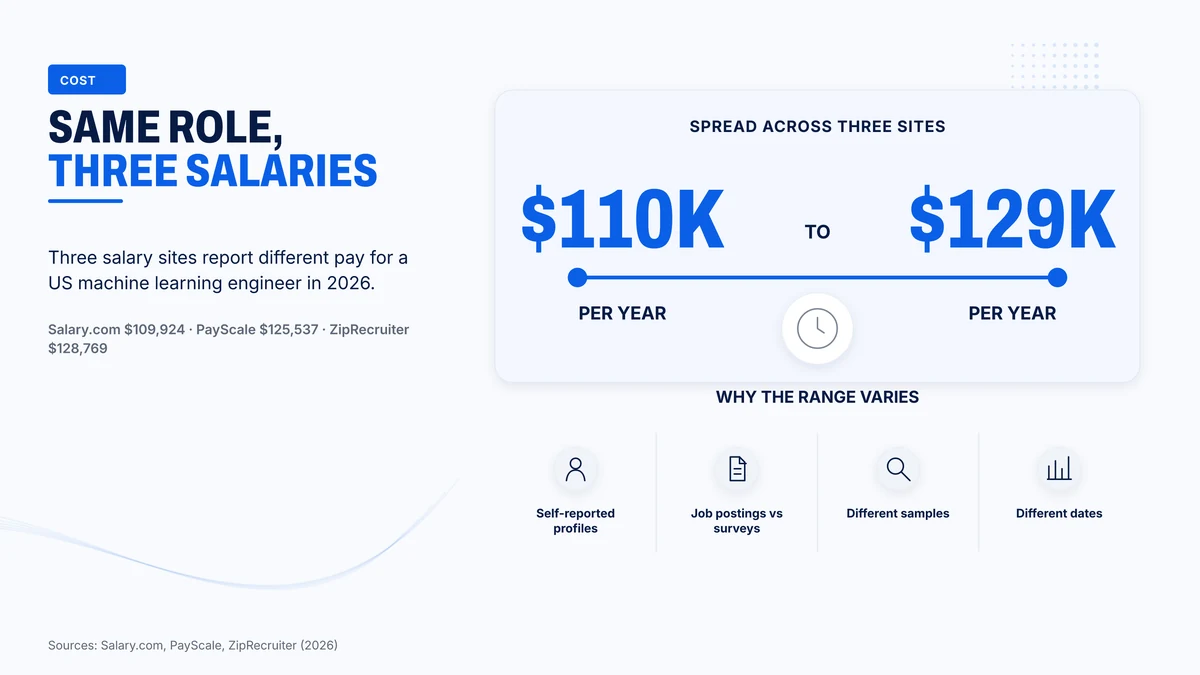
That is an $18,845 spread, and each site uses a different sample, method and date. The Bureau of Labor Statistics does not track machine learning engineers separately, but its median for computer and information research scientists was $140,300 in May 2025, with employment projected to grow 22% from 2025 to 2035 (BLS).
Salary is only part of an AI budget. Unlike most software, an AI system keeps costing money every time someone uses it. Eight factors move most quotes.
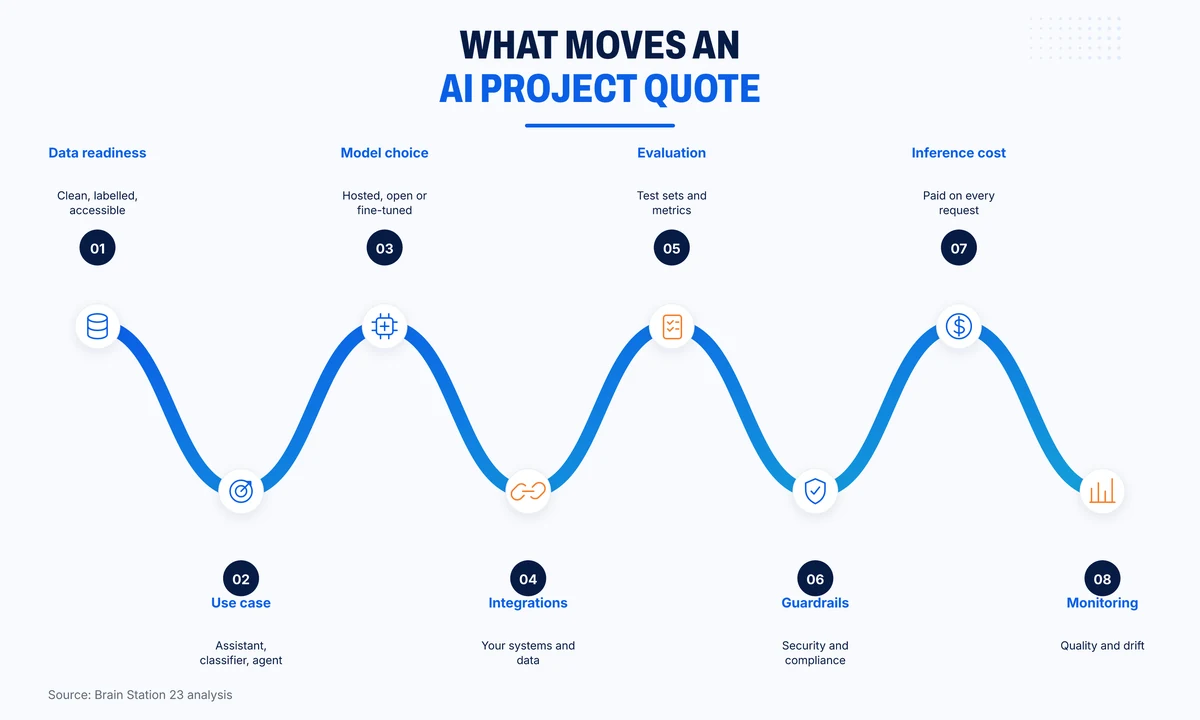
Data readiness comes first, because cleaning, labelling and connecting data can take a large share of the effort. The use case follows: a retrieval assistant, a classifier and an autonomous agent are different jobs. Model choice, integrations with your systems, evaluation and testing, guardrails and compliance, usage-based inference costs and ongoing monitoring finish the list. Ask each vendor to price build and run separately, and to estimate the monthly inference bill at your expected volume.
The Top 20 AI Development Companies in USA, compared
Firms 2 to 21 below are the top 20 organic firms by Clutch Rank on Clutch’s US artificial intelligence directory, read on 14 September 2026. The page interleaves featured and sponsor placements with the organic ranking. We removed every paid row, and kept a firm when it also held its own organic position, as BlueLabel does. Clutch describes Clutch Rank as its organic ranking based on reviews, awards and past work.
Brain Station 23 is placed first because we publish this article. We are US-headquartered and Premier Verified on Clutch, but AI development is 5 percent of our published service mix, so the directory’s ranking did not place us in its top 20 and we are not claiming it did.
Overall ratings below run from 4.7 to 5.0, so the stars cannot separate these firms. The columns are decision columns instead.
| # | Company | Best For | Team Size | AI Focus | Key AI Capabilities | Industries Served | Locations |
|---|---|---|---|---|---|---|---|
| 1 | Brain Station 23 — brainstation-23.com | Adding cost-controlled engineers to an AI programme you already lead | 250 – 999 | 5% AI development; staff augmentation 60% | Custom software, data and backend engineering, AI features in existing products | Retail, medical, telecoms, education, financial services | Springfield VA; Bangladesh, UAE, England, Malaysia, Germany |
| 2 | Dualboot Partners — dualbootpartners.com | Mid-market companies with $200,000-plus AI and platform programmes | 250 – 999 | 35% | Machine learning, chatbots, NLP, AI consulting | Financial services, manufacturing, medical, arts and entertainment | Charlotte NC; Montevideo |
| 3 | BlueLabel — bluelabellabs.com | Enterprises commissioning generative AI products with design included | 50 – 249 | 70% | Generative AI, conversational AI, cognitive computing | Business services, consumer products, education, energy | New York, Redmond WA |
| 4 | Vention — ventionteams.com | Enterprises adding AI engineers across a mixed software estate | 1,000 – 9,999 | 20% | Computer vision, machine learning, recommendation systems | Advertising, education, financial services, food, IT | New York; London, Vienna, Vilnius, Berlin |
| 5 | Scopic — scopicsoftware.com | Medical and manufacturing products adding AI features | 250 – 999 | 30% | Chatbots, machine learning, NLP, speech | Medical, automotive, manufacturing, education | Marlborough MA |
| 6 | SOLTECH — soltech.net | Mid-market firms wanting AI agents alongside custom software and CRM | 50 – 249 | 55% | AI consulting, AI agents, custom software, CRM integration | Medical, automotive, business services, financial services | Atlanta, Key Largo FL |
| 7 | BotsCrew — botscrew.com | Enterprises focused on conversational AI and assistants | 50 – 249 | 100% | Chatbots, NLP, voice, machine learning, generative AI | Automotive, medical, e-commerce, hospitality | San Francisco; Lviv |
| 8 | HatchWorks AI — hatchworks.com | Healthcare and fintech firms with large AI and data programmes | 250 – 999 | 90% | Machine learning, conversational AI, NLP, generative AI | Medical, financial services, telecoms, gaming | Atlanta, Chicago; Costa Rica, Colombia |
| 9 | MMC Global — mmcgbl.com | Real estate and hospitality firms mixing AI, blockchain and apps | 250 – 999 | 30% | Generative AI, chatbots, voice, NLP | Real estate, education, hospitality, automotive | Austin; Dubai, Abu Dhabi |
| 10 | AE Studio — ae.studio | Buyers wanting research-grade AI teams for production systems | 50 – 249 | 80% | Machine learning, cognitive computing, NLP, AI consulting | IT, business services, arts and entertainment, consumer products | Marina del Rey CA |
| 11 | Gigster — gigster.com | Enterprises buying AI-assisted builds on a large budget | 250 – 999 | 35% | Machine learning, NLP, chatbots, app modernisation | Automotive, consumer products, education, financial services | Austin |
| 12 | SEROKELL — serokell.io | Technical teams needing AI infrastructure and research-heavy engineering | 50 – 249 | 50% | Machine learning, AI agents, computer vision, blockchain | Medical, automotive, dental, education | Paris, Los Angeles, Tel Aviv, New York, Austin |
| 13 | Orases — orases.com | Mid-market organisations with $200,000-plus AI and software builds | 50 – 249 | 40% | AI consulting, recommendation systems, chatbots, NLP, voice | Manufacturing, nonprofit, retail, logistics | Frederick MD, Washington DC |
| 14 | Turing — turing.com | Enterprises sourcing generative AI teams and modernisation at scale | 250 – 999 | 55% | Generative AI, computer vision, NLP, staff augmentation | IT, consumer products, food and beverage, medical | Palo Alto; Bengaluru |
| 15 | Biz4Group — biz4group.com | Small and mid-sized firms wanting AI chat and apps at mid-market rates | 250 – 999 | 60% | AI development, chatbots, voice, computer vision | Legal, medical, real estate, retail | Orlando |
| 16 | Liquid Technologies — liqteq.com | Manufacturers and retailers automating operations at the lowest band | 50 – 249 | 70% | AI agents, generative AI, chatbots, machine learning | Manufacturing, e-commerce, energy, retail | Houston; Dubai |
| 17 | GoGloby — gogloby.com | Software companies embedding AI engineers into their teams | 10 – 49 | 80% | AI development, staff augmentation, conversational AI | IT, advertising, financial services, medical | Needham MA; Bahia Blanca |
| 18 | DOOR3 — door3.com | Enterprises wanting AI strategy with UX and custom software | 50 – 249 | 34% | AI consulting, UX design, custom software, speech | Arts and entertainment, business services, education, financial services | New York; Barcelona |
| 19 | KitelyTech — kitelytech.com | Automotive and commerce firms wanting AI products from a US team | 50 – 249 | 70% | Generative AI, AI agents, recommendation systems, robotics | Automotive, e-commerce, financial services, government | Chicago, Detroit, Austin, New York, Miami |
| 20 | Frogslayer — frogslayer.com | Texas mid-market firms automating operations with AI | 50 – 249 | 60% | AI consulting, automation, machine learning, NLP | Education, energy, financial services, food and beverage | College Station TX |
| 21 | Forte Group — fortegrp.com | Enterprises with $1 million-plus AI-first product programmes | 250 – 999 | 45% | AI development, AI consulting, custom software, staff augmentation | Financial services, e-commerce, business services, IT | Chicago; Bogota, Ternopil |
Team sizes, AI focus (the combined share of AI development, AI consulting, generative AI and AI agent service lines in each firm’s published service mix), capabilities, industries and locations are from each firm’s published Clutch profile, read 14 September 2026. “Best For” is our reading of that data. Engagement models and certifications are not published consistently across these profiles, so we have left them out rather than guess.
Profiles are grouped by the kind of buyer each firm suits, and the numbers match the table. Each caution comes from the Review Highlights Clutch publishes from that firm’s verified reviews, where one exists. Certifications are self-published and unverified by us, and Clutch profiles do not carry ISO or CMMI certifications, which is why the profiles say to ask.
1. Brain Station 23
We publish this article and put ourselves first, so read this as the publisher’s pick, not a ranking. The honest gap is specialism. AI development is 5 percent of our published Clutch service mix, against a 52.5 percent median AI share for the twenty firms below, because most of what we sell is engineers embedded in client teams. We do not claim AI research depth. Our $25 to $49 band is the lowest published on this page, shared only with Liquid Technologies. Our ISO 27001 and SOC 2 Type II controls apply to the data handling and security risks covered later. Our 21 reviews score Quality at 5.0 and Cost at 4.9, and reviewers have asked for better internal coordination. If you need an AI research team, call one of the firms below.
Founded: 2006
US Presence: Springfield VA
Company size: Clutch band 250 to 999; we publish 900+ engineers
- Adding cost-controlled engineers to an AI programme you already lead
- CMMI Level 3
- ISO 27001
- ISO 9001
- SOC 2 Type II (company-published)
- Staff augmentation
- AI features in existing products
- Data and backend engineering
- Custom software
- Enterprise app modernisation
- Dedicated teams
- Retail
- Medical
- Telecoms
- Education
- Financial services
- Hospitality
- Ask which engineers on the proposed team have put a model-backed feature into production, and how it is evaluated
For AI-first specialists
3. BlueLabel
AI consulting, generative AI and AI development make up 70 percent of BlueLabel’s services, and conversational AI is 45 percent of its AI expertise. Enterprises are 60 percent of its clients, and it publishes a $75,000 minimum. It also buys a featured placement on this directory while holding its own organic rank. Its 4.7 rating is the lowest here, with Cost at 4.5. Clutch’s caution is timelines, with some projects delayed. It suits enterprises wanting a designed generative AI product and a firm schedule.
Founded: 2009
US Presence: New York, Redmond WA
Company size: 50 to 249
- Enterprises commissioning generative AI products with design included
- Not published; ask directly
- AI consulting
- Generative AI
- AI development
- Conversational AI
- Mobile apps
- Product and web design
- Business services
- Consumer products
- Education
- Energy
- Financial services
- Ask for a timeline with named dependencies and weekly progress against it
7. BotsCrew
BotsCrew is the only firm here whose entire service mix is AI: consulting, development and generative AI at roughly a third each. Conversational AI, machine learning and NLP lead its expertise, and enterprise and mid-market clients make up all of its base. It lists San Francisco with an office in Lviv, and bills $50 to $99 an hour. Clutch’s caution is scope, with early misunderstandings leading to later adjustments. It suits enterprises building assistants who can define the use case tightly.
Founded: 2016
US Presence: San Francisco
Company size: 50 to 249
- Enterprises focused on conversational AI and assistants
- Not published; ask directly
- AI consulting
- AI development
- Generative AI
- Chatbots and conversational AI
- NLP
- Voice and speech recognition
- Automotive
- Medical
- E-commerce
- Hospitality
- Manufacturing
- Agree a written scope and acceptance criteria before development starts
8. HatchWorks AI
AI consulting and development together make up 80 percent of HatchWorks AI’s services, and medical is 40 percent of its industries. The most common project in its reviews is $200,000 to $999,999, and it bills $50 to $99 an hour from Atlanta and Chicago with offices in Costa Rica and Colombia. Its 29 reviews rate 4.9. Clutch’s one improvement area is documentation. It suits healthcare and fintech buyers running a sizeable programme who will specify handover documents.
Founded: 2016
US Presence: Atlanta, Chicago
Company size: 250 to 999
- Healthcare and fintech firms with large AI and data programmes
- Not published; ask directly
- AI consulting
- AI development
- Generative AI
- Machine learning
- Conversational AI
- Custom software
- Medical
- Financial services
- Telecoms
- Gaming
- Retail
- Specify the documentation and runbooks you expect at each milestone
10. AE Studio
AE Studio’s profile describes alignment research and production AI work under one roof, and AI lines make up 80 percent of its services. It does not publish an hourly rate. Its 24 reviews rate 5.0, with Cost at 4.7. Clutch’s caution is the design process, which some clients felt could be more structured. It suits technical buyers who want a research-minded team on a hard AI problem, and who will set design expectations themselves.
Founded: 2016
US Presence: Marina del Rey CA
Company size: 50 to 249
- Buyers wanting research-grade AI teams for production systems
- Not published; ask directly
- AI consulting
- AI development
- Generative AI
- Machine learning
- NLP
- Custom software
- IT
- Business services
- Arts and entertainment
- Consumer products
- Agree how design work and user research fit into the delivery plan
17. GoGloby
GoGloby is the youngest and smallest firm here. AI development is 70 percent of its services and staff augmentation 20 percent, and IT companies are 70 percent of its industries. It does not publish an hourly rate and lists a $5,000 minimum. It has 10 reviews rated 4.9, and Clutch names no improvement area. It lists Massachusetts with an office in Argentina. It suits software companies adding AI engineers to an existing team, provided they check references.
Founded: 2021
US Presence: Needham MA
Company size: 10 to 49
- Software companies embedding AI engineers into their teams
- Not published; ask directly
- AI development
- AI engineering staff augmentation
- AI consulting
- Conversational AI
- Speech recognition
- IT
- Advertising
- Financial services
- Medical
- Ask for references from recent clients, because the review sample is small
For enterprise programmes and large budgets
2. Dualboot Partners
Dualboot Partners ranks first organically on this directory. AI consulting and development make up 35 percent of its services, alongside a long list of platform and managed services. It publishes a $75,000 minimum, does not publish a rate, and the most common project in its reviews is $200,000 to $999,999. Its 56 reviews rate 4.9. Clutch’s caution is timeline estimation. It suits mid-market companies that want AI delivered as part of a wider platform programme.
Founded: 2018
US Presence: Charlotte NC
Company size: 250 to 999
- Mid-market companies with $200,000-plus AI and platform programmes
- Not published; ask directly
- AI consulting
- AI development
- Machine learning
- Chatbots
- Custom software
- DevOps and cybersecurity
- Financial services
- Manufacturing
- Medical
- Arts and entertainment
- Ask for a timeline estimate with stated assumptions, and revisit it after discovery
11. Gigster
Gigster ranks on two Clutch reviews, the fewest here, and publishes the highest band at $300 or more an hour, with a $50,000 minimum. Its profile describes an AI-first engineering method, and AI development is 35 percent of its services, with machine learning leading its expertise. Its profile shows no review summary. It suits enterprises with a large budget and their own procurement diligence, not buyers who need a public track record to decide.
Founded: 2014
US Presence: Austin
Company size: 250 to 999
- Enterprises buying AI-assisted builds on a large budget
- Not published; ask directly
- AI development
- Machine learning
- NLP
- Custom software
- Enterprise app modernisation
- Mobile apps
- Automotive
- Consumer products
- Education
- Financial services
- Government
- Ask for enterprise references, because the Clutch sample is two reviews
13. Orases
Orases has 74 reviews rated 5.0, and the most common project among them is $200,000 to $999,999. Its services split evenly across AI consulting, AI development, custom software, mobile and web. It bills $150 to $199 an hour with a $75,000 minimum, from Maryland and Washington DC. Clutch’s caution is initial scoping, where requirements were not fully captured. It suits mid-market organisations wanting AI inside a larger custom build, with the budget for proper discovery.
Founded: 2000
US Presence: Frederick MD, Washington DC
Company size: 50 to 249
- Mid-market organisations with $200,000-plus AI and software builds
- Not published; ask directly
- AI consulting
- AI development
- Recommendation systems
- Chatbots
- Voice
- Custom web and mobile software
- Manufacturing
- Nonprofit
- Retail
- Supply chain and logistics
- Invest in a paid requirements phase and sign off the captured scope
14. Turing
Turing’s profile describes an AGI infrastructure company, and generative AI is 35 percent of its services. Enterprises are 60 percent of its clients, and it bills $50 to $99 an hour with a $50,000 minimum, from Palo Alto and Bengaluru. It holds its rank on four reviews. Clutch’s summary credits value for cost and names no improvement area. It is also one of two firms here where Cost is not the lowest sub-score. It suits enterprises sourcing generative AI capacity who will verify delivery themselves.
Founded: 2018
US Presence: Palo Alto
Company size: 250 to 999
- Enterprises sourcing generative AI teams and modernisation at scale
- Not published; ask directly
- Generative AI
- AI consulting
- AI development
- Enterprise app modernisation
- Staff augmentation
- Low-code builds
- IT
- Consumer products
- Food and beverage
- Medical
- Ask for enterprise references, because the Clutch sample is four reviews
20. Frogslayer
Frogslayer describes itself as the AI and automation partner for mid-market businesses in Texas, and mid-market clients are 90 percent of its base. AI consulting and development make up 60 percent of its services. The most common project in its reviews is over $1,000,000, though it lists a $5,000 minimum and does not publish a rate. Its Cost sub-score is 4.6. Clutch’s caution is requirement definition upfront. It suits Texas mid-market firms planning a substantial automation programme.
Founded: 2005
US Presence: College Station TX
Company size: 50 to 249
- Texas mid-market firms automating operations with AI
- Not published; ask directly
- AI consulting
- AI development
- Automation
- Machine learning
- NLP
- App modernisation
- Education
- Energy
- Financial services
- Food and beverage
- Hospitality
- Define requirements in writing before estimating, and review them after discovery
21. Forte Group
Forte Group describes itself as an AI-first product development partner for enterprises, and AI development is 35 percent of its services. The most common project in its reviews is over $1,000,000. It bills $50 to $99 an hour with a $50,000 minimum, from Chicago with offices in Colombia and Ukraine. It holds a 4.9 rating across 20 reviews, but its profile page showed no review summary or sub-scores when we read it. It suits enterprises running large AI product programmes.
Founded: 2000
US Presence: Chicago
Company size: 250 to 999
- Enterprises with $1 million-plus AI-first product programmes
- Not published; ask directly
- AI development
- AI consulting
- Custom software
- IT managed services
- Staff augmentation
- Web design
- Financial services
- E-commerce
- Business services
- IT
- Legal
- Ask for two recent client references, since the profile shows no review summary
For AI inside custom software and product builds
4. Vention
Vention has the most Clutch reviews on this list, 102, and AI development is its largest service line at 20 percent, the lowest AI share here. Computer vision and machine learning lead its AI expertise. Its profile claims more than 3,000 developers, with a $50,000 minimum. Clutch’s summary flags early friction in matching the right skills for some clients. It suits enterprises adding AI capacity inside a broad software programme, not buyers wanting an AI specialist.
Founded: 2002
US Presence: New York
Company size: 1,000 to 9,999
- Enterprises adding AI engineers across a mixed software estate
- Not published; ask directly
- AI development
- Computer vision
- Machine learning
- Recommendation systems
- Enterprise app modernisation
- Staff augmentation
- Advertising
- Education
- Financial services
- Food and beverage
- IT
- Interview the proposed AI engineers yourself before the start date
5. Scopic
AI development is 30 percent of Scopic’s services, level with custom software, and medical is 40 percent of its industries. It bills $50 to $99 an hour with a $10,000 minimum. Its 69 reviews rate 4.8, and it is one of two firms here where Cost is not the lowest sub-score; Schedule is. Clutch’s summary reports mixed experiences on budget, with some projects running over. It suits small and mid-sized medical and industrial firms adding AI features to an existing product.
Founded: 2006
US Presence: Marlborough MA
Company size: 250 to 999
- Medical and manufacturing products adding AI features
- Not published; ask directly
- AI development
- Chatbots
- Machine learning
- NLP
- Speech recognition
- Custom web and mobile software
- Medical
- Automotive
- Manufacturing
- Education
- Media
- Ask for a monthly budget review against the original estimate
6. SOLTECH
SOLTECH is the oldest firm on this list, and AI consulting, development and agents make up 55 percent of its services, with a CRM integration line alongside. It bills $150 to $199 an hour from Atlanta. Its 56 reviews rate 4.9, with Cost at 4.6. Clutch’s summary credits on-time, on-budget delivery and notes that some clients wanted stronger project management personnel. It suits mid-market firms connecting AI agents to existing business systems.
Founded: 1998
US Presence: Atlanta, Key Largo FL
Company size: 50 to 249
- Mid-market firms wanting AI agents alongside custom software and CRM
- Not published; ask directly
- AI consulting
- AI development
- AI agents
- Custom software
- CRM consulting and integration
- Mobile apps
- Medical
- Automotive
- Business services
- Financial services
- IT
- Meet the proposed project manager before signing
18. DOOR3
DOOR3 describes itself as a software and AI consultancy, and its services split in thirds between AI consulting, custom software and UX design. It does not list an AI development line. It bills $100 to $149 an hour from New York, with an office in Barcelona. Its 47 reviews rate 4.9. Clutch’s caution is attention to detail, with occasional minor oversights such as spelling. It suits enterprises that want AI strategy and user experience from one consultancy.
Founded: 2002
US Presence: New York
Company size: 50 to 249
- Enterprises wanting AI strategy with UX and custom software
- Not published; ask directly
- AI consulting
- Custom software
- UX and UI design
- Conversational AI
- NLP
- Speech recognition
- Arts and entertainment
- Business services
- Education
- Financial services
- Build a review step for content and small details into each deliverable
19. KitelyTech
KitelyTech publishes the second-highest band here at $200 to $300 an hour, and AI lines make up 70 percent of its services, spread across consulting, development, generative AI and agents. Automotive is 25 percent of its industries, and its locations are all in US cities. Its 23 reviews rate 4.9. Clutch’s caution is communication frequency. It suits automotive and commerce buyers who want an AI product team working in US time zones and can pay senior rates.
Founded: 2009
US Presence: Chicago, Detroit, Austin, New York, Miami
Company size: 50 to 249
- Automotive and commerce firms wanting AI products from a US team
- Not published; ask directly
- AI consulting
- AI development
- Generative AI
- AI agents
- Recommendation systems
- Custom software
- Automotive
- E-commerce
- Financial services
- Government
- IT
- Agree the frequency and format of status updates before kickoff
For lower rates and specialised engineering
9. MMC Global
MMC Global splits its services between blockchain, custom software, generative AI and mobile at 20 percent each, with AI development at 10. Real estate leads its industries. It bills $50 to $99 an hour from Austin, with offices in Dubai and Abu Dhabi. Its 34 reviews rate 5.0. Clutch notes minor challenges adapting some advanced settings to clients’ internal processes. It suits real estate and hospitality firms wanting AI alongside apps or blockchain, not a pure AI programme.
Founded: 2013
US Presence: Austin
Company size: 250 to 999
- Real estate and hospitality firms mixing AI, blockchain and apps
- Not published; ask directly
- Generative AI
- AI development
- Chatbots
- Voice
- Blockchain
- Mobile apps
- Real estate
- Education
- Hospitality
- Automotive
- Financial services
- Plan a short adoption period for configuring the system to your internal processes
12. SEROKELL
SEROKELL’s profile centres on work where failure is expensive, including inference infrastructure, and AI lines make up 50 percent of its services, with blockchain at 20. It appears on the US directory but lists Paris first, alongside Los Angeles, Tel Aviv and New York. It bills $50 to $99 an hour. Its 34 reviews rate 4.9. Clutch’s caution is initial scoping and planning. It suits technical teams with a demanding infrastructure problem who can define the target clearly.
Founded: 2015
US Presence: Paris, Los Angeles, Tel Aviv, New York, Austin
Company size: 50 to 249
- Technical teams needing AI infrastructure and research-heavy engineering
- Not published; ask directly
- AI development
- AI agents
- AI consulting
- Machine learning
- Computer vision
- Blockchain
- Medical
- Automotive
- Dental
- Education
- Financial services
- Align on scope and success measures before the planning phase closes
15. Biz4Group
AI development is half of Biz4Group’s services, the highest single AI line here after GoGloby, and conversational AI leads its expertise. Legal, medical, real estate and retail each take 15 percent of its industries. It bills $50 to $99 an hour from Orlando, and its sub-scores are 5.0 across the board. Clutch’s caution is post-launch support, with some clients wanting more guidance on maintaining the system. It suits smaller firms launching a first AI assistant who will contract for support.
Founded: 2003
US Presence: Orlando
Company size: 250 to 999
- Small and mid-sized firms wanting AI chat and apps at mid-market rates
- Not published; ask directly
- AI development
- Generative AI
- Chatbots
- Voice
- Computer vision
- Mobile and web apps
- Legal
- Medical
- Real estate
- Retail
- Business services
- Write post-launch support and training into the contract
16. Liquid Technologies
Liquid Technologies publishes the lowest band on this list, $25 to $49 an hour, and AI lines make up 70 percent of its services. Its profile describes automating enterprise operations with AI, custom software and data engineering, and manufacturing and e-commerce lead its industries. It lists Houston with an office in Dubai. Its 18 reviews rate 4.9. Clutch’s caution is communication timing, with clients wanting earlier notice of changes. It suits operations-heavy firms on a budget.
Founded: 2017
US Presence: Houston
Company size: 50 to 249
- Manufacturers and retailers automating operations at the lowest band
- Not published; ask directly
- AI development
- AI consulting
- AI agents
- Generative AI
- Machine learning
- Data engineering
- Manufacturing
- E-commerce
- Energy
- Retail
- Financial services
- Agree an update schedule and early warning for changes to scope or dates
What we found in the top 20
We tallied the published data behind all twenty profiles. None of it is a ranking. It shows what normal looks like, so you can spot a quote that is out of line.
The directory is half advertising at the top. Twenty-one of the first forty rows are paid, and paid rows repeat: Azumo and Sketch Development each appear twice as paid placements, and BlueLabel appears as both a paid and an organic row (Clutch, read 14 September 2026).
AI focus varies from a fifth to all of the business. The combined share of AI service lines runs from 20 to 100 percent, with a median of 52.5 percent. BotsCrew is AI-only, and HatchWorks AI is at 90 percent. Six firms put AI below 40 percent, including Vention at 20 (Brain Station 23 analysis of Clutch profiles). A place on this Top 20 AI Development Companies in USA list says little on its own about how much of a firm’s work is AI.
Projects run large, and rates are often hidden. Five firms’ most common review project is $200,000 or more, and two, Frogslayer and Forte Group, report over $1,000,000. Four firms do not publish an hourly rate. Of those that do, nine publish $50 to $99, and bands run from $25 to $49 at Liquid Technologies to $300 or more at Gigster. The median minimum is $25,000.
Cost is the weak score. Overall ratings run from 4.7 to 5.0. Forte Group’s profile showed no sub-scores, and Gigster and Biz4Group score identically across all four. Of the other seventeen, Cost is the lowest or joint-lowest for fifteen.
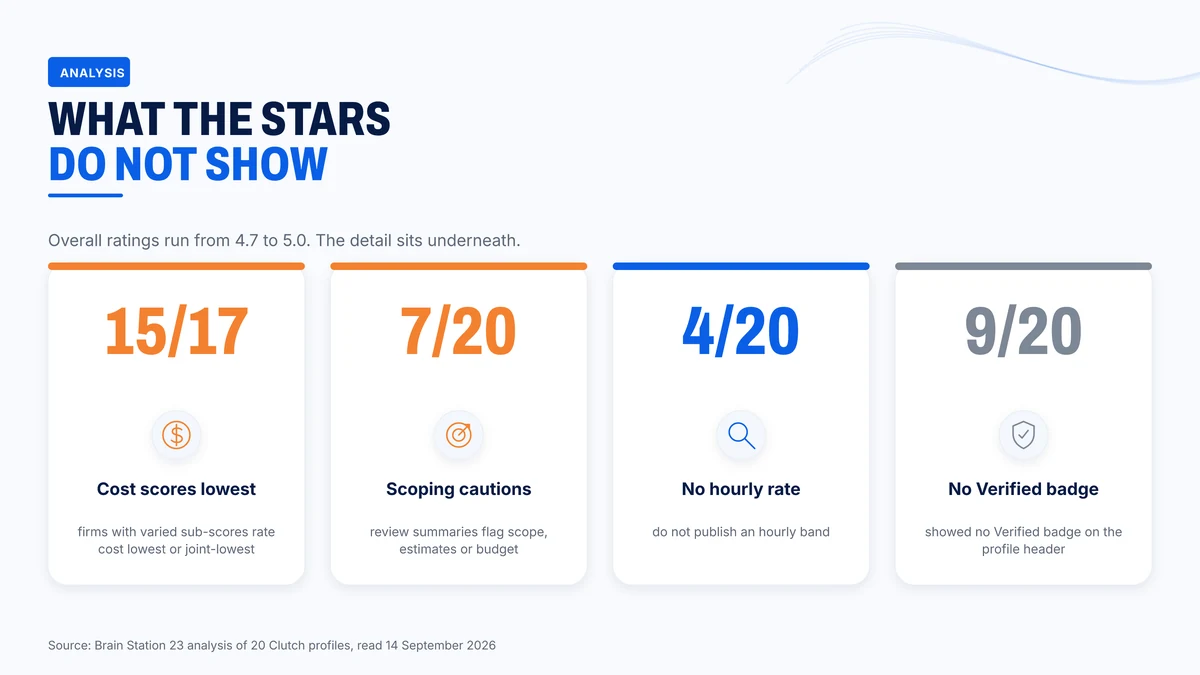
Scoping is the recurring complaint. For seven firms, Clutch’s review summary flags scoping, requirements, estimates or budget. Three are flagged on communication and three on documentation, detail or design. Four have no improvement area, three of them on small review samples.
Some rankings rest on very few reviews. Gigster ranks on two reviews and Turing on four. Nine of the twenty showed no Verified badge on their profile header, and eleven list a location outside the US.
Model splits say little. Clutch’s AI model categories still include options such as GPT-3 and DALL-E 2, so a firm’s published model split is a weak guide to the models it uses today. Ask directly.
How to shortlist an AI development company
Start with the filter that removes the most firms, and save the long calls for the few that remain.
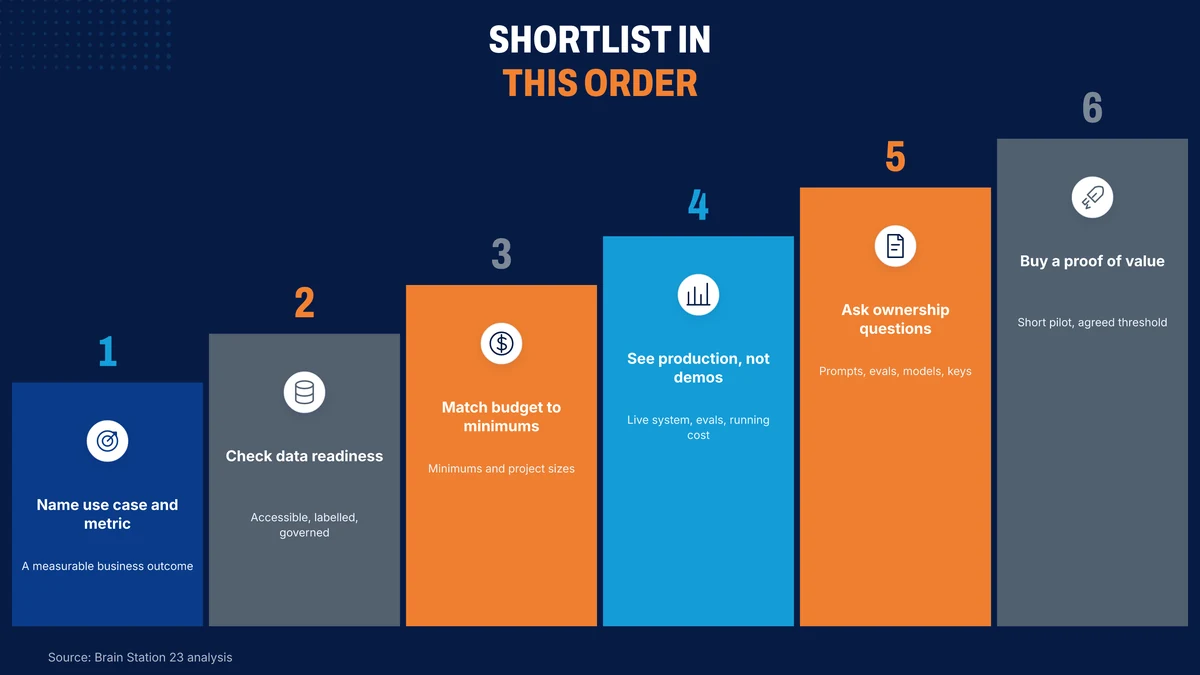
Step 1: Name the use case and the metric. “Reduce claim handling time by 30 percent” filters vendors better than “add AI”.
Step 2: Check data readiness. If your data is not accessible or labelled, shortlist firms with data engineering in their service mix.
Step 3: Match budget to minimums and typical project size. A $40,000 budget rules out the seven firms with minimums of $50,000 or more.
Step 4: Ask for a production system, not a demo. Ask to see an AI feature in live use, with its evaluation results and monthly running cost.
Step 5: Ask the ownership questions. Who owns the prompts, evaluation sets, fine-tuned models and model provider accounts?
Step 6: Buy a paid proof of value. Fund a short, measured pilot with a go or no-go threshold agreed in advance.
How to buy AI development: four engagement models
The engagement model decides who pays when the scope moves, and in AI work the scope moves when the data does.
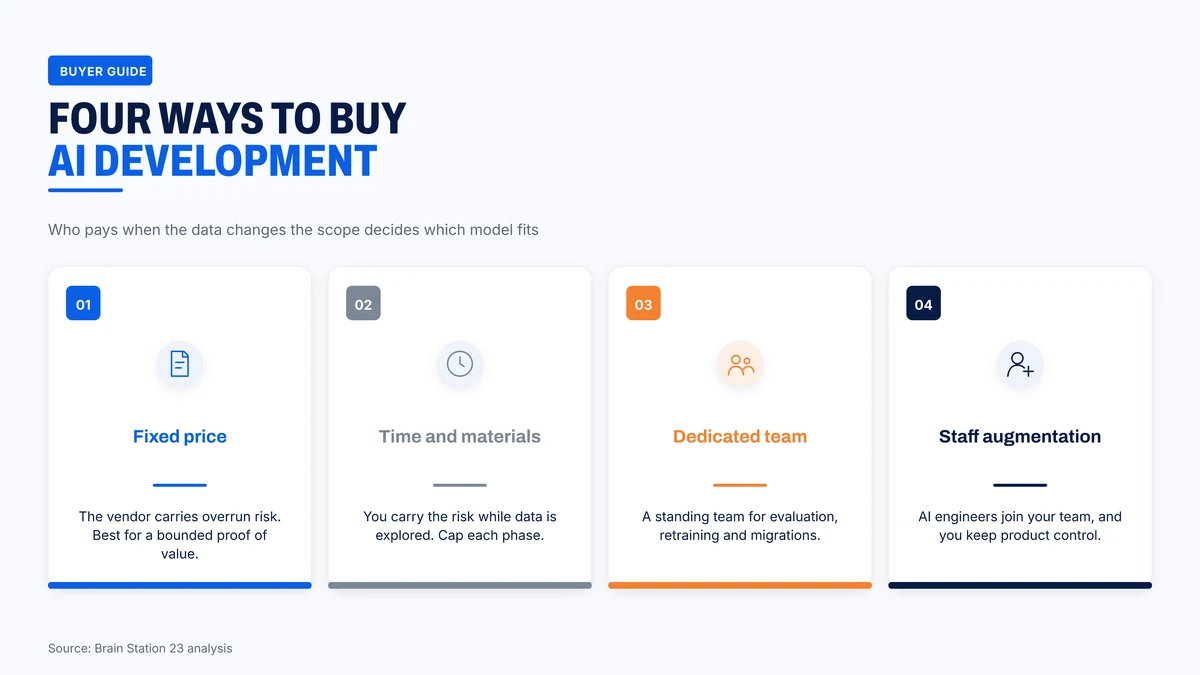
Fixed price puts overrun risk on the vendor. It suits a tightly bounded proof of value with agreed metrics. It fails when model accuracy targets are set before anyone has seen the data.
Time and materials puts the risk on you in exchange for flexibility. It suits discovery, data work and iteration. Cap each phase and review results against the metric weekly.
Dedicated team gives you a standing group on a monthly fee. It suits an AI product that needs evaluation, retraining and model migrations for years. Ask for named people and a replacement clause.
Staff augmentation adds AI engineers to your own team while you keep product and architecture control. GoGloby, Turing, Forte Group and Brain Station 23 publish staff augmentation work. It fails if nobody in-house owns evaluation.
The technical question: getting from pilot to production
The gap between a working demo and a production AI system is evaluation, security and lifecycle management, and it has an order.
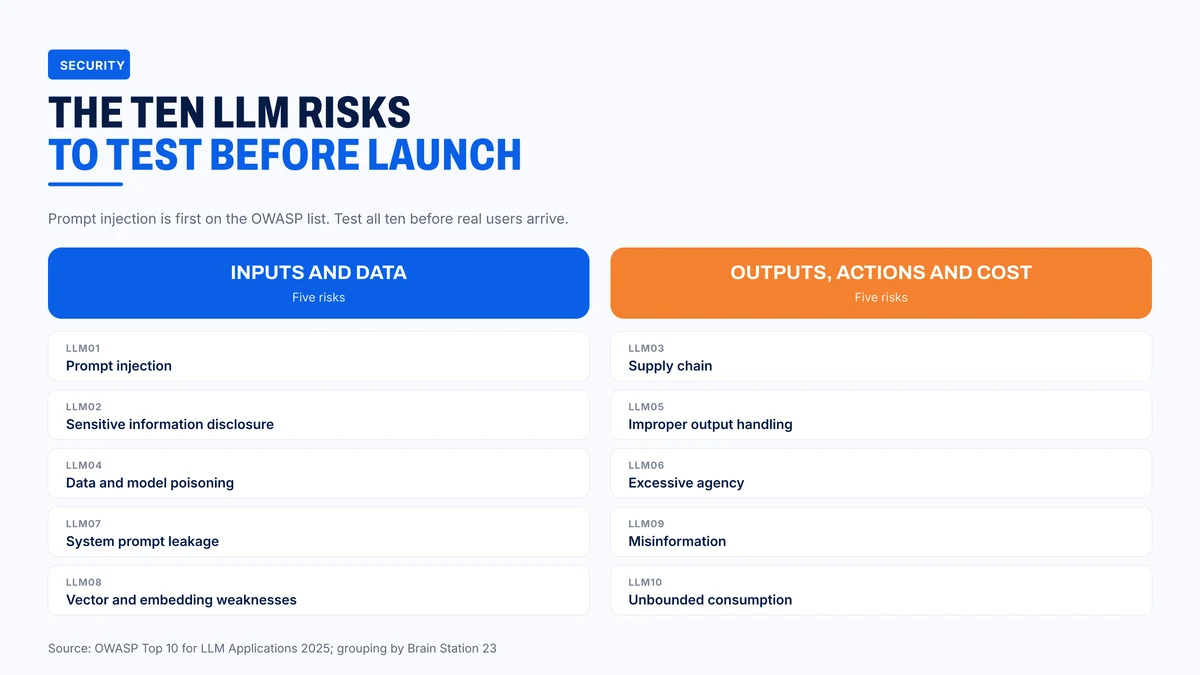
Security comes first because language model applications fail in their own ways. The OWASP Top 10 for LLM Applications 2025 puts prompt injection first, followed by sensitive information disclosure, supply chain risks, data and model poisoning and improper output handling, with excessive agency at number six (OWASP). The NIST AI Risk Management Framework, released on 26 January 2023 for voluntary use, and its Generative AI Profile from 26 July 2024 give a structure for managing those risks (NIST).
The model underneath also changes. Anthropic, for example, gives at least 60 days’ notice before retiring a publicly released model, and requests to a retired model fail. Its Claude Opus 4.1 model was deprecated on 5 June 2026 and retired on 5 August 2026 (Anthropic). Any AI system built on a hosted model needs a migration plan.
The steps, in the order that keeps them cheapest:
Step 1: Define success and build an evaluation set. Collect real examples with expected outputs before choosing a model.
Step 2: Prepare and govern the data. Clean it, set access controls, and decide what may be sent to a model provider.
Step 3: Build a narrow first version. One use case, measured against the evaluation set.
Step 4: Add guardrails and security testing. Test against prompt injection, data leakage and excessive agency before users arrive.
Step 5: Launch with monitoring and cost tracking. Track quality, latency and inference spend per user from day one.
Step 6: Plan the model lifecycle. Keep the evaluation set current so a replacement model can be tested before the old one retires.
Red flags: eight answers to walk away from
Some answers in a sales call should end the conversation, or at least move a firm down the list.
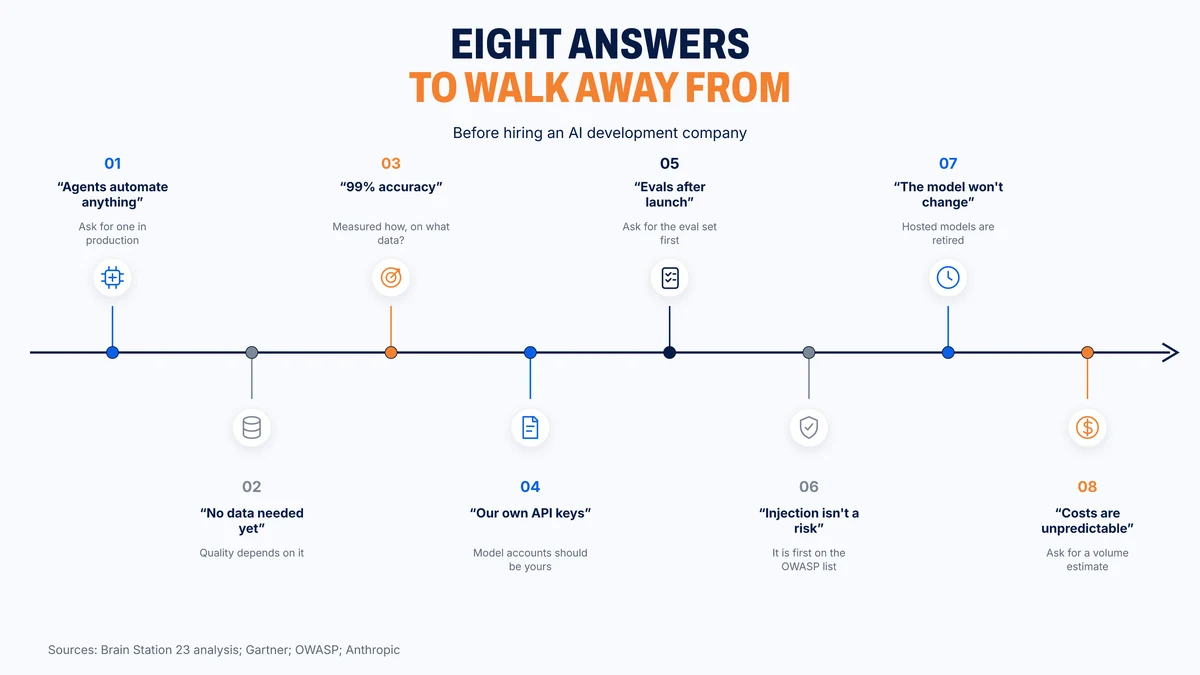
“Our agents can automate anything.” Ask for one agent in production and its measured results.
“We do not need your data yet.” AI quality depends on it.
“Accuracy will be 99 percent.” Ask how it will be measured, and on what data.
“We use our own API keys.” Model accounts and usage should be yours.
“Evaluation happens after launch.” Ask for the evaluation set before the build.
“Prompt injection is not a real risk for us.” It is first on the OWASP list.
“The model will not change.” Hosted models are retired on a schedule.
“Running costs are hard to predict.” Ask for an estimate at your expected volume.
After launch: what the build quote leaves out
The list tells you who can build the system. This section covers the eighteen months after it goes live, which is where AI projects most often lose their value.
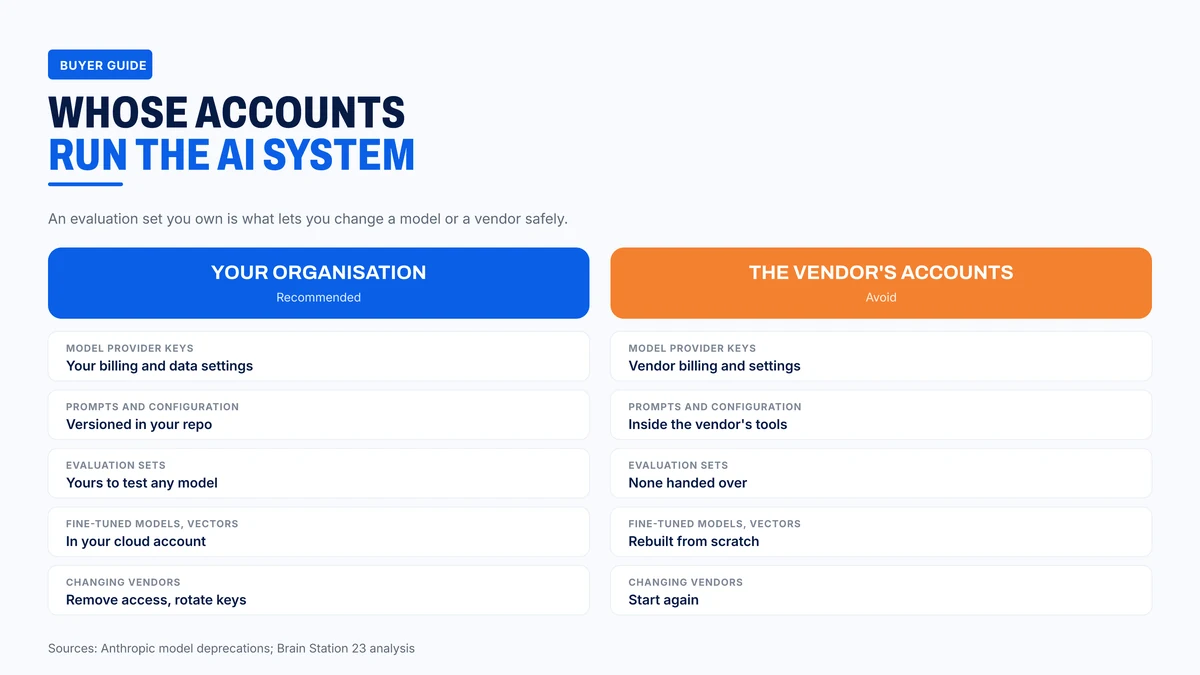
What you must own before the final invoice
Model provider accounts and API keys, under your organisation’s billing, so usage, limits and data settings are in your control.
Prompts, system instructions and configuration, versioned in your repository rather than in a vendor’s tool.
Evaluation sets and test results, which are how you will judge any future model or vendor.
Fine-tuned models, embeddings and vector databases, including the pipelines that rebuild them.
The repository, data pipelines, cloud accounts and a runbook to deploy, monitor and roll back.
The bill that arrives after launch
An AI build quote covers the build. Unlike most software, the system keeps costing money every time it is used.
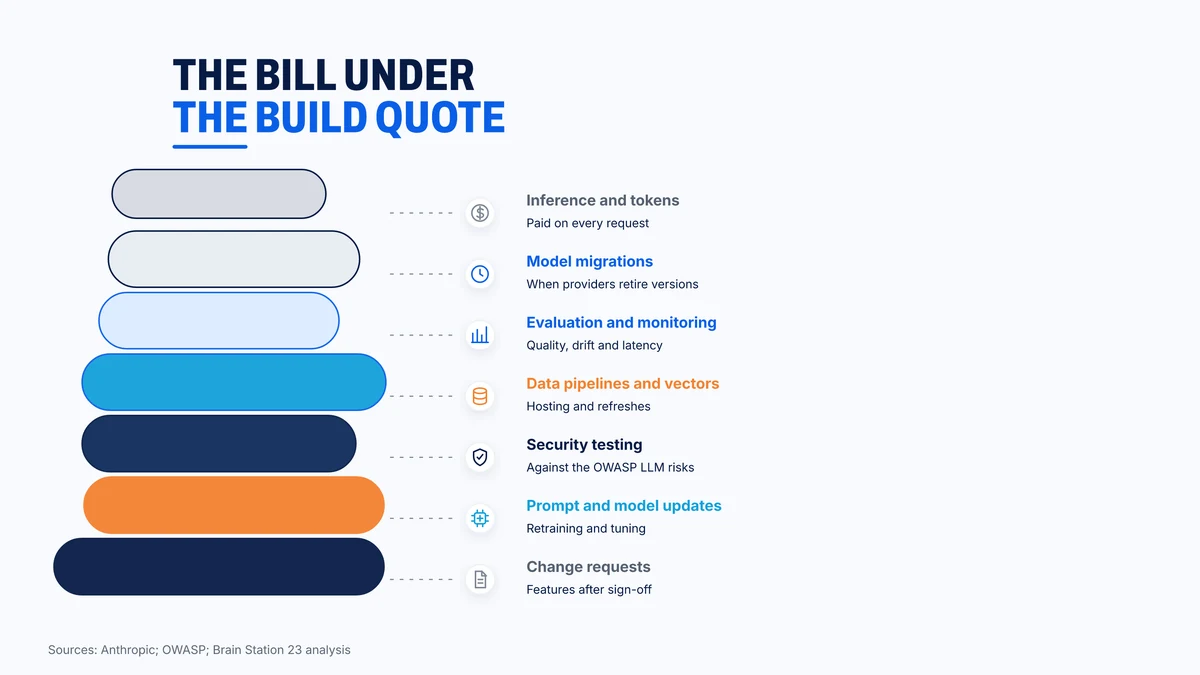
The recurring lines are inference and token usage, model migrations when providers retire versions, evaluation and quality monitoring, data pipeline and vector database hosting, security testing, retraining or prompt updates, and change requests. Get the monthly running estimate in writing at your expected volume, and compare vendors on three years of total cost.
Security is a recurring cost
AI has become part of how breaches happen. In IBM’s 2026 study of 602 organisations, one in four malicious breaches was AI-enabled, up 56% on the year, and those breaches cost an average of $6 million against a $4.99 million global average. More than 20% of organisations reported a breach targeting AI models or applications (IBM).
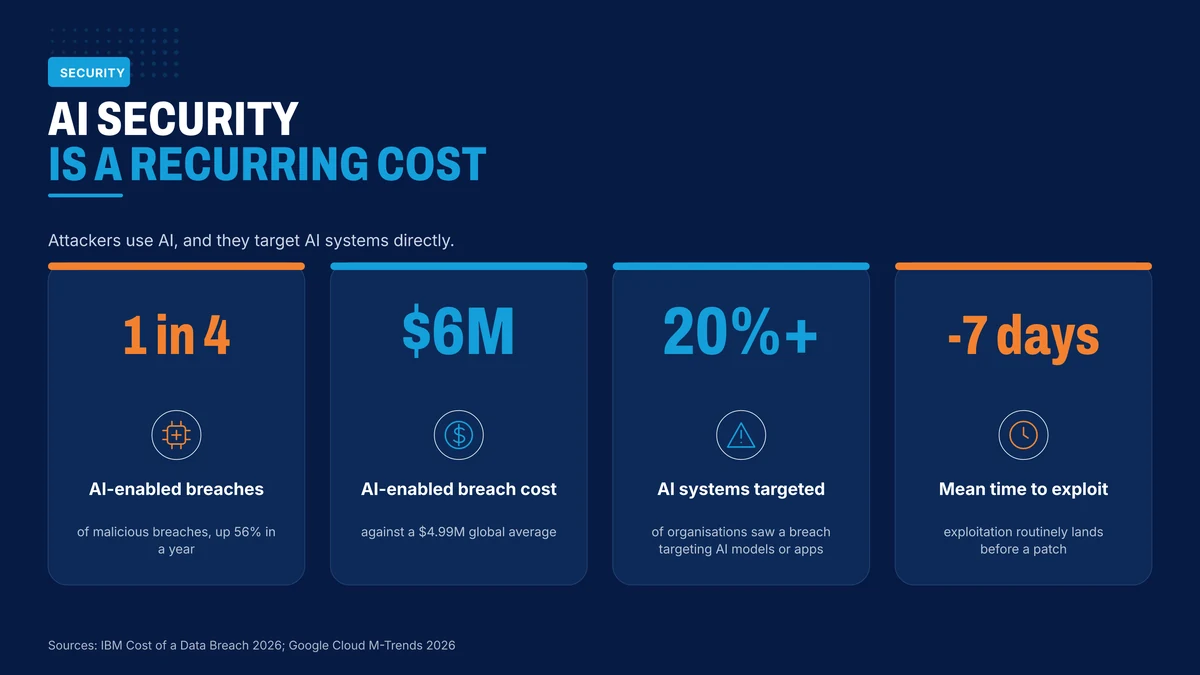
Timing adds pressure. Google Cloud’s M-Trends 2026 estimated the mean time to exploit at minus seven days (Google Cloud), and the average US data breach cost a record USD 11.5 million in IBM’s 2026 report (IBM Cost of a Data Breach Report 2026). Ask vendors to test against the OWASP LLM risks, to limit what the system can do on its own, and to log every model call.
Accessibility is legal exposure
Most AI features reach users through a web or mobile interface, and chat widgets inherit the same legal risks as any other page. WebAIM found detected WCAG 2 failures on 95.9% of the top million home pages in 2026 (WebAIM Million 2026), and more than 5,000 digital accessibility lawsuits were filed in 2025 (UsableNet).
Write a named standard such as WCAG 2.2 AA into the contract for any AI interface, and test chat and voice features with a screen reader and keyboard, not only with automated tools.
Contract clauses that surface in month nine
These rarely come up in a sales call and often decide the relationship later. This is not legal advice; have your own counsel review any agreement.
IP assignment on payment covering code, prompts, evaluation sets and fine-tuned models.
Data use, stating that your data is not used to train the vendor’s other products.
Model change notice, requiring the vendor to test and report before switching or upgrading models.
Running cost caps or alerts, so inference spend cannot grow unnoticed.
Transition assistance, a fixed number of hours at an agreed rate if you move vendors.
Liability caps and insurance that reflect AI-specific risks, and non-solicitation in both directions.
How to leave without losing the system
Confirm ownership of model accounts, prompts, evaluation sets, fine-tuned models, data pipelines and the repository first. Run the evaluation set yourself so you have a baseline the next team must match.
Trigger transition hours while relations are still cordial, and record walkthroughs of the pipeline, evaluation and deployment. On the last day, remove the departing team from every account and rotate every model API key, database credential and secret they could have seen.
Hire in-house or hire an agency
The honest comparison starts with the wage. The three salary sites above put a US machine learning engineer at $109,924 to $128,769, and the BLS median for computer and information research scientists was $140,300 in May 2025 (BLS), before benefits, recruiting and computing costs.
Hire in-house when AI is core to the product, you will iterate on it continuously, and you can keep a small team that owns data, evaluation and deployment.
Hire an agency for a proof of value, a first production system, or specialist skills such as infrastructure or computer vision you need for months rather than years. Keep the accounts and evaluation sets in your name.
Combine the two when you have an AI lead but need capacity. Staff augmentation or a dedicated team adds engineers without handing over the product.
FAQ
How much do US AI development companies charge?
Among the twenty firms here, nine publish $50 to $99 an hour, and published bands run from $25 to $49 up to $300 or more; four do not publish a rate. The median minimum project is $25,000, and five firms’ most common project is $200,000 or more (Clutch).
Why do so many AI projects fail to reach production?
Gartner predicts over 40% of agentic AI projects will be canceled by the end of 2027 because of escalating costs, unclear business value or inadequate risk controls (Gartner). Defining a metric and an evaluation set before building is the most direct counter.
How do I tell a real AI firm from “agent washing”?
Ask for a system in production, its evaluation results and its monthly running cost. Gartner estimates only about 130 of the thousands of agentic AI vendors are real (Gartner). On Clutch, check how much of the firm’s service mix is actually AI.
What are the main security risks in an LLM application?
The OWASP Top 10 for LLM Applications 2025 lists prompt injection first, then sensitive information disclosure, supply chain risk and data and model poisoning (OWASP). Test for them before launch, not after.
What happens when a model provider retires a model?
Requests to the retired model fail. Anthropic, for example, gives at least 60 days’ notice (Anthropic). Keep an evaluation set so a replacement can be tested and switched in before the deadline.
Why are Clutch AI rankings hard to read?
Twenty-one of the first forty rows in Clutch Rank order on the US AI directory are paid placements, and some firms rank on very few reviews: Gigster on two and Turing on four (Clutch).
Who should own the prompts and the model keys?
Your organisation. Model provider accounts, prompts, evaluation sets and fine-tuned models are what let you change vendors or models without starting again.
Is a Clutch Verified badge a sign of quality?
It is a sign of identity. Clutch says Verified providers have passed a credit check and had their business entity validated. Nine of the twenty organic top-ranked firms here showed no Verified badge on their profile header (Clutch).
Conclusion
The data behind this Top 20 AI Development Companies in USA list points three ways. The directory’s top rows are mostly paid, so the organic ranking takes work to find. AI’s share of these firms’ businesses ranges from a fifth to all of it, with a median just over half. And the most common complaint in their reviews is scoping, not model quality.
Any of the twenty can build a demo. What decides whether the system survives past the pilot is what surrounds it: an evaluation set you own, running costs you can see, a plan for the day the model is retired, and model keys that stay with you when the vendor leaves.
Sources
- https://clutch.co/us/developers/artificial-intelligence?sort_by=ClutchRank
- https://clutch.co/profile/brain-station-23
- https://www.gartner.com/en/newsroom/press-releases/2025-06-25-gartner-predicts-over-40-percent-of-agentic-ai-projects-will-be-canceled-by-end-of-2027
- https://hai.stanford.edu/ai-index/2026-ai-index-report/economy
- https://www.bls.gov/ooh/computer-and-information-technology/computer-and-information-research-scientists.htm
- https://www.salary.com/research/salary/posting/machine-learning-engineer-salary
- https://www.payscale.com/research/US/Job=Machine_Learning_Engineer/Salary
- https://www.ziprecruiter.com/Salaries/Machine-Learning-Engineer-Salary
- https://genai.owasp.org/llm-top-10/
- https://www.nist.gov/itl/ai-risk-management-framework
- https://platform.claude.com/docs/en/about-claude/model-deprecations
- https://newsroom.ibm.com/2026-07-29-ibm-study-one-in-four-malicious-breaches-are-ai-enabled,-costing-companies-6-million-on-average
- https://www.ibm.com/reports/data-breach
- https://cloud.google.com/blog/topics/threat-intelligence/m-trends-2026
- https://webaim.org/projects/million/
- https://blog.usablenet.com/ada-web-lawsuit-trends-2026