
Who holds the root login to your cloud account on the day the contract ends?
Not the dashboard. Not the pipeline. The account.
We start there because DevOps work lives inside infrastructure the buyer pays for but rarely touches. The Terraform state, the pipeline secrets and the Kubernetes clusters often sit in accounts an agency set up.
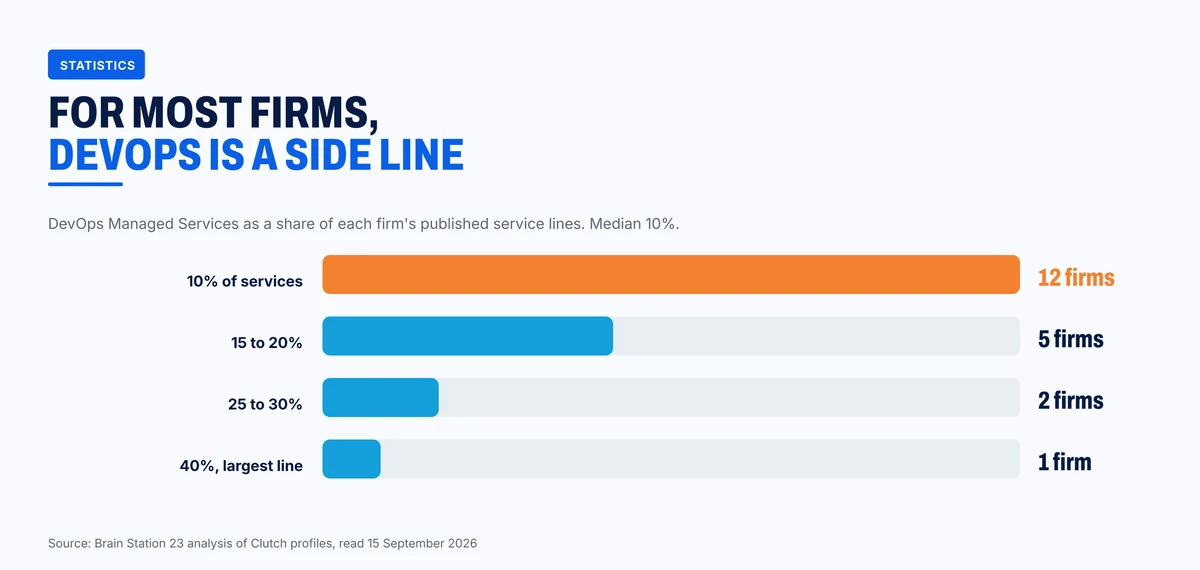
The firms on this Top 20 DevOps Development Companies in USA list come from Clutch’s US DevOps Managed Services directory, where 576 firms compete. Twelve of the twenty put DevOps at 10 percent of their published service mix.
The risk around those keys is growing. Developers added 28.65 million new hardcoded secrets to public GitHub in 2025, and more than 64 percent of the secrets confirmed valid in 2022 still worked in January 2026 (GitGuardian).
This guide measures each firm’s DevOps focus and prices the work. Then it covers what a pipeline quote leaves out: who owns the state files, what an old Kubernetes version costs to keep running, and how to take the keys back.
Key takeaways
- 12 of 20 top-ranked US DevOps firms on Clutch put DevOps at 10% of their service mix; only NextLink Labs makes it the largest line, at 40% (Brain Station 23 analysis of Clutch profiles, read 15 September 2026).
- 0 of the first 50 rows on Clutch’s US DevOps directory were paid placements, unlike its web and AI directories (Clutch).
- 82% of container users now run Kubernetes in production, up from 66% in 2023 (CNCF).
- $0.60 per cluster per hour is Amazon EKS extended support, six times the $0.10 standard rate (AWS).
- 29% of cloud spend is wasted, the first rise in five years, according to Flexera’s 2026 survey (Flexera).
- $103,203 to $125,908 is what three salary sites report for the same US DevOps engineer title, a $22,705 spread (Salary.com, ZipRecruiter).
- 6x more likely: internal repositories contain hardcoded secrets far more often than public ones (GitGuardian).
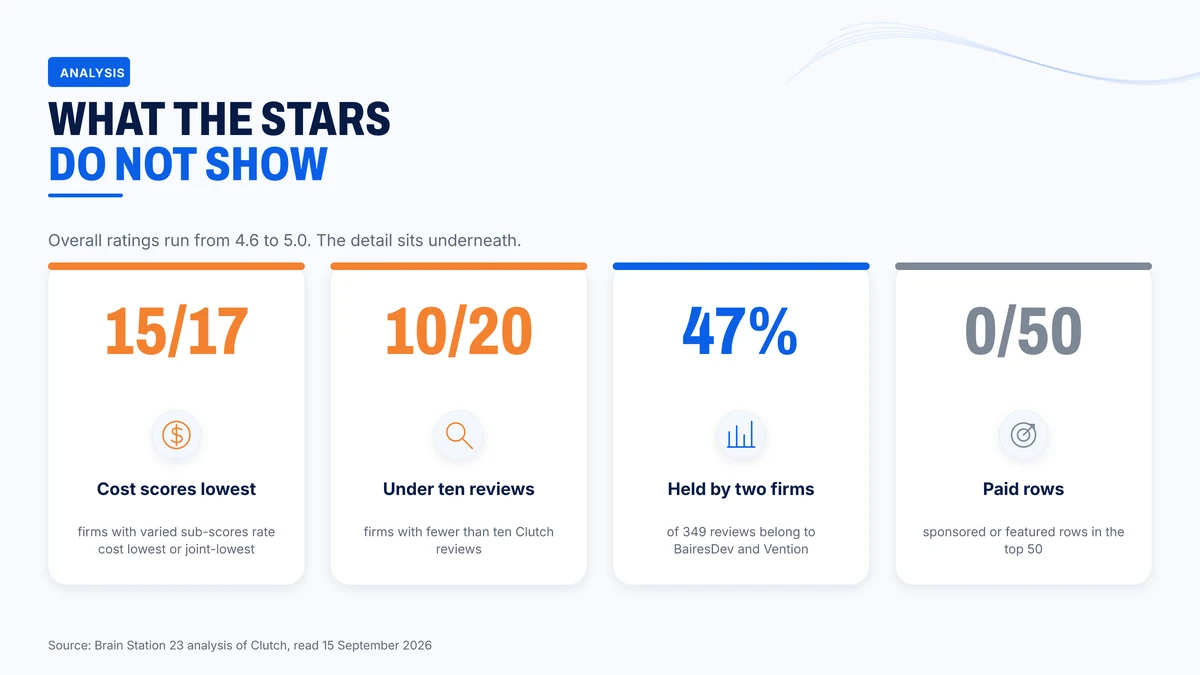
- 15 of 17 firms whose Clutch sub-scores differ rate Cost lowest or joint-lowest (Clutch profiles).
DevOps in 2026: faster releases, shakier stability
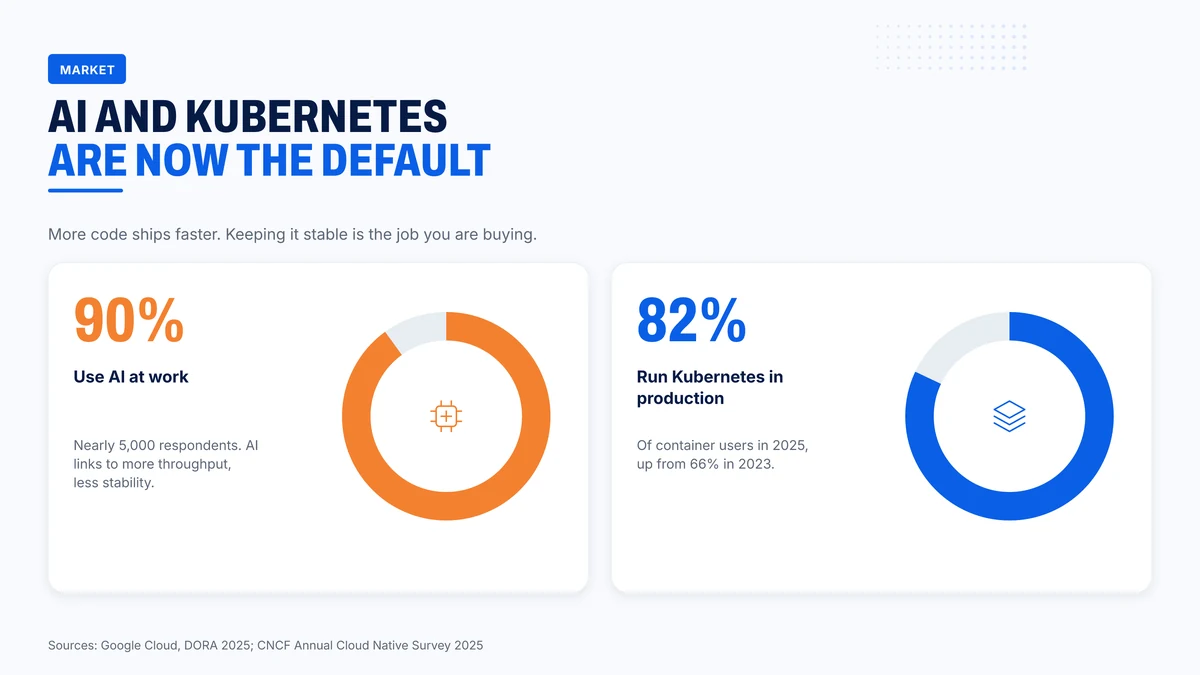
The 2025 DORA report, based on nearly 5,000 technology professionals, found that 90 percent use AI at work and that 90 percent of organisations have adopted at least one internal platform (Google Cloud, DORA 2025). It found a positive relationship between AI adoption and software delivery throughput, and a continuing negative relationship with delivery stability. More code is shipping. More of it breaks.
Containers are now the default runtime. The CNCF’s 2025 survey found that 82 percent of container users run Kubernetes in production, up from 66 percent in 2023, and that the top challenge is no longer technical: 47 percent cited cultural changes with the development team (CNCF).
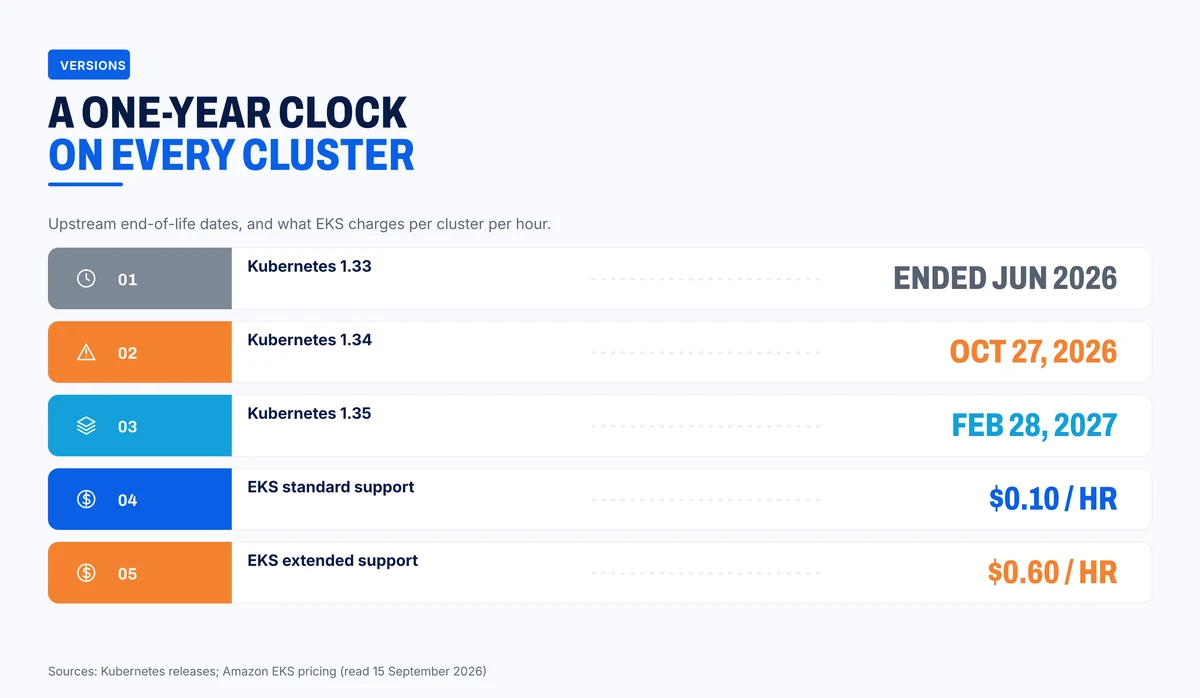
Kubernetes also runs on a short clock. Each minor release gets approximately one year of patch support (Kubernetes). Version 1.34 reaches end of life on 27 October 2026, and the supported releases are now 1.35, 1.36 and 1.37. Managed services charge for falling behind. Amazon EKS bills $0.10 per cluster per hour for the first 14 months of a version’s life and $0.60 per cluster per hour for the 12 months of extended support that follow (AWS).
The tooling licences have moved too. HashiCorp moved future releases of its products, including Terraform, from the Mozilla Public License 2.0 to the Business Source License 1.1 on 10 August 2023, restricting use in competing commercial offerings (HashiCorp). For most buyers this changes nothing day to day, but it is a reason to know which version of each tool your pipelines run and under which licence.
So brief a DevOps vendor with your current state: which clouds, how many clusters on which versions, how many pipelines, and who has administrator access today.
What DevOps development costs in the US
Salary data disagrees by more than $20,000.
Salary.com puts the average US DevOps engineer at $103,203 as of 1 September 2026, with the middle half earning $90,367 to $117,930 (Salary.com). PayScale reports an average base of $114,777 across 1,745 profiles (PayScale, updated 24 June 2026). ZipRecruiter reports $125,908 as of 15 September 2026 (ZipRecruiter).
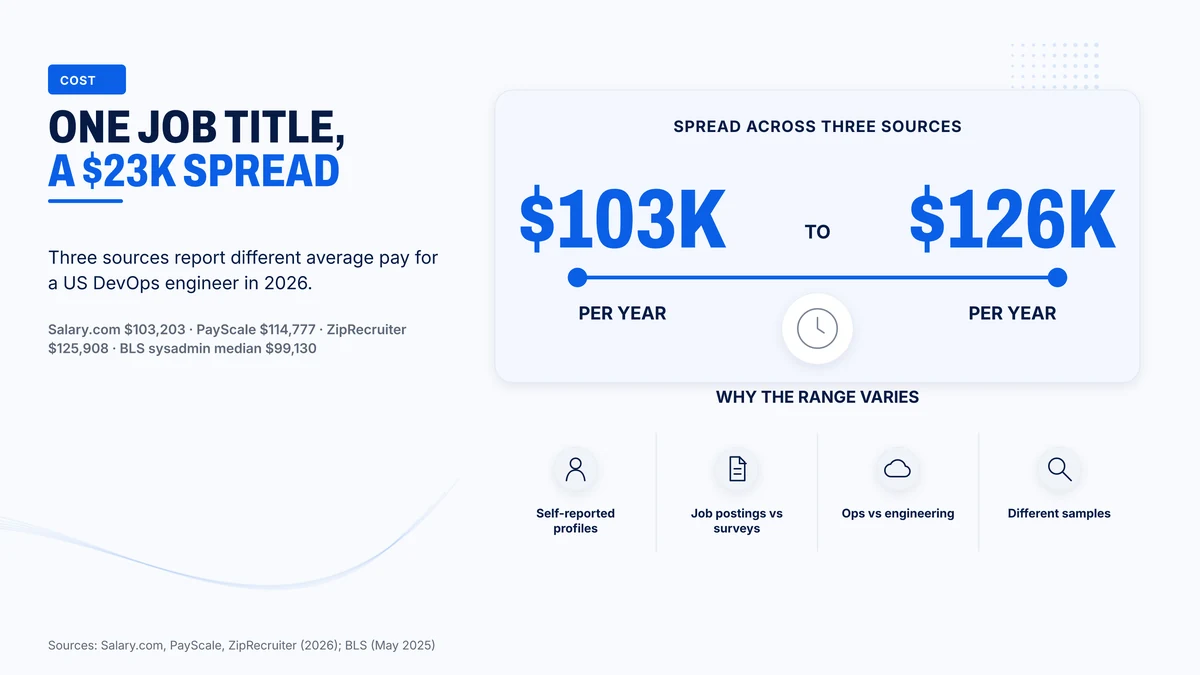
The Bureau of Labor Statistics has no DevOps occupation, and its neighbours sit on either side. Network and computer systems administrators earned a median of $99,130 in May 2025, and BLS projects that employment will decline 4 percent to 2035 (BLS). Software developers earned a median of $135,980 (BLS). DevOps pay sits between the two, and a vendor’s rate depends on whether it staffs the work like operations or like engineering.
The twenty firms below publish hourly bands from under $25 to $300, and fourteen publish a band under $100 (Clutch profiles, read 15 September 2026).
The vendor’s rate is often the smaller number. The cloud bill it manages is the larger one. Flexera’s 2026 survey of more than 750 cloud decision-makers found wasted cloud spend rose to 29 percent, the first increase in five years, and 85 percent named managing cloud spend a top challenge (Flexera).
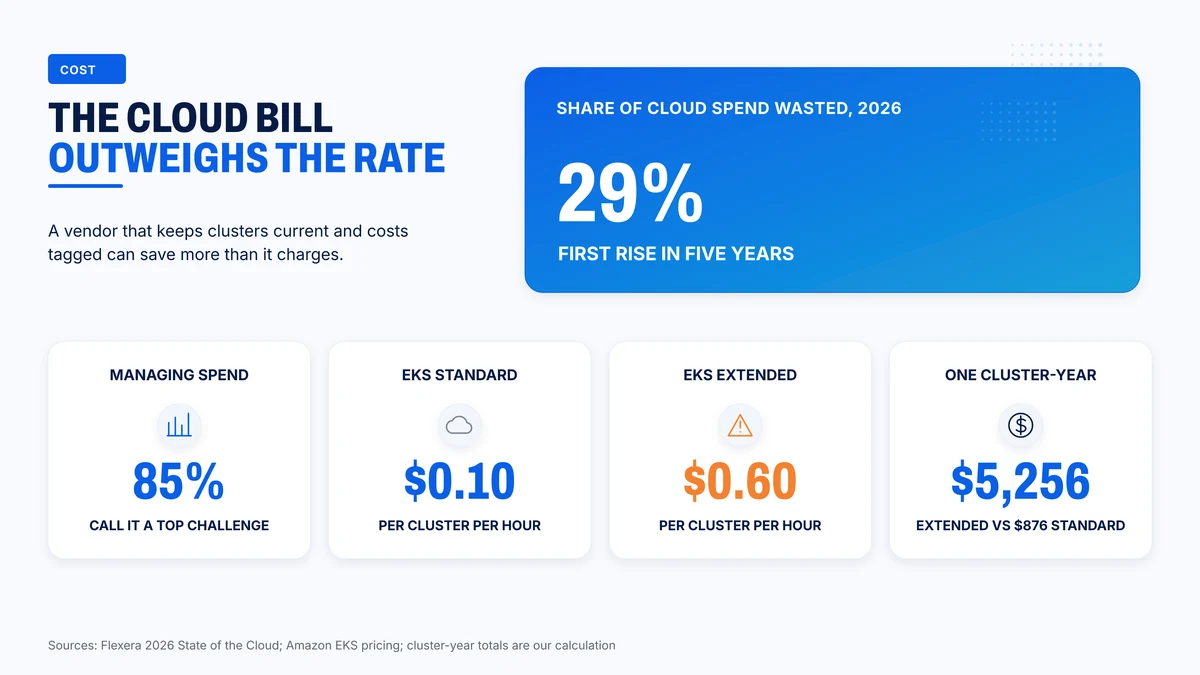
A single EKS cluster left running all year costs $876 in control-plane fees on standard support and $5,256 on extended support, before a single node is paid for. A vendor that keeps clusters current can save more than its own hourly rate suggests, and one that does not can cost more.
Eight factors decide most DevOps quotes.
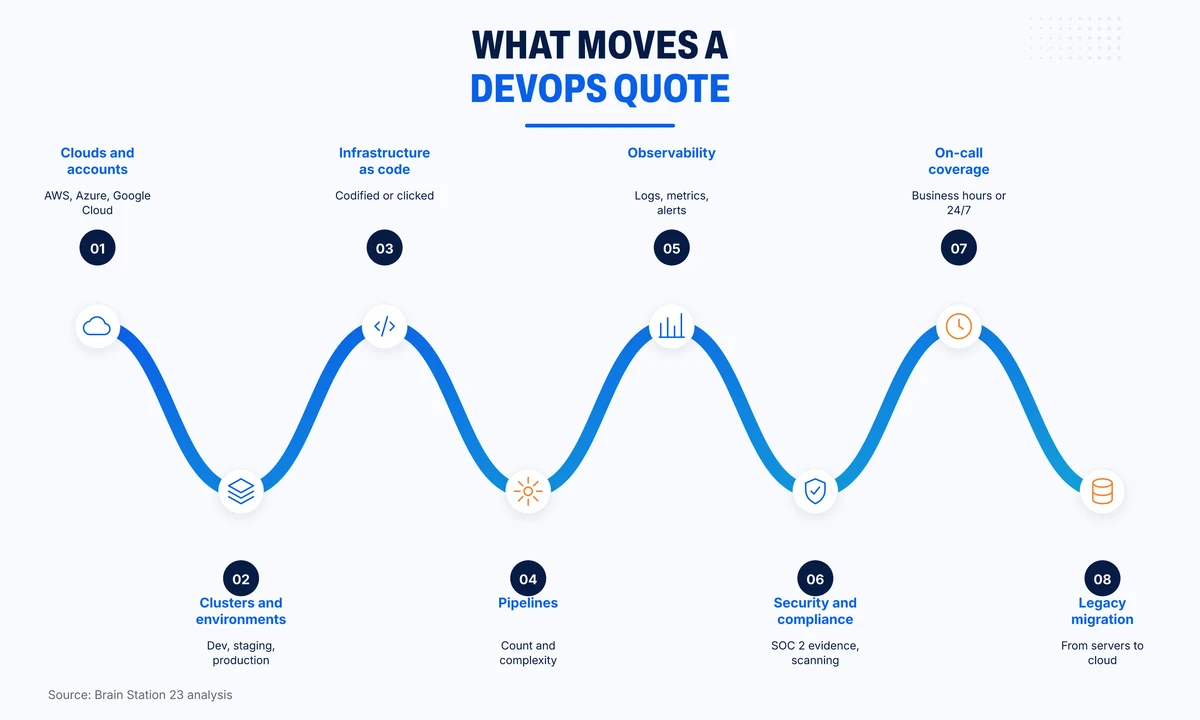
The number of clouds and accounts comes first, then the number of clusters and environments. How much infrastructure is already in code decides whether the vendor is automating or rebuilding. Pipeline count and complexity follow, then observability and alerting. Security and compliance evidence, such as SOC 2 controls, adds scope. On-call coverage is the line that changes price most: business hours and 24/7 are different contracts. Migration from legacy hosting closes the list. Ask every vendor to price these lines separately.
The Top 20 DevOps Development Companies in USA, compared
Firms 2 to 21 below are the top 20 on Clutch’s DevOps Managed Services directory for the United States, sorted by Clutch Rank and read on 15 September 2026. The directory lists 576 firms. None of the first 50 rows was marked as a sponsored or featured placement, so the list below is Clutch’s organic order without removals.
Brain Station 23 is placed first because we publish this article. We are US-headquartered and Premier Verified on Clutch, but DevOps Managed Services is not one of our published service lines, so the directory’s ranking did not place us in its top 20 and we are not claiming it did.
Every overall rating below runs from 4.6 to 5.0, so the stars do not separate these firms. The DevOps Focus column shows each firm’s DevOps Managed Services share of its published services, which is the number that does.
| # | Company | Best For | Team Size | DevOps Focus | Key Tech Stack | Industries Served | Locations |
|---|---|---|---|---|---|---|---|
| 1 | Brain Station 23 — brainstation-23.com | Adding DevOps and cloud engineers to a team you run, under ISO 27001 and SOC 2 controls | 250 – 999 | No DevOps line; IT managed services 5%, staff augmentation 60% | Java, .NET, Python, cloud migration, managed applications, security | Retail, medical, telecoms, education, financial services | Springfield VA; Bangladesh, UAE, England, Malaysia, Germany |
| 2 | BairesDev — bairesdev.com | Enterprises adding nearshore DevOps engineers inside a wider staffing contract | 1,000 – 9,999 | 10% of 10 service lines; no DevOps split published | Staff augmentation, testing, custom software, DevOps managed services | IT, financial services, medical, advertising | San Francisco; Buenos Aires, Sao Paulo, Mexico City, Bogota, Barcelona |
| 3 | Vention — ventionteams.com | Companies wanting containerisation and AWS work from a large engineering bench | 1,000 – 9,999 | 10%; containerisation and consulting lead | AWS (60%), Azure, Google Cloud, containers, CI/CD | Advertising, education, financial services, IT, medical | New York; London, Vienna, Vilnius, Berlin, Warsaw |
| 4 | Stackgenie — stackgenie.io | Mid-sized companies wanting AWS-first cloud and Kubernetes work from a DevOps-heavy firm | 50 – 249 | 30%; containerisation leads | AWS (65%), Azure, Google Cloud, containers, cybersecurity | Government, energy, financial services, IT, manufacturing | Montreal; Chicago, Washington DC, Austin, Las Vegas, Toronto, Dubai, Sydney |
| 5 | Jalasoft — jalasoft.com | Large, long engagements wanting low-rate nearshore engineers from Bolivia | 1,000 – 9,999 | 10%; consulting and assessment lead | DevOps consulting, CI/CD, containers, Angular, React, Node.js | Business services, energy, financial services, IT, manufacturing | Cochabamba, La Paz; Houston |
| 6 | OpsWorks Co. — opsworks.co | Mid-market companies on AWS that want infrastructure run and cloud bills cut | 50 – 249 | 25%; spread across all six areas | AWS (70%), Google Cloud, containers, cloud security | Financial services, gaming, medical | Hallandale Beach FL; Kyiv, Australia |
| 7 | Beehive Software — beehivesoftware.com | Product teams wanting DevOps inside a crowd-sourced build model | 50 – 249 | 10%; CI/CD, assessment and release lead | CI/CD, release management, React Native, Django, React | Medical, IT | San Jose |
| 8 | Clear Measure — clearmeasure.com | .NET teams on Azure wanting senior DevOps help at a premium rate | 10 – 49 | 20% of five equal lines; no DevOps split published | Azure (75%), AWS, .NET, Angular | Business services, education, financial services, legal, medical | Austin |
| 9 | Gearheart.io — gearheart.io | Python and Node.js product teams wanting CI/CD built with the application | 10 – 49 | 10%; CI/CD leads | CI/CD, containers, Python, Django, Node.js, React | Business services, medical, financial services, education | Kyiv; San Francisco, Tallinn |
| 10 | Launch by NTT DATA — launch.nttdata.com | Enterprises wanting DevOps strategy and release management inside a large programme | 250 – 999 | 10%; assessment leads | DevOps assessment, release management, testing, APIs, mobile | Business services, consumer products, energy, financial services, medical | Plano TX |
| 11 | NextLink Labs — nextlinklabs.com | Mid-market companies wanting a DevOps-first firm for CI/CD, GitLab and security | 10 – 49 | 40%, its largest line | CI/CD, GitLab, containers, maturity audits, cybersecurity | Automotive, education, financial services, gaming, government | Pittsburgh |
| 12 | Tevpro — tevpro.com | Energy and enterprise clients modernising across Google Cloud, AWS and Azure | 10 – 49 | 10%; CI/CD leads | Google Cloud (40%), AWS, Azure, CI/CD, containers, APIs | Energy, IT, financial services, logistics, telecoms | Houston |
| 13 | Oxagile — oxagile.com | Media and advertising companies wanting DevOps within a larger software contract | 250 – 999 | 10%; spread evenly | Containers, CI/CD, release management, custom software | Media, advertising, financial services, medical | New York; Warsaw |
| 14 | Amrood Labs — amroodlabs.com | Ruby on Rails and Node.js teams wanting CI/CD and security work at a low rate | 10 – 49 | 20%; CI/CD leads | CI/CD, containers, Ruby on Rails, Node.js, cybersecurity | IT, automotive, education, financial services, government | Wilmington DE |
| 15 | Carte Blanche — carteblanche.tech | Healthcare and education product teams needing CI/CD with design and development | 10 – 49 | 20%; entirely CI/CD | CI/CD, Django, React, mobile, UX design | IT, medical, education, logistics | Springfield IL |
| 16 | Admios — admios.com | Software companies wanting DevOps consulting from an augmented engineering team | 10 – 49 | 10%; entirely consulting | DevOps consulting, microservices, Node.js, React, testing | IT, medical | San Francisco |
| 17 | Airtight Design — airtightdesign.com | Enterprise web teams wanting deployment handled by their web partner | 10 – 49 | 10%; no DevOps split published | Web development, APIs, custom software, UX | Advertising, automotive, education, financial services, legal | Atlanta |
| 18 | LOGICON — logicon.tech | Healthcare and finance firms wanting a DevOps assessment across AWS and Azure | 10 – 49 | 10%; assessment is 70% | AWS, Azure (40% each), Google Cloud, microservices, APIs, RPA | Medical, financial services, education, retail | Oakbrook Terrace IL |
| 19 | Geeks2Connect — geeks2connect.com | Small businesses wanting low-cost CI/CD and release help alongside CRM or low-code work | 10 – 49 | 20%; CI/CD leads | CI/CD, release management, low-code, CRM | Automotive, education, energy, financial services, hospitality | Tallahassee FL |
| 20 | MANGOSOFT — mangosoft.tech | Retail and hospitality e-commerce teams on Magento needing DevOps support | 50 – 249 | 15%; spread across four areas | Containers, CI/CD, Magento, Angular, mobile | Financial services, hospitality, retail | Kyiv; San Francisco |
| 21 | OnPath Testing — onpathtesting.com | Software companies wanting test automation wired into their pipelines | 10 – 49 | 10%; CI/CD leads | Test automation, CI/CD, Python, JavaScript, Kotlin | IT | Boulder CO |
Team sizes, service splits, DevOps and cloud focus splits, industries and locations are from each firm’s published Clutch profile, read 15 September 2026. “Best For” is our reading of that data. Engagement models and certifications are not published consistently across these profiles, so we have left them out rather than guess.
Profiles are grouped by the kind of buyer each firm suits, and the numbers match the table. Each caution comes from the Review Highlights Clutch publishes from the firm’s verified reviews, where one exists. Clutch reviews cover each firm’s whole business, not only DevOps work. Certifications are self-published and unverified by us, and none of these profiles carry cloud or ISO certifications, which is why the profiles say to ask.
1. Brain Station 23
We publish this article and placed ourselves first, so read this entry as the publisher’s pick. DevOps Managed Services is not one of our published Clutch service lines; the nearest is IT Managed Services at 5 percent, mostly managed applications, security and cloud migration. Every firm below publishes DevOps as a service, and NextLink Labs makes it 40 percent. What we bring to the ownership questions in this guide is process: ISO 27001 and SOC 2 Type II controls over access and change, and 900+ engineers for staff augmentation, which is 60 percent of our work. Our $25 to $49 band matches five firms below. Our 21 Clutch reviews score Quality at 5.0 and Cost at 4.9, though none of them is specific to DevOps, and reviewers have asked us for tighter internal coordination. For a DevOps-first specialist, start below.
Founded: 2006
US Presence: Springfield VA
Company size: Clutch band 250 to 999; we publish 900+ engineers
Rating: 4.9 across 21 Clutch reviews, HQ Springfield, Virginia
- Adding DevOps and cloud engineers to a team you run, under ISO 27001 and SOC 2 controls
- CMMI Level 3
- ISO 27001
- ISO 9001
- SOC 2 Type II (company-published)
- Staff augmentation
- Managed software applications
- Security
- Cloud server migration
- Application modernisation
- Dedicated teams
- Retail
- Medical
- Telecoms
- Education
- Financial services
- Hospitality
- Ask which engineers on the proposed team hold current cloud or Kubernetes certifications
For DevOps and cloud specialists
11. NextLink Labs
NextLink Labs is the only firm of the twenty whose largest service line is DevOps, at 40 percent, with cybersecurity at another 15. Its DevOps focus is spread evenly across all six categories Clutch tracks. Reviewers describe CI/CD optimisation and migrations such as moving development environments to GitLab SaaS. Mid-market companies are 80 percent of its clients. Its ten reviews score 5.0, and Clutch’s summary lists no improvement area. The $150 to $199 band buys specialism, not scale.
Founded: 2018
US Presence: Pittsburgh
Company size: 10 to 49
- Mid-market companies wanting a DevOps-first firm for CI/CD, GitLab and security
- Not published; ask directly (Clutch lists DevOps Managed Services under “Certified in”)
- DevOps consulting
- Assessments
- Containerisation
- CI/CD
- Maturity audits
- Release management
- Cybersecurity
- Automotive
- Education
- Financial services
- Gaming
- Government
- Manufacturing
- Ask how a team of 10 to 49 covers incidents outside business hours
4. Stackgenie
Stackgenie is one of three firms here where DevOps is at least a quarter of the business, at 30 percent, second only to cloud consulting. Its DevOps work leads with containerisation and assessments, and AWS is 65 percent of its cloud split. Founded in 2020, it lists Montreal first among ten offices from Chicago to Busan. Its eight reviews score 5.0 and Clutch’s summary records no areas for improvement, but eight is a small base. A $5,000 minimum makes a trial project easy.
Founded: 2020
US Presence: Montreal
Company size: 50 to 249
- Mid-sized companies wanting AWS-first cloud and Kubernetes work from a DevOps-heavy firm
- Not published; ask directly
- Containerisation and orchestration
- DevOps assessment and strategy
- AWS DevOps and managed cloud
- AWS and Azure migrations
- Release management
- Cybersecurity
- Government
- Advertising
- Energy
- Financial services
- IT
- Manufacturing
- Confirm which of its ten offices would staff your work and cover your hours
6. OpsWorks Co.
OpsWorks puts cloud consulting and DevOps together at 55 percent of its services, and AWS is 70 percent of its cloud work. Reviewers credit it with running AWS infrastructure and cutting cloud bills. Mid-market companies are 70 percent of its clients, and financial services, gaming and medical are its only listed industries. Its 20 reviews score 4.9. The caution is commercial: some clients wanted a more stable pricing structure and faster responses on contract matters. It lists offices in Kyiv and Australia.
Founded: 2017
US Presence: Hallandale Beach FL
Company size: 50 to 249
- Mid-market companies on AWS that want infrastructure run and cloud bills cut
- Not published; ask directly
- AWS DevOps and migrations
- Containerisation
- CI/CD
- Maturity audits
- Cloud security
- Managed infrastructure
- Financial services
- Gaming
- Medical
- Ask for a fixed rate card and a commercial response time in the contract
8. Clear Measure
Clear Measure publishes the highest band on the list, $200 to $300 an hour, and splits its services evenly across five lines, DevOps among them at 20 percent. Its technical profile is the most specific here: Azure is 75 percent of its cloud work and .NET 75 percent of its frameworks. Small businesses are 75 percent of its clients. With two Clutch reviews and no review summary, there is almost no independent evidence to weigh. Ask for Azure DevOps references before paying senior rates.
Founded: 2013
US Presence: Austin
Company size: 10 to 49
- .NET teams on Azure wanting senior DevOps help at a premium rate
- Not published; ask directly
- Azure DevOps and migrations
- AWS
- IT managed services
- Custom .NET software
- Staff augmentation
- Business services
- Education
- Financial services
- Legal
- Medical
- Retail
- Ask for references, since its Clutch profile carries only two reviews
For product teams that want DevOps with development
7. Beehive Software
Beehive scores 5.0 on every measure across 12 reviews, and Clutch describes a crowd-sourced development model behind it. DevOps is 10 percent of eleven service lines, split evenly across CI/CD, assessments and release management. Its most common reviewed project is under $10,000. The recorded suggestion is QA: one client wanted stronger testing processes. A crowd-sourced model raises a DevOps question the reviews do not answer: how production access is granted and revoked.
Founded: 2021
US Presence: San Jose
Company size: 50 to 249
- Product teams wanting DevOps inside a crowd-sourced build model
- Not published; ask directly
- CI/CD
- Assessment and strategy
- Release and version management
- Containerisation
- Custom software
- Application testing
- Medical
- IT
- Ask how many people get production credentials and how access is removed
9. Gearheart.io
Gearheart lists Kyiv first, with San Francisco and Tallinn, and builds mainly in Python, which is half its language split. CI/CD leads its DevOps focus at 30 percent, the pattern of a product studio that ships pipelines with the code rather than a standalone operations firm. Its $50,000 minimum is high for a team of 10 to 49. Thirteen reviews score 4.8. Clutch notes a slow start on some projects, so write the first week’s deliverable into the contract.
Founded: 2012
US Presence: Kyiv
Company size: 10 to 49
- Python and Node.js product teams wanting CI/CD built with the application
- Not published; ask directly
- CI/CD
- Containerisation
- DevOps consulting
- Maturity audits
- Assessments
- API development
- Business services
- Medical
- Financial services
- Education
- Government
- Media
- Agree a start plan with named people and a first-week deliverable
12. Tevpro
Tevpro is the only firm here whose cloud split leads with Google Cloud, at 40 percent, ahead of AWS and Azure. Energy is its largest industry at 25 percent, fitting a Houston firm, and enterprises are 60 percent of its clients despite a team of 10 to 49. CI/CD and containerisation lead its DevOps focus. Its eight reviews score 4.9 and describe repeat business. One client noted early communication problems, which were resolved.
Founded: 2016
US Presence: Houston
Company size: 10 to 49
- Energy and enterprise clients modernising across Google Cloud, AWS and Azure
- Not published; ask directly
- CI/CD
- Containerisation
- Assessments
- Release management
- Application modernisation
- API development
- Energy
- IT
- Financial services
- Logistics
- Telecoms
- Utilities
- Ask which cloud the team is strongest on for your workload
14. Amrood Labs
Amrood Labs gives DevOps and cybersecurity 20 percent each of its services, and CI/CD is 35 percent of its DevOps work, built mostly around Ruby on Rails and Node.js. Its $25 to $49 band is among the lowest here. The review base is thin: three reviews at 4.7, with Schedule its weakest score at 4.2. Reviewers credit its communication and AI integration work. Ask for delivery references on pipeline work specifically.
Founded: 2015
US Presence: Wilmington DE
Company size: 10 to 49
- Ruby on Rails and Node.js teams wanting CI/CD and security work at a low rate
- Not published; ask directly
- CI/CD
- Containerisation
- DevOps consulting
- Assessments
- Cybersecurity
- Staff augmentation
- IT
- Automotive
- Education
- Financial services
- Government
- Medical
- Ask for references on pipeline work, since three reviews is a thin base
15. Carte Blanche
Carte Blanche gives DevOps its joint-largest service share, 20 percent, level with UX design, but its DevOps focus is 100 percent CI/CD. That makes it a product builder that ships pipelines rather than an infrastructure operator. Medical and education together are half its industries. Seven reviews score 5.0, and Clutch’s summary lists no significant areas for improvement. If you also need Kubernetes, monitoring or on-call cover, ask who provides them.
Founded: 2019
US Presence: Springfield IL
Company size: 10 to 49
- Healthcare and education product teams needing CI/CD with design and development
- Not published; ask directly
- CI/CD
- UX and product design
- Mobile apps
- Custom software
- Low-code builds
- IT
- Medical
- Education
- Logistics
- Confirm who handles infrastructure, since its DevOps focus is entirely CI/CD
16. Admios
Admios sells mainly to software companies: IT is 85 percent of its industries. Its DevOps focus is entirely consulting, which it pairs with staff augmentation, microservices architecture and corporate training. Its $50,000 minimum is among the highest on the list for a team of 10 to 49. Four reviews score 4.8. Clutch’s summary suggests its project management could be stronger, so agree up front whether your team or Admios runs the backlog.
Founded: 2005
US Presence: San Francisco
Company size: 10 to 49
- Software companies wanting DevOps consulting from an augmented engineering team
- Not published; ask directly
- DevOps consulting
- Staff augmentation
- Microservices architecture
- Application testing
- IT managed services
- Corporate training
- IT
- Medical
- Decide who runs the backlog, since project management is the recorded caution
17. Airtight Design
Airtight Design is a web design and development firm at heart: design, UX, web and custom software take 80 percent of its services, and DevOps 10. It publishes no DevOps focus split, so its place on a DevOps list rests on reviews rather than stated specialism. Enterprises are 40 percent of its clients. Four reviews score 5.0 and credit how well it works inside in-house teams. It suits a web platform that needs deployment support, not a Kubernetes estate.
Founded: 2001
US Presence: Atlanta
Company size: 10 to 49
- Enterprise web teams wanting deployment handled by their web partner
- Not published; ask directly
- Web development
- Custom software
- API development
- DevOps managed services
- UX and web design
- Advertising
- Automotive
- Education
- Financial services
- IT
- Legal
- Ask exactly which DevOps services it runs, since its profile publishes no DevOps split
20. MANGOSOFT
MANGOSOFT lists Kyiv first and San Francisco second. E-commerce is its largest service line, with Magento half its commerce platforms, and DevOps is 15 percent, split evenly across containerisation, CI/CD, consulting and maturity audits. Enterprises and mid-market firms are 90 percent of its clients. Eight reviews score 4.9 and describe replies within 24 hours. The suggestion Clutch records is deeper immersion in clients’ industries.
Founded: 2016
US Presence: Kyiv
Company size: 50 to 249
- Retail and hospitality e-commerce teams on Magento needing DevOps support
- Not published; ask directly
- Containerisation
- CI/CD
- DevOps consulting
- Maturity audits
- E-commerce development
- Mobile apps
- Financial services
- Hospitality
- Retail
- Ask for references in your industry, since deeper sector knowledge is the recorded gap
For enterprises and large delivery teams
2. BairesDev
BairesDev tops Clutch’s US DevOps list, but DevOps is 10 percent of a service mix spread across ten lines, and its profile publishes no DevOps focus split, so the directory cannot tell you what kind of DevOps it does. Its 63 reviews rate it 4.9, with Cost lowest at 4.6. Its $50,000 minimum is the joint highest here. Clutch notes occasional language barriers and a need for clearer explanation of technical concepts, which matters most during incidents. It suits a large company with its own platform lead.
Founded: 2009
US Presence: San Francisco
Company size: 1,000 to 9,999
- Enterprises adding nearshore DevOps engineers inside a wider staffing contract
- Not published; ask directly
- DevOps managed services
- IT staff augmentation
- Application testing
- Custom software
- IT strategy consulting
- IT
- Financial services
- Medical
- Advertising
- Business services
- Ask how incident communication works across its teams and languages
3. Vention
Vention has the largest review base on the list, 102 reviews at 4.9, and DevOps is 10 percent of its services. Its DevOps split leads with containerisation and consulting at 30 percent each, and AWS is 60 percent of its cloud work. Offices in Warsaw, Vilnius, Berlin and Vienna sit behind its New York address. Clutch’s summary records early difficulty finding the right skill match and some communication barriers. Interview the named engineers before signing, not after.
Founded: 2002
US Presence: New York
Company size: 1,000 to 9,999
- Companies wanting containerisation and AWS work from a large engineering bench
- Not published; ask directly
- Containerisation and orchestration
- DevOps consulting
- CI/CD
- Maturity audits
- Release management
- AWS DevOps
- Advertising
- Education
- Financial services
- Food and beverage
- IT
- Medical
- Interview the proposed engineers before signing, since skill match is the recorded caution
5. Jalasoft
Jalasoft pairs the lowest band among the three large firms, $25 to $49, with a $50,000 minimum and a most common reviewed project above $1 million, the largest on the list. Its engineers work from Cochabamba and La Paz, with an office in Houston. DevOps is 10 percent of its services, led by consulting and assessments. Seven reviews score 4.9, but Cost is 4.4, and Clutch notes English is a second language for many of its staff. It suits a long, large engagement.
Founded: 2001
US Presence: Cochabamba, La Paz
Company size: 1,000 to 9,999
- Large, long engagements wanting low-rate nearshore engineers from Bolivia
- Not published; ask directly
- DevOps consulting
- Assessment and strategy
- CI/CD
- Containerisation
- Maturity audits
- Staff augmentation
- Business services
- Consumer products
- Energy
- Financial services
- IT
- Manufacturing
- Test written and spoken English with the named team before signing
10. Launch by NTT DATA
Launch by NTT DATA carries the NTT DATA name, a 2023 founding date on Clutch and 250 to 999 staff. Its DevOps work is strategy-led: assessments are 35 percent and release management 25, with little CI/CD. Its most common reviewed project is $200,000 to $999,999, based on 19 reviews. Cost is its weak score at 4.2, joint lowest on the list, and Clutch records team turnover that hurt continuity and knowledge retention.
Founded: 2023 (Clutch)
US Presence: Plano TX
Company size: 250 to 999
- Enterprises wanting DevOps strategy and release management inside a large programme
- Not published; ask directly
- DevOps assessment and strategy
- DevOps consulting
- Release and version management
- Application testing
- API development
- Product and UX design
- Business services
- Consumer products
- Energy
- Financial services
- Medical
- Real estate
- Ask for named leads and a continuity clause, since team turnover is the recorded caution
13. Oxagile
Oxagile is the one firm here that publishes neither an hourly rate nor a minimum project size. Custom software is half its services and DevOps 10 percent, spread evenly across Clutch’s DevOps categories. Media is 40 percent of its industries. Its 15 reviews score 4.9, but Schedule is 4.6 and Cost 4.5, and Clutch notes requests for better return on investment and more versatile testing resources. Put pricing and ROI measures in writing before the scope.
Founded: 2005
US Presence: New York
Company size: 250 to 999
- Media and advertising companies wanting DevOps within a larger software contract
- Not published; ask directly
- Containerisation
- DevOps consulting
- Assessments
- CI/CD
- Release management
- Maturity audits
- Media
- Advertising
- Financial services
- Medical
- Sports
- Ask for a rate card up front, since it publishes neither a rate nor a minimum
For assessments, pipelines and QA-led DevOps
18. LOGICON
LOGICON’s DevOps focus is 70 percent assessment and strategy, the most advisory profile on the list, and it splits cloud work evenly between AWS and Azure. Medical and financial services make up half its industries. Its services also cover microservices, robotic process automation and BI. Six reviews score 5.0. Clutch’s summary records language barriers that occasionally delayed development, so confirm who does the build after the assessment.
Founded: 2015
US Presence: Oakbrook Terrace IL
Company size: 10 to 49
- Healthcare and finance firms wanting a DevOps assessment across AWS and Azure
- Not published; ask directly
- DevOps assessment and strategy
- CI/CD
- Microservices
- API development
- Robotic process automation
- Business intelligence
- Medical
- Financial services
- Education
- Retail
- IT
- Legal
- Ask where the delivery team sits, since language barriers delayed some projects
19. Geeks2Connect
Geeks2Connect has the lowest price points on the list: a band under $25 an hour and a $1,000 minimum, and its most common reviewed project is under $10,000. Its 14 reviews score 5.0 on every measure. DevOps is 20 percent of its services, led by CI/CD and release management, beside low-code and CRM work. Clutch’s summary suggests more detailed documentation at handoff and faster QA feedback. In DevOps, the handoff documentation is the asset you keep.
Founded: 2016
US Presence: Tallahassee FL
Company size: 10 to 49
- Small businesses wanting low-cost CI/CD and release help alongside CRM or low-code work
- Not published; ask directly
- CI/CD
- Release management
- DevOps consulting
- Assessments
- Low-code development
- CRM consulting
- Automotive
- Education
- Energy
- Financial services
- Food and beverage
- Hospitality
- Make handoff documentation a paid deliverable, since that is the recorded gap
21. OnPath Testing
OnPath Testing is a QA firm first: testing is 80 percent of its services, and its DevOps work, 10 percent, leads with CI/CD, where test automation meets the pipeline. IT is 75 percent of its industries. It has the lowest overall rating on the list, 4.6 across 17 reviews, with Cost at 4.2. Clutch records one client’s concerns about leadership, prioritisation and missed deadlines. It fits a team whose problem is test coverage in the pipeline, not infrastructure.
Founded: 2009
US Presence: Boulder CO
Company size: 10 to 49
- Software companies wanting test automation wired into their pipelines
- Not published; ask directly
- Application testing
- CI/CD
- DevOps consulting
- Assessments
- Containerisation
- Application support
- IT
- Ask for a named delivery lead and an escalation path, since missed deadlines are the recorded caution
What the twenty profiles show
We tallied the published data behind every profile. None of it is a ranking. It shows what normal looks like on this Top 20 DevOps Development Companies in USA list, so a proposal that is out of line stands out.
DevOps is a side line for most. DevOps Managed Services is 10 percent of the service mix for twelve of the twenty, and the median is 10 percent. Only three firms give it a quarter or more: NextLink Labs at 40, Stackgenie at 30 and OpsWorks at 25. Only NextLink makes it the largest line (Brain Station 23 analysis of Clutch profiles, read 15 September 2026).
“DevOps” means different work. Seventeen firms publish a DevOps focus split. CI/CD is the largest or joint-largest area for eight of them, and Carte Blanche’s split is entirely CI/CD. Assessment and consulting lead for others: LOGICON is 70 percent assessment and Admios 100 percent consulting. Fourteen of the seventeen list containerisation. BairesDev, Clear Measure and Airtight Design publish no DevOps split at all.
Few publish their cloud. Only six firms publish a cloud split. AWS leads for Vention, Stackgenie and OpsWorks and ties with Azure at LOGICON; Azure leads for Clear Measure and Google Cloud for Tevpro.
Rates are mostly under $100. Fourteen firms publish a band under $100 an hour. Clear Measure is the outlier at $200 to $300, and Oxagile publishes no rate. Published minimums run from $1,000 to $50,000, with a median of $10,000.
The review base is thin and concentrated. The twenty profiles carry 349 reviews, and BairesDev and Vention hold 165 of them, 47 percent. The median firm has nine, and ten firms have fewer than ten. Of the seventeen whose sub-scores differ, Cost is lowest or joint-lowest for fifteen.
The cautions are about people, not tools. Clutch’s review summaries flag communication or language for five firms, delivery, project management or turnover for four, pricing for two and QA or documentation for two. Six firms have no improvement area recorded. None of the cautions names a tool.
Most are small, and many are nearshore. Fifteen of the twenty have fewer than 250 staff, and eleven have fewer than 50. Eight list offices outside the US, and four list a non-US city first: Stackgenie in Montreal, Jalasoft in Cochabamba, and Gearheart and MANGOSOFT in Kyiv. None of the first 50 rows on the directory was a paid placement.
How to shortlist a DevOps company
Order the filters so the first removes the most firms.
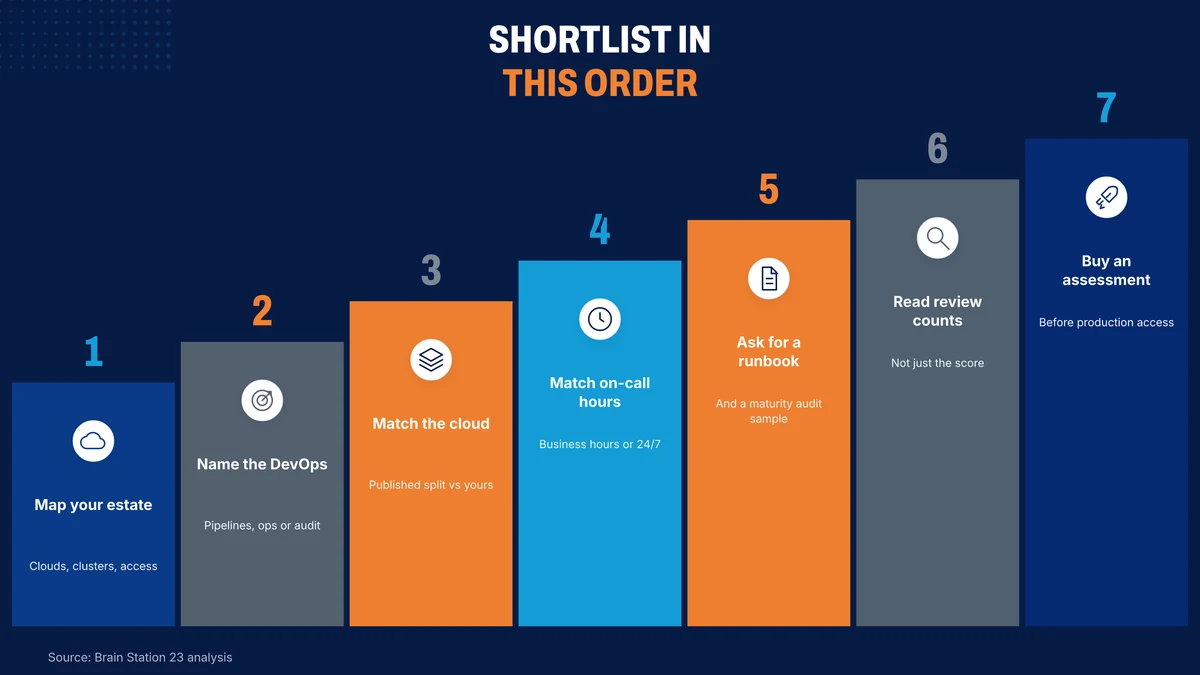
Step 1: Map your estate. List clouds, accounts, clusters and versions, pipelines, and everyone with administrator access.
Step 2: Name the kind of DevOps you need. Pipelines, infrastructure operations and an assessment are different purchases, and the focus splits above show which firms sell which.
Step 3: Match the cloud. Prefer a firm whose published cloud split includes yours, and ask for engineers certified on it.
Step 4: Match budget and on-call hours. A $10,000 minimum and a business-hours team is not the same product as 24/7 cover.
Step 5: Ask for a sample runbook and a maturity audit. A firm that cannot show one for another client will not write one for you.
Step 6: Read the review sample, not just the score. Ten of the twenty have fewer than ten reviews.
Step 7: Buy an assessment first. A paid two-to-four-week audit of your pipelines and accounts shows how the firm works before you hand over production access.
How to buy DevOps services: four engagement models
The engagement model decides who answers the page at 3 a.m. and who pays when an outage runs long.
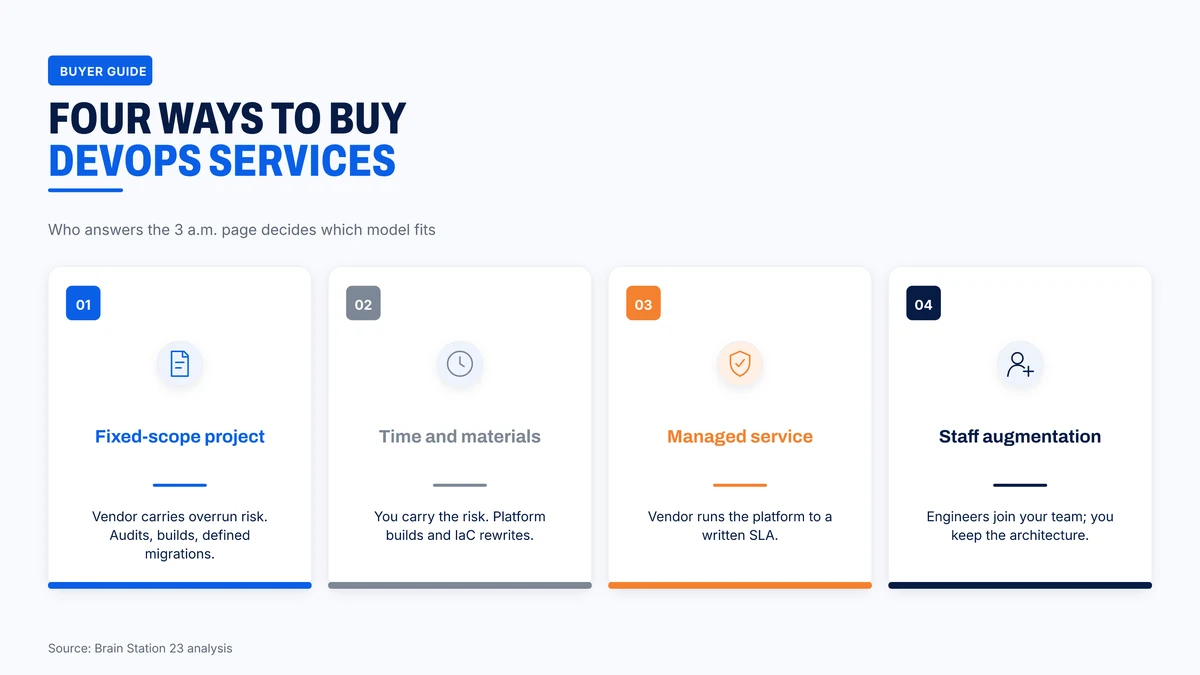
Fixed-scope project moves overrun risk to the vendor. It suits an assessment, a pipeline build or a defined migration with an agreed end state. It fails when the estate turns out to be larger than the inventory said.
Time and materials keeps the risk with you. It suits platform builds and infrastructure-as-code rewrites, where scope becomes clear once the accounts are open. Cap each phase.
Managed service with an SLA makes the vendor responsible for running the platform, with response times, on-call hours and escalation written down. It suits companies without an operations team. Read the SLA exclusions before the price.
Staff augmentation adds DevOps engineers to a team you run. Eight of the twenty publish a staff augmentation line, including BairesDev, Vention, Jalasoft and OpsWorks, and so do we. It fails when nobody in-house owns the architecture and the access model.
The technical question: taking over an existing cloud estate
Most DevOps engagements start with infrastructure someone else built, and the order of the takeover decides whether anything breaks.
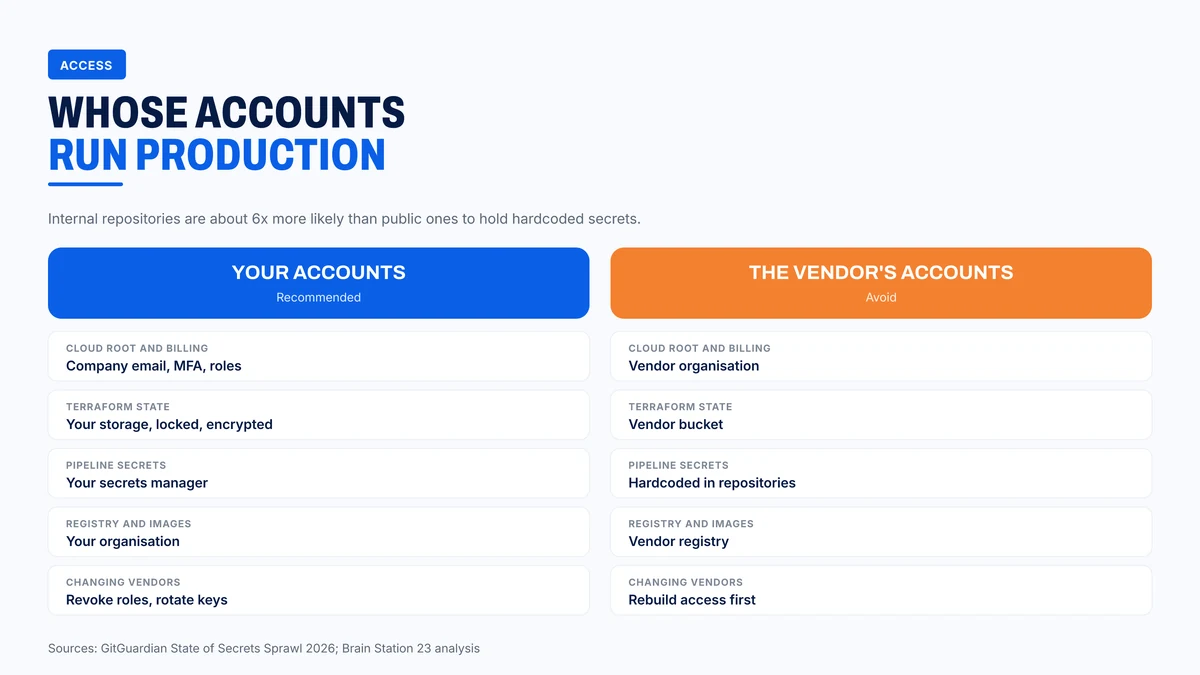
The takeover has a cost clock. Kubernetes 1.34 reaches end of life on 27 October 2026 (Kubernetes), and an EKS cluster left on an old version moves from $0.10 to $0.60 per cluster per hour when standard support ends (AWS). Secrets are the other clock: GitGuardian found internal repositories roughly six times more likely than public ones to contain hardcoded secrets (GitGuardian).
The steps, in the order that keeps them safest:
Step 1: Inventory accounts and access. List every cloud account, the root and billing owners, IAM users and roles, and who can reach production.
Step 2: Secure the root accounts. Put root and organisation accounts under company-owned email addresses with multifactor authentication before any other change.
Step 3: Codify what exists. Import running resources into infrastructure-as-code, so the vendor changes code rather than consoles.
Step 4: Move state and secrets into your accounts. Remote state with locking and encryption, and pipeline secrets in a secrets manager you control, not in repositories.
Step 5: Upgrade clusters to a supported version. One minor version at a time, with tested rollbacks.
Step 6: Own observability and alerts. Monitoring, logging and on-call tools should page your people as well as the vendor’s.
Step 7: Tag costs and review them monthly. With 29 percent of cloud spend wasted in Flexera’s survey (Flexera), tagging is the cheapest saving in the takeover.
Red flags: eight answers to walk away from
Some answers in a sales call should end it, or at least move a firm down the list.
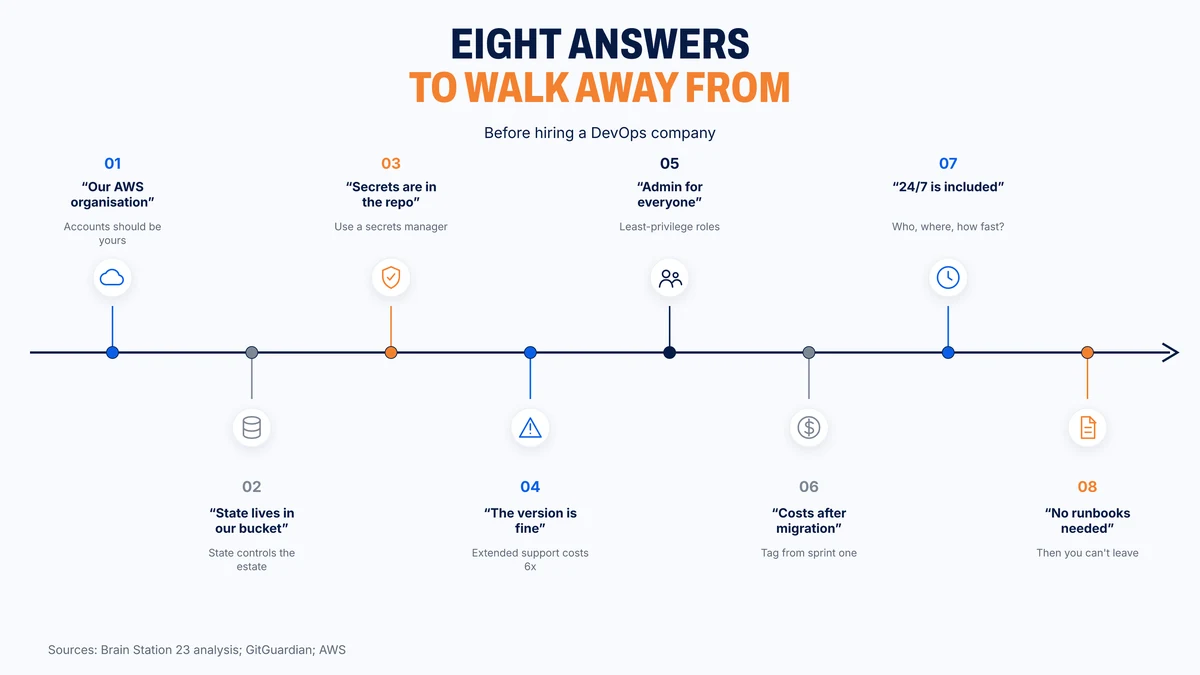
“We will run it in our AWS organisation.” Your workloads belong in accounts you own.
“The Terraform state lives in our bucket.” Whoever holds the state controls the infrastructure.
“Secrets are in the repo, but it’s private.” Internal repositories are where hardcoded secrets concentrate.
“The cluster version is fine for now.” Falling out of standard support raises EKS control-plane fees sixfold.
“The whole team gets admin access.” Ask for least-privilege roles and an access list.
“We’ll optimise costs after the migration.” Tagging and budgets belong in the first sprint.
“24/7 cover is included.” Ask who is on call, from which time zone, with what response time.
“Runbooks aren’t needed; we know the system.” Then you cannot change vendors.
After launch: what the DevOps contract leaves out
The list tells you who can build pipelines and platforms. This part covers what buyers wish they had settled before the first invoice, and what recurs for as long as the infrastructure runs.
What you must own before the final invoice
Cloud organisation, root and billing accounts, registered to company email addresses, with multifactor authentication and the vendor added through roles.
Infrastructure-as-code repositories and state files, in your source control and your storage, with full history.
CI/CD configuration, runners and pipeline secrets, in your organisation and your secrets manager.
Container registries and images, including base images and the scanning setup.
Domains, DNS and TLS certificates, under your registrar and billing.
Monitoring, logging and on-call tool accounts, plus tool licences contracted in your name.
Runbooks and architecture diagrams, current as of handover, covering deploys, rollbacks, restores and incident steps.
The bill that arrives after launch
The build quote covers the pipelines. The rest recurs.
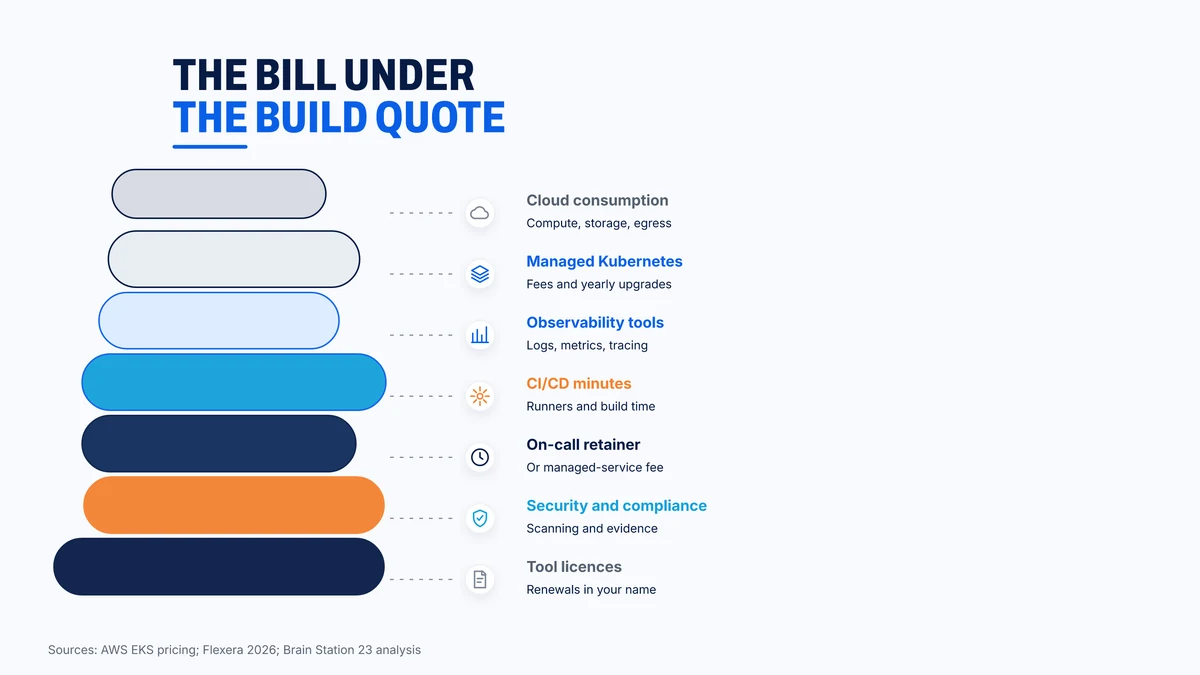
The recurring lines are cloud consumption, managed Kubernetes fees and version upgrades, observability tooling, CI/CD minutes and runners, an on-call or managed-service retainer, security scanning and compliance evidence, and tool licence renewals. Get the recurring number in writing before signing, and compare vendors on three years of total cost, including one Kubernetes upgrade cycle a year.
Security is a recurring cost
Pipelines hold the keys to production, and attackers have noticed. GitGuardian counted 28.65 million new hardcoded secrets on public GitHub in 2025, a 34 percent rise, and found that 59 percent of compromised machines in its Shai-Hulud dataset were CI/CD runners rather than developer laptops (GitGuardian). After the Shai-Hulud worm compromised more than 500 npm packages in September 2025, CISA told organisations to pin dependencies, rotate developer credentials and require phishing-resistant multifactor authentication (CISA).
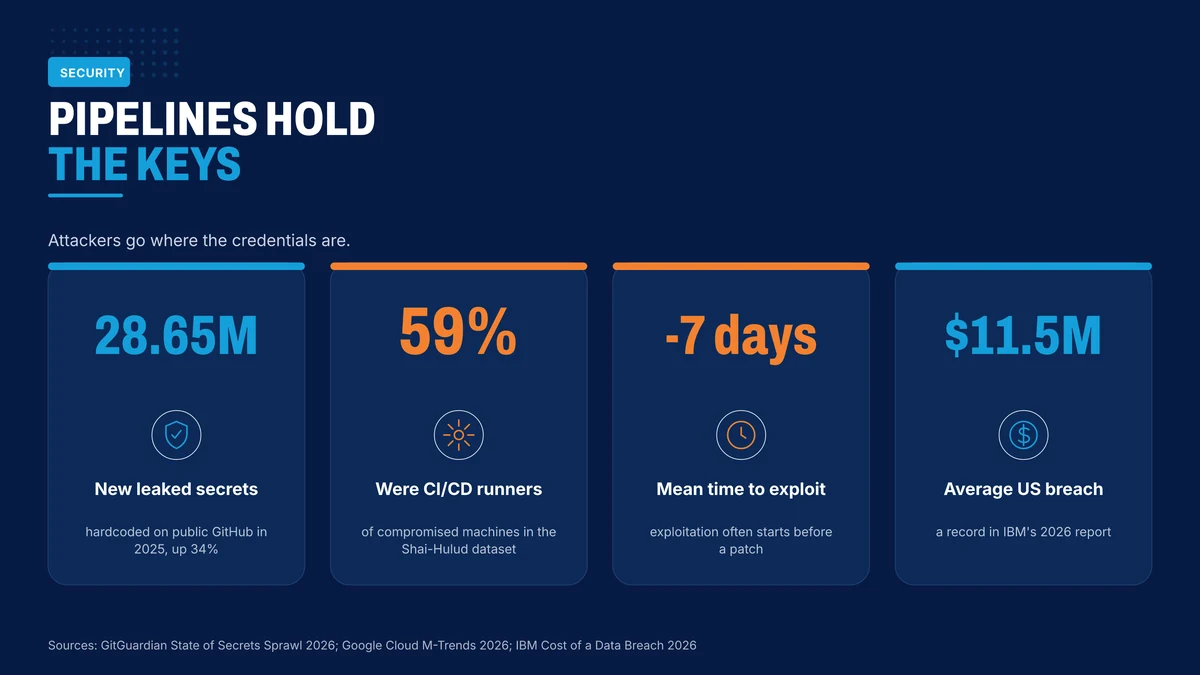
Speed of response is what a managed-service agreement has to buy. Google Cloud’s M-Trends 2026 put the mean time to exploit at minus seven days (Google Cloud), and the average US data breach cost a record USD 11.5 million in IBM’s 2026 report (IBM Cost of a Data Breach Report 2026). Ask vendors how quickly a critical patch reaches production, how secrets are scanned and rotated, and how runner permissions are limited.
Accessibility is legal exposure
DevOps does not design interfaces, but the pipeline decides what ships. WebAIM found detected WCAG 2 failures on 95.9 percent of the top million home pages in 2026 (WebAIM Million 2026), and more than 5,000 digital accessibility lawsuits had been filed by the end of 2025 (UsableNet).
If the vendor builds pipelines for a customer-facing application, ask for automated accessibility checks as a build gate beside unit and security tests. A failing contrast or missing label is cheaper to block in CI than to defend later.
Contract clauses that surface in month nine
These rarely come up in a sales call and often decide the relationship later. This is not legal advice; have your own counsel review any agreement.
Account ownership, naming cloud, source control, registry, DNS and tooling accounts as yours.
IP assignment on payment for infrastructure code, pipeline definitions, scripts and runbooks.
Service levels, stating on-call hours, response and resolution times, escalation contacts and exclusions.
Access revocation, requiring credential rotation and removal of vendor access within an agreed time at exit.
Transition assistance, a fixed number of hours at an agreed rate if you move to another vendor.
Cost reporting, requiring tagging standards and a monthly cloud cost review.
Subcontracting and data location, disclosing where engineers with production access work, plus liability caps and insurance matched to that access.
How to leave without losing the platform
Confirm ownership of every account, repository, state file and secret store first. Trigger transition hours while relations are cordial, and record walkthroughs of deploys, rollbacks, restores and incident response.
On the last day, remove the vendor’s roles and users, revoke pipeline and API tokens, rotate every secret the team could read, and check the audit logs for access that should not be there.
Hire in-house or hire a DevOps company
Start with the wage. The salary sites above put a US DevOps engineer between $103,203 and $125,908 a year, and BLS reports a $99,130 median for systems administrators and $135,980 for software developers (BLS). One engineer cannot cover on-call alone, so a 24/7 in-house rota means several salaries.
Hire in-house when the platform is core to the product, changes weekly, and you can keep at least two engineers who know it well.
Hire a DevOps company for an assessment, a migration, a pipeline rebuild, or on-call cover you cannot staff. Keep every account in your name so the choice stays reversible.
Combine the two when you have a platform lead but need hands or night cover. Staff augmentation or a managed service adds capacity while the architecture stays with you.
FAQ
How much do US DevOps companies charge per hour?
The twenty firms here publish bands from under $25 to $300 an hour, and fourteen publish a band under $100. Published minimums run from $1,000 to $50,000, with a median of $10,000 (Clutch).
What does a DevOps engineer earn in the US?
Salary.com reports $103,203, PayScale $114,777 and ZipRecruiter $125,908 in 2026 (Salary.com, PayScale, ZipRecruiter). The spread reflects different samples and methods.
How long is a Kubernetes version supported?
Upstream Kubernetes gives each minor release approximately one year of patch support, and version 1.34 reaches end of life on 27 October 2026 (Kubernetes). Amazon EKS offers 14 months of standard support, then 12 months of extended support at a higher price (AWS).
What does EKS extended support cost?
$0.60 per cluster per hour, against $0.10 in standard support (AWS). For one cluster running all year, that is about $5,256 instead of $876 in control-plane fees alone.
Who should own the Terraform state and cloud accounts?
Your company. Whoever controls the state files and the root accounts controls the infrastructure. Vendors should work through roles you grant and can revoke, with state stored in your storage and secrets in your secrets manager.
Is AI making DevOps delivery less stable?
DORA’s 2025 research found a positive relationship between AI adoption and delivery throughput and a continuing negative relationship with delivery stability (Google Cloud, DORA 2025). Strong automated testing and fast feedback loops are the controls it points to.
How much cloud spend is wasted?
Flexera’s 2026 survey put wasted cloud spend at 29 percent, the first increase in five years, with 85 percent naming cloud spend a top challenge (Flexera). Tagging, budgets and regular reviews belong in any DevOps contract.
Why does Clutch’s DevOps directory have no sponsored rows?
On 15 September 2026, none of the first 50 rows on Clutch’s US DevOps Managed Services page was marked as a sponsored or featured placement (Clutch). Clutch’s larger directories, such as web development, carried many paid rows the same week, so the DevOps list reflects Clutch Rank directly.
Conclusion
The data behind this Top 20 DevOps Development Companies in USA list says three things. For most of the twenty, DevOps is a 10 percent side line, and the firms that specialise are small. “DevOps” covers different work, from pure CI/CD to pure consulting, so the focus split matters more than the label. And the review base is thin, with half of all reviews belonging to two large firms.
Any of the twenty can build a pipeline. What decides the next three years is what surrounds it: whether your clusters stay in standard support, whether secrets live in a vault or a repository, and whether the root account, the state files and every credential are in your name on the day you choose someone else.
Sources
- https://clutch.co/us/it-services/devops/msp?sort_by=ClutchRank
- https://clutch.co/profile/brain-station-23
- https://cloud.google.com/blog/products/ai-machine-learning/announcing-the-2025-dora-report
- https://www.cncf.io/announcements/2026/01/20/kubernetes-established-as-the-de-facto-operating-system-for-ai-as-production-use-hits-82-in-2025-cncf-annual-cloud-native-survey/
- https://kubernetes.io/releases/
- https://aws.amazon.com/eks/pricing/
- https://www.hashicorp.com/en/blog/hashicorp-adopts-business-source-license
- https://www.flexera.com/about-us/press-center/flexera-finds-cloud-value-is-rising-while-ai-waste-grows
- https://blog.gitguardian.com/the-state-of-secrets-sprawl-2026/
- https://www.salary.com/research/salary/standard/devops-engineer-salary
- https://www.payscale.com/research/US/Job=Development_Operations_%28DevOps%29_Engineer/Salary
- https://www.ziprecruiter.com/Salaries/Devops-Engineer-Salary
- https://www.bls.gov/ooh/computer-and-information-technology/network-and-computer-systems-administrators.htm
- https://www.bls.gov/ooh/computer-and-information-technology/software-developers.htm
- https://www.cisa.gov/news-events/alerts/2025/09/23/widespread-supply-chain-compromise-impacting-npm-ecosystem
- https://cloud.google.com/blog/topics/threat-intelligence/m-trends-2026
- https://www.ibm.com/reports/data-breach
- https://webaim.org/projects/million/
- https://blog.usablenet.com/ada-web-lawsuit-trends-2026