

On 1 June 2027, Adobe stops maintaining Commerce Cloud environments that still run an unsupported version, and its lifecycle policy warns that traffic to those stores can be suspended and the storefront taken offline (Adobe Commerce lifecycle policy).
We checked that date against the firms we researched. Nine firms on this Top 20 eCommerce Development Companies in USA list include Magento, the platform Adobe sells as Adobe Commerce, in their published platform split. Nineteen list Shopify, and Shopify had its own cutoff: any Shopify Script still published on a store was deactivated on 30 June 2026 (Shopify Help Center).
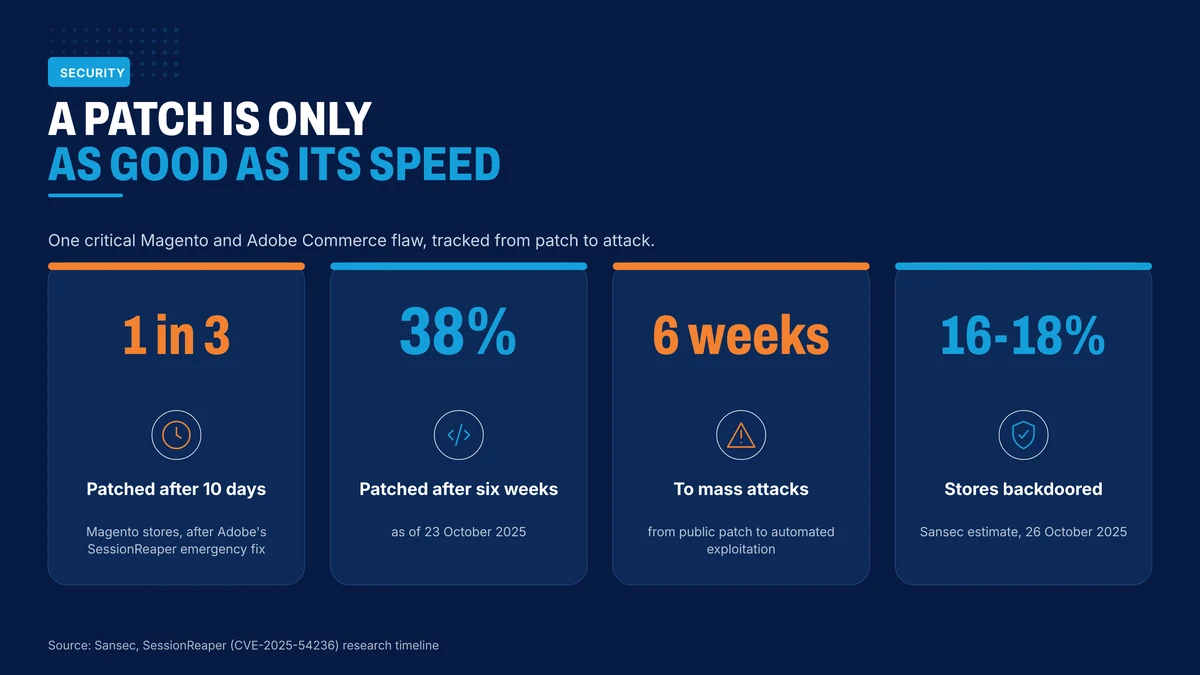
Dates like these rarely appear in a build quote. Neither does patch speed. Ten days after Adobe released an emergency fix for the SessionReaper flaw in September 2025, fewer than one in three Magento stores had applied it (Sansec).
The twenty firms come from Clutch’s US directory, each shown with its platform split, its price floor and the cautions in its own reviews. The longer part of the guide covers what the quote leaves out: whose account holds the store, what the platform bills every month, and how fast a patch reaches production.
Key takeaways
- 1 June 2027 is when Adobe stops maintaining Adobe Commerce Cloud environments on unsupported versions; standard support for version 2.4.6 already ended on 11 August 2026 (Adobe Commerce lifecycle policy).
- 30 June 2026 is when Shopify deactivated every Shopify Script still published on a store; the replacement is Shopify Functions (Shopify Help Center).
- 19 of 20 firms on this list include Shopify in their platform split; Shopify is the largest platform for nine and Magento for six (Brain Station 23 analysis of Clutch profiles, read 15 September 2026).
- $10,000 is the median minimum project across the twenty, but minimums run from $1,000 to $250,000 (Clutch profiles).
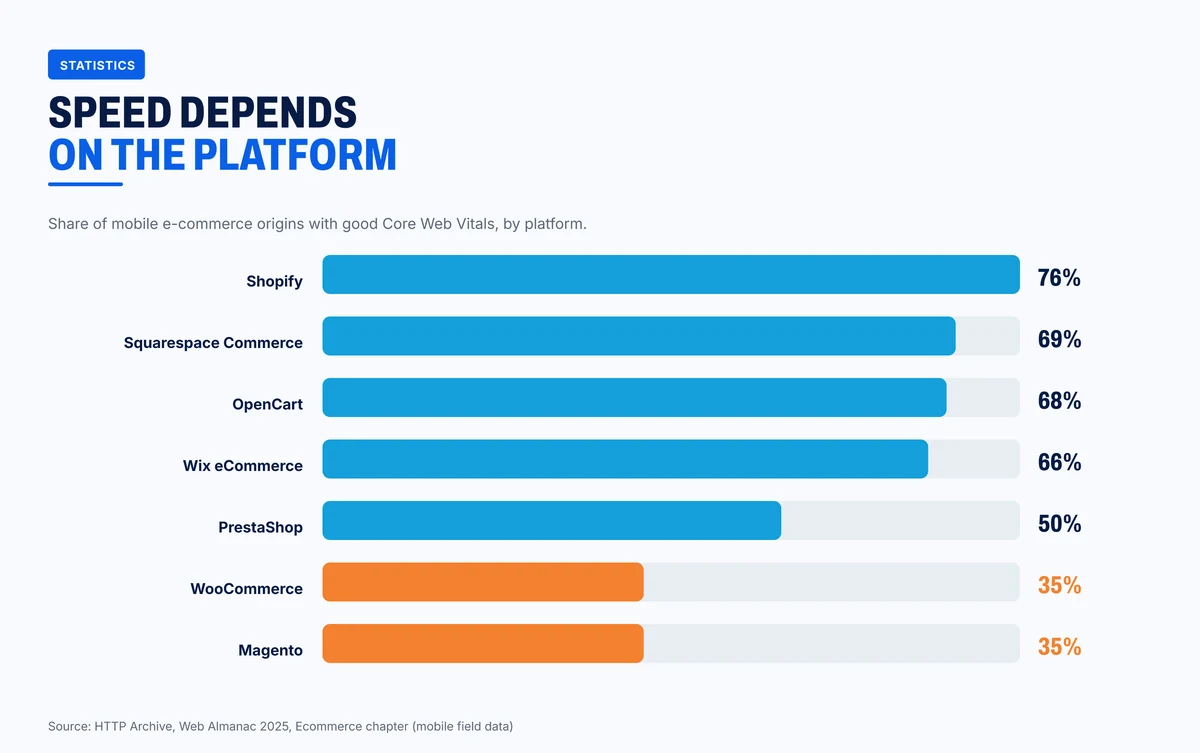
- 76% of Shopify stores had good mobile Core Web Vitals in HTTP Archive’s field data, against 35% of WooCommerce and Magento stores (Web Almanac 2025).
- 8.4% more retail conversions followed a 0.1-second mobile speed improvement in Deloitte’s study (Deloitte).
- 38% of Magento stores had patched SessionReaper six weeks after Adobe’s fix, the week mass attacks began (Sansec).
- $340.2 billion in US retail e-commerce sales in the second quarter of 2026, 17.1% of all retail (US Census Bureau).
E-commerce platforms in 2026: share, speed and support dates
US retail e-commerce reached $340.2 billion in the second quarter of 2026, seasonally adjusted, 12.2 percent more than a year earlier and 17.1 percent of all retail sales (US Census Bureau).
Platform share depends on who is counting. W3Techs finds WooCommerce on 47.8 percent of sites with a known e-commerce system, Shopify on 32.1 percent and Adobe Commerce on 1.6 percent (W3Techs, WooCommerce; W3Techs, Shopify; W3Techs, Adobe Commerce). HTTP Archive’s 2025 Web Almanac puts WooCommerce at about 36 percent of detected stores and Shopify at 21 percent (Web Almanac 2025).
Both surveys count sites, not revenue. A platform on under 2 percent of stores still appears in nine of the twenty agency profiles below, a sign that agencies follow budgets rather than site counts.
The calendar matters more than the share. Adobe gives each Commerce release three years of standard support from general availability. Standard support for 2.4.6 and extended support for 2.4.5 both ended on 11 August 2026, and from 1 June 2027 Adobe Commerce Cloud environments on unsupported versions can have their traffic suspended (Adobe Commerce lifecycle policy). Shopify’s changes landed on the checkout. Additional scripts became view-only on 28 August 2025, and non-Plus stores had until 26 August 2026 to upgrade their Thank you and Order status pages (Shopify Help Center, checkout upgrade).
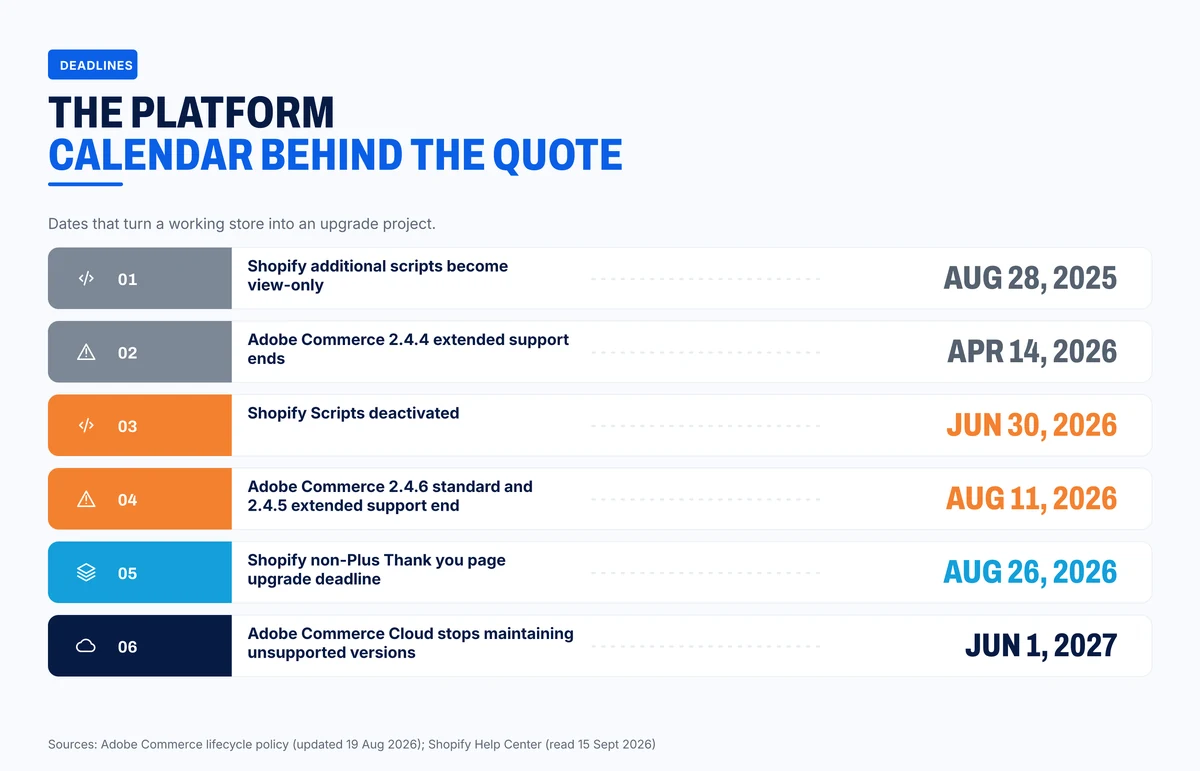
Adobe also states that it does not provide fixes for third-party dependencies such as PHP and MySQL that reach end of life inside a support window (Adobe Commerce lifecycle policy). An upgrade plan has to cover the whole stack, not only the application.
Speed varies by platform too. Among mobile e-commerce origins in the Web Almanac’s field data, 76 percent of Shopify stores had good Core Web Vitals, against 35 percent of WooCommerce stores and 35 percent of Magento stores (Web Almanac 2025). Most of the gap is loading speed: 86 percent of Shopify origins passed Largest Contentful Paint on mobile, compared with 52 percent on Magento and 39 percent on WooCommerce.
That gap has a price. In Deloitte’s study of mobile sites from European and US brands, a 0.1-second speed improvement came with an 8.4 percent rise in retail conversions and a 9.2 percent rise in average order value (Deloitte, Milliseconds Make Millions). A self-hosted platform is not doomed to be slow, but somebody has to be paid to make it fast.
Checkout is the other lever. Baymard’s benchmark finds the average US checkout shows 23.48 form elements by default when 12 to 14 can be enough, and estimates that large e-commerce sites can gain a 35.26 percent increase in conversion rate through better checkout design (Baymard Institute).
A useful brief therefore starts with four facts about the current store: platform and version, checkout customisations, mobile Core Web Vitals, and every system the store exchanges data with.
What e-commerce development costs in the US
The job title does not settle the wage.
ZipRecruiter reports an average of $59,092 for an ecommerce developer as of 15 September 2026 (ZipRecruiter). Glassdoor puts the same title at $96,053 in average total pay, with base pay of $59,000 to $107,000 and additional pay on top, from 49 salaries (Glassdoor). The Bureau of Labor Statistics reports a median of $92,650 for web developers in May 2025 (BLS). ZipRecruiter’s figure for a Magento developer is $123,499 (ZipRecruiter, Magento Developer).
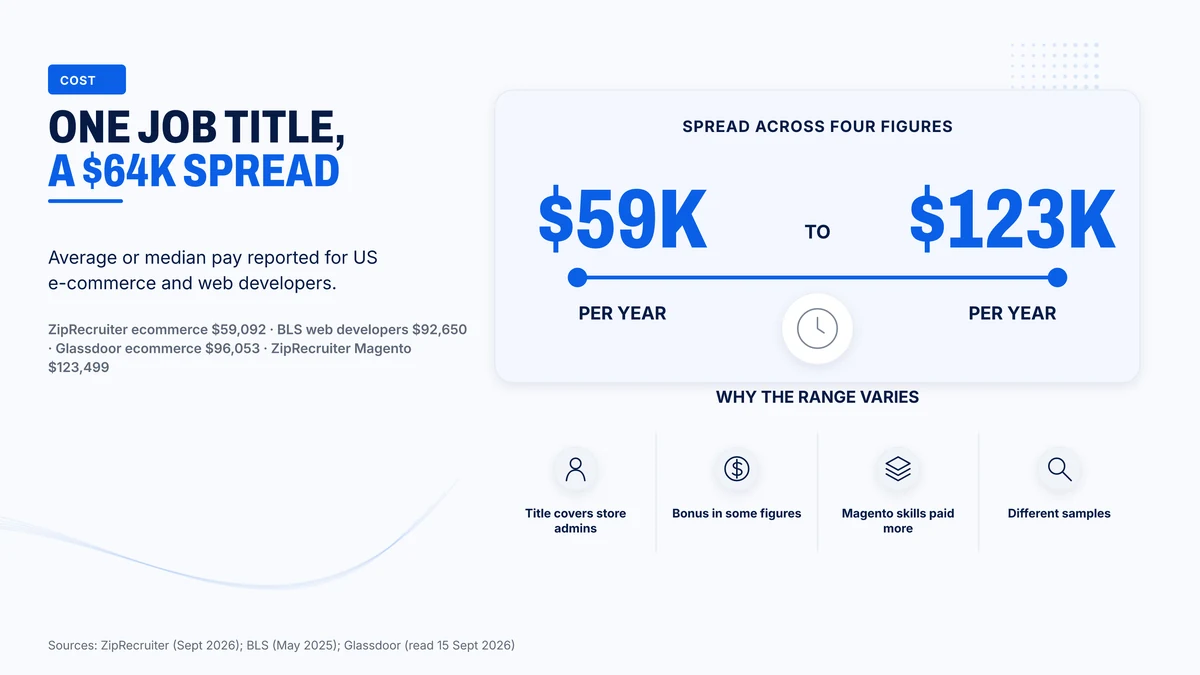
The $64,407 spread has three causes. “Ecommerce developer” covers store administrators as well as engineers who write integrations. Glassdoor’s figure includes bonuses and other pay. And platform skills are priced differently, with the Magento figure the highest of the four. We left out ZipRecruiter’s Shopify and BigCommerce developer pages because both showed exactly the same average, which points to a shared estimate rather than separate data.
Platform fees sit on top of labour. Shopify Plus starts at $2,300 a month on a three-year term, or $2,500 a month on a one-year term, and more complex, higher-volume businesses move to a variable platform fee (Shopify Plus pricing). Ask for the platform cost over three years next to the build price, whichever platform you pick.
Agency price floors vary far more than wages. The median minimum project across the twenty firms is $10,000, but minimums run from $1,000 to $250,000 (Clutch profiles, read 15 September 2026). Sixteen firms publish $100 an hour or more, and sixteen report a most common project size under $50,000.
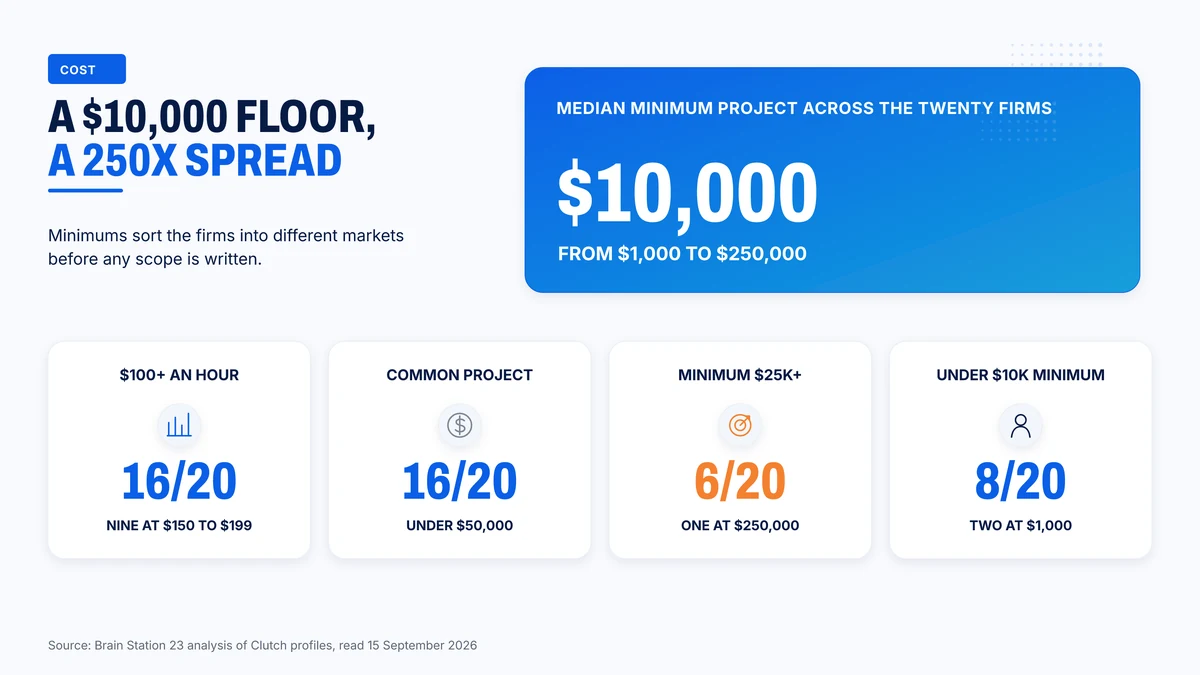
A minimum tells you which market a firm serves before anyone discusses scope. Two firms start at $1,000; Arctic Grey starts at $75,000 and CQL at $250,000. Eight factors decide where a quote lands inside that range.
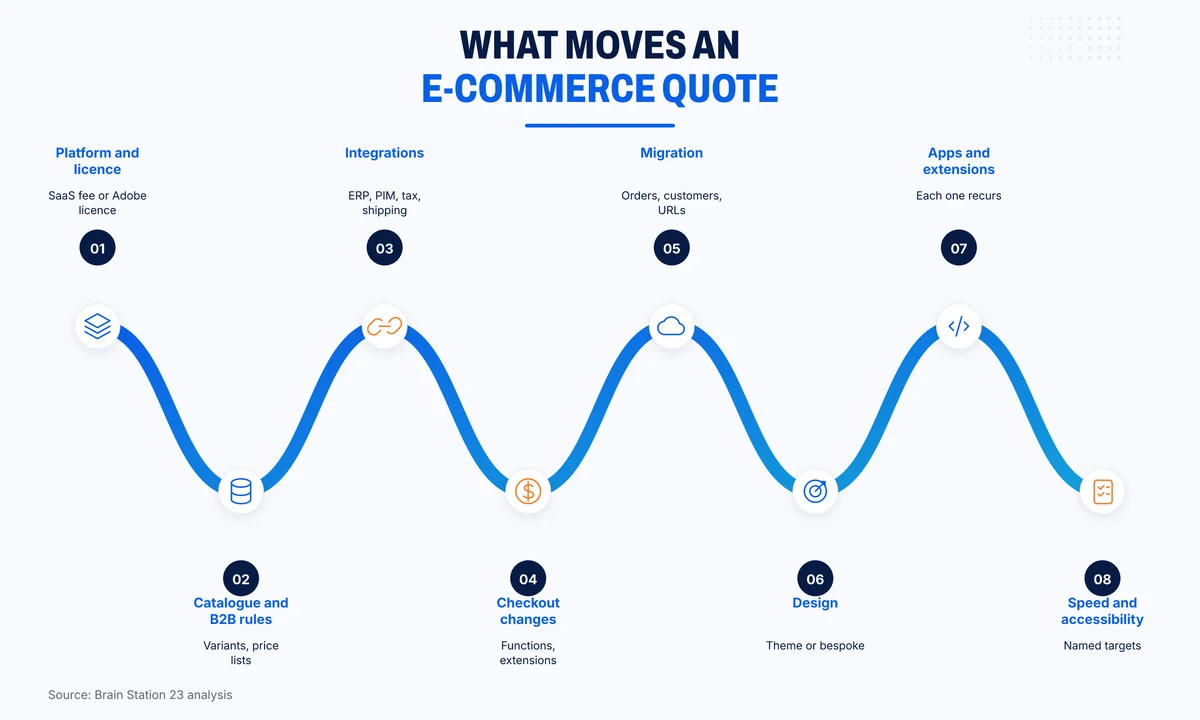
Platform and licence come first because they set the recurring base. Catalogue complexity and B2B rules, such as customer-specific price lists, change the data model. Integrations with ERP, PIM, tax and shipping systems carry the most unknowns. Checkout changes now run through Shopify Functions and checkout extensions, or through custom modules on Adobe Commerce. Migration adds orders, customer accounts and URL redirects. Design, the app and extension list, and named speed and accessibility targets complete it. Ask every vendor to price these lines separately, so you can compare like with like.
The Top 20 eCommerce Development Companies in USA, compared
We used Clutch’s directory of e-commerce developers in the United States, sorted by Clutch Rank and read on 15 September 2026. It lists 5,461 firms. The first two rows, FJ Solutions and Blue Badger, were paid placements, and we removed them. Firms 2 to 21 below are the next 20 in Clutch Rank order.
Brain Station 23 is placed first because we publish this article. We are US-headquartered, but e-commerce development is 5 percent of our published Clutch services, against a median of 70 percent for the twenty firms, so Clutch’s ranking did not place us in its top 20 and we are not claiming it did.
Every overall rating below sits between 4.8 and 5.0, so the stars do not separate these firms. The Platform Focus column does: it shows each firm’s largest e-commerce platform and how much of its services e-commerce development takes up.
| # | Company | Best For | Team Size | Platform Focus | Key Tech Stack | Industries Served | Locations |
|---|---|---|---|---|---|---|---|
| 1 | Brain Station 23 — brainstation-23.com | Adding cost-controlled engineers to an in-house commerce team | 250 – 999 | Other platforms 60%, Shopify and WooCommerce 20% each; e-commerce 5% of services | Shopify, WooCommerce, Java, .NET, Python, Flutter | Retail, medical, telecoms, education, financial services | Springfield VA; Bangladesh, UAE, England, Malaysia, Germany |
| 2 | EbizON Digital — ebizondigital.com | Magento-led stores on a low hourly budget | 50 – 249 | Magento 65%; e-commerce 70% of services | Magento, WooCommerce, Shopify, Drupal, PHP, React Native | Medical, consumer products, education, financial services | Altadena CA; Noida |
| 3 | Arctic Grey — arcticgrey.com | Enterprise Shopify brands with large budgets | 50 – 249 | Shopify 100%; e-commerce 80% | Shopify, React, Next.js, Node.js, Ruby on Rails | Retail, e-commerce, advertising, food and beverage, media | New York, Mountain View CA; London |
| 4 | Rave Digital — ravedigital.agency | Larger Magento builds and migrations | 250 – 999 | Magento 80%; e-commerce 100% | Magento, Shopify, React Native | Medical, consumer products, automotive, hospitality, media | Coral Springs FL; Indore |
| 5 | Codup — codup.co | B2B sellers connecting a store to NetSuite or SAP | 50 – 249 | Shopify and WooCommerce 30% each; e-commerce 30% | Shopify, WooCommerce, BigCommerce, NetSuite, SAP, Node.js | E-commerce, manufacturing, electrical, HVAC, retail | Houston, Irvine; Dubai |
| 6 | First Pier — firstpier.com | Small Shopify brands wanting a build plus SEO and marketing | 10 – 49 | Shopify 100%; e-commerce 45% | Shopify, Shopify SEO, WordPress, Squarespace | E-commerce, consumer products, retail, food and beverage | Portland ME |
| 7 | Staylime — staylime.com | Magento and Shopify stores that need performance work | 10 – 49 | Magento 70%; e-commerce 80% | Magento, Shopify, UX research | E-commerce | Redwood City CA |
| 8 | Absolute Web — absoluteweb.com | Mid-market retailers on Magento, Shopify or BigCommerce | 50 – 249 | Magento 50%; e-commerce 50% | Magento, Shopify, BigCommerce, WooCommerce, Adobe Experience Manager, Vue | E-commerce, retail, consumer products, manufacturing | Miami; Lisbon |
| 9 | HTMLPanda — htmlpanda.com | Small stores on the lowest hourly budget | 250 – 999 | Magento and Shopify 35% each; e-commerce 50% | Magento, Shopify, WooCommerce, WordPress, Laravel, React | E-commerce, business services, IT, medical | Walpole MA |
| 10 | SOLO MEDIA GROUP — solomediagroup.com | Small Shopify merchants with a low minimum | 10 – 49 | Shopify 100%; e-commerce 90% | Shopify, React, Vue, Node.js | E-commerce | Miami |
| 11 | CoSpark — cospark.com | WooCommerce stores needing API and integration work | 10 – 49 | WooCommerce 100%; e-commerce 75% | WooCommerce, WordPress, REST and webhook APIs | E-commerce | Irvine CA, Fredericksburg VA |
| 12 | Netalico — netalico.com | Shopify brands focused on conversion and UX | 10 – 49 | Shopify 85%; e-commerce 60% | Shopify, Magento, BigCommerce, Laravel, Vue, Sanity | E-commerce, food and beverage, automotive, consumer products | Miami, New York |
| 13 | Trellis — trellis.co | Mid-market manufacturers pairing commerce with ERP and marketing | 50 – 249 | BigCommerce and Shopify 40% each; e-commerce 35% | BigCommerce, Shopify, Magento, NetSuite, Microsoft Dynamics, React | Manufacturing, consumer products, e-commerce, retail | Malden MA, Springfield MO, Charlotte NC |
| 14 | Uncap — uncap.com | Shopify brands wanting a commerce-only team | 10 – 49 | Shopify 100%; e-commerce 100% | Shopify, React, Vue, Node.js, Ruby on Rails | E-commerce | Chicago, Dallas, Los Angeles |
| 15 | Sunrise Integration — sunriseintegration.com | Shopify apps and API integrations | 10 – 49 | Shopify 100%; e-commerce 50% | Shopify, Node.js, React, React Native, Salesforce Lightning | E-commerce, retail, consumer products, legal cannabis | Los Angeles |
| 16 | Above The Fray — abovethefray.io | Magento and BigCommerce redesigns for manufacturers | 10 – 49 | Magento 80%; e-commerce 60% | Magento, BigCommerce, Shopify, UX strategy | E-commerce, manufacturing, consumer products, medical | Portland OR |
| 17 | Ambaum — ambaum.com | Shopify-first stores on a small budget | 10 – 49 | Shopify 80%; e-commerce 90% | Shopify, WooCommerce | E-commerce, automotive, consumer products, hospitality, medical | Burien WA |
| 18 | Kadro Solutions — kadro.com | Magento stores that need rescue or replatforming | 50 – 249 | Magento 70%; e-commerce 80% | Magento, BigCommerce, Shopify, Adobe Experience Manager, PHP, Java | E-commerce | Raleigh NC |
| 19 | CQL — cqlcorp.com | Enterprise manufacturers and retailers on Salesforce Commerce | 50 – 249 | Salesforce Commerce 60%; e-commerce 50% | Salesforce Commerce, Shopify, .NET, Angular, Node.js | Manufacturing, retail, e-commerce | Grand Rapids MI |
| 20 | Bryt Designs — brytdesigns.com | Shopify stores wanting a very small React-skilled team | 2 – 9 | Shopify 100%; e-commerce 100% | Shopify, React | E-commerce, real estate, consumer products | Temecula CA |
| 21 | Fyresite — fyresite.com | Mid-market Shopify builds with AI and mobile work | 10 – 49 | Shopify 100%; e-commerce 70% | Shopify, AI development, mobile apps | E-commerce, arts and entertainment, consumer products | Tempe AZ |
Team sizes, service splits, e-commerce platform splits, industries and locations are from each firm’s published Clutch profile, read 15 September 2026. CQL’s “Demandware” listing is shown as Salesforce Commerce. “Best For” is our reading of that data. Engagement models and certifications are not published consistently across these profiles, so we have left them out rather than guess.
Profiles are grouped by the kind of buyer each firm suits, and the numbers match the table. Each caution comes from the Review Highlights that Clutch publishes from the firm’s verified reviews. Certifications are self-published and unverified by us; none of these Clutch profiles list PCI, ISO or platform partner credentials, which is why the profiles say to ask.
1. Brain Station 23
We publish this article and placed ourselves first, so read this entry as the publisher’s pick. E-commerce development is 5 percent of our published Clutch services, far below the 70 percent median of the firms below, and our platform split is 60 percent other systems, with Shopify and WooCommerce at 20 percent each. Most of our work, 60 percent, is engineers embedded in client teams, at a $25 to $49 band that only two firms below match or undercut. Where we help with the risks in this guide is process: ISO 27001 and SOC 2 Type II controls over access, change and patching. Our 21 reviews score Quality at 5.0 and Cost at 4.9, and reviewers have asked for tighter internal coordination. If you want a Shopify or Magento studio to own design and build, choose from the firms below.
Founded: 2006
US Presence: Springfield VA
Company size: Clutch band 250 to 999; we publish 900+ engineers
Rating: 4.9 across 21 Clutch reviews, HQ Springfield, Virginia
- Adding cost-controlled engineers to an in-house commerce team
- CMMI Level 3
- ISO 27001
- ISO 9001
- SOC 2 Type II (company-published)
- Staff augmentation
- E-commerce development
- Shopify and WooCommerce work
- Integrations
- Application modernisation
- Managed application support
- Retail
- Medical
- Telecoms
- Education
- Financial services
- E-commerce
- Ask which engineers on the proposed team have shipped the platform and version you run
For Shopify brands
3. Arctic Grey
Arctic Grey lists Shopify as its only e-commerce platform, and e-commerce development is 80 percent of its services. Half its clients are enterprises. Its $75,000 minimum is the second highest here, yet its most common reviewed project is $10,000 to $49,999, so older reviews may describe smaller work than it now accepts. Reviewers across 52 reviews credit timely delivery and project management. Some wanted more hours of post-launch support. Brands with budgets below the minimum should look further down this list.
Founded: 2015
US Presence: New York, Mountain View CA
Company size: 50 to 249
- Enterprise Shopify brands with large budgets
- Not published; ask directly
- Shopify Plus store builds
- Theme customisation
- Migrations
- ERP and POS integrations
- UX strategy
- Usability testing
- Retail
- E-commerce
- Advertising
- Food and beverage
- Media
- Ask how many post-launch support hours the proposal includes
6. First Pier
E-commerce development is 45 percent of First Pier’s services; the rest is marketing, conversion work, SEO and design, and 95 percent of its SEO focus is Shopify. Small businesses are 55 percent of its clients. Its 23 reviews rate it 4.9, with Cost the lowest sub-score at 4.6. Clutch’s summary puts typical projects at $2,500 to $25,000. One client raised team continuity. It suits a brand that wants one firm for the store and its marketing more than a complex integration.
Founded: 2009
US Presence: Portland ME
Company size: 10 to 49
- Small Shopify brands wanting a build plus SEO and marketing
- Not published; ask directly
- Shopify builds
- Shopify SEO
- Conversion rate audits
- E-commerce marketing
- Email marketing
- Web design
- E-commerce
- Consumer products
- Retail
- Food and beverage
- Manufacturing
- Ask who stays on your account if a team member leaves
10. SOLO MEDIA GROUP
SOLO MEDIA GROUP lists Shopify as its only platform and puts 90 percent of its services into e-commerce development. Three quarters of its clients are small businesses, and its $1,000 minimum ties for the lowest here. Clutch’s summary puts typical investments at $5,000 to $20,000, and its 48 reviews score 4.9 on every sub-score. One client reported missed deadlines and poor communication during a website redesign, which Clutch describes as an isolated case.
Founded: 2018
US Presence: Miami
Company size: 10 to 49
- Small Shopify merchants with a low minimum
- Not published; ask directly
- Shopify store builds
- Shopify customisation
- Web design
- React and Vue front ends
- E-commerce
- Ask how redesign timelines are tracked and who you escalate to
12. Netalico
Shopify is 85 percent of Netalico’s platform split, with Magento and BigCommerce making up the rest, and e-commerce is 70 percent of its industries. Clutch’s summary describes engagements from $2,000 monthly retainers to $110,000 projects and notes that some projects exceeded budgets. Its 28 reviews score Cost lowest at 4.6. Reviewers credit conversion rate gains. Some asked for more frequent updates and consistent contact with the same account managers. Agree the reporting cadence and budget checkpoints before work starts.
Founded: 2012
US Presence: Miami, New York
Company size: 10 to 49
- Shopify brands focused on conversion and UX
- Not published; ask directly
- Shopify builds
- Magento and BigCommerce work
- UX strategy
- Email marketing
- Web design
- Laravel development
- E-commerce
- Food and beverage
- Automotive
- Consumer products
- Ask how often you will get status updates and whether your account manager stays the same
14. Uncap
Uncap is one of three firms here that put all of their services into e-commerce development, and Shopify is its only platform. Its 73 reviews are the most of any Shopify-led firm on this list, and they rate it 5.0. Clutch’s summary puts projects at $10,000 to $50,000, while the profile lists a $25,000 minimum, so confirm the current floor. Reviewers describe large data migrations handled well. A few mentioned communication problems early in projects.
Founded: 2014
US Presence: Chicago, Dallas, Los Angeles
Company size: 10 to 49
- Shopify brands wanting a commerce-only team
- Not published; ask directly
- Shopify store builds
- Large data migrations
- Custom features
- Node.js and React development
- Ruby on Rails
- E-commerce
- Ask how information is shared across teams in the first weeks of the project
15. Sunrise Integration
Sunrise Integration pairs a Shopify-only platform split with mobile, low-code and web work, and Salesforce Lightning is 90 percent of its low-code focus. Founded in 1999, it is joint second-oldest here. Its 11 reviews rate it 5.0, and Clutch’s summary cites an API development investment of around $80,000. Reviewers praise its problem solving. Some said hour and budget estimates could be more accurate. It fits integration-heavy briefs better than design-led rebuilds.
Founded: 1999
US Presence: Los Angeles
Company size: 10 to 49
- Shopify apps and API integrations
- Not published; ask directly
- Shopify development
- API integrations
- Custom apps
- React Native mobile apps
- Salesforce Lightning
- UX design
- E-commerce
- Retail
- Consumer products
- Legal cannabis
- Ask how hour estimates are revised when scope changes
17. Ambaum
E-commerce development is 90 percent of Ambaum’s services, and Shopify is 80 percent of its platform split, with WooCommerce the rest. Clients are mid-market and small businesses. Clutch’s summary puts projects at $2,000 to over $50,000, and its 21 reviews rate it 4.9, with Quality the lowest sub-score at 4.8. Some clients asked for work to be double-checked before final review after mismatches with creative specs. Build a QA sign-off step into the plan.
Founded: 2012
US Presence: Burien WA
Company size: 10 to 49
- Shopify-first stores on a small budget
- Not published; ask directly
- Shopify store builds
- WooCommerce development
- E-commerce customisation
- Web development
- E-commerce
- Automotive
- Consumer products
- Hospitality
- Medical
- Ask how work is checked against the creative specification before your review
20. Bryt Designs
Bryt Designs is the smallest firm here and puts all of its services into e-commerce development, with Shopify as its only platform and React its only framework. Small businesses are 60 percent of its clients. Its 19 reviews rate it 4.9 and describe faster load times, better usability and more efficient checkouts. Some clients wanted more proactive strategic guidance and updates. With so small a team, confirm holiday and sickness cover before fixing a launch date.
Founded: 2014
US Presence: Temecula CA
Company size: 2 to 9
- Shopify stores wanting a very small React-skilled team
- Not published; ask directly
- Shopify store builds
- Custom Shopify development
- React
- Checkout and performance improvements
- E-commerce
- Real estate
- Consumer products
- Ask who provides strategic guidance and how often you get progress updates
21. Fyresite
Fyresite lists Shopify as its only platform, with AI and mobile development at 15 percent of services each. Mid-market companies are 75 percent of its clients. Clutch’s summary cites projects from $2,975 to $1 million. Its 38 reviews rate it 5.0, with Schedule the only sub-score below 5.0, at 4.9. Reviewers credit its integration and migration work. Some asked for fuller documentation of backend workflows and post-launch analytics, which belongs in the handover clause.
Founded: 2009
US Presence: Tempe AZ
Company size: 10 to 49
- Mid-market Shopify builds with AI and mobile work
- Not published; ask directly
- Shopify development
- Custom e-commerce
- Integrations and migrations
- AI development
- Mobile app development
- E-commerce
- Arts and entertainment
- Consumer products
- Automotive
- Ask what documentation you receive for backend workflows and analytics at handover
For Adobe Commerce and Magento stores
2. EbizON Digital
Magento is 65 percent of EbizON Digital’s platform split, and e-commerce development is 70 percent of its services. Enterprises and mid-market companies are 40 percent of its clients each. Its 99 reviews are the second most here, and its $25 to $49 band is the second lowest. Schedule is its lowest sub-score at 4.6. Some clients reported problems with project scoping and initial planning that led to unmet expectations and delays. Pay for a discovery phase before accepting a fixed quote.
Founded: 2007
US Presence: Altadena CA
Company size: 50 to 249
- Magento-led stores on a low hourly budget
- Not published; ask directly
- Magento development
- WooCommerce and Shopify builds
- Platform migrations
- Drupal and WordPress
- Mobile apps
- Custom software
- Medical
- Consumer products
- Education
- Financial services
- Manufacturing
- Ask for a written scope and plan before the estimate is final
4. Rave Digital
Rave Digital is one of three firms here that put all of their services into e-commerce development, and Magento is 80 percent of its platform split. Its 110 reviews are the most on this list, rate it 5.0, and put its most common reviewed project at $50,000 to $199,999, a larger band than sixteen of the other firms. Reviewers credit platform migrations and custom module work. Some said initial scoping and documentation could be better to avoid delays and miscommunication.
Founded: 2008
US Presence: Coral Springs FL
Company size: 250 to 999
- Larger Magento builds and migrations
- Not published; ask directly
- Magento development
- Shopify builds
- Platform migrations
- Custom module development
- React Native apps
- Medical
- Consumer products
- Arts and entertainment
- Automotive
- Hospitality
- Ask for scoping documents to be signed off before development starts
7. Staylime
E-commerce is Staylime’s only industry and 80 percent of its services, with Magento at 70 percent of its platforms. Its most common reviewed project is $50,000 to $199,999, despite a $5,000 minimum and a $50 to $99 band. Clutch’s summary puts projects at $2,500 to $80,000. Its 49 reviews rate it 4.8, and reviewers describe faster sites and higher sales. A few found technical details hard to follow or updates slow. Ask for a written weekly summary.
Founded: 2010
US Presence: Redwood City CA
Company size: 10 to 49
- Magento and Shopify stores that need performance work
- Not published; ask directly
- Magento development
- Shopify development
- Site performance optimisation
- UX strategy
- User research
- Web design
- E-commerce
- Ask how technical decisions will be explained and how often you get updates
8. Absolute Web
Absolute Web is joint second-oldest here and splits its platforms across Magento at 50 percent, Shopify at 30 and BigCommerce and WooCommerce at 10 each. Mid-market and enterprise companies are 90 percent of its clients. Its 83 reviews rate it 4.9, and Clutch’s summary puts projects from $5,000 to over $450,000. Reviewers credit its project management and technical knowledge. Some said its marketing services could be more comprehensive, so judge the development and marketing lines separately.
Founded: 1999
US Presence: Miami
Company size: 50 to 249
- Mid-market retailers on Magento, Shopify or BigCommerce
- Not published; ask directly
- Magento builds
- Shopify and BigCommerce development
- WooCommerce
- Adobe Experience Manager
- Email marketing
- Marketing strategy
- E-commerce
- Retail
- Consumer products
- Manufacturing
- Financial services
- Ask for marketing deliverables to be specified separately from development
16. Above The Fray
Magento is 80 percent of Above The Fray’s platform split, and e-commerce development 60 percent of its services. Its $25,000 minimum is among the higher floors here, and Clutch’s summary puts projects at $25,000 to $100,000 with teams of 2 to 10 people. Its 10 reviews rate it 4.8, with Quality lowest at 4.7. Reviewers mention sales tax compliance and integration work. Clutch notes initial challenges on some projects, resolved by adjusting resources and management approaches.
Founded: 2017
US Presence: Portland OR
Company size: 10 to 49
- Magento and BigCommerce redesigns for manufacturers
- Not published; ask directly
- Magento development
- BigCommerce builds
- Platform migrations
- Integrations
- UX strategy
- E-commerce marketing
- E-commerce
- Manufacturing
- Consumer products
- Medical
- Ask how resourcing changes if the first milestone slips
18. Kadro Solutions
E-commerce is Kadro Solutions’ only industry, and Magento is 70 percent of its platform split. Its $50,000 minimum is the third highest here, and Clutch’s summary puts projects at $20,000 to $300,000. It has nine reviews, rated 4.9, but a Schedule score of 4.4, the lowest schedule score on this list. Reviewers describe turning troubled stores into working ones and migrating platforms. Some suggest timeline management could improve. Tie payments to dated milestones.
Founded: 2001
US Presence: Raleigh NC
Company size: 50 to 249
- Magento stores that need rescue or replatforming
- Not published; ask directly
- Magento development
- Bug fixing and site rescue
- Platform migrations
- BigCommerce and Shopify builds
- Adobe Experience Manager
- Custom software
- E-commerce
- Ask how timelines are managed and which third-party tools the team depends on
For B2B, ERP and enterprise commerce
5. Codup
Codup is the only firm here that lists NetSuite SuiteCommerce and SAP in its platform split, alongside Shopify, WooCommerce and BigCommerce. Custom software matches e-commerce at 30 percent of its services, and manufacturing is 25 percent of its industries. Its 75 reviews rate it 4.9, and Clutch’s summary puts projects at $1,500 to over $80,000. Cost is its lowest sub-score at 4.7. Some clients experienced timeline extensions and scope adjustments. Agree a change-request process before integration work begins.
Founded: 2012
US Presence: Houston, Irvine
Company size: 50 to 249
- B2B sellers connecting a store to NetSuite or SAP
- Not published; ask directly
- Shopify and WooCommerce builds
- BigCommerce
- NetSuite SuiteCommerce
- SAP e-commerce
- Custom software
- Staff augmentation
- Application modernisation
- E-commerce
- Manufacturing
- Electrical
- HVAC
- Retail
- Ask how scope and timeline changes are approved and priced
13. Trellis
Trellis is the only firm here where e-commerce marketing, at 40 percent of services, outweighs e-commerce development, at 35. It is also the only one with an ERP consulting line, split across NetSuite, Infor and Microsoft Dynamics. Mid-market companies are 70 percent of its clients. Clutch’s summary puts projects at $15,000 to $250,000. Its 12 reviews rate it 4.9, with Cost lowest at 4.6. Some clients wanted clearer high-level project status and timeline reporting.
Founded: 2012
US Presence: Malden MA, Springfield MO, Charlotte NC
Company size: 50 to 249
- Mid-market manufacturers pairing commerce with ERP and marketing
- Not published; ask directly
- BigCommerce and Shopify builds
- Magento
- NetSuite
- Infor and Microsoft Dynamics ERP consulting
- E-commerce marketing
- Web design
- Manufacturing
- Consumer products
- E-commerce
- Retail
- Ask to see the status and timeline report format in the proposal
19. CQL
CQL is the oldest firm here and the only one whose largest platform is Salesforce Commerce, listed on Clutch as Demandware, at 60 percent. It also has the highest minimum, $250,000, and the only rate band above $199, at $200 to $300 an hour. Its four reviews rate it 4.9 and name no significant areas for improvement, but four reviews say little, and its Cost score is 4.3, the lowest sub-score on this list. It is priced for enterprise programmes, not first stores.
Founded: 1995
US Presence: Grand Rapids MI
Company size: 50 to 249
- Enterprise manufacturers and retailers on Salesforce Commerce
- Not published; ask directly
- Salesforce Commerce Cloud builds
- Shopify development
- UX strategy and research
- Web design
- Custom software
- .NET development
- Manufacturing
- Retail
- E-commerce
- Ask for recent client references, because the profile has only four reviews
For WooCommerce and low-budget stores
9. HTMLPanda
HTMLPanda publishes the lowest hourly band here, under $25, and ties for the lowest minimum at $1,000. Its platform split is close to even: Magento and Shopify at 35 percent each and WooCommerce at 30. Small businesses are 45 percent of its clients, and its most common reviewed project is under $10,000. Its 45 reviews score 5.0 on every sub-score, which leaves little to compare. One client suggested more communication methods. Confirm how much senior time the price includes.
Founded: 2014
US Presence: Walpole MA
Company size: 250 to 999
- Small stores on the lowest hourly budget
- Not published; ask directly
- Magento
- Shopify and WooCommerce builds
- WordPress
- Laravel and React development
- Low-code development
- E-commerce
- Business services
- IT
- Medical
- Ask which communication channels and meeting schedule the project will use
11. CoSpark
CoSpark is the only firm on this list whose platform split is WooCommerce alone, and API development is 10 percent of its services. Its clients spread across mid-market (40 percent), enterprise and small businesses (30 percent each). Clutch’s summary puts projects from $1,500 to over $100,000. Its 21 reviews rate it 4.9, with Cost lowest at 4.6, and reviewers describe ongoing support and maintenance. A few noted minor delays in back-end communication that did not affect delivery.
Founded: 2009
US Presence: Irvine CA, Fredericksburg VA
Company size: 10 to 49
- WooCommerce stores needing API and integration work
- Not published; ask directly
- WooCommerce development
- WordPress
- REST
- SOAP and webhook API development
- Integrations
- Support and maintenance
- E-commerce
- Ask how back-end questions are escalated and answered during development
What the twenty profiles show
We tallied the published data behind every profile. The result is not a ranking. It is a baseline for this Top 20 eCommerce Development Companies in USA list, so a proposal far outside it stands out.
Shopify is almost universal; Magento is the second specialism. Nineteen of the twenty include Shopify in their e-commerce platform split, and seven list it as their only platform. Shopify is the largest platform for nine firms and Magento for six. Three split their largest share evenly between two platforms, and WooCommerce and Salesforce Commerce lead at one firm each (Brain Station 23 analysis of Clutch profiles, read 15 September 2026).
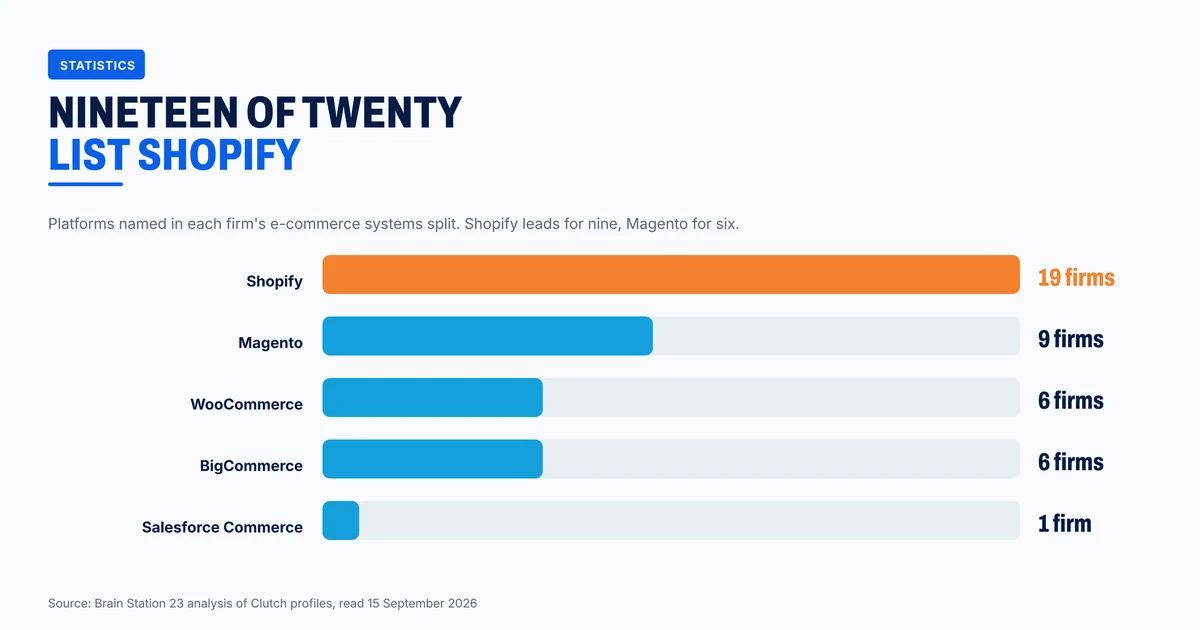
Shopify-led firms charge more per hour, for smaller projects. Six of the nine Shopify-led firms publish $150 to $199 an hour; one of the six Magento-led firms does. None of the Shopify-led firms reports a most common project of $50,000 or more, while three of the six Magento-led firms do, although Kadro’s figure rests on a single review. Our reading is that Magento stores carry more custom code, while Shopify absorbs hosting and much of the checkout.
Price floors split the market. Minimums run from $1,000 to $250,000, with a median of $10,000. Sixteen firms publish $100 an hour or more, nine of them $150 to $199, yet sixteen report a most common project under $50,000.
Cost is the weakest score. The twenty carry 830 reviews, with a median of 33, and four firms hold 44 percent of them. Six have fewer than 20. HTMLPanda and SOLO MEDIA GROUP score identically on all four sub-scores. Of the other eighteen, Cost is the lowest or joint-lowest for twelve, and Schedule and Quality for five each.
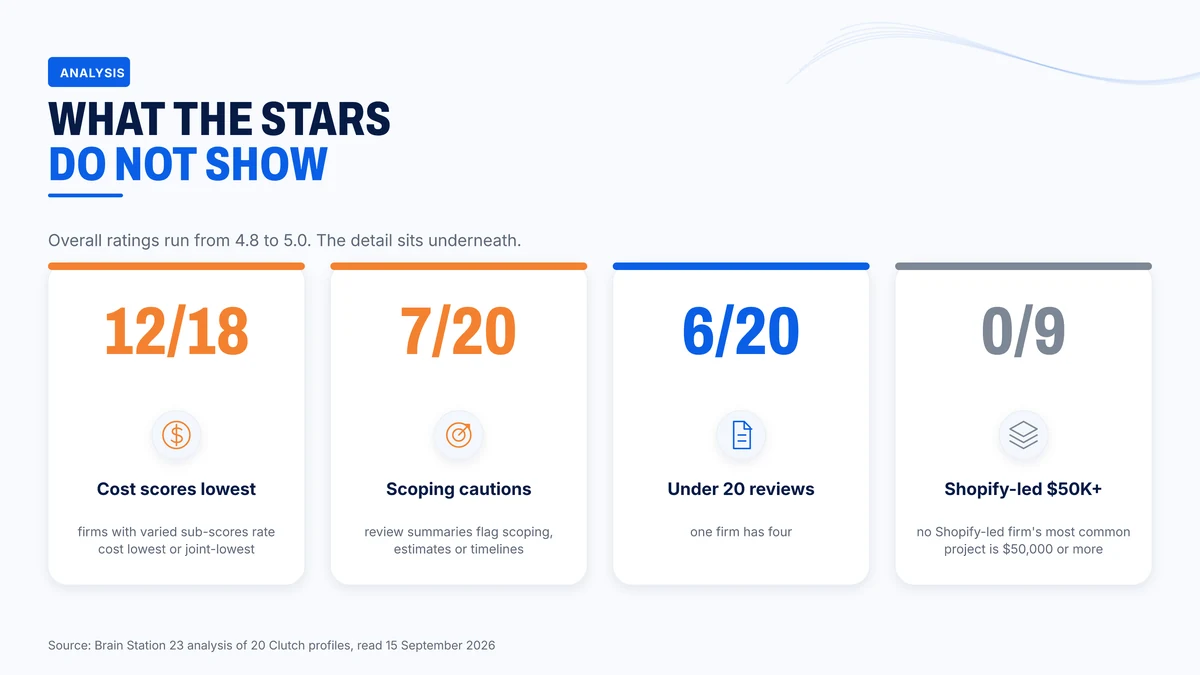
The cautions are about scoping and communication. Clutch’s review summaries flag scoping, estimates or timelines for seven firms and communication or reporting for six. Two have cautions about post-launch support or documentation, and quality checks, team continuity, strategic guidance and marketing services come up once each. CQL’s four reviews name no improvement area.
Most are small and US-based. Eighteen firms have fewer than 250 staff and eleven fewer than 50. Five list offices outside the US, in India, the UAE, England and Portugal.
How to shortlist an e-commerce development company
Order the filters so the first one removes the most firms.
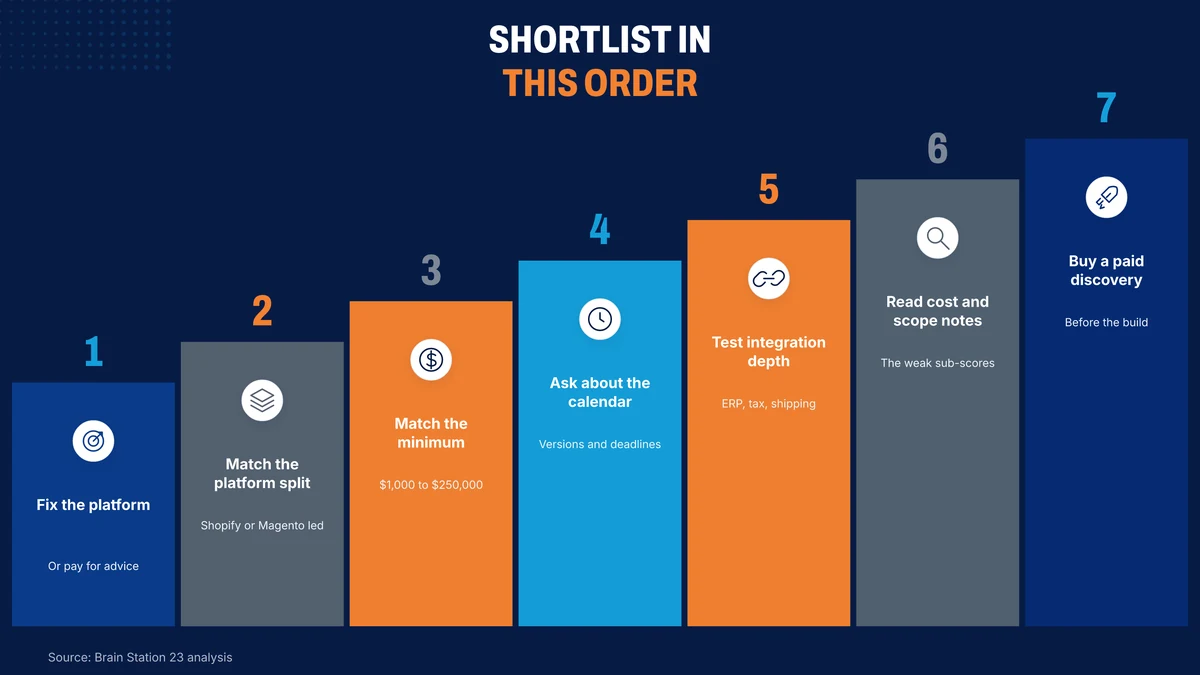
Step 1: Decide whether the platform is fixed. If you are still choosing, pay a multi-platform firm for a short platform assessment before asking anyone to quote a build.
Step 2: Match the firm’s platform split to yours. Nine firms here lead with Shopify and six with Magento. A firm that lists your platform at 10 percent has done it, but not often.
Step 3: Match your budget to the minimum. Minimums run from $1,000 to $250,000, so this step alone removes most of the list.
Step 4: Ask about the calendar. A serious vendor should know your version’s support dates, the Shopify Scripts and checkout changes, and what they mean for your store.
Step 5: Test integration depth. Ask for a recent example with your ERP, tax or shipping system, and who wrote the connector.
Step 6: Read the weak sub-scores and cautions. Cost is the lowest sub-score for twelve of the eighteen firms with varied scores, and scoping is the most common caution.
Step 7: Buy a paid discovery phase. A fixed-fee audit or discovery shows how the firm works before you commit to a build.
How to buy e-commerce development: four engagement models
The engagement model decides who pays when an integration takes three times its estimate.
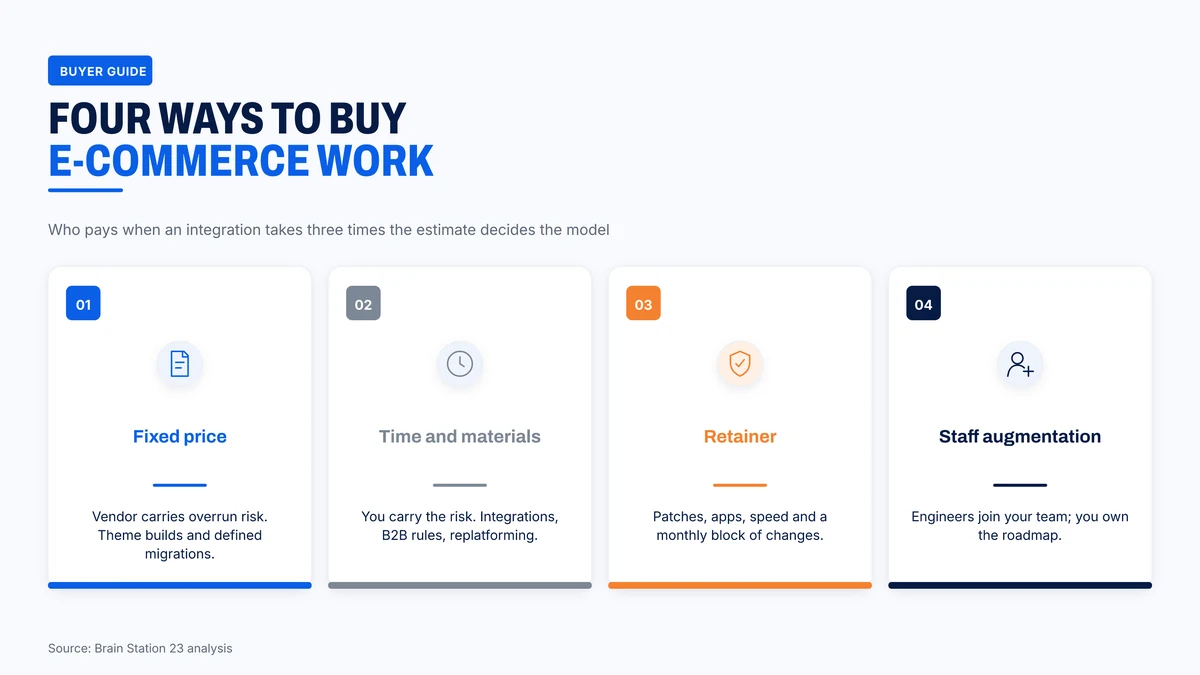
Fixed price moves overrun risk to the vendor, who prices it in. It suits theme-based builds and migrations with a known data set. It fails when integrations or B2B rules are still undefined, which is when change requests pile up.
Time and materials keeps the risk with you. It suits integrations, replatforming and custom checkout logic. Cap each phase and review burn weekly.
Retainer buys patches, app updates, speed work and a monthly block of changes. Two firms here carry review cautions about post-launch support or documentation, so write the retainer’s response times down.
Staff augmentation adds engineers to your team. Codup and Brain Station 23 publish staff augmentation lines. It fails when nobody in-house owns the roadmap and the platform decisions.
The technical question: upgrade, replatform or rebuild
Most e-commerce work is on stores that already exist. The order of the steps decides whether an upgrade is routine or a lost weekend of sales.
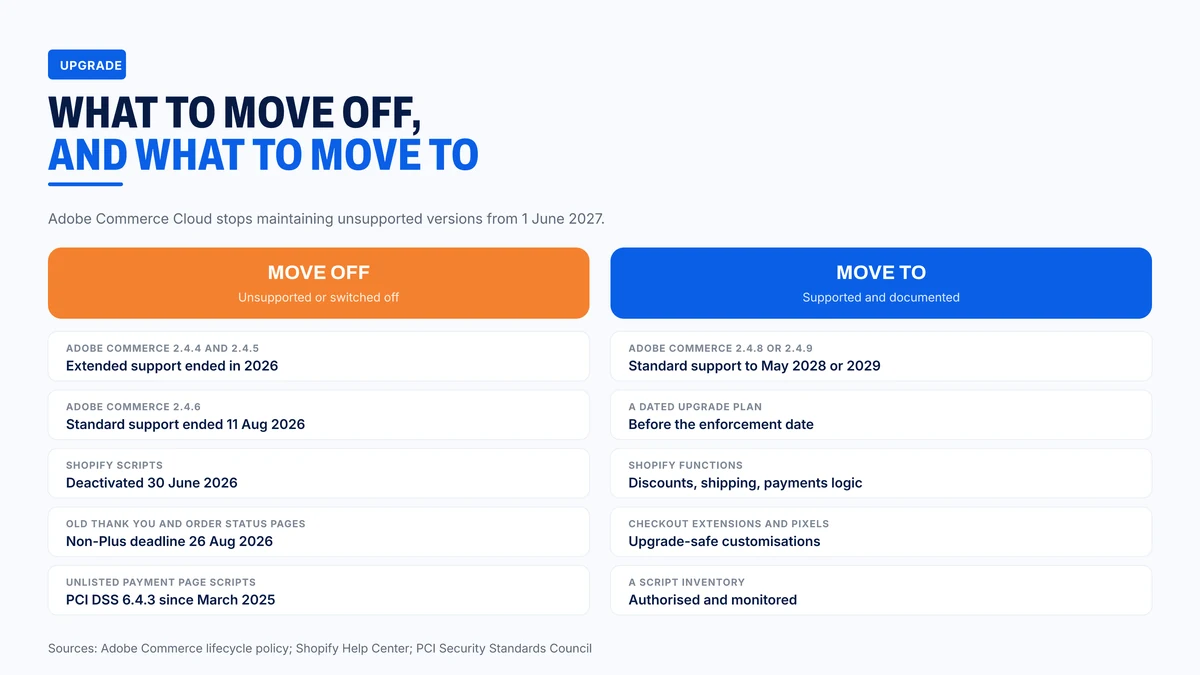
The steps, in the order that keeps them safest:
Step 1: Record the version and its dates. On Adobe Commerce, 2.4.8 has standard support to 31 May 2028 and 2.4.9 to 31 May 2029, while 2.4.6 and older are past standard support (Adobe Commerce lifecycle policy).
Step 2: Inventory customisations. List every module, app, script and theme change, with who wrote it and whether anyone still uses it. Shopify generates a customisations report for Scripts that were active before they were switched off (Shopify Help Center).
Step 3: Decide upgrade, replatform or rebuild. Upgrade when the customisations are few and documented. Replatform when the cost of staying current exceeds a migration over three years. Rebuild only when the data model itself is the problem.
Step 4: Rebuild checkout logic on supported extension points. On Shopify that means Shopify Functions and checkout extensions; on Adobe Commerce it means modules tested against the target version.
Step 5: Inventory payment page scripts. List every script on payment pages with its purpose, as PCI DSS requirement 6.4.3 expects for merchants in its scope (PCI Security Standards Council).
Step 6: Test orders end to end on staging. Place real test orders through payment, tax, shipping, ERP sync and refunds before anything reaches production.
Step 7: Measure before and after. Record mobile Core Web Vitals and checkout conversion before the release, so the upgrade can be judged on numbers.
Red flags: eight answers to walk away from
Some answers in a sales call should end it, or at least move a firm down the list.
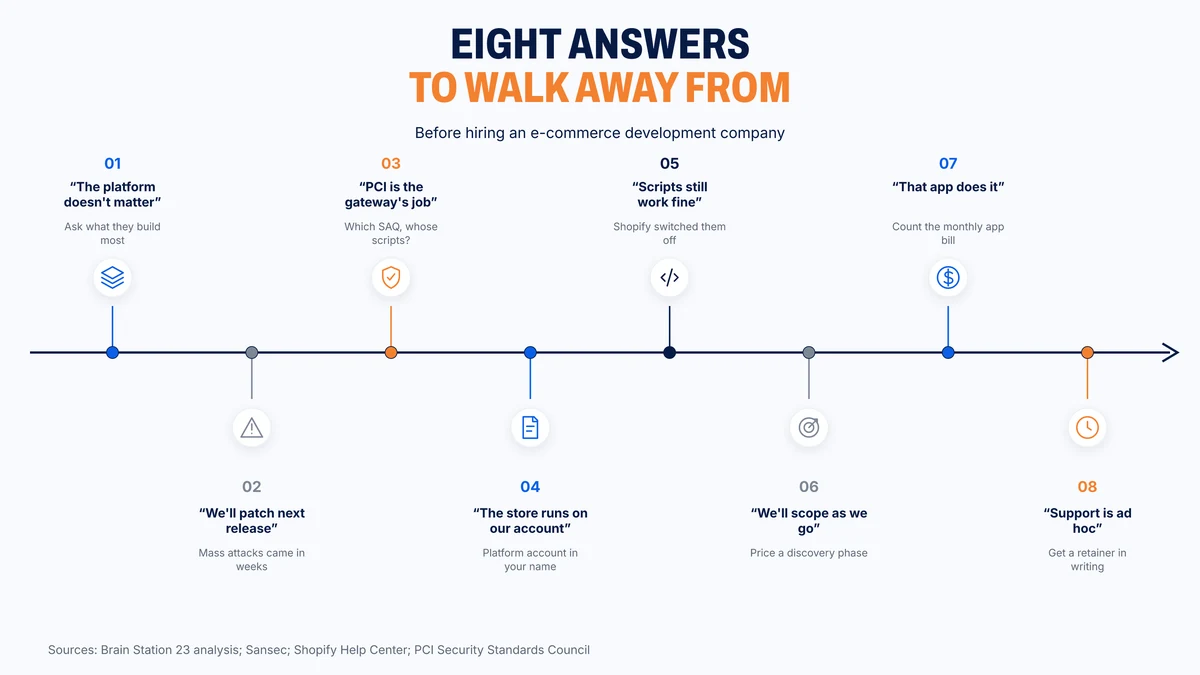
“The platform doesn’t matter, we do them all.” Ask which platform made up most of their last ten projects.
“We’ll include the patch in the next release.” SessionReaper mass attacks began six weeks after Adobe’s fix, while most stores were still unpatched.
“PCI is the payment gateway’s problem.” Ask which SAQ applies and who manages scripts on the payment page.
“The store runs on our platform account.” The Shopify or Adobe account, domain and hosting belong in your company’s name.
“Your scripts still work fine.” Shopify deactivated published Scripts on 30 June 2026.
“We’ll scope it as we go.” Seven firms here have review cautions about scoping or estimates. Pay for discovery instead.
“There’s an app for that.” Ask for the total monthly app bill at launch.
“Support is ad hoc.” Get a retainer with response times in writing before signing the build.
After launch: what the build quote leaves out
The list tells you who can build a store. This part covers what store owners wish they had settled before the final invoice, and what recurs for as long as the store sells.
What you must own before the final invoice
The platform account, whether Shopify, Adobe Commerce or BigCommerce, with your company as owner and the agency added as a staff or collaborator account.
The code repository with its history, including custom modules, apps, theme code and Shopify Functions.
Domain, DNS, CDN and hosting, under your billing where the platform is self-hosted.
Payment gateway, tax, shipping and ERP connector accounts, with API keys you can rotate.
App and extension subscriptions, under your company’s billing, with a list of what each one does.
A runbook, covering deployments, scheduled jobs, integrations and who to call when an order fails to sync.
The bill that arrives after launch
The build quote covers the store. The rest recurs.
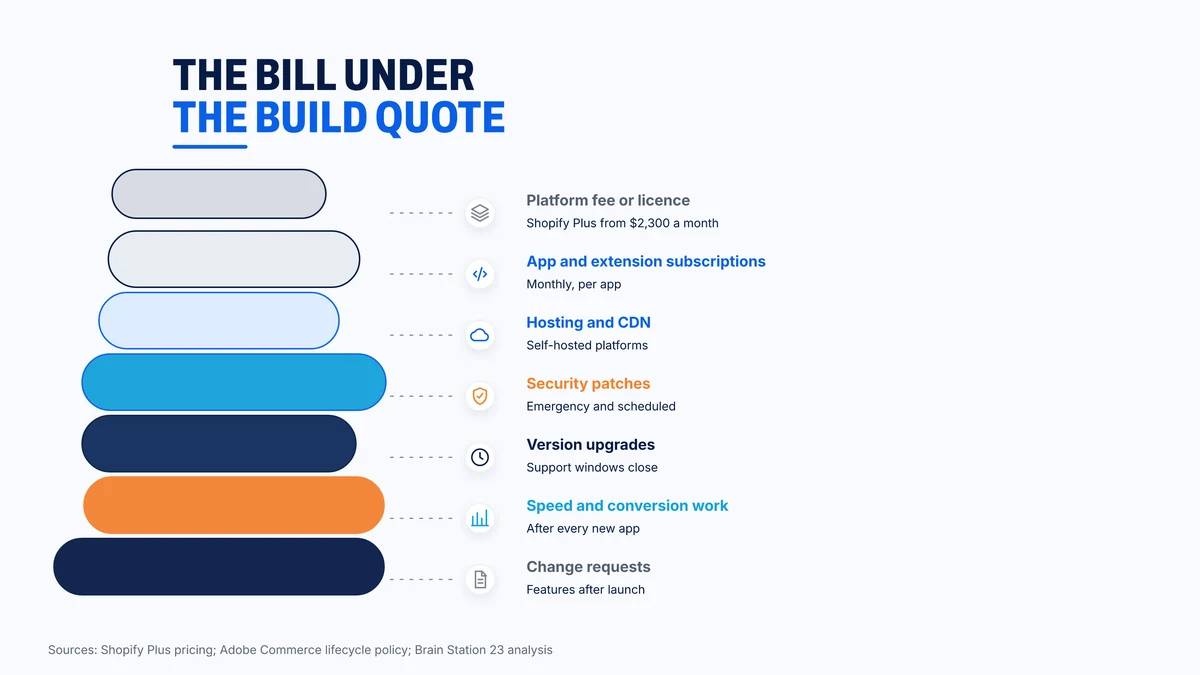
The recurring lines are the platform fee or licence, app and extension subscriptions, hosting and CDN on self-hosted platforms, security patches, version upgrades, speed and conversion work after each new app, and change requests. On Shopify Plus the platform fee alone starts at $27,600 a year on a three-year term (Shopify Plus pricing). Get the retainer price in writing before signing the build, and compare vendors on three years of cost.
Security is a recurring cost
The SessionReaper flaw in Magento and Adobe Commerce shows why patch speed belongs in the contract. Adobe published an emergency fix on 9 September 2025. Ten days later fewer than one in three Magento stores had applied it, mass attacks began on 22 October, and by 26 October Sansec estimated that 16 to 18 percent of all Magento stores had one or more backdoors injected (Sansec).
Hosted platforms move much of that patching to the vendor, but not the checkout. PCI DSS requirements 6.4.3 and 11.6.1, effective 31 March 2025, cover payment page script management and tamper detection; merchants using SAQ A must instead confirm their site is not susceptible to script attacks that could affect their e-commerce systems (PCI Security Standards Council). The average US data breach cost a record USD 11.5 million in IBM’s 2026 report (IBM Cost of a Data Breach Report 2026). Ask vendors how many hours a critical patch takes to reach production, and who watches the payment page for changed scripts.
Accessibility is legal exposure
Online stores draw most of the lawsuits. E-commerce accounted for nearly 70 percent of ADA web lawsuits, and more than 5,000 digital accessibility lawsuits had been filed by the end of 2025 (UsableNet). WebAIM found detected WCAG 2 failures on 95.9 percent of the top million home pages in 2026 (WebAIM Million 2026).
Name WCAG 2.2 AA in the contract rather than the word “accessible”. Test product, cart and checkout pages with a keyboard and a screen reader, including every app that injects content, and treat overlay widgets with scepticism.
Contract clauses that surface in month nine
These rarely come up in a sales call and often decide the relationship later. This is not legal advice; have your own counsel review any agreement.
IP assignment on payment, covering custom modules, apps, Shopify Functions, theme code and design files.
Account ownership, naming the platform account, domain, payment gateway, app subscriptions and integration credentials as yours.
Patch and support terms, stating how fast critical security patches are applied and what counts as a change request.
Platform deadline responsibility, stating who tracks version support and deprecation dates and when they must warn you.
PCI responsibilities, stating who manages payment page scripts and supports your SAQ.
Transition assistance, a fixed number of hours at an agreed rate if you move vendors.
Rate escalation caps, subcontracting disclosure, liability caps and insurance, and non-solicitation in both directions.
How to leave without losing the store
Confirm ownership of the platform account, repository, domain and gateway first. Export the app list, integration settings and a full data backup, and record walkthroughs of custom modules, Functions and scheduled jobs while relations are cordial.
On the last day, remove the agency’s staff and collaborator accounts, revoke its API tokens and app permissions, rotate payment, shipping and ERP credentials, and change hosting and database passwords.
Hire in-house or hire an e-commerce development company
Start with the wage. ZipRecruiter reports $59,092 for an ecommerce developer and $123,499 for a Magento developer, and Glassdoor $96,053 in average total pay for an ecommerce developer (ZipRecruiter, ZipRecruiter, Magento Developer, Glassdoor). A single hire at any of those figures costs more each year than the most common project size for sixteen of the twenty firms, before benefits.
Hire in-house when the store is the business, changes every week, and you can keep at least two people who know the integrations.
Hire an e-commerce development company for a build, a replatforming, a version upgrade or a checkout rebuild you cannot staff. Keep every account in your name so the choice stays reversible.
Combine the two when you have a store manager or a developer but need specialist help with integrations, security or speed.
FAQ
How much do US e-commerce development companies charge?
The twenty firms here publish hourly bands from under $25 to $300, and nine publish $150 to $199. Minimum projects run from $1,000 to $250,000, with a median of $10,000 (Clutch).
Which platform do most US e-commerce agencies build on?
On this list, Shopify. Nineteen of the twenty firms include it in their platform split and nine list it as their largest, while six lead with Magento (Clutch profiles).
Is Magento still supported?
Adobe Commerce 2.4.8 has standard support to 31 May 2028 and 2.4.9 to 31 May 2029. Standard support for 2.4.6 ended on 11 August 2026, and Adobe Commerce Cloud stops maintaining unsupported versions from 1 June 2027 (Adobe).
What happened to Shopify Scripts?
Shopify deprecated Scripts on 30 June 2026, and any Scripts still published were deactivated. Customisations have to be recreated with Shopify Functions or apps (Shopify Help Center).
Which e-commerce platform is fastest?
In HTTP Archive’s 2025 field data, 76 percent of Shopify stores had good mobile Core Web Vitals, against 35 percent of WooCommerce and Magento stores (Web Almanac 2025). A well-built store on any platform can beat those averages.
Does page speed affect sales?
Deloitte observed an 8.4 percent rise in retail conversions and a 9.2 percent rise in average order value with a 0.1-second mobile speed improvement (Deloitte).
How fast should security patches be applied?
Within days for critical flaws. Mass attacks on the SessionReaper flaw began six weeks after Adobe’s fix, when only 38 percent of Magento stores had patched (Sansec).
What does Shopify Plus cost?
Shopify lists Plus from $2,300 a month on a three-year term or $2,500 a month on a one-year term, with a variable platform fee for more complex, higher-volume businesses (Shopify).
Conclusion
The data behind this Top 20 eCommerce Development Companies in USA list says three things. Shopify is on nineteen of the twenty profiles, and Magento remains the second specialism, with larger projects. Price floors run from $1,000 to $250,000 around a $10,000 median. And reviewers mark cost lower than anything else, while the most common caution is scoping.
Any of the twenty can launch a store. What decides the next three years is the calendar and the upkeep: which version you run and when its support ends, how many apps and scripts sit on the checkout, how fast a critical patch reaches production, and whether the platform account and every credential are in your name on the day you choose someone else.
Sources
- https://clutch.co/us/developers/ecommerce?sort_by=ClutchRank
- https://clutch.co/profile/brain-station-23
- https://experienceleague.adobe.com/en/docs/commerce-operations/release/planning/lifecycle-policy
- https://help.shopify.com/en/manual/checkout-settings/script-editor/migrating
- https://help.shopify.com/en/manual/checkout-settings/checkout-extensibility/checkout-upgrade
- https://www.shopify.com/plus/pricing
- https://w3techs.com/technologies/details/cm-shopify
- https://almanac.httparchive.org/en/2025/ecommerce
- https://www.deloitte.com/ie/en/services/consulting/research/milliseconds-make-millions.html
- https://baymard.com/lists/cart-abandonment-rate
- https://sansec.io/research/sessionreaper
- https://www.census.gov/retail/ecommerce.html
- https://blog.pcisecuritystandards.org/important-updates-announced-for-merchants-validating-to-self-assessment-questionnaire-a
- https://www.ziprecruiter.com/Salaries/Ecommerce-Developer-Salary
- https://www.ziprecruiter.com/Salaries/Magento-Developer-Salary
- https://www.glassdoor.com/Salaries/ecommerce-developer-salary-SRCH_KO0,19.htm
- https://www.bls.gov/ooh/computer-and-information-technology/web-developers.htm
- https://www.ibm.com/reports/data-breach
- https://blog.usablenet.com/ada-web-lawsuit-trends-2026
- https://webaim.org/projects/million/