
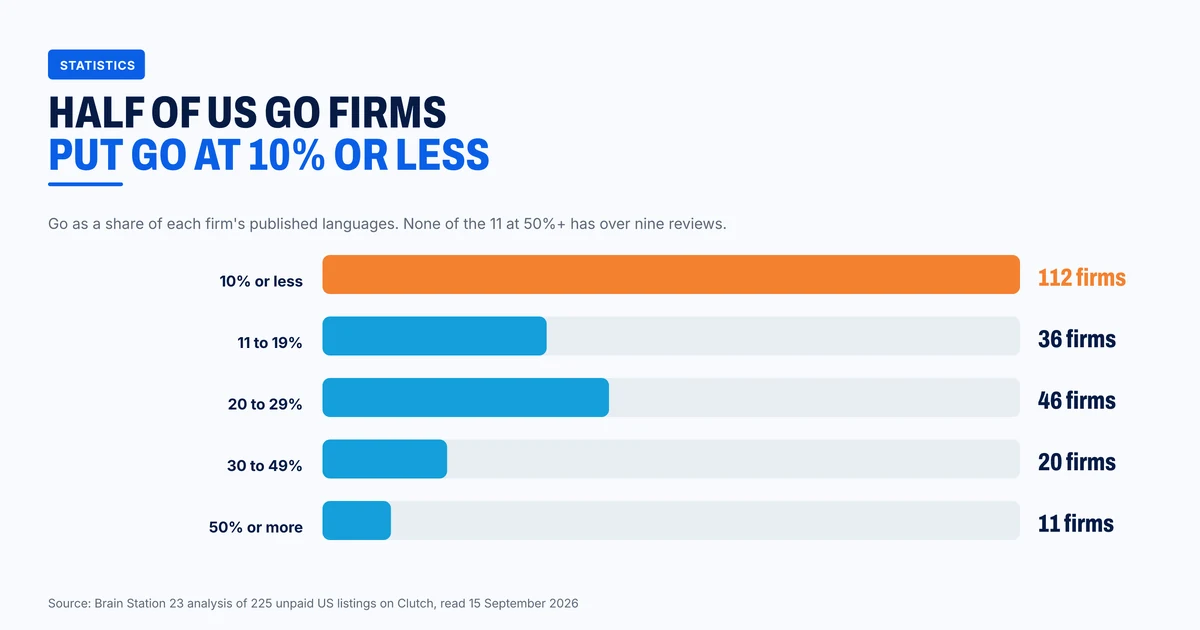
Clutch lists 226 companies in the United States under Go development, and 112 of the 225 unpaid listings put Go at 10 percent or less of their language work (Clutch, read 15 September 2026). Only 11 put it at half or more, and the highest-ranked of those sits 24th with a single review. We read all 689 client reviews behind this Top 20 Golang Development Companies in USA list, and four of them name Go, the most recent written in February 2023. The language is not the weak point. Ninety-one percent of the 5,379 developers in the Go team’s 2025 survey said they were satisfied working with it (Go Developer Survey 2025).
A directory tag is not evidence of Go work.
So we show the published Go share and the review record behind each firm, and we say where that record runs out. The guide also prices the work, sets out the release calendar that ends support for every Go version about a year after it ships, and covers what you must hold in your own name after launch: the repository, the cloud accounts, the build pipeline and the module settings.
Key takeaways
- 4 of 689 client reviews behind the twenty firms name Go, at three firms, and the newest dates from February 2023 (Brain Station 23 analysis of Clutch reviews, read 15 September 2026).
- 112 of 225 unpaid US listings in Clutch’s Go directory put Go at 10 percent or less of their languages, and 11 put it at 50 percent or more (Clutch).
- 19 August 2026 is when Go 1.27 shipped and Go 1.25 lost support, because each Go release is supported until two newer ones exist (Go release history).
- 8 of 8 months from January to August 2026 brought a Go point release with security fixes (Go release history).
- 1,953 reports were published to the Go vulnerability database between January and 10 September 2026, against 743 in all of 2025 (Go vulnerability database).
- 91% of 5,379 Go developers were satisfied with the language, and 55 percent build both command-line tools and API services with it (Go Developer Survey 2025).
- $130,886 to $141,247 is the range between Indeed’s and Glassdoor’s average pay for a US Golang developer (Indeed; Glassdoor).
- 14 of 19 firms that publish a rate charge under $100 an hour (Clutch profiles).
Go in 2026: well liked, narrowly used and on a six-month clock
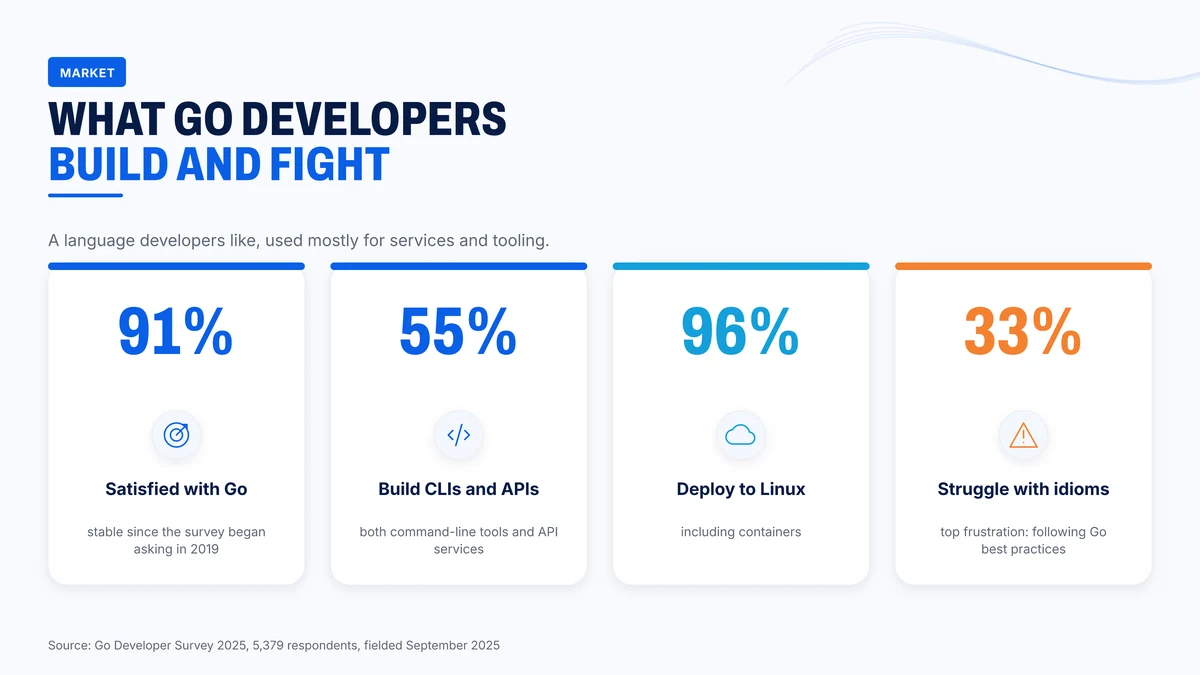
Go is a working language for services. In the Go team’s 2025 survey, 55 percent of respondents built both command-line tools and API services with it, more than a third built cloud infrastructure tooling, and 96 percent deployed to Linux-based systems, including containers (Go Developer Survey 2025). AWS was the most common deployment environment at 46 percent, followed by company-owned servers at 44 percent and Google Cloud at 26 percent.
Usage is steady rather than broad. Go was used by 16.4 percent of respondents to Stack Overflow’s 2025 survey and 17.4 percent of professional developers (Stack Overflow Developer Survey 2025). TIOBE’s September 2026 index, which counts search-engine results rather than use, places Go 12th, down from 8th a year earlier (TIOBE Index). Both say Go is a specialist tool for back ends and infrastructure, not a general-purpose default.
Most Go developers learned another language first. Eighty-one percent of survey respondents had more professional experience than Go experience, and the most common frustration, at 33 percent, was making code follow Go’s idioms and best practices (Go Developer Survey 2025). That matters for hiring. A vendor’s Java or Node.js engineers can write Go that compiles on day one and still reads like Java a year later.
The release clock is the fact that changes the brief. Each major Go release is supported until there are two newer major releases (Go release history). Go 1.26 shipped on 10 February 2026, which ended support for Go 1.24. Go 1.27 shipped on 19 August 2026, which ended support for Go 1.25. Only Go 1.27 and 1.26 receive fixes now.
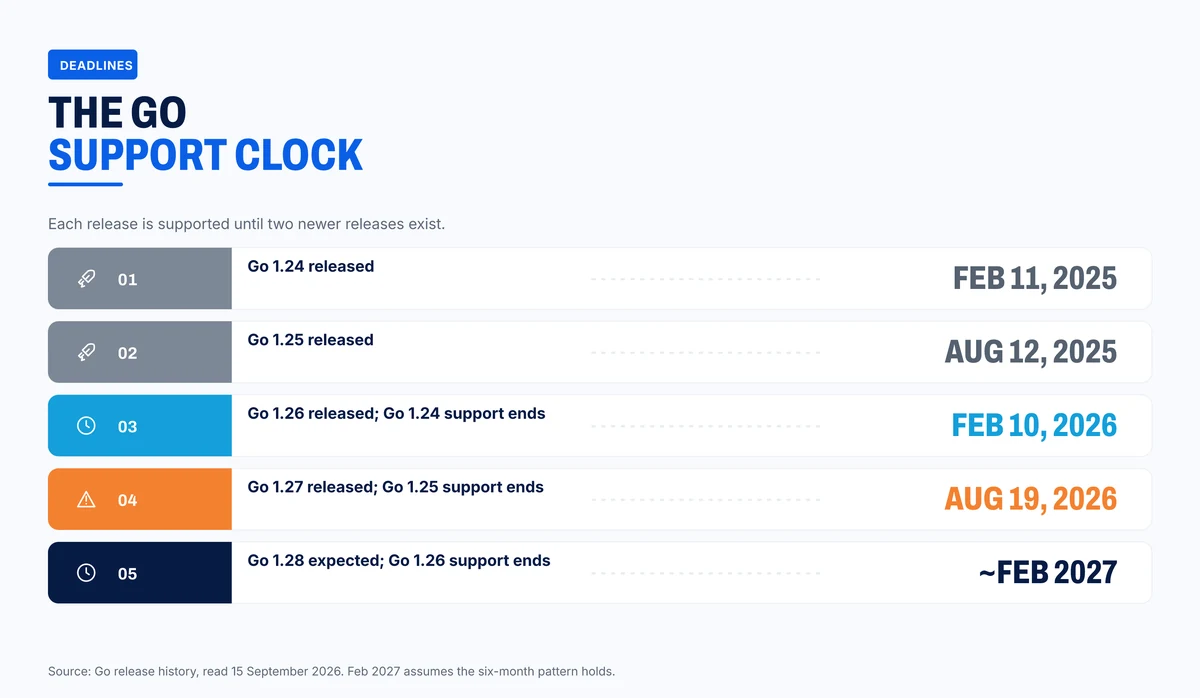
Go has shipped major releases in February and August for the last two years. If that pattern holds, Go 1.28 arrives around February 2027 and ends support for Go 1.26. A service built today needs two Go upgrades a year to stay supported, a line most build quotes leave out.
So brief a Go vendor with four facts: the services and their Go version in production, where they run, what they depend on, and who will own upgrades after launch.
What Go development costs in the US
Go salary figures are high, and the aggregators disagree on how high.
Indeed reports an average base salary of $130,886 for a Golang developer, from job postings over the past 36 months, updated 1 September 2026 (Indeed). The Bureau of Labor Statistics puts the median for all software developers at $135,980 in May 2025 (BLS). Glassdoor reports an average of $141,247 for a Golang developer from 96 salaries, with a typical range of $109,028 to $184,930 (Glassdoor).
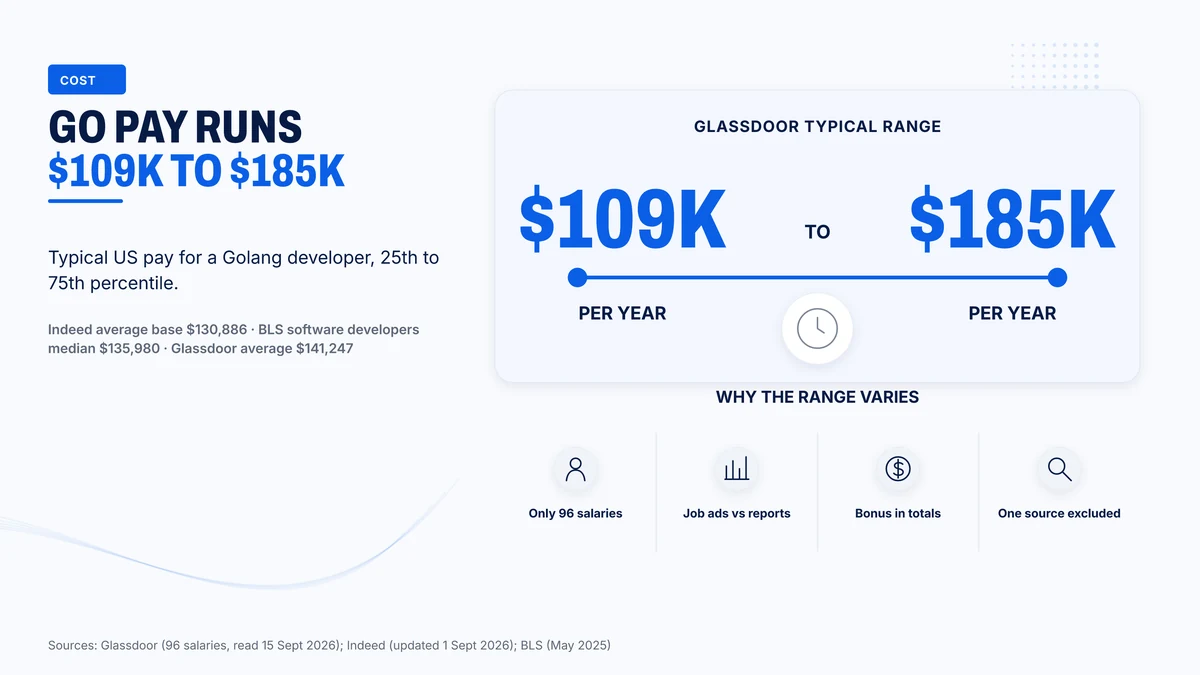
We left one source out. ZipRecruiter returned $120,086 for a Golang developer and the same figure for a generic backend developer on 15 September 2026, so it is not a Go-specific number. The honest reading is a band of roughly $110,000 to $185,000, close to software developer pay overall.
Agency pricing on this list is lower than those salaries suggest, and half the firms list offices outside the US. Fourteen of the nineteen firms that publish a rate charge under $100 an hour, and six charge $25 to $49 (Clutch profiles, read 15 September 2026). Minimum projects run from $5,000 to $100,000, and nine of the eighteen published minimums are $10,000 or less.
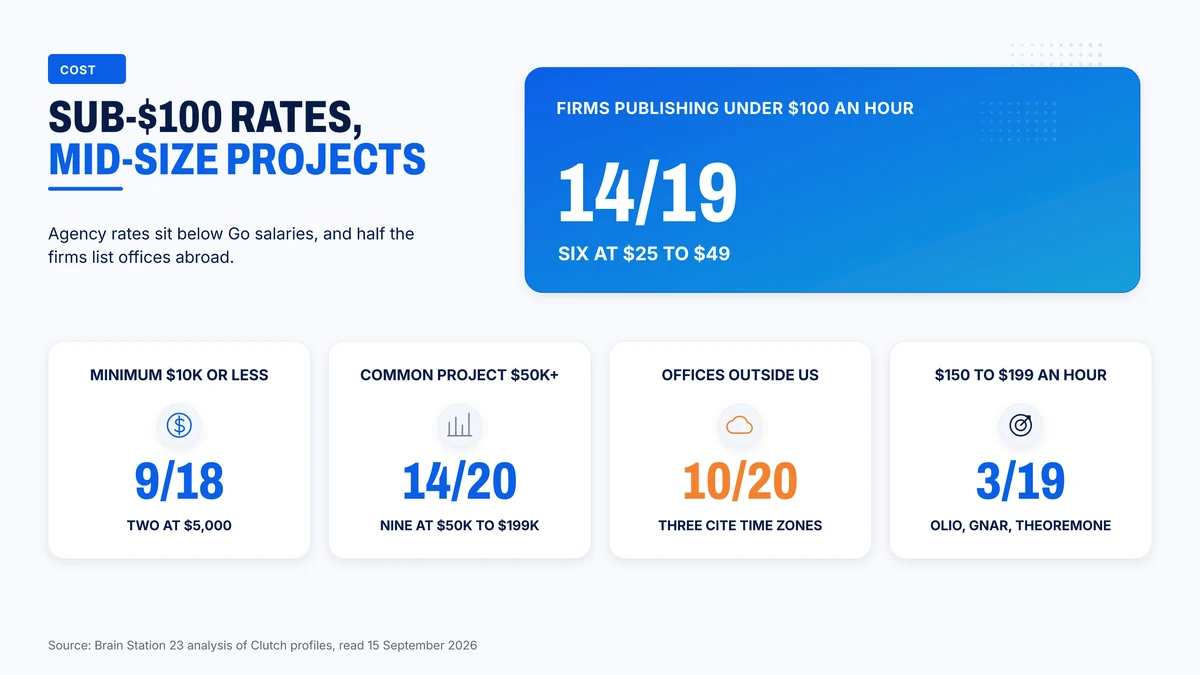
Project sizes tell a different story from minimums. Nine firms report a most common project of $50,000 to $199,999, and five report $200,000 or more. Eight factors decide where a Go quote lands inside that range.
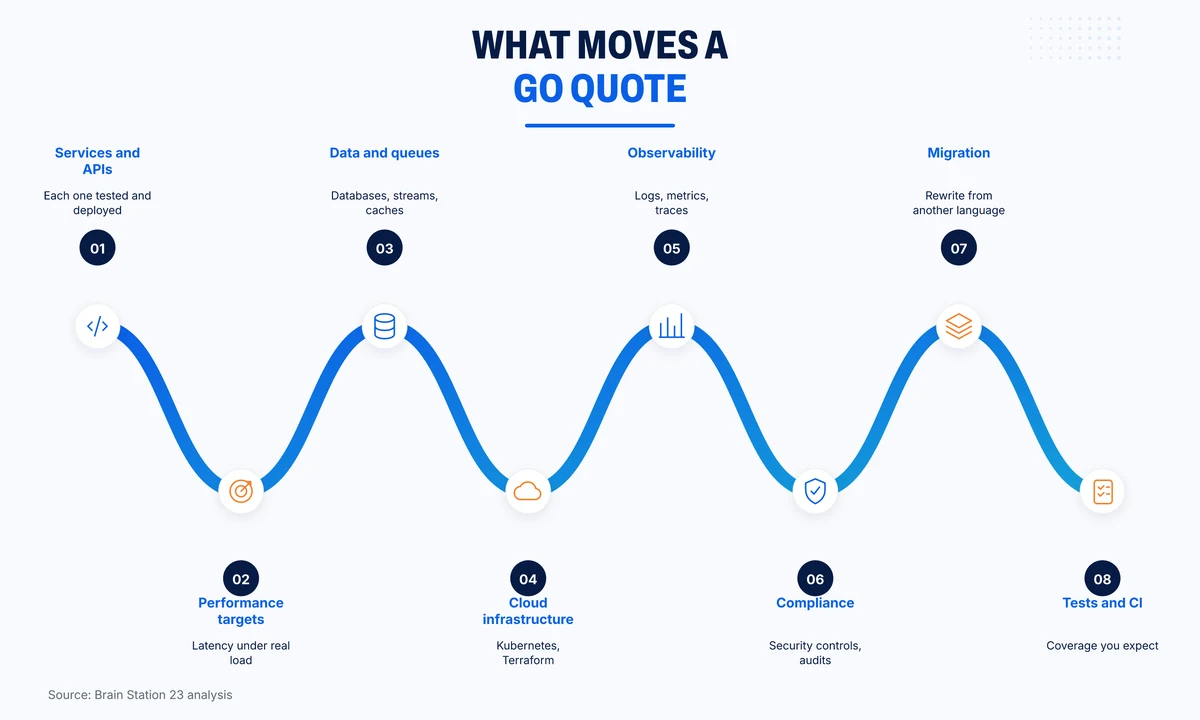
The number of services and APIs comes first, because each needs its own contracts, tests and deployment. Performance targets under load follow, then data stores and queues, cloud infrastructure, observability, compliance, any migration from another language, and the test coverage you expect. Ask every vendor to price these separately.
The Top 20 Golang Development Companies in USA, compared
Clutch has no separate page for Go firms in the United States, so we used Clutch’s Go developer directory filtered to the United States, sorted by Clutch Rank and read on 15 September 2026. It lists 226 firms. One row, Goji Labs in fourth place, was a paid placement, and we removed it. Firms 2 to 21 below are the next 20 in Clutch Rank order.
Brain Station 23 is placed first because we publish this article. We are US-headquartered, but Go is 7 percent of our published languages and Clutch’s US Go directory does not list us, so Clutch’s ranking did not place us in its top 20 and we are not claiming it did.
Every overall rating below sits between 4.7 and 5.0, so the stars do not separate these firms. The Go Focus column does: Go’s share of each firm’s published languages, the language that leads when Go does not, and the largest service line.
| # | Company | Best For | Team Size | Go Focus | Key Tech Stack | Industries Served | Locations |
|---|---|---|---|---|---|---|---|
| 1 | Brain Station 23 — brainstation-23.com | Adding cost-controlled engineers, including Go, to an in-house team | 250 – 999 | Go 7% of languages; not in Clutch’s US Go directory; staff augmentation 60% of services | Java, Spring, .NET, Python, Go | Retail, medical, telecoms, education | Springfield VA; Bangladesh, UAE, England, Malaysia, Germany |
| 2 | Vention — ventionteams.com | Large mid-market programmes mixing Go with JavaScript, Java and .NET | 1,000 – 9,999 | Go 20% (behind JavaScript 25%); AI development 20% of services | Go, JavaScript, Java, .NET, Python | Advertising, education, financial services, IT | New York, San Francisco; London, Vienna, Vilnius, Berlin, Warsaw |
| 3 | X-Team — x-team.com | Enterprise and gaming teams adding remote Go engineers | 250 – 999 | Go 30%, its largest language; staff augmentation 40% | Go, Kotlin, ASP.NET, React, Node.js | IT, gaming, financial services, media | Austin TX; Hawthorn East, Australia |
| 4 | Cleveroad — cleveroad.com | Education and mid-market software on a lower hourly budget | 250 – 999 | Go 10% (behind ASP.NET 40%, TypeScript 30%); custom software and web 30% each | .NET, TypeScript, Flutter, Node.js, Go | Education, financial services, IT, insurance | New York; Kharkiv, Dnipro, Kraków |
| 5 | Dualboot Partners — dualbootpartners.com | Product builds with budgets of $200,000 or more | 250 – 999 | Go 10%, one of ten languages at 10%; AI consulting 20% | React Native, Ruby on Rails, Django, Node.js, Go | Financial services, manufacturing, medical, construction | Charlotte NC; Montevideo |
| 6 | ScaleTech Solutions — scaletech.xyz | Startups and gaming or media platforms wanting Go and Node.js on AWS | 50 – 249 | Go 38% (level with JavaScript); custom software 40% | Go, Node.js, Django, Laravel, Next.js | Gaming, media, e-commerce, automotive | San Francisco; Frankfurt, Ahmedabad |
| 7 | NIX — nix-united.com | Large programmes needing a big bench across many stacks | 1,000 – 9,999 | Go 10%, one of seven at 10%; custom software 25% | Go, Java, Kotlin, Python, PHP | Automotive, education, medical, IT | Tampa FL, Boston |
| 8 | Calibrate Software — calibrated.io | Small and mid-sized mobile and web products on Go and Node.js | 10 – 49 | Go 30% (level with SQL); mobile and web 30% each | Go, SQL, Node.js, React Native, React | E-commerce, education, financial services, medical | Chicago |
| 9 | CyberCraft — cybercraftinc.com | Real estate and IT products on Rails and .NET with Go services | 50 – 249 | Go 15% (behind Ruby 40%, C# 30%); web 40% | Ruby on Rails, .NET, React, Go | IT, real estate, financial services, education | San Francisco |
| 10 | Jahnel Group — jahnelgroup.com | Companies wanting a US-based team at mid-range rates | 50 – 249 | Go 10% (behind Java and JavaScript, 30% each); web 40% | Java, JavaScript, Angular, Spring, Go | Business services, financial services, gaming, education | Schenectady NY, New York |
| 11 | Trango Tech — trangotech.com | Mobile-led projects with a cloud back end on a lower rate | 250 – 999 | Go 10%, one of ten at 10%; mobile 40% | Go, Node.js, Laravel, Angular, React Native | Automotive, education, financial services, gaming | Salt Lake City UT, Chicago; Dubai, Riyadh |
| 12 | Bluelight — bluelight.co | Larger nearshore builds at a lower rate | 250 – 999 | Go 10%, one of eight at 10%; custom software 30% | Go, Rust, TypeScript, Laravel, Node.js | Business services, education, financial services, manufacturing | Sacramento CA; São Paulo |
| 13 | Imaginovation — imaginovation.net | Mid-market AI, mobile and web builds with a US-managed team | 10 – 49 | Go 20% (level with Java); AI, custom software, mobile and web 25% each | Go, Java, Angular, React Native, Node.js | Business services, construction, education, legal | Raleigh NC |
| 14 | Piboutique Software — piboutique.com | Small businesses with modest budgets | 2 – 9 | Go 20%, one of five at 20%; web 40% | Go, PHP, Python, Laravel, Vue.js | Business services, medical, real estate | Plantation FL, Miami |
| 15 | TheoremOne — theoremone.co | Enterprises wanting strategy plus engineering for a new platform | 250 – 999 | Go 10% (behind Ruby 15%); custom software 30% | Ruby, C#, Go, .NET, Node.js | Business services, IT, telecoms, consumer products | Los Angeles, Santa Monica |
| 16 | Olio Apps — olioapps.com | Larger custom builds at senior rates, including generative AI | 10 – 49 | Go 20% (behind JavaScript 40%); custom software and web 30% each | JavaScript, Go, Java, Python | IT, medical, business services, energy | Portland OR |
| 17 | SEROKELL — serokell.io | AI, blockchain and research-heavy systems | 50 – 249 | Go 10% (behind Rust 30%, Elixir and Python 20%); AI 30% | Rust, Elixir, Python, Go, TypeScript | Medical, automotive, education, financial services | Los Angeles, New York, Austin; Paris, Tel Aviv, Berlin, Dubai, Riyadh |
| 18 | EbizON Digital — ebizondigital.com | E-commerce stores and small improvements on a tight budget | 50 – 249 | Go 10% (behind PHP 60%); e-commerce 70% | PHP, Laravel, React Native, Node.js, Go | Medical, consumer products, education, energy | Altadena CA; Noida |
| 19 | The Gnar Company — thegnar.com | Enterprise and government teams wanting senior JavaScript and Ruby engineers | 10 – 49 | Go 10% (behind JavaScript 40%); custom software and mobile 30% each | JavaScript, TypeScript, Ruby on Rails, React, Go | Business services, government, manufacturing, logistics | Needham MA |
| 20 | Azumo — azumo.com | Mid-market AI and generative AI projects with nearshore engineers | 50 – 249 | Go 11% (behind Kotlin 12%); AI development 35% | Go, Kotlin, Python, .NET, Laravel | Advertising, business services, education, financial services | San Francisco; Rosario, Argentina |
| 21 | Mercury Development — mercurydevelopment.com | Long-term product partnerships above $200,000 | 250 – 999 | Go 10%, one of ten at 10%; mobile 20% | Go, Python, Java, Flutter, React Native | Hospitality, medical, business services, media | Aventura FL, Atlanta |
Team sizes, service splits, language splits, industries and locations are from each firm’s published Clutch profile, read 15 September 2026. “Best For” is our reading of that data. Engagement models and certifications are not published consistently across these profiles, so we have left them out rather than guess.
Profiles are grouped by buyer type, and the numbers match the table. Each caution comes from the Review Highlights that Clutch publishes from the firm’s verified reviews. Certifications are self-published and unverified by us, and none of the twenty Clutch profiles lists one, so ask directly. Where we say a firm’s reviews name Go, we read every review on its Clutch profile to check.
1. Brain Station 23
We publish this article and placed ourselves first, so read this entry as the publisher’s pick. Go is 7 percent of our published languages, and Clutch’s US Go directory does not list us, so we are not a Go specialist in the way X-Team or ScaleTech are. Our strength is staffing: 60 percent of our work is engineers embedded in client teams, at a $25 to $49 band that six firms below also publish. For the risks in this guide, our ISO 27001 and SOC 2 Type II controls govern access, change and patching, which matters when Go ships security fixes every month. Our 21 reviews score Quality at 5.0 and Cost at 4.9, none of them name Go, and reviewers have asked for tighter internal coordination. If you want a Go-first firm to design and own a platform, start with the first group below.
Founded: 2006
US Presence: Springfield VA
Company size: Clutch band 250 to 999; we publish 900+ engineers
Rating: 4.9 across 21 Clutch reviews, HQ Springfield, Virginia
- Adding cost-controlled engineers, including Go, to an in-house team
- CMMI Level 3
- ISO 27001
- ISO 9001
- SOC 2 Type II (company-published)
- Staff augmentation
- Custom software development
- Application modernisation
- Java and Spring
- .NET
- Python
- Go
- Retail
- Medical
- Telecoms
- Education
- Financial services
- Ask which engineers on the proposed team have run Go services in production, and on which Go release
Where Go is a fifth or more of the work
2. Vention
Go is 20 percent of Vention’s languages, behind JavaScript at 25, and its services spread across eight lines led by AI development. Its 102 reviews are the deepest record on this list, and Clutch’s summary puts projects at $25,000 to over $200,000 against a $50,000 minimum. Reviewers credit responsiveness and the speed at which it scales teams. Some reported an initial skill mismatch or communication barriers that Vention then corrected, so interview the named engineers before the start date.
Founded: 2002
US Presence: New York, San Francisco
Company size: 1,000 to 9,999
- Large mid-market programmes mixing Go with JavaScript, Java and .NET
- Not published; ask directly
- Go
- JavaScript
- Java
- ASP.NET
- Python
- AI development
- Application modernisation
- Advertising
- Education
- Financial services
- IT
- Medical
- Ask who approves each engineer’s skill match before they join your team
3. X-Team
X-Team is the only firm in this top 20 where Go is the single largest language, at 30 percent, and staff augmentation is 40 percent of its services. Sixty percent of its clients are enterprises. The review record is thin: eight reviews, with Clutch’s summary citing projects from $100,000 to $1 million. Reviewers praise engineer quality and account management. One found email-heavy communication slow, so set up shared chat and ticketing on day one. Treat X-Team as a staffing partner rather than a firm that owns delivery.
Founded: 2006
US Presence: Austin TX
Company size: 250 to 999
- Enterprise and gaming teams adding remote Go engineers
- Not published; ask directly
- IT staff augmentation
- Custom software development
- Go
- Kotlin
- React
- Node.js
- Cloud consulting
- IT
- Gaming
- Financial services
- Media
- Education
- Agree the communication tools before engineers join
6. ScaleTech Solutions
ScaleTech puts Go at 38 percent of its languages, level with JavaScript and the highest share in this top 20. Infrastructure shows in the profile: IT managed services are 25 percent of its work, and AWS and Linux servers are its main platforms. Sixty percent of its clients are small businesses, and its most common project is under $50,000. Quality is its lowest sub-score at 4.6. Some clients found real-time communication hard across time zones, with teams in Frankfurt and Ahmedabad as well as San Francisco.
Founded: 2017
US Presence: San Francisco
Company size: 50 to 249
- Startups and gaming or media platforms wanting Go and Node.js on AWS
- Not published; ask directly
- Custom software development
- IT managed services
- Go
- JavaScript
- Node.js
- Django
- Laravel
- Gaming
- Media
- E-commerce
- Automotive
- IT
- Fix overlap hours and a response window with the offshore team
8. Calibrate Software
Go and SQL are tied at 30 percent of Calibrate’s languages, and AWS accounts for 70 percent of its platform work. Half of its clients are small businesses and its most common project is under $50,000, although Clutch’s summary records projects from $1,000 to over $500,000. Reviewers describe a flexible team with strong project management. Schedule is its lowest sub-score at 4.7, and some clients noted occasional delays, so put milestone dates and a written process for flagging slippage into the contract.
Founded: 2017
US Presence: Chicago
Company size: 10 to 49
- Small and mid-sized mobile and web products on Go and Node.js
- Not published; ask directly
- Mobile app development
- Web development
- Custom software
- UX/UI design
- AI consulting
- Go
- SQL
- E-commerce
- Education
- Financial services
- Medical
- Business services
- Ask for milestone dates and how slippage is reported
13. Imaginovation
Imaginovation splits its services evenly across AI, custom software, mobile and web at 25 percent each, with Go and Java tied at 20 percent of its languages. AWS is 90 percent of its platform work. Clutch’s summary puts investments at $17,000 to $800,000, and its most common project is $50,000 to $199,999. Reviewers credit technical expertise and an enthusiastic team. One asked for more frequent check-ins between the US team and offshore programmers, which confirms that part of the build happens outside the US.
Founded: 2011
US Presence: Raleigh NC
Company size: 10 to 49
- Mid-market AI, mobile and web builds with a US-managed team
- Not published; ask directly
- AI development
- Custom software
- Mobile and web development
- Go
- Java
- Angular
- React Native
- Business services
- Construction
- Education
- Legal
- Medical
- Ask how often the US team and offshore developers check in, and whether you can join
14. Piboutique Software
Piboutique is the smallest firm here, with a $5,000 minimum, and every client it lists is a small business. Go is one of five languages at 20 percent each. All 30 reviews score 5.0 on every measure, and its most common project is $10,000 to $49,999. Reviewers describe strong QA and adaptability. The one suggestion was better onboarding for new or junior staff. A team this size suits a contained product. It is a risk for a platform that needs cover when someone is away.
Founded: 2019
US Presence: Plantation FL, Miami
Company size: 2 to 9
- Small businesses with modest budgets
- Not published; ask directly
- Web development
- Custom software
- Mobile app development
- Go
- PHP
- Python
- Laravel
- Business services
- Medical
- Real estate
- Ask who joins if the project grows, and how new or junior staff are onboarded
16. Olio Apps
Olio Apps charges $150 to $199 an hour, the top band on this list, and its most common project is $200,000 to $999,999. Go is 20 percent of its languages, behind JavaScript at 40. Its clients split almost evenly between small businesses, mid-market firms and enterprises. Reviewers rate it 5.0 and credit adaptability and integration with client teams. Some wanted more transparency on task assignments and code contributions, so ask for repository access and a role map from the first sprint.
Founded: 2012
US Presence: Portland OR
Company size: 10 to 49
- Larger custom builds at senior rates, including generative AI
- Not published; ask directly
- Custom software development
- Web development
- AI consulting
- Generative AI
- Mobile development
- Go
- JavaScript
- IT
- Medical
- Business services
- Energy
- Arts and entertainment
- Ask for named roles and visibility of who commits which code
For large teams and staff augmentation
4. Cleveroad
Cleveroad publishes a $25 to $49 band and a $10,000 minimum, and its most common project is under $50,000. Go is 10 percent of its languages, behind ASP.NET at 40 and TypeScript at 30, and education is half its industry mix. Reviewers highlight QA, design and cost management, and Clutch lists no improvement area. Development runs from Ukraine and Poland as well as New York. With 81 reviews it is a well-documented choice for .NET or TypeScript work that includes some Go, and a weaker one for a Go-first platform.
Founded: 2011
US Presence: New York
Company size: 250 to 999
- Education and mid-market software on a lower hourly budget
- Not published; ask directly
- Custom software development
- Web and mobile development
- API development
- AI agents
- .NET
- TypeScript
- Go
- Education
- Financial services
- IT
- Insurance
- Medical
- Ask which named engineers have shipped Go services, because .NET and TypeScript lead its languages
5. Dualboot Partners
Dualboot’s $75,000 minimum is the second highest here, and its most common project is $200,000 to $999,999. It does not publish a rate. Go is one of ten languages at 10 percent each, and AI consulting and development together make up 35 percent of its services. Reviewers describe a partnership mentality and smooth integration with client teams. Clutch’s summary says initial timeline estimates could be more accurate, so pay for a discovery phase before committing to a delivery date.
Founded: 2018
US Presence: Charlotte NC
Company size: 250 to 999
- Product builds with budgets of $200,000 or more
- Not published; ask directly
- AI consulting
- AI development
- Custom software
- DevOps
- Cybersecurity
- Product design
- Go
- Financial services
- Manufacturing
- Medical
- Arts and entertainment
- Construction
- Ask how the first timeline estimate is built and how scope changes move it
7. NIX
NIX is the oldest firm here, and it lists 13 languages, with Go at 10 percent alongside six others. Its services spread across custom software, AI and staff augmentation, and Clutch’s summary puts projects at $10,000 to $350,000 with teams of two to ten. It does not publish a minimum. Its 33 reviews average 4.8, with Schedule and Cost lowest at 4.6. Clutch’s summary records one past project with site crashes and delayed development, so ask for an early-stage delivery plan with launch support.
Founded: 1994
US Presence: Tampa FL, Boston
Company size: 1,000 to 9,999
- Large programmes needing a big bench across many stacks
- Not published; ask directly
- Custom software development
- AI development
- Staff augmentation
- Cloud consulting
- Cybersecurity
- Managed IT services
- Go
- Automotive
- Education
- Medical
- IT
- Manufacturing
- Ask how the first weeks are staffed and who supports launch
11. Trango Tech
Mobile development is 40 percent of Trango Tech’s services, and Go is one of ten languages at 10 percent each. It lists Salt Lake City and Chicago with offices in Dubai and Riyadh, and publishes a $25 to $49 band without a minimum. Its 30 reviews carry the lowest overall rating in this top 20, 4.7, with Schedule and Cost at 4.5. Clients asked for faster delivery of minor updates, more detailed documentation and earlier check-ins, so write all three into the statement of work.
Founded: 2003
US Presence: Salt Lake City UT, Chicago
Company size: 250 to 999
- Mobile-led projects with a cloud back end on a lower rate
- Not published; ask directly
- Mobile app development
- Custom software
- E-commerce
- ERP integration
- AR/VR
- Blockchain
- Go
- Automotive
- Education
- Financial services
- Gaming
- Government
- Ask for documentation deliverables and response times for minor updates
12. Bluelight
Bluelight pairs a $25 to $49 band with large projects: its most common size is $200,000 to $999,999. It lists Sacramento and São Paulo. Go is one of eight languages at 10 percent, alongside Rust and TypeScript. All 17 reviews score 5.0 on every measure, and clients credit efficient project management. The one improvement noted was early miscommunication between the sales and delivery teams, which was resolved professionally. Hold a kickoff where the delivery lead restates scope before work begins.
Founded: 2019
US Presence: Sacramento CA
Company size: 250 to 999
- Larger nearshore builds at a lower rate
- Not published; ask directly
- Custom software development
- Mobile and web development
- AI development
- Staff augmentation
- UX/UI design
- Go
- Rust
- Business services
- Consumer products
- Education
- Financial services
- Manufacturing
- Confirm the delivery lead has the scope agreed during the sales process, in writing
21. Mercury Development
Mercury Development reports its most common project above $200,000, and Clutch’s summary mentions a $150,000 app and a partnership worth over $5 million. It lists ten languages at 10 percent each, including Go, and one of its 33 reviews names Golang work for a fitness technology startup in 2022. Its 34 reviews average 5.0. Some clients noted language barriers and time zone differences, and asked for more direct developer and management communication. Agree both channels before the first sprint.
Founded: 1999
US Presence: Aventura FL, Atlanta
Company size: 250 to 999
- Long-term product partnerships above $200,000
- Not published; ask directly
- Mobile app development
- AI agents and consulting
- Application testing
- IoT
- Custom software
- Python
- Go
- Hospitality
- Medical
- Business services
- Consumer products
- Media
- Ask for direct developer-to-developer contact and a named manager for status updates
For product studios with Go in a mixed stack
9. CyberCraft
CyberCraft is the only firm in this top 20 with two reviews that name Go: a 2019 dedicated team working in Golang and other languages, and a 2023 CI/CD project in Node.js, React and Golang. Ruby is its largest language at 40 percent, with Go at 15. It publishes a $25 to $49 band but a $50,000 minimum. All 20 reviews score 4.9 across every measure. Some clients found time zone differences affected communication, so agree overlap hours and escalation contacts at kickoff.
Founded: 2012
US Presence: San Francisco
Company size: 50 to 249
- Real estate and IT products on Rails and .NET with Go services
- Not published; ask directly
- Web development
- Custom software
- Staff augmentation
- UX/UI design
- Ruby on Rails
- .NET
- Go
- IT
- Real estate
- Financial services
- Education
- Retail
- Agree meeting hours across time zones before work starts
10. Jahnel Group
Jahnel Group lists only US offices, Schenectady and New York, and charges $100 to $149 an hour with a $10,000 minimum. Java and JavaScript lead its languages at 30 percent each, with Go at 10. Its 18 reviews average 5.0 and credit project management and company culture, and Clutch’s summary records projects from hundreds of thousands of dollars to over $1 million. One client wanted risk mitigation plans for when resources became unavailable, so ask for named backups in the proposal.
Founded: 2012
US Presence: Schenectady NY, New York
Company size: 50 to 249
- Companies wanting a US-based team at mid-range rates
- Not published; ask directly
- Web development
- Custom software
- Cloud consulting
- Staff augmentation
- Java
- JavaScript
- Go
- Business services
- Financial services
- Gaming
- Education
- Manufacturing
- Ask how the team covers a gap when an engineer becomes unavailable
15. TheoremOne
TheoremOne publishes the highest minimum here, $100,000, with a $150 to $199 band, and 75 percent of its clients are enterprises. It reached this list with one review: a 2022 account of an MVP for an oil and gas construction marketplace, in the $1 million to $9,999,999 band, scoring 5.0 throughout. Go is 10 percent of its languages, behind Ruby at 15. One review cannot show a pattern, so ask for enterprise references who ran a Go service with the team.
Founded: 2007
US Presence: Los Angeles, Santa Monica
Company size: 250 to 999
- Enterprises wanting strategy plus engineering for a new platform
- Not published; ask directly
- Custom software development
- Business consulting
- IT strategy
- Application modernisation
- IoT
- Ruby
- Go
- Business services
- IT
- Telecoms
- Consumer products
- TheoremOne’s own site names Monks as its parent company and its Clutch profile links to monkstechservices.com, so confirm which entity signs the contract
19. The Gnar Company
The Gnar Company charges $150 to $199 an hour, and Clutch’s summary describes high-quality work at a premium price. Cost is its lowest sub-score at 4.5, joint lowest in this top 20. JavaScript leads its languages at 40 percent, with Go at 10, and a 2021 review describes Go and React work for an advertising technology company. Government makes up 20 percent of its industries. Some clients noted early mismatches in engineers’ expertise, so interview each person before they join.
Founded: 2015
US Presence: Needham MA
Company size: 10 to 49
- Enterprise and government teams wanting senior JavaScript and Ruby engineers
- Not published; ask directly
- Custom software development
- Mobile and web development
- AI development
- JavaScript
- TypeScript
- Ruby on Rails
- Go
- Business services
- Government
- Manufacturing
- Logistics
- Consumer products
- Check the experience level of each assigned engineer against the brief
For AI, blockchain and commerce specialists
17. SEROKELL
SEROKELL’s languages lead with Rust at 30 percent, then Elixir and Python at 20, with Go at 10. AI and blockchain make up half its services, and reviewers credit problem-solving on complex AI and machine learning work. Clutch’s summary cites projects from $50,000 to over $700,000. Its offices run from Los Angeles, New York and Austin to Paris, Tel Aviv, Berlin, Dubai and Riyadh. Some clients found initial scoping and planning difficult, so fund a discovery phase before agreeing a fixed timeline.
Founded: 2015
US Presence: Los Angeles, New York, Austin
Company size: 50 to 249
- AI, blockchain and research-heavy systems
- Not published; ask directly
- AI development
- Blockchain
- Custom software
- AI agents
- Rust
- Elixir
- Go
- Medical
- Automotive
- Dental
- Education
- Financial services
- Ask for a paid scoping phase that sets expectations and timelines
18. EbizON Digital
E-commerce is 70 percent of EbizON’s services and PHP 60 percent of its languages, so Go is a minor line at 10. Its 99 reviews are the second deepest record here, and its most common project is under $10,000, the smallest in this top 20. The minimum is $5,000. Reviewers credit responsiveness and e-commerce platform migrations. Some clients experienced scoping issues that led to unmet expectations and delays. It suits store work, not a Go-first platform.
Founded: 2007
US Presence: Altadena CA
Company size: 50 to 249
- E-commerce stores and small improvements on a tight budget
- Not published; ask directly
- E-commerce development
- Platform migrations
- Custom software
- Mobile and web development
- PHP
- Laravel
- Go
- Medical
- Consumer products
- Education
- Energy
- Financial services
- Ask for a written requirements review before any estimate is final
20. Azumo
AI accounts for 80 percent of Azumo’s services across four AI lines, and it works from San Francisco and Rosario, Argentina, at $25 to $49 an hour. Go is 11 percent of its languages, one of nine within two points of each other. Clutch’s summary records projects from $4,200 to $500,000, and its 27 reviews average 4.9. Clients describe a flexible, communicative team. Some suggested reducing turnover to protect continuity, so ask for a replacement and handover commitment in writing.
Founded: 2016
US Presence: San Francisco
Company size: 50 to 249
- Mid-market AI and generative AI projects with nearshore engineers
- Not published; ask directly
- AI development
- AI agents
- AI consulting
- Generative AI
- Custom software
- Go
- Kotlin
- Advertising
- Business services
- Education
- Financial services
- Gaming
- Ask how the team handles turnover and what continuity commitment applies
What the twenty profiles show
We tallied the published data behind every profile. It shows what normal looks like on this Top 20 Golang Development Companies in USA list, so a proposal far outside it stands out.
Go is a line item, not the business. Go’s share of each firm’s languages runs from 10 to 38 percent, with a median of 10. Twelve firms put it at 10 or 11 percent. X-Team is the only firm where Go is the single largest language, nine more list it joint largest, often as one of seven to ten languages at the same 10 percent, and at the other ten another language leads (Brain Station 23 analysis of Clutch profiles, read 15 September 2026).
The whole directory looks the same. Across all 225 unpaid US listings, 112 put Go at 10 percent or less and 11 put it at 50 percent or more. None of those eleven has more than nine reviews, and the best placed, Integrated Digital Solutions at 60 percent, ranks 24th with one review.
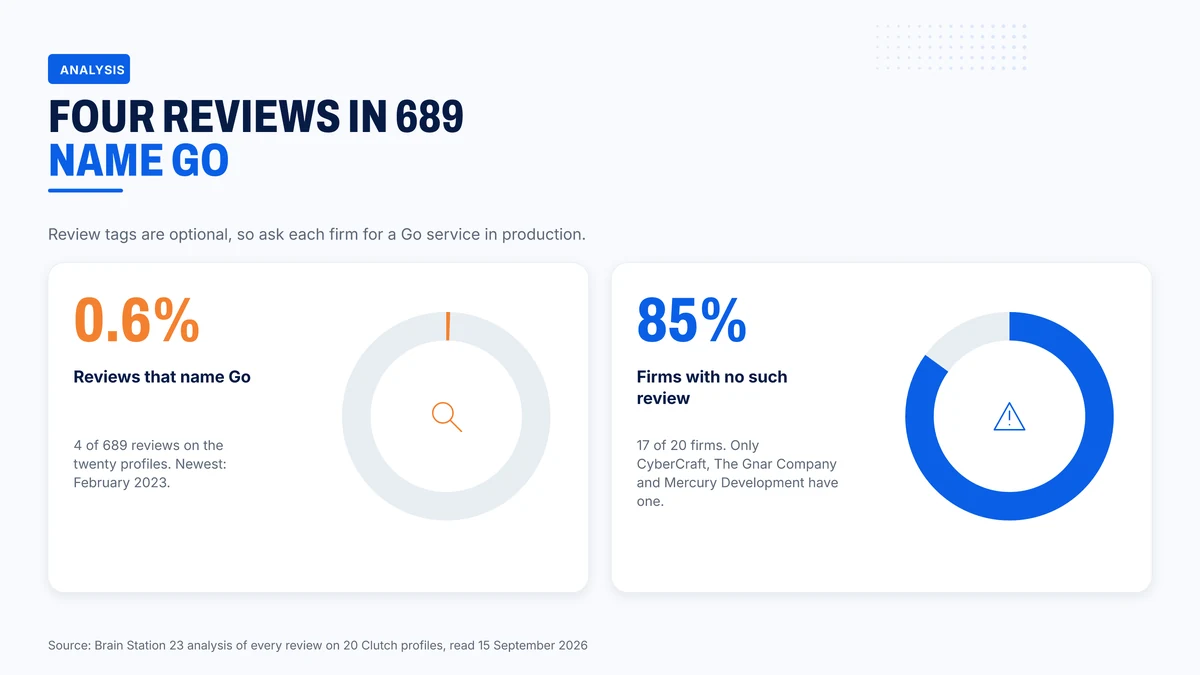
The reviews rarely mention Go. We read all 689 reviews on the twenty profiles. Four name Go, either as a technology tag or in the text: two at CyberCraft, one at The Gnar Company and one at Mercury Development, written between 2019 and February 2023. Seventeen firms have none. Technology tags on reviews are optional, and a reviewer can describe a Go back end without naming the language. Still, a buyer who wants proof of Go work has to ask for it.
Prices sit below $100 an hour. Six firms publish $25 to $49, eight $50 to $99, two $100 to $149 and three $150 to $199, and Dualboot does not publish a rate. Minimums run from $5,000 to $100,000, and NIX and Trango Tech publish none.
Cost is the weakest score. The twenty carry 701 reviews, with a median of 28.5, and four firms hold 48 percent of them. Seven have fewer than 20. Four firms score identically on all four sub-scores. Of the other sixteen, Cost is the lowest or joint-lowest for thirteen and Schedule for five.
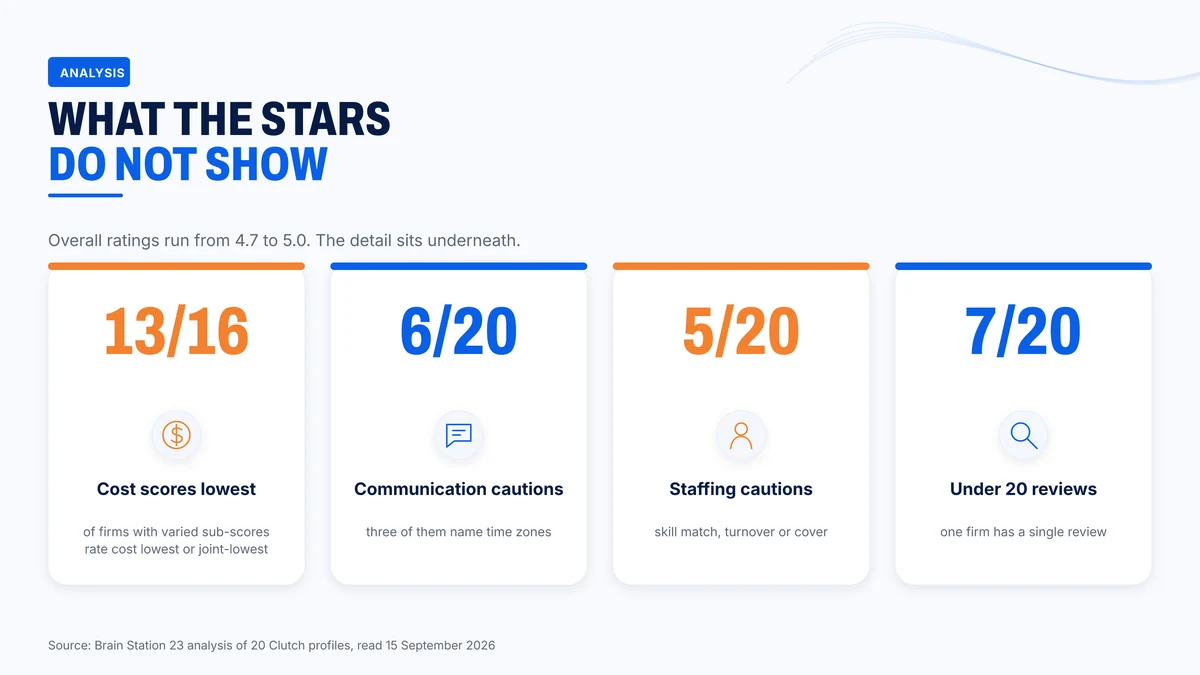
The cautions are about communication and staffing. Clutch’s review summaries flag communication for six firms, including time zones at three, and staffing, skill match or turnover for five. Scoping and timelines come up for four, and delivery execution, documentation and transparency once each. Cleveroad has no improvement area listed, and TheoremOne has a single review.
Half list offices abroad. Ten firms list offices outside the US, and eleven have fewer than 250 staff.
How to shortlist a Go development company
Order the filters so the first one removes the most firms.
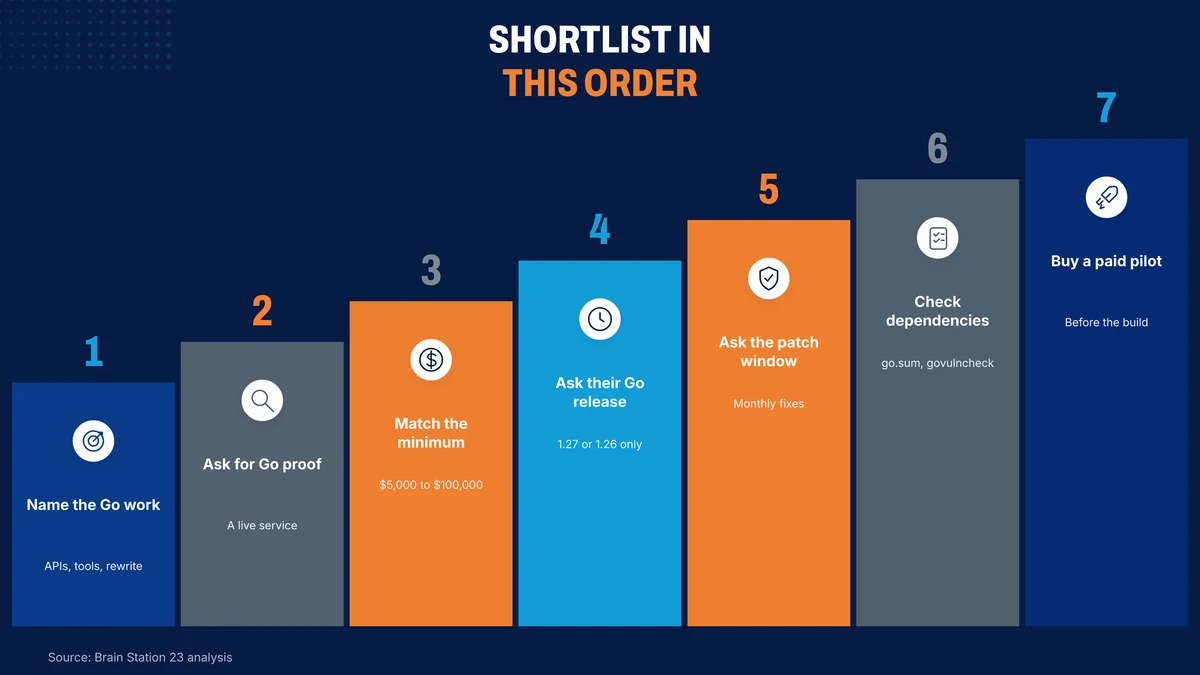
Step 1: Name the Go work. API services, command-line tools, infrastructure tooling and a rewrite from another language are different jobs, and firms quote them differently.
Step 2: Ask for evidence of Go in production. Reviews name Go four times in 689, so ask for a repository walkthrough, a technical reference or a case study that shows a Go service the firm still supports.
Step 3: Match your budget to the minimum. Minimums run from $5,000 to $100,000, and common project sizes from under $10,000 to over $200,000.
Step 4: Ask which Go release their services run. Only Go 1.27 and 1.26 are supported (Go release history). A firm running clients on Go 1.25 or older is already behind.
Step 5: Ask about the patch window. Go shipped security fixes in every month from January to August 2026. Ask how many days a Go security release takes to reach production.
Step 6: Check dependency hygiene. Ask whether they commit go.sum, run govulncheck in CI, and control which third-party modules can be added.
Step 7: Buy a paid pilot. A two-week sprint or a fixed-fee code review shows how the firm writes Go before you commit.
How to buy Go development: four engagement models
The engagement model decides who pays when a service that worked in staging falls over at production load.
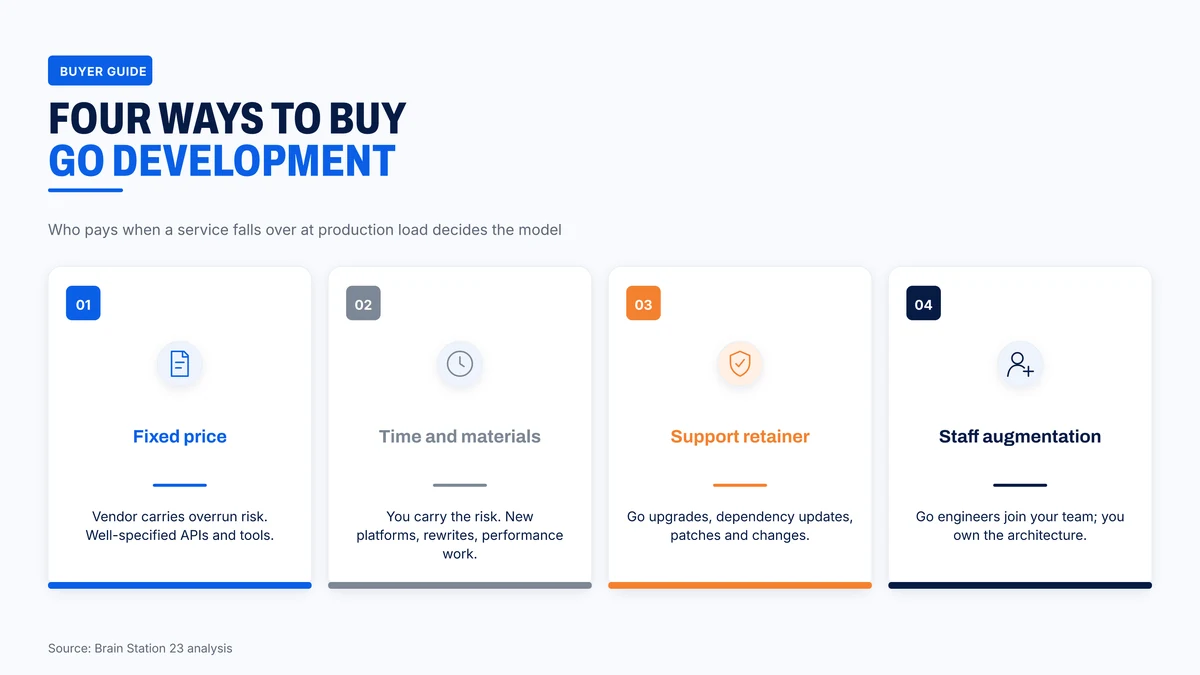
Fixed price moves overrun risk to the vendor, who prices it in. It suits a well-specified API or tool with agreed performance targets. It fails when load, data volume or integrations are still unknown.
Time and materials keeps the risk with you. It suits new platforms, rewrites from another language and performance work. Cap each phase and review burn every week.
Support retainer covers Go release upgrades, dependency updates, security patches and a monthly block of changes. Many owners skip it.
Staff augmentation adds Go engineers to your team. X-Team, NIX, CyberCraft, Vention, Jahnel Group, Bluelight and Brain Station 23 publish staff augmentation lines of 10 percent or more. It fails when nobody in-house owns the architecture and the backlog.
The technical question: keeping Go services on a supported release
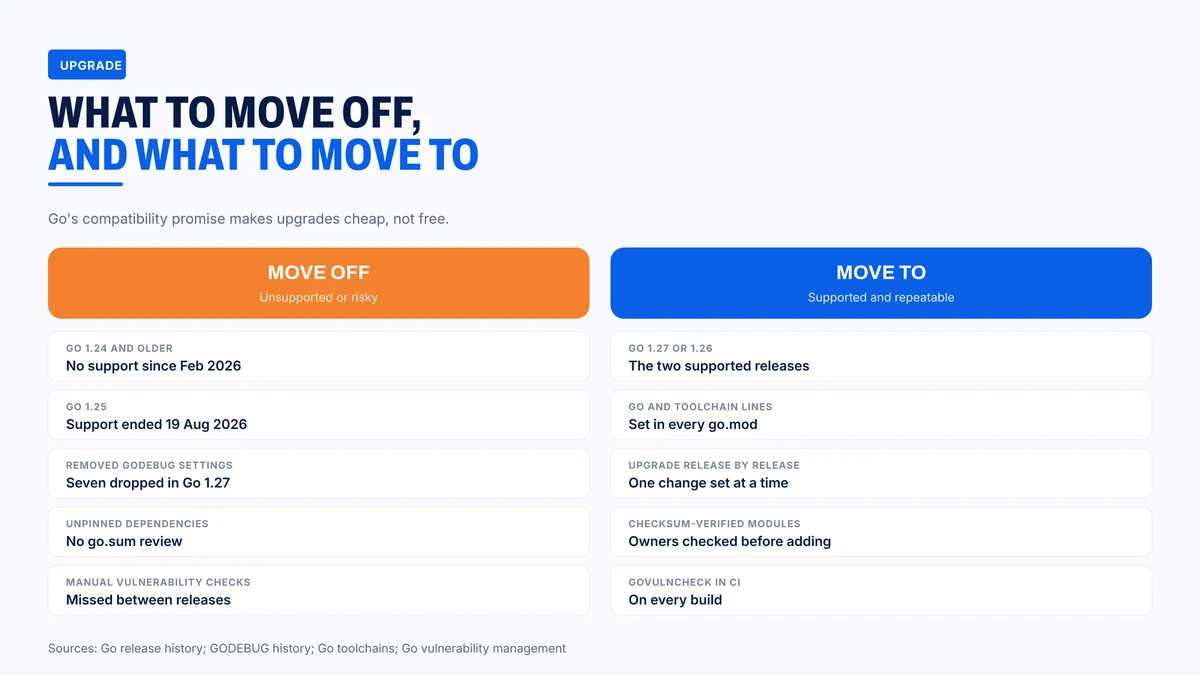
Go’s compatibility promise says that Go 1 programs should continue to compile and run correctly over the lifetime of Go 1 (Go 1 compatibility). That promise makes upgrades cheap, not free. The order of the steps decides whether an upgrade takes a day or a quarter.
The steps, in the order that keeps them safest:
Step 1: Record the Go version of every service. Note the go and toolchain lines in each go.mod file, which since Go 1.21 set the minimum and preferred toolchain (Go toolchains), and the Go version in each build image.
Step 2: Scan before you change anything. Run govulncheck, which reports vulnerabilities based on the functions your code actually calls (Go vulnerability management), so you know which fixes the upgrade has to deliver.
Step 3: Check GODEBUG settings. Go keeps compatibility settings for a minimum of two years, or four releases, and can remove them after that. Go 1.27 removed seven, including tls3des, tls10server and tlsrsakex (GODEBUG history). A service that relied on one of them changes behaviour on upgrade.
Step 4: Upgrade one release at a time. Moving from 1.25 to 1.26 and then to 1.27 isolates each set of changes, which makes a failing test easier to explain.
Step 5: Update dependencies separately. Keep module updates in their own change, verify them against the checksum database (Go modules reference), and check each new module’s owner, because a typosquatted module can look identical to the real one.
Step 6: Run the test suite with the race detector in CI. Concurrency bugs pass quick manual tests.
Step 7: Put the next release on the calendar. If the February and August pattern holds, Go 1.28 ends support for Go 1.26 around February 2027.
A rewrite into Go is a different project, and idiomatic Go is the top frustration for 33 percent of Go developers (Go Developer Survey 2025). Budget for review by someone who writes Go every day.
Red flags: eight answers to walk away from
Some answers in a sales call should end it.
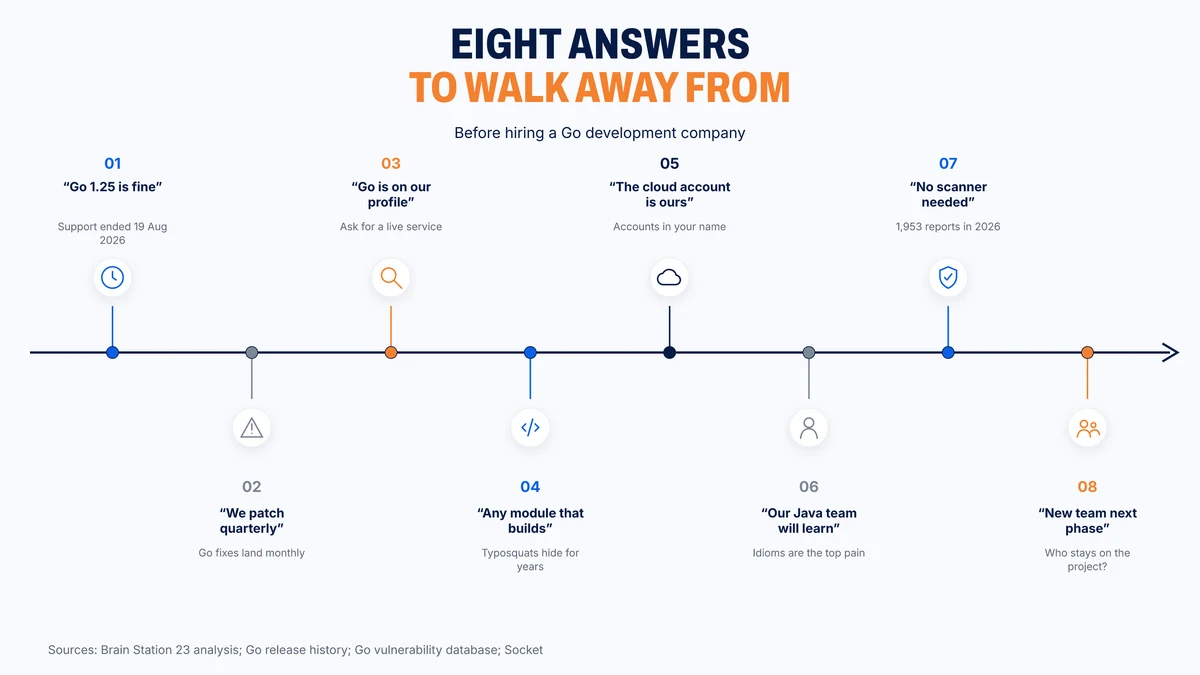
“Go 1.25 is fine for now.” It lost support on 19 August 2026.
“We patch quarterly.” Go shipped security fixes every month from January to August 2026.
“Go is on our profile.” Ask for a Go service in production. Reviews on this list name Go four times in 689.
“We pull whatever module version builds.” A backdoored copy of a popular Go module stayed available through the Go module mirror for over three years (Socket).
“The cloud account is ours.” Cloud accounts, registries and infrastructure state belong under your company’s name.
“Our Java team will pick up Go.” Idiomatic Go is the top frustration among Go developers themselves.
“We don’t need a vulnerability scanner.” The Go vulnerability database published 1,953 reports in 2026 by 10 September (Go vulnerability database).
“There’ll be a new team for the next phase.” Five firms here have review cautions about staffing, skill match or turnover.
After launch: what the build quote leaves out
This part covers what owners wish they had settled before the final invoice, and what recurs while the services run.
What you must own before the final invoice
The code repository with its full history, including go.mod, go.sum, build scripts and infrastructure code, not a zip.
Cloud accounts and billing, on AWS, Google Cloud or wherever the services run, with the vendor added as users you can remove.
The container registry and every image tag in production, so you can redeploy without the vendor.
Infrastructure state, pipelines and secrets, such as Terraform state, Kubernetes manifests, CI/CD, signing keys and any private module proxy settings, under your organisation.
Domain, DNS, certificates and third-party API accounts, in your name.
Dashboards, alerts and a runbook, covering deployment, rollback, scaling, on-call contacts and how to restore data.
The bill that arrives after launch
The build quote covers the services. The rest recurs.
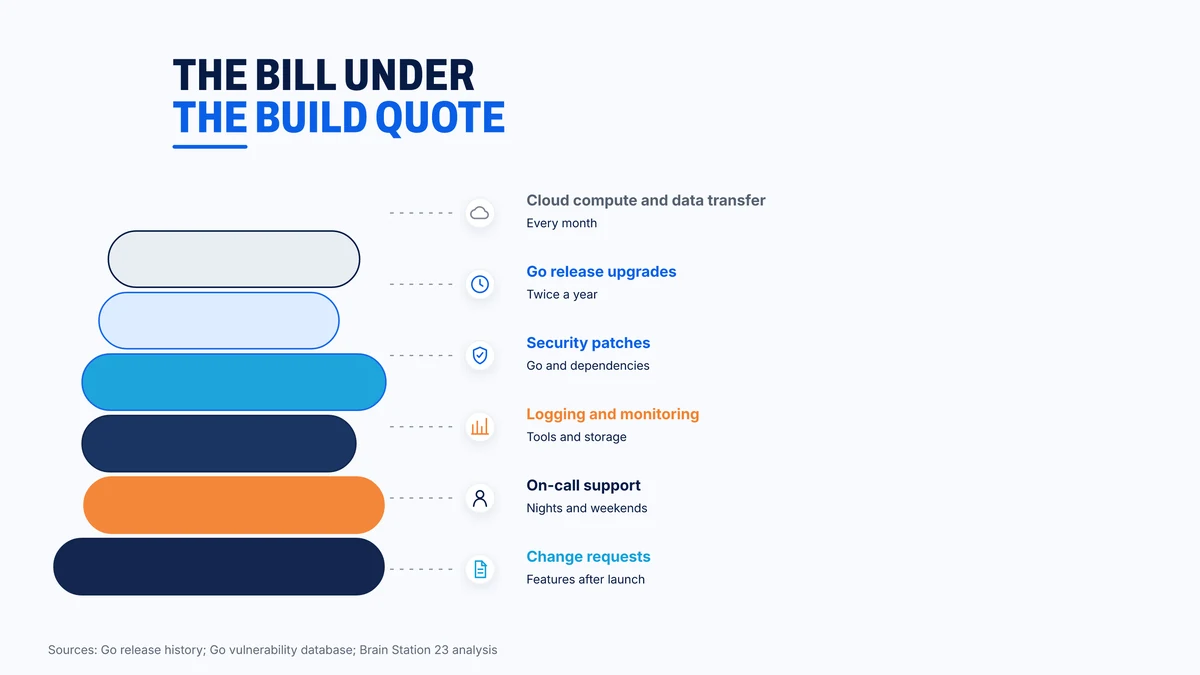
The recurring lines are cloud compute, storage and data transfer, two Go release upgrades a year, monthly security patches for Go and its dependencies, logging and monitoring tools, on-call support, accessibility testing for any front end the services feed, and change requests. Get the retainer price in writing before signing the build, and compare vendors on three years of cost.
Security is a recurring cost
Go’s own security workload is steady and frequent. From January to August 2026, every month brought a Go point release with security fixes, in packages such as crypto/tls, crypto/x509, net/http and html/template (Go release history). The ecosystem around it moves faster: the Go vulnerability database published 1,953 reports between January and 10 September 2026, against 743 in all of 2025, and most of the 2026 entries are marked unreviewed (Go vulnerability database).
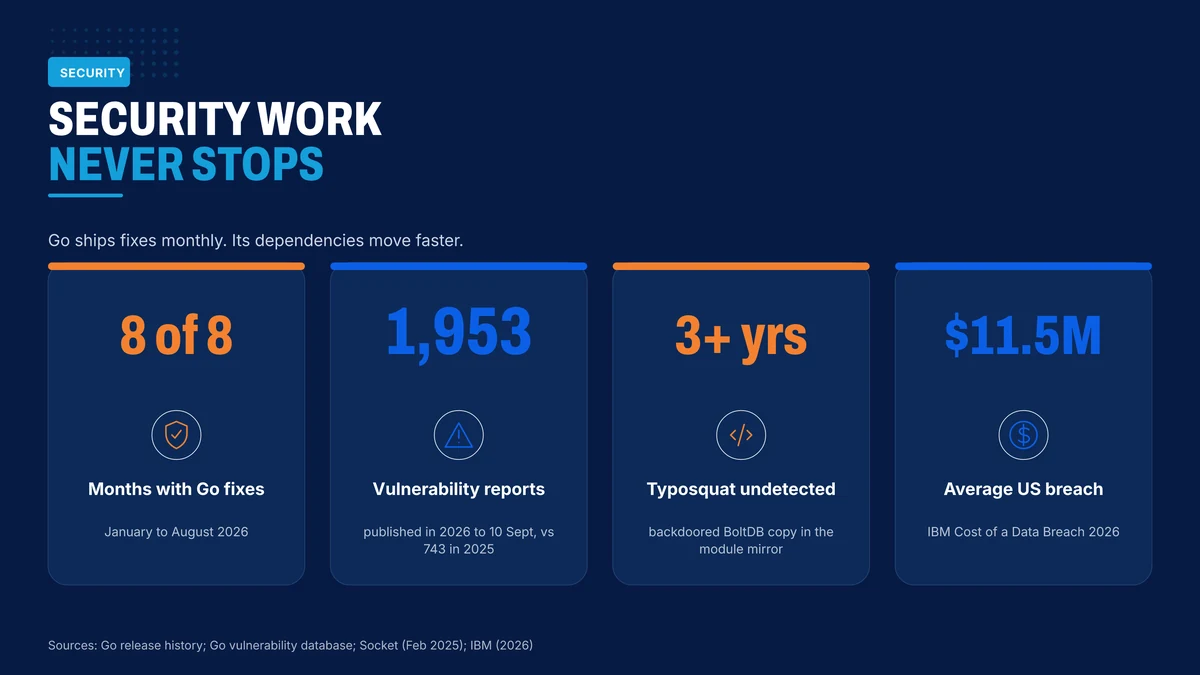
Dependencies are where Go supply-chain attacks land. Socket found a typosquat of the BoltDB module that carried a backdoor, was cached by the Go module mirror, and stayed undetected for over three years after its author rewrote the GitHub tags to a clean version (Socket). It later found three Go modules that fetched disk-wiping malware (Socket). Black Duck found open source in 98 percent of the codebases it audited for 2026, and the mean number of vulnerabilities per codebase rose 107 percent on the previous year (Black Duck).
Google Cloud’s M-Trends 2026 put the mean time to exploit at minus seven days (Google Cloud), and the average US data breach cost a record USD 11.5 million in IBM’s 2026 report (IBM Cost of a Data Breach Report 2026). Ask vendors how many days a Go security release takes to reach production, whether govulncheck runs on every build, and who approves a new module.
Accessibility is legal exposure
Go usually runs behind the interface, but it often renders pages through html/template or serves the API a front end depends on. WebAIM found detected WCAG 2 failures on 95.9 percent of the top million home pages in 2026 (WebAIM Million 2026), and more than 5,000 digital accessibility lawsuits had been filed in the US by the end of 2025 (UsableNet).
If your Go services render HTML, error pages or emails, name WCAG 2.2 AA in the contract and state who pays to fix failures found after launch. If they only serve APIs, put the same clause in the front-end vendor’s contract.
Contract clauses that surface in month nine
These rarely come up in a sales call. This is not legal advice; have your own counsel review any agreement.
IP assignment on payment, covering source code, infrastructure code, build pipelines and documentation.
Account ownership, naming cloud, registry, CI/CD, domain and third-party accounts as yours.
Release responsibility, stating which Go release the services run and how soon after a new release the vendor upgrades, so support never lapses.
Patch terms, stating how many days a Go or dependency security fix takes to reach production.
Dependency policy, requiring committed go.sum files, vulnerability scanning in CI and approval for new third-party modules.
Named team and transition assistance, a fixed number of hours at an agreed rate if you move vendors.
Rate escalation caps, subcontracting disclosure, liability caps and insurance, and non-solicitation in both directions.
How to leave without losing the services
Confirm ownership of the repository, cloud accounts and registry first. Check that you can build and deploy every service from your own pipeline, and record architecture and deployment walkthroughs while relations are cordial.
On the last day, remove the vendor from cloud IAM and the source host, revoke deploy keys and CI tokens, rotate database passwords, API keys and any module proxy credentials, and confirm that no production service still pulls images or modules from an account the vendor controls.
Hire in-house or hire a Go development company
Start with the wage. Glassdoor reports an average of $141,247 for a US Golang developer and Indeed an average base of $130,886 (Glassdoor, Indeed). One hire at those figures, before benefits, costs about as much each year as the most common project at nine of the twenty firms, which report $50,000 to $199,999.
Hire in-house when the Go services are central to the business, change every week, and you can keep at least two engineers who know the architecture and the on-call rota.
Hire a Go development company for a defined new service, a rewrite, an audit, or a support retainer you cannot staff. Keep every account in your name so the choice stays reversible.
Combine the two when you have a technical lead but need extra engineers or specialist help with upgrades and security.
FAQ
How much do US Go development companies charge?
The twenty firms here publish hourly bands from $25 to $199, and fourteen of the nineteen that publish a rate charge under $100. Minimum projects run from $5,000 to $100,000, and nine firms report a most common project of $50,000 to $199,999 (Clutch).
How long is a Go release supported?
Each major Go release is supported until there are two newer major releases, which in practice is about a year (Go release history). Go 1.25, released in August 2025, lost support when Go 1.27 shipped on 19 August 2026.
Which Go versions are supported in September 2026?
Go 1.27, released on 19 August 2026, and Go 1.26, released on 10 February 2026 (Go release history). Services on Go 1.25 or older no longer receive security fixes.
What does a Golang developer earn in the US?
What is Go mostly used for?
Services and tools. In the 2025 Go Developer Survey, 55 percent of respondents built both command-line tools and API services with Go, and 96 percent deployed to Linux-based systems (Go Developer Survey 2025).
How often does Go release security fixes?
Every month from January to August 2026 brought a Go point release with security fixes (Go release history). Private-track issues are fixed in the next scheduled minor release (Go security policy).
How can I tell whether a firm really does Go work?
Not from a directory tag. On this list, four of 689 reviews name Go (Clutch). Ask for a Go service the firm still supports, a repository walkthrough, and the Go release and scanning tools it uses.
Is Go still popular?
It is steady. Stack Overflow’s 2025 survey found 16.4 percent of respondents used Go (Stack Overflow), and 91 percent of Go developers were satisfied with it (Go Developer Survey 2025). TIOBE’s search-based index moved it from 8th to 12th over the past year (TIOBE).
Conclusion
The data behind this Top 20 Golang Development Companies in USA list says three things. Go is a minor line at most of these firms: the median firm puts it at 10 percent of its languages, and four of 689 reviews name it. The price of the work is moderate, with fourteen of nineteen published rates under $100 an hour. And the calendar is short, because a Go release loses support about a year after it ships.
Any of the twenty can write Go. What decides the next three years is the upkeep: whether the services move to each new release before the old one loses support, how fast each monthly security fix reaches production, who approves the modules the code depends on, and whether the repository, cloud accounts and registry are in your name on the day you choose someone else.
Sources
- https://clutch.co/developers/go?geona_id=840&sort_by=ClutchRank
- https://clutch.co/profile/brain-station-23
- https://www.theoremone.co/
- https://go.dev/doc/devel/release
- https://go.dev/blog/survey2025
- https://go.dev/doc/go1compat
- https://go.dev/doc/toolchain
- https://go.dev/doc/godebug
- https://go.dev/doc/security/vuln/
- https://go.dev/doc/security/policy
- https://go.dev/ref/mod
- https://pkg.go.dev/vuln/list
- https://survey.stackoverflow.co/2025/technology
- https://www.tiobe.com/tiobe-index/
- https://www.glassdoor.com/Salaries/golang-developer-salary-SRCH_KO0,16.htm
- https://www.indeed.com/career/golang-developer/salaries
- https://www.bls.gov/ooh/computer-and-information-technology/software-developers.htm
- https://socket.dev/blog/malicious-package-exploits-go-module-proxy-caching-for-persistence
- https://socket.dev/blog/wget-to-wipeout-malicious-go-modules-fetch-destructive-payload
- https://www.blackduck.com/blog/ossra-2026-open-source-vulnerability-counts-doubled-year-over-year.html
- https://cloud.google.com/blog/topics/threat-intelligence/m-trends-2026
- https://www.ibm.com/reports/data-breach
- https://webaim.org/projects/million/
- https://blog.usablenet.com/ada-web-lawsuit-trends-2026