
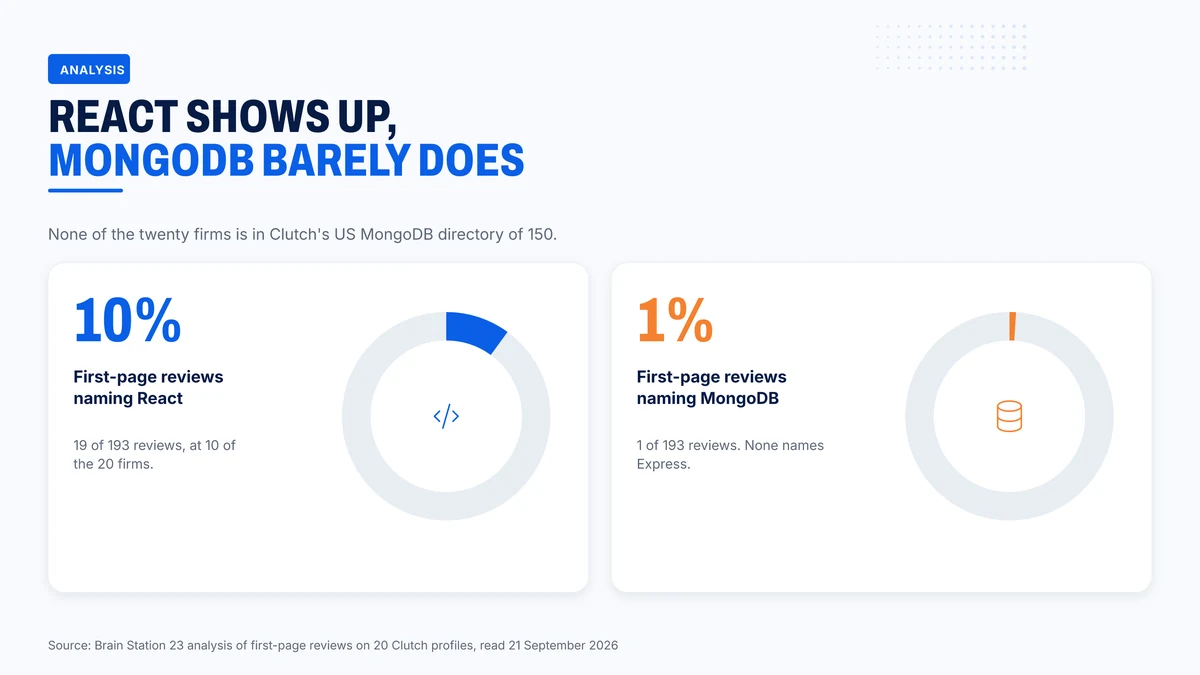
None of the twenty firms on this list appears in Clutch’s US directory of MongoDB developers. That directory holds 150 firms, against 2,122 in Clutch’s US React directory and 2,912 in its Node.js directory (Clutch), so we built this Top 20 MERN Stack Development Companies in USA list from the two MERN layers Clutch ranks at scale: firms that place in both the React and the Node.js rankings. The reviews lean the same way. Across the 193 reviews on the first page of the twenty profiles, 19 name React, seven name Node.js, one names MongoDB and none names Express. Developers show the tilt too: 49.1 percent of professional developers used Node.js in 2025, 24.3 percent used MongoDB and 58.2 percent used PostgreSQL (Stack Overflow Developer Survey 2025).
So brief the database as carefully as the front end.
The guide prices the work and sets out how to shortlist, then covers what you must hold at handover: the MongoDB Atlas organisation, the npm organisation, the repository and the keys to all three.
Key takeaways
- 0 of 20 firms on this list appear in Clutch’s US MongoDB directory, which lists 150 firms against 2,912 for Node.js (Clutch).
- 24.3% of professional developers used MongoDB in 2025, against 49.1% for Node.js, 46.9% for React and 20.3% for Express (Stack Overflow).
- CVSS 10.0 was the rating of CVE-2025-55182, a remote code execution flaw in React Server Components disclosed on 3 December 2025 (React).
- 10 days separated MongoDB’s CVE-2025-14847 reaching the NVD on 19 December 2025 and CISA adding it to the Known Exploited Vulnerabilities catalog on 29 December (NVD; CISA).
- 30 April 2026 was the end of life for Node.js 20, and Node.js 22 follows on 30 April 2027 (Node.js Release schedule).
- $92,320 to $136,918 is the spread in average pay for a US full stack developer between PayScale and Indeed (PayScale; Indeed).
- 39.5% is the median share React and Node.js take of the twenty firms’ published framework splits; only five put them at half or more (Clutch profiles).
- $25,000 is the median minimum project, and 11 of the 20 firms publish rates under $100 an hour (Clutch profiles).
MERN in 2026: four layers on four different clocks
MERN names four technologies: MongoDB, Express, React and Node.js. They are released by different organisations, on different schedules, and a MERN application is only as current as its oldest layer.
React and Node.js are the popular layers. In Stack Overflow’s 2025 survey, 49.1 percent of professional developers had used Node.js and 46.9 percent React in the past year. Express reached 20.3 percent and Next.js 21.5 percent. Among databases, MongoDB reached 24.3 percent, while PostgreSQL reached 58.2 percent (Stack Overflow Developer Survey 2025).
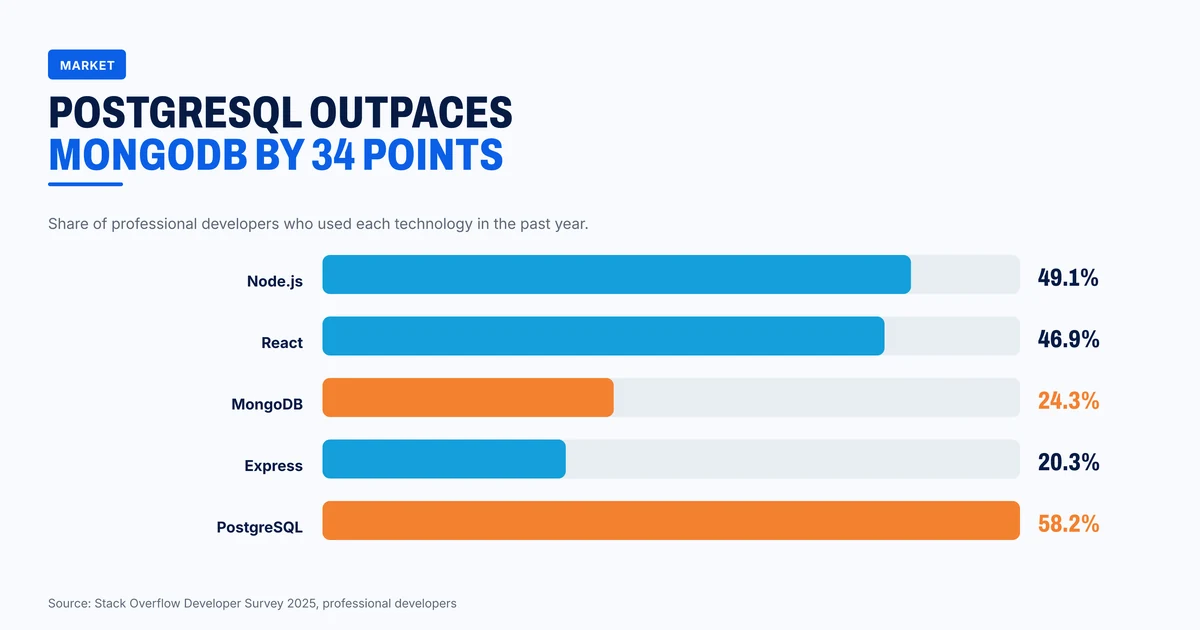
That gap matters for a brief. A vendor that proposes MERN is proposing a document database. For content, catalogues and flexible records that is often the right choice. For ledgers, reporting and anything with many joins, ask whether PostgreSQL would serve you better, and expect a straight answer.
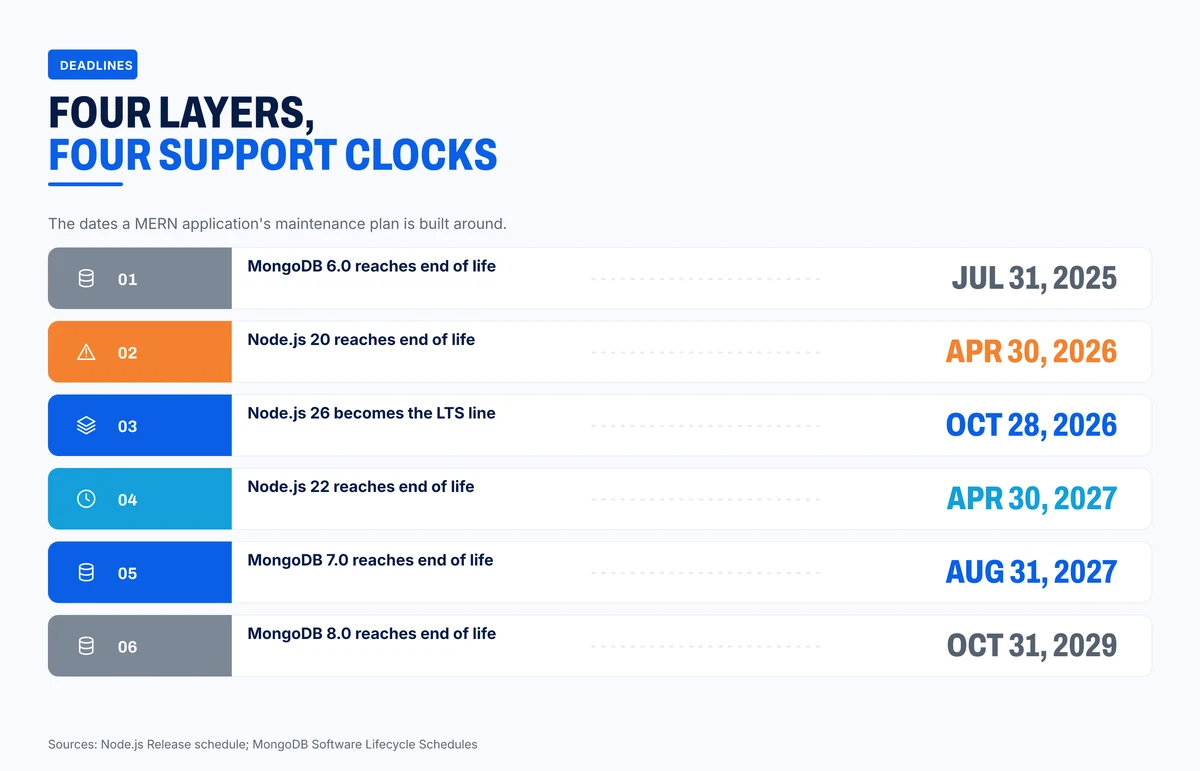
Each layer has its own support calendar. Node.js 20 reached end of life on 30 April 2026. Node.js 22 is in maintenance until 30 April 2027, Node.js 24 moves to maintenance on 20 October 2026, and Node.js 26 becomes the new LTS line on 28 October 2026 (Node.js Release schedule).
MongoDB 6.0 reached end of life on 31 July 2025. MongoDB 7.0 follows on 31 August 2027 and 8.0 on 31 October 2029. On Atlas, the auto-upgrading 8.2 release reached end of life on 31 July 2026 (MongoDB lifecycle schedules).
Express moves slowly. Express 5 has been supported since September 2024 and needs Node.js 18 or later. Express 4 is still supported, but only its latest release, and the project says end-of-life versions get no guarantee of security fixes (Express).
React changed its own starting point. The React team deprecated Create React App on 14 February 2025, saying it had no active maintainers, and now recommends starting with a framework (React). A proposal in 2026 that starts a new project on Create React App is starting on a deprecated tool.
So a MERN brief needs four version answers, not one: which Node.js LTS line, which MongoDB release, which Express major and which React setup.
What MERN stack development costs in the US
Average pay for the same US role spreads by $44,598 across four salary sites.
PayScale puts a full stack software developer at $92,320 from 1,436 salary profiles, updated 14 July 2026 (PayScale). Glassdoor reports a median total pay of $119,000 for a full stack developer (Glassdoor). ZipRecruiter reports $123,262 for a MERN stack developer as of 20 September 2026 (ZipRecruiter). Indeed reports $136,918 for a full stack developer from 14,500 job-posting salaries, updated 14 September 2026 (Indeed).
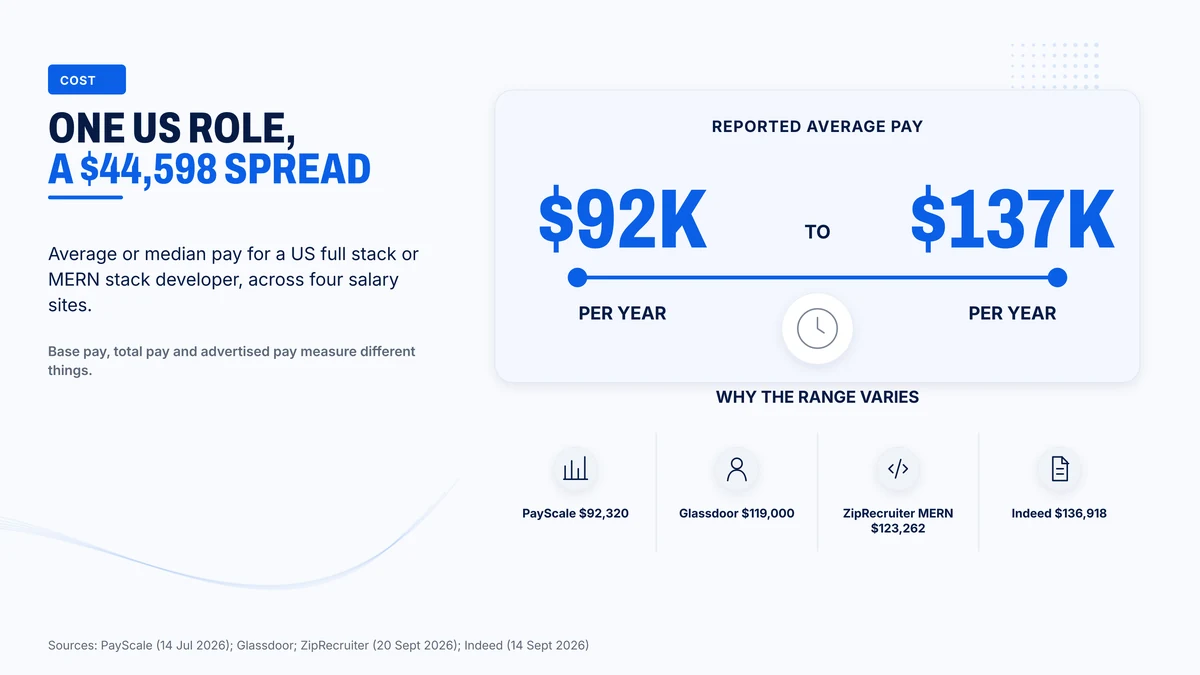
None of the four is wrong. PayScale reports self-reported base pay, Glassdoor reports total pay including bonus, and Indeed draws on advertised salaries. The Bureau of Labor Statistics puts the median for all software developers at $135,980 in May 2025 (BLS). Only ZipRecruiter publishes a MERN-titled figure, and Glassdoor’s MERN page shows no national average, so we used full stack figures for the other three.
Agency pricing sits in a narrower band. Eleven of the twenty firms publish rates under $100 an hour, and the median minimum project is $25,000 (Clutch profiles, read 21 September 2026). Ten report a most common project of $50,000 to $199,999, and nine report one under $50,000.
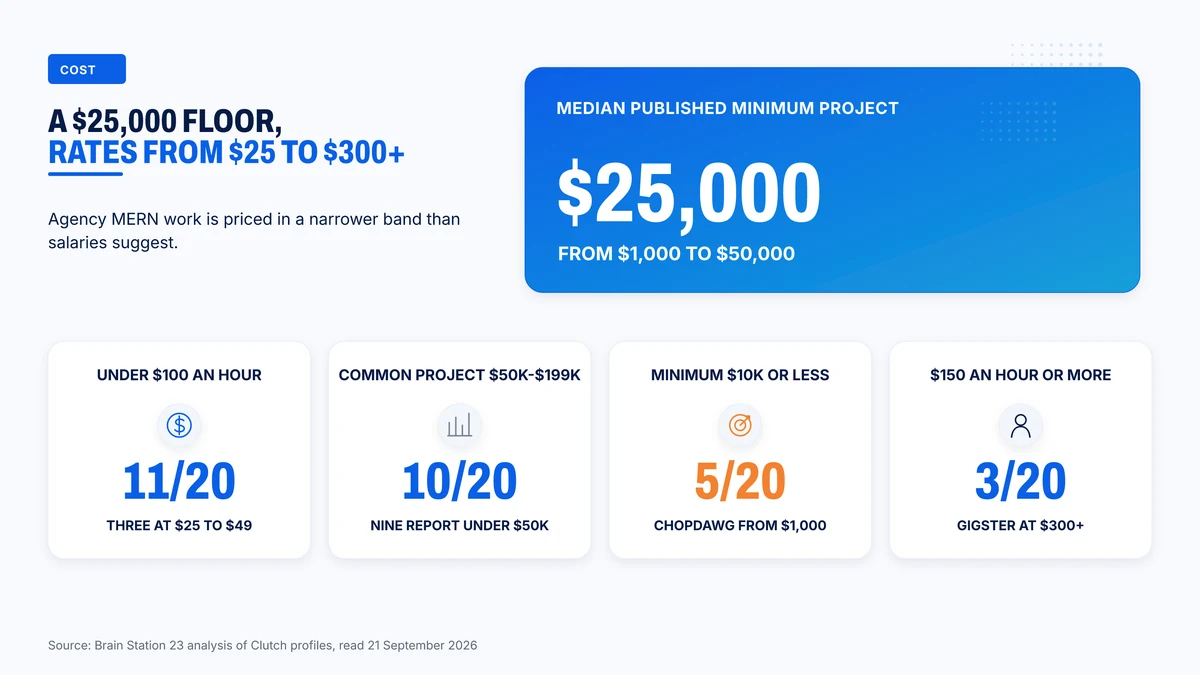
Minimums run from $1,000 at ChopDawg to $50,000 at six firms. Published rates run from $25 an hour to more than $300. Eight factors decide where a MERN quote lands inside that range.
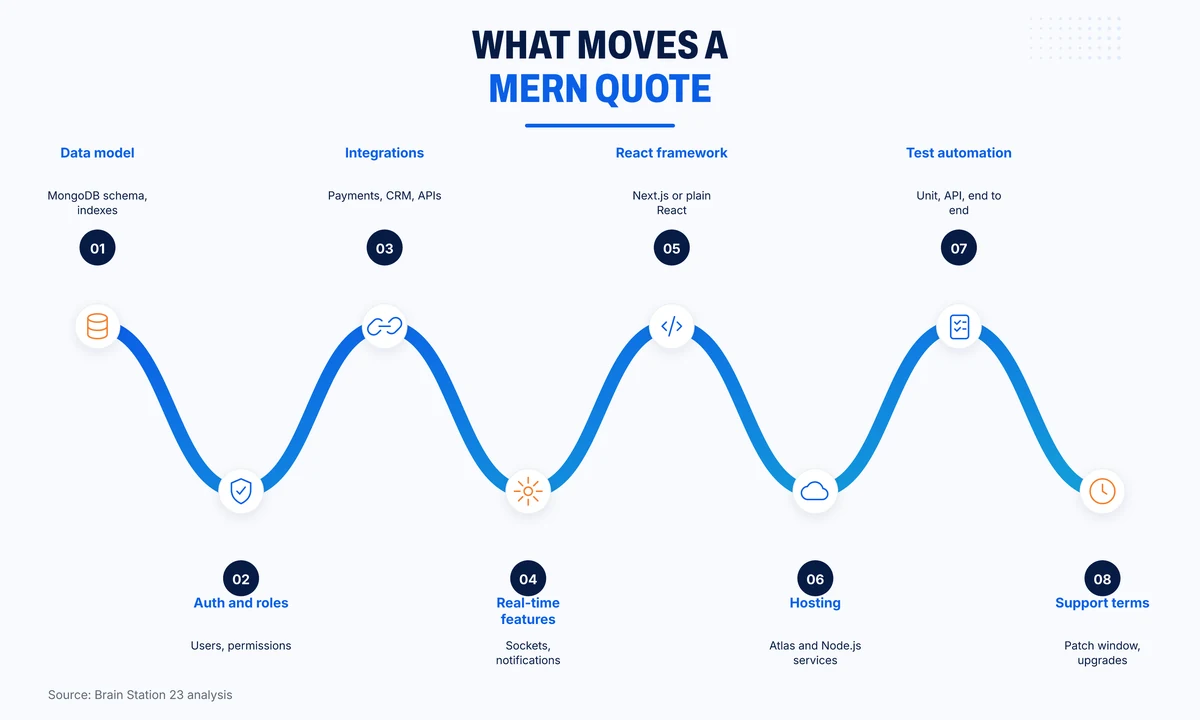
The data model comes first, because a MongoDB schema designed for your queries is cheap to build on and expensive to redesign later. Then authentication and roles, integrations with payment or CRM systems, real-time features, the React framework choice, the hosting model for Atlas and the Node.js services, test automation and the support terms after launch. Ask every vendor to price these separately.
The Top 20 MERN Stack Development Companies in USA, compared
Clutch has no MERN category. We used its two US directories that cover MERN layers at scale: React developers, 2,122 firms, and Node.js developers, 2,912 firms, both sorted by Clutch Rank and read on 21 September 2026. We removed the one paid row on the React page, Bilberrry, and took the organic top 300 of each. Of those, 171 firms appear in both. We ranked those 171 by adding each firm’s two positions, lowest total first. Firms 2 to 21 below are the top 20 by that sum.
Brain Station 23 is placed first because we publish this article. We are US-headquartered, but React does not appear in our published Clutch framework split and Node.js is 8 percent of it, so neither ranking placed us in its top 300 and we are not claiming it did.
Every overall rating below sits between 4.8 and 5.0, so the stars do not separate these firms. The MERN Focus column does: the combined share of React and Node.js in each firm’s published framework split, with the two positions behind the rank.
| # | Company | Best For | Team Size | MERN Focus | Key Tech Stack | Industries Served | Locations |
|---|---|---|---|---|---|---|---|
| 1 | Brain Station 23 — brainstation-23.com | Adding MERN engineers inside your own team at offshore rates | 250 – 999 | Node.js 8%; React not published; staff augmentation 60% | Java, Spring, .NET, Python, TypeScript, Node.js | Retail, medical, telecoms, education, financial services | Springfield VA; Bangladesh, UAE, England, Malaysia, Germany |
| 2 | INOXOFT — inoxoft.com | Balanced React and Node.js builds for fintech and education at lower rates | 50 – 249 | 70%: React 35, Node.js 35 (React #4, Node #3) | Node.js, React, Flutter, TypeScript, Python | Financial services, education, real estate, automotive | Newark DE; Wrocław, Lviv |
| 3 | Vention — ventionteams.com | Large programmes needing a deep bench across AI, cloud and web | 1,000 – 9,999 | 35%: React 20, Node.js 15 (React #8, Node #1) | React, Node.js, .NET, Angular, Go, Java | Ten sectors at 10% each, incl. fintech, medical, e-commerce | New York, San Francisco; London, Vienna, Vilnius, Berlin, Warsaw |
| 4 | BairesDev — bairesdev.com | Enterprise team augmentation from nearshore Latin American engineers | 1,000 – 9,999 | 20%: React 10, Node.js 10 (React #10, Node #4) | .NET, React Native, React, Node.js, PHP, Java | IT, financial services, medical, advertising | San Francisco; Buenos Aires, São Paulo, Mexico City, Bogotá, Barcelona |
| 5 | Scopic — scopicsoftware.com | Medical and manufacturing software from a remote team | 250 – 999 | 39%: React 22, Node.js 17 (React #9, Node #9) | React, .NET, Node.js, React Native, Laravel, C++ | Medical, automotive, manufacturing, education | Marlborough MA |
| 6 | FocusReactive — focusreactive.com | Next.js and headless websites for small companies | 50 – 249 | 30%: React 20, Node.js 10; Next.js 70 (React #5, Node #15) | Next.js, React, Node.js, TypeScript | E-commerce, media, medical, financial services | New York; London, Warsaw |
| 7 | X-Team — x-team.com | Enterprise and gaming teams adding senior React and Node.js engineers | 250 – 999 | 88%: React 47, Node.js 41 (React #12, Node #8) | React, Node.js, .NET, Go, Kotlin | IT, gaming, financial services, media | Austin; Hawthorn East, Australia |
| 8 | Vincit — vincit.com | Consumer and entertainment brands with larger budgets | 250 – 999 | 50%: React 25, Node.js 25 (React #15, Node #16) | React, Node.js, React Native, Next.js, TypeScript | Arts and entertainment, e-commerce, consumer, media, retail | Irvine CA |
| 9 | Jalasoft — jalasoft.com | Seven-figure programmes staffed from Bolivia | 1,000 – 9,999 | 65%: React 35, Node.js 30 (React #16, Node #22) | React, Angular, Node.js, Kotlin, Swift | Business services, energy, financial services, IT, medical | Houston; Cochabamba, La Paz |
| 10 | Agency Partner Interactive — agencypartner.com | Healthcare and education apps delivered in small phases | 50 – 249 | 30%: React 20, Node.js 10 (React #27, Node #13) | React, Angular, Flutter, Laravel, Next.js, Node.js | Medical, education, e-commerce, non-profit | Plano TX |
| 11 | Brainvire — brainvire.com | E-commerce builds at offshore rates | 250 – 999 | 27%: React 11, Node.js 16 (React #26, Node #26) | PHP, .NET, Angular, Node.js, React | Media, retail, automotive, medical, logistics | Irving TX; Dubai, Mississauga |
| 12 | Collective42 — collective42.com | Marketing-led websites on React and Next.js | 10 – 49 | 50%: React 25, Node.js 25 (React #21, Node #32) | Next.js, Node.js, React, React Native | Manufacturing, medical, business services, financial services | Encinitas CA |
| 13 | Codup — codup.co | E-commerce and manufacturing firms needing Node.js integrations | 50 – 249 | 35%: React 13, Node.js 22 (React #44, Node #11) | Node.js, .NET, Laravel, Next.js, React | E-commerce, manufacturing, HVAC, retail | Houston, Irvine; Dubai |
| 14 | Gigster — gigster.com | Enterprise AI builds where speed matters more than rate | 250 – 999 | 45%: React 30, Node.js 15 (React #29, Node #27) | React, Angular, Next.js, Node.js, Python | Automotive, education, financial services, government, medical | Austin |
| 15 | Perpetual — perpetualny.com | Design-led products for New York startups and enterprises | 50 – 249 | 40%: React 18, Node.js 22 (React #31, Node #25) | Node.js, React, Angular, React Native, Ruby on Rails | IT, advertising, financial services, media, medical | New York |
| 16 | Goji Labs — gojilabs.com | Mobile-first startups wanting design and build together | 50 – 249 | 25%: React 10, Node.js 15 (React #41, Node #18) | Ruby on Rails, Node.js, Flutter, React, Swift | Automotive, education, energy, financial services, medical | Los Angeles, New York |
| 17 | Six Feet Up — sixfeetup.com | Python data and AI products with a React front end | 10 – 49 | 20%: React 10, Node.js 10 (React #52, Node #12) | Python, Django, React, Node.js, TypeScript | IT, medical, education, energy, financial services | Fishers IN |
| 18 | ChopDawg — chopdawg.com | Founders building a first mobile or web product | 10 – 49 | 44%: React 33, Node.js 11 (React #18, Node #48) | React Native, React, Django, Node.js, Vue.js | Business services, consumer, education, financial services | Philadelphia, Smyrna GA, Seattle, Boston |
| 19 | Plego — plego.com | Mid-market firms adding AI to web applications | 50 – 249 | 26%: React 13, Node.js 13 (React #49, Node #23) | Angular, Flutter, Laravel, Node.js, React, Ruby on Rails | IT, real estate, e-commerce, manufacturing | Chicago, Downers Grove, Houston, Miami |
| 20 | Orangesoft — orangesoft.co | Healthcare apps, mobile first | 50 – 249 | 40%: React 25, Node.js 15 (React #39, Node #41) | React, Next.js, Flutter, Node.js, Kotlin, Swift | Medical, financial services | San Francisco; Warsaw |
| 21 | Diffco AI — diffco.us | AI products built on Node.js and React | 50 – 249 | 45%: React 20, Node.js 25 (React #60, Node #21) | Node.js, React, React Native, Next.js, Python | Business services, medical, consumer, education | San Jose CA |
Team sizes, framework and service splits, industries and locations are from each firm’s published Clutch profile, read 21 September 2026. Positions are organic Clutch Rank positions on the US React and Node.js directories. Clutch does not record Express or MongoDB in its framework split, so the MERN Focus column covers React and Node.js only. “Best For” is our reading of that data. Engagement models and certifications are not published consistently across these profiles, so we have left them out rather than guess.
Profiles are grouped by buyer type, and the numbers match the table. Each caution comes from the Review Highlights that Clutch publishes from the firm’s verified reviews. Certifications are self-published and unverified by us. Where we cite reviews that name React, Node.js or MongoDB, we read the first page of reviews on each profile, up to eleven per firm.
1. Brain Station 23
We publish this article and placed ourselves first, so read this entry as the publisher’s pick. React does not appear in our published Clutch framework split, and Node.js is 8 percent, which is why neither of Clutch’s rankings placed us in its top 300. Our strength is staffing: 60 percent of our work is engineers embedded in client teams, at the $25 to $49 band that INOXOFT, Jalasoft and Brainvire also publish, with a $10,000 minimum. That suits a buyer who already runs a MERN product and needs more engineers, not one who wants a studio to own it. Our ISO 27001 and SOC 2 Type II controls matter when our engineers work inside your Atlas and npm organisations. Reviewers score Quality at 5.0 and have asked for tighter internal coordination. For a new MERN build, start with X-Team or INOXOFT below.
Founded: 2006
US Presence: Springfield VA
Company size: Clutch band 250 to 999; we publish 900+ engineers
Rating: 4.9 across 21 Clutch reviews, HQ Springfield, Virginia
- Adding MERN engineers inside your own team at offshore rates
- CMMI Level 3
- ISO 27001
- ISO 9001
- SOC 2 Type II (company-published)
- Staff augmentation
- Custom software development
- Application modernisation
- Node.js
- TypeScript
- Java and Spring
- .NET
- Flutter mobile apps
- Retail
- Medical
- Telecoms
- Education
- Financial services
- Hospitality
- React is not in our published framework split, so ask which engineers have shipped React and MongoDB in production before they join your team
For JavaScript-first custom software
2. INOXOFT
React and Node.js are 35 percent each of INOXOFT’s framework split, a combined 70 percent that only X-Team exceeds among the twenty, and TypeScript is 30 percent of its languages. Financial services make up 40 percent of its industries. It publishes a $25 to $49 band, and its most common project size, across 74 reviews, is under $50,000. Cost scores 4.9. Development runs from Poland and Ukraine as well as Delaware. Some clients wanted more design variations early in a project.
Founded: 2014
US Presence: Newark DE
Company size: 50 to 249
- Balanced React and Node.js builds for fintech and education at lower rates
- ISO 27001 (stated in its Clutch profile text)
- Custom software
- Web development
- Node.js
- React
- TypeScript
- JavaScript
- AI consulting
- Dedicated teams
- Financial services
- Education
- Real estate
- Automotive
- IT
- Ask for a MERN case study, because none of its first-page reviews names the stack
5. Scopic
Scopic’s React and Node.js shares are 22 and 17 percent, alongside .NET at 20 and React Native at 15. Medical work is 40 percent of its industries, and automotive and manufacturing 20 percent each, which suits regulated or engineering-heavy products. Its $10,000 minimum is among the lowest here, yet its most common project runs $50,000 to $199,999. Review Highlights describe budget overruns and unexpected costs on some projects, even though most clients call its pricing fair.
Founded: 2006
US Presence: Marlborough MA
Company size: 250 to 999
- Medical and manufacturing software from a remote team
- Not published; ask directly
- Custom software
- AI development
- Web development
- React
- Node.js
- React Native
- .NET
- Cloud consulting
- Medical
- Automotive
- Manufacturing
- Education
- Media
- Agree a budget review cadence and a change-request rule before work starts
8. Vincit
Vincit splits its frameworks evenly: React, Node.js and React Native at 25 percent each, plus Next.js at 15. It publishes one of the highest bands on this list, $150 to $199 an hour, with a $50,000 minimum, and arts, entertainment and e-commerce lead its industries. Clutch’s review summary says clients found good value despite higher initial costs, and Cost is its lowest sub-score at 4.5. Sixty percent of its clients are mid-market.
Founded: 2007
US Presence: Irvine CA
Company size: 250 to 999
- Consumer and entertainment brands with larger budgets
- Not published; ask directly
- Custom software
- Web development
- Mobile apps
- React
- Node.js
- React Native
- Next.js
- TypeScript
- Arts and entertainment
- E-commerce
- Consumer products
- Media
- Retail
- Get the full quote, including post-launch support, before comparing it with lower bands
14. Gigster
Gigster publishes the highest rate on this list, $300 or more an hour, with a $50,000 minimum. AI development is 35 percent of its services, React 30 percent of its frameworks and Node.js 15, and half its clients are enterprises. It has two Clutch reviews, both rated 5.0, which is too few to judge delivery. Treat its position as a lead rather than evidence, and consider a paid discovery before committing a build budget.
Founded: 2014
US Presence: Austin
Company size: 250 to 999
- Enterprise AI builds where speed matters more than rate
- Not published; ask directly
- AI development
- Custom software
- Mobile apps
- Application modernisation
- React
- Angular
- Next.js
- Node.js
- Automotive
- Education
- Financial services
- Government
- Medical
- Ask for enterprise references on comparable React and Node.js work, because two reviews cannot show a pattern
21. Diffco AI
Diffco AI puts Node.js at 25 percent of its framework split, React and React Native at 20 each, and Next.js at 15. AI development and AI agents make up 40 percent of its services. Its sub-scores run from 4.9 to 5.0 across 32 reviews, and its most common project is $50,000 to $199,999 against a $25,000 minimum. Clients suggested it could be more open to ideas outside its comfort zone.
Founded: 2008
US Presence: San Jose CA
Company size: 50 to 249
- AI products built on Node.js and React
- Not published; ask directly
- AI development
- AI agents
- Custom software
- Mobile apps
- Staff augmentation
- Node.js
- React
- React Native
- Next.js
- Business services
- Medical
- Consumer products
- Education
- Financial services
- Test how the team responds when you propose an architecture of your own
For senior benches and staff augmentation
3. Vention
Vention holds first place in Clutch’s US Node.js ranking. React is 20 percent and Node.js 15 percent of its framework split, alongside .NET, Angular and Go, so MERN is one stack among several. Its 102 reviews are the third most on this list, and its most common project runs $50,000 to $199,999 against a $50,000 minimum. Cost is its lowest sub-score at 4.7. Clients describe early trouble finding the right skill match and some communication barriers, which Vention worked to fix.
Founded: 2002
US Presence: New York, San Francisco
Company size: 1,000 to 9,999
- Large programmes needing a deep bench across AI, cloud and web
- Not published; ask directly
- AI development
- Custom software
- Application modernisation
- Cloud
- DevOps
- Staff augmentation
- React
- Node.js
- Financial services
- Medical
- E-commerce
- Education
- Retail
- Logistics
- Name the MERN seniority you need in the first brief, so the initial skill match is right
4. BairesDev
BairesDev builds from Argentina, Brazil, Mexico, Colombia and Spain, and reviewers value the time-zone overlap with US teams. React and Node.js are 10 percent each of its framework split, behind .NET and React Native at 20, and half its clients are enterprises. It is the only firm here with a first-page review naming MongoDB. Cost is its lowest sub-score at 4.6. A few clients noted minor language barriers and asked for clearer explanations of technical concepts.
Founded: 2009
US Presence: San Francisco
Company size: 1,000 to 9,999
- Enterprise team augmentation from nearshore Latin American engineers
- Not published; ask directly
- Web development
- Staff augmentation
- Custom software
- DevOps
- Testing
- React
- Node.js
- React Native
- IT
- Financial services
- Medical
- Advertising
- Business services
- Confirm how the team explains technical decisions to non-technical stakeholders
7. X-Team
X-Team has the highest combined share on the list: React is 47 percent of its framework split and Node.js 41. Staff augmentation is 40 percent of its services, 60 percent of its clients are enterprises, and gaming is a quarter of its industries. Four of its eight reviews name React, the closest match between label and evidence here. Eight reviews is still a thin record, and Cost is its lowest sub-score at 4.6.
Founded: 2006
US Presence: Austin
Company size: 250 to 999
- Enterprise and gaming teams adding senior React and Node.js engineers
- Not published; ask directly
- Staff augmentation
- Custom software
- React
- Node.js
- Cloud consulting
- Mobile apps
- Web development
- IT
- Gaming
- Financial services
- Media
- Education
- Agree the communication tools up front, because one reviewer found email slow
9. Jalasoft
Jalasoft builds from Cochabamba and La Paz with more than 1,000 staff and a $25 to $49 band. React is 35 percent and Node.js 30 percent of its framework split, with Angular also at 35. Its most common project size is over $1 million, the largest on this list, but that rests on five reviews that report a size. Its Cost score of 4.4 is the lowest sub-score of any firm here. Some clients noted that English is a second language for many of its staff.
Founded: 2001
US Presence: Houston
Company size: 1,000 to 9,999
- Seven-figure programmes staffed from Bolivia
- Not published; ask directly
- Staff augmentation
- Custom software
- React
- Angular
- Node.js
- DevOps
- Testing
- Application support
- Business services
- Energy
- Financial services
- IT
- Medical
- Telecoms
- Interview the engineers who will join your team, not only the account lead
For Next.js, design-led and marketing sites
6. FocusReactive
FocusReactive is a Next.js specialist: Next.js is 70 percent of its framework split, React 20 and Node.js 10. Web development is half its services and web design another 20 percent, and 80 percent of its clients are small businesses. Two of its ten first-page reviews name React, and all four sub-scores are 4.9. The fit is a headless or content-heavy React site rather than a MongoDB-backed application. Some clients wanted it to recommend optimisations more proactively.
Founded: 2019
US Presence: New York
Company size: 50 to 249
- Next.js and headless websites for small companies
- Not published; ask directly
- Web development
- Next.js
- React
- Node.js
- Web design
- Headless CMS
- E-commerce
- TypeScript
- E-commerce
- Media
- Medical
- Financial services
- Education
- Confirm the back end it proposes, because its depth is in Next.js front ends
10. Agency Partner Interactive
Agency Partner Interactive is a Plano studio where custom software and mobile make up 65 percent of services. React is 20 percent of its frameworks and Node.js 10, spread across nine frameworks. Medical work is 40 percent of its industries. Its most common project size across 86 reviews is under $10,000, which points to many small phases rather than a few large builds. Some clients experienced delays and periods of limited updates.
Founded: 2010
US Presence: Plano TX
Company size: 50 to 249
- Healthcare and education apps delivered in small phases
- Not published; ask directly
- Custom software
- Mobile apps
- AI development
- Web development
- React
- Node.js
- Next.js
- Angular
- Medical
- Education
- E-commerce
- Non-profit
- Fix a weekly reporting rhythm in the contract
12. Collective42
Collective42 is a small Encinitas agency whose frameworks split evenly across Next.js, Node.js, React and React Native at 25 percent each. Search and paid advertising are 30 percent of its services, so it suits a marketing-led website more than a complex application. Its Schedule, Cost and Willingness to Refer scores are all 5.0, and Clutch’s Review Highlights find no significant area for improvement. Its most common project is $10,000 to $49,999.
Founded: 2017
US Presence: Encinitas CA
Company size: 10 to 49
- Marketing-led websites on React and Next.js
- Not published; ask directly
- Web development
- Web design
- Next.js
- React
- Node.js
- React Native
- SEO
- Manufacturing
- Medical
- Business services
- Financial services
- Insurance
- Confirm who maintains the site and its dependencies after launch
15. Perpetual
Perpetual is a New York product studio where UX and UI design is 30 percent of services and low-code 15 percent. Node.js is 22 percent of its framework split and React 18, and its clients split almost evenly between small, mid-market and enterprise. Across 97 reviews its most common project is under $50,000, and Cost is its lowest sub-score at 4.6. Some clients wanted clearer product management, including test cases and a sharper split between project and product roles.
Founded: 2012
US Presence: New York
Company size: 50 to 249
- Design-led products for New York startups and enterprises
- Not published; ask directly
- UX and UI design
- Web development
- Low-code development
- Custom software
- Node.js
- React
- React Native
- IT
- Advertising
- Financial services
- Media
- Medical
- Ask who writes the test cases and who owns product decisions
For mobile-first products
16. Goji Labs
Goji Labs is mobile first: mobile apps are half its services, and Ruby on Rails is 25 percent of its frameworks. Node.js is 15 percent and React 10. Two of its ten first-page reviews name React and one names Node.js. It has 90 reviews averaging 5.0 and a $25,000 minimum, but some clients noted budget overruns and timeline extensions as scope evolved, so fix a change-request process before the build starts.
Founded: 2014
US Presence: Los Angeles, New York
Company size: 50 to 249
- Mobile-first startups wanting design and build together
- Not published; ask directly
- Mobile apps
- Custom software
- UX design
- AI development
- Node.js
- React
- React Native
- Ruby on Rails
- Automotive
- Education
- Energy
- Financial services
- Medical
- Confirm the back end it proposes is Node.js and not Ruby on Rails
18. ChopDawg
ChopDawg is a mobile studio: mobile apps are 80 percent of its services, React Native 34 percent of its frameworks and React 33. Node.js is 11 percent. Its minimum is $1,000, the lowest here, and its most common project size across 112 reviews is under $50,000, which fits a founder building a first version. Some clients experienced delays from scope changes, though reviewers say it communicated them clearly.
Founded: 2009
US Presence: Philadelphia, Smyrna GA, Seattle, Boston
Company size: 10 to 49
- Founders building a first mobile or web product
- Not published; ask directly
- Mobile apps
- Web development
- React Native
- React
- Node.js
- Django
- Vue.js
- Business services
- Consumer products
- Education
- Financial services
- Government
- Plan who will scale the product after the first version
20. Orangesoft
Orangesoft is a healthcare specialist: medical work is 90 percent of its industries, and mobile and IoT development 60 percent of its services. React is 25 percent of its frameworks, Next.js 20 and Node.js 15, while Kotlin and Swift lead its languages. It builds from Warsaw as well as San Francisco, and 60 percent of its clients are small businesses. None of its first-page reviews names a MERN technology. Some reviews raised concerns about design quality.
Founded: 2011
US Presence: San Francisco
Company size: 50 to 249
- Healthcare apps, mobile first
- Not published; ask directly
- Mobile apps
- IoT development
- Custom software
- Web development
- React
- Next.js
- Node.js
- React Native
- Medical
- Financial services
- Review design output early, because some reviews questioned design quality
For e-commerce, Python and specialist back ends
11. Brainvire
Brainvire has more reviews than any firm here, 262, and its most common project size is under $50,000. E-commerce is half its services and PHP 40 percent of its languages, so Node.js at 16 percent and React at 11 support commerce builds rather than lead them. It publishes a $25 to $49 band and a $25,000 minimum. Some clients noted communication and timeline problems linked to time zones and scope changes.
Founded: 2012
US Presence: Irving TX
Company size: 250 to 999
- E-commerce builds at offshore rates
- Not published; ask directly
- E-commerce development
- Mobile apps
- Web development
- Node.js
- React
- React Native
- .NET
- Angular
- Media
- Retail
- Automotive
- Medical
- Logistics
- E-commerce
- Ask who leads the MERN work and which hours overlap with yours
13. Codup
Codup puts Node.js at 22 percent of its framework split and React at 13, and e-commerce is 30 percent of its services. Its industries are unusual: manufacturing, HVAC, electrical and legal cannabis alongside e-commerce. Its most common project size across 75 reviews is under $10,000, so it often works in small increments. Some clients experienced timeline extensions and scope adjustments, often from outside factors.
Founded: 2012
US Presence: Houston, Irvine
Company size: 50 to 249
- E-commerce and manufacturing firms needing Node.js integrations
- Not published; ask directly
- Custom software
- E-commerce development
- Application modernisation
- Staff augmentation
- Node.js
- React
- Next.js
- Laravel
- E-commerce
- Manufacturing
- Electrical
- HVAC
- Retail
- Write the scope and acceptance tests before the first sprint
17. Six Feet Up
Six Feet Up is a Python firm: Python is 70 percent of its languages and Django 60 percent of its frameworks, with React and Node.js at 10 percent each. It publishes a $200 to $300 band and a $50,000 minimum, and three of its first-page reviews name React. It suits a data or AI product with a React front end, not a MongoDB and Express back end. A few clients noted issues with junior developers’ work, which senior staff then fixed.
Founded: 1999
US Presence: Fishers IN
Company size: 10 to 49
- Python data and AI products with a React front end
- Not published; ask directly
- Custom software
- AI development
- Data and BI
- Web development
- React
- Node.js
- Python
- Django
- IT
- Medical
- Education
- Energy
- Financial services
- Ask how senior engineers review junior developers’ work
19. Plego
Plego is a Chicago firm where AI development is 45 percent of services and custom software 30. React and Node.js are 13 percent each of an eight-way framework split that also includes Ruby on Rails, Laravel and .NET. It scores 5.0 for Quality across 31 reviews, and one first-page review names React and one names Node.js. Some clients noted it does not offer 24-hour support.
Founded: 2002
US Presence: Chicago, Downers Grove, Houston, Miami
Company size: 50 to 249
- Mid-market firms adding AI to web applications
- Not published; ask directly
- AI development
- Custom software
- Web development
- Node.js
- React
- Angular
- Laravel
- Ruby on Rails
- IT
- Real estate
- E-commerce
- Manufacturing
- Media
- Confirm out-of-hours support if your application runs around the clock
What the twenty profiles show
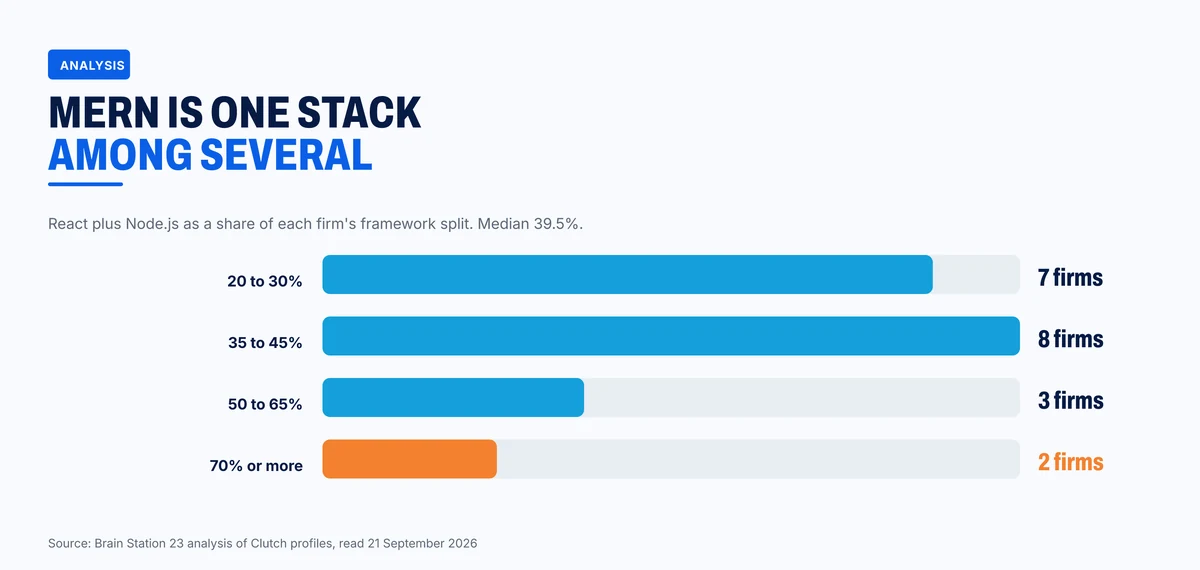
MERN is one stack among several at most of these firms. React and Node.js together take a median 39.5 percent of the twenty firms’ published framework splits. Five firms put them at half or more: X-Team at 88 percent, INOXOFT at 70, Jalasoft at 65, and Vincit and Collective42 at 50. Seven put them at 30 percent or less (Brain Station 23 analysis of Clutch profiles, read 21 September 2026).
The M and the E are invisible in the directory. Clutch’s framework split has no field for Express or MongoDB, so no profile records them. None of the twenty appears among the 150 firms in Clutch’s US MongoDB directory (Clutch), and only one of 193 first-page reviews names MongoDB. A firm on this Top 20 MERN Stack Development Companies in USA list may still build excellent MongoDB schemas. The directory simply cannot show it, so the evidence has to come from you.
The neighbouring frameworks are common. Fifteen of the twenty list React Native and nine list Next.js. Expect proposals that pair a React web app with a React Native mobile app, and expect some to propose Next.js instead of a separate Express server.
Cost is the weak sub-score. Among the 18 firms whose sub-scores differ, Cost is the lowest or joint lowest for 16. Six of the twenty carry a Review Highlights caution about budgets, scope or timelines, and three have fewer than ten reviews: Gigster with two, Jalasoft with seven and X-Team with eight.
Nine firms list a location outside the US. They include INOXOFT, Vention, BairesDev, Jalasoft, Brainvire and Orangesoft. That usually explains the lower bands, and it makes working-hours overlap a question for the first call.
How to shortlist a MERN stack development company
Order the filters so the first one removes the most firms.
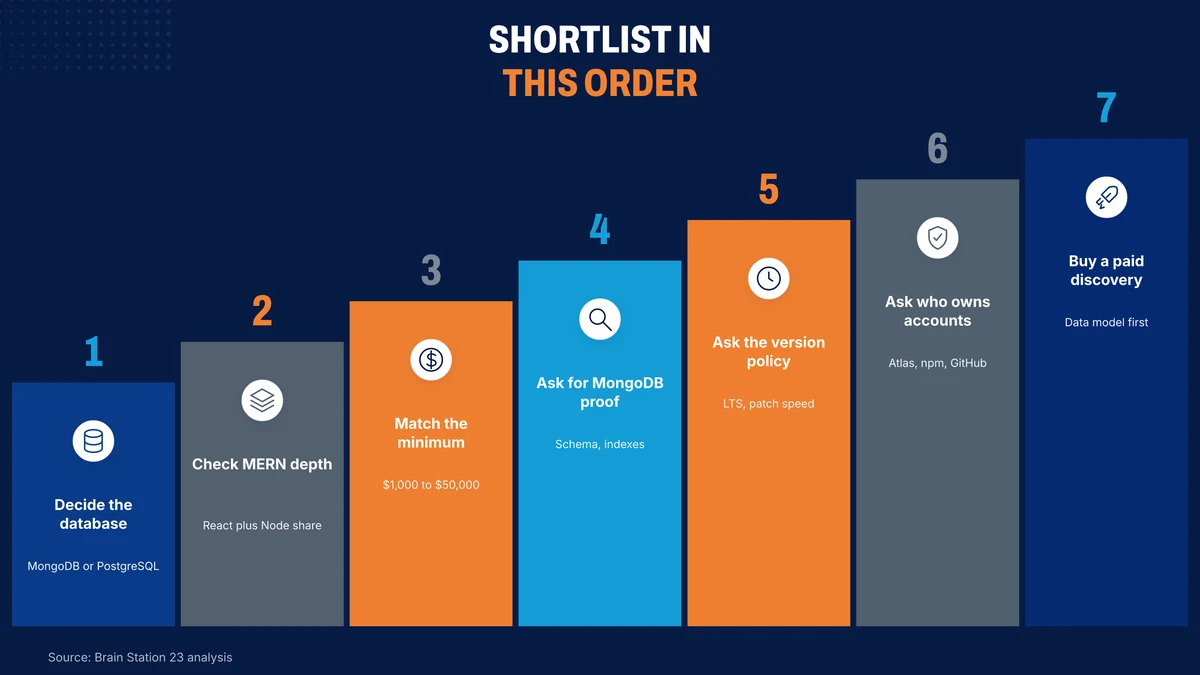
Step 1: Decide on the database first. MongoDB suits flexible documents; PostgreSQL suits joins and reporting. If you are unsure, pay for that decision before you pay for a build.
Step 2: Check React and Node.js depth. Compare the MERN Focus column. A firm at 20 percent may still be right, but it is not a MERN specialist.
Step 3: Match your budget to the minimum. Minimums run from $1,000 to $50,000, and rates from $25 to more than $300 an hour.
Step 4: Ask for MongoDB evidence. The directory cannot show it, so ask for a schema from a past project, how the firm indexes it, and how it handled a migration.
Step 5: Ask for the version policy. The answer should name a Node.js LTS line, a MongoDB release with its end-of-life date, and how fast React security releases are applied.
Step 6: Ask who owns the accounts. GitHub, MongoDB Atlas, npm and the cloud account should be in your organisation from day one.
Step 7: Buy a paid discovery. A short fixed-fee phase that produces a data model and architecture shows how the firm thinks before you fund a build.
How to buy MERN development: four engagement models
The engagement model decides who pays when the data model has to change halfway through.
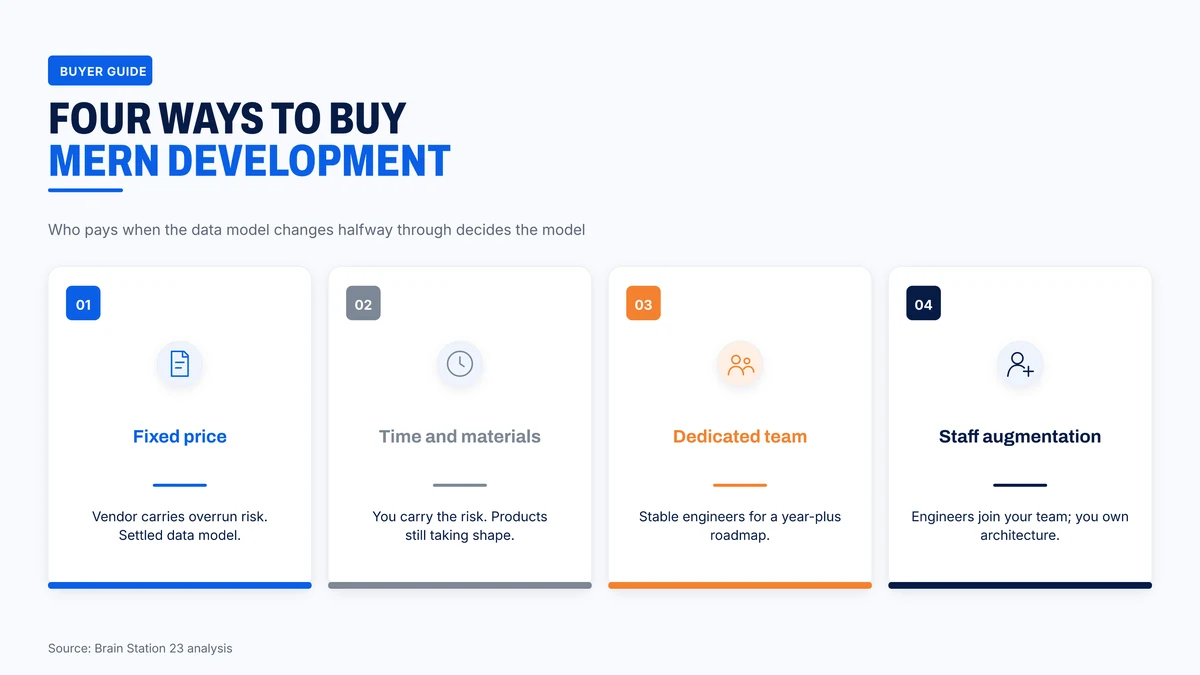
Fixed price moves overrun risk to the vendor, who prices it in. It suits a well-specified application with a settled data model. It fails when the MongoDB schema has to change after the first users arrive.
Time and materials keeps the risk with you. It suits products still finding their shape. Cap each phase and review burn every week.
Dedicated team gives you a stable group of engineers who learn your product. It suits a roadmap of a year or more, and it works best with your own product owner setting priorities.
Staff augmentation adds React or Node.js engineers to your team. Vention, BairesDev, X-Team, Jalasoft, Codup, Diffco AI and Brain Station 23 publish staff augmentation lines. It fails when nobody in-house owns the architecture and release decisions.
The technical question: keeping four layers on supported versions
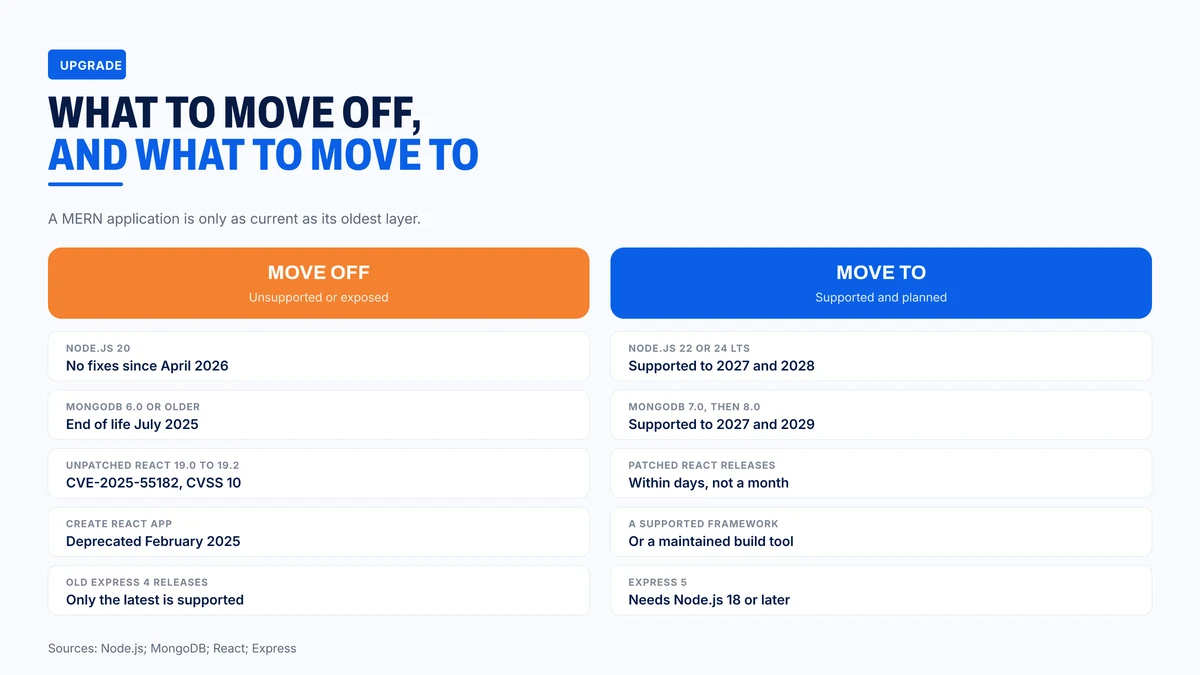
A MERN application ages at four speeds. The order of the upgrade work decides whether it is routine or an outage.
Step 1: Take an inventory. Record the exact Node.js, MongoDB server and driver, Express, React and framework versions in every environment. Most upgrade surprises come from the one environment nobody listed.
Step 2: Close the known exploited holes first. React Server Components versions 19.0, 19.1.0, 19.1.1 and 19.2.0 carried CVE-2025-55182, rated CVSS 10.0, and further fixes followed on 26 January 2026 (React). MongoDB’s CVE-2025-14847 is fixed in 8.0.17, 7.0.28 and 6.0.27, among others, while the NVD lists every 4.2, 4.0 and 3.6 release as affected (NVD).
Step 3: Move Node.js to an LTS line. Node.js 20 has had no fixes since 30 April 2026. Node.js 22 runs to 30 April 2027 and Node.js 24 to 30 April 2028 (Node.js Release schedule).
Step 4: Upgrade MongoDB one major version at a time. MongoDB 6.0 ended on 31 July 2025, so move to 7.0, supported to 31 August 2027, then plan for 8.0, supported to 31 October 2029. MongoDB also warns that drivers released more than three years after a server version’s end of life will not be compatible with it (MongoDB).
Step 5: Move Express 4 to Express 5 when Node.js is ready. Express 5 needs Node.js 18 or later, and only the latest release of each major line is supported (Express).
Step 6: Retire Create React App. It was deprecated on 14 February 2025 (React). Move to a supported framework or build tool as part of a planned release, not during an incident.
Step 7: Schedule the next round. Put the next end-of-life dates in the maintenance plan now: Node.js 22 in April 2027 and MongoDB 7.0 in August 2027.
Red flags: eight answers to walk away from
Each of these answers should end the conversation, or at least change the contract.
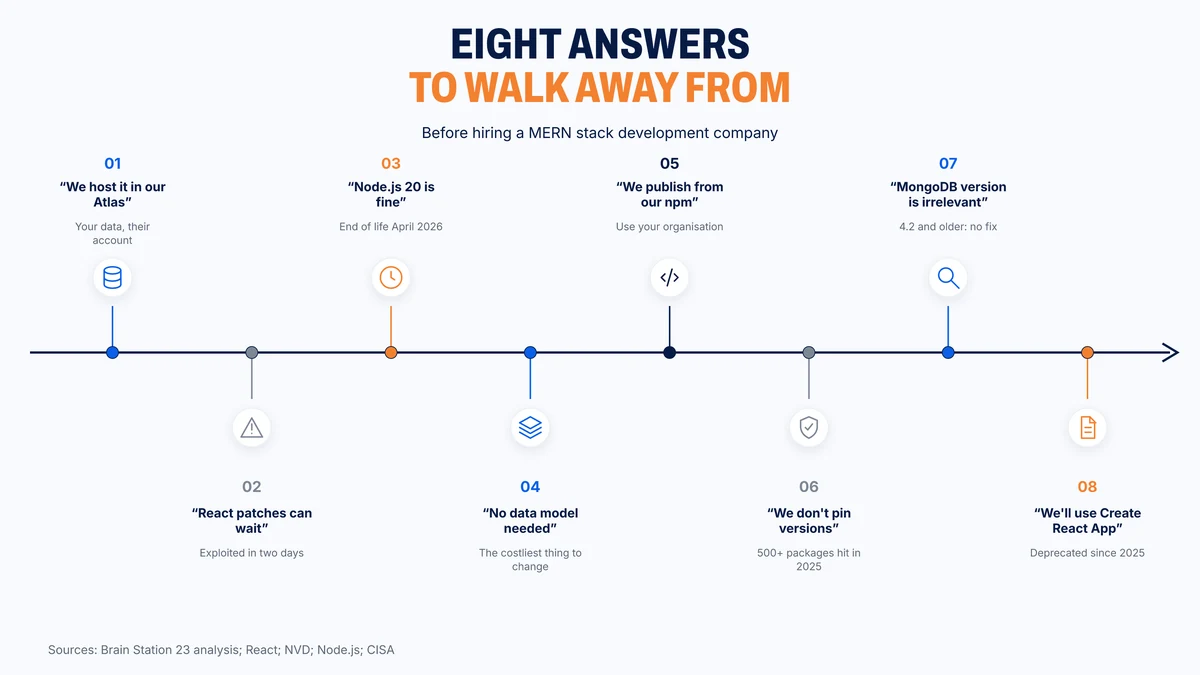
“We’ll host the database in our Atlas account.” The Atlas organisation, its billing and its backups should be yours.
“React patches can wait for the monthly release.” CISA added CVE-2025-55182 to its exploited list two days after React disclosed it (CISA).
“Node.js 20 is fine for now.” It reached end of life on 30 April 2026 (Node.js Release schedule).
“MongoDB is schemaless, so we skip the data model.” The data model is the most expensive thing to change later. Ask for it in writing.
“We publish packages from our own npm account.” Publishing belongs in your npm organisation, with your staff as owners.
“We don’t pin dependencies.” The Shai-Hulud worm compromised more than 500 npm packages in September 2025, and CISA told organisations to pin to known safe releases (CISA).
“The MongoDB version doesn’t matter.” Versions 4.2 and older are listed as affected by CVE-2025-14847 with no fixed release (NVD).
“We’ll start it on Create React App.” It has been deprecated since February 2025 (React).
After launch: what the build quote leaves out
This part covers what owners wish they had settled before the final invoice, and what recurs for as long as the application runs.
What you must own before the final invoice
The code repository with its full history, in your GitHub or GitLab organisation, including infrastructure scripts and tests, not a zip.
The MongoDB Atlas organisation and project, with billing in your name, database users you can revoke, and backup and restore settings you have tested.
Your own npm organisation, if the project publishes packages. npm revoked all classic tokens on 9 December 2025, and publishing now uses two-hour session tokens or granular write tokens limited to 90 days (GitHub). Tokens that short need an owner on your side.
The cloud account running the Node.js services, with billing, access roles and logs under your control.
Domain, DNS and email sending, registered to your organisation.
Environment configuration and secrets, stored in a secrets manager you administer, with a list of every third-party key.
Design source files, for the React components and any React Native app.
A runbook, covering deployment, rollback, database restore, version upgrades and incident contacts.
The bill that arrives after launch
A build quote covers the build. Ask for the recurring number before you sign, and compare vendors over three years.
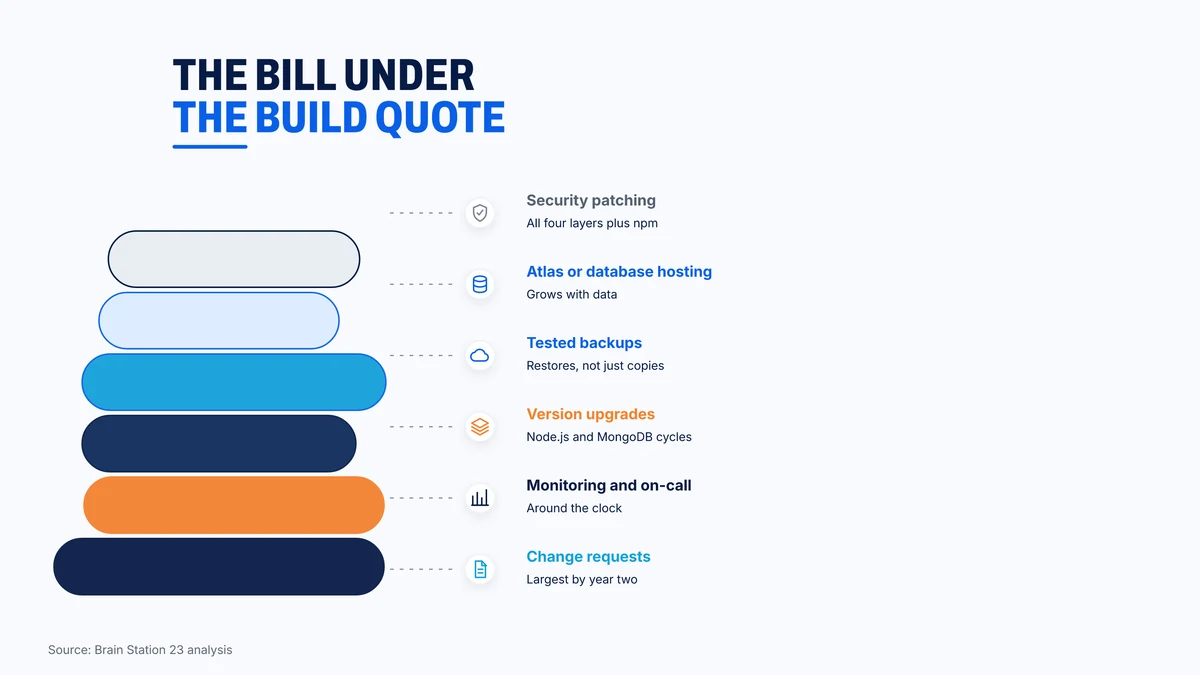
Security patching comes first, for React, Node.js, Express and every npm dependency. Then Atlas or database hosting, which grows with data and traffic, and backups you have actually restored. Then version upgrades: every two to three years for Node.js and MongoDB on the current calendars. Then monitoring and on-call cover, and finally change requests, which usually outgrow everything else by year two.
Security is a recurring cost
Both ends of the stack had exploited flaws within weeks of each other. React disclosed CVE-2025-55182, an unauthenticated remote code execution flaw rated CVSS 10.0, on 3 December 2025 (React). CISA added it to the Known Exploited Vulnerabilities catalog on 5 December (CISA). MongoDB’s CVE-2025-14847, which lets an unauthenticated client read uninitialised memory, was published on 19 December and added to the same catalog on 29 December (NVD; CISA).
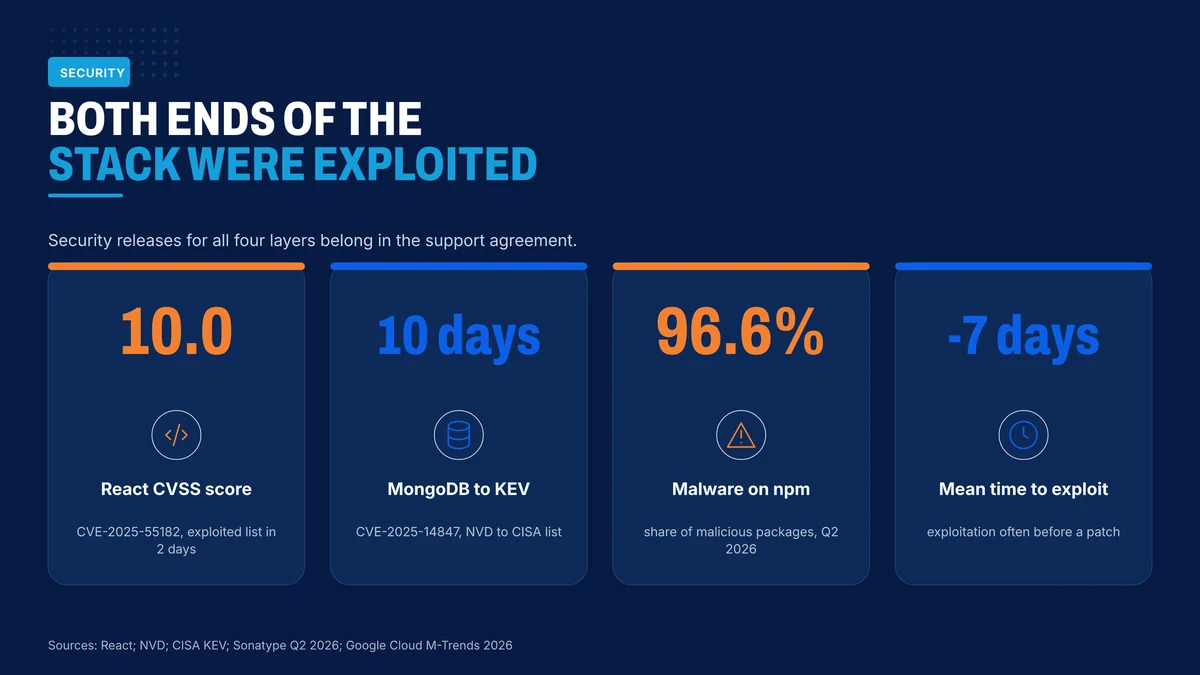
The packages around the stack are a target too. Sonatype attributed 96.6 percent of malicious package counts in Q2 2026 to npm (Sonatype). After the Shai-Hulud worm, CISA told organisations to pin dependencies, rotate developer credentials and require phishing-resistant multifactor authentication on developer accounts (CISA).
Timing makes it harder. Google Cloud’s M-Trends 2026 estimated the mean time to exploit at minus seven days, meaning exploitation often arrives before a patch (Google Cloud). A retainer that applies security releases in a monthly window does not cover that risk. The average US data breach cost USD 11.5 million in IBM’s 2026 report (IBM Cost of a Data Breach Report 2026). Write a patch window for critical and actively exploited flaws, in days, into the support agreement.
Accessibility is legal exposure
The React front end is where accessibility is won or lost. WebAIM found detected WCAG 2 failures on 95.9 percent of the top million home pages in 2026, an average of 56.1 errors per page (WebAIM Million 2026). More than 5,000 digital accessibility lawsuits were filed in 2025, and 46 percent of federal cases involved repeat defendants (UsableNet).
Name WCAG 2.2 AA in the contract rather than the word “accessible”, ask for automated and manual checks in the definition of done, and treat overlay widgets sceptically. Accessible React components are cheap to build and expensive to retrofit.
Contract clauses that surface in month nine
IP assignment on payment, not on final acceptance, so a dispute over the last milestone does not leave the code in limbo.
Transition assistance, a fixed number of hours at an agreed rate, available whether the relationship ends well or badly.
Rate escalation caps for the support period, so year two does not reprice the retainer.
Subcontracting, named and approved in writing, because a MERN team is easy to assemble from contractors you never meet.
A patch window, in days, for critical and actively exploited vulnerabilities in React, Node.js, Express and MongoDB.
Liability cap and insurance, sized against the data the application holds.
Non-solicitation in both directions, with a reasonable term.
This is general guidance, not legal advice. Have your own counsel review the contract.
How to leave without losing the codebase
Confirm, in writing, that the repository, the Atlas organisation, the npm organisation and the cloud account are already yours. Trigger the transition hours while the relationship is still cordial. Ask the departing team to record walkthroughs of deployment, the data model and the release process, and to restore a database backup in front of your staff.
On the last day, remove the departing team from every organisation, revoke their npm and cloud tokens, remove their Atlas database users and IP access entries, and rotate every secret they could have seen. CISA’s advice after Shai-Hulud, to rotate all developer credentials, applies just as well to a vendor exit (CISA).
Hire in-house or hire a MERN stack development company
The comparison starts with the wage. Indeed reports $136,918 for a US full stack developer, and the BLS median for all software developers was $135,980 in May 2025 (Indeed; BLS). That is before benefits, recruiting, equipment and the time to hire.
Hire in-house when the MERN application is your product and you will change it every week. The knowledge of the data model is the asset, and it should sit with your staff.
Hire an agency for a defined build, a first version or a specialist phase such as a MongoDB migration, with the accounts in your name and transition hours in the contract.
Mix the two when you have a technical lead but not enough engineers. Staff augmentation from the firms that publish it fills the gap, and your lead keeps the architecture decisions.
FAQ
Which companies are the top MERN stack developers in the USA?
By combined Clutch Rank on the US React and Node.js directories, read 21 September 2026, the top five are INOXOFT, Vention, BairesDev, Scopic and FocusReactive (Clutch). Clutch has no MERN category, so we ranked the 171 firms that appear in the top 300 of both directories.
How much do US MERN stack development companies charge?
The twenty firms here publish hourly bands from $25 to more than $300, and eleven charge under $100. Minimum projects run from $1,000 to $50,000, with a median of $25,000 (Clutch).
How much does a MERN stack developer earn in the US?
ZipRecruiter reports $123,262 for a MERN stack developer as of 20 September 2026 (ZipRecruiter). Full stack figures range from $92,320 on PayScale to $136,918 on Indeed, because each site measures pay differently (PayScale; Indeed).
Should a MERN application use MongoDB or PostgreSQL?
It depends on the data. MongoDB suits flexible documents such as content and catalogues; PostgreSQL suits joins and reporting. PostgreSQL is more widely used, by 58.2 percent of professional developers against 24.3 percent for MongoDB in 2025 (Stack Overflow). Decide before the build.
Which Node.js version should a MERN application run?
An LTS release. In September 2026 that means Node.js 22 or 24. Node.js 20 reached end of life on 30 April 2026, Node.js 22 follows on 30 April 2027, and Node.js 26 becomes LTS on 28 October 2026 (Node.js Release schedule).
Which MongoDB versions are still supported?
MongoDB 7.0 is supported to 31 August 2027 and 8.0 to 31 October 2029. MongoDB 6.0 reached end of life on 31 July 2025 (MongoDB lifecycle schedules). An application on 6.0 or older should have an upgrade date in its maintenance plan.
Is Create React App still a good way to start a React project?
No. The React team deprecated it on 14 February 2025 because it had no active maintainers, and it recommends starting with a framework (React). Treat a proposal built on Create React App as a sign the vendor’s tooling is out of date.
Who should own the MongoDB Atlas account?
Your organisation. The Atlas organisation, its billing, database users and backups hold your data, and a vendor exit should mean removing their access, not negotiating for yours. The same applies to the npm organisation, where tokens now last two hours for sessions or up to 90 days for granular write tokens (GitHub).
Conclusion
The data behind this Top 20 MERN Stack Development Companies in USA list says three things. React and Node.js are one stack among several at most of these firms, with a median combined share of 39.5 percent. MongoDB and Express are invisible in the directory, so the evidence for them has to come from your own questions. And the work is priced under $100 an hour at eleven of the twenty firms, around a $25,000 median minimum.
Any of the twenty can build a React front end on a Node.js service. What decides the next three years is who owns the Atlas organisation, the npm organisation and the repository, how fast security releases for all four layers are applied, and whether Node.js 22 and MongoDB 7.0 already have upgrade dates in the plan.
Sources
- https://clutch.co/us/developers/reactjs?sort_by=ClutchRank
- https://clutch.co/us/developers/nodejs?sort_by=ClutchRank
- https://clutch.co/it-services/mongodb?geona_id=840&sort_by=ClutchRank
- https://clutch.co/profile/brain-station-23
- https://survey.stackoverflow.co/2025/technology
- https://github.com/nodejs/Release
- https://www.mongodb.com/legal/support-policy/lifecycles
- https://expressjs.com/en/support/
- https://react.dev/blog/2025/02/14/sunsetting-create-react-app
- https://react.dev/blog/2025/12/03/critical-security-vulnerability-in-react-server-components
- https://nvd.nist.gov/vuln/detail/CVE-2025-14847
- https://www.cisa.gov/known-exploited-vulnerabilities-catalog
- https://www.cisa.gov/news-events/alerts/2025/09/23/widespread-supply-chain-compromise-impacting-npm-ecosystem
- https://github.blog/changelog/2025-12-09-npm-classic-tokens-revoked-session-based-auth-and-cli-token-management-now-available/
- https://www.sonatype.com/blog/q2-2026-open-source-malware-index-attackers-abuse-developer-trust
- https://www.payscale.com/research/US/Job=Full_Stack_Software_Developer/Salary
- https://www.glassdoor.com/Salaries/us-full-stack-developer-salary-SRCH_IL.0,2_IN1_KO3,23.htm
- https://www.ziprecruiter.com/Salaries/Mern-Stack-Developer-Salary
- https://www.indeed.com/career/full-stack-developer/salaries
- https://www.bls.gov/ooh/computer-and-information-technology/software-developers.htm
- https://cloud.google.com/blog/topics/threat-intelligence/m-trends-2026
- https://www.ibm.com/reports/data-breach
- https://webaim.org/projects/million/
- https://blog.usablenet.com/ada-web-lawsuit-trends-2026