
Staff Augmentaion
Hire React Native Developer in USA
and your first PR lands by day five.
An empty mobile seat stalls two app stores at once. When you hire React Native developers in USA through Brain Station 23, senior engineers are shipping PRs into your repo by day five, on your standup, under your code review and inside your release train. A dedicated seat starts from $2,500 a month.
Get senior React Native engineers by day five.
Tell us what you are shipping, a new app, an Expo project or an older app on the legacy architecture. We will line up senior engineers who match your stack.
Why Choose React Native Developers in USA
Your buyers expect the same feature on iPhone and Android on the same day. One React Native codebase lets a single team keep that promise.
HIPAA, COPPA, PCI DSS
Health data, children's data and card payments each carry their own rules, and store review adds a second gate.
Two stores, one roadmap
A feature that lands on iOS alone leaves Android users waiting. Shared code closes that gap.
Engineers who have shipped to the stores
Store submissions, crash triage, push edge cases and rollbacks. Senior judgment is learned in production.
Your code under federal law
Assignment terms enforceable under federal copyright law from the first commit.
Meta, Expo and Microsoft
React Native is maintained by Meta, with Expo and Microsoft among the major contributors.
4-hour live overlap
Bangladesh to Eastern Time gives you four shared hours a day, 9 AM to 1 PM New York, where both teams are at full capacity.
Four things that start working when the right team shows up.
Hover or tap a card to see what changes.
Velocity
iOS and Android get the same feature in the same sprint. First PR by day five.
ShippingMath that works
One codebase, one team, one release train. Throughput is the metric, not the hourly rate.
LiveRisk reframed
Mobile projects rarely fail on screens. They fail on upgrades, native modules and release process.
WatchedPosition locked
Launching before the season or after it is a market position. A slipped release costs more than the sprint.
TrackedWhat a React Native Development Company in USA Does
First PR ships in five days, not five sprints.
Understand the gap
A new app, a stalled roadmap, an architecture you cannot upgrade, or plain throughput.
Match seniority to the actual gap
Three CVs with links to apps live in the stores. Two technical conversations with you. You pick.
First PR by day five
Engineer in your repo, on your Slack and in your standup, with a working simulator build.
Senior judgment, your patterns
ADRs into your repo. PR reviews by your tech lead. Crash-free rate and release frequency on your dashboards.
Scale with demand
Need a QA engineer for device testing or a native iOS specialist next month. Three days from request to start.
Handover or extend
Build scripts, signing setup, release runbooks and ADRs checked into your repo. No black box. Most clients extend.
Which one of these sounds painfully familiar?
Click a scenario to see what changes.
Scaling startup
The iOS app found its market first. Android users are asking when, and the roadmap is committed for two quarters.
HotMid-market platform
Your senior mobile engineer gave notice, and the next release is already scheduled.
WatchingLegacy architecture
The app still runs on the old bridge, and every library upgrade breaks something.
TrackedBoth stores get the feature in the same sprint.
Two senior React Native engineers shipping into your repo by day five, with one codebase feeding iOS and Android. Release notes stop saying coming soon to Android.
The bill you are already paying for being under-staffed.
Staggered releases
Android ships a month after iOS, so marketing runs two launches and support answers every question twice.
Senior tax
Your most senior mobile engineer spends the week on dependency upgrades and store rejections. Architecture decisions wait.
Hiring overhead
Recruiter fees, interview loops and ramp time. Four months is quick. Six is normal.
Rating drift
Unfixed crashes become one-star reviews, and store ratings are slow to climb back.
30 days from hello to the stores.
20-minute call
The actual gap. Release timing. Expo or bare workflow. No deck.
Three CVs
Each with apps you can download. Two technical conversations. You pick.
Onboard
Repo access, simulator build, standup. First PR by Friday.
Release cadence
First store release out. Familiar by week 2, velocity stable by week 4.
Wins for USA teams, in the business not just the codebase.
Patient app live on both stores ten weeks early.
Two senior React Native engineers joined an iOS-only team. Android shared most of its code with iOS, and the HIPAA review ran once instead of twice.
10 weeks earlier to Google PlayOld architecture retired without a code freeze.
A payments app two major versions behind. Three engineers moved native modules to TurboModules while the team kept shipping every two weeks.
Zero missed releases during migrationDriver app crashes cut by more than half.
Offline sync was failing on older Android devices. A pod of three rebuilt it and added device-farm tests to every pull request.
Crash rate down by more than halfMobile checkout rebuilt before the holiday peak.
Four engineers rebuilt cart and checkout in nine weeks, with over-the-air updates ready for hotfixes during peak week.
4x normal traffic, zero downtimePick the one that matches your current chaos.
1 to 6 senior engineers into your team
Dedicated React Native developers in your repo, your standup and your review queue. We handle hiring, payroll and performance.
A mobile squad with its own lead
3 to 5 engineers with a tech lead, a QA engineer and a PM. Your roadmap, our delivery, weekly TestFlight builds for review.
Fixed scope, fixed timeline
An app from design to store listing, or one migration. Two-week sprints, weekly demos, handover at the end.
Two-week paid app audit
Architecture, dependency health, crash data and upgrade path, written up with ADRs in your repo.
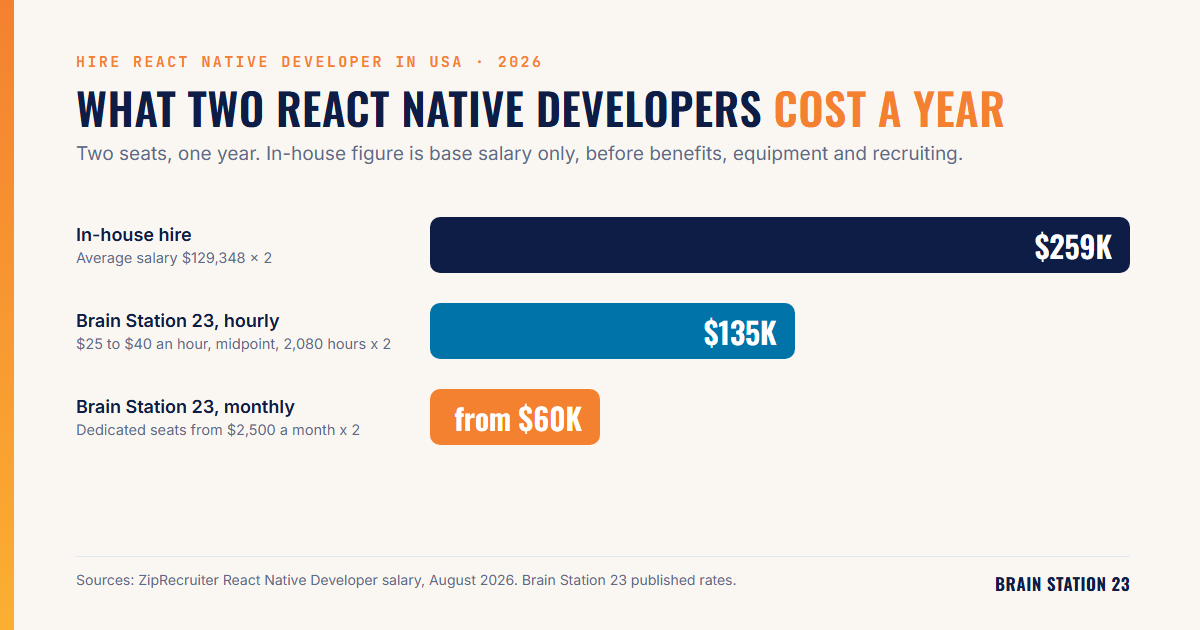
Cost to hire React Native Developers in USA in 2026
Published ranges from named sources, beside what an augmented seat costs. If you are comparing React Native developers for hire in USA, compare the whole row, not only the price.
| Route | Typical cost | Time to first PR | Live overlap | Commitment |
|---|---|---|---|---|
| In-house hire | $106K to $157Kbase salary a year, before benefits and recruiting | Months, after the search | Full day | Permanent, plus a notice period |
| Freelance or contract | $60 to $165per hour, vetted networks to local contract rates | 1 to 3 weeks | Full day, if local | Per project, no bench behind them |
| Nearshore team | $35 to $80per hour, mid to senior, Mexico and Colombia | 2 to 4 weeks | 6 to 8 hours | Usually 3 months minimum |
| Offshore marketplace | $24 to $45per hour, typical range, $30 median | Days, but unvetted | Varies | None, and no continuity |
| Brain Station 23 augmentation | From $2,500 a monthdedicated seat, fully loaded, no recruiting fee; or $25 to $40 an hour. Monthly is the better value | 5 days | 4 hours, 9 AM to 1 PM Eastern | 30-day notice, both ways |
Sources: ZipRecruiter, React Native Developer salary, 25th to 75th percentile, August 2026 (average $129,348); Arc.dev React Native hiring page and SecondTalent cost-to-hire guide, 2026; Curotec, nearshore developer hourly rates by country, 2026; Upwork React Native cost page, 2026. Third-party ranges as published on the dates shown. You can also book React Native developers by the hour at $25 to $40, though a dedicated monthly seat works out cheaper.
Pay for the time zone
A local senior hire gives you the full working day and the highest bill, before benefits and recruiting.
Pay for the overlap
Mexico and Colombia buy you six to eight shared hours at roughly double the offshore rate, usually with a three-month minimum.
Pay for the outcome
A dedicated seat from $2,500 a month, four live hours a day, a tech lead on the account and a replacement in three days.
What to Check Before You Hire React Native Engineers in USA
Six questions that separate vendors who can answer them from vendors who cannot.
Which apps has this engineer shipped to the stores?
Apps you can download, not a list of frameworks. Ask which parts they built.
Who owns the repo, the signing keys and the store accounts?
You do, from day one. If a vendor publishes under its own developer account, your app is not portable.
Have they moved an app to the New Architecture?
Fabric, TurboModules and a working upgrade plan. Fresh projects never meet the hard part.
Can I see a crash-free rate, not a slide?
Crash-free sessions, release frequency and test coverage from comparable apps.
What is the actual time to first PR?
Five days. If it is three weeks, that is a recruiting agency, not a mobile engineering practice.
What happens at handover?
Build scripts, signing setup, release runbooks and full ADR documentation checked into your repo, not held by the vendor.
How we vet React Native Developers before you meet them
Four gates, in order. Every engineer we put forward has passed all four, and you still run your own interview.
CV and store portfolio screen
We read the CV against apps live in the App Store and Google Play, and check which parts the engineer built.
Proves production shippingTechnical interview
A senior engineer covers state, navigation, native modules, profiling and how they would plan an upgrade.
Proves depth, not keywordsPaid live coding on a real ticket
A paid session on a realistic ticket with an offline edge case, reviewed like any pull request.
Proves how they work under reviewReference and background check
Former leads confirm delivery, and a background check runs before any access to client systems.
Proves they are who they sayWhat to look for before the interview
Eight things to screen a React Native CV against, whoever you hire from.
In the code
Beyond the code
Why teams renew after the first engagement.
Senior React Native engineers live in your Eastern morning, 9 AM to 1 PM, every working day.
Planning, code review, release calls and incident response happen inside that window.
Vetting that is real
Store portfolio review, technical interview, paid live coding and reference checks on every engineer.
Flex on both sides
30-day notice, both ways. Add a QA or native iOS engineer in 3 days when a release needs it.
Continuity built in
Two-engineer minimum on every account. A backup shadows for one sprint at any rollover.
The app is yours
Your repo, your signing keys, your store accounts, your IP. ADRs documented. No black box at exit.
What changed in their business.
Rated 4.9 out of 5 across 21 reviews on our Clutch profile, including the one thing reviewers asked us to improve.
Paraphrase: reviewers score the quality of the work at 5.0 out of 5, the highest of the four Clutch sub-scores.
Paraphrase: reviewers rate value for cost at 4.9 out of 5, and describe budgets that held from the first estimate to delivery.
Paraphrase: reviewers asked for better internal coordination. That is why every account now has one named tech lead inside your overlap window.
What our React Native Developers build, in plain language
Engineers embedded in your app team
1 to 6 senior engineers inside your existing squad, building features for iOS and Android from one codebase, on your board and your review process.
Upgrade and migration crews
Apps stuck on the legacy bridge moved to the New Architecture, old libraries replaced, and releases kept on schedule while the work lands.
Two native apps brought into one
Separate Swift and Kotlin codebases consolidated screen by screen, with native modules where they earn their place and automated store releases.
What our React Native Engineers cover, by name
The names buyers ask about most, and what we do with each.
New Architecture0.82+
Fabric and TurboModules, the only architecture from 0.82 onward, including migrations off the old bridge.
Expo and EAS
Expo SDK, EAS Build and EAS Update for over-the-air fixes, with prebuild when custom native code is needed.
TypeScript
Strict typing across screens, hooks and API clients, so upgrades fail at compile time, not in the store.
Expo Router and React Navigation
Deep links, universal links and auth flows that survive a cold start.
Redux Toolkit and Zustand
Client state kept small and predictable, shaped around features.
TanStack Query and GraphQL
Server state, caching, offline queues and optimistic updates over REST or GraphQL.
Reanimated and Gesture Handler
Animations and gestures on the UI thread, smooth on mid-range Android devices.
Swift and Kotlin native modules
Custom modules when a library is missing, unmaintained or too slow.
Firebase
Authentication, push notifications through FCM and APNs, Crashlytics, Remote Config and analytics events.
Jest, Detox and Maestro
Component tests with React Native Testing Library and end-to-end flows on devices in CI.
Hermes
Startup time, memory and bundle size tuned with real profiling.
Fastlane and store releases
Signing, TestFlight, Play Console tracks and staged rollouts, automated in your CI.
Brain Station 23: Powerhouse of the Best React Native Engineering in USA
Brain Station 23 has put engineers into client codebases since 2006, from Bangladesh and an office in Springfield, Virginia. As a React Native development company in USA, we work under SOC 2 Type II, ISO 27001, CMMI Level 3 and GDPR-aligned controls.
Engagements across USA.
Nashville, Seattle, Chicago, New York and San Francisco. Same playbook and the same code review discipline on every account.
Questions you should ask before signing.
Five business days from the first call to the first PR. Three CVs with store links inside three days, two technical conversations, and the engineer you pick is in your repo and your standup by day five.
With Brain Station 23, a dedicated full-time seat starts from $2,500 a month, fully loaded with no recruiting fee, or $25 to $40 an hour for hourly work. For comparison, ZipRecruiter put the base salary for an in-house React Native developer at $106,000 to $157,000 a year in August 2026, before benefits, equipment and recruiting.
Start with the gap. Screen CVs against apps that are live in the stores, run a technical interview on architecture and native modules, then a short paid task on a realistic ticket. Check references last. Our vetting runs those four gates before you see a CV.
Yes. The react-native package was downloaded more than 49 million times from npm in the month to 11 September 2026, and new releases ship roughly every two months. Release 0.82 was the first to run entirely on the New Architecture, so engineers who can deliver that upgrade are in short supply.
The eight-point checklist above covers it, four skills in the code and four in how the engineer works with your team. If you only check one thing, ask which apps they have shipped to the stores and maintained after launch.
Onshore gives you the full working day at the highest cost. Nearshore teams in Mexico and Colombia give six to eight shared hours at $35 to $80 an hour, often with a three-month minimum. Offshore with a tech lead on the account gives four live hours at a fraction of either.
Tell us inside the first two weeks and a replacement is in your repo three days later, at no extra cost, with one sprint of overlap.
Senior means apps shipped to both stores and maintained after launch, not years on a CV. You run the technical interview and you say yes or no.
You do, from day one. Code stays in your repo and apps publish under your Apple and Google developer accounts, never ours. SOC 2 Type II and ISO 27001 certified, GDPR aligned, and every engineer signs an NDA governed by federal law.
30-day notice, both ways. Scale up by adding engineers, with a 3-day start. Scale down by giving notice. No minimum beyond the notice period.
A recruiter sells you a person and leaves. We sell you a practice: a tech lead on every account, a replacement in three days, and release metrics on your dashboards.
Yes, on your paper or ours. Standard MSAs are signed in five business days, with a Statement of Work per engagement.
Nearshore buys more overlap hours at a higher rate. We give you four live hours with Eastern Time and twenty years of client work in USA. If you truly need six live hours a day, nearshore is the better answer and we will say so.
Every app on this page started with one phone call.
Twenty minutes. Your actual app, your actual gap, and what a senior React Native engineer in your repo by Friday would change.
Also hiring for: PHP developers·IT staff augmentation·Top React Native companies compared·About Brain Station 23