
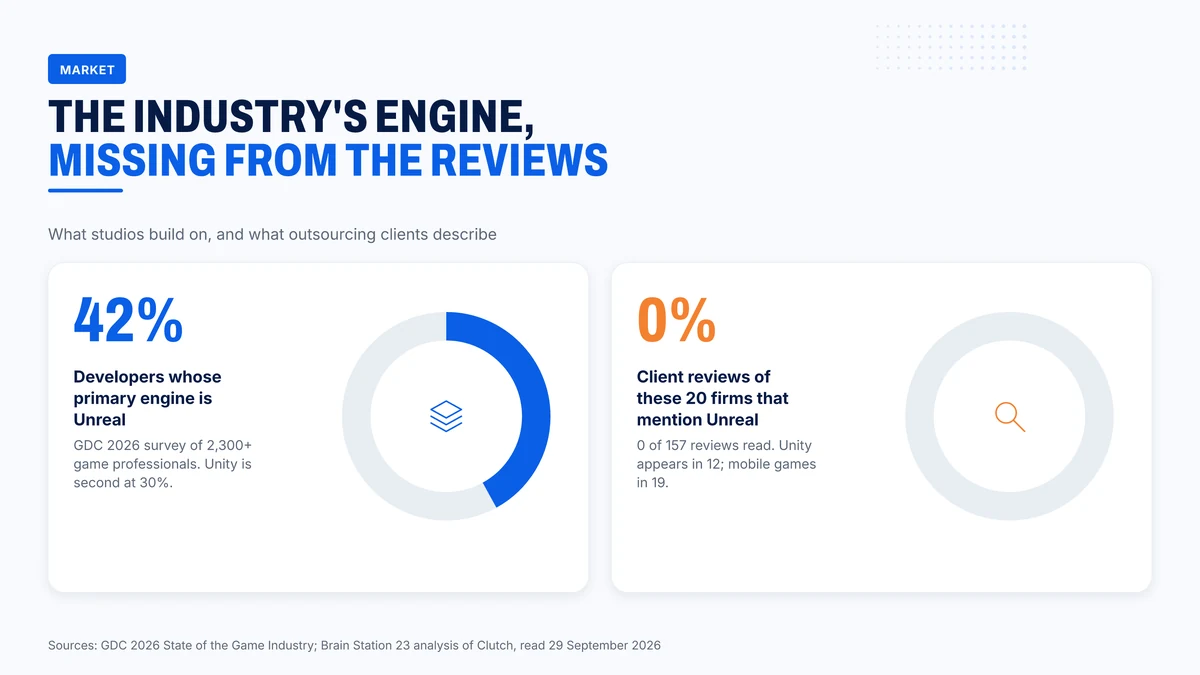
Unreal is the industry’s engine.
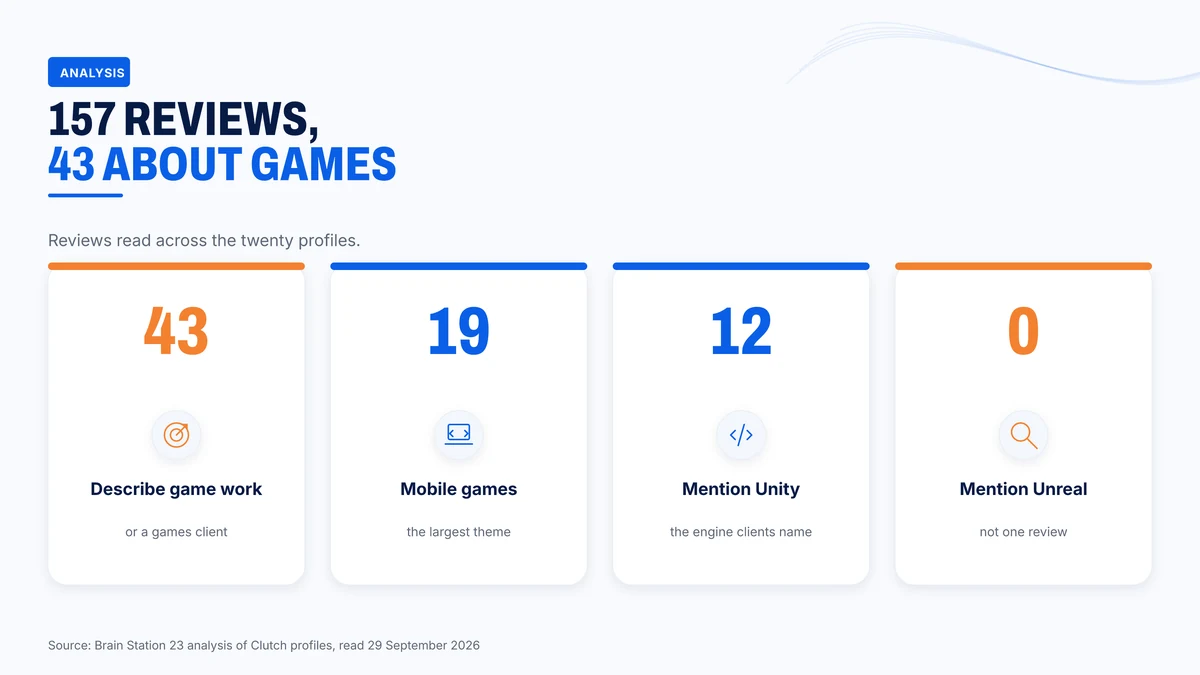
In the GDC 2026 State of the Game Industry survey, 42 percent of developers named it their primary engine, ahead of Unity at 30 percent. Not one of the 157 client reviews behind this Top 20 Game Development Companies in USA list mentions it.
Twelve mention Unity. Nineteen describe mobile games.
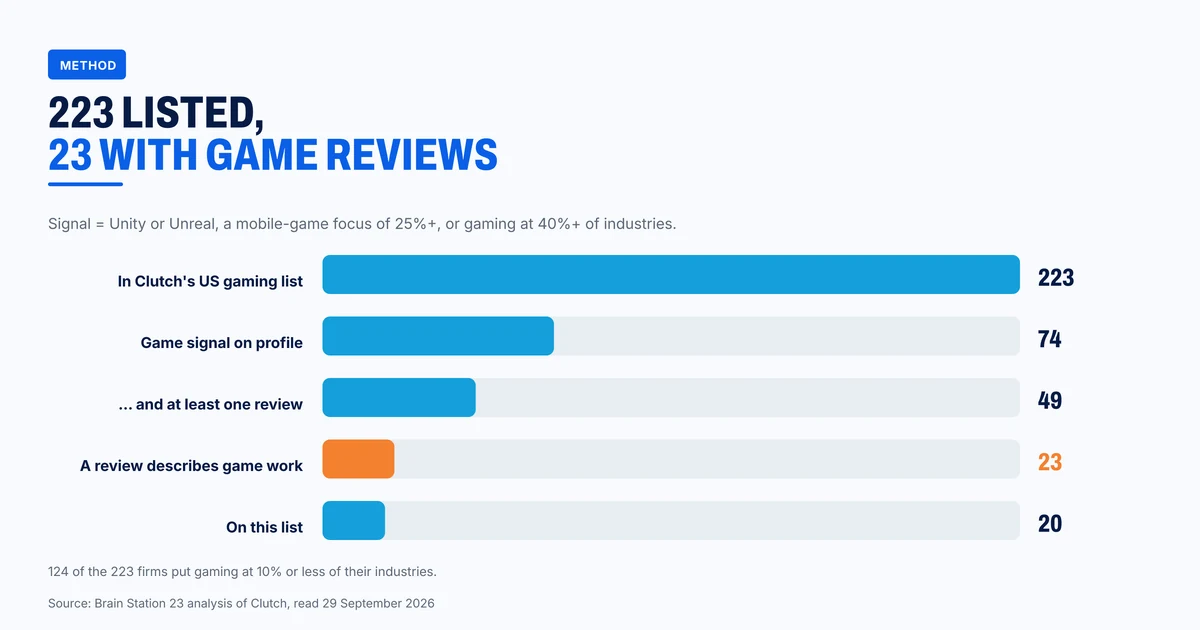
That gap is the shape of the US outsourcing market for games. Clutch lists 223 US firms that serve gaming companies, and 124 of them put gaming at 10 percent or less of their work. Only 23 have a client review that describes building a game or working for a games company.
So the first question is not which studio is best. It is whether the studio has shipped the kind of game being briefed, in the engine it will be built in.
The guide covers what games cost to build and run, how engine and store terms change the budget, and what a studio should hand over at the end: the source, the art files and the store accounts.
Key takeaways
- 23 of 223 US firms in Clutch’s gaming directory have a review that describes game work or a games client; 88 have no reviews at all (Clutch).
- 42% vs 30% of game developers name Unreal and Unity as their primary engine (GDC 2026).
- 0 of 157 client reviews across the twenty firms mention Unreal; 12 mention Unity (Clutch profiles).
- $60.7 billion was spent on video games by US consumers in 2025, the second-highest year on record (ESA).
- 33% of US game developers were laid off in the past two years (GDC 2026).
- 16 October 2026 is the end of support for Unity 6.0 LTS (endoflife.date).
- 5% royalty applies to Unreal Engine games above $1 million in lifetime gross revenue; Unity Pro costs $2,310 per seat a year (Unreal Engine; Unity).
- $10,000 is the median published minimum project across the twenty firms, and 13 of them have fewer than ten reviews (Clutch profiles).
Game development in 2026: a large market and a narrow outsourcing bench
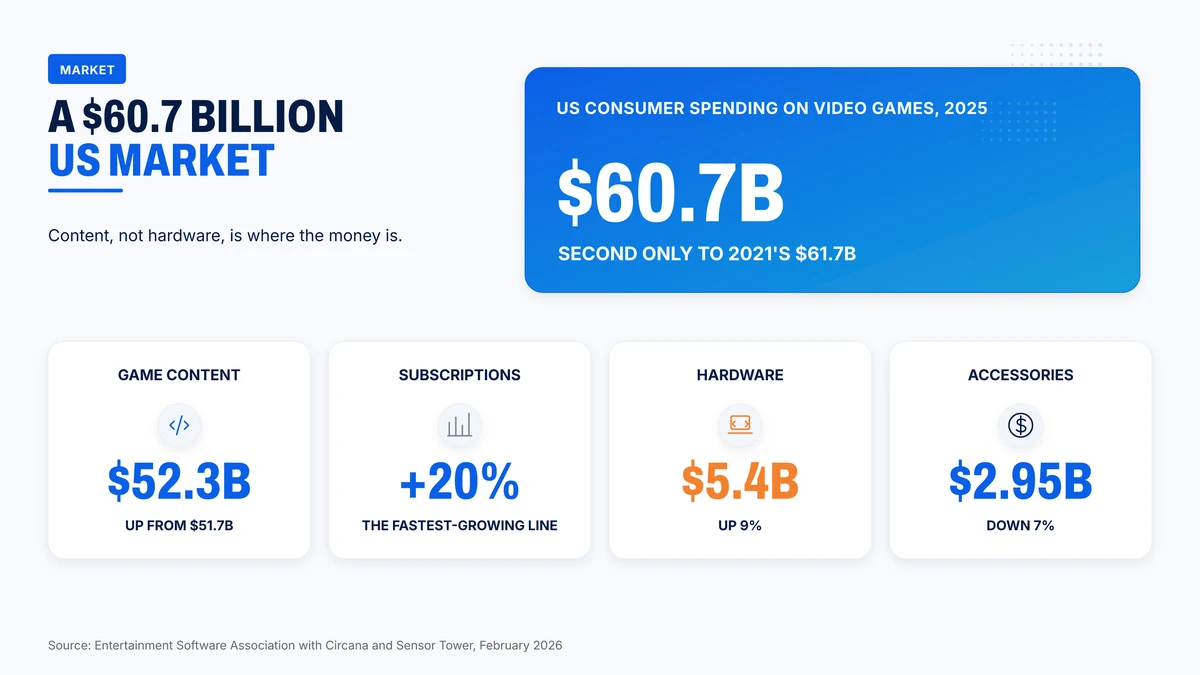
US players spend more than ever on content. Consumer spending on video games in the US reached $60.7 billion in 2025, up 1.4 percent and second only to 2021’s $61.7 billion. Content accounted for $52.3 billion, subscriptions grew 20 percent, hardware rose 9 percent to $5.4 billion and accessories fell 7 percent to $2.95 billion (ESA with Circana and Sensor Tower).
Studios build on Unreal; outsourcing clients describe Unity. GDC’s 2026 survey of more than 2,300 game professionals found Unreal is the primary engine for 42 percent of developers and Unity for 30 percent. Unreal is more common at AA (59 percent) and AAA (47 percent) studios, while 54 percent of developers at older indie studios still use Unity and 11 percent of newer indies use Godot (GDC 2026). The outsourcing market looks different: 50 of the 223 US firms in Clutch’s gaming directory list Unity on their profiles and 10 list Unreal.
The industry is still cutting staff. Twenty-eight percent of GDC’s respondents were laid off in the past two years, rising to 33 percent in the United States. Over half, 52 percent, now think generative AI is having a negative impact on the industry, up from 30 percent a year earlier (GDC 2026). For a buyer, that means experienced developers are available, and it also means studios change shape quickly.
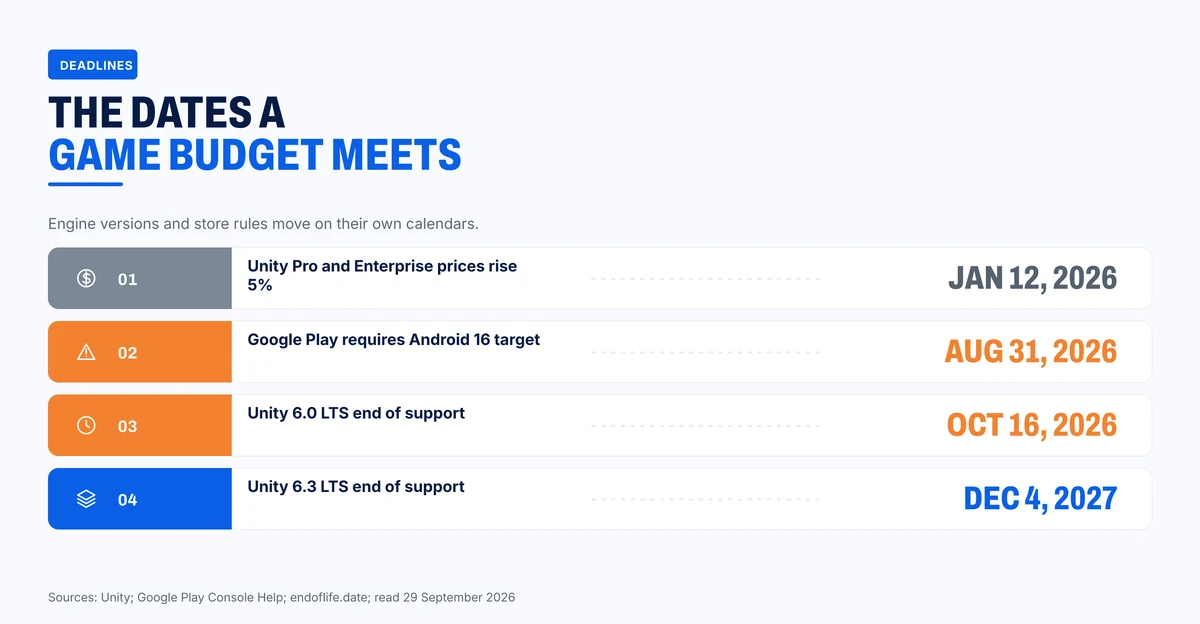
Engines and stores set dates the budget has to meet. Unity raised Pro and Enterprise prices by 5 percent from 12 January 2026 (Unity). Google Play has required new apps and updates to target Android 16 since 31 August 2026 (Google Play Console Help). Unity 6.0 LTS reaches end of support on 16 October 2026 and Unity 6.3 LTS on 4 December 2027 (endoflife.date).
So a game brief needs three answers before any studio is compared: the genre and target platforms, the engine and version, and whether the studio is building the whole game, adding a team to yours, or handling the back end, art or porting.
What game development costs in the US
Pay figures for game and software developers spread by $39,591 across three sources.
Glassdoor puts the average US game developer at $96,389, with a 25th to 75th percentile range of $72,428 to $129,264, and ZipRecruiter reports $108,471 (Glassdoor; ZipRecruiter). The Bureau of Labor Statistics puts the median software developer at $135,980 in May 2025 (BLS). PayScale’s video game developer page rests on six salary profiles, too few to use.
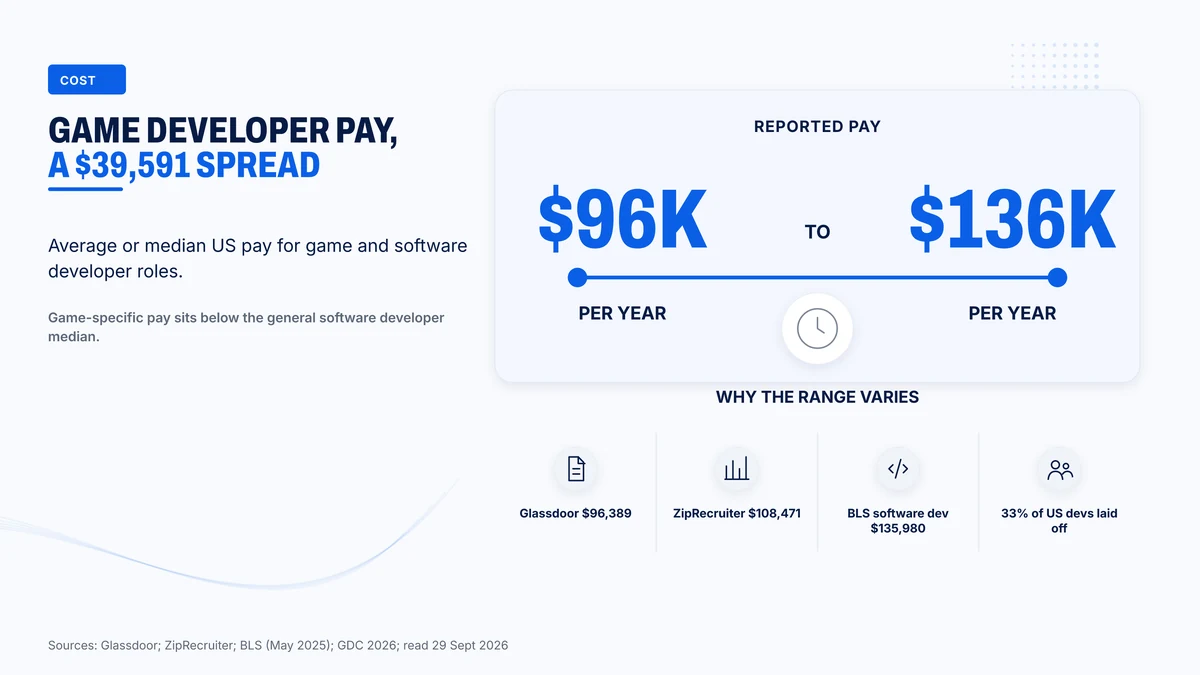
Game-specific pay sits below the general software median, which is one reason studios staff games with a mix of specialists rather than general developers.
The engine is part of the cost. Unity Personal is free up to $200,000 in revenue and funding, Unity Pro costs $2,310 per seat a year, and Unity Enterprise is required above $25 million (Unity). Unreal is free until a product earns $1 million in lifetime gross revenue, then takes a 5 percent royalty, with sales through the Epic Games Store exempt (Unreal Engine).
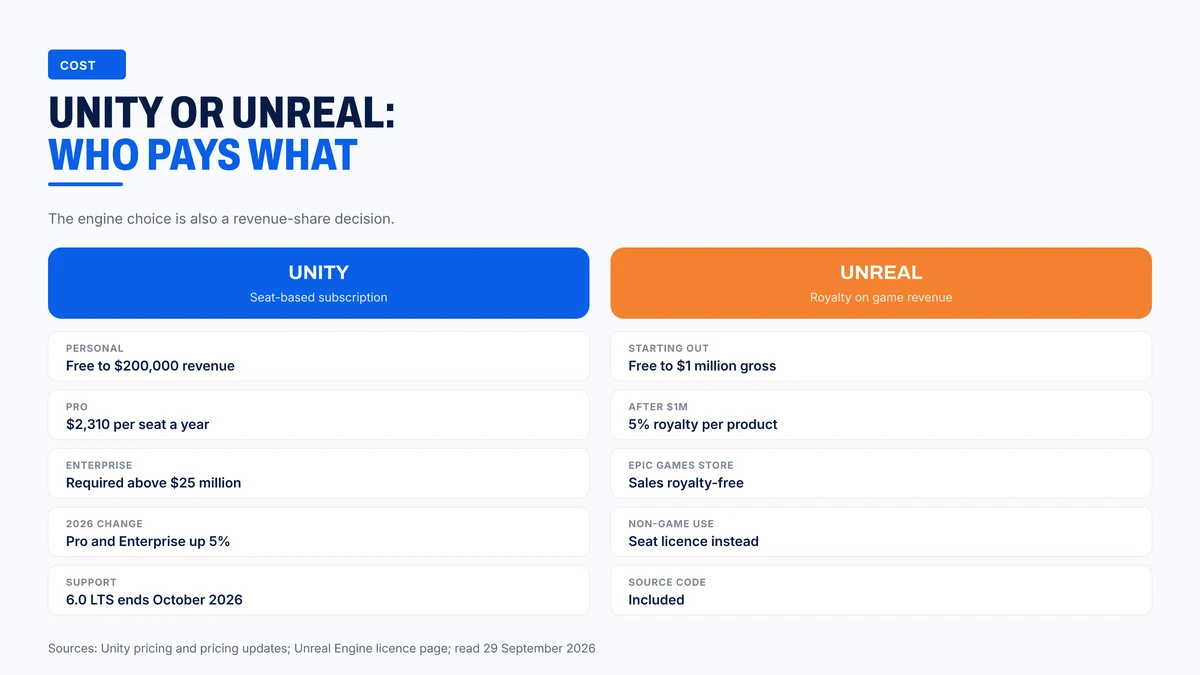
Stores take their share too. Apple’s Small Business Program charges 15 percent on paid apps and in-app purchases for developers under $1 million in proceeds (Apple), and Steam charges a $100 submission fee for each product (Steam).
Studio pricing on this list is modest. Eleven of the twenty publish $25 to $49 an hour and none publishes more than $149. The median published minimum project is $10,000, from $1,000 to $100,000 at ByOwls (Clutch profiles, read 29 September 2026).
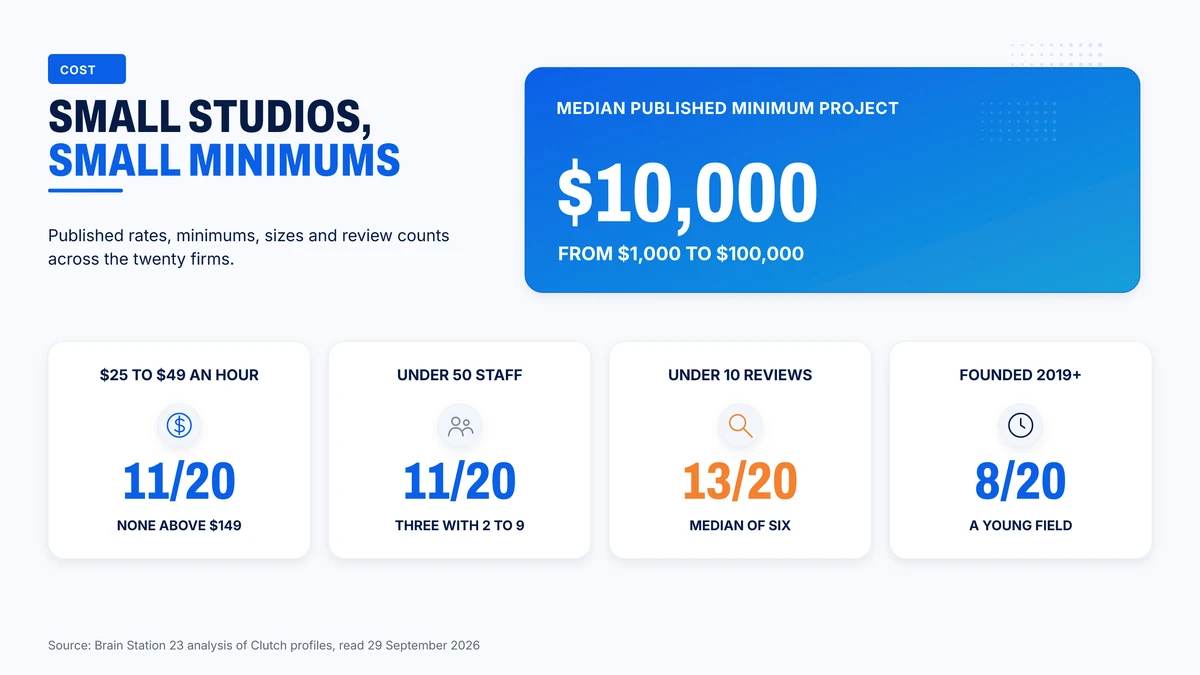
Eight factors decide where a game quote lands.
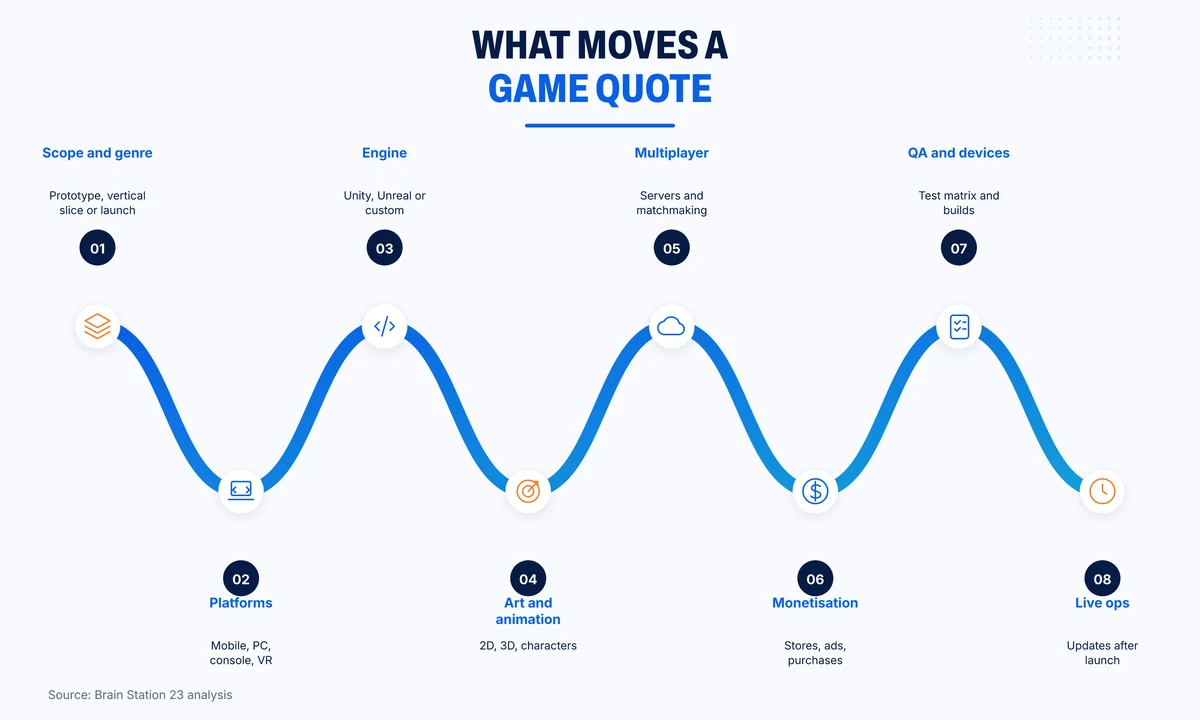
Scope comes first: a prototype, a vertical slice or a full launch. Then the platforms; the engine; the volume and style of art and animation; multiplayer, which adds servers and matchmaking; monetisation through stores, ads or in-game purchases; the device and platform test matrix; and live operations after launch. Ask every studio to price art, engineering and live ops as separate lines.
The Top 20 Game Development Companies in USA, compared
Clutch has no game development category. Its US directory of software developers for gaming companies, sorted by Clutch Rank and read on 29 September 2026, lists 223 firms, many of them general software shops with a gaming client or two. We read every profile in rank order and kept firms that show a game signal (Unity or Unreal on the profile, a mobile-game focus of 25 percent or more, or gaming at 40 percent or more of industries) and have at least one review in their first two pages describing a game or work for a games company. Twenty-three firms qualified. Firms 2 to 21 below are the highest-ranked twenty, in Clutch Rank order.
Brain Station 23 is placed first because we publish this article. We are US-headquartered and verified on Clutch, but we are not a game studio: gaming is none of our published industries and none of our reviews describes a game, so we are not claiming a place in this ranking.
The Game Focus column shows gaming’s share of each firm’s industries and its mobile-game focus where published. The # column is this list’s position. Certifications are self-published and unverified wherever they appear.
| # | Company | Best For | Team Size | Game Focus | Key Tech Stack | Industries Served | Locations |
|---|---|---|---|---|---|---|---|
| 1 | Brain Station 23 — brainstation-23.com | Back-end and payment engineering for studios | 250 – 999 | Gaming 0%; AR/VR 5% of services | .NET, Spring, Node.js, Unity (AR/VR), Angular, Flutter | Retail, medical, telecoms, education, financial services | Springfield VA; Bangladesh, UAE, England, Malaysia, Germany |
| 2 | ScaleTech Solutions — scaletech.xyz | Platform and analytics engineering for gaming companies | 50 – 249 | Gaming 30%; mobile games 25% | Node.js, Django, Laravel, Next.js, React Native | Gaming, media, e-commerce, automotive | San Francisco CA; Frankfurt, Ahmedabad |
| 3 | ByOwls — byowls.com | VR and multiplayer game builds | 10 – 49 | Gaming 100%; mobile games 100% | VR, mobile, custom game code | Gaming | Middletown DE |
| 4 | Dream Foundry Games — dreamfoundrygames.com | Unity mobile games and AR for small studios | 10 – 49 | Gaming 70%; mobile games 85% | Unity, .NET, Node.js, React Native | Gaming, advertising, medical | Pittsburgh PA |
| 5 | Zco Corporation — zco.com | Mobile apps with Unity and gamified features | 250 – 999 | Gaming 10%; mobile games 44% | Unity, React Native, Node.js, .NET, Flutter | Business services, consumer products, gaming, manufacturing, medical | Nashua NH, Boston MA, New York NY |
| 6 | Houdini Interactive — houdini.studio | Interactive web games and 3D avatars for brands | 10 – 49 | Gaming 10%; AR/VR 25% of services | Unity, Angular, Node.js, Vue, React Native | Advertising and marketing, medical, gaming, real estate | Spokane WA |
| 7 | DevTeamSpace — devteam.space | Apps with game and e-sports back-end credits | 50 – 249 | Gaming 10%; AR/VR 10% of services | Unity, Angular, Flutter, Laravel, Node.js, Ruby on Rails | Arts and entertainment, business services, financial services, gaming | Los Angeles CA |
| 8 | Webashlar — webashlar.com | Game QA and fixes at a low rate | 50 – 249 | Gaming 20%; mobile games 30% | Unity, .NET, Angular, React, Node.js | Business services, gaming, financial services, real estate | Philadelphia PA; Surat |
| 9 | Mobilenani — mobilenani.com | AR mobile games through to store launch | 10 – 49 | Gaming 35%; mobile games 30% | Flutter, React, Node.js, React Native, ARKit | Gaming, advertising, business services, e-commerce | Kalamazoo MI; Milan |
| 10 | Aventrio — aventrio.co | AR and VR add-ons for existing games | 10 – 49 | Gaming 10%; AR/VR 10% of services | Unity, React, Node.js, Django, Flutter | IT, retail, e-commerce, gaming, medical | Chicago IL |
| 11 | CKC — ckcollab.com | Browser games and VR simulations from a small senior team | 2 – 9 | Gaming 10%; mobile games 50% | Django, React, React Native, Vue, Unity | Gaming, gambling, arts, business services, government | Coeur d’Alene ID |
| 12 | Salvay — salvay.io | Racing and arcade games including Web3 builds | 10 – 49 | Gaming 35%; mobile games 50% | Unity, Unreal, Flutter, Node.js, React Native | Gaming, legal, real estate | Lakewood Ranch FL |
| 13 | The Apptitude — theapptitude.com | Companion and social apps around games | 50 – 249 | Gaming 10%; mobile apps 50% of services | Unity, Angular, Node.js, React Native, Next.js | IT, business services, gaming, medical | Houston TX |
| 14 | Hyperlink InfoSystem — hyperlinkinfosystem.com | High-volume app development with game design on offer | 1,000 – 9,999 | Gaming 10%; mobile games 40% | .NET, Laravel, Flutter, React Native, CodeIgniter | IT, automotive, business services, education, gaming | Jersey City NJ; Ahmedabad |
| 15 | INFINITY-UP — infinityup.org | Unity and WebGL game prototypes on small budgets | 10 – 49 | Gaming 70%; mobile games 65% | Unity, WebGL, React, React Native, Firebase | Gaming, education, IT | Dover DE; Lahore, London ON |
| 16 | Lucrum Labs — lucrumlabs.com | Unity mobile work for educational games | 2 – 9 | Gaming 25%; AR/VR 20% of services | Unity, Node.js, .NET, React Native | Advertising, arts, education, gaming | Los Angeles CA |
| 17 | Kevuru Games — kevurugames.com | Game art and animation with mobile game design | 50 – 249 | Gaming 85%; mobile games 70% | Unity, Unreal, 2D and 3D art pipelines | Gaming, arts and entertainment | San Francisco CA; Kyiv, Warsaw |
| 18 | Arcadia Tech — arcadiatech.io | Back-end APIs for gaming and sports apps | 10 – 49 | Gaming 20%; mobile games 30% | React, Next.js, Node.js, React Native, Flutter | Arts, financial services, gaming, real estate, retail | Surfside FL; Argentina |
| 19 | Sprint Studios — sprintmode.co | Nearshore engineers including Unity ports | 50 – 249 | Gaming 15%; staff augmentation 40% of services | Angular, Node.js, React, React Native, Ruby on Rails, Unity | IT, financial services, gaming, advertising | San Francisco CA, Miami FL, New York NY, San Juan PR; Bogota, Mexico City, Buenos Aires |
| 20 | Double Coconut — doublecoconut.com | Casual games including slot and Web3 titles | 50 – 249 | Gaming 50%; mobile games 80% | Unity, Angular, Node.js, Spring, Flutter | Gaming, arts and entertainment, gambling, IT | San Francisco CA |
| 21 | RockinDev — rockindev.com | Cloud and custom software for gaming companies | 2 – 9 | Gaming 60% | AWS, custom software, web development | Gaming, arts and entertainment, education, media | Hollywood FL; Buenos Aires |
Team sizes, industry and focus splits, stacks and locations are from each firm’s published Clutch profile, read 29 September 2026. “Best For” is our reading of that data and of each firm’s reviews. Founding years come from the same profiles; certifications are not published consistently, so they appear only in the profiles, marked where a firm states them.
1. Brain Station 23
We publish this article and placed ourselves first, so read this as the publisher’s entry, with its limitation stated first: we are not a game studio. Gaming is none of our published industries, AR/VR is 5 percent of our services with Unity 43 percent of that focus, and none of our reviews describes a game. What we do is the engineering around a game: back-end services, account and payment systems, web portals and admin tools, often through engineers embedded in client teams, which is 60 percent of our work, at $25 to $49 an hour with a $10,000 minimum. ISO 27001 and SOC 2 Type II matter when engineers touch player accounts and payment data. One reviewer asked for tighter internal coordination. For game design, art or engine work, use a studio below.
Founded: 2006
US Presence: Springfield VA
Company size: Clutch band 250 to 999; we publish 900+ engineers
Rating: 4.9 across 21 Clutch reviews, HQ Springfield, Virginia
- Back-end and payment engineering for studios
- CMMI Level 3
- ISO 27001
- ISO 9001
- SOC 2 Type II (company-published)
- Staff augmentation
- Custom software
- Back-end services
- E-commerce and payments
- AR/VR in Unity
- .NET
- Spring
- Node.js
- Retail
- Medical
- Telecoms
- Education
- Financial services
- Hospitality
- Confirm the work is back end, web or tooling, not game design
For game-first studios
17. Kevuru Games
Kevuru Games is the most gaming-focused firm here, with gaming 85 percent of its industries and mobile games 70 percent of its mobile work. Its reviews describe a mobile game from concept and design documents to strategy, 2D animated characters for a video game, and casual art for a studio. It scores 5.0 on every sub-score across four reviews and publishes $25 to $49 an hour with a $25,000 minimum. Clutch’s summary credits accurate early estimates; one client wanted faster replies across time zones.
Founded: 2012
US Presence: San Francisco CA
Company size: 50 to 249
- Game art and animation with mobile game design
- Not published; ask directly
- Mobile game development
- Game design documents
- 2D animation
- Casual art
- Unity
- Unreal
- Gaming
- Arts and entertainment
- Agree daily overlap hours with its Kyiv team
15. INFINITY-UP
INFINITY-UP has the strongest game record here: nine of its ten first-page reviews describe game work, including a Unity fishing prototype with quest and inventory systems, a WebGL game with a Firebase back end, NPC navigation and car mechanics, and an educational trivia game. It holds 5.0 across 12 reviews, and most projects come in under $10,000 at $25 to $49 an hour, with teams in Lahore and Ontario. One client wanted a wider range of art options; others noted time-zone gaps.
Founded: 2019
US Presence: Dover DE
Company size: 10 to 49
- Unity and WebGL game prototypes on small budgets
- Not published; ask directly
- Mobile game development
- Unity prototypes
- WebGL games
- UX/UI design
- Concept art
- React
- Gaming
- Education
- IT
- Ask how wide a range of art styles it can offer
4. Dream Foundry Games
Dream Foundry Games, in Pittsburgh, is a Unity shop: Unity is 90 percent of its AR/VR focus and mobile games 85 percent of its mobile work. Its three reviews describe a mobile game built from scratch in Unity, a demo for a studio with level design, sound design and character animation, and a Unity AR surgical planning system. It publishes $50 to $99 an hour with a $50,000 minimum. Schedule is its lowest sub-score at 4.5, and one client had early communication problems that the CEO fixed.
Founded: 2021
US Presence: Pittsburgh PA
Company size: 10 to 49
- Unity mobile games and AR for small studios
- Not published; ask directly
- Mobile game development
- AR/VR
- UX/UI design
- Level design
- Sound design
- Unity
- Gaming
- Advertising and marketing
- Medical
- Agree a weekly build and update rhythm from the start
20. Double Coconut
Double Coconut, in San Francisco, has game work in nine of its ten first-page reviews: an online slot game’s graphics and sound for a gambling company, a Unity SDK for a game developer, trivia game ports to iOS, Android and web, and PC and mobile games in Unity. It publishes $25 to $49 an hour, and its most common project is $200,000 to $999,999. At 4.6 it has the lowest overall rating here but one; one client reported serious quality and project issues, another uneven code review.
Founded: 2011
US Presence: San Francisco CA
Company size: 50 to 249
- Casual games including slot and Web3 titles
- Not published; ask directly
- Mobile game development
- Web games
- Unity SDKs
- Game ports
- Blockchain
- UX/UI design
- Gaming
- Arts and entertainment
- Gambling
- IT
- Ask who reviews each engineer’s code
3. ByOwls
ByOwls, in Middletown, Delaware, lists gaming as 100 percent of its industries and mobile games as all of its mobile work. Its single review describes a multiplayer VR game for a VR company, with a single-player mode and support for the major VR headsets, and the client called the delivery exceptional. It has the highest minimum here at $100,000, at $50 to $99 an hour. One review is too little to judge a studio at that price.
Founded: 2021
US Presence: Middletown DE
Company size: 10 to 49
- VR and multiplayer game builds
- Not published; ask directly
- AR/VR development
- Multiplayer games
- Custom software
- Mobile games
- Gaming
- Ask for playable builds and a second reference
12. Salvay
Salvay, formerly CLV Technologies, lists Unity as all of its AR/VR focus and mobile games at half its mobile work. Three of its four reviews are games: a kart racing game with blockchain rewards, a Unity 2D mobile game released on both stores, and an arcade racing game for an NFT games company. It publishes $25 to $49 an hour with a $5,000 minimum. Schedule is its lowest sub-score at 4.6, and one client asked for more frequent testing.
Founded: 2019
US Presence: Lakewood Ranch FL
Company size: 10 to 49
- Racing and arcade games including Web3 builds
- Not published; ask directly
- Mobile game development
- AR/VR
- Blockchain
- Web development
- Unity 2D
- Unreal
- Gaming
- Legal
- Real estate
- Keep the game and any token or NFT work in separate contracts
For mobile, AR/VR and interactive work
9. Mobilenani
Mobilenani, in Kalamazoo, Michigan, puts gaming at 35 percent of its industries. One of its two reviews describes an AR racing game for a mobile gaming company, built through design, testing and release on the App Store and Google Play; the other is a survey app. It publishes $25 to $49 an hour with a $1,000 minimum, and its most common project is $50,000 to $199,999. The game client said testing could have started earlier and been more structured.
Founded: 2012
US Presence: Kalamazoo MI
Company size: 10 to 49
- AR mobile games through to store launch
- Not published; ask directly
- Mobile app development
- Mobile games
- AR
- Testing
- Flutter
- React Native
- ARKit
- Gaming
- Advertising and marketing
- Business services
- E-commerce
- Ask for a device test plan before development starts
6. Houdini Interactive
Houdini Interactive, in Spokane, Washington, works mainly for brands: advertising is 45 percent of its industries. One of its six reviews is a game, an interactive video game web experience for a content company, and another rebuilt an avatar system with 3D modelling, rigging and animation; the rest are websites and branding. It scores 5.0 on every sub-score and publishes $100 to $149 an hour with a $25,000 minimum. Clients named no improvements, but its game record is short.
Founded: 2018
US Presence: Spokane WA
Company size: 10 to 49
- Interactive web games and 3D avatars for brands
- Not published; ask directly
- Custom software
- AR/VR
- Web games
- 3D modelling
- Rigging
- Animation
- Unity
- Advertising and marketing
- Medical
- Gaming
- Real estate
- Ask whether games are the core team or a side line
11. CKC
CKC, in Coeur d’Alene, Idaho, lists mobile games at half its mobile work. Its reviews include a mobile and browser game for a gaming company, with APIs, an asset generator, in-game currency and item storage, and a Unity VR skydiving simulator; the rest are web applications built on Django and Vue. It holds 5.0 across ten reviews at $100 to $149 an hour with a $50,000 minimum. Clutch’s summary notes that responsiveness could be slightly better.
Founded: 2011
US Presence: Coeur d'Alene ID
Company size: 2 to 9
- Browser games and VR simulations from a small senior team
- Not published; ask directly
- Web development
- Mobile and browser games
- VR simulation
- Unity
- Django
- React
- Vue
- Gaming
- Gambling
- Arts
- Business services
- Government
- Ask who covers the work if one engineer is unavailable
16. Lucrum Labs
Lucrum Labs, in Los Angeles, lists Unity as all of its AR/VR focus. Its single review describes iOS development in the Unity 3D engine for an educational gaming studio. It does not publish an hourly rate, and its minimum is $10,000. With two to nine people and one review, it suits a narrow, well-defined Unity task more than a full game.
Founded: 2019
US Presence: Los Angeles CA
Company size: 2 to 9
- Unity mobile work for educational games
- Not published; ask directly
- Mobile app development
- Web development
- AR/VR
- Unity 3D
- Node.js
- React Native
- Advertising
- Arts
- Education
- Gaming
- Ask for its hourly rate and references
10. Aventrio
Aventrio, in Chicago, is the youngest firm here. One of its three reviews says it helps a gaming company build AR and VR for its games; the other two describe business development and lead generation services. Staff augmentation is 35 percent of its work, at $25 to $49 an hour with a $1,000 minimum. The game evidence is a single sentence, so check references before relying on it.
Founded: 2022
US Presence: Chicago IL
Company size: 10 to 49
- AR and VR add-ons for existing games
- Not published; ask directly
- Staff augmentation
- Web development
- Custom software
- AR/VR
- Unity
- IT
- Retail
- E-commerce
- Gaming
- Medical
- Ask to speak to the gaming client its review describes
For app builders with game credits
5. Zco Corporation
Zco, founded in 1989 in Nashua, New Hampshire, is the oldest firm here and mostly a mobile app studio. Unity is all of its AR/VR focus and mobile games 44 percent of its mobile work; its reviews include a mobile game for a gamified fitness company and a Unity cross-platform app for an education retailer. It has 58 reviews at 4.8, at $25 to $49 an hour. One client rated the visual design phase 7 out of 10, and Clutch’s summary asks for better documentation.
Founded: 1989
US Presence: Nashua NH, Boston MA, New York NY
Company size: 250 to 999
- Mobile apps with Unity and gamified features
- Not published; ask directly
- Mobile app development
- Custom software
- AR/VR
- Unity
- React Native
- Node.js
- Business services
- Consumer products
- Gaming
- Manufacturing
- Medical
- Review its visual design samples before signing
7. DevTeamSpace
DevTeamSpace, in Los Angeles, lists Unity as all of its AR/VR focus and has 46 reviews at 4.9. Two of the twenty we read are game-related: several iOS and Android mobile games built for a startup’s staff engagement, and back-end work for an e-sports platform. It publishes $50 to $99 an hour with a $10,000 minimum. Clutch’s summary notes delays on some projects, and one client wanted faster releases to production.
Founded: 2016
US Presence: Los Angeles CA
Company size: 50 to 249
- Apps with game and e-sports back-end credits
- Not published; ask directly
- Mobile apps
- Web development
- Modernisation
- AR/VR
- Unity
- Node.js
- Laravel
- Arts and entertainment
- Business services
- Financial services
- Gaming
- Media
- Ask for game references, since most reviews describe apps
13. The Apptitude
The Apptitude, in Houston, builds mobile apps; its game credit is a social companion app for a mobile game that lets players trade in-game collectibles. Mobile apps are half its services, at $25 to $49 an hour with a $25,000 minimum. Its 4.0 rating across seven reviews is the lowest here, with every sub-score at 4.1. One client was surprised by server and developer-account costs, and another wanted to see past work before signing.
Founded: 2016
US Presence: Houston TX
Company size: 50 to 249
- Companion and social apps around games
- Not published; ask directly
- Mobile app development
- AR/VR
- App support
- Web development
- Unity
- React Native
- IT
- Business services
- Gaming
- Medical
- Logistics
- Ask for every third-party cost, such as servers and developer accounts, in writing
8. Webashlar
Webashlar, with offices in Philadelphia and Surat, India, lists gaming at 20 percent of its industries. Its game review describes debugging a game development company’s video game, adding design features and supporting QA; the others are mapping, analytics and web platforms. It holds 5.0 across nine reviews at $25 to $49 an hour with a $1,000 minimum. One client said developers sometimes built things nobody had asked for.
Founded: 2009
US Presence: Philadelphia PA
Company size: 50 to 249
- Game QA and fixes at a low rate
- Not published; ask directly
- QA and testing
- Custom software
- Mobile apps
- AR/VR
- Unity
- .NET
- React
- Business services
- Gaming
- Financial services
- Real estate
- Education
- Write change control into the statement of work
14. Hyperlink InfoSystem
Hyperlink InfoSystem has 174 reviews, 46 percent of all the reviews behind this list, and 1,000 to 9,999 staff. Of the twenty reviews we read, one lists game design among the projects it runs for a technology consulting firm; the rest describe mobile apps, e-commerce and booking platforms. It publishes $25 to $49 an hour with a $25,000 minimum. Clutch’s summary notes missed deadlines, and one client said it did not deliver what was promised on time.
Founded: 2011
US Presence: Jersey City NJ
Company size: 1,000 to 9,999
- High-volume app development with game design on offer
- Not published; ask directly
- Mobile apps
- AI
- Blockchain
- Custom software
- Game design
- .NET
- Laravel
- Flutter
- IT
- Automotive
- Business services
- Education
- Gaming
- Ask for shipped games, since its reviews describe apps
For back end, platforms and engineering capacity
2. ScaleTech Solutions
ScaleTech, in San Francisco with teams in Frankfurt and Ahmedabad, is the highest-ranked firm here and puts gaming at 30 percent of its industries. Two of its seventeen reviews involve gaming clients: analytics programming and platform development for an online gaming company, and design and development work for a gaming company. It publishes $50 to $99 an hour with a $10,000 minimum. Quality is its lowest sub-score at 4.6; one client called UI and UX design a weaker area, another cited time-zone gaps.
Founded: 2017
US Presence: San Francisco CA
Company size: 50 to 249
- Platform and analytics engineering for gaming companies
- Not published; ask directly
- Custom software
- Managed IT
- Mobile apps
- Analytics
- Node.js
- Django
- Laravel
- Next.js
- Gaming
- Media
- E-commerce
- Automotive
- IT
- Bring your own art direction; clients rate its UI design lower
18. Arcadia Tech
Arcadia Tech, in Surfside, Florida, with a team in Argentina, is a back-end shop: microservices, APIs and mobile apps. One of its two reviews describes back-end development and API integrations for a gaming company; the other covers a KYC flow and card issuing for a sports app. It publishes $25 to $49 an hour with a $5,000 minimum and has no engine on its profile. Two reviews is a thin record.
Founded: 2021
US Presence: Surfside FL
Company size: 10 to 49
- Back-end APIs for gaming and sports apps
- Not published; ask directly
- Microservices
- API development
- Mobile apps
- Web development
- React
- Next.js
- Node.js
- Arts
- Financial services
- Gaming
- Real estate
- Retail
- Use it for the back end, not the game client
19. Sprint Studios
Sprint Studios, whose reviews appear under its former name Code Power, supplies nearshore engineers from Latin America; staff augmentation is 40 percent of its work. Its game credit is porting a game developer’s platform and apps to Unity. It publishes $50 to $99 an hour with a $50,000 minimum, and its most common project is $200,000 to $999,999. Clutch’s summary records one client’s difficult first year, resolved later, and another found the payment contract confusing.
Founded: 2017
US Presence: San Francisco CA, Miami FL, New York NY, San Juan PR
Company size: 50 to 249
- Nearshore engineers including Unity ports
- Not published; ask directly
- Staff augmentation
- Custom software
- E-commerce
- Mobile apps
- Unity
- Node.js
- React
- IT
- Financial services
- Gaming
- Advertising
- Medical
- Ask for a first-month plan and a named lead
21. RockinDev
RockinDev, in Hollywood, Florida, with a team in Buenos Aires, lists gaming as 60 percent of its industries. One of its two reviews, from a gaming company’s CEO, describes custom software, talent sourcing and AWS infrastructure for a social experience platform, delivered on a very short timeline. It publishes $50 to $99 an hour with a $50,000 minimum. No engine appears on its profile, so treat it as a cloud and back-end partner.
Founded: 2020
US Presence: Hollywood FL
Company size: 2 to 9
- Cloud and custom software for gaming companies
- Not published; ask directly
- Cloud consulting
- Custom software
- Web development
- AWS
- Blockchain
- Gaming
- Arts and entertainment
- Education
- Media
- Confirm engine experience, since its profile lists none
What the twenty profiles show
Game work is rare in a gaming directory. Of the 223 firms in Clutch’s US list, 124 put gaming at 10 percent or less of their industries and only 14 at half or more. Seventy-four show a game signal on their profile, 25 of those have no reviews, and 23 have a review that describes game work or a games client (Brain Station 23 analysis of Clutch, read 29 September 2026).
The reviews describe mobile and Unity work. We read 157 reviews across the twenty profiles. Forty-three describe a game or a games client, 19 of them mobile games. Twelve mention Unity and none mentions Unreal. Seven describe VR or AR, five Web3 or NFT games and two gambling or betting products.
Six firms are game-first. ByOwls, Kevuru Games, Dream Foundry Games, INFINITY-UP, RockinDev and Double Coconut put gaming at half or more of their industries. The rest are app, web or engineering firms with game credits, which is useful for porting, back-end work or a companion app and risky for a full game.
The records are thin. Thirteen of the twenty have fewer than ten reviews, and the median is six. Hyperlink InfoSystem alone holds 174 of the 380 reviews behind the list. Eight firms were founded in 2019 or later.
The studios are small and cheap. Eleven have fewer than 50 staff, and eleven publish $25 to $49 an hour. Only Zco and Hyperlink have 250 or more people. In this Top 20 Game Development Companies in USA list, Zco also appears on five of our other lists, including mobile app and C#, and ScaleTech on our Golang list; the other eighteen are new to our lists. The next three firms to qualify were Cubix, Aspired and Alternova.
How to shortlist a game development company
Order the filters so the first one removes the most studios.
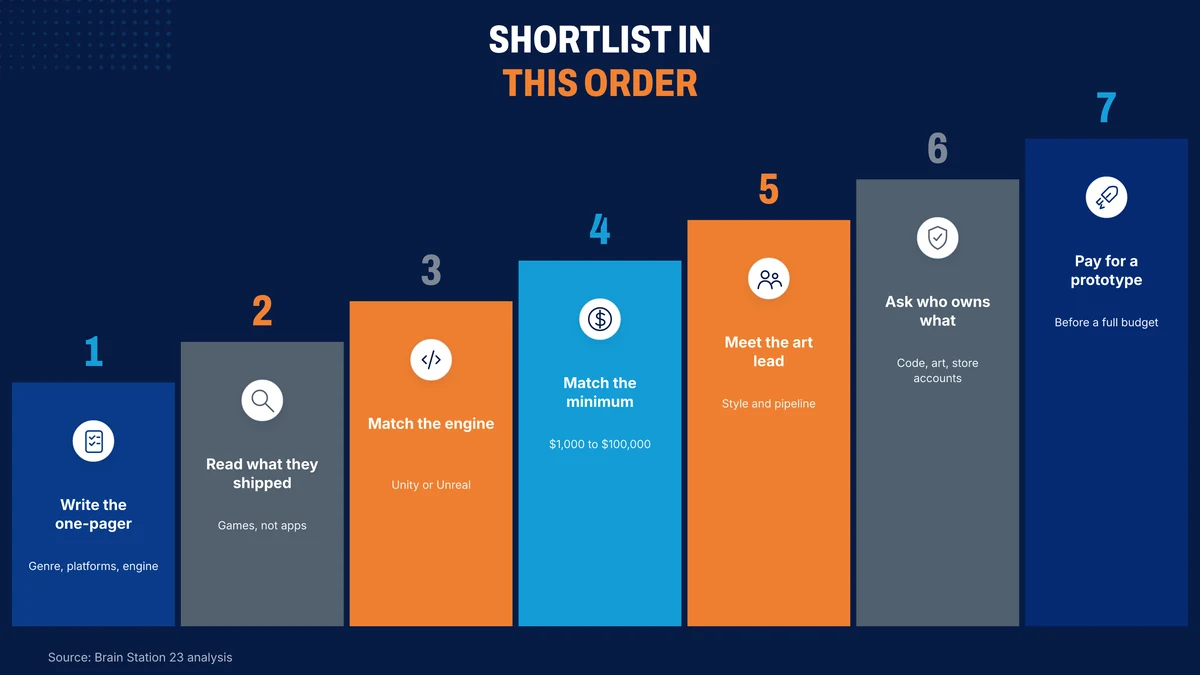
Step 1: Write the one-pager. Genre, target platforms, engine, art style, monetisation and the date that matters.
Step 2: Read what they shipped. Look for reviews and portfolios that describe games like yours, not apps with a game feature.
Step 3: Match the engine. A Unity mobile studio is not an Unreal console studio. Ask which engine each shipped title used.
Step 4: Match your budget to the minimum. Minimums on this list run from $1,000 to $100,000.
Step 5: Meet the art lead. Art is usually the largest line. See the style range and the pipeline, from concept to in-engine assets.
Step 6: Ask who owns what. The source, art source files, engine project and store accounts should be yours.
Step 7: Pay for a prototype. A short fixed-fee prototype or vertical slice proves the core loop is fun and shows how the studio works before the full budget.
How to buy game development: four engagement models
The engagement model decides who pays when the design changes, and in games it always changes.
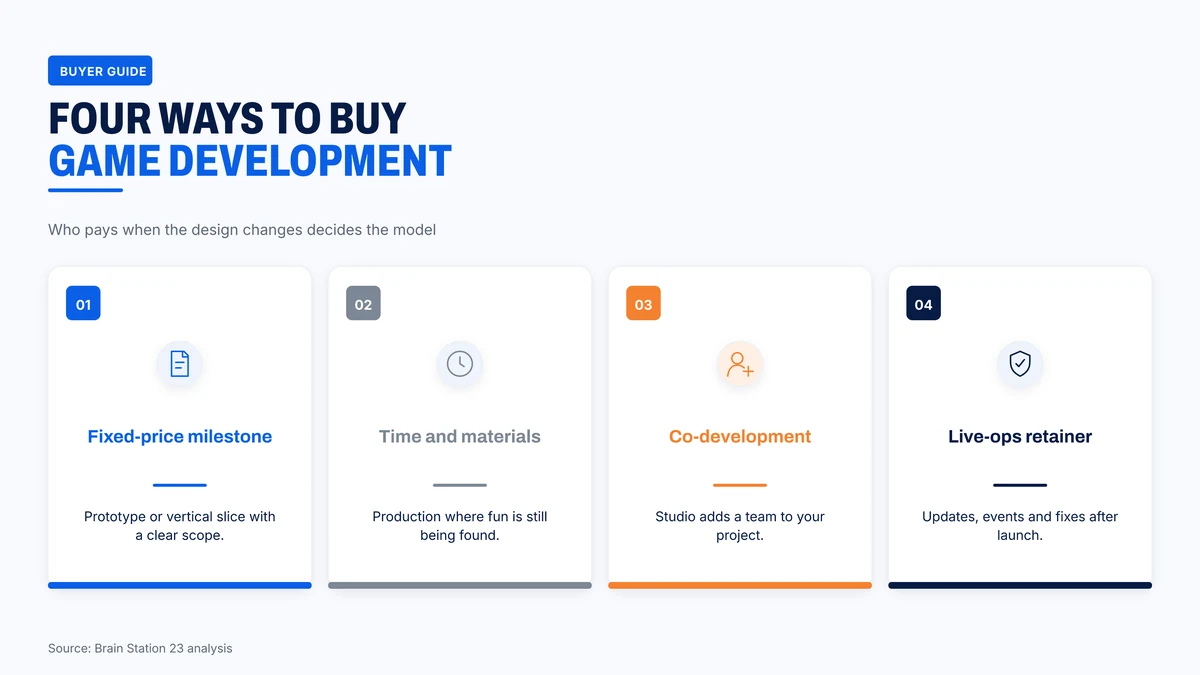
Fixed-price milestones suit a prototype or vertical slice with a clear scope. They fail on full production, where the design is still moving.
Time and materials keeps the risk with you and suits production while the fun is still being found. Cap each milestone and review builds every sprint.
Co-development adds a studio team to your project, often for art, porting or a feature set. Sprint Studios, DevTeamSpace and Brain Station 23 publish this kind of work. It fails when nobody in-house owns the game design.
A live-ops retainer covers updates, events, balancing and fixes after launch. For a game with in-game purchases, it is often the contract that pays for the rest.
The technical question: engine, versions and the build pipeline
Game projects slip when the engine version, the platform rules and the build process drift apart. The order of the work decides whether an update is routine or a crisis.
Step 1: Pick the engine for the game, not the studio. Unreal dominates AA and AAA work; Unity dominates older indie and mobile studios (GDC 2026). Choose, then hire a studio that ships in it.
Step 2: Lock a supported version. Unity 6.0 LTS ends support on 16 October 2026 and Unity 6.3 LTS on 4 December 2027 (endoflife.date). Start new projects on a version that will outlast launch.
Step 3: Put the project in your repository from day one. Engine project, code and art source files, with large-file storage set up so art is versioned too.
Step 4: Automate builds for every platform. One pipeline that produces iOS, Android, PC or console builds from the repository, so no build depends on one person’s machine.
Step 5: Track store rules on a calendar. Google Play has required Android 16 targeting for new apps and updates since 31 August 2026 (Google Play Console Help). Missing a store deadline blocks updates, not just new releases.
Step 6: Plan the upgrade path. Put the move to the next supported engine version into the live-ops contract, with a date.
The order matters because each step keeps the next update cheap. A game built on an unsupported engine version, in a studio’s repository, with manual builds, is expensive to change the day the relationship ends.
Red flags: eight answers to walk away from
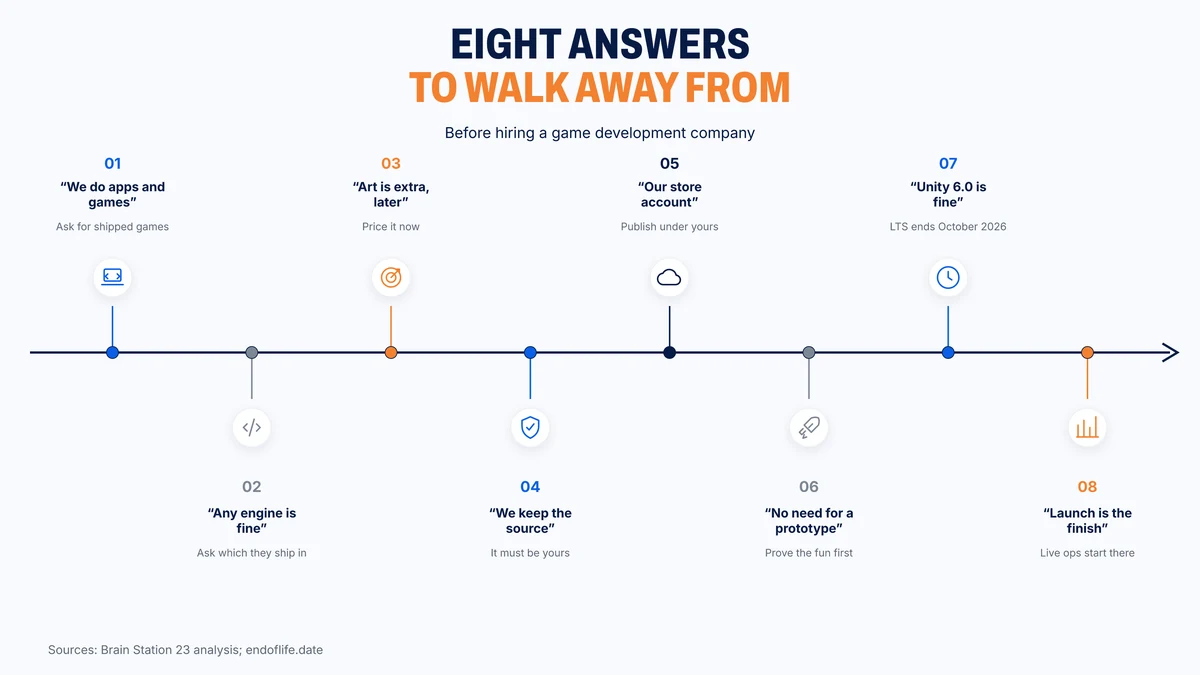
“We build apps and games.” Ask for shipped games. Most firms in Clutch’s gaming list have none in their reviews.
“Any engine is fine.” Ask which engine their shipped titles used. None of the 157 reviews here mentions Unreal.
“Art is extra, we’ll price it later.” Art is usually the largest line. Price it now.
“We keep the source and art files.” Then you do not own your game. Both belong to you, in your repository.
“We’ll publish under our store account.” Publish under your own Apple, Google Play and Steam accounts, or you cannot update the game without them.
“You don’t need a prototype.” A prototype is how both sides find out whether the game is fun before the big spend.
“Unity 6.0 is fine for launch.” Its LTS support ends on 16 October 2026 (endoflife.date).
“Launch is the finish line.” For most games, live operations start there.
After launch: what the build quote leaves out
This part covers what owners wish they had settled before the final invoice, and what recurs for as long as the game is live.
What you must own before the final invoice
The source repository with its full history, including the engine project, scripts, shaders and build configuration.
The art source files: layered originals, 3D scenes, rigs and animation files, not just the exported assets.
The store accounts: Apple, Google Play, Steam and any console accounts in your name, with the studio added as a user you can remove.
Signing keys and certificates for every platform, held by you.
The back end: cloud accounts, databases, multiplayer services and analytics, with billing in your name.
Licences for the engine, middleware, fonts, audio and any purchased assets, issued to you.
A runbook: how to build, submit and roll back each platform version.
The bill that arrives after launch
A build quote covers the build. What recurs afterwards is usually larger over three years.
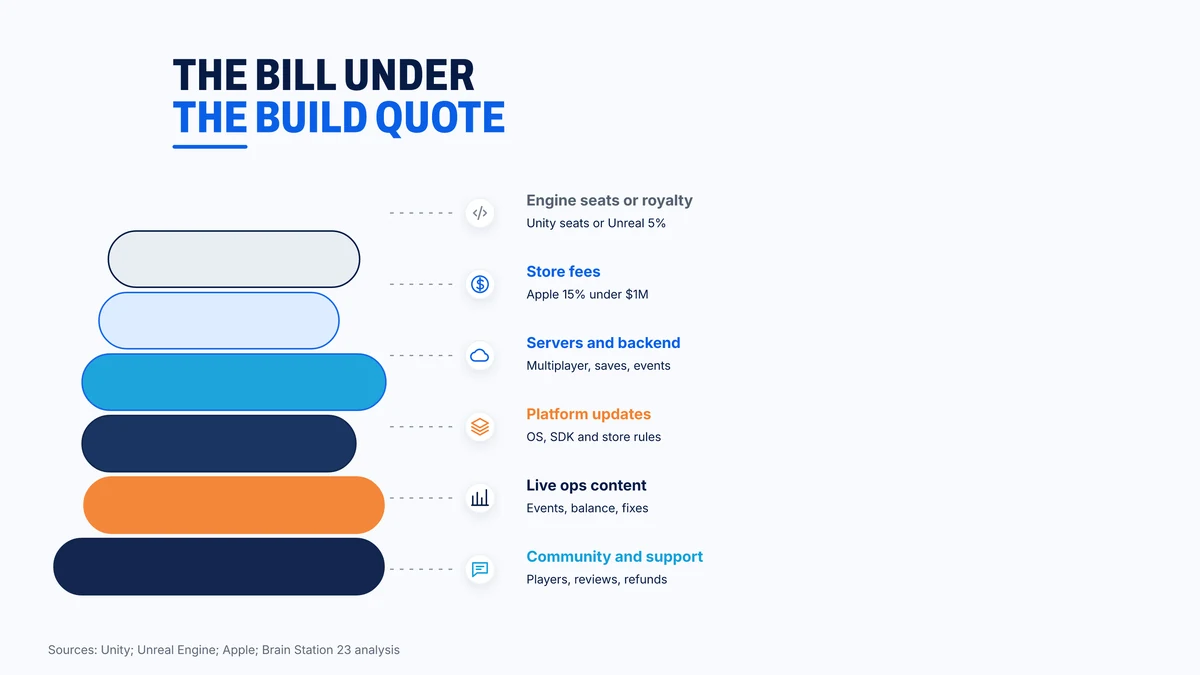
Add engine seats or royalties, store commissions, servers for multiplayer, saves and events, platform and SDK updates, live-ops content and balancing, and player support. Get the recurring number before you sign the build, and compare studios over three years.
Security is a recurring cost
Player accounts, payments and multiplayer servers are targets. Exploited vulnerabilities started 31 percent of the breaches in Verizon’s 2026 report, and the median time to fully patch rose to 43 days (Verizon DBIR 2026; SecurityWeek). A US breach averages $10.22 million (IBM). Write a patch window in days into the live-ops contract, and keep payment and account data out of the game client.
Accessibility is legal exposure
Games themselves are a developing area, but the websites, store pages, account portals and companion apps around them are not: 5,114 US digital accessibility lawsuits were filed in 2025 (UsableNet). Name WCAG 2.2 AA for those surfaces in the contract, and ask the studio how it handles subtitles, remappable controls and colour-blind modes in the game.
Contract clauses that surface in month nine
IP assignment on payment, covering code, art and audio, not on final acceptance.
Transition assistance: a set number of hours to hand over to another studio.
Rate escalation caps for the live-ops term.
Subcontracting, including outsourced art, named in the statement of work.
Engine and middleware obligations: which engine version the studio will keep the game on, and by when.
Liability cap and insurance that reflect what a breach of player data would cost.
Non-solicitation both ways.
This is not legal advice; have counsel review the contract.
How to leave without losing the game
Confirm you hold the repository, art source files, store accounts, signing keys and back-end accounts. Trigger the transition hours while relations are cordial. Record walkthroughs of the build pipeline and the live-ops tools. On the last day, rotate every credential the studio could reach and remove their access.
Hire in-house or hire a game development company
Glassdoor puts the average US game developer at $96,389 and ZipRecruiter at $108,471, before benefits (Glassdoor; ZipRecruiter).
Hire in-house when the game is the business and will run for years. A core team that knows the design and the code is hard to replace.
Hire a studio for a prototype, a vertical slice or a contained game with a launch date, where you need design, art, engineering and QA for a few months.
Use co-development or staff augmentation when you have a creative lead and a game in production but need more engineers, artists or porting capacity.
FAQ
Which companies are the top game developers in the USA?
Using Clutch’s US directory for gaming companies, filtered to firms with game signals and reviewed game work, the five highest-ranked on 29 September 2026 were ScaleTech Solutions, ByOwls, Dream Foundry Games, Zco Corporation and Houdini Interactive (Clutch).
How much do US game development companies charge?
Eleven of the twenty publish $25 to $49 an hour and none publishes more than $149. Minimum projects run from $1,000 to $100,000, with a median of $10,000 (Clutch).
Should a game use Unity or Unreal?
Unreal is the primary engine for 42 percent of developers and Unity for 30 percent, with Unreal stronger at AA and AAA studios and Unity at older indie studios (GDC 2026). Choose for the game, then hire a studio that ships in that engine.
How much do Unity and Unreal cost?
Unity Personal is free up to $200,000 in revenue and funding and Unity Pro costs $2,310 per seat a year (Unity). Unreal takes a 5 percent royalty above $1 million in lifetime gross revenue per product (Unreal Engine).
When does Unity 6.0 LTS lose support?
On 16 October 2026. Unity 6.3 LTS is supported until 4 December 2027 (endoflife.date).
How big is the US video game market?
US consumers spent $60.7 billion on video games in 2025, the second-highest year on record (ESA).
Who should own the game’s source code and store accounts?
You should. Ask for the repository, art source files, signing keys and Apple, Google Play and Steam accounts in your name before the final invoice.
Conclusion
The data behind this Top 20 Game Development Companies in USA list says three things. Clutch’s US gaming directory is mostly general software firms: 124 of 223 put gaming at 10 percent or less of their work, and only 23 have a review that describes a game. The twenty that do are small, young and inexpensive, with a median of six reviews. And they work in Unity and mobile, while the wider industry’s primary engine is Unreal.
Any of the twenty can build part of a game. What decides the next three years is whether the studio has shipped your kind of game in your engine, whether that engine stays on a supported version, and whether the source, art files and store accounts are in your name on the day the studio leaves.
Sources
- https://clutch.co/us/developers/gaming-industry?sort_by=ClutchRank
- https://clutch.co/profile/brain-station-23
- https://usa.brainstation-23.com/top-mobile-app-development-companies-in-usa/
- https://usa.brainstation-23.com/top-20-c-sharp-development-companies-in-usa/
- https://gdconf.com/article/gdc-2026-state-of-the-game-industry-reveals-impact-of-layoffs-generative-ai-and-more/
- https://www.theesa.com/2025-u-s-consumer-spending-on-video-games-nears-pandemic-level-peak-at-60-7-billion-second-highest-on-record/
- https://unity.com/pricing
- https://unity.com/products/pricing-updates
- https://www.unrealengine.com/en-US/license
- https://endoflife.date/unity
- https://support.google.com/googleplay/android-developer/answer/11926878
- https://developer.apple.com/app-store/small-business-program/
- https://partner.steamgames.com/doc/gettingstarted/onboarding
- https://www.glassdoor.com/Salaries/game-developer-salary-SRCH_KO0,14.htm
- https://www.ziprecruiter.com/Salaries/Game-Developer-Salary
- https://www.bls.gov/ooh/computer-and-information-technology/software-developers.htm
- https://www.verizon.com/business/resources/reports/dbir/
- https://www.securityweek.com/verizon-dbir-2026-vulnerability-exploitation-overtakes-credential-theft-as-top-breach-vector/
- https://www.ibm.com/reports/data-breach
- https://info.usablenet.com/2025-year-end-report-on-web-accessibility-lawsuits