
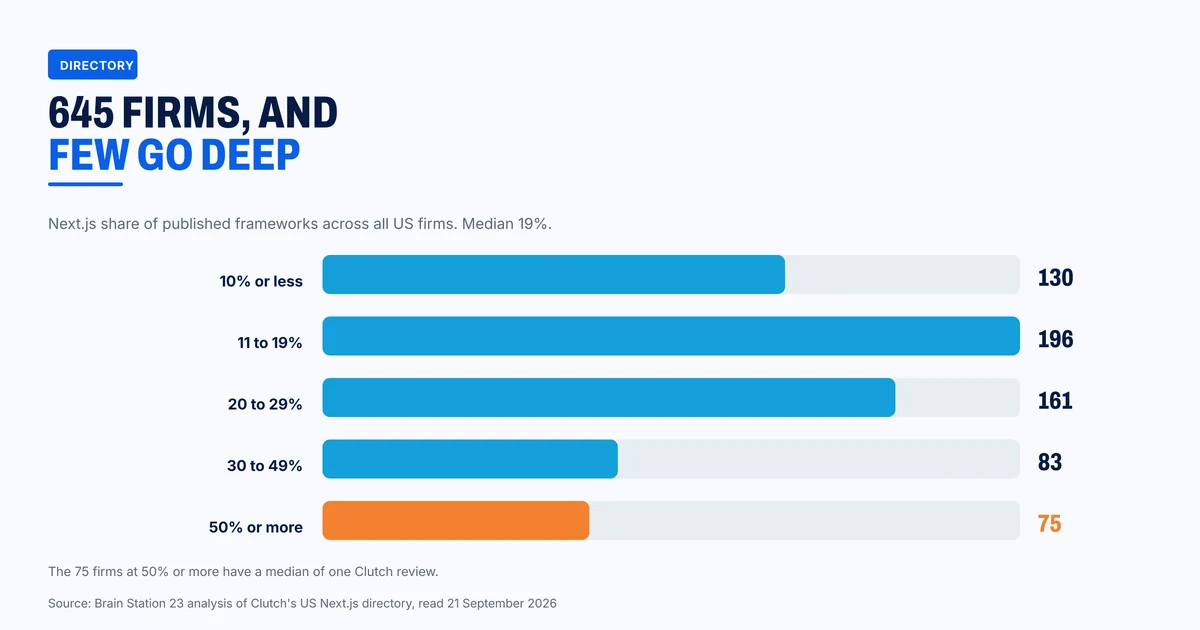
Clutch lists 645 Next.js development agencies in the United States. Its ranking does not sort them by Next.js depth: the median firm on the page puts Next.js at 19 percent of its published frameworks, and the 75 firms that put it at half or more have a median of one review (Clutch).
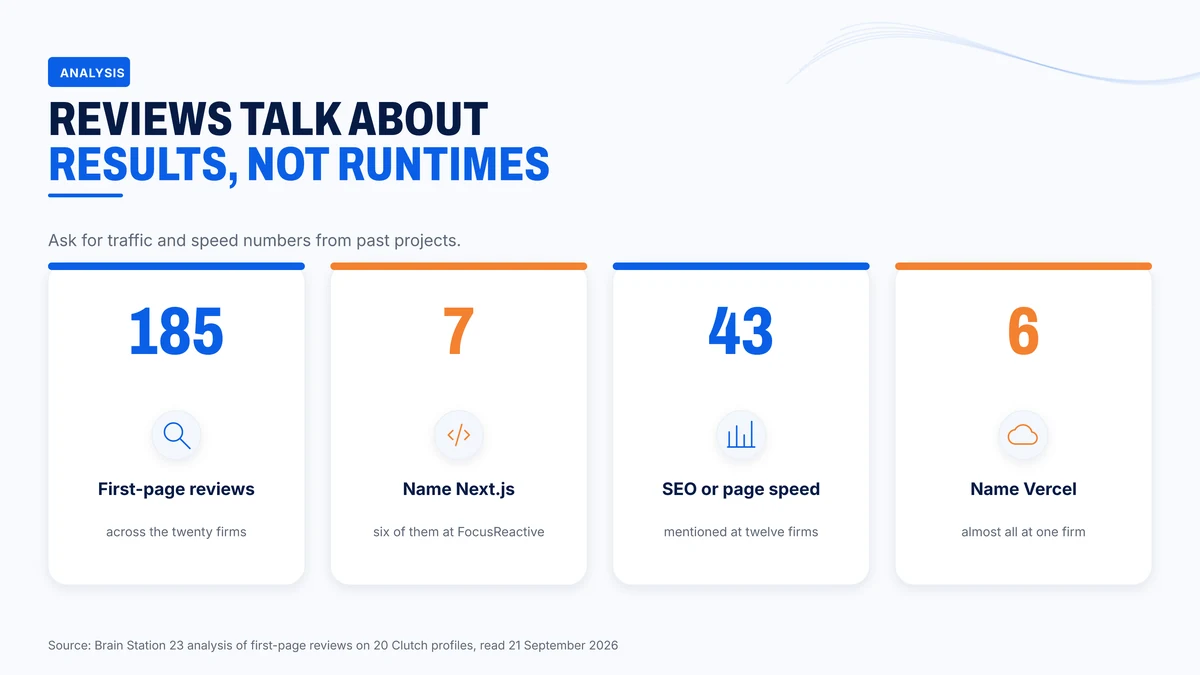
The top of the page shows the same pattern, and this Top 20 Next JS Development Companies in USA list keeps Clutch’s order. Five of the twenty put Next.js at 10 percent. Across the 185 reviews on the first page of their profiles, seven name Next.js, and six of those describe one firm.
Timing adds a second test. Next.js keeps each major version in maintenance for two years after release, so Next.js 15, released on 21 October 2024, reaches the end of that window in October 2026 (Next.js support policy).
The list is the shorter part. The longer part covers what to own after launch: the Vercel team, the repository, the headless CMS and the upgrade plan.
Key takeaways
- 645 US agencies are listed in Clutch’s Next.js directory; the median puts Next.js at 19% of its frameworks (Clutch).
- 7 of 185 first-page reviews across the top twenty firms name Next.js, and 43 mention SEO, page speed or Core Web Vitals (Clutch profiles).
- 21.5% of professional developers used Next.js in 2025, against 46.9% for React (Stack Overflow).
- 3.4% of all websites run Next.js, according to W3Techs in September 2026 (W3Techs).
- October 2026 is when Next.js 15 reaches the end of its two-year maintenance window; Next.js 16 has been the active line since 21 October 2025 (Next.js).
- CVSS 9.1 was the rating of CVE-2025-29927, which let requests bypass authorization checks placed in Next.js middleware (NVD).
- $89,372 to $127,317 is the spread in average US pay between PayScale’s front end developer figure and Indeed’s (PayScale; Indeed).
- 10 of 20 firms on this list publish a minimum project of $10,000 or less, and the median minimum is $17,500 (Clutch profiles).
Next.js in 2026: popular, fast-moving and easy to over-claim
Next.js is the default React framework for many teams, not a niche. In Stack Overflow’s 2025 survey, 21.5 percent of professional developers had used Next.js in the past year, against 46.9 percent for React (Stack Overflow Developer Survey 2025). W3Techs finds Next.js on 3.4 percent of all websites, and on 4.5 percent of sites whose JavaScript library it can identify (W3Techs).
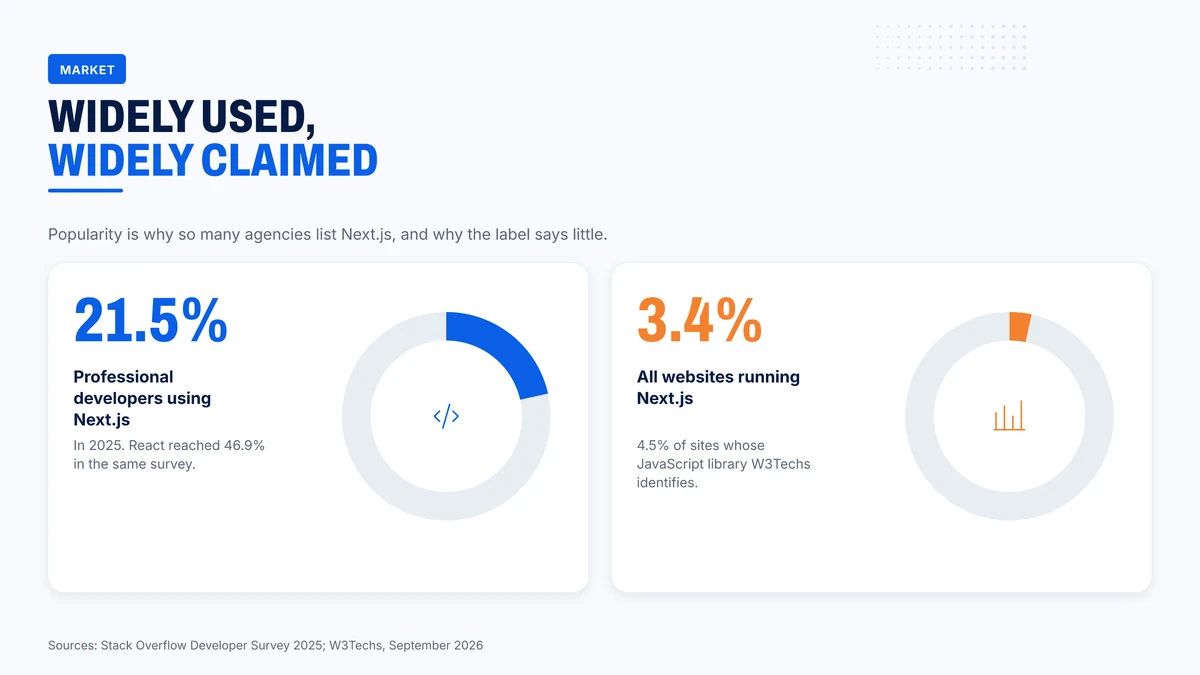
That popularity is why so many agencies list it. It is also why the label says little. A firm that builds React apps can add Next.js to its profile without changing how it works.
The framework moves fast. Next.js 16 was released on 21 October 2025 and is the Active LTS line. Next.js 15 is in Maintenance LTS, and each major version stays there for two years after its initial release. Next.js 14 and earlier are unsupported (Next.js support policy).
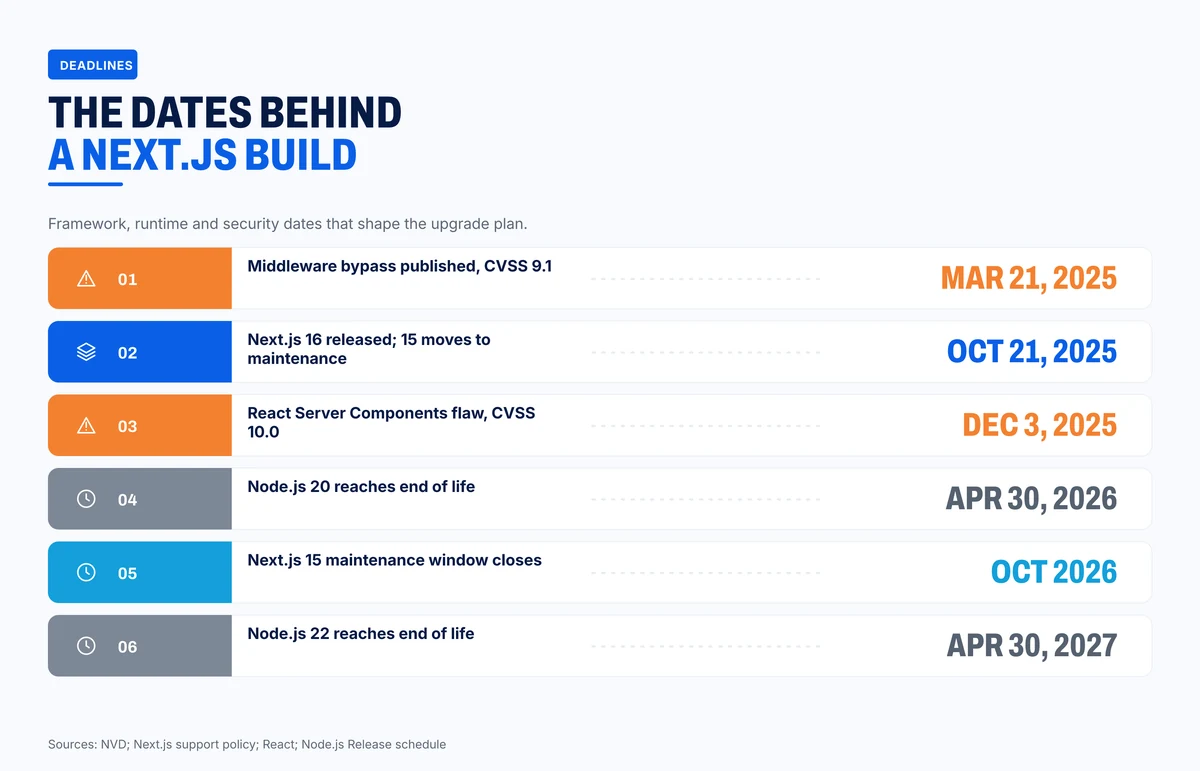
Next.js 16 made Turbopack the default bundler, renamed middleware.ts to proxy.ts, and raised the minimum Node.js version to 20.9 while dropping Node.js 18 (Next.js 16). Node.js 20 itself reached end of life on 30 April 2026 (Node.js Release schedule). An upgrade touches the framework, the runtime and the build.
Security releases are frequent and serious. CVE-2025-29927, published on 21 March 2025 and rated CVSS 9.1, let requests bypass authorization checks that ran in Next.js middleware (NVD). In December 2025, a CVSS 10.0 remote code execution flaw in React Server Components reached Next.js 15 and 16 apps, and React listed patched versions for every affected Next.js line (React).
So a Next.js brief needs three answers before any firm is compared: which major version, where it will be hosted, and who applies security releases, how fast.
What Next.js development costs in the US
Average pay for comparable US roles spreads by $37,945 across four sources.
PayScale puts a front end developer at $89,372 from 1,908 salary profiles, updated 1 June 2026 (PayScale). The Bureau of Labor Statistics puts the median web developer at $92,650 in May 2025 (BLS). Glassdoor reports a median total pay of $122,000 for a React developer (Glassdoor). Indeed reports $127,317 for a front end developer from 3,300 job-posting salaries, updated 14 September 2026 (Indeed).
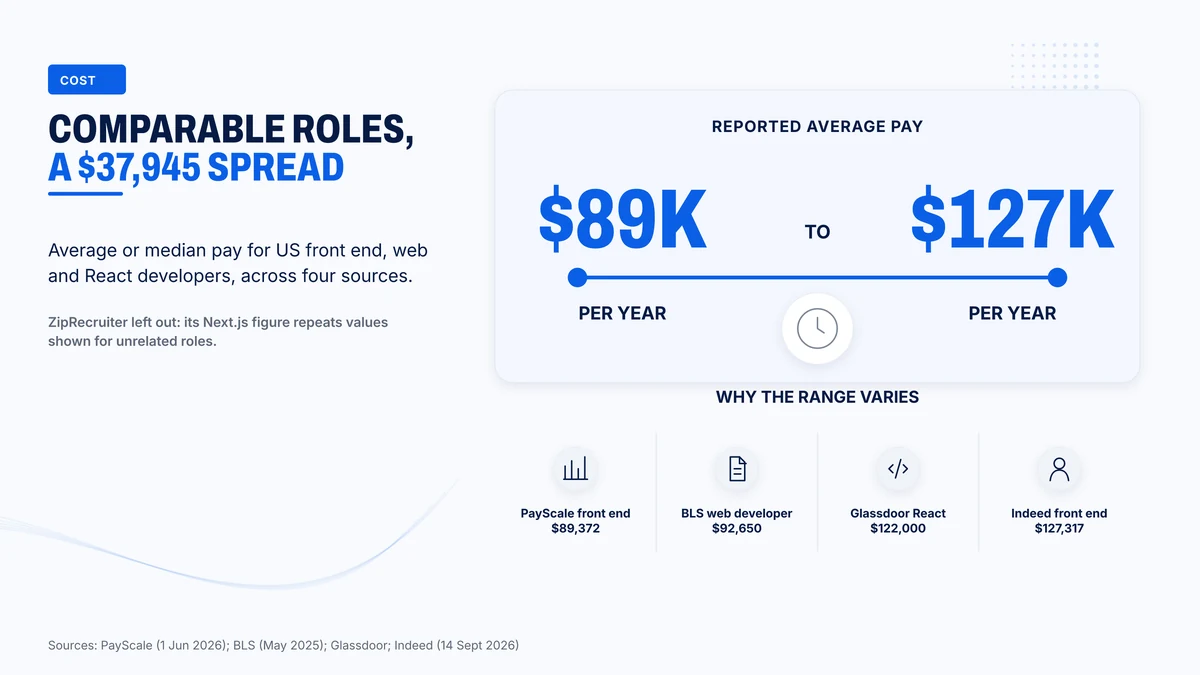
None of the four is wrong. PayScale reports self-reported base pay, Glassdoor reports total pay including bonus, Indeed draws on advertised salaries and the BLS covers all web developers. We left out ZipRecruiter, because its Next.js and React developer pages show figures the site also shows for unrelated job titles.
Agency pricing splits in two. Nine of the twenty firms publish rates under $100 an hour, while six publish $150 or more. Minimum projects run from $1,000 to $50,000, with a median of $17,500 (Clutch profiles, read 21 September 2026). Nine report a most common project of $50,000 to $199,999.
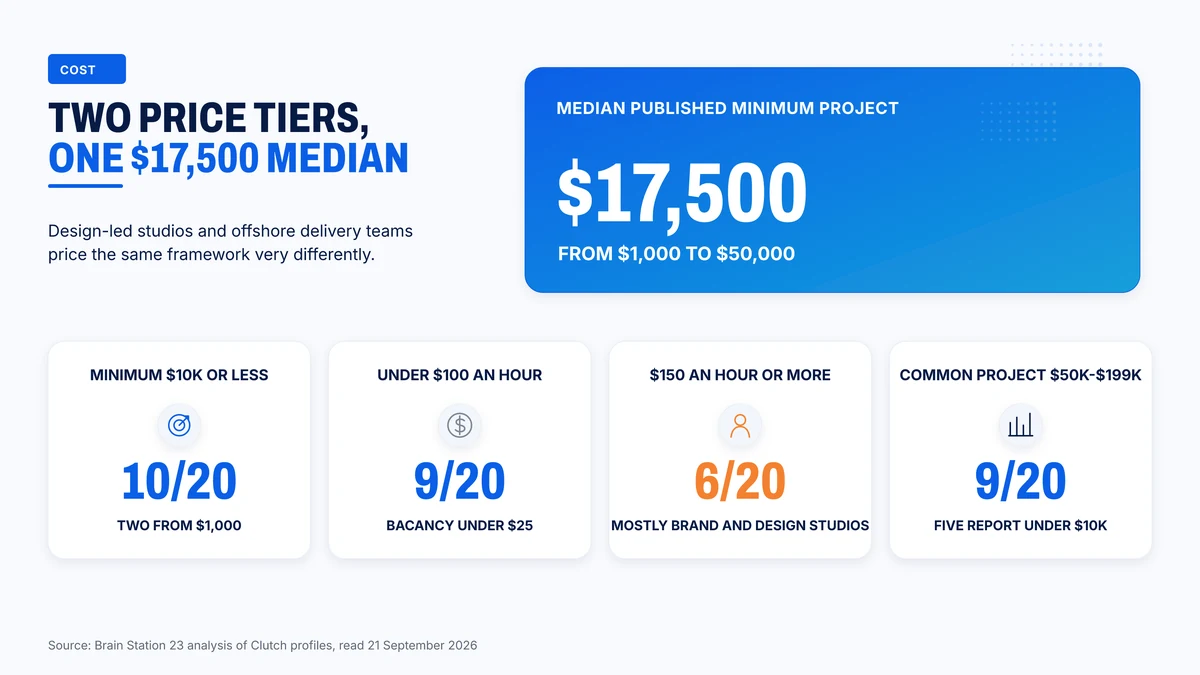
The split follows the kind of firm. Brand and web design studios cluster at $150 to $199, and offshore delivery teams at $25 to $99. Eight factors decide where a Next.js quote lands.
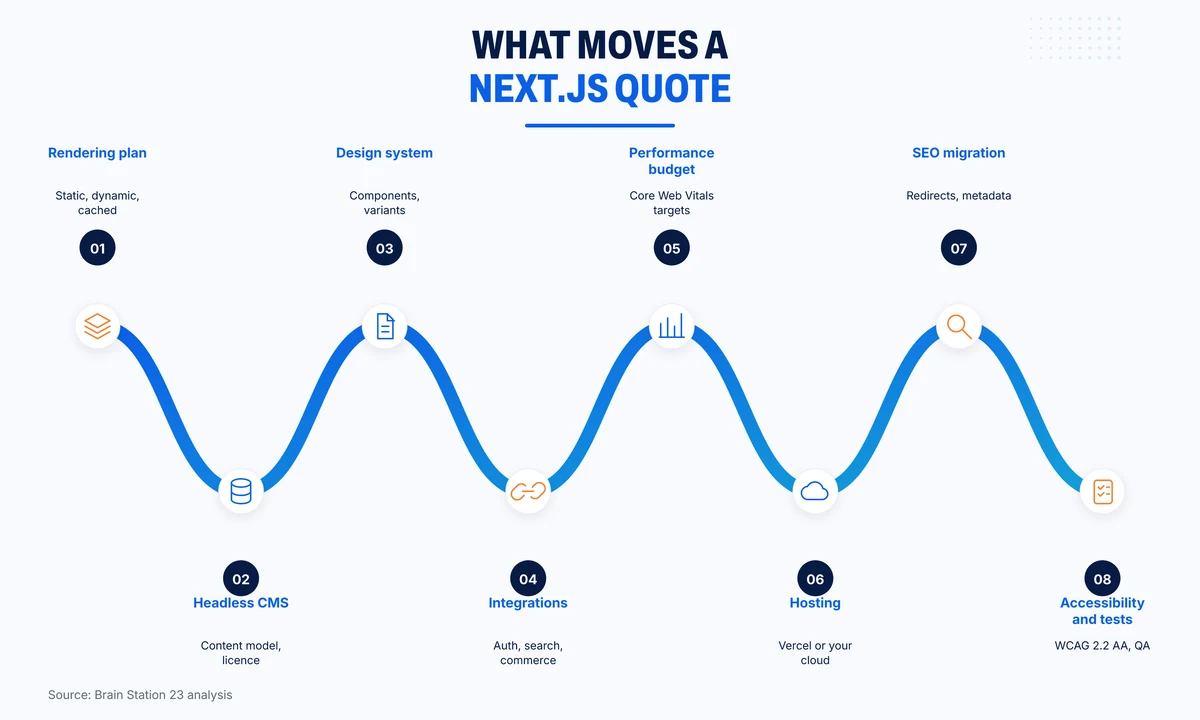
The rendering strategy comes first: which pages are static, which are rendered per request and what is cached. Then the headless CMS and its content model, the design system, integrations such as authentication, search and commerce, the performance budget, hosting, the SEO migration with its redirects, and accessibility and testing. Ask every vendor to price these separately.
The Top 20 Next JS Development Companies in USA, compared
We used Clutch’s directory of Next.js development agencies in the United States, sorted by Clutch Rank and read on 21 September 2026. It lists 645 firms. A paid featured row for Digis appears at the top of every page, and we removed it. Firms 2 to 21 below are the organic top 20 in Clutch Rank order.
Brain Station 23 is placed first because we publish this article. We are US-headquartered, but Next.js does not appear in our published Clutch framework split, so Clutch’s ranking did not place us in its top 20 and we are not claiming it did.
Every overall rating below sits between 4.7 and 5.0, so the stars do not separate these firms. The Next.js Focus column does: Next.js’s share of each firm’s published framework split.
| # | Company | Best For | Team Size | Next.js Focus | Key Tech Stack | Industries Served | Locations |
|---|---|---|---|---|---|---|---|
| 1 | Brain Station 23 — brainstation-23.com | Adding engineers to an in-house Next.js team at offshore rates | 250 – 999 | Not in published frameworks; staff augmentation 60% | Java, Spring, .NET, Node.js, TypeScript | Retail, medical, telecoms, education, financial services | Springfield VA; Bangladesh, UAE, England, Malaysia, Germany |
| 2 | FocusReactive — focusreactive.com | Headless Next.js sites where performance and SEO decide success | 50 – 249 | Next.js 70%, largest framework | Next.js, React, Node.js, TypeScript | E-commerce, media, medical, financial services | New York; London, Warsaw |
| 3 | Suffescom Solutions — suffescom.com | Mobile and web products in finance and healthcare on a lower budget | 250 – 999 | Next.js 15%, joint largest | Next.js, Node.js, React Native, .NET, Django | Financial services, medical, real estate, e-commerce | New York, Wilmington DE; Mohali, Dubai, London, Sydney |
| 4 | Cleveroad — cleveroad.com | Education and fintech platforms from an Eastern European team | 250 – 999 | Next.js 10%; .NET 30% | .NET, Flutter, Next.js, Node.js, TypeScript | Education, financial services, IT, insurance, medical | New York; Kharkiv, Dnipro, Kraków |
| 5 | Collective42 — collective42.com | Marketing websites where search traffic is the goal | 10 – 49 | Next.js 25%, joint largest | Next.js, React, Node.js, React Native | Manufacturing, medical, business services, financial services | Encinitas CA |
| 6 | The Frontend Company — thefrontendcompany.com | Front-end specialists for React and Next.js work, including staff augmentation | 10 – 49 | Next.js 30%; React 45% | React, Next.js, Angular, TypeScript | Financial services, advertising, IT, medical | Covina CA |
| 7 | Vincit — vincit.com | Consumer and entertainment brands with larger budgets | 250 – 999 | Next.js 15%; React and Node.js 25% each | React, Node.js, React Native, Next.js | Arts and entertainment, e-commerce, consumer, media | Irvine CA |
| 8 | Bacancy Technology — bacancytechnology.com | Enterprises wanting the lowest published rate | 1,000 – 9,999 | Next.js 10%, one of ten frameworks | Next.js, React, Ruby on Rails, .NET, Angular | Medical, advertising, automotive, energy, gaming | Miami; Brampton, Ahmedabad |
| 9 | Five Jars — fivejars.com | Non-profits and education institutions | 10 – 49 | Next.js 20%, joint largest | Next.js, React, Laravel, Symfony, Flutter | Non-profit, education, arts, medical, legal | Brooklyn NY, Arlington VA; Warsaw |
| 10 | Clear Digital — cleardigital.com | Enterprise brand and website programmes | 50 – 249 | Next.js 25%; React 35% | React, Next.js, Node.js, TypeScript | IT, financial services, business services, manufacturing | San Jose, San Francisco, Chicago, New York |
| 11 | Orangesoft — orangesoft.co | Healthcare web and mobile products | 50 – 249 | Next.js 20%; React 25% | React, Next.js, Flutter, Node.js, Kotlin | Medical, financial services | San Francisco; Warsaw |
| 12 | Codup — codup.co | E-commerce and manufacturing firms needing integrations | 50 – 249 | Next.js 13%; Node.js 22% | Node.js, Next.js, React, Laravel, .NET | E-commerce, manufacturing, HVAC, retail | Houston, Irvine; Dubai |
| 13 | Agency Partner Interactive — agencypartner.com | Healthcare and education apps in small phases | 50 – 249 | Next.js 10%; React 20% | React, Next.js, Angular, Flutter, Laravel | Medical, education, e-commerce, non-profit | Plano TX |
| 14 | Goji Labs — gojilabs.com | Mobile-first startups wanting design and build together | 50 – 249 | Next.js 10%; Ruby on Rails 25% | Ruby on Rails, Node.js, Next.js, React, Flutter | Automotive, education, energy, financial services | Los Angeles, New York |
| 15 | Coalesce — coalesce.nyc | Mid-market custom software and AI with a Next.js front end | 10 – 49 | Next.js 55%, largest framework | Next.js, Laravel, React, JavaScript | Arts, business services, consumer, education | New York, Lake Worth Beach FL |
| 16 | Inspirovate Creatives — inspirovatecreatives.com | Small businesses wanting a Next.js site plus social marketing | 10 – 49 | Next.js 50%, largest framework | Next.js, Node.js, TypeScript, React Native | Business services, legal, financial services, dental | Los Angeles |
| 17 | Prolific Digital — prolificdigital.com | Consumer and e-commerce brands wanting brand and site together | 10 – 49 | Next.js 50%, React 50% | Next.js, React, JavaScript, PHP | Consumer products, e-commerce, advertising, arts | Louisville KY |
| 18 | Diffco AI — diffco.us | AI products with a Next.js interface | 50 – 249 | Next.js 15%; Node.js 25% | Node.js, React, React Native, Next.js, Python | Business services, medical, consumer, education | San Jose CA |
| 19 | Dotlogics — dotlogics.com | Mid-market firms rebuilding a brand website | 50 – 249 | Next.js 16%, largest framework | Next.js, .NET, Laravel, Ruby on Rails, Flutter | Business services, e-commerce, advertising, education | Huntington NY |
| 20 | Gigster — gigster.com | Enterprise AI builds where speed matters more than rate | 250 – 999 | Next.js 15%; React 30% | React, Angular, Next.js, Node.js | Automotive, education, financial services, government | Austin |
| 21 | Coalition Technologies — coalitiontechnologies.com | Small businesses buying SEO with a site rebuild | 50 – 249 | Next.js 10%; SEO 70% of services | PHP, JavaScript, Next.js, Laravel, React | Retail, e-commerce, financial services, legal cannabis | Los Angeles, Austin |
Team sizes, framework and service splits, industries and locations are from each firm’s published Clutch profile, read 21 September 2026. “Best For” is our reading of that data. Engagement models and certifications are not published consistently across these profiles, so we have left them out rather than guess.
Profiles are grouped by buyer type, and the numbers match the table. Each caution comes from the Review Highlights that Clutch publishes from the firm’s verified reviews. Certifications are self-published and unverified by us. Where we cite reviews that name Next.js, Vercel or SEO, we read the first page of reviews on each profile, up to eleven per firm.
1. Brain Station 23
We publish this article and placed ourselves first, so read this entry as the publisher’s pick. Next.js does not appear in our published Clutch framework split, and we are not in Clutch’s Next.js directory, so we are not a Next.js studio. Our strength is staffing: 60 percent of our work is engineers embedded in client teams, at the $25 to $49 band that Suffescom and Cleveroad also publish, with a $10,000 minimum. That suits a company that already runs a Next.js product and needs more engineers, not one that wants a studio to design and own it. Our ISO 27001 and SOC 2 Type II controls matter when our engineers hold access to your hosting and CMS accounts. Reviewers score Quality at 5.0 and have asked for tighter internal coordination.
Founded: 2006
US Presence: Springfield VA
Company size: Clutch band 250 to 999; we publish 900+ engineers
Rating: 4.9 across 21 Clutch reviews, HQ Springfield, Virginia
- Adding engineers to an in-house Next.js team at offshore rates
- CMMI Level 3
- ISO 27001
- ISO 9001
- SOC 2 Type II (company-published)
- Staff augmentation
- Custom software development
- Application modernisation
- Node.js
- TypeScript
- Java and Spring
- .NET
- Flutter mobile apps
- Retail
- Medical
- Telecoms
- Education
- Financial services
- Hospitality
- Next.js is not in our published framework split, so ask which engineers have shipped Next.js in production before they join your team
For Next.js-first specialists
2. FocusReactive
FocusReactive is the clearest Next.js specialist in the top 20: Next.js is 70 percent of its framework split, and it holds first place in Clutch’s ranking. It is also the only firm here whose reviews consistently describe the work. Six of its ten first-page reviews name Next.js, five name Vercel and five mention a headless CMS. Eighty percent of its clients are small businesses, and all four sub-scores are 4.9. Some clients wanted it to recommend optimisations and new features more proactively.
Founded: 2019
US Presence: New York
Company size: 50 to 249
- Headless Next.js sites where performance and SEO decide success
- Not published; ask directly
- Next.js development
- Headless CMS builds
- React
- Node.js
- Web design
- E-commerce front ends
- Performance and SEO work
- E-commerce
- Media
- Medical
- Financial services
- Education
- Ask it to propose optimisations unprompted, because some clients wanted more of that
15. Coalesce
Next.js is 55 percent of Coalesce’s framework split, with Laravel at 30, and JavaScript is 70 percent of its languages. Custom software and AI make up 65 percent of its services, and 85 percent of its clients are mid-market. It publishes a $150 to $199 band with a $10,000 minimum. Its Willingness to Refer score of 4.3 is the lowest sub-score of any firm here. A few clients suggested shorter testing phases and closer management of budget expectations.
Founded: 2006
US Presence: New York, Lake Worth Beach FL
Company size: 10 to 49
- Mid-market custom software and AI with a Next.js front end
- Not published; ask directly
- Custom software
- AI development
- Next.js
- Laravel
- React
- Branding
- UX and UI design
- Arts and entertainment
- Business services
- Consumer products
- Education
- Financial services
- Agree the testing phase length and a budget review cadence up front
16. Inspirovate Creatives
Next.js is 50 percent of Inspirovate Creatives’ framework split and Node.js 35, and TypeScript is 40 percent of its languages. Social media marketing is a quarter of its services, and 65 percent of its clients are small businesses. It publishes a $25 to $49 band with a $1,000 minimum, the joint lowest here. Five reviews, all rated 5.0, is a thin record. Some clients wanted more proactive strategic recommendations after launch.
Founded: 2016
US Presence: Los Angeles
Company size: 10 to 49
- Small businesses wanting a Next.js site plus social marketing
- Not published; ask directly
- Web development
- Next.js
- Node.js
- TypeScript
- Web design
- Social media marketing
- Mobile apps
- Business services
- Legal
- Financial services
- Beauty
- Dental
- Ask for more than five references before a larger project
17. Prolific Digital
Prolific Digital’s frameworks are Next.js and React at 50 percent each, and its services split evenly across branding, strategy, design and development. Half its clients are enterprises. It publishes a $150 to $199 band, and its Cost score of 4.4 is its lowest. One of its first-page reviews names Next.js, the only one outside FocusReactive. Some clients said it could weigh feedback from all team members more equally.
Founded: 2021
US Presence: Louisville KY
Company size: 10 to 49
- Consumer and e-commerce brands wanting brand and site together
- Not published; ask directly
- Next.js
- React
- Web development
- Web design
- Branding
- Digital strategy
- Consumer products
- E-commerce
- Advertising
- Arts and entertainment
- Agree how feedback from every stakeholder will be gathered and weighed
6. The Frontend Company
The Frontend Company does exactly what its name says: JavaScript is 80 percent of its languages and TypeScript the rest, with React at 45 percent of its frameworks and Next.js at 30. Staff augmentation is a quarter of its services. Its most common project is under $10,000, and all four sub-scores are 4.9 or higher across 30 reviews. Two first-page reviews name React. One client suggested getting familiar with each other’s processes earlier.
Founded: 2016
US Presence: Covina CA
Company size: 10 to 49
- Front-end specialists for React and Next.js work, including staff augmentation
- Not published; ask directly
- Web development
- React
- Next.js
- Angular
- TypeScript
- UX and UI design
- Front-end staff augmentation
- Financial services
- Advertising
- IT
- Medical
- Spend the first week aligning processes, which one client said would have helped
For design, brand and marketing-led websites
5. Collective42
Collective42 splits its frameworks evenly across Next.js, React, Node.js and React Native, and search and paid advertising are 30 percent of its services. That shows in its reviews: seven of its ten first-page reviews mention SEO or site speed, and none names Next.js. It publishes a $100 to $149 band with a $10,000 minimum. Schedule, Cost and Willingness to Refer all score 5.0, and Clutch’s Review Highlights find no significant area for improvement.
Founded: 2017
US Presence: Encinitas CA
Company size: 10 to 49
- Marketing websites where search traffic is the goal
- Not published; ask directly
- Web design
- Web development
- Next.js
- React
- Node.js
- SEO
- Pay per click
- Manufacturing
- Medical
- Business services
- Financial services
- Insurance
- Confirm who maintains the site and its dependencies after launch
9. Five Jars
Five Jars splits its frameworks evenly across Next.js, React, Laravel, Symfony and Flutter, and PHP is 40 percent of its languages. Non-profit and education work make up 55 percent of its industries. It publishes a $100 to $149 band with a $10,000 minimum, and its most common project is $50,000 to $199,999. Clutch’s summary notes annual rate increases on some projects. Some clients noted resource availability problems during peak periods.
Founded: 2017
US Presence: Brooklyn NY, Arlington VA
Company size: 10 to 49
- Non-profits and education institutions
- Not published; ask directly
- Web development
- Web design
- Next.js
- React
- Laravel
- Symfony
- AI development
- Non-profit
- Education
- Arts and entertainment
- Medical
- Legal
- Confirm the named team is available through your peak period
10. Clear Digital
Clear Digital is a brand-led agency: design, strategy and branding make up 65 percent of its services. React is 35 percent of its frameworks and Next.js 25. Half its clients are enterprises, and it publishes a $150 to $199 band with a $50,000 minimum. Three reviews is too few to judge delivery, although one client describes a website and brand overhaul of about $250,000. Clients noted it works best once its delivery pace matches their feedback speed.
Founded: 1999
US Presence: San Jose, San Francisco, Chicago, New York
Company size: 50 to 249
- Enterprise brand and website programmes
- Not published; ask directly
- Web design
- Web development
- Digital strategy
- Branding
- UX and UI design
- React
- Next.js
- Node.js
- IT
- Financial services
- Business services
- Manufacturing
- Medical
- Set a feedback rhythm your stakeholders can keep up with
19. Dotlogics
Web design is half of Dotlogics’ services and branding 20 percent. Next.js is its largest framework at 16 percent, in a split of seven. All four sub-scores are 5.0 across 32 reviews, and 70 percent of its clients are mid-market. It publishes a $150 to $199 band, and its most common project runs $50,000 to $199,999. Most reviewers report no significant improvement area, while some asked for more proactive updates on smaller milestones.
Founded: 2005
US Presence: Huntington NY
Company size: 50 to 249
- Mid-market firms rebuilding a brand website
- Not published; ask directly
- Web design
- Branding
- Web development
- Next.js
- AI agents
- Custom software
- .NET
- Laravel
- Business services
- E-commerce
- Advertising
- Education
- Financial services
- Ask for progress updates on minor milestones, not only major ones
21. Coalition Technologies
Coalition Technologies is an SEO agency first: search is 70 percent of its services, and every one of its eleven first-page reviews mentions SEO or site speed. Next.js is one of ten frameworks at 10 percent each. It has the most reviews on this list, 165, and a $1,000 minimum. Its most common project is under $10,000. Some clients experienced delayed responses and less transparency than they expected.
Founded: 2009
US Presence: Los Angeles, Austin
Company size: 50 to 249
- Small businesses buying SEO with a site rebuild
- Not published; ask directly
- Search engine optimisation
- Pay per click
- Web design
- Web development
- Next.js
- React
- Laravel
- Retail
- E-commerce
- Financial services
- Legal cannabis
- Advertising
- Agree response times and reporting in writing
For larger teams and lower rates
3. Suffescom Solutions
Next.js, Node.js and React Native are 15 percent each of Suffescom’s framework split, among ten frameworks. Mobile and web are 40 percent each of its services, and finance and medical work are 35 percent each of its industries. It has 121 reviews averaging 4.9 and publishes a $25 to $49 band. None of its first-page reviews names Next.js. Some clients noted it delivers to specification but offers little creative input.
Founded: 2013
US Presence: New York, Wilmington DE
Company size: 250 to 999
- Mobile and web products in finance and healthcare on a lower budget
- HIPAA and SOC 2 are named in its Clutch profile text; confirm scope
- Mobile apps
- Web development
- Next.js
- Node.js
- React Native
- AI development
- Blockchain
- Financial services
- Medical
- Real estate
- E-commerce
- Bring your own design and product direction, because some clients wanted more creative input
4. Cleveroad
Cleveroad builds from Kharkiv, Dnipro and Kraków with a $25 to $49 band and a $10,000 minimum. .NET is 30 percent of its framework split and Next.js 10, and TypeScript is 30 percent of its languages. Education is half its industries. Five of its first-page reviews name React, and its Cost score of 4.7 is its lowest. Clients find it good value but noted that cost estimates could be more precise.
Founded: 2011
US Presence: New York
Company size: 250 to 999
- Education and fintech platforms from an Eastern European team
- Not published; ask directly
- Custom software
- Web development
- Mobile apps
- .NET
- Next.js
- Node.js
- TypeScript
- Staff augmentation
- Education
- Financial services
- IT
- Insurance
- Medical
- Ask for a line-item estimate, because some clients wanted more precise cost estimates
8. Bacancy Technology
Bacancy publishes the lowest band on this list, under $25 an hour, with more than 1,000 staff and a $10,000 minimum. Next.js is one of ten frameworks at 10 percent each, and half its clients are enterprises. Its sub-scores run from 4.6 to 4.7 across 64 reviews, the lowest overall rating here. Three first-page reviews name React. Some clients noted that time zone differences affected communication and timelines.
Founded: 2011
US Presence: Miami
Company size: 1,000 to 9,999
- Enterprises wanting the lowest published rate
- ISO 9001 (named in its Clutch profile text)
- Web development
- AI development
- Cloud consulting
- Staff augmentation
- Next.js
- React
- Ruby on Rails
- .NET
- Medical
- Advertising
- Automotive
- Energy
- Gaming
- Agree overlap hours with the team in India before the first sprint
12. Codup
Codup’s framework split leads with Node.js at 22 percent, and Next.js is one of six frameworks at 13. E-commerce is 30 percent of its services and 35 percent of its industries, with manufacturing, HVAC and electrical work behind it. Its most common project size across 75 reviews is under $10,000, and Cost is its lowest sub-score at 4.7. Some clients experienced timeline extensions and scope adjustments.
Founded: 2012
US Presence: Houston, Irvine
Company size: 50 to 249
- E-commerce and manufacturing firms needing integrations
- Not published; ask directly
- Custom software
- E-commerce development
- Node.js
- Next.js
- React
- Laravel
- Staff augmentation
- E-commerce
- Manufacturing
- Electrical
- HVAC
- Retail
- Write acceptance tests and scope before the first sprint
For product studios with a Next.js line
7. Vincit
Vincit is a product studio where Next.js is 15 percent of the framework split, behind React, Node.js and React Native at 25 each. It publishes a $150 to $199 band with a $50,000 minimum, and 60 percent of its clients are mid-market. One first-page review mentions Vercel. Clutch’s summary says clients found good value despite higher initial costs, and Cost is its lowest sub-score at 4.5.
Founded: 2007
US Presence: Irvine CA
Company size: 250 to 999
- Consumer and entertainment brands with larger budgets
- Not published; ask directly
- Custom software
- Web development
- Mobile apps
- React
- Node.js
- React Native
- Next.js
- Arts and entertainment
- E-commerce
- Consumer products
- Media
- Retail
- Compare the full quote, including support, before weighing the rate
11. Orangesoft
Medical work is 90 percent of Orangesoft’s industries. React is 25 percent of its framework split and Next.js 20, with Kotlin and Swift leading its languages, and it builds from Warsaw as well as San Francisco. It publishes a $50 to $99 band with a $25,000 minimum. None of its first-page reviews names Next.js or React. Some reviews raised concerns about the quality of design work.
Founded: 2011
US Presence: San Francisco
Company size: 50 to 249
- Healthcare web and mobile products
- Not published; ask directly
- Mobile apps
- IoT development
- Web development
- React
- Next.js
- Flutter
- React Native
- Medical
- Financial services
- Review design output at the first milestone
13. Agency Partner Interactive
Agency Partner Interactive lists nine frameworks, with React at 20 percent and Next.js at 10. Custom software and mobile make up 65 percent of its services, and medical work 40 percent of its industries. Its most common project size across 86 reviews is under $10,000, which suggests work bought in small phases. It publishes a $100 to $149 band. Some clients experienced delays and periods of limited updates.
Founded: 2010
US Presence: Plano TX
Company size: 50 to 249
- Healthcare and education apps in small phases
- Not published; ask directly
- Custom software
- Mobile apps
- AI development
- React
- Next.js
- Angular
- Web design
- Medical
- Education
- E-commerce
- Non-profit
- Put a weekly reporting rhythm in the contract
14. Goji Labs
Goji Labs is mobile first, with mobile apps half its services and Ruby on Rails its largest framework at 25 percent. Next.js is 10 percent. It has 90 reviews averaging 5.0 and a $25,000 minimum, and two first-page reviews name React. Some clients noted budget overruns and timeline extensions as scope evolved, so fix a change-request process before the build starts.
Founded: 2014
US Presence: Los Angeles, New York
Company size: 50 to 249
- Mobile-first startups wanting design and build together
- Not published; ask directly
- Mobile apps
- Custom software
- UX design
- Ruby on Rails
- Node.js
- Next.js
- React
- Automotive
- Education
- Energy
- Financial services
- Medical
- Confirm the web stack it proposes, because Ruby on Rails leads its frameworks
18. Diffco AI
AI development and AI agents are 40 percent of Diffco AI’s services. Node.js leads its framework split at 25 percent, and Next.js is 15. Its sub-scores run from 4.9 to 5.0 across 32 reviews, and its most common project is $50,000 to $199,999 against a $25,000 minimum. None of its first-page reviews names Next.js. Clients suggested it could be more open to ideas outside its comfort zone.
Founded: 2008
US Presence: San Jose CA
Company size: 50 to 249
- AI products with a Next.js interface
- Not published; ask directly
- AI development
- AI agents
- Custom software
- Mobile apps
- Node.js
- React
- Next.js
- Staff augmentation
- Business services
- Medical
- Consumer products
- Education
- Financial services
- Test how the team responds to an architecture you propose
20. Gigster
Gigster publishes the highest rate on this list, $300 or more an hour, with a $50,000 minimum. AI development is 35 percent of its services, React 30 percent of its frameworks and Next.js 15, and half its clients are enterprises. Two reviews, both rated 5.0, cannot show a pattern. Treat its position as a lead rather than evidence, and consider a paid discovery before a build budget.
Founded: 2014
US Presence: Austin
Company size: 250 to 999
- Enterprise AI builds where speed matters more than rate
- Not published; ask directly
- AI development
- Custom software
- Mobile apps
- Application modernisation
- React
- Angular
- Next.js
- Automotive
- Education
- Financial services
- Government
- Medical
- Ask for enterprise references on comparable Next.js work
What the twenty profiles show
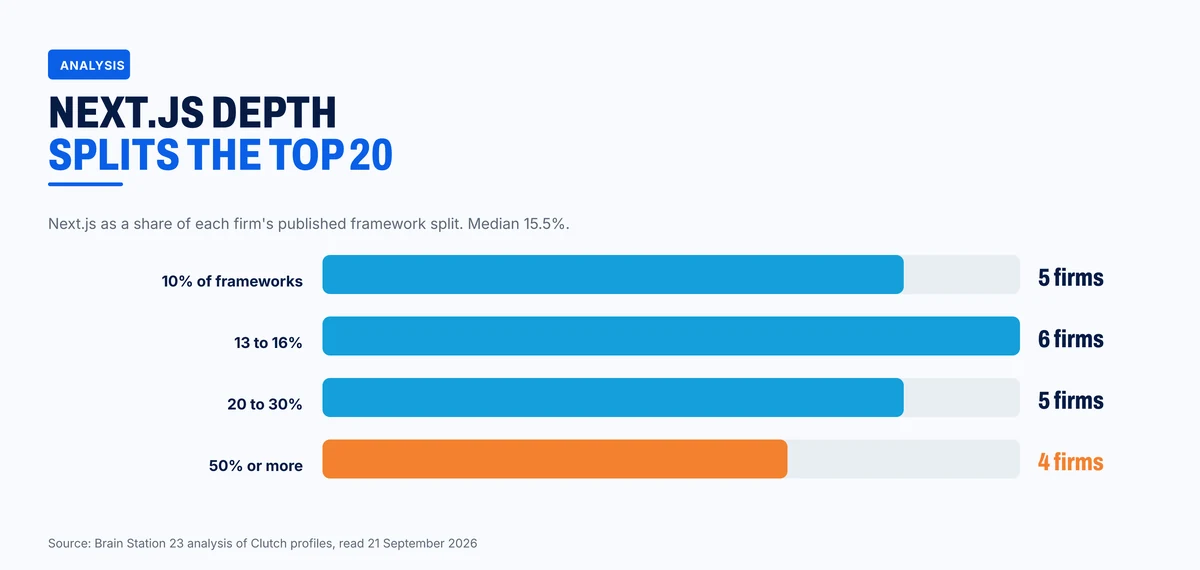
Next.js depth is uneven. Next.js’s share of the twenty firms’ framework splits has a median of 15.5 percent. Five firms put it at 10 percent, and four put it at half or more: FocusReactive at 70, Coalesce at 55, and Inspirovate Creatives and Prolific Digital at 50 (Brain Station 23 analysis of Clutch profiles, read 21 September 2026).
The whole directory looks the same. Across all 645 US firms, 130 put Next.js at 10 percent or less. The 75 that put it at half or more have a median of one review, so depth and track record rarely sit in the same firm. That is the main reason a Top 20 Next JS Development Companies in USA list has to be read beyond the ranking.
Reviews talk about outcomes, not the framework. Of 185 first-page reviews, seven name Next.js and six name Vercel, almost all at FocusReactive. Forty-three mention SEO, page speed or Core Web Vitals, at twelve firms. Buyers of Next.js work judge it by traffic and speed, so ask for those numbers from past projects.
A third of the list sells brand or marketing first. Seven firms list branding, SEO or social media marketing among their services, and Coalition Technologies puts 70 percent into SEO. That suits a marketing site and is the wrong fit for a complex application.
Cost is the weak sub-score. Among the 14 firms whose sub-scores differ, Cost is the lowest or joint lowest for 11. Three firms have fewer than ten reviews: Gigster with two, Clear Digital with three and Inspirovate Creatives with five.
How to shortlist a Next.js development company
Order the filters so the first one removes the most firms.
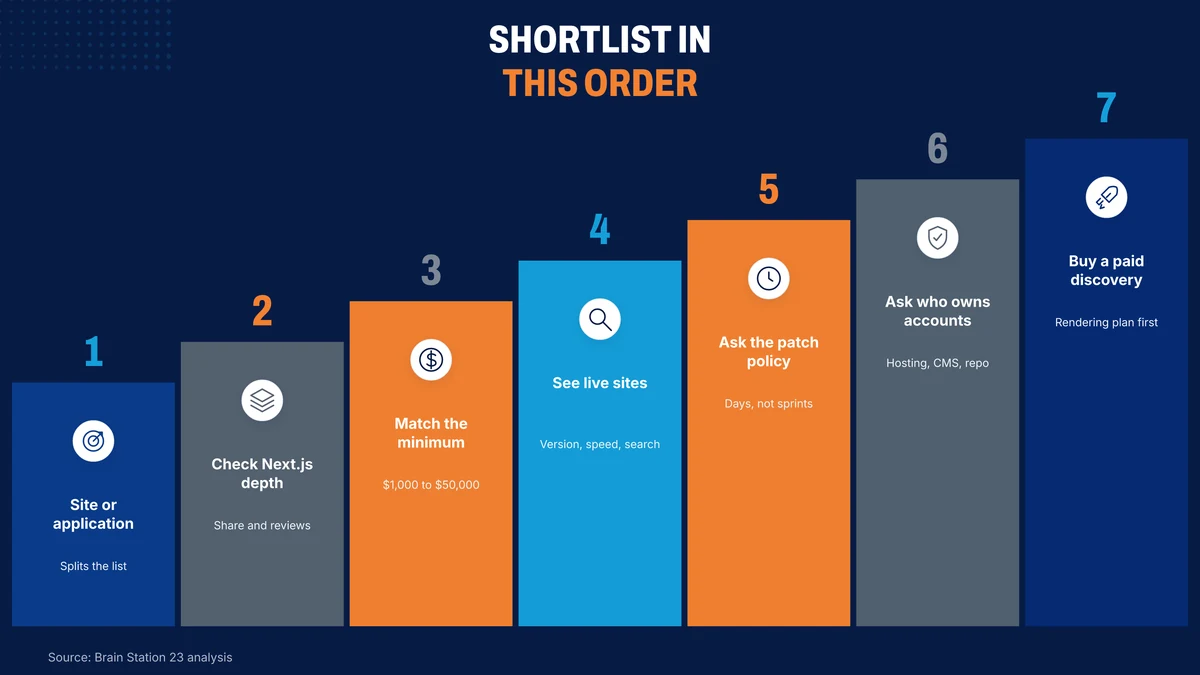
Step 1: Decide whether it is a site or an application. A content-led marketing site and a logged-in product need different firms. This one decision splits the list in two.
Step 2: Check Next.js depth. Compare the Next.js Focus column, then read the firm’s reviews for the framework and for outcomes such as speed and search traffic.
Step 3: Match your budget to the minimum. Minimums run from $1,000 to $50,000, and rates from under $25 to more than $300 an hour.
Step 4: Ask for live sites and their numbers. Ask for URLs built in the last two years, the Next.js version each runs, and before-and-after Core Web Vitals or search figures.
Step 5: Ask for the version and patch policy. The answer should name Next.js 16, a Node.js LTS line, and how many days the firm takes to apply a critical security release.
Step 6: Ask who owns the accounts. The Vercel team or cloud account, the headless CMS, the domain and the repository should be in your organisation from day one.
Step 7: Buy a paid discovery. A short fixed-fee phase that produces a rendering plan, a content model and a redirect map shows how the firm thinks before you fund a build.
How to buy Next.js development: four engagement models
The engagement model decides who pays when the content model or the design changes mid-build.
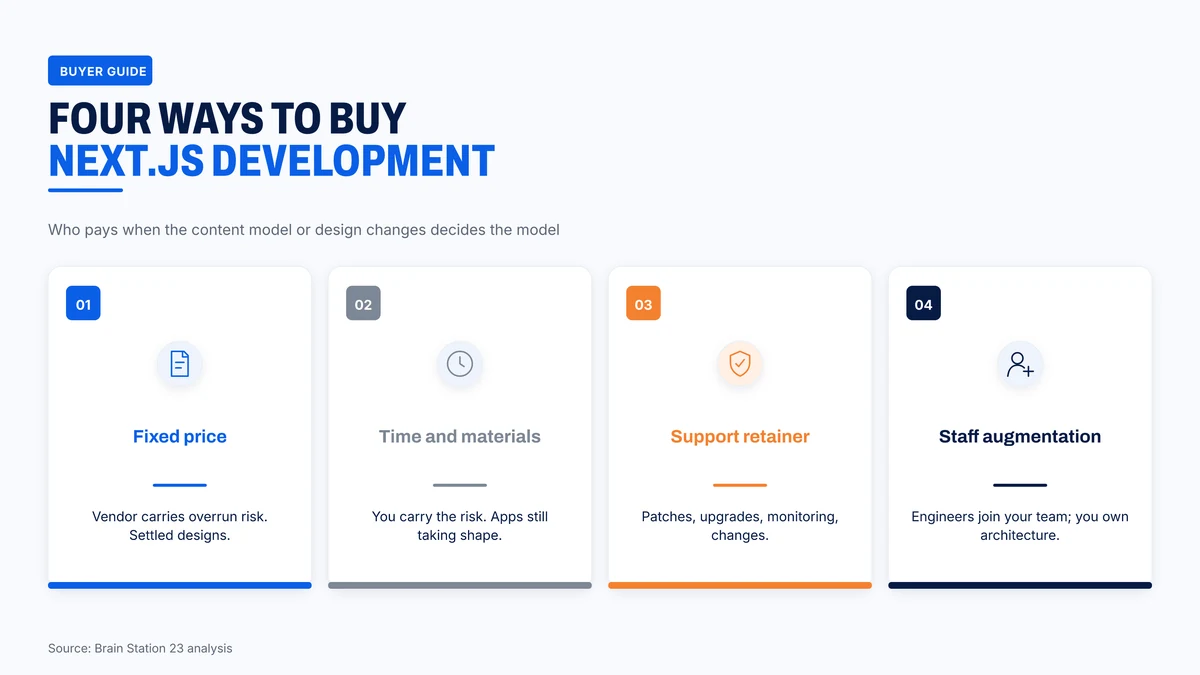
Fixed price moves overrun risk to the vendor, who prices it in. It suits a marketing site with settled designs and content. It fails when the CMS content model changes after build starts.
Time and materials keeps the risk with you. It suits applications still finding their shape. Cap each phase and review burn every week.
Support retainer covers security releases, framework upgrades, performance monitoring and a block of change requests. A Next.js site that is not maintained drifts out of support within two years.
Staff augmentation adds React and Next.js engineers to your team. The Frontend Company, Cleveroad, Bacancy, Codup, Diffco AI and Brain Station 23 publish staff augmentation lines. It fails when nobody in-house owns the architecture and release decisions.
The technical question: staying on a supported Next.js line
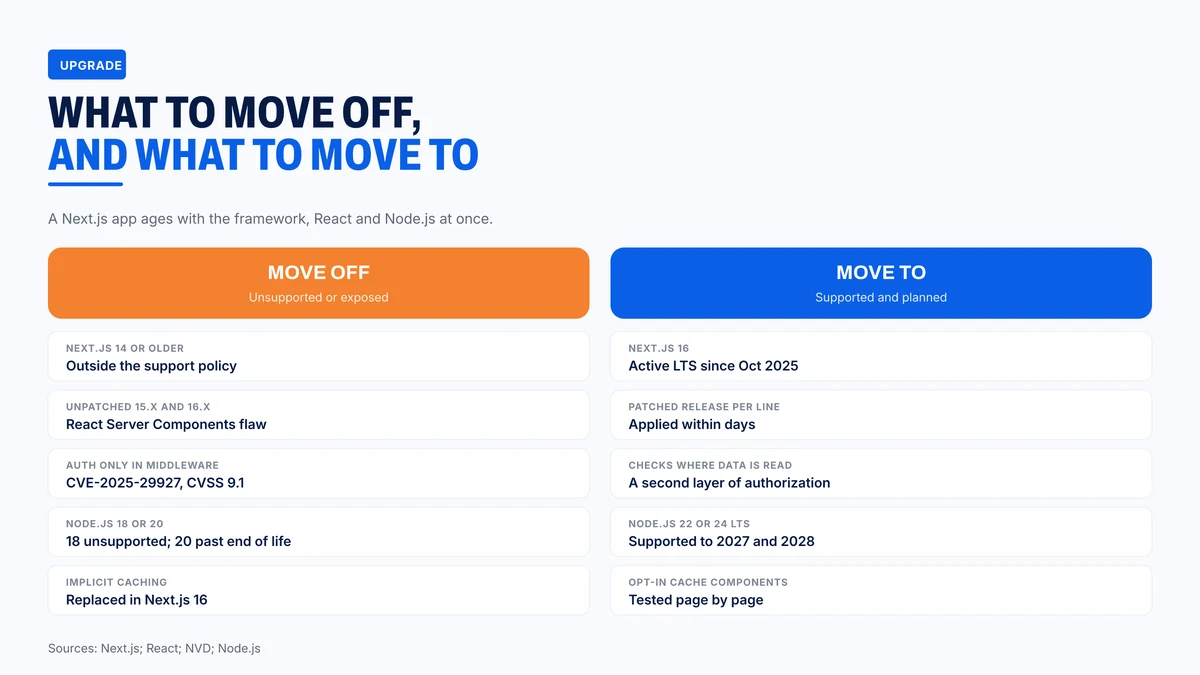
A Next.js application ages with the framework, React and Node.js at once. The order of the upgrade work decides whether it is routine or an outage.
Step 1: Take an inventory. Record the exact Next.js, React and Node.js versions in every environment, and whether the app uses the App Router, Server Components or middleware.
Step 2: Apply the security releases for your line. React published patched Next.js versions for every affected line, from 14.2.35 for the 13.3 to 14.x lines through the 15.x and 16.x lines (React). CVE-2025-29927 was fixed in 12.3.5, 13.5.9, 14.2.25 and 15.2.3 (NVD).
Step 3: Do not rely on middleware alone for authorization. The middleware bypass showed why. Check permissions again where data is read, so one layer failing does not expose it.
Step 4: Move Node.js to a supported LTS line. Next.js 16 needs Node.js 20.9 or later, and Node.js 20 reached end of life on 30 April 2026, so plan on Node.js 22 or 24 (Next.js 16; Node.js Release schedule).
Step 5: Upgrade to Next.js 16. Expect Turbopack as the default bundler, middleware.ts renamed to proxy.ts, opt-in Cache Components and several removed features (Next.js 16). Test caching behaviour page by page, because it is where upgrades change what users see.
Step 6: Schedule the next round. Next.js keeps each major version in maintenance for two years after release (Next.js support policy). Put the next upgrade in the maintenance plan now.
Red flags: eight answers to walk away from
Each of these answers should end the conversation, or at least change the contract.
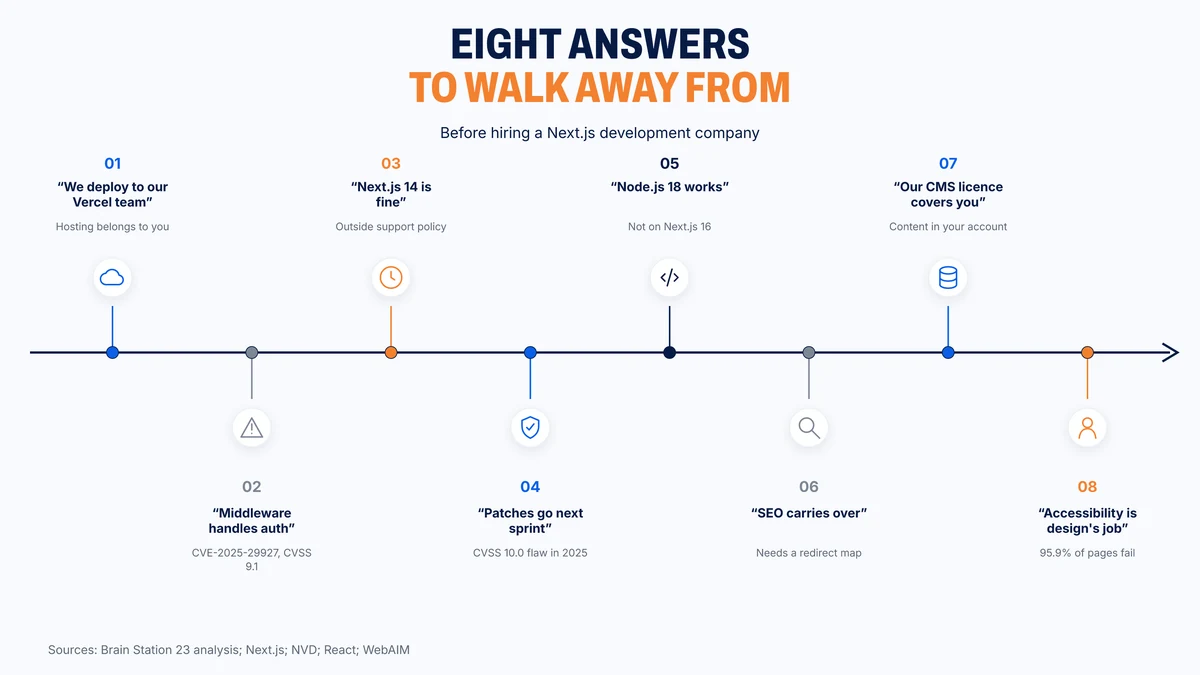
“We’ll deploy it to our Vercel team.” The hosting team, its billing and its domains should be yours.
“Middleware handles all our authorization.” CVE-2025-29927 let requests skip middleware checks, and it was rated CVSS 9.1 (NVD).
“Next.js 14 is fine.” It is outside the support policy (Next.js).
“Security releases go out with the next sprint.” The React Server Components flaw of December 2025 was rated CVSS 10.0 (React).
“It runs fine on Node.js 18.” Next.js 16 does not support it (Next.js 16).
“SEO will carry over automatically.” A rebuild needs a redirect map, metadata and a plan for every indexed URL.
“Our CMS licence covers you.” The CMS space and its content belong under your account.
“Accessibility is the designer’s job.” WebAIM found detected WCAG failures on 95.9 percent of the top million home pages (WebAIM).
After launch: what the build quote leaves out
This part covers what owners wish they had settled before the final invoice, and what recurs for as long as the site runs.
What you must own before the final invoice
The code repository with its full history, in your GitHub or GitLab organisation, not a zip.
The hosting team or cloud account, with billing, domains and deployment settings in your name. On Vercel, that means your own team, with the agency invited as members.
The headless CMS space, with your staff as owners and the content model documented.
Domain, DNS and email sending, registered to your organisation.
Analytics, Google Search Console and tag manager accounts, owned by you, with the agency added as users.
Environment variables and secrets, in a store you administer, with a list of every third-party key.
Design source files and the component library, so the next team can extend the design system.
A runbook, covering deployment, rollback, cache purges, upgrades and incident contacts.
The bill that arrives after launch
A build quote covers the build. Ask for the recurring number before you sign, and compare vendors over three years.
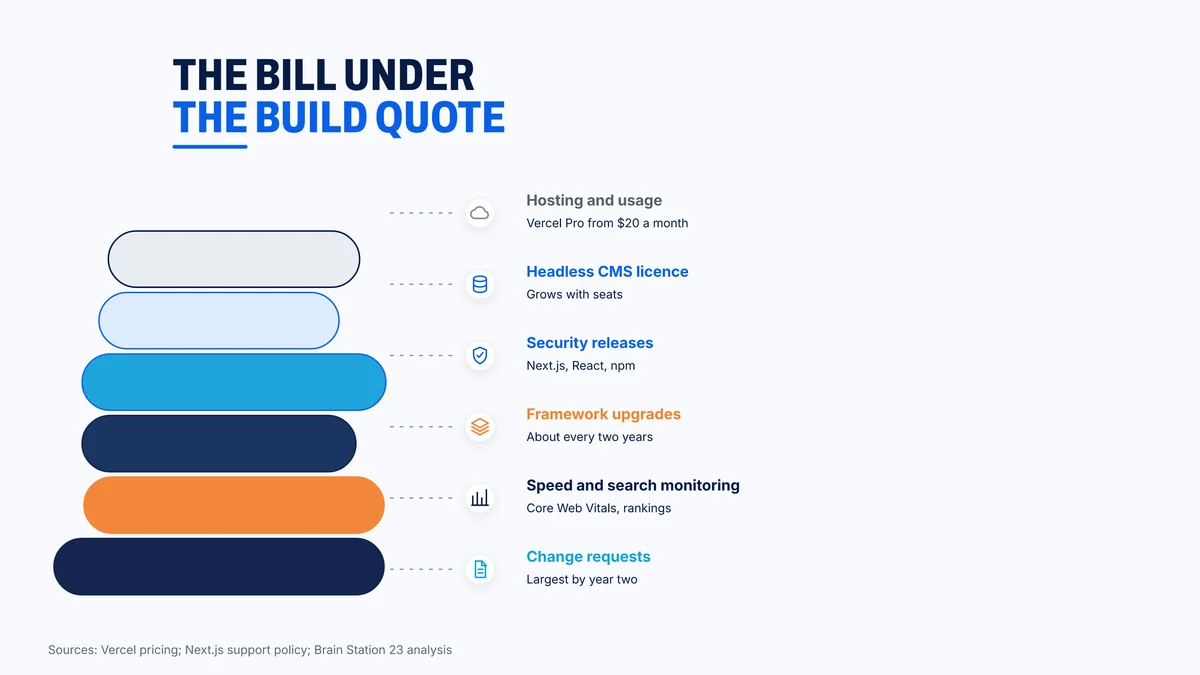
Hosting comes first. Vercel’s Pro plan starts at $20 a month and includes $20 of usage credit, with spend management for usage beyond it (Vercel). Then the headless CMS licence, security releases for Next.js, React and every npm dependency, a major framework upgrade roughly every two years, performance and search monitoring, and change requests, which usually outgrow everything else by year two.
Security is a recurring cost
Next.js had two serious advisories in nine months. CVE-2025-29927 was reported to the Next.js team on 27 February 2025 and published on 21 March, rated CVSS 9.1 (Vercel; NVD). The React Server Components flaw followed on 3 December 2025, rated CVSS 10.0, and CISA added it to its Known Exploited Vulnerabilities catalog on 5 December (React; CISA).
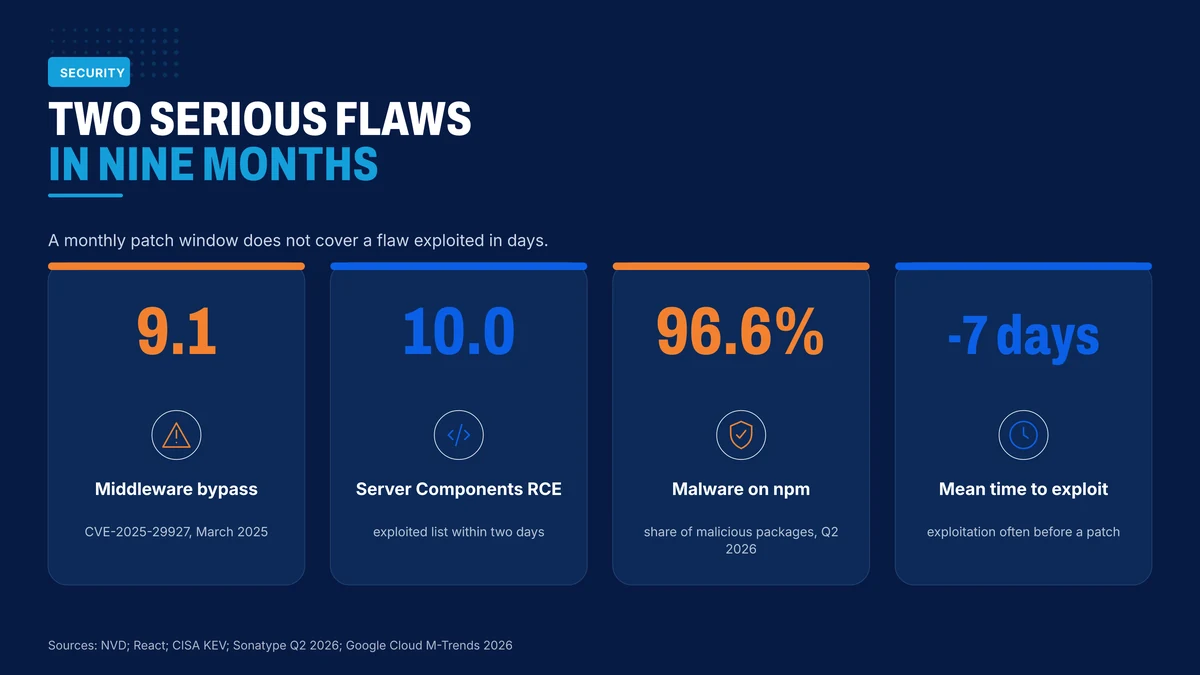
The packages underneath are a target too. Sonatype attributed 96.6 percent of malicious package counts in Q2 2026 to npm (Sonatype). After the Shai-Hulud worm, CISA told organisations to pin dependencies, rotate developer credentials and require phishing-resistant multifactor authentication (CISA).
Google Cloud’s M-Trends 2026 estimated the mean time to exploit at minus seven days, meaning exploitation often arrives before a patch (Google Cloud). A retainer that applies security releases in a monthly window does not cover that risk. The average US data breach cost USD 11.5 million in IBM’s 2026 report (IBM Cost of a Data Breach Report 2026). Write a patch window, in days, into the support agreement.
Accessibility is legal exposure
A Next.js site is mostly front end, which is where accessibility is won or lost. WebAIM found detected WCAG 2 failures on 95.9 percent of the top million home pages in 2026, an average of 56.1 errors per page (WebAIM Million 2026). More than 5,000 digital accessibility lawsuits were filed in 2025, and 46 percent of federal cases involved repeat defendants (UsableNet).
Name WCAG 2.2 AA in the contract rather than the word “accessible”, put automated and manual checks in the definition of done, and treat overlay widgets sceptically.
Contract clauses that surface in month nine
IP assignment on payment, not on final acceptance, so a dispute over the last milestone does not leave the code in limbo.
Transition assistance, a fixed number of hours at an agreed rate, available whether the relationship ends well or badly.
Rate escalation caps for the support period, because some firms here raise rates annually.
Subcontracting, named and approved in writing.
A patch window, in days, for critical and actively exploited vulnerabilities in Next.js, React and their dependencies.
Search performance handover, including the redirect map and the metadata rules, so the next team does not lose rankings.
Non-solicitation in both directions, with a reasonable term.
This is general guidance, not legal advice. Have your own counsel review the contract.
How to leave without losing the site
Confirm, in writing, that the repository, hosting team, CMS space, domain and analytics are already yours. Trigger the transition hours while the relationship is still cordial. Ask the departing team to record walkthroughs of deployment, caching and the content model, and to deploy once in front of your staff.
On the last day, remove the departing team from every account, revoke their hosting and CMS tokens, and rotate every secret they could have seen. CISA’s advice after Shai-Hulud, to rotate all developer credentials, applies just as well to a vendor exit (CISA).
Hire in-house or hire a Next.js development company
The comparison starts with the wage. The BLS median for web developers was $92,650 in May 2025, and Indeed reports $127,317 for a front end developer (BLS; Indeed). That is before benefits, recruiting, equipment and the time to hire.
Hire in-house when the Next.js application is your product and changes every week. The knowledge of the rendering and caching choices is the asset.
Hire an agency for a site rebuild, a first version or a specialist phase such as a Next.js 16 upgrade, with the accounts in your name and transition hours in the contract.
Mix the two when you have a technical lead but not enough engineers. Staff augmentation from the firms that publish it fills the gap, and your lead keeps the architecture decisions.
FAQ
Which companies are the top Next.js developers in the USA?
By Clutch Rank on its US Next.js directory, read 21 September 2026, the top five organic firms are FocusReactive, Suffescom Solutions, Cleveroad, Collective42 and The Frontend Company (Clutch). FocusReactive is the only one that puts Next.js above half its framework split.
How much do US Next.js development companies charge?
The twenty firms here publish hourly bands from under $25 to more than $300. Nine charge under $100 and six charge $150 or more. Minimum projects run from $1,000 to $50,000, with a median of $17,500 (Clutch).
Which Next.js version should a new project use?
Next.js 16, the Active LTS line since 21 October 2025. Next.js 15 is in Maintenance LTS, which lasts two years from its October 2024 release, and Next.js 14 and earlier are unsupported (Next.js support policy).
What changed in Next.js 16?
Turbopack became the default bundler, middleware.ts was renamed proxy.ts, caching moved to opt-in Cache Components, and the minimum Node.js version rose to 20.9, dropping Node.js 18 (Next.js 16). Budget an upgrade as its own piece of work, with caching tested page by page.
Is Next.js secure?
Do I have to host Next.js on Vercel?
No. Next.js can run on your own Node.js servers or other platforms, and Vercel’s postmortem on the middleware flaw examined self-hosted setups as well as its own (Vercel). Whichever host you choose, the account and its billing should be in your name.
Conclusion
The data behind this Top 20 Next JS Development Companies in USA list says three things. Next.js depth is uneven: the median firm puts it at 15.5 percent of its frameworks, and only four put it at half or more. Reviews describe speed and search results far more often than the framework itself. And prices split between design studios at $150 an hour and up, and delivery teams under $100.
Any of the twenty can build a Next.js site. What decides the next three years is who owns the hosting team, the CMS and the repository, how fast security releases are applied, and whether the move to Next.js 16 is already in the plan.
Sources
- https://clutch.co/us/web-developers/nextjs?sort_by=ClutchRank
- https://clutch.co/profile/brain-station-23
- https://nextjs.org/support-policy
- https://nextjs.org/blog/next-16
- https://nvd.nist.gov/vuln/detail/CVE-2025-29927
- https://vercel.com/blog/postmortem-on-next-js-middleware-bypass
- https://react.dev/blog/2025/12/03/critical-security-vulnerability-in-react-server-components
- https://www.cisa.gov/known-exploited-vulnerabilities-catalog
- https://github.com/nodejs/Release
- https://survey.stackoverflow.co/2025/technology
- https://w3techs.com/technologies/details/js-nextjs
- https://vercel.com/pricing
- https://www.payscale.com/research/US/Job=Front_End_Developer_%2F_Engineer/Salary
- https://www.bls.gov/ooh/computer-and-information-technology/web-developers.htm
- https://www.glassdoor.com/Salaries/us-react-developer-salary-SRCH_IL.0,2_IN1_KO3,18.htm
- https://www.indeed.com/career/front-end-developer/salaries
- https://www.sonatype.com/blog/q2-2026-open-source-malware-index-attackers-abuse-developer-trust
- https://www.cisa.gov/news-events/alerts/2025/09/23/widespread-supply-chain-compromise-impacting-npm-ecosystem
- https://cloud.google.com/blog/topics/threat-intelligence/m-trends-2026
- https://www.ibm.com/reports/data-breach
- https://webaim.org/projects/million/
- https://blog.usablenet.com/ada-web-lawsuit-trends-2026