
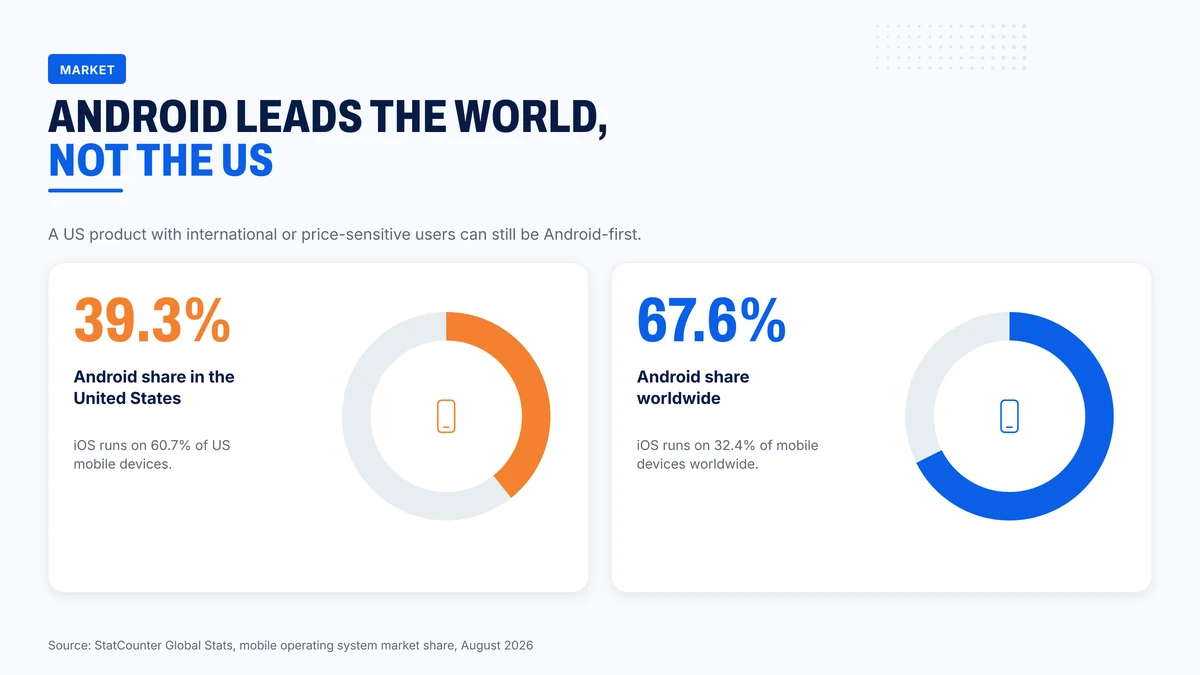
Android runs on 67.6 percent of the world’s mobile devices and on 39.3 percent of those in the United States (StatCounter, worldwide; StatCounter, United States, August 2026). That gap explains this Top 20 Android Application Development Companies in USA list better than any star rating.
Not one of the twenty firms puts more of its published mobile work into Android than into the iPhone. Ten split the two evenly, ten lean toward iOS, and seventeen also list React Native or Flutter (Brain Station 23 analysis of Clutch profiles, read 15 September 2026). In the American market, Android is usually the second build, or the same codebase shipped twice.
That can be the right call. It becomes an expensive one when most of your customers carry Android phones, or when the Play Store rules change under an app nobody is watching.
This guide compares the twenty firms, prices the work and shows how to shortlist. It then covers what a build quote leaves out: whose Play Console holds the app, whose identity it is verified under, who keeps the signing key, and who updates the target API every year.
Key takeaways
- 39.3% of US mobile devices ran Android in August 2026, against 67.6 percent worldwide (StatCounter).
- 0 of 20 firms on this list put more of their mobile work into Android than iPhone, and ten lean toward iOS (Clutch profiles).
- 17 of 20 list React Native or Flutter, and only 8 list Kotlin among their languages (Clutch profiles).
- Over 60% of professional Android developers use Kotlin, and Google says Kotlin apps are 20 percent less likely to crash (Android Developers).
- 31 August 2026 is when Google Play began requiring new apps and updates to target Android 16, with extensions available to 1 November 2026 (Play Console Help).
- 30 September 2026 starts Android developer verification in four countries, ahead of a global rollout in 2027 (Android developer verification).
- 1.75 million policy-violating apps were blocked from Google Play in 2025, and more than 80,000 developer accounts were banned (Google Security Blog).
- $106,099 to $140,376 is the gap between Glassdoor’s and Indeed’s average pay for a US Android developer (Glassdoor; Indeed).
Android in 2026: the world’s platform, America’s second build
The United States is an iPhone market. In August 2026, iOS ran on 60.7 percent of US mobile devices and Android on 39.3 percent. Worldwide the split reverses: Android 67.6 percent, iOS 32.4 percent (StatCounter, United States; StatCounter, worldwide). A US product with international users, field workers on company handsets, or a price-sensitive audience can easily have an Android majority that the national figure hides.
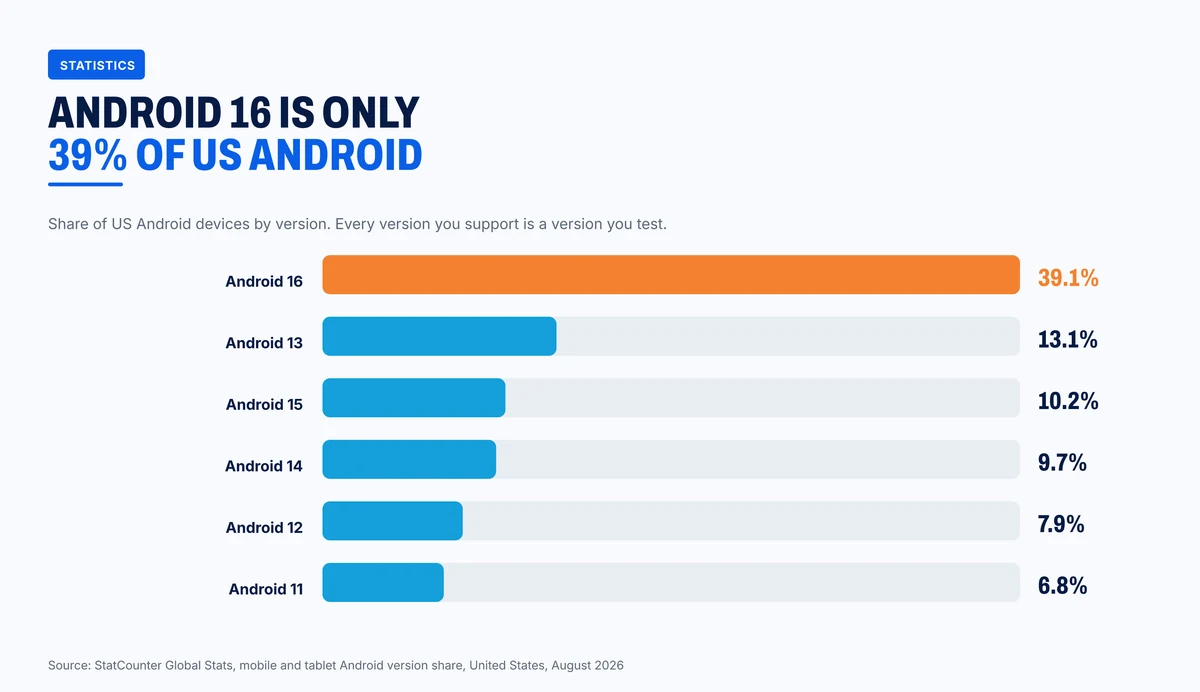
Android is several platforms at once. Among US Android devices in August 2026, Android 16 accounted for 39.1 percent, Android 13 for 13.1 percent, Android 15 for 10.2 percent and Android 14 for 9.7 percent, while Android 12 and 11 together still made up 14.6 percent (StatCounter). Every version a team supports is a version it has to test.
Kotlin is Google’s default; it is not every vendor’s. Google says Kotlin is used by over 60 percent of professional Android developers and that apps using it are 20 percent less likely to crash (Android Developers). Across all developers, Stack Overflow’s 2025 survey found 10.8 percent used Kotlin and 29.4 percent used Java (Stack Overflow Developer Survey 2025).
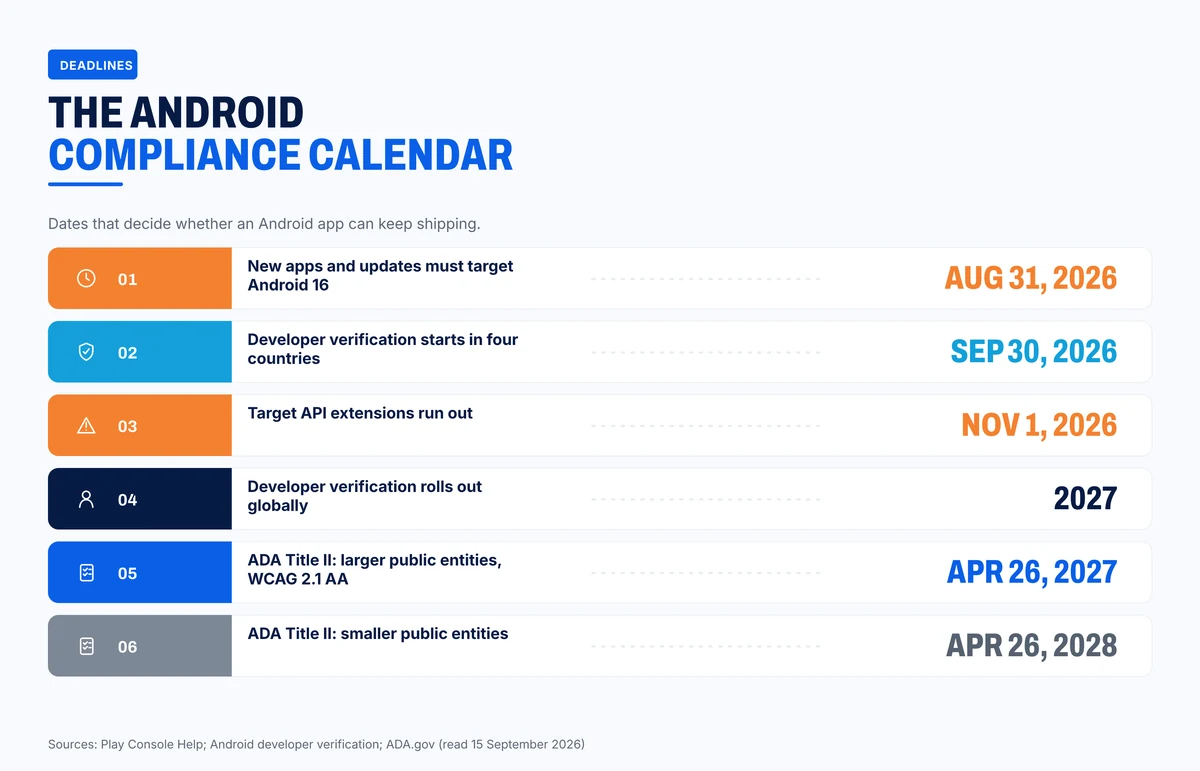
The rules move every year. From 31 August 2026, new apps and app updates on Google Play must target Android 16, API level 36, and existing apps must target at least Android 15 to stay available to new users on newer devices. Developers can request an extension to 1 November 2026 (Play Console Help). Separately, Android developer verification starts on 30 September 2026 for apps installed from participating stores in Brazil, Indonesia, Singapore and Thailand, with a global rollout to certified Android devices in 2027 (Android developer verification).
So brief an Android vendor with four facts: the share of your users on Android, the oldest Android version you must support, whether you want native Kotlin or one cross-platform codebase, and whose Google account the app will live in.
What Android app development costs in the US
Pay figures for Android developers spread by about $34,000.
Glassdoor reports an average of $106,099 for a US Android developer from 505 salaries, with a typical range of $80,845 to $140,181 (Glassdoor). The Bureau of Labor Statistics puts the median for all software developers at $135,980 in May 2025 (BLS). Indeed reports an average of $140,376, from job postings over the past 36 months, updated 7 September 2026 (Indeed).
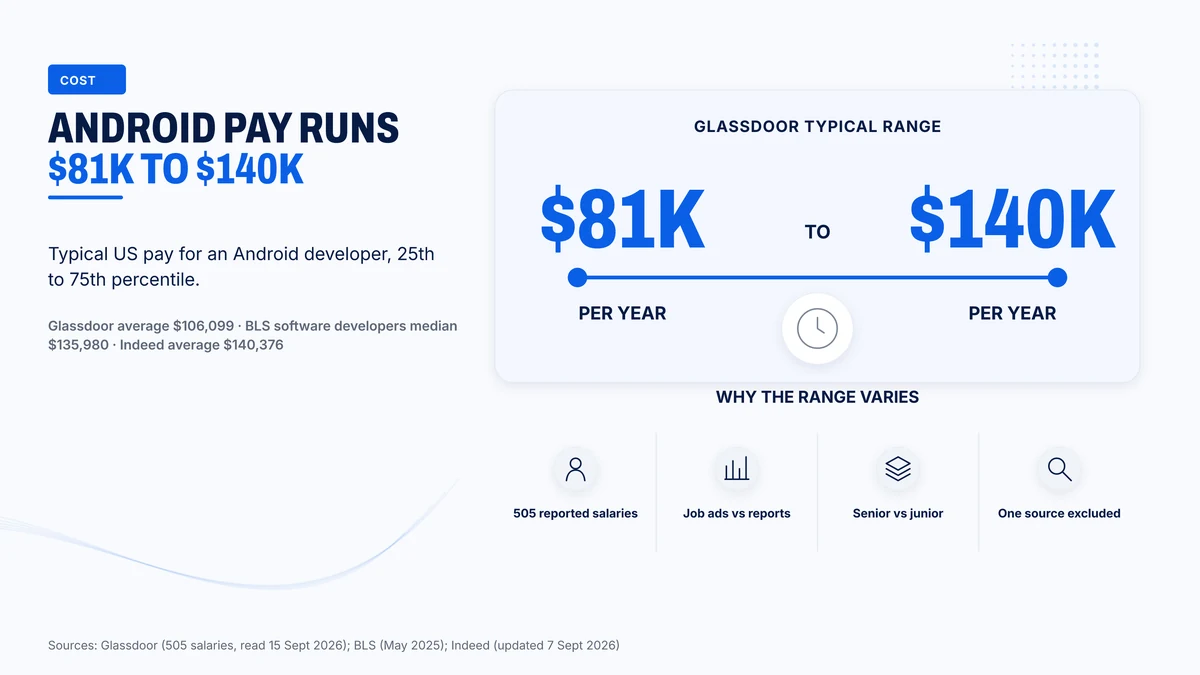
The spread has plain causes. Glassdoor’s figure comes from salaries people report, while Indeed’s comes from what employers advertise. We left ZipRecruiter out because it returned exactly the same $127,151 for an Android developer and a Kotlin developer on 15 September 2026.
Agency pricing is lower. Thirteen of the twenty firms publish rates under $100 an hour, five of them $25 to $49, and the median minimum project is $25,000 (Clutch profiles, read 15 September 2026). Eleven report a most common project under $50,000.
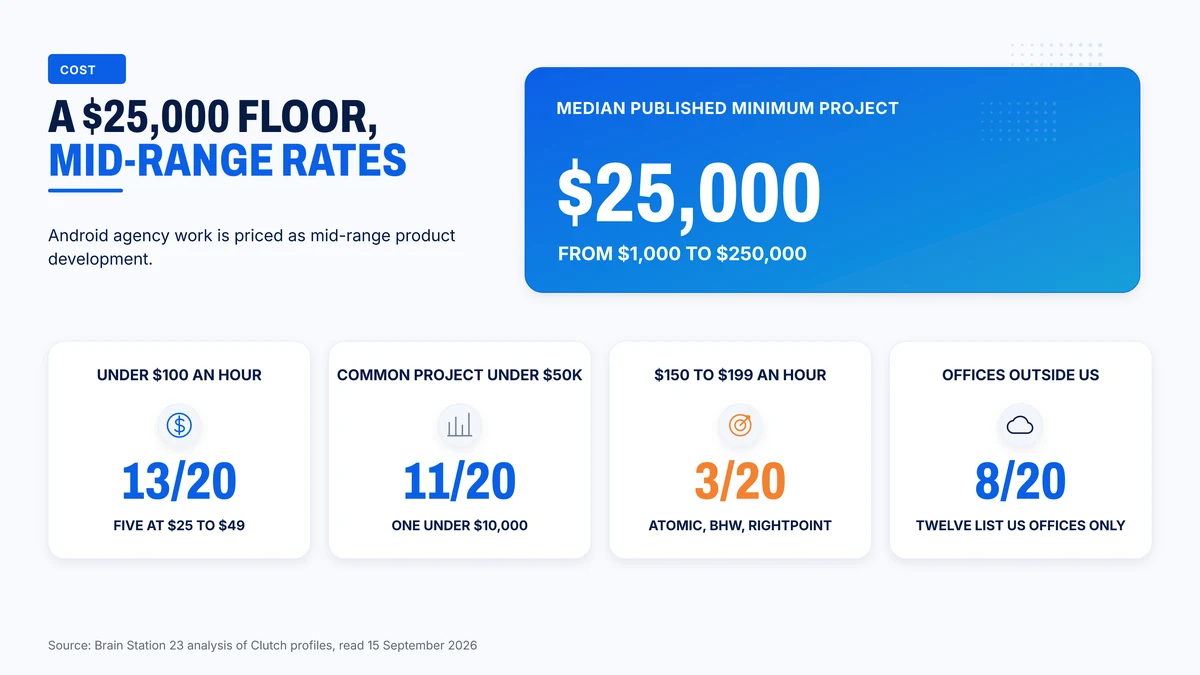
Minimums run from $1,000 at ChopDawg.com to $250,000 at Rightpoint. Eight factors decide where an Android quote lands.
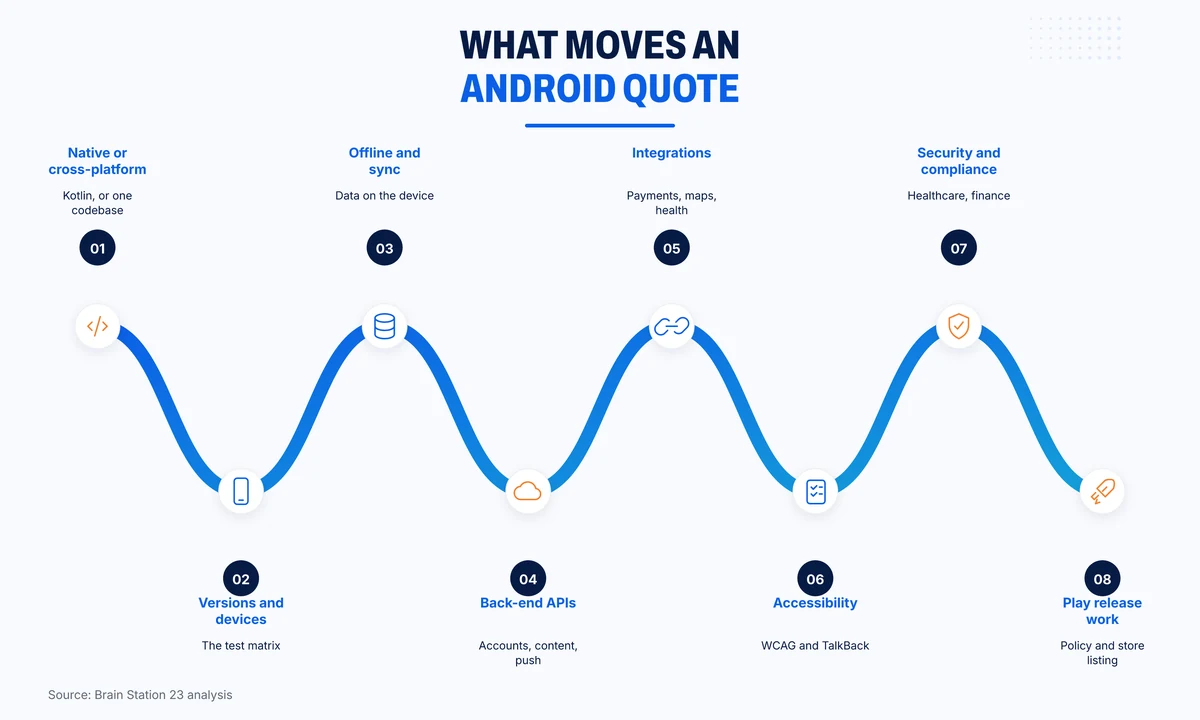
Native Kotlin or cross-platform comes first, because it decides whether iOS is a second build or the same one. The range of Android versions and devices you support sets the testing bill. Offline data and sync, back-end APIs, integrations such as payments and maps, accessibility, security and compliance, and Play Store release and policy work complete the list. Ask every vendor to price these separately.
The Top 20 Android Application Development Companies in USA, compared
We used Clutch’s directory of Android app developers in the United States, sorted by Clutch Rank and read on 15 September 2026. It lists 3,890 firms. We found no paid placements among the first 50 rows, so firms 2 to 21 below are the first 20 in Clutch Rank order.
Brain Station 23 is placed first because we publish this article. We are US-headquartered, but mobile is 5 percent of our published services, so Clutch’s ranking did not place us in its top 20 and we are not claiming it did.
Every overall rating below sits between 4.7 and 5.0, so the stars do not separate these firms. The Android Focus column does: Android’s share of each firm’s published mobile platforms, the iPhone share beside it, and the firm’s mobile share of services.
| # | Company | Best For | Team Size | Android Focus | Key Tech Stack | Industries Served | Locations |
|---|---|---|---|---|---|---|---|
| 1 | Brain Station 23 — brainstation-23.com | Adding Android and Kotlin engineers to an in-house product team | 250 – 999 | Android 25% (iPhone 25%); mobile 5% of services, staff augmentation 60% | Java, Kotlin, Flutter, Spring, .NET | Retail, medical, telecoms, education | Springfield VA; Bangladesh, UAE, England, Malaysia, Germany |
| 2 | Suffescom Solutions — suffescom.com | Fintech and healthcare apps on a lower hourly budget | 250 – 999 | Android 30% (iPhone 40%); mobile 40% | Kotlin, Swift, React Native, Next.js, Python | Financial services, medical, real estate, e-commerce | New York, Wilmington DE; Mohali, Dubai, London, Sydney |
| 3 | Atomic Object — atomicobject.com | Healthcare and logistics products with senior US engineers | 50 – 249 | Android 40% (iPhone 50%); mobile 50% | React Native, TypeScript, Ruby on Rails, Node.js | Medical, logistics, automotive, insurance | Grand Rapids MI, Ann Arbor MI, Chicago, Raleigh |
| 4 | Arbisoft — arbisoft.com | Education and hospitality platforms above $200,000 | 250 – 999 | Android 50% (iPhone 50%); mobile 25% | Python, Java, Django, React Native, Flutter | Education, hospitality, medical, financial services | Plano TX; Lahore, Islamabad, Riyadh |
| 5 | AppMakers USA — appmakersla.com | Small businesses building one Flutter app for both stores | 50 – 249 | Android 40% (iPhone 50%); mobile 40% | Flutter, JavaScript, Python, Java | Education, financial services, gaming, medical | Los Angeles, New York |
| 6 | TekRevol — tekrevol.com | Mid-market apps on a lower budget, including AR/VR | 250 – 999 | Android 30% (iPhone 30%); mobile 40% | React Native, Flutter, JavaScript, PHP, Laravel | Education, gaming, government, medical | Houston, Austin, Washington DC; Dubai, London |
| 7 | Trango Tech — trangotech.com | Mobile-led projects with AR/VR or e-commerce on a lower rate | 250 – 999 | Android 25% (iPhone 25%, cross-platform 30%); mobile 40% | Kotlin, Java, Swift, React Native, Node.js | Automotive, education, financial services, government | Salt Lake City UT, Chicago; Dubai, Riyadh |
| 8 | Dedicated Developers — dedicateddevelopers.com | Healthcare and hospitality apps from a small US team | 10 – 49 | Android 30% (iPhone 50%); mobile 65% | React Native, PHP, Swift, .NET, Angular | Medical, hospitality, e-commerce, education | Atlanta, New York, Boston |
| 9 | ChopDawg.com — chopdawg.com | Founders with small budgets building a first app | 10 – 49 | Android 25% (iPhone 25%, cross-platform 25%); mobile 80% | React Native, React, Java, Swift, Node.js | Business services, consumer products, education, government | Philadelphia, Smyrna GA, Seattle, Boston |
| 10 | Zco Corporation — zco.com | Established companies wanting a long-running US firm at a lower rate | 250 – 999 | Android 33% (iPhone 34%, cross-platform 33%); mobile 40% | Java, Kotlin, C#, React Native, Flutter | Business services, consumer products, gaming, medical | Nashua NH, Boston, New York |
| 11 | Apptechies — apptechies.com | Small businesses wanting a lower-rate US team | 50 – 249 | Android 40% (iPhone 40%); mobile 55% | Kotlin, Swift, Flutter, React Native, React | IT, advertising, education, medical | Greenwood IN |
| 12 | The BHW Group — thebhwgroup.com | Mid-market React Native apps from a senior Texas team | 10 – 49 | Android 50% (iPhone 50%); mobile 60% | React Native, JavaScript, Go, Java | Consumer products, medical, education, government | Austin, Dallas |
| 13 | Designli — designli.co | One cross-platform build with design support | 50 – 249 | Android 15% (iPhone 20%, cross-platform 55%); mobile 50% | React Native, Node.js, React, Swift, Kotlin | Consumer products, construction, education, financial services | Greenville SC, San Francisco, Dallas; Buenos Aires, Mexico City |
| 14 | Rightpoint — rightpoint.com | Enterprise brands with budgets of $250,000 or more | 250 – 999 | Android 40% (iPhone 60%); mobile 45% | Swift, Java, C++, React Native | Consumer products, financial services, medical, automotive | Chicago, Boston, Plano, Atlanta |
| 15 | Mercury Development — mercurydevelopment.com | Long-term partnerships covering apps, wearables and IoT | 250 – 999 | Android 30% (iPhone 30%, cross-platform 40%); mobile 20% | Java, Python, Flutter, React Native, .NET | Hospitality, medical, business services, media | Aventura FL, Atlanta |
| 16 | Orangesoft — orangesoft.co | Healthcare apps built natively in Kotlin and Swift | 50 – 249 | Android 40% (iPhone 40%); mobile 40% | Kotlin, Swift, Flutter, React Native, React | Medical, financial services | San Francisco; Warsaw |
| 17 | MMC Global — mmcgbl.com | Blockchain and generative AI products with a mobile front end | 250 – 999 | Android 30% (iPhone 35%); mobile 20% | Python, Kotlin, Java, Next.js, React | Real estate, education, hospitality, automotive | Austin; Dubai, Abu Dhabi |
| 18 | Goji Labs — gojilabs.com | iPhone-first or cross-platform products for startups and enterprises | 50 – 249 | Android 10% (iPhone 40%, cross-platform 40%); mobile 50% | Ruby on Rails, Swift, React Native, Kotlin, Flutter | Automotive, education, energy, financial services | Los Angeles, New York |
| 19 | BairesDev — bairesdev.com | Enterprises needing large nearshore teams across mobile and web | 1,000 – 9,999 | Android 20% (iPhone 25%); mobile 10% | Java, PHP, Python, React Native, Flutter | IT, financial services, medical, advertising | San Francisco; Buenos Aires, Sao Paulo, Mexico City, Bogota, Barcelona |
| 20 | Toptal — toptal.com | Hiring individual freelance Android or iOS developers | 1,000 – 9,999 | Android 30% (iPhone 30%); mobile 15% | Java, JavaScript, Python, .NET, Django | Arts, business services, education, financial services | San Francisco |
| 21 | Metova — metova.com | Enterprise retail, manufacturing and healthcare apps | 50 – 249 | Android 50% (iPhone 50%); mobile 35% | JavaScript, Python, Java, Symfony | Financial services, manufacturing, medical, e-commerce | Bentonville AR, Irving TX |
Team sizes, service splits, mobile platform splits, languages, industries and locations are from each firm’s published Clutch profile, read 15 September 2026. iPad is listed separately from iPhone on these profiles. “Best For” is our reading of that data. Engagement models and certifications are not published consistently across these profiles, so we have left them out rather than guess.
Profiles are grouped by buyer type, and the numbers match the table. Each caution comes from the Review Highlights that Clutch publishes from the firm’s verified reviews. Certifications are self-published and unverified by us, and none of the twenty Clutch profiles lists one, so ask directly. Where we cite review mentions of Android or Kotlin, we read every review on the profile.
1. Brain Station 23
We publish this article and placed ourselves first, so read this entry as the publisher’s pick. Mobile is 5 percent of our published services, so we are not a mobile agency in the way most firms below are. Our platform split is even, with Android, iPhone, iPad and cross-platform at 25 percent each, and Java and Kotlin at 14 and 7 percent of our languages. Most of our work, 60 percent, is engineers embedded in client teams, at a $25 to $49 band that five firms below also publish. Our ISO 27001 and SOC 2 Type II controls cover access and change management, which matters when the signing keys and Play Console must stay in your name. Reviewers score Quality at 5.0 and have asked for tighter internal coordination. For a full agency build, start with the groups below.
Founded: 2006
US Presence: Springfield VA
Company size: Clutch band 250 to 999; we publish 900+ engineers
Rating: 4.9 across 21 Clutch reviews, HQ Springfield, Virginia
- Adding Android and Kotlin engineers to an in-house product team
- CMMI Level 3
- ISO 27001
- ISO 9001
- SOC 2 Type II (company-published)
- Staff augmentation
- Android and cross-platform apps
- Flutter
- Java
- Kotlin
- Application modernisation
- Managed IT services
- Retail
- Medical
- Telecoms
- Education
- Financial services
- Hospitality
- Ask which proposed engineers have shipped an app that targets Android 16, and from whose Play Console
For healthcare and regulated products
3. Atomic Object
Medical work is 65 percent of Atomic Object’s industry mix, and all four of its offices are in the US. Its platform split leans to iPhone, 50 percent against 40 for Android, and its languages list TypeScript and Ember.js rather than Kotlin or Java, with React Native at 30 percent of frameworks. Clutch’s summary calls it a premium price point, with projects from $20,000 to over $2 million. Reviewers credit communication and user-centred design. Some flagged cost management and asked for clearer initial scoping to prevent overruns.
Founded: 2001
US Presence: Grand Rapids MI, Ann Arbor MI, Chicago, Raleigh
Company size: 50 to 249
- Healthcare and logistics products with senior US engineers
- Not published; ask directly
- Mobile app development
- Custom software
- React Native
- TypeScript
- Ruby on Rails
- Node.js
- UX design
- Medical
- Logistics
- Automotive
- Insurance
- Ask for a scoped estimate with change-control rules before work starts
8. Dedicated Developers
Mobile is 65 percent of Dedicated Developers’ services, and medical clients are 40 percent of its industries. Its platform split is 50 percent iPhone and 30 percent Android. Its published languages are PHP, Swift and ASP.NET, with React Native its main framework, so ask how Android-specific work is staffed. Its 56 reviews average 5.0, and its most common project is under $50,000. Some clients, especially first-time app owners, wanted more detailed progress documentation during the build.
Founded: 2007
US Presence: Atlanta, New York, Boston
Company size: 10 to 49
- Healthcare and hospitality apps from a small US team
- Not published; ask directly
- Mobile app development
- Web development
- React Native
- PHP
- Swift
- .NET
- Angular
- Medical
- Hospitality
- E-commerce
- Education
- Agree a written progress report for each sprint
16. Orangesoft
Orangesoft is one of two firms here where Kotlin is a leading language, level with Swift at 25 percent, and Android and iPhone share its mobile work at 40 percent each. Medical clients make up 90 percent of its industries, and IoT is a fifth of its services. Development runs from Warsaw as well as San Francisco. Clutch’s summary puts projects at $5,000 to over $100,000. Some reviews criticised design quality, so ask for design samples and write acceptance criteria for screens.
Founded: 2011
US Presence: San Francisco
Company size: 50 to 249
- Healthcare apps built natively in Kotlin and Swift
- Not published; ask directly
- Mobile app development
- IoT development
- Web development
- Custom software
- Kotlin
- Swift
- Flutter
- Medical
- Financial services
- Review design samples and agree acceptance criteria for screens
For enterprise programmes and larger budgets
4. Arbisoft
Arbisoft splits its mobile work evenly, 50 percent Android and 50 percent iPhone, and it is one of two firms we read whose reviews mention Android more often than iOS. Custom software is half its services. Its most common project is $200,000 to $999,999, against a $50,000 minimum, and education is 40 percent of its industries. Reviewers credit proactive problem-solving and client retention. Some noted that time zone differences occasionally complicated coordination with its Lahore and Islamabad teams.
Founded: 2007
US Presence: Plano TX
Company size: 250 to 999
- Education and hospitality platforms above $200,000
- Not published; ask directly
- Custom software development
- Android and iOS apps
- Web development
- AI development
- Django
- React Native
- Flutter
- Education
- Hospitality
- Medical
- Financial services
- Agree overlap hours with the teams in Pakistan
14. Rightpoint
Rightpoint’s $250,000 minimum is more than three times the next highest on this list, and 60 percent of its clients are enterprises. Its mobile split leans to iPhone at 60 percent, with Android at 40, and Java is 20 percent of its languages. Mobile is 45 percent of its services. Its 20 reviews average 4.9, with Cost lowest at 4.6. A few clients said initial scoping underestimated complexity and caused temporary disruption, so budget a discovery phase inside the minimum.
Founded: 2007
US Presence: Chicago, Boston, Plano, Atlanta
Company size: 250 to 999
- Enterprise brands with budgets of $250,000 or more
- Not published; ask directly
- Mobile app development
- Web development
- IoT
- UX/UI design
- Swift
- Java
- C++
- Consumer products
- Financial services
- Medical
- Automotive
- IT
- Ask how complexity is sized in the first estimate
15. Mercury Development
Mercury Development puts 40 percent of its mobile work into cross-platform apps and splits the rest evenly between Android and iPhone. Mobile is 20 percent of its services, next to AI, testing, IoT and wearables at 10 percent each. It is one of three firms here reporting a most common project of $200,000 or more. Its 34 reviews average 5.0. Some clients noted language barriers and time zone differences, and asked for more direct communication between developers and with management.
Founded: 1999
US Presence: Aventura FL, Atlanta
Company size: 250 to 999
- Long-term partnerships covering apps, wearables and IoT
- Not published; ask directly
- Mobile app development
- Cross-platform apps
- Wearables
- IoT
- Application testing
- AI development
- Flutter
- Hospitality
- Medical
- Business services
- Consumer products
- Media
- Ask for direct developer-to-developer contact and a named manager
19. BairesDev
BairesDev is one of two firms here with more than 1,000 staff, and mobile is one of ten service lines at 10 percent. Android is 20 percent of its mobile split, behind iPhone at 25, with iPad and cross-platform at 20 each. Java is 30 percent of its languages. Half its clients are enterprises, and Clutch’s summary records projects from $10,000 to over $5 million. Reviewers value talent in similar time zones. A few mentioned minor language barriers and unclear explanations of technical concepts.
Founded: 2009
US Presence: San Francisco
Company size: 1,000 to 9,999
- Enterprises needing large nearshore teams across mobile and web
- Not published; ask directly
- Staff augmentation
- Mobile app development
- Web development
- Application testing
- DevOps
- Java
- React Native
- IT
- Financial services
- Medical
- Advertising
- Business services
- Ask how technical decisions are explained to non-technical stakeholders
20. Toptal
Toptal describes itself as a place to hire freelance talent (Toptal), and its reviews fit: the most common project is under $10,000, the smallest band on this list. Android and iPhone take 30 percent each of its mobile split, and Java is a quarter of its languages. Cost is its lowest sub-score at 4.5, joint lowest in this top 20, and some clients found its pricing higher than competitors while judging the talent worth it. You manage the work yourself.
Founded: 2010
US Presence: San Francisco
Company size: 1,000 to 9,999
- Hiring individual freelance Android or iOS developers
- Not published; ask directly
- Freelance developer hiring
- Mobile app development
- Custom software
- AI development
- Web development
- Java
- AR/VR
- Arts and entertainment
- Business services
- Consumer products
- Education
- Financial services
- Compare the total hourly cost against agency quotes for the same scope
21. Metova
Metova splits mobile work evenly between Android and iPhone, and design accounts for 30 percent of its services across product and UX design. Half its clients are enterprises, and it lists Bentonville, Arkansas, and Irving, Texas. Its minimum is $50,000 and its most common project $200,000 to $999,999. It has ten reviews, the fewest in this top 20, averaging 5.0, and Clutch lists no improvement area. None of the ten mentions Android or iOS by name.
Founded: 2006
US Presence: Bentonville AR, Irving TX
Company size: 50 to 249
- Enterprise retail, manufacturing and healthcare apps
- Not published; ask directly
- Mobile app development
- Web development
- Product design
- UX/UI design
- Custom software
- JavaScript
- Python
- Financial services
- Manufacturing
- Medical
- E-commerce
- Logistics
- Ask for app references, because the review record is small
For startups and first apps
5. AppMakers USA
AppMakers USA lists one framework, Flutter, at 100 percent, so its Android apps usually share a codebase with iOS. Its mobile split is 50 percent iPhone and 40 Android. It has 101 reviews averaging 5.0 on every measure, and Clutch’s summary found no significant areas for improvement. Sixty percent of its clients are small businesses, and projects run from under $5,000 to over $200,000. Of the 100 reviews we read, 18 mention Android and 20 mention iOS.
Founded: 2014
US Presence: Los Angeles, New York
Company size: 50 to 249
- Small businesses building one Flutter app for both stores
- Not published; ask directly
- Mobile app development
- Flutter
- AI development
- Custom software
- UX/UI design
- Web development
- Education
- Financial services
- Gaming
- Hospitality
- Medical
- Confirm Android-specific testing and Play release steps are in the plan
9. ChopDawg.com
ChopDawg publishes a $1,000 minimum, the lowest here, and 80 percent of its services are mobile. Its mobile split gives Android, iPhone and cross-platform apps 25 percent each, with smart TV apps at 10, and React Native leads its frameworks. With 112 reviews, it has the second deepest record on this list. Clutch’s summary puts projects at $10,000 to $350,000. Some clients experienced delays, usually after scope changes, and reviewers say ChopDawg stayed transparent about the schedule.
Founded: 2009
US Presence: Philadelphia, Smyrna GA, Seattle, Boston
Company size: 10 to 49
- Founders with small budgets building a first app
- Not published; ask directly
- Mobile app development
- Cross-platform apps
- React Native
- React
- Web development
- Smart TV apps
- Business services
- Consumer products
- Education
- Financial services
- Government
- Agree how scope changes affect the timeline before signing
11. Apptechies
Apptechies is based in Greenwood, Indiana, publishes a $25 to $49 band, and puts 40 percent of its mobile work into Android and 40 into iPhone. Kotlin is one of ten languages at 10 percent, and it has the only review among the 804 we read that mentions Kotlin. Its 27 reviews average 5.0 on every measure, and 65 percent of its clients are small businesses. A few asked for more post-launch guidance for less technical staff, so write handover training into the contract.
Founded: 2018
US Presence: Greenwood IN
Company size: 50 to 249
- Small businesses wanting a lower-rate US team
- Not published; ask directly
- Mobile app development
- Web development
- Flutter
- React Native
- Kotlin
- Swift
- Custom software
- IT
- Advertising
- Business services
- Education
- Home services
- Ask what post-launch guidance and handover training are included
12. The BHW Group
The BHW Group lists React Native as its only framework, and JavaScript is 70 percent of its languages, so Android and iOS usually come from one codebase. Its mobile split is 50 percent each. It charges $150 to $199 an hour with a $75,000 minimum, and 70 percent of its clients are mid-market. Its 24 reviews average 5.0. Some non-technical clients wanted more proactive guidance on the implications of decisions and on alternative approaches.
Founded: 2005
US Presence: Austin, Dallas
Company size: 10 to 49
- Mid-market React Native apps from a senior Texas team
- Not published; ask directly
- Mobile app development
- React Native
- JavaScript
- Web development
- UX/UI design
- Go
- Consumer products
- Medical
- Business services
- Education
- Government
- Ask the team to present options and trade-offs, not only a recommendation
13. Designli
Cross-platform apps are 55 percent of Designli’s mobile work, and Android on its own is 15 percent, the second lowest share in this top 20. React Native and Node.js lead its frameworks. Its 83 reviews average 5.0, and Clutch’s summary records projects from $7,000 to over $650,000. Development runs from Buenos Aires and Mexico City as well as three US cities. Some clients saw timelines extend beyond the first estimate, so ask for a range rather than a date.
Founded: 2013
US Presence: Greenville SC, San Francisco, Dallas
Company size: 50 to 249
- One cross-platform build with design support
- Not published; ask directly
- Mobile app development
- Cross-platform apps
- React Native
- Node.js
- Custom software
- UX/UI design
- AI development
- Consumer products
- Construction
- Education
- Energy
- Financial services
- Ask for a timeline range and how estimates are revised
18. Goji Labs
Goji Labs has the lowest Android share in this top 20: 10 percent of its mobile work, against 40 percent for iPhone and 40 for cross-platform. Ruby and Swift lead its languages. It has 89 reviews averaging 5.0, and Clutch’s summary says it is not the cheapest option. Some clients reported budget overruns and timeline extensions as project scope evolved. If Android matters to your users, ask which engineers work on Android and how Android releases are tested.
Founded: 2014
US Presence: Los Angeles, New York
Company size: 50 to 249
- iPhone-first or cross-platform products for startups and enterprises
- Not published; ask directly
- Mobile app development
- Custom software
- Cross-platform apps
- Ruby on Rails
- React Native
- Swift
- UX/UI design
- Automotive
- Education
- Energy
- Financial services
- Gaming
- Agree how evolving scope changes budget and timeline
For lower rates and larger teams
2. Suffescom Solutions
Suffescom is the only firm here where Kotlin is the single largest language, at 20 percent, although iPhone still leads its mobile split at 40 percent against Android’s 30. It has the deepest review record on this list, 121 reviews averaging 4.9, and none of them mentions Kotlin. Its most common project is $10,000 to $49,999, and financial services and medical are 35 percent each of its industries. Reviewers credit flexibility and cost. Some said it delivers to specification without much creative input.
Founded: 2013
US Presence: New York, Wilmington DE
Company size: 250 to 999
- Fintech and healthcare apps on a lower hourly budget
- Not published; ask directly
- Mobile app development
- Web development
- Kotlin
- Swift
- React Native
- Blockchain
- AI development
- Financial services
- Medical
- Real estate
- E-commerce
- Education
- Ask for design input in the proposal, not only delivery to specification
6. TekRevol
TekRevol splits its mobile work evenly between Android and iPhone at 30 percent, with iPad and cross-platform at 20 each, and 40 of the 82 reviews we read mention Android. React Native is its main framework, and its languages list neither Kotlin nor Java. It publishes a $25 to $49 band with a $25,000 minimum. Cost is its lowest sub-score at 4.6. Some clients experienced delays and asked for more accurate timeline estimates.
Founded: 2018
US Presence: Houston, Austin, Washington DC
Company size: 250 to 999
- Mid-market apps on a lower budget, including AR/VR
- Not published; ask directly
- Mobile app development
- Staff augmentation
- AR/VR
- Custom software
- React Native
- Flutter
- Web development
- Education
- Gaming
- Government
- Medical
- Real estate
- Ask how timeline estimates are built and how delays are reported
7. Trango Tech
Trango Tech puts 30 percent of its mobile work into cross-platform apps and 25 each into Android and iPhone, and still lists Windows Phone and smart TV at 5 percent each. Kotlin and Java are among ten languages at 10 percent. It carries the lowest overall rating here, 4.7 across 30 reviews, with Schedule and Cost at 4.5, and it does not publish a minimum. Clients asked for faster minor updates, more detailed documentation and earlier check-ins.
Founded: 2003
US Presence: Salt Lake City UT, Chicago
Company size: 250 to 999
- Mobile-led projects with AR/VR or e-commerce on a lower rate
- Not published; ask directly
- Mobile app development
- Cross-platform apps
- AR/VR
- E-commerce
- Kotlin
- Java
- React Native
- Automotive
- Education
- Financial services
- Gaming
- Government
- Put documentation and response times for minor updates in the statement of work
10. Zco Corporation
Zco is the oldest firm here and splits its mobile work almost exactly in thirds: 34 percent iPhone, 33 Android and 33 cross-platform. Java is 16 percent of its languages and Kotlin 10. It lists offices only in New Hampshire, Massachusetts and New York while publishing a $25 to $49 band, and its most common project is $50,000 to $199,999. Reviewers praise responsiveness and quality. Some wanted more complete documentation and long-term project planning.
Founded: 1989
US Presence: Nashua NH, Boston, New York
Company size: 250 to 999
- Established companies wanting a long-running US firm at a lower rate
- Not published; ask directly
- Mobile app development
- Custom software
- AR/VR
- Staff augmentation
- Java
- Kotlin
- React Native
- Business services
- Consumer products
- Gaming
- Manufacturing
- Medical
- Ask for architecture documentation and a long-term roadmap as deliverables
17. MMC Global
Mobile is one of four service lines at 20 percent for MMC Global, alongside blockchain, generative AI and custom software. Its mobile split lists seven platforms, with iPhone at 35 percent, Android at 30, and BlackBerry OS and Windows Phone at 5 each. Python is 21 percent of its languages and Kotlin 11. It scores 4.8 on every measure across 35 reviews. Development runs from Dubai and Abu Dhabi as well as Austin. A few clients needed early adjustments to fit internal processes.
Founded: 2013
US Presence: Austin
Company size: 250 to 999
- Blockchain and generative AI products with a mobile front end
- Not published; ask directly
- Blockchain
- Generative AI
- Custom software
- Mobile app development
- Python
- Kotlin
- Next.js
- Real estate
- Education
- Hospitality
- Automotive
- Financial services
- Ask how the product adapts to your internal processes during rollout
What the twenty profiles show
We tallied the published data behind every profile. It shows what normal looks like on this Top 20 Android Application Development Companies in USA list, so a proposal far outside it stands out.
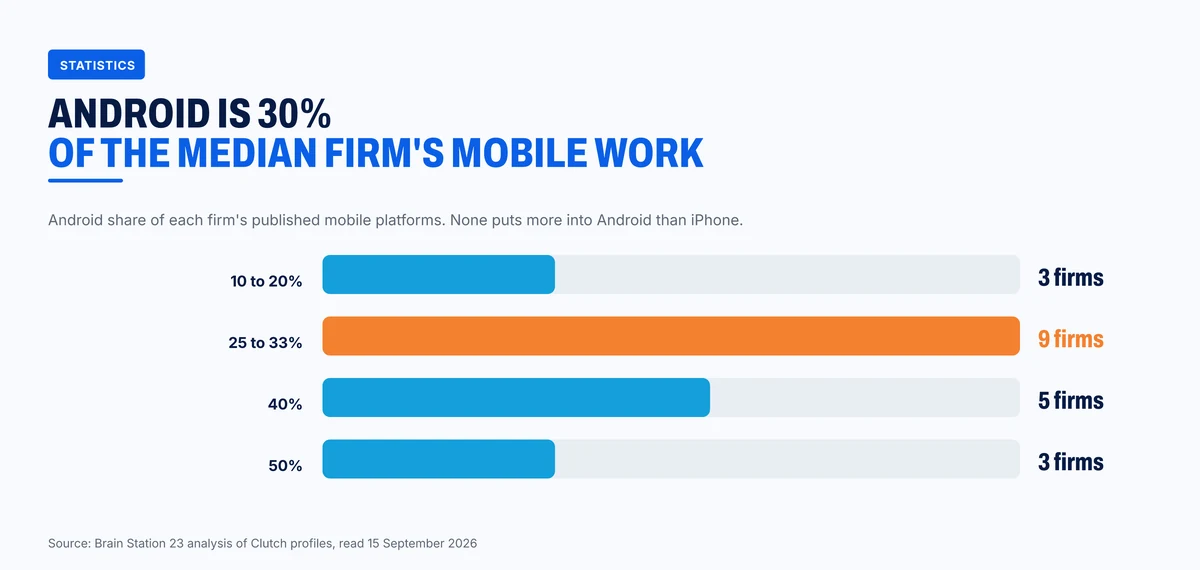
Android is rarely the lead platform. Android’s share of each firm’s mobile work runs from 10 to 50 percent, with a median of 30. It is level with iPhone at ten firms and behind it at the other ten. Goji Labs, Designli and BairesDev put 20 percent or less into Android (Brain Station 23 analysis of Clutch profiles, read 15 September 2026).
Cross-platform is the default stack. Sixteen firms list React Native and eleven list Flutter, and only MMC Global, Toptal and Metova list neither. AppMakers USA and The BHW Group each list a single cross-platform framework at 100 percent. Four firms put more of their mobile work into cross-platform apps than into Android.
Kotlin is thin on the ground. Eight firms list Kotlin among their languages and fourteen list Java, while Atomic Object, TekRevol and Dedicated Developers list neither. Kotlin leads only at Suffescom, and ties with Swift at Orangesoft. In the reviews we could read, the gap is starker: of 804 reviews on fourteen profiles, 225 mention Android, 253 mention iOS, 37 mention React Native, and one mentions Kotlin.
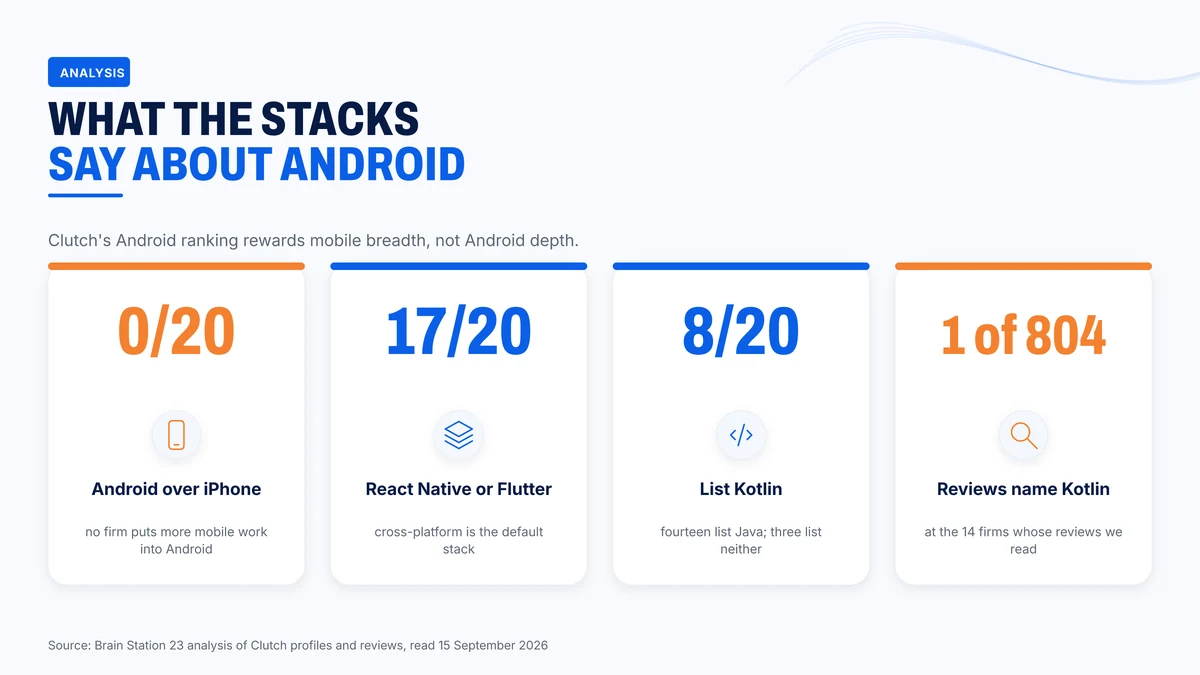
That review count has a stated limit. Clutch began serving a verification check before we reached Mercury Development, Orangesoft, MMC Global, Goji Labs, BairesDev and Toptal, so their 316 reviews are not in it. Orangesoft, which lists Kotlin at 25 percent, is among them.
Prices sit in the middle. Five firms publish $25 to $49 an hour, eight $50 to $99, four $100 to $149 and three $150 to $199. Minimums run from $1,000 to $250,000, with a median of $25,000, and Trango Tech publishes none.
Cost is the weakest score. The twenty carry 1,129 reviews, with a median of 52.5, and four firms hold 37 percent of them. Four firms score identically on all four sub-scores. Of the other sixteen, Cost is the lowest or joint-lowest for fifteen.
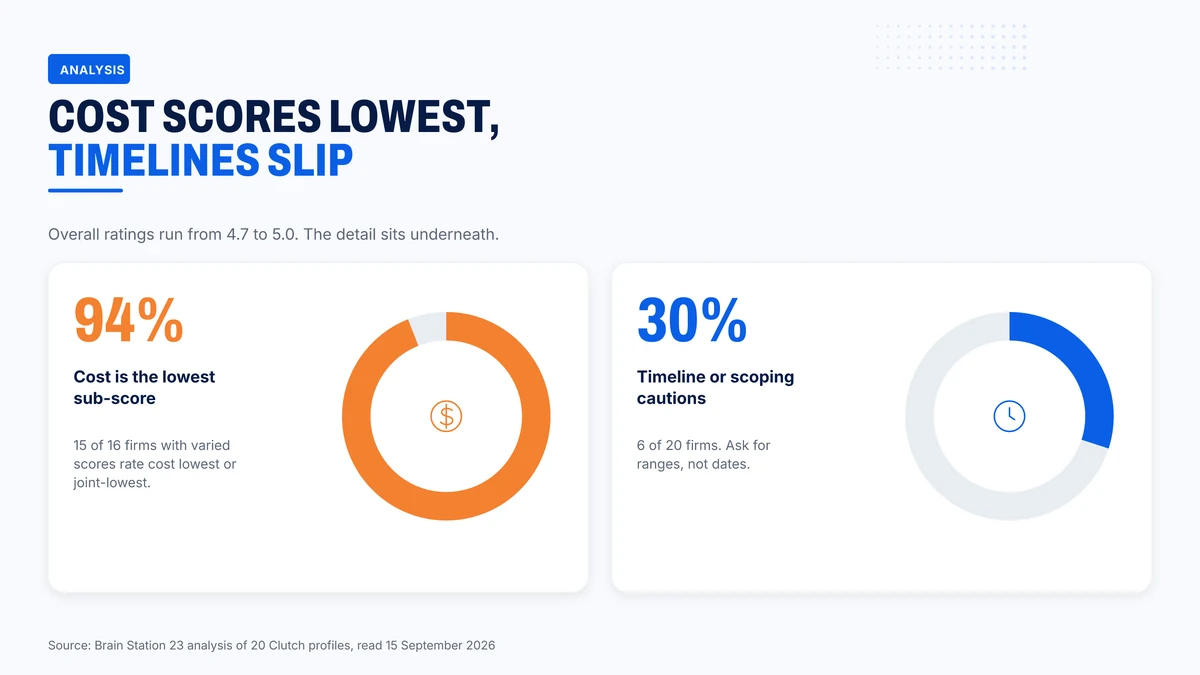
The cautions are about timelines. Clutch’s review summaries flag timelines, scoping or budget for six firms. Communication and documentation come up for three each, post-launch guidance and design for two each, and pricing once. AppMakers USA, MMC Global and Metova have no material improvement area listed.
Every firm lists healthcare. All twenty include medical clients, and it is 35 percent or more of the work at Orangesoft, Atomic Object, Dedicated Developers and Suffescom. Eight firms list offices outside the US.
How to shortlist an Android app development company
Order the filters so the first one removes the most firms.
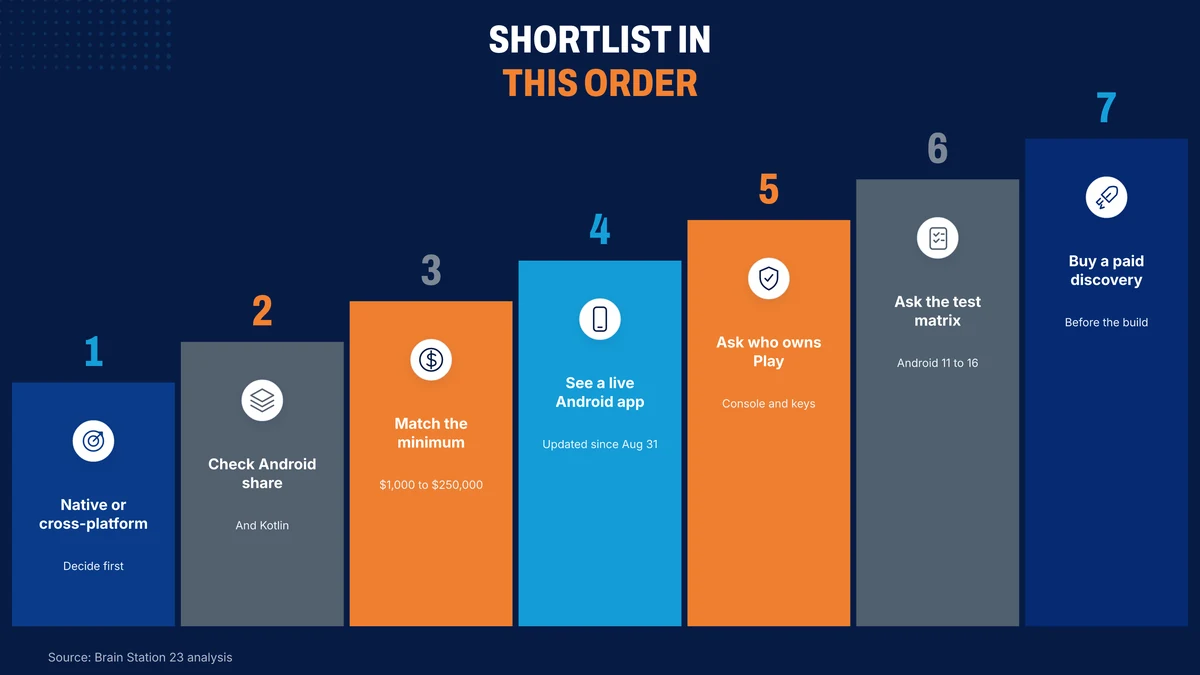
Step 1: Decide native, cross-platform or both. A Kotlin app, a React Native or Flutter app for both stores, and an Android version of an existing iPhone app are different jobs, and the firms here lean clearly one way.
Step 2: Check the Android share and the stack. Compare each firm’s Android and iPhone split, and whether Kotlin appears in its languages at all.
Step 3: Match your budget to the minimum. Minimums run from $1,000 to $250,000, so this step removes much of the list.
Step 4: Ask for a live Android app. Ask for a Play Store listing the firm built, updated since 31 August 2026, so you know it already meets the Android 16 target API rule.
Step 5: Ask who owns the Play Console and signing key. The answer should be your organisation, with the vendor added as a user.
Step 6: Ask for the device and version test matrix. Android 16 is 39 percent of US Android devices, so a plan that tests only the newest phones misses most of your users.
Step 7: Buy a paid discovery or prototype. A short fixed-fee phase shows how the firm handles Android before you commit to a build.
How to buy Android app development: four engagement models
The engagement model decides who pays when a device, an Android version or a Play policy breaks the plan.
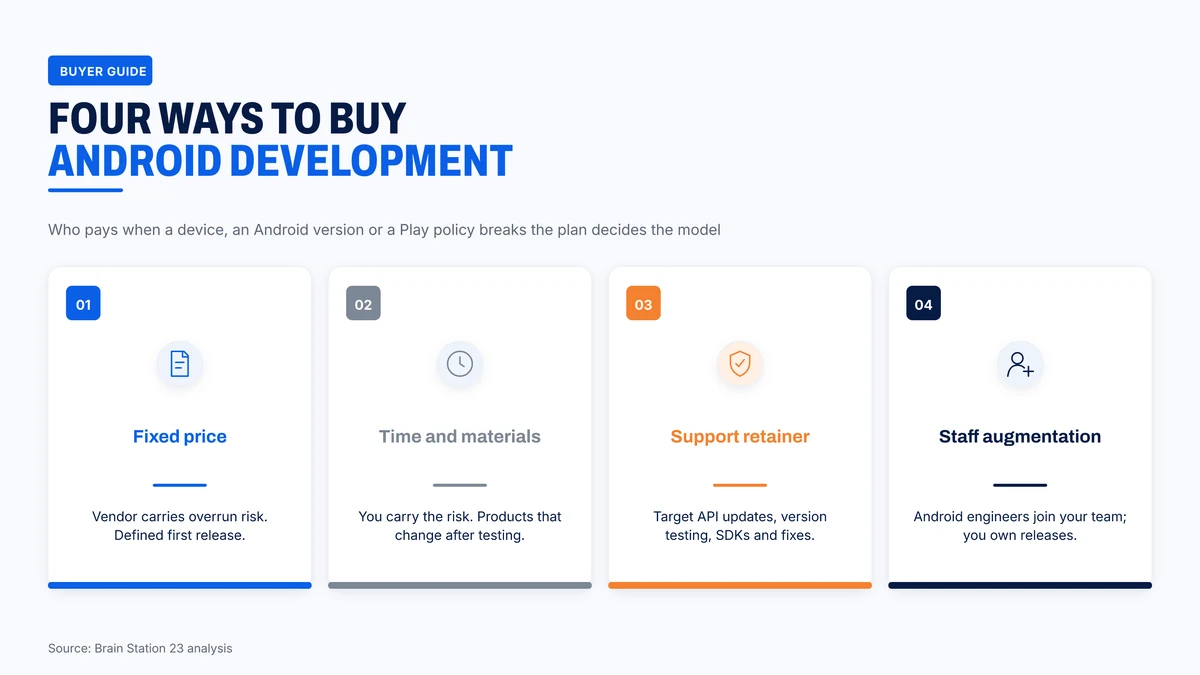
Fixed price moves overrun risk to the vendor, who prices it in. It suits a defined first release with agreed screens and devices. It fails when integrations or supported devices are still undecided.
Time and materials keeps the risk with you. It suits products that will change after user testing. Cap each phase and review burn every week.
Support retainer covers the annual target API update, Android version testing, SDK updates, crash fixes and a block of changes. Without it, an app eventually stops being allowed to ship updates.
Staff augmentation adds Android engineers to your team. TekRevol, Zco, BairesDev and Brain Station 23 publish staff augmentation lines. It fails when nobody in-house owns the architecture and the release process.
The technical question: keeping an Android app shippable
An Android app does not stay finished. Google Play raises its target API requirement, new Android versions change behaviour, and developer verification ties the app to a verified identity. The order of the steps decides whether the yearly update takes a week or a quarter.
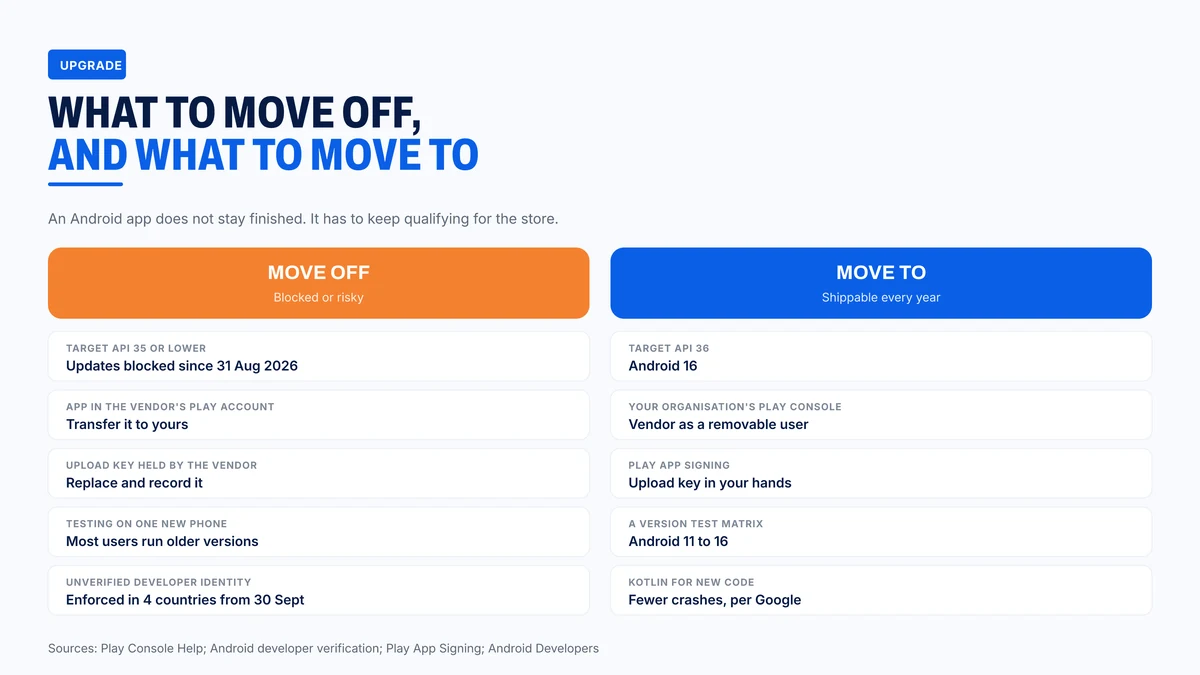
The steps, in the order that keeps them safest:
Step 1: Record target and minimum SDK versions. Check what each app targets against the Play requirement: API level 36 for new apps and updates since 31 August 2026 (Play Console Help).
Step 2: Confirm the account and identity. Make sure the app sits in your organisation’s Play Console and that developer verification is completed under your organisation. Google Play registers 99 percent of apps automatically, and apps distributed elsewhere need manual registration (Android developer verification).
Step 3: Check signing. With Play App Signing, Google holds the app signing key and you sign uploads with a separate upload key that Google can reset if it is lost (Play App Signing). Confirm the upload key is yours.
Step 4: Update the build tools and SDKs. Move the Android Gradle plugin, libraries and third-party SDKs before changing the target API, so each failure has one cause.
Step 5: Fix behaviour changes for the new target. Each Android release changes permissions, background work and notifications for apps that target it. Test those paths first.
Step 6: Test across the versions your users run. Use your own analytics, and the US spread from Android 11 to Android 16 as a floor (StatCounter).
Step 7: Put next year’s deadline on the calendar. This year’s deadline was 31 August. Check the Play target API page early each year and start the update well before the date Google sets.
Moving an app from Java to Kotlin is optional but pays back over time: Google reports that Kotlin apps are 20 percent less likely to crash (Android Developers). Write new code in Kotlin and convert older code as you touch it.
Red flags: eight answers to walk away from
Some answers in a sales call should end it.
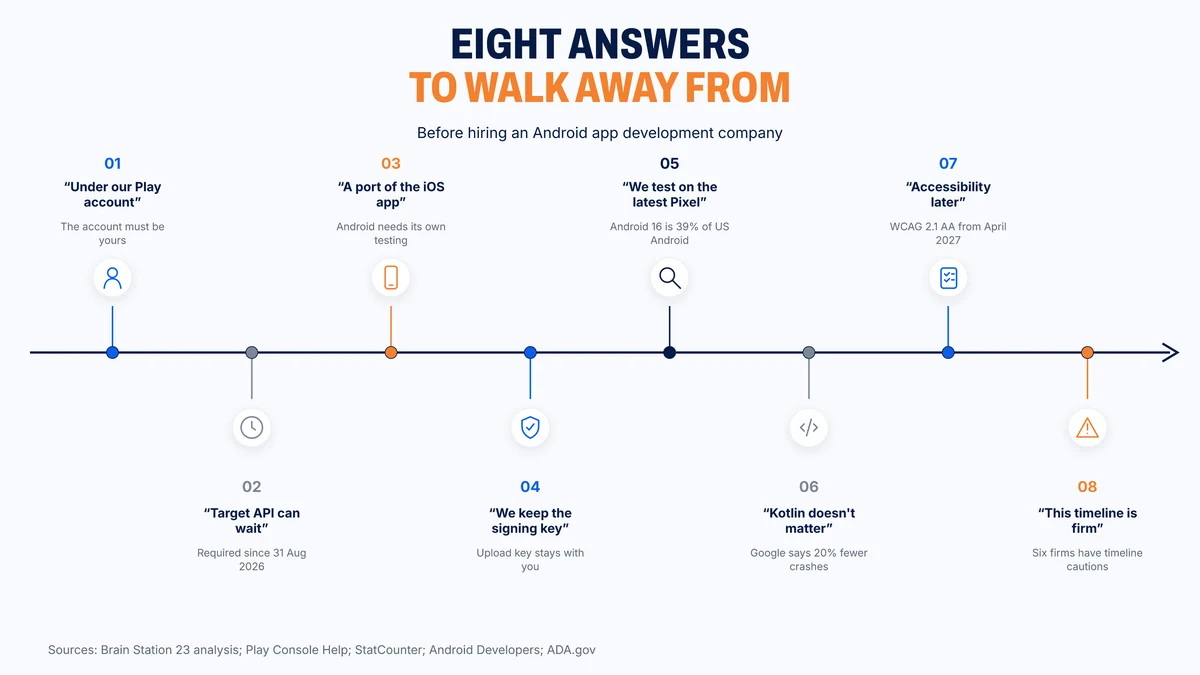
“We’ll publish it under our Play account.” The app, its listing and its verified identity belong to your organisation.
“The target API update can wait.” Since 31 August 2026, updates must target Android 16.
“Android is a port of the iOS app.” Android runs on 39 percent of US devices and 68 percent worldwide. It needs its own testing.
“We keep the signing key for safety.” Your organisation holds the upload key, and Google holds the app signing key under Play App Signing.
“We test on the latest Pixel.” Android 16 is only 39 percent of US Android devices.
“Kotlin doesn’t matter.” Google recommends it, and reports Kotlin apps crash 20 percent less often.
“Accessibility can come after launch.” Public bodies must meet WCAG 2.1 AA in their mobile apps from April 2027.
“This timeline is firm.” Six firms here have review cautions about timelines, scoping or budget.
After launch: what the build quote leaves out
This part covers what owners wish they had settled before the final invoice, and what recurs for as long as the app is in the store.
What you must own before the final invoice
The Google Play developer account, registered and verified under your organisation, with the vendor added as a user you can remove.
The upload key and Play App Signing settings, recorded in your password manager, not the vendor’s.
The source repository with its full history, including build scripts, Gradle files and configuration, not a zip.
Firebase, Google Cloud and back-end accounts, such as push notifications, crash reporting, analytics and APIs, under your billing.
Third-party SDK accounts, such as payments, maps and authentication, in your name.
The store listing assets and a runbook, covering release steps, the data safety declaration, rollback and who to contact when Google flags a policy issue.
The bill that arrives after launch
The build quote covers the first release. The rest recurs.
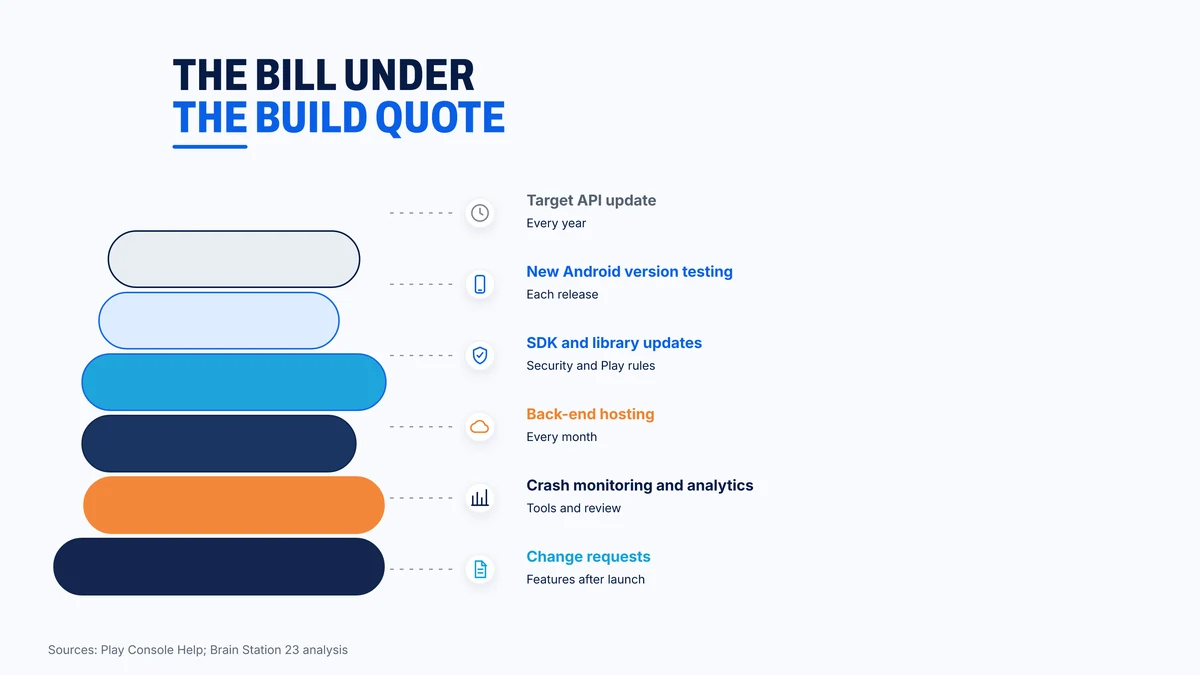
The recurring lines are the annual target API update, testing on each new Android version, SDK and library updates, back-end hosting, crash monitoring and analytics, Play policy declarations, accessibility testing and change requests. Get the retainer price in writing before signing the build, and compare vendors on three years of cost.
Security is a recurring cost
Google Play is strict, and it is getting stricter. In 2025 Google prevented more than 1.75 million policy-violating apps from being published, banned more than 80,000 bad developer accounts, and stopped more than 255,000 apps from getting excessive access to sensitive user data. Google Play Protect scans more than 350 billion Android apps every day (Google Security Blog).
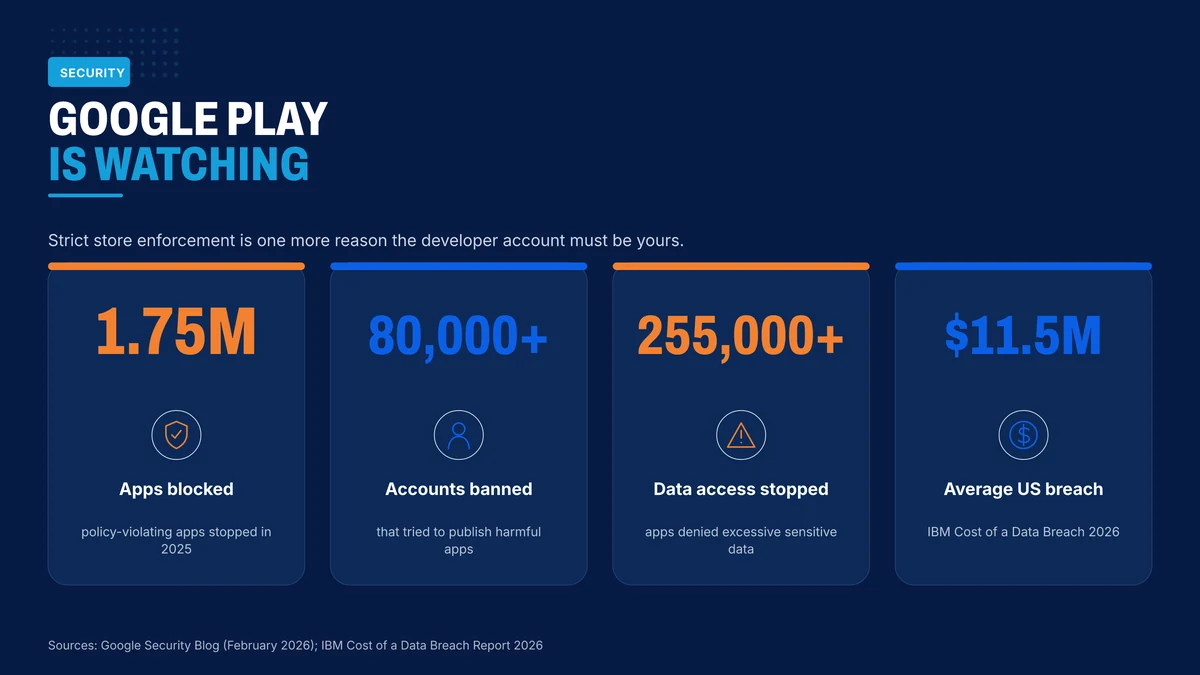
That strictness cuts both ways. The developer account holds every app in it, so its standing matters, which is one more reason it must be yours. Apps are also built from libraries: Black Duck found open source in 98 percent of the codebases it audited for 2026, and the mean number of vulnerabilities per codebase rose 107 percent (Black Duck). Google Cloud’s M-Trends 2026 put the mean time to exploit at minus seven days (Google Cloud), and the average US data breach cost a record USD 11.5 million (IBM Cost of a Data Breach Report 2026). Every firm on this list works with healthcare clients, so ask how SDKs are reviewed, how secrets are kept out of the app, and how fast a security fix reaches the store.
Accessibility is legal exposure
Mobile apps are now named in federal accessibility rules. The Department of Justice’s ADA Title II rule sets WCAG 2.1 AA for the web content and mobile apps of state and local governments, with compliance dates of 26 April 2027 for entities serving 50,000 people or more and 26 April 2028 for smaller ones (ADA.gov). Private businesses face lawsuits instead: more than 5,000 digital accessibility lawsuits had been filed by the end of 2025 (UsableNet).
Name WCAG 2.1 AA or 2.2 AA in the contract, and ask the vendor to test with TalkBack, larger font sizes and keyboard or switch access before each release.
Contract clauses that surface in month nine
These rarely come up in a sales call. This is not legal advice; have your own counsel review any agreement.
IP assignment on payment, covering source code, designs, build scripts and store assets.
Account ownership, naming the Play developer account, Firebase, cloud and SDK accounts as yours.
Target API responsibility, stating who tracks Google Play’s yearly requirement and how early the update starts.
Policy response, stating how fast the vendor responds when Google flags a policy issue or rejects an update.
Accessibility standard, naming the WCAG level and who pays to fix failures found after launch.
Named team and transition assistance, a fixed number of hours at an agreed rate if you move vendors.
Rate escalation caps, subcontracting disclosure, liability caps and insurance, and non-solicitation in both directions.
How to leave without losing the app
If the app sits in the vendor’s Play account, move it first: Google supports transferring apps to a different developer account through a transfer request, and both accounts must be in good standing with policy (Play Console Help). Then confirm you can build, sign and upload a release from your own machine and pipeline.
On the last day, remove the vendor’s Play Console, Firebase and cloud access, rotate API keys and back-end credentials, and replace any upload key the vendor has held.
Hire in-house or hire an Android app development company
Start with the wage. Indeed reports an average of $140,376 for a US Android developer and Glassdoor $106,099 (Indeed, Glassdoor). One hire at those figures, before benefits, costs more each year than the most common project at eleven of the twenty firms.
Hire in-house when the app is the product, ships every few weeks, and you can keep at least two engineers who know the codebase and the Play release process.
Hire an Android app development company for a first release, a rebuild, a move to Kotlin or a cross-platform framework, or a support retainer you cannot staff. Keep every account in your name so the choice stays reversible.
Combine the two when you have a product lead or one developer but need extra engineers for a build or help with the yearly target API update.
FAQ
How much do US Android app development companies charge?
The twenty firms here publish hourly bands from $25 to $199, and thirteen charge under $100. Minimum projects run from $1,000 to $250,000, with a median of $25,000 (Clutch).
What share of US phones run Android?
In August 2026, Android ran on 39.3 percent of US mobile devices and iOS on 60.7 percent. Worldwide, Android’s share was 67.6 percent (StatCounter).
What API level must Android apps target in 2026?
Since 31 August 2026, new apps and app updates on Google Play must target Android 16, API level 36. Developers can request an extension to 1 November 2026 (Play Console Help).
What is Android developer verification?
It is Google’s program to verify the identity of Android developers. Enforcement starts on 30 September 2026 in Brazil, Indonesia, Singapore and Thailand, with a global rollout to certified devices in 2027 (Android developer verification).
Should an Android app be built in Kotlin or a cross-platform framework?
Kotlin suits apps where Android performance and platform features matter, and Google says Kotlin apps crash 20 percent less often (Android Developers). React Native or Flutter suits products that need both stores from one team. Seventeen of the twenty firms here offer one of them.
What does an Android developer earn in the US?
Who should own the Google Play developer account?
Your organisation. A developer account holds every app in it, and Google banned more than 80,000 bad developer accounts in 2025 (Google Security Blog). Apps in a vendor’s account can be moved through a transfer request (Play Console Help).
Do Android apps need to meet accessibility standards?
For state and local governments, yes: the ADA Title II rule sets WCAG 2.1 AA for mobile apps, with compliance dates in April 2027 and April 2028 (ADA.gov). Private businesses face accessibility lawsuits under the ADA.
Conclusion
The data behind this Top 20 Android Application Development Companies in USA list says three things. Android is the second platform for most of these firms: none puts more work into Android than iPhone, and seventeen list React Native or Flutter. Kotlin depth is uneven, with eight firms listing it and one review in 804 mentioning it. And the work is priced in the middle, around a $25,000 median minimum.
Any of the twenty can ship an Android app. What decides the next three years is the upkeep: whether the app meets each year’s target API rule, whether it is tested on the Android versions your users actually run, and whether the Play Console, the verified identity and the upload key are in your name on the day you choose someone else.
Sources
- https://clutch.co/us/app-developers/android?sort_by=ClutchRank
- https://clutch.co/profile/brain-station-23
- https://gs.statcounter.com/os-market-share/mobile/united-states-of-america
- https://gs.statcounter.com/os-market-share/mobile/worldwide
- https://gs.statcounter.com/android-version-market-share/mobile-tablet/united-states-of-america
- https://support.google.com/googleplay/android-developer/answer/11926878
- https://developer.android.com/developer-verification
- https://developer.android.com/kotlin
- https://support.google.com/googleplay/android-developer/answer/9842756
- https://support.google.com/googleplay/android-developer/answer/6230247
- https://security.googleblog.com/2026/02/keeping-google-play-android-app-ecosystem-safe-2025.html
- https://survey.stackoverflow.co/2025/technology
- https://www.toptal.com/
- https://www.glassdoor.com/Salaries/android-developer-salary-SRCH_KO0,17.htm
- https://www.indeed.com/career/android-developer/salaries
- https://www.bls.gov/ooh/computer-and-information-technology/software-developers.htm
- https://www.ada.gov/resources/2024-03-08-web-rule/
- https://www.blackduck.com/blog/ossra-2026-open-source-vulnerability-counts-doubled-year-over-year.html
- https://cloud.google.com/blog/topics/threat-intelligence/m-trends-2026
- https://www.ibm.com/reports/data-breach
- https://blog.usablenet.com/ada-web-lawsuit-trends-2026