
18 January 2027.
That is the date the US Treasury expects the GENIUS Act to take effect. From then, a company generally may not issue a payment stablecoin in the United States without a federal or state licence (US Treasury).
If your product touches stablecoins, custody or payments, put that date in the brief you send to any firm on this Top 20 Blockchain Development Companies in USA list.
Not every firm on it is built for that brief.
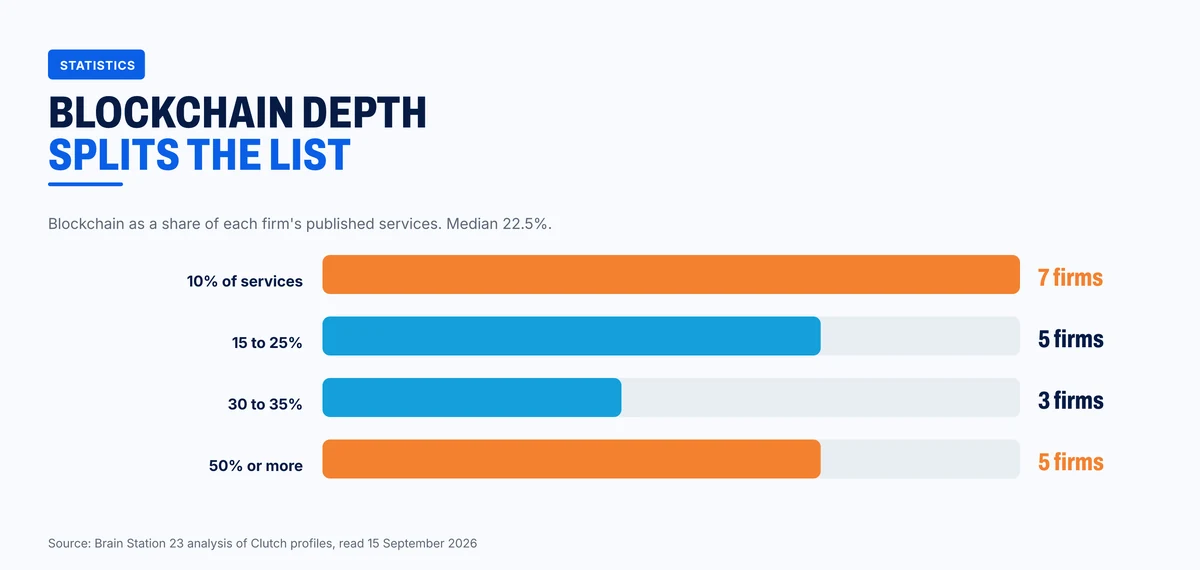
Seven of the twenty put blockchain at 10 percent of their published services. Five put it at half or more, and two of those five have fewer than ten client reviews (Brain Station 23 analysis of Clutch profiles, read 15 September 2026).
And the stakes are measured in billions. Chainalysis counted more than $3.4 billion stolen from crypto services and users in 2025 (Chainalysis).
This guide compares the firms, prices the work and sets out how to shortlist. Then it covers what matters after deployment: who holds the admin and upgrade keys, what an audit does and does not cover, and which engineers can reach production.
Key takeaways
- 18 January 2027 is the expected effective date of the GENIUS Act, after which issuing a payment stablecoin in the US generally requires a licence (US Treasury).
- $3.4 billion was stolen from crypto services and users in 2025, including $1.5 billion in the Bybit compromise alone (Chainalysis).
- $2.02 billion of it went to North Korean hackers, who increasingly embed IT workers inside crypto services to gain privileged access (Chainalysis).
- Access control tops the OWASP Smart Contract Top 10 for 2026, ahead of business logic flaws and price oracle manipulation (OWASP).
- 7 of 20 firms on this list put blockchain at 10 percent of their services, and 5 put it at 50 percent or more (Clutch profiles).
- 27% of the reviews on the first page of each firm’s profile mention blockchain, Web3 or crypto, and five firms have none (Clutch reviews).
- $25,000 is the median minimum project, and 15 of the 20 firms publish rates under $100 an hour (Clutch profiles).
- $111,845 to $140,987 is the gap between ZipRecruiter’s and Glassdoor’s average pay for a US blockchain developer (ZipRecruiter; Glassdoor).
Blockchain in 2026: a federal rulebook, record thefts and shifting protocols
The rules are arriving. The GENIUS Act was enacted on 18 July 2025. It takes effect on the earlier of 18 months after enactment or 120 days after regulators issue final rules (OCC Bulletin 2026-3). The OCC proposed its implementing rules on 25 February 2026, and Treasury issued its own proposal on 17 August 2026, naming 18 January 2027 as the expected effective date. Digital asset service providers will also generally be barred from offering foreign-issued payment stablecoins unless the issuer can comply with lawful orders (US Treasury).
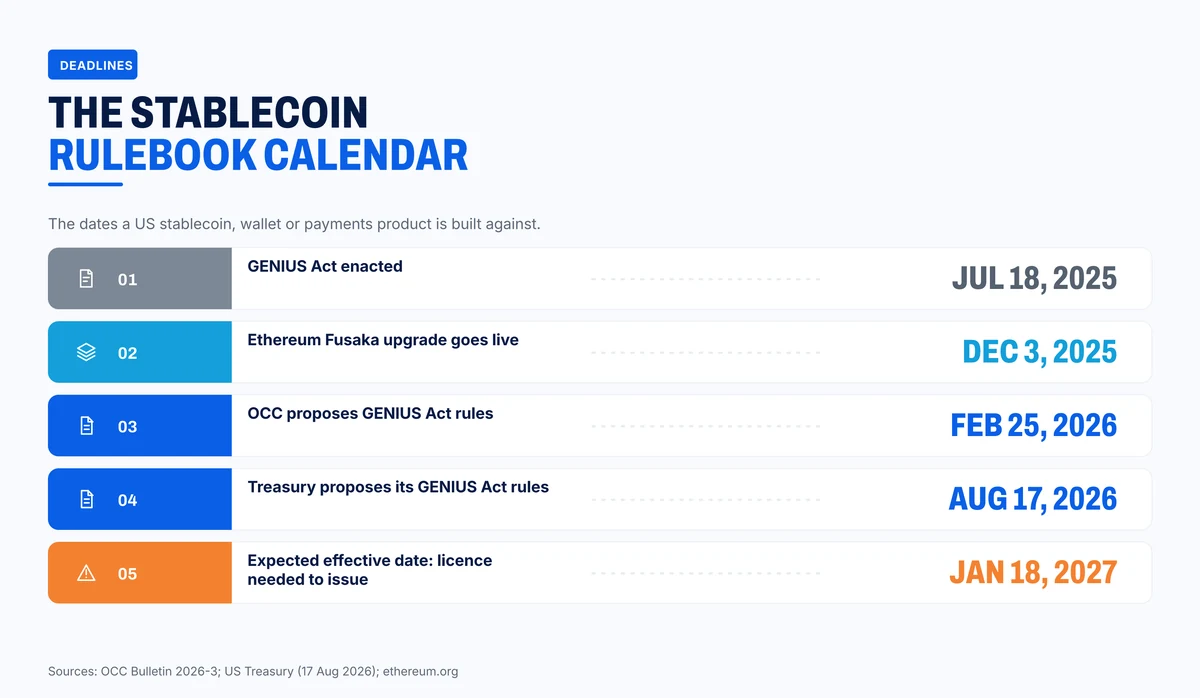
For a buyer, that changes the brief. A stablecoin, wallet or payments product scoped in 2026 will launch under a licensing regime whose final details are still being written. Choose a vendor that expects requirements to move, and keep regulatory decisions with your own counsel.
Theft is concentrated and severe. Chainalysis counted more than $3.4 billion stolen from January to early December 2025. The February compromise of Bybit accounted for $1.5 billion, and North Korean hackers took at least $2.02 billion, up 51 percent on 2024. Personal wallet compromises reached 158,000 incidents affecting 80,000 victims, with $713 million stolen (Chainalysis).
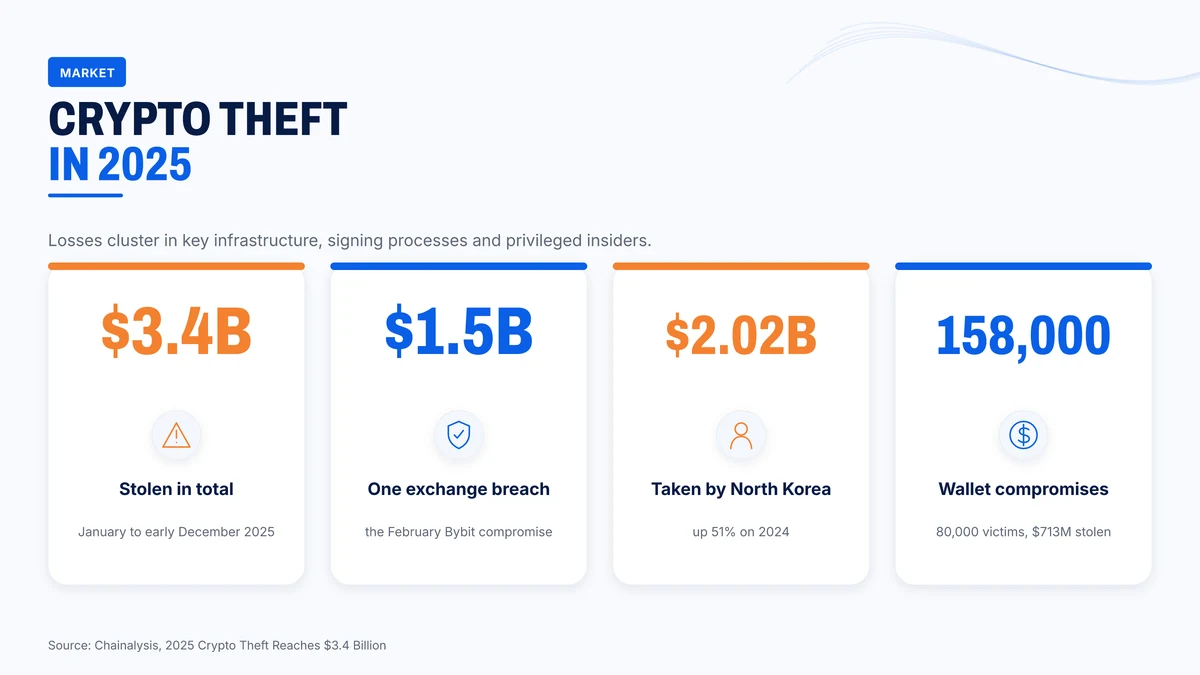
Two details in that report matter for hiring. Centralised services are losing large sums through attacks on private key infrastructure and signing processes. And North Korean actors increasingly embed IT workers inside crypto services to gain privileged access (Chainalysis). The people a vendor puts on your project are part of your attack surface.
The code risks are well mapped. OWASP’s Smart Contract Top 10 for 2026 ranks access control first, then business logic, price oracle manipulation, flash loan attacks and missing input validation, based on 2025 incidents and survey data (OWASP). Most of those are design errors, which is why an audit at the end cannot replace security thinking at the start.
Protocols keep changing underneath. Ethereum’s Fusaka upgrade went live on 3 December 2025 (ethereum.org). Every network upgrade is a moment to retest what you have deployed.
So brief a blockchain vendor with four facts: the chain and token standards you need, whether you will hold customer funds or issue a stablecoin, who will hold the admin keys, and your audit budget.
What blockchain development costs in the US
Salary figures for blockchain developers spread by about $29,000.
ZipRecruiter reports an average of $111,845 for a US blockchain developer, $120,804 for a Solidity developer and $129,348 for a smart contract developer as of 15 September 2026 (ZipRecruiter). The Bureau of Labor Statistics puts the median for all software developers at $135,980 in May 2025 (BLS). Glassdoor reports an average of $140,987 for a blockchain developer from 220 salaries, with a typical range of $112,375 to $178,953 (Glassdoor).
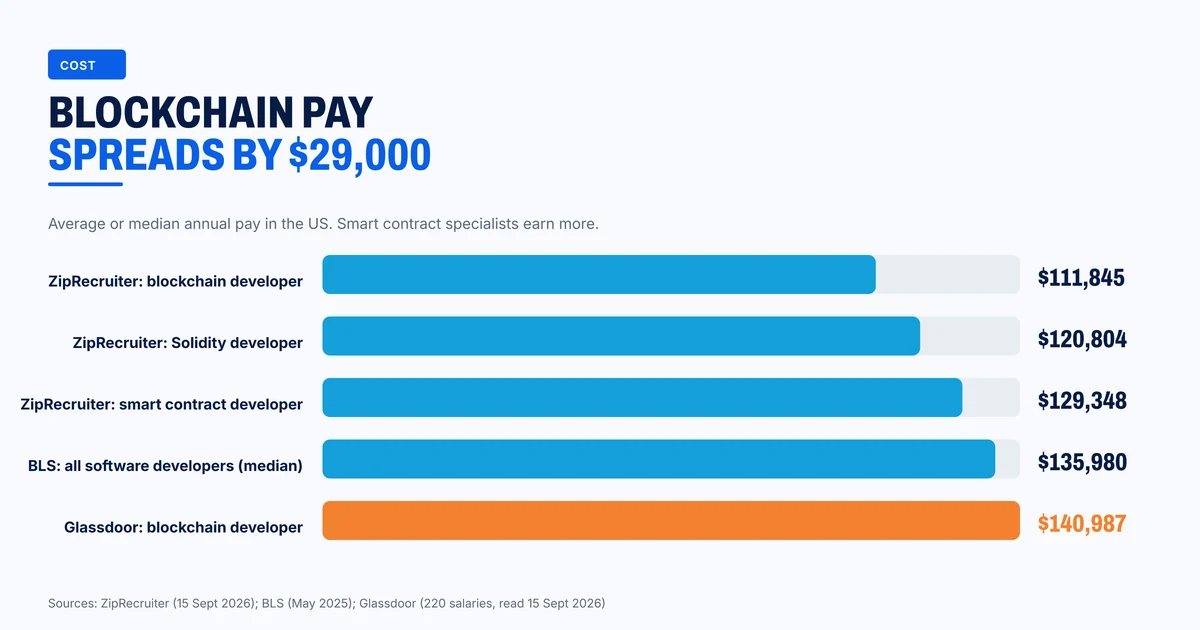
The spread follows specialism. A smart contract developer earns more than a general blockchain developer on ZipRecruiter’s own figures. We left out ZipRecruiter’s Web3 developer page, because its $109,905 figure is one the site also shows for several unrelated job titles.
Agency pricing is lower than those salaries suggest. Fifteen of the twenty firms publish rates under $100 an hour, and the median minimum project is $25,000 (Clutch profiles, read 15 September 2026). Eleven report a most common project under $50,000, and two report one over $1 million.
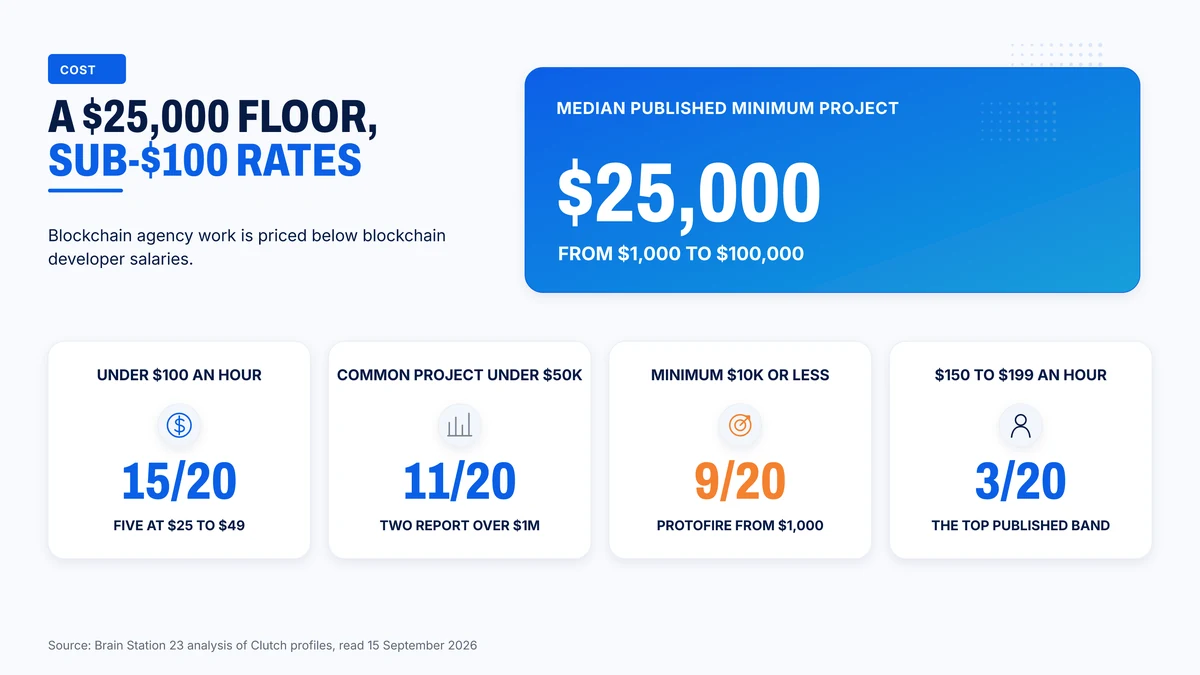
Minimums run from $1,000 at Protofire to $100,000 at Revelry Labs. Eight factors decide where a blockchain quote lands.
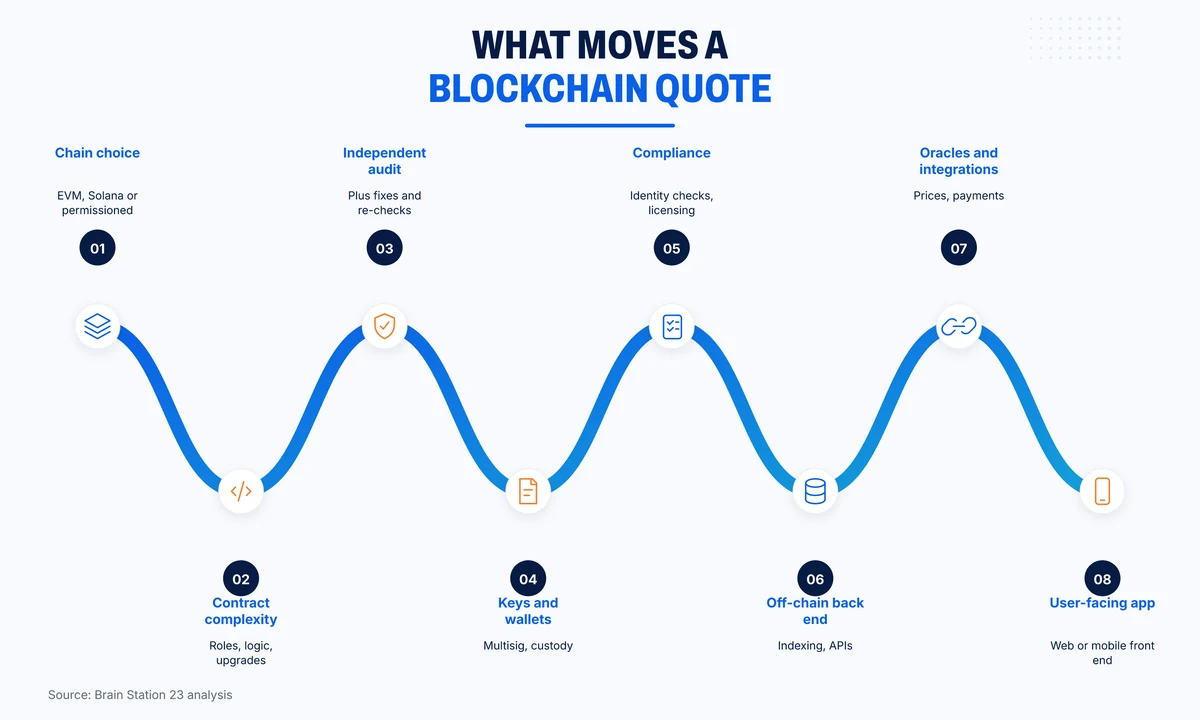
The chain comes first, because an EVM chain, Solana and a permissioned ledger need different skills. Smart contract complexity follows, then independent audits, key management and wallets, compliance such as identity checks, the off-chain back end and indexing, oracles and integrations, and the user-facing app. Ask every vendor to price these separately, and price the audit with a firm other than the builder.
The Top 20 Blockchain Development Companies in USA, compared
We used Clutch’s directory of blockchain companies in the United States, sorted by Clutch Rank and read on 15 September 2026. It lists 1,071 firms. The first row, RedDuck, was a paid placement, and we removed it. Firms 2 to 21 below are the next 20 in Clutch Rank order.
Brain Station 23 is placed first because we publish this article. We are US-headquartered, but blockchain does not appear in our published Clutch services, so Clutch’s ranking did not place us in its top 20 and we are not claiming it did.
Every overall rating below sits between 4.8 and 5.0, so the stars do not separate these firms. The Blockchain Focus column does: blockchain’s share of each firm’s published services, and whether it is the firm’s largest line.
| # | Company | Best For | Team Size | Blockchain Focus | Key Tech Stack | Industries Served | Locations |
|---|---|---|---|---|---|---|---|
| 1 | Brain Station 23 — brainstation-23.com | Off-chain systems around a blockchain product: back ends, apps and integrations | 250 – 999 | Not in published services; staff augmentation 60% | Java, Spring, .NET, Python, Flutter | Retail, medical, telecoms, financial services | Springfield VA; Bangladesh, UAE, England, Malaysia, Germany |
| 2 | Pharos Production — pharosproduction.com | Fintech and healthcare teams wanting a blockchain-first studio | 50 – 249 | Blockchain 65%, largest line | Java, TypeScript, Rust, Next.js, Spring | Financial services, medical, gaming, IT | Las Vegas; Kyiv |
| 3 | Boosty Labs — boostylabs.com | IT companies commissioning smart contracts above $50,000 | 50 – 249 | Blockchain 55%, largest line | Not published | Information technology | New York |
| 4 | Interexy — interexy.com | Blockchain, AI and mobile together at a lower rate | 250 – 999 | Blockchain 30%, largest line | Node.js, .NET, Flutter, React Native, Kotlin | IT, e-commerce, education, medical | Lauderdale-by-the-Sea FL; Dubai, Tallinn, Warsaw |
| 5 | MMC Global — mmcgbl.com | Enterprises combining blockchain with generative AI and mobile | 250 – 999 | Blockchain 20%, joint largest | Python, Next.js, React, Kotlin, Java | Real estate, education, hospitality, financial services | Austin; Dubai, Abu Dhabi |
| 6 | Protofire — protofire.io | Protocol and DeFi teams on a small budget | 50 – 249 | Blockchain 90%, largest line | Not published | Financial services, IT, business services | Sunnyvale CA |
| 7 | Suffescom Solutions — suffescom.com | Mobile and web products with a blockchain feature on a lower budget | 250 – 999 | Blockchain 10%; mobile and web 40% each | Kotlin, Python, React Native, Next.js | Financial services, medical, real estate, e-commerce | New York, Wilmington DE; Mohali, Dubai, London, Sydney |
| 8 | SEROKELL — serokell.io | Research-heavy protocols and AI systems | 50 – 249 | Blockchain 20%; AI 30% | Rust, Elixir, Python, Go, TypeScript | Medical, automotive, education, financial services | Los Angeles, New York, Austin; Paris, Tel Aviv, Berlin, Dubai, Riyadh |
| 9 | Dreamers Inc. — thedreamers.us | Small companies building AI and blockchain products | 50 – 249 | Blockchain 25%; AI 35% | Django, Flutter, React, React Native | IT, education, financial services | Los Angeles |
| 10 | INMIND — inmindsoftware.com | Retail and e-commerce brands adding blockchain to a mobile product | 10 – 49 | Blockchain 50%, largest line | Not published | Retail, e-commerce, consumer products | Chandler AZ; Montevideo |
| 11 | InvoBlox — invoblox.com | Buyers wanting a blockchain-only firm who will check references | 250 – 999 | Blockchain 100% | Not published | Automotive, business services, education, IT | Pembroke Pines FL |
| 12 | Jalasoft — jalasoft.com | Large programmes needing a nearshore bench | 1,000 – 9,999 | Blockchain 10%; staff augmentation 20% | Kotlin, Swift, Angular, React, Node.js | Business services, energy, financial services, IT | Houston; Cochabamba, La Paz |
| 13 | Hypotenuse Labs — hypotenuselabs.com | Senior engineers across blockchain, AI and web | 10 – 49 | Blockchain 25%, largest line | Not published | Not published | San Francisco, New York |
| 14 | Visible Magic — visiblemagic.com | Fintech and entertainment ventures with seven-figure budgets | 10 – 49 | Blockchain 35%, largest line | Go, Java, JavaScript, Ruby | Financial services, arts, e-commerce | Chapel Hill NC |
| 15 | Superscript Systems — superscriptsystems.com | Fintech firms building on .NET with a blockchain component | 10 – 49 | Blockchain 15%; custom software 55% | C#, .NET, React, TypeScript | Financial services, advertising | Langhorne PA |
| 16 | Iron Forge Development — ironforge.co | Mid-market companies needing senior engineers for varied builds | 10 – 49 | Blockchain 10%; custom software 20% | Flutter, React, Node.js, JavaScript, Go | Medical, business services, IT, real estate | Palm Beach Gardens FL |
| 17 | Venture Aviator — ventureaviator.com | Enterprise and mid-market brands in finance, media and retail | 10 – 49 | Blockchain 35%, largest line | JavaScript, Java, .NET, Django, Ruby on Rails | Financial services, media, real estate, retail | New York, Santa Monica |
| 18 | Revelry Labs — revelry.co | Financial services and healthcare products above $100,000 | 50 – 249 | Blockchain 10%; custom software 40% | Elixir, Ruby, React Native, Ruby on Rails | Financial services, medical, business services | New Orleans |
| 19 | The SilverLogic — tsl.io | Mid-market firms with complex custom software | 50 – 249 | Blockchain 10%; custom software 25% | Vue.js, React, Django, Python | Business services, manufacturing, construction | Boca Raton FL |
| 20 | Slashdev — slashdev.io | Small businesses needing developers quickly | 10 – 49 | Blockchain 10%; custom, mobile and web 20% each | Laravel, React, Node.js, Kotlin | Advertising, education, financial services, gaming | Seattle; Stockholm |
| 21 | LITSLINK — litslink.com | Startups building AI and mobile products with some blockchain | 250 – 999 | Blockchain 10%; AI 30% | JavaScript, Python, Rust, Flutter, Node.js | Financial services, medical, IT, manufacturing | Palo Alto |
Team sizes, service splits, languages, industries and locations are from each firm’s published Clutch profile, read 15 September 2026. Five firms publish no language or framework split, marked “Not published”. “Best For” is our reading of that data. Chains supported, engagement models and certifications are not published consistently across these profiles, so we have left them out rather than guess.
Profiles are grouped by buyer type, and the numbers match the table. Each caution comes from the Review Highlights that Clutch publishes from the firm’s verified reviews. Certifications are self-published and unverified by us, and none of the twenty Clutch profiles lists one, so ask directly. Where we cite review mentions of blockchain, crypto or smart contracts, we read the first page of reviews shown on each profile, up to ten per firm.
1. Brain Station 23
We publish this article and placed ourselves first, so read this entry as the publisher’s pick. Blockchain does not appear in our published Clutch services, and none of the ten reviews on our first page mentions it, so we are not a blockchain specialist. Our strength is the systems around a chain: 60 percent of our work is engineers embedded in client teams, at a $25 to $49 band that five firms below also publish. Chainalysis reports hostile operatives joining crypto services as IT workers, so our ISO 27001 and SOC 2 Type II controls over access and change are relevant. Financial services are 10 percent of our published industries, and Spring and .NET lead our frameworks. Reviewers score Quality at 5.0 and have asked for tighter internal coordination. For smart contracts, start with the specialists below.
Founded: 2006
US Presence: Springfield VA
Company size: Clutch band 250 to 999; we publish 900+ engineers
Rating: 4.9 across 21 Clutch reviews, HQ Springfield, Virginia
- Off-chain systems around a blockchain product: back ends, apps and integrations
- CMMI Level 3
- ISO 27001
- ISO 9001
- SOC 2 Type II (company-published)
- Staff augmentation
- Custom software development
- Application modernisation
- Java and Spring
- .NET
- Python
- Flutter mobile apps
- Retail
- Medical
- Telecoms
- Education
- Financial services
- Hospitality
- Blockchain is not in our published services, so ask which engineers have shipped smart contracts before assigning them to on-chain work
For blockchain-first specialists
2. Pharos Production
Blockchain is 65 percent of Pharos Production’s services, and with 108 reviews it has by far the deepest record of the five blockchain-first firms here. Every sub-score averages 5.0. Financial services make up 40 percent of its industries, and its most common project is under $50,000 against a $10,000 minimum. Development runs from Kyiv as well as Las Vegas. Of the nine reviews on its first page, six mention blockchain or crypto and four mention smart contracts. Some clients suggested it expand its team.
Founded: 2013
US Presence: Las Vegas
Company size: 50 to 249
- Fintech and healthcare teams wanting a blockchain-first studio
- Not published; ask directly
- Blockchain development
- AI agents
- Generative AI
- Cybersecurity
- Custom software
- Java
- TypeScript
- Rust
- Financial services
- Medical
- Gaming
- IT
- Insurance
- Ask how the team scales if your project needs more engineers mid-build
3. Boosty Labs
Blockchain is 55 percent of Boosty Labs’ services, and every client industry it lists is information technology. All nine reviews on its first page mention blockchain or crypto, and five mention smart contracts. Its $50,000 minimum is among the highest here, and its most common project is $50,000 to $199,999. Quality, Schedule and Cost each average 4.7 across 18 reviews. Some reviews flag gaps in regular updates and responsiveness, so set the reporting rhythm in the contract.
Founded: 2017
US Presence: New York
Company size: 50 to 249
- IT companies commissioning smart contracts above $50,000
- Not published; ask directly
- Blockchain development
- Smart contracts
- AI development
- Staff augmentation
- Web development
- Information technology
- Agree a written cadence for progress updates
6. Protofire
Protofire puts 90 percent of its services into blockchain, and all four reviews on its first page mention Ethereum, Solidity or the EVM. It publishes a $1,000 minimum, the lowest here, and a $25 to $49 band. Financial services are 55 percent of its industries. The evidence is thin: five reviews, and Clutch bases its most common project size on one of them. Clutch lists no improvement areas. Treat it as a candidate for protocol work, and check references before committing.
Founded: 2016
US Presence: Sunnyvale CA
Company size: 50 to 249
- Protocol and DeFi teams on a small budget
- Not published; ask directly
- Blockchain development
- Smart contract development
- Custom software
- Financial services
- IT
- Business services
- Ask for protocol references you can call, because Clutch shows five reviews
10. INMIND
Blockchain is half of INMIND’s services and mobile apps another 40 percent, and its clients are mostly retail, e-commerce and consumer brands. Seventy percent are small businesses. It lists Chandler, Arizona, and Montevideo, Uruguay. Clutch’s summary puts projects at $20,000 to over $200,000, and its 25 reviews average 5.0. Only two of the ten reviews on its first page mention blockchain or crypto. Some clients wanted better early reporting of work completed, and INMIND added reporting structures in response.
Founded: 2008
US Presence: Chandler AZ
Company size: 10 to 49
- Retail and e-commerce brands adding blockchain to a mobile product
- Not published; ask directly
- Blockchain development
- Mobile app development
- Web development
- Retail
- E-commerce
- Consumer products
- Financial services
- Agree the reporting format and frequency at kickoff
11. InvoBlox
InvoBlox lists blockchain as 100 percent of its services, the only firm here with no other service line. It publishes a 250 to 999 headcount band, a $25 to $49 rate and a $5,000 minimum. It ranks tenth on two reviews, both scoring 5.0, and Clutch publishes no review summary for it. Ten industries sit at 10 percent each. With a record this small, a reference call and a paid review of a smart contract it has shipped matter more than the rating.
Founded: 2014
US Presence: Pembroke Pines FL
Company size: 250 to 999
- Buyers wanting a blockchain-only firm who will check references
- Not published; ask directly
- Blockchain development; no further breakdown published
- Automotive
- Business services
- Education
- IT
- Medical
- Ask for at least three client references, because Clutch shows two reviews
For fintech and Web3 product studios
4. Interexy
Blockchain is Interexy’s largest service line at 30 percent, ahead of AI and mobile at 20 each, and staff augmentation adds 15. It publishes a $25 to $49 band and a $10,000 minimum. Its 73 reviews average 4.8, and its most common project is $10,000 to $49,999. Offices in Dubai, Tallinn and Warsaw sit alongside Florida. Three of the nine reviews on its first page mention blockchain or crypto. A few clients questioned the accuracy of its time tracking.
Founded: 2017
US Presence: Lauderdale-by-the-Sea FL
Company size: 250 to 999
- Blockchain, AI and mobile together at a lower rate
- Not published; ask directly
- Blockchain development
- AI development
- Mobile app development
- Staff augmentation
- Node.js
- Flutter
- React Native
- IT
- E-commerce
- Education
- Medical
- Financial services
- Ask how hours are tracked and reported against the estimate
9. Dreamers Inc.
AI is Dreamers’ largest service at 35 percent, with blockchain at 25 and mobile at 20. Sixty-five percent of its clients are small businesses, and 65 percent of its industry mix is IT. It charges $100 to $149 an hour with a $25,000 minimum, and its most common project is $50,000 to $199,999. Its 15 reviews average 5.0 on every measure, and Clutch lists no improvement area. Two of the ten reviews on its first page mention blockchain or crypto.
Founded: 2013
US Presence: Los Angeles
Company size: 50 to 249
- Small companies building AI and blockchain products
- Not published; ask directly
- AI development
- Blockchain development
- Mobile app development
- Custom software
- Web design
- Flutter
- React Native
- IT
- Education
- Financial services
- Energy
- Medical
- Ask for blockchain-specific references, since most reviews describe other work
13. Hypotenuse Labs
Hypotenuse Labs splits its services across blockchain at 25 percent, AI, custom software and web at 20 each, and generative AI at 15. It charges $150 to $199 an hour, the top band here, with a $50,000 minimum, and lists San Francisco and New York. Sixty-five percent of its clients are mid-market. It has four reviews, all scoring 5.0, and two of them mention smart contracts. It publishes no industry split. A record this small is a reason to ask for references, not a warning.
Founded: 2018
US Presence: San Francisco, New York
Company size: 10 to 49
- Senior engineers across blockchain, AI and web
- Not published; ask directly
- Blockchain development
- AI development
- Generative AI
- Custom software
- Web development
- Not published
- Ask for references, because Clutch shows four reviews
14. Visible Magic
Blockchain is Visible Magic’s largest service at 35 percent, alongside AR/VR at 25 and AI at 20. Its most common project is over $1 million, and Clutch’s summary records investments from $270,200 to $5 million, unusually large for a team of 10 to 49. Its minimum is $50,000, and financial services lead its industries. It has six reviews averaging 4.9, and Clutch lists no improvement area. Three of the six mention blockchain or crypto.
Founded: 2019
US Presence: Chapel Hill NC
Company size: 10 to 49
- Fintech and entertainment ventures with seven-figure budgets
- Not published; ask directly
- Blockchain development
- AR/VR development
- AI development
- Generative AI
- Custom software
- Go
- Financial services
- Arts and entertainment
- E-commerce
- Business services
- Ask who leads a multi-million-dollar build on a team this size
17. Venture Aviator
Blockchain is Venture Aviator’s largest service at 35 percent, and 80 percent of its clients are enterprise or mid-market. Its most common project is $200,000 to $999,999, and Clutch’s summary records projects from $8,500 to $1 million. It lists New York and Santa Monica. Its 10 reviews average 4.9, but only one mentions blockchain or crypto. Some clients noted minor communication issues when coordinating with international team members.
Founded: 2011
US Presence: New York, Santa Monica
Company size: 10 to 49
- Enterprise and mid-market brands in finance, media and retail
- Not published; ask directly
- Blockchain development
- Custom software
- Mobile and web development
- JavaScript
- Java
- Ruby on Rails
- Financial services
- Media
- Real estate
- Retail
- Ask how work is coordinated with international team members
For AI and custom software firms with a blockchain line
5. MMC Global
Blockchain is one of four service lines at 20 percent for MMC Global, level with generative AI, custom software and mobile. Forty percent of its clients are enterprises, the joint highest share here. It scores 4.8 on every measure across 35 reviews, and its most common project is $10,000 to $49,999. None of the ten reviews on its first page mentions blockchain, Web3 or crypto. Development runs from Dubai and Abu Dhabi as well as Austin.
Founded: 2013
US Presence: Austin
Company size: 250 to 999
- Enterprises combining blockchain with generative AI and mobile
- Not published; ask directly
- Blockchain development
- Generative AI
- Custom software
- Mobile app development
- Python
- Next.js
- Real estate
- Education
- Hospitality
- Automotive
- Financial services
- Ask for a blockchain case study, because none of its first ten reviews mentions one
8. SEROKELL
SEROKELL’s languages lead with Rust at 30 percent and Elixir and Python at 20, and blockchain is 20 percent of its services behind AI at 30. Four of the nine reviews on its first page mention Solana or Rust. Clutch’s summary puts projects at $50,000 to over $700,000, and Cost is its lowest sub-score at 4.7. It lists offices from Los Angeles, New York and Austin to Paris, Tel Aviv, Berlin, Dubai and Riyadh. Some clients found initial scoping and planning difficult.
Founded: 2015
US Presence: Los Angeles, New York, Austin
Company size: 50 to 249
- Research-heavy protocols and AI systems
- Not published; ask directly
- AI development
- Blockchain development
- Custom software
- AI agents
- Rust
- Elixir
- Python
- Medical
- Automotive
- Education
- Financial services
- Gaming
- Fund a scoping phase before fixing a timeline
15. Superscript Systems
Financial services are 75 percent of Superscript Systems’ industries, the highest share here, and C# is 65 percent of its languages. Blockchain is 15 percent of its services. Clutch’s summary records projects from $8,000 to $800,000, though its minimum is $50,000 and its most common project $10,000 to $49,999. Its 21 reviews average 5.0, and five of the ten on its first page mention blockchain or crypto. A few clients noted possible language barriers with some team members.
Founded: 2013
US Presence: Langhorne PA
Company size: 10 to 49
- Fintech firms building on .NET with a blockchain component
- Not published; ask directly
- Custom software
- AI development
- Blockchain development
- C#
- .NET
- React
- TypeScript
- Financial services
- Advertising
- Medical
- Ask who your day-to-day contacts will be and confirm their fluency
16. Iron Forge Development
Iron Forge spreads its services across nine lines, with blockchain one of eight at 10 percent, and lists 16 programming languages. It charges $150 to $199 an hour with a $25,000 minimum, and Clutch’s summary cites a proprietary build worth over $1 million. Its 22 reviews average 4.8, with Schedule and Cost lowest at 4.7. One of the nine reviews on its first page mentions blockchain or crypto. Some clients suggested better scoping and less rigid agile practices.
Founded: 2016
US Presence: Palm Beach Gardens FL
Company size: 10 to 49
- Mid-market companies needing senior engineers for varied builds
- Not published; ask directly
- Custom software
- Blockchain development
- ERP integration
- Application modernisation
- IT strategy
- Flutter
- React
- Medical
- Business services
- Consumer products
- IT
- Real estate
- Agree how scope is managed and how sprints adapt to change
18. Revelry Labs
Revelry Labs publishes a $100,000 minimum, the highest here, and its most common project is $200,000 to $999,999. Custom software and AI make up 70 percent of its services, with blockchain at 10. Elixir and Ruby lead its languages. Its 14 reviews average 4.8, with Schedule and Cost lowest at 4.6. One of the ten reviews on its first page mentions blockchain or crypto. Clients noted that planning and ramp-up sometimes took longer than expected, though execution was smooth once work started.
Founded: 2012
US Presence: New Orleans
Company size: 50 to 249
- Financial services and healthcare products above $100,000
- Not published; ask directly
- Custom software
- AI development
- Blockchain development
- Mobile and web development
- Elixir
- Ruby on Rails
- React Native
- Financial services
- Medical
- Business services
- Education
- Energy
- Build the ramp-up period into the schedule
19. The SilverLogic
Blockchain is 10 percent of The SilverLogic’s services, behind custom software and AI. It charges $150 to $199 an hour, and Clutch’s summary mentions one client investing about $3 million. Its 14 reviews average 5.0, with Quality lowest at 4.8, and reviewers credit it with taking on technically difficult projects. None of the nine reviews on its first page mentions blockchain, Web3 or crypto. Clutch lists no improvement area.
Founded: 2012
US Presence: Boca Raton FL
Company size: 50 to 249
- Mid-market firms with complex custom software
- Not published; ask directly
- Custom software
- AI consulting
- AI development
- Mobile development
- Blockchain development
- Low-code
- Django
- Business services
- Manufacturing
- Construction
- Financial services
- Medical
- Ask for a blockchain case study, because none of its first nine reviews mentions one
For larger teams and lower rates
7. Suffescom Solutions
Suffescom has the deepest review record on this list, 121 reviews averaging 4.9, but blockchain is only 10 percent of its services, behind mobile and web at 40 each. None of the ten reviews on its first page mentions blockchain, Web3 or crypto. It publishes a $25 to $49 band, and its most common project is $10,000 to $49,999. Financial services and medical are 35 percent each of its industries. Some clients said it delivers to specification without much creative input.
Founded: 2013
US Presence: New York, Wilmington DE
Company size: 250 to 999
- Mobile and web products with a blockchain feature on a lower budget
- Not published; ask directly
- Mobile app development
- Web development
- AI development
- Blockchain development
- Kotlin
- React Native
- Next.js
- Financial services
- Medical
- Real estate
- E-commerce
- Education
- Ask for a shipped blockchain project, and for design input in the proposal
12. Jalasoft
Jalasoft is the only firm here with more than 1,000 staff, and blockchain is one of eight service lines at 10 percent, behind staff augmentation at 20. Its most common project is over $1 million, and Clutch’s summary puts annual investments at $20,000 to $2.5 million. It has seven reviews, with Cost at 4.4, the lowest sub-score in this top 20. None of the six on its first page mentions blockchain or crypto. Some clients noted language barriers, which Jalasoft has worked to address.
Founded: 2001
US Presence: Houston
Company size: 1,000 to 9,999
- Large programmes needing a nearshore bench
- Not published; ask directly
- Staff augmentation
- Application testing
- Application support
- DevOps
- Blockchain development
- Kotlin
- Swift
- React
- Business services
- Consumer products
- Energy
- Financial services
- IT
- Confirm English fluency for the engineers assigned to your team
20. Slashdev
Slashdev is the youngest firm here, founded in 2020, and 75 percent of its clients are small businesses. Blockchain is one of four service lines at 10 percent. It publishes a $5,000 minimum, and Clutch’s summary puts engagements at $1,200 to over $25,000. Its 18 reviews average 5.0. One of the nine reviews on its first page mentions blockchain or crypto. It lists Seattle and Stockholm. Some clients wanted clearer planning of deliverables and early infrastructure requirements.
Founded: 2020
US Presence: Seattle
Company size: 10 to 49
- Small businesses needing developers quickly
- Not published; ask directly
- Custom software
- Mobile and web development
- AI development
- Blockchain development
- E-commerce
- Staff augmentation
- Advertising
- Arts and entertainment
- Business services
- Education
- Financial services
- Agree deliverables and infrastructure needs before the first sprint
21. LITSLINK
AI is LITSLINK’s largest service at 30 percent, and blockchain is 10 percent. Rust is one of four languages at 20 percent. Its 78 reviews average 4.8, and its most common project is $10,000 to $49,999, against a $5,000 minimum. None of the ten reviews on its first page mentions blockchain, Web3 or crypto. Sixty percent of its clients are small businesses. Some clients reported scope management issues and final costs above initial estimates.
Founded: 2014
US Presence: Palo Alto
Company size: 250 to 999
- Startups building AI and mobile products with some blockchain
- Not published; ask directly
- AI development
- Mobile app development
- UX/UI design
- Web development
- Blockchain development
- Low-code
- Rust
- Financial services
- Medical
- IT
- Manufacturing
- E-commerce
- Ask for a written change-control process so final costs match estimates
What the twenty profiles show
We tallied the published data behind every profile. It shows what normal looks like on this Top 20 Blockchain Development Companies in USA list, so a proposal far outside it stands out.
Blockchain depth splits the list in two. Blockchain’s share of each firm’s services runs from 10 to 100 percent, with a median of 22.5. Seven firms sit at 10 percent. Five sit at 50 percent or more: Pharos Production, Boosty Labs, INMIND, Protofire and InvoBlox. It is the single largest service line at eight firms (Brain Station 23 analysis of Clutch profiles, read 15 September 2026).
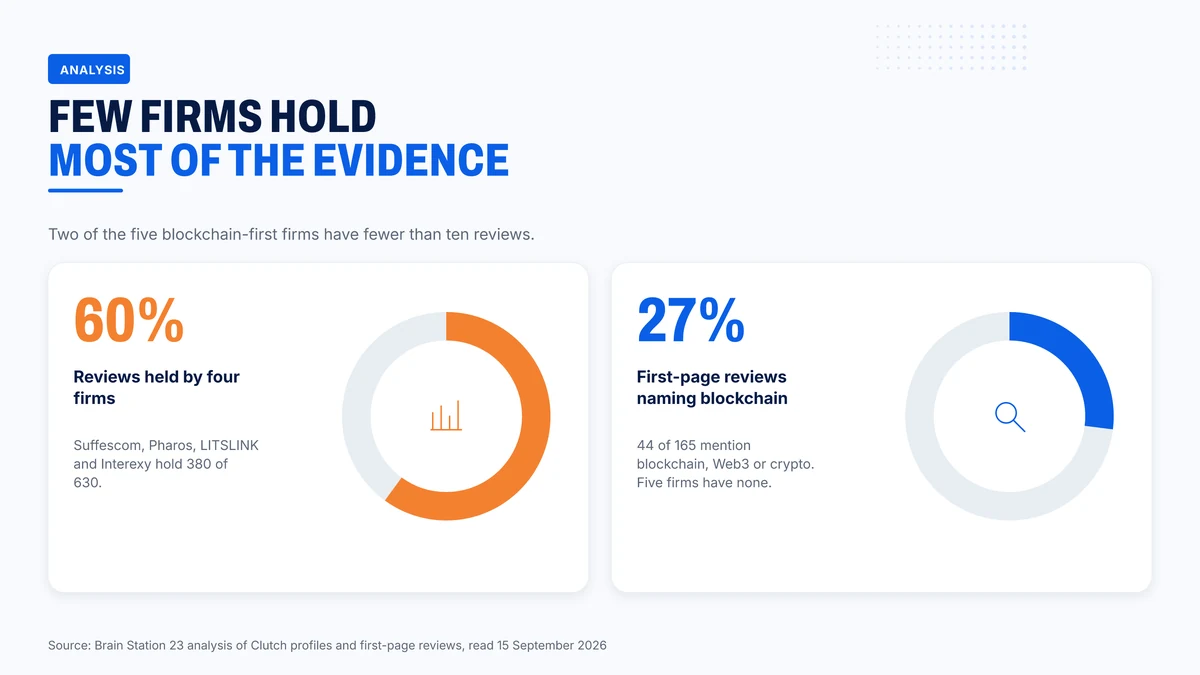
The deepest specialists have the thinnest records. Of the five blockchain-first firms, Protofire has five reviews and InvoBlox two. Across all twenty, five firms have fewer than ten reviews, while four firms hold 60 percent of the 630 reviews, and the median is 18.
The reviews rarely describe blockchain work. On the first page of each profile, 44 of 165 reviews mention blockchain, Web3 or crypto, and 20 mention smart contracts. MMC Global, Suffescom, Jalasoft, The SilverLogic and LITSLINK have none. First pages show up to ten reviews per firm, so this is a sample, not a census, but it matches the service splits.
Prices sit below $100 an hour. Five firms publish $25 to $49, ten $50 to $99, two $100 to $149 and three $150 to $199. Minimums run from $1,000 to $100,000, with a median of $25,000.
Cost is the weakest score. Six firms score identically on all four sub-scores. Of the other fourteen, Cost is the lowest or joint-lowest for eleven. Jalasoft’s 4.4 for Cost is the lowest sub-score on the list.
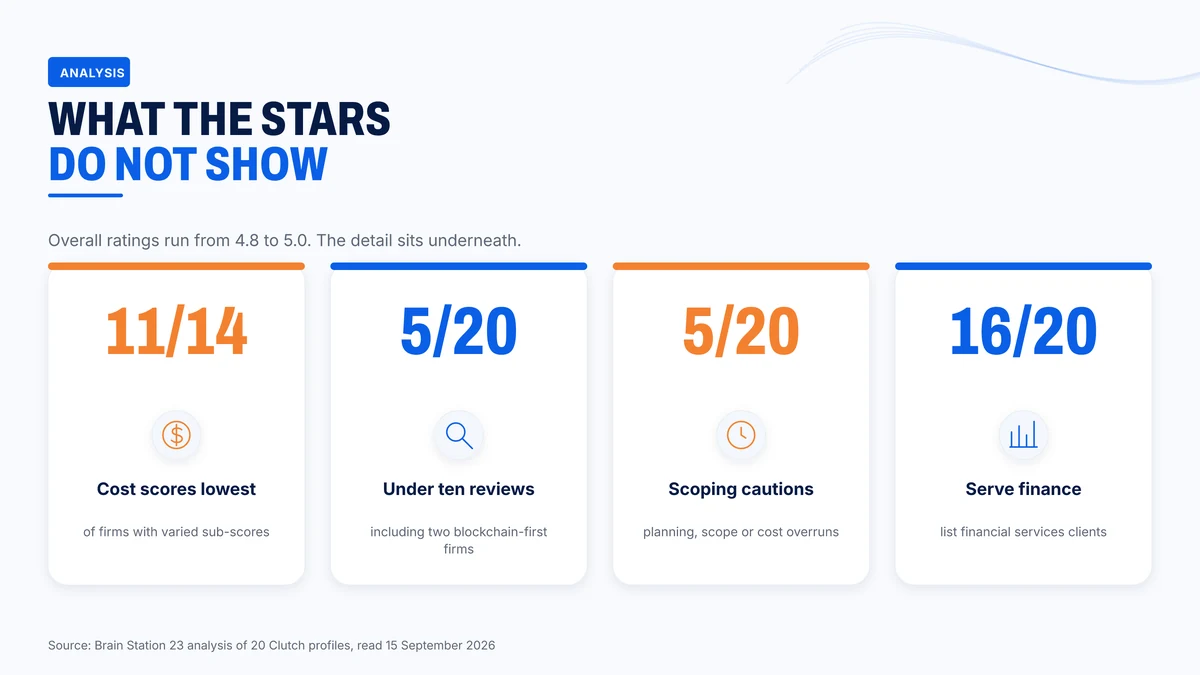
The cautions are about scoping and communication. Clutch’s review summaries flag scoping, planning or cost overruns for five firms, communication or language for four, and reporting or time tracking for two. Six firms have no improvement area listed, and four of those six have fewer than ten reviews.
Most serve finance. Sixteen firms list financial services clients, and it is 75 percent of Superscript Systems’ work. Eight firms list offices outside the US.
How to shortlist a blockchain development company
Order the filters so the first one removes the most firms.
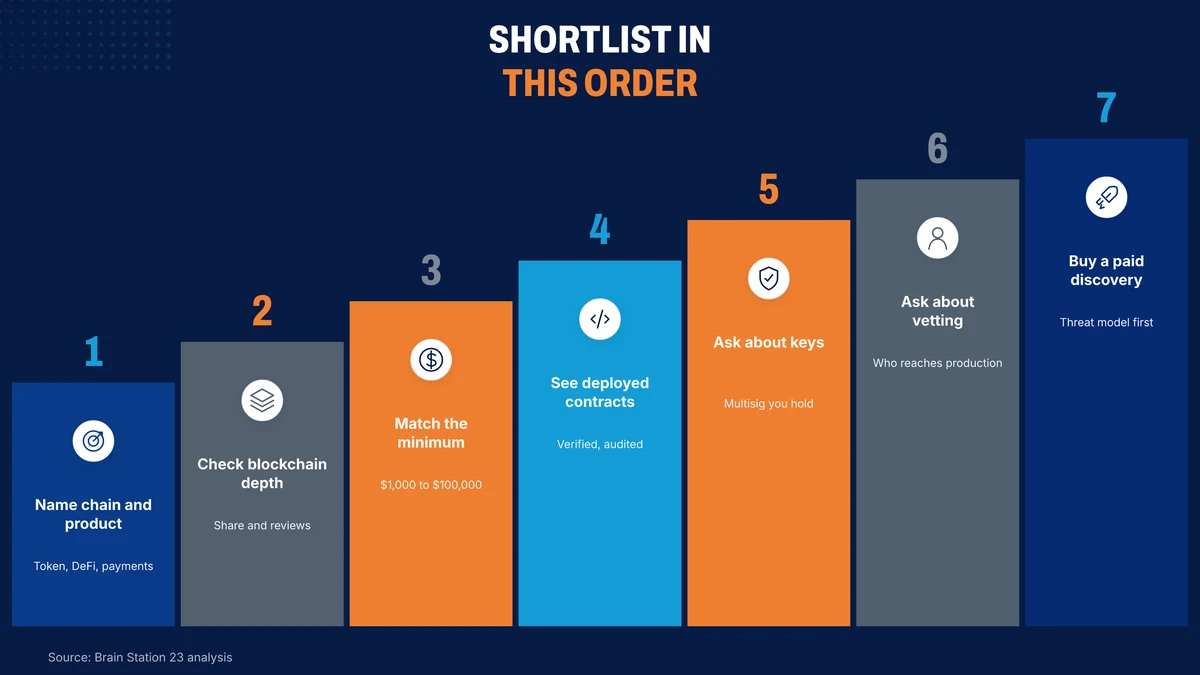
Step 1: Name the chain and the product. A token, a DeFi protocol, a stablecoin or payments product, and a permissioned enterprise ledger are different jobs.
Step 2: Check blockchain depth. Compare each firm’s blockchain share, and read its reviews for smart contract work, not just the service label.
Step 3: Match your budget to the minimum. Minimums run from $1,000 to $100,000, so this step removes part of the list.
Step 4: Ask for deployed contracts. Ask for contract addresses the firm deployed, verified source code and the audit reports that went with them.
Step 5: Ask how keys are managed. The answer should describe multisig or equivalent controls that your organisation holds, not a single engineer’s wallet.
Step 6: Ask how engineers are vetted. Chainalysis reports hostile IT workers gaining privileged access inside crypto services (Chainalysis). Ask about identity checks and who can reach production.
Step 7: Buy a paid technical discovery. A short fixed-fee phase that produces a threat model and architecture shows how the firm thinks before you fund a build.
How to buy blockchain development: four engagement models
The engagement model decides who pays when a contract needs rework after the audit.
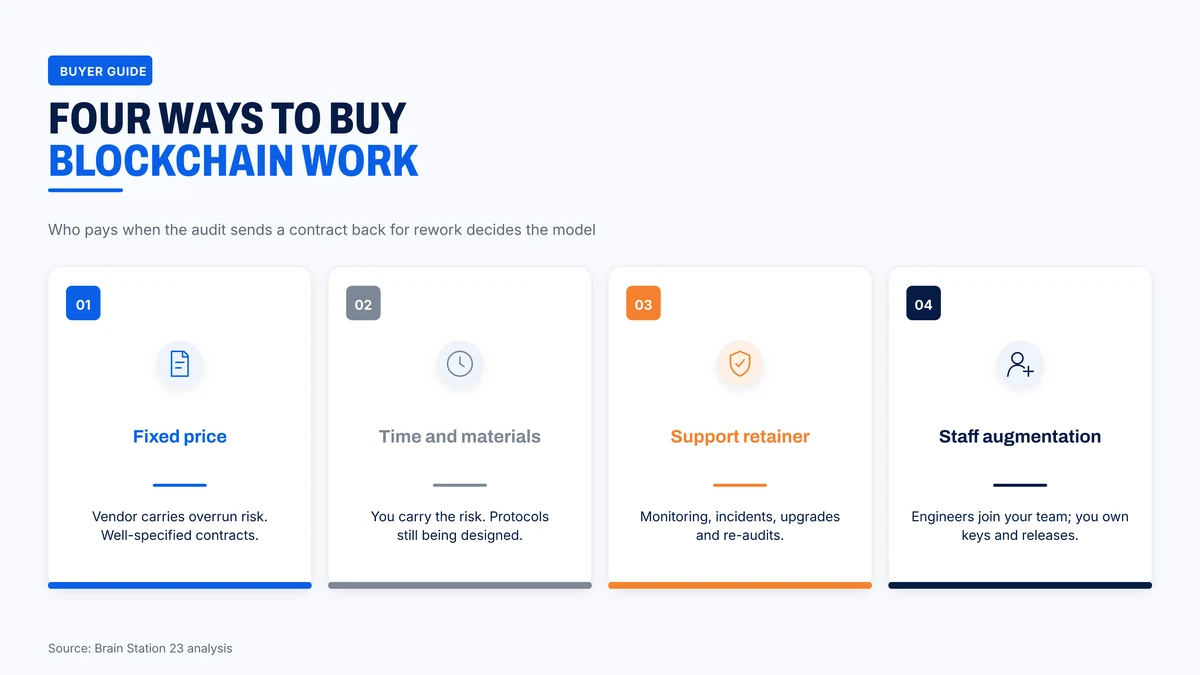
Fixed price moves overrun risk to the vendor, who prices it in. It suits a well-specified token or contract set with an agreed audit scope. It fails when the audit finds design issues that change the scope.
Time and materials keeps the risk with you. It suits protocols and products still being designed. Cap each phase and review burn every week.
Support retainer covers monitoring, incident response, upgrades, re-audits of changes and a block of development. Deployed contracts hold value, so they need someone watching.
Staff augmentation adds blockchain engineers to your team. Boosty Labs, Interexy, Jalasoft, Slashdev and Brain Station 23 publish staff augmentation lines. It fails when nobody in-house owns the key management and release decisions.
The technical question: shipping contracts you can still change safely
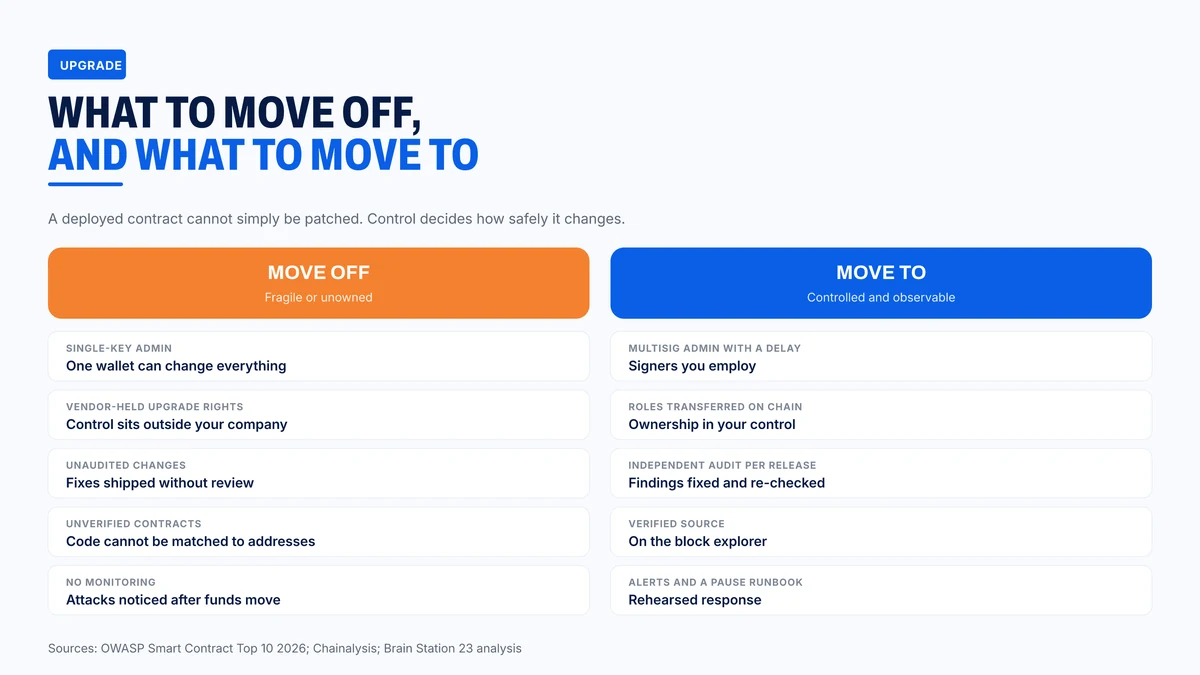
A deployed smart contract cannot simply be patched. Most teams use upgradeable designs or migrations, and those create their own risks. The order of the steps decides whether a fix is routine or an emergency.
The steps, in the order that keeps them safest:
Step 1: Write a threat model before code. List who can call each function, what an attacker gains, and which external data the contract trusts. Access control and business logic lead OWASP’s 2026 list (OWASP).
Step 2: Design roles and keys. Put admin and upgrade rights behind multisig or an equivalent control your organisation holds, with a delay on sensitive changes.
Step 3: Test beyond the happy path. Unit tests, property-based or fuzz tests, and tests against price oracle and flash loan scenarios.
Step 4: Commission an independent audit. Audit before mainnet, from a firm other than the builder, and budget for fixing and re-checking findings.
Step 5: Publish verified source. Verify deployed contracts on the relevant block explorer, so users and auditors can match code to addresses.
Step 6: Monitor and plan incidents. Set alerts for unusual transactions and admin actions, and rehearse who can pause what, and how fast.
Step 7: Re-test at every network upgrade and change. Ethereum’s Fusaka upgrade in December 2025 is the kind of event that should trigger a regression run (ethereum.org). Every change to a deployed contract gets its own review.
Red flags: eight answers to walk away from
Some answers in a sales call should end it.
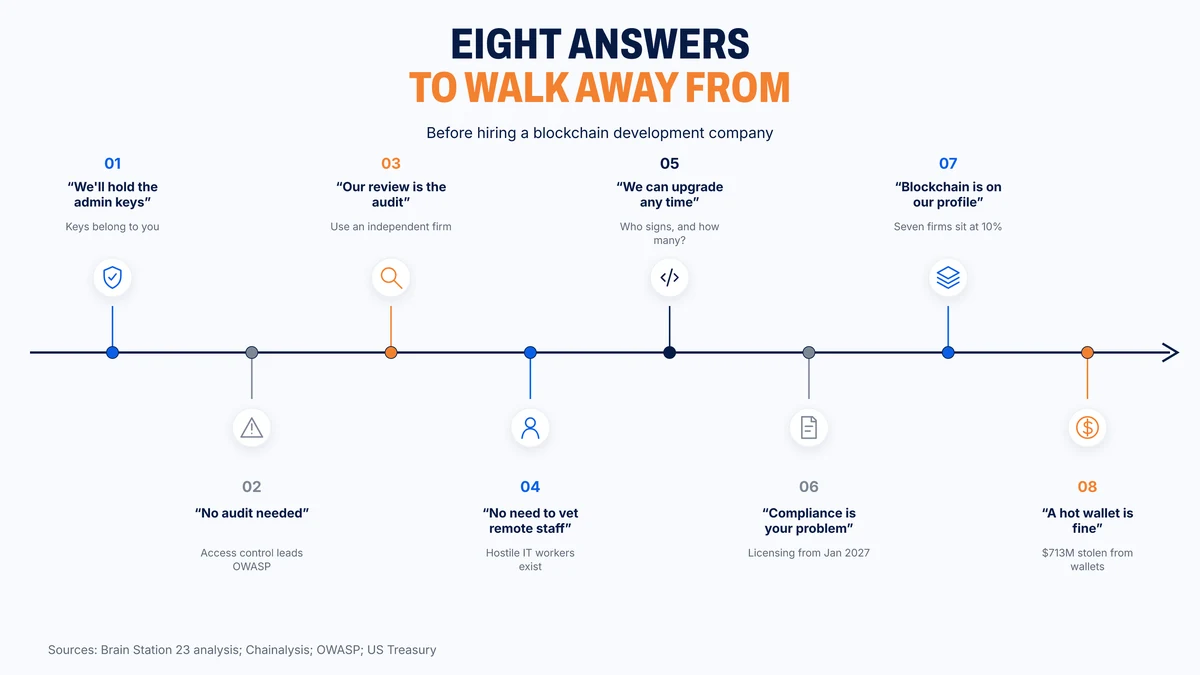
“We’ll hold the admin keys for now.” Admin and upgrade rights belong in controls your organisation holds.
“This contract doesn’t need an audit.” Access control failures lead OWASP’s 2026 list, and they are cheap to find before deployment.
“Our own review counts as the audit.” An audit should come from a firm other than the builder.
“Our remote engineers don’t need vetting.” Chainalysis reports hostile IT workers gaining privileged access inside crypto services.
“We can upgrade the contract any time.” Ask who can, how many signers it takes, and how users are warned.
“Compliance is your lawyer’s problem.” Your counsel decides, but the product must be built so it can meet licensing rules expected from January 2027.
“Blockchain is on our profile.” Seven firms here put it at 10 percent of their services. Ask for deployed contracts.
“A hot wallet is fine for the treasury.” Personal wallet compromises cost victims $713 million in 2025.
After launch: what the build quote leaves out
This part covers what owners wish they had settled before the final invoice, and what recurs for as long as the contracts hold value.
What you must own before the final invoice
Admin, upgrade and treasury keys, held in multisig or equivalent controls whose signers work for you.
The deployed contract addresses and verified source, with ownership and roles transferred to your organisation on chain.
The code repository with its full history, including deployment scripts, configuration and tests, not a zip.
Audit reports and fix records, issued to your organisation, with the commit each audit covered.
Node, RPC, indexing and cloud accounts, under your billing, with API keys you can rotate.
Domain, front-end hosting and the app store accounts for any wallet or mobile app.
A runbook, covering deployment, pausing, key rotation, incident contacts and who can sign what.
The bill that arrives after launch
The build quote covers the first deployment. The rest recurs.
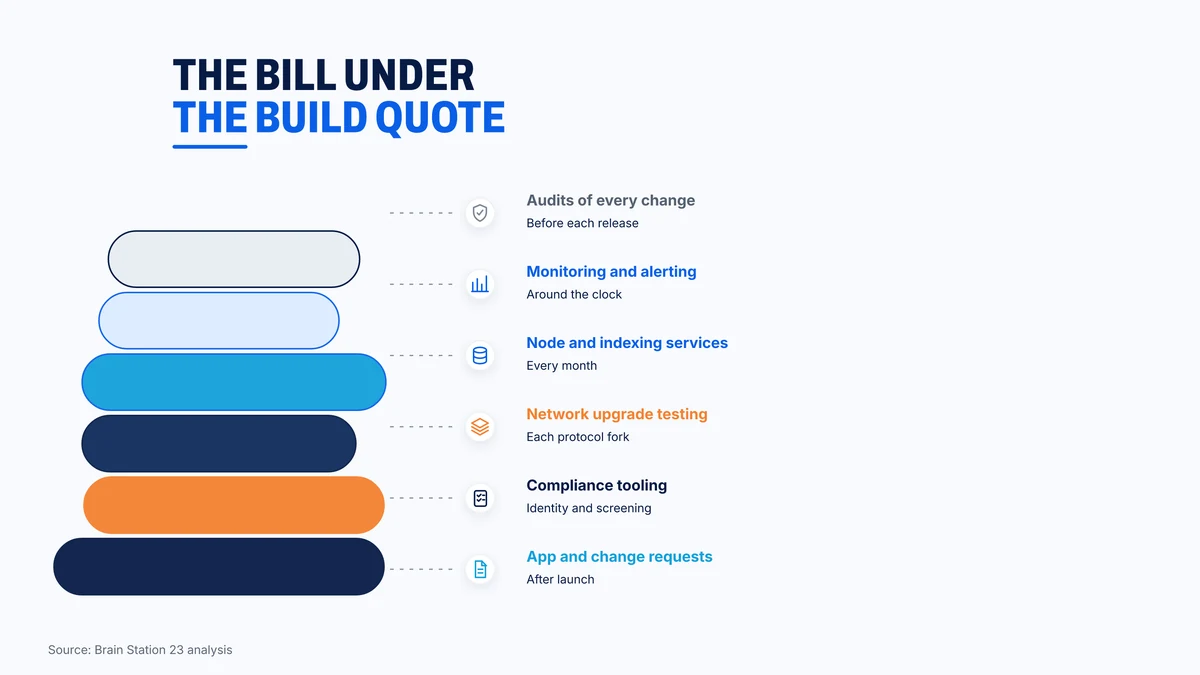
The recurring lines are audits of every contract change, a bug bounty if you run one, monitoring and alerting, node and indexing services, network upgrade testing, compliance tooling such as identity checks, front-end and app maintenance, and change requests. Get the retainer price in writing before signing the build, and compare vendors on three years of cost.
Security is a recurring cost
The threat is persistent. Chainalysis counted $3.4 billion stolen in 2025, with centralised services losing large sums through attacks on private key infrastructure and signing processes, and North Korean hackers alone taking $2.02 billion (Chainalysis).
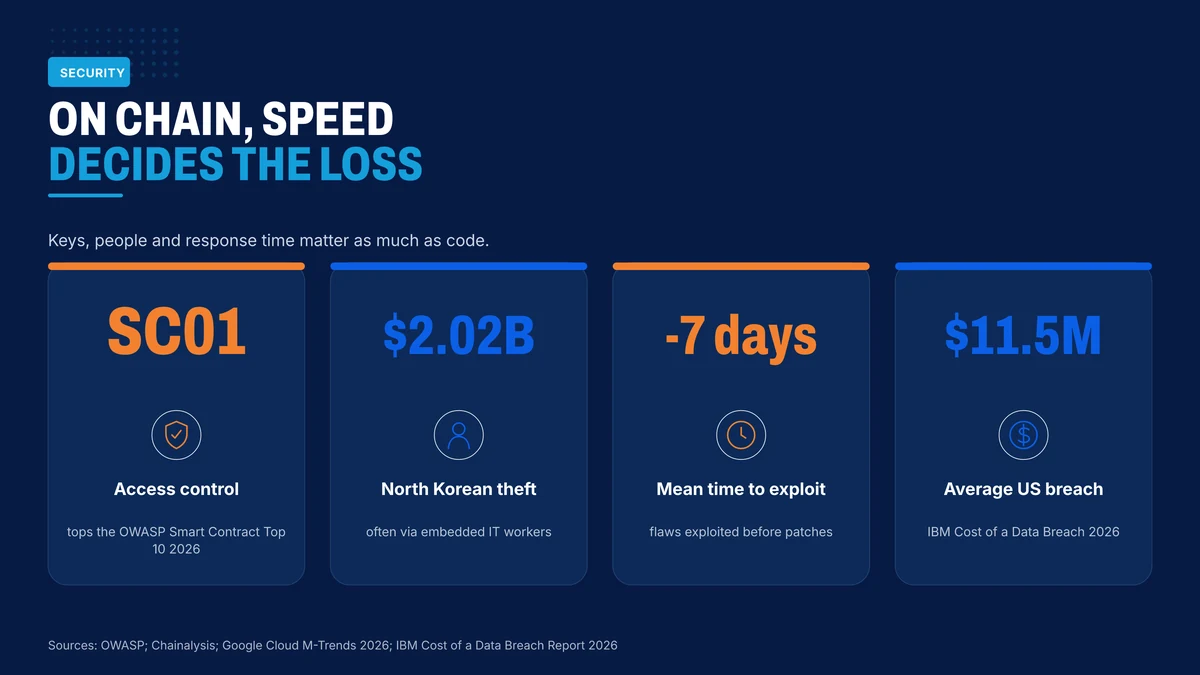
Speed matters more on chain than off it, because stolen assets move in minutes. Google Cloud’s M-Trends 2026 put the mean time to exploit at minus seven days (Google Cloud), and the average US data breach cost a record USD 11.5 million in IBM’s 2026 report (IBM Cost of a Data Breach Report 2026). Ask vendors who is on call when an alert fires, how fast a contract can be paused, and how every engineer with production access was vetted.
Accessibility is legal exposure
Most blockchain products reach users through a web or mobile front end, and those front ends carry the same legal exposure as any other. WebAIM found detected WCAG 2 failures on 95.9 percent of the top million home pages in 2026 (WebAIM Million 2026), and more than 5,000 digital accessibility lawsuits had been filed by the end of 2025 (UsableNet).
Name WCAG 2.2 AA in the contract, and test wallet connection, transaction signing and error messages with a keyboard and a screen reader. Signing flows are where many dApp interfaces fail.
Contract clauses that surface in month nine
These rarely come up in a sales call. This is not legal advice; have your own counsel review any agreement.
IP assignment on payment, covering contracts, scripts, front ends and documentation.
Key custody, naming who holds admin and upgrade rights, how signers are added and removed, and when ownership transfers to you.
Audit scope, stating which contracts and commits are audited, by whom, and who pays for re-audits after changes.
Personnel vetting, requiring identity verification for engineers with repository or production access, and notice of any change in staff.
Incident response, stating response times, pause authority and who communicates with users.
Regulatory cooperation, requiring the vendor to support changes your counsel requires as stablecoin and licensing rules take effect.
Transition assistance, rate escalation caps, subcontracting disclosure, liability caps and insurance, and non-solicitation in both directions.
How to leave without losing control
Transfer contract ownership, admin roles and upgrade rights to controls your organisation holds first, and confirm the change on chain. Then confirm you can build, test and deploy from your own pipeline, and record walkthroughs of the architecture, monitoring and incident runbooks while relations are cordial.
On the last day, remove the vendor’s signers from every multisig, rotate RPC, cloud and API keys, revoke repository and deploy access, and check that no role in any deployed contract still points to an address the vendor controls.
Hire in-house or hire a blockchain development company
Start with the wage. Glassdoor reports an average of $140,987 for a US blockchain developer and ZipRecruiter $111,845 (Glassdoor, ZipRecruiter). One hire at those figures, before benefits, costs more each year than the most common project at eleven of the twenty firms.
Hire in-house when the protocol or product is the business, holds significant value, and needs someone who owns key management and incident response every day.
Hire a blockchain development company for a defined build, a prototype, or specialist work you will not need full time. Commission the audit separately, and keep every key and account in your organisation’s control.
Combine the two when you have a technical lead who owns keys and releases but needs extra engineers or specialist contract work.
FAQ
How much do US blockchain development companies charge?
The twenty firms here publish hourly bands from $25 to $199, and fifteen charge under $100. Minimum projects run from $1,000 to $100,000, with a median of $25,000 (Clutch).
When does the GENIUS Act take effect?
It takes effect on the earlier of 18 months after its 18 July 2025 enactment or 120 days after final rules (OCC). Treasury names 18 January 2027 as the expected effective date (US Treasury).
How much crypto was stolen in 2025?
Chainalysis counted more than $3.4 billion stolen from January to early December 2025, including $1.5 billion from Bybit and at least $2.02 billion taken by North Korean hackers (Chainalysis).
What are the most common smart contract vulnerabilities?
OWASP’s Smart Contract Top 10 for 2026 ranks access control first, followed by business logic, price oracle manipulation, flash loan attacks and lack of input validation (OWASP).
Should the development firm also audit the contracts?
No. An independent firm should audit, so the builder is not grading its own work. Budget time and money to fix findings and re-check them before deployment.
What does a blockchain developer earn in the US?
Glassdoor reports an average of $140,987 from 220 salaries. ZipRecruiter reports $111,845 for a blockchain developer and $129,348 for a smart contract developer (Glassdoor; ZipRecruiter).
Who should hold a smart contract’s admin keys?
Your organisation, through multisig or equivalent controls with signers you employ. Chainalysis reports large losses from attacks on private key infrastructure and signing processes (Chainalysis).
How can I tell whether a firm really does blockchain work?
Check its blockchain share of services and ask for deployed, verified contracts. On this list, seven firms put blockchain at 10 percent, and five have no first-page review that mentions it (Clutch).
Conclusion
The data behind this Top 20 Blockchain Development Companies in USA list says three things. Blockchain depth is uneven: five firms put it at half their services or more, and seven at just 10 percent. The deepest specialists often have the thinnest review records. And the work is priced below $100 an hour at fifteen of the twenty firms, around a $25,000 median minimum.
Any of the twenty can write a contract. What decides the next three years is control and upkeep: who holds the admin and upgrade keys, whether every change is audited before it ships, which vetted people can reach production, and whether the product is ready for stablecoin rules expected to take effect in January 2027.
Sources
- https://clutch.co/us/developers/blockchain?sort_by=ClutchRank
- https://clutch.co/profile/brain-station-23
- https://home.treasury.gov/news/press-releases/sb0605
- https://www.occ.gov/news-issuances/bulletins/2026/bulletin-2026-3.html
- https://www.chainalysis.com/blog/crypto-hacking-stolen-funds-2026/
- https://owasp.org/www-project-smart-contract-top-10/
- https://ethereum.org/roadmap/fusaka/
- https://www.glassdoor.com/Salaries/blockchain-developer-salary-SRCH_KO0,20.htm
- https://www.ziprecruiter.com/Salaries/Blockchain-Developer-Salary
- https://www.bls.gov/ooh/computer-and-information-technology/software-developers.htm
- https://cloud.google.com/blog/topics/threat-intelligence/m-trends-2026
- https://www.ibm.com/reports/data-breach
- https://webaim.org/projects/million/
- https://blog.usablenet.com/ada-web-lawsuit-trends-2026