
Four of the twenty highest-ranked firms in Clutch’s US Python and Django directory do not list Django anywhere in their published frameworks.
Three list nothing but Django.
The rest sit in between, and the median firm puts Django at 27.5 percent of its framework split (Brain Station 23 analysis of Clutch profiles, read 15 September 2026).
That is the first thing to know about this Top 20 Django Development Companies in USA list: the directory groups Python and Django together, so a high rank is not a measure of Django depth.
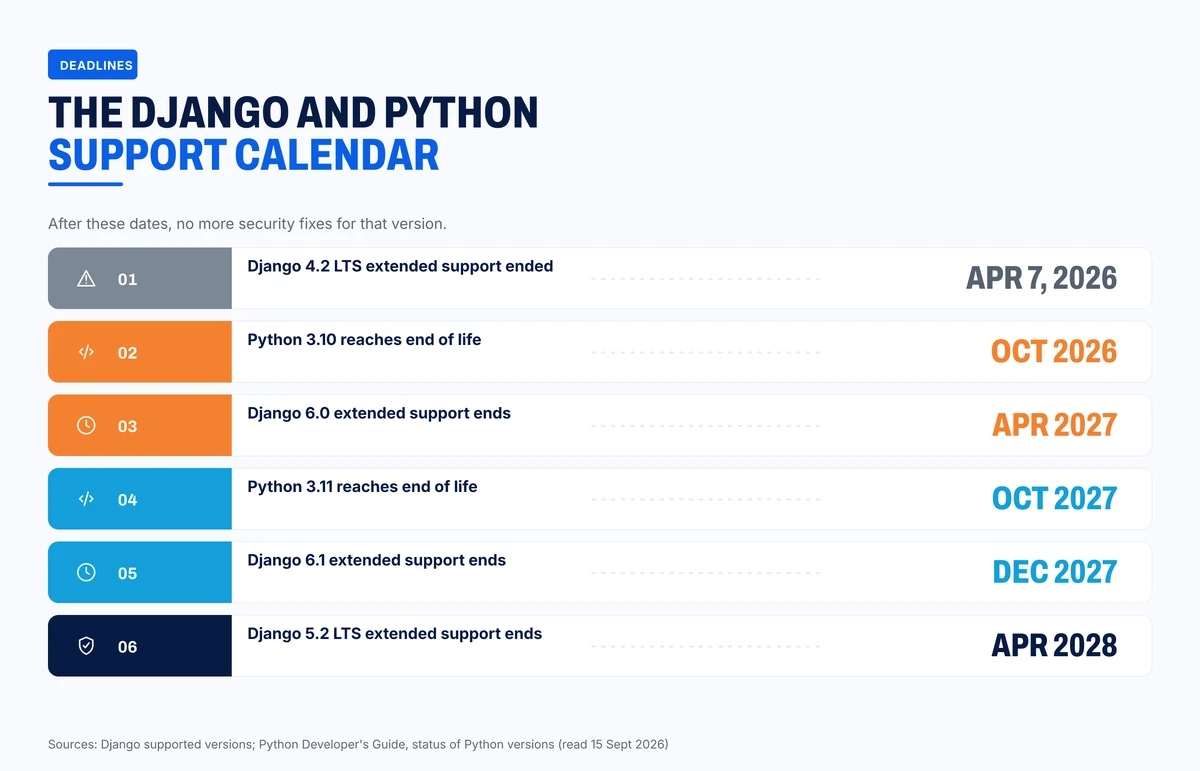
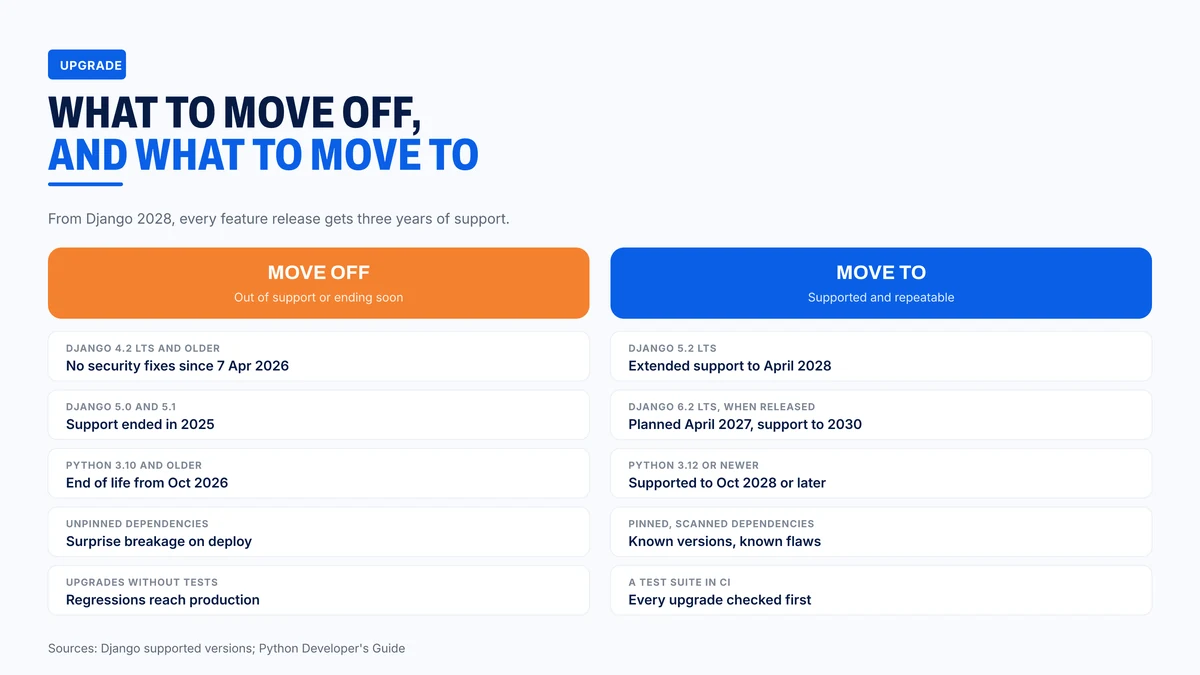
Depth matters because Django runs on a calendar. Django 4.2 LTS stopped receiving security fixes in April 2026 (Django).
Python 3.10 reaches end of life in October 2026 (Python Developer’s Guide).
And the fixes keep coming. Django’s security archive lists 28 issues fixed between February and August 2026, against 12 in the whole of 2025 (Django security archive).
This guide sets those numbers against each firm’s data, then covers what they mean for the quote, the contract and the upgrade that arrives in year two.
Key takeaways
- 27.5% is the median Django share of the twenty firms’ published framework splits; four firms list no Django at all and three list only Django (Brain Station 23 analysis of Clutch profiles).
- 28 Django security issues were fixed in the first eight months of 2026, more than double the 12 fixed in all of 2025 (Django security archive).
- 7 April 2026 was when Django 4.2 LTS extended support ended; Django 5.2 LTS is supported to April 2028 (Django supported versions).
- 45% of respondents to the Django Developers Survey were running Django 4.2, and 12% were still on 3.2 (Django Developers Survey 2025).
- October 2026 is end of life for Python 3.10, which 31% of those survey respondents used (Python Developer’s Guide; Django Developers Survey 2025).
- $25,000 is the median published minimum project across the twenty, and half report a most common project of $50,000 or more (Clutch profiles).
- $120,633 is ZipRecruiter’s average for a US Django developer as of 14 September 2026 (ZipRecruiter).
- 2.6 million Python contributors were active on GitHub in 2025, up 48% in a year (GitHub Octoverse 2025).
Django in 2026: a growing language, a moving calendar
Python is growing fast. GitHub counted 2.6 million Python contributors in 2025, up 48 percent in a year, even as TypeScript overtook Python as the most used language on the platform in August 2025 (GitHub Octoverse 2025). Stack Overflow’s 2025 survey found Python usage up 7 percentage points in a year, and FastAPI up 5 points among web frameworks (Stack Overflow Developer Survey 2025).
On the public web the picture is smaller. W3Techs finds Python on 1.1 percent of websites whose server-side language it can detect (W3Techs). Django’s work mostly sits behind logins: internal tools, data platforms, APIs and products, which a crawler does not count.
The support calendar is what changes the brief. Django’s LTS releases get about three years of support. Extended support for 4.2 LTS ended on 7 April 2026, 5.2 LTS is supported to April 2028, and 6.2 LTS is planned for April 2027 with support to April 2030 (Django supported versions). From Django 2028, feature releases move to yearly version numbers and each one gets three years of support. Python has its own dates: 3.10 reaches end of life in October 2026 and 3.11 in October 2027 (Python Developer’s Guide).
Many existing applications sit behind that calendar. In the Django Developers Survey run by JetBrains and the Django Software Foundation from November 2024 to January 2025, with about 4,600 respondents, 62 percent used Django 5.1, 45 percent used 4.2 and 12 percent still used 3.2 (Django Developers Survey 2025). Every version in that answer is now out of support.
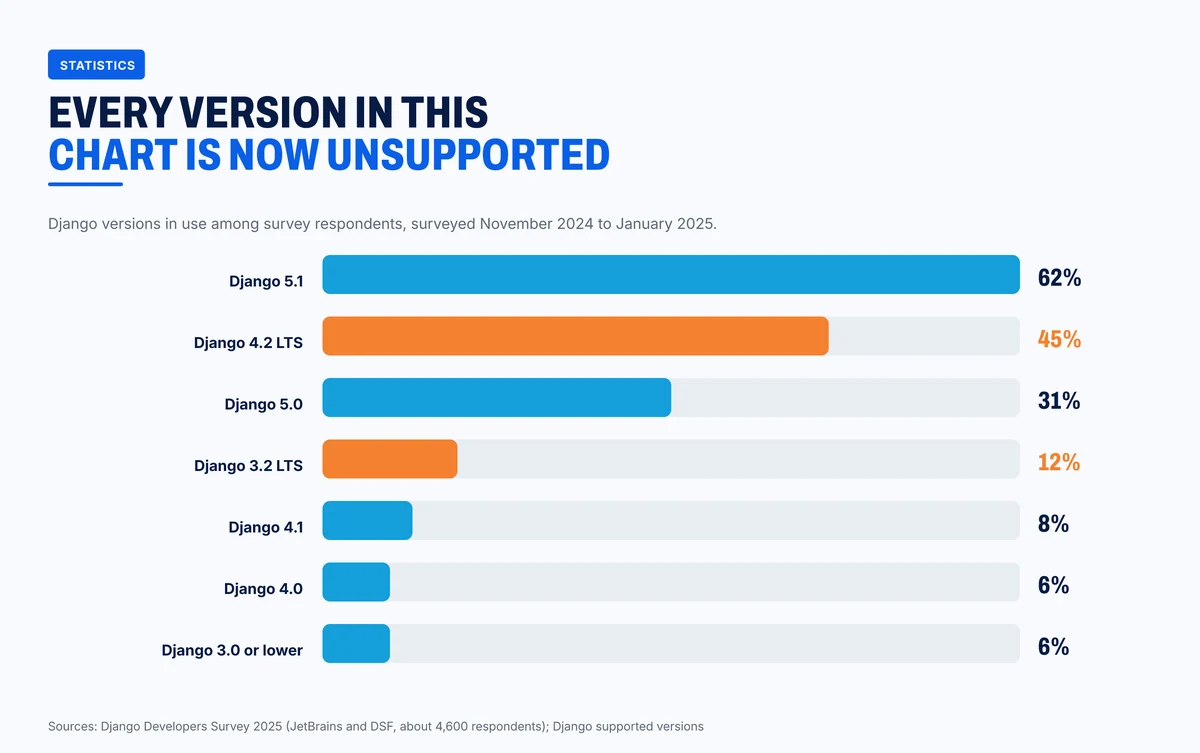
Upgrade habits explain the gap. In the same survey 48 percent upgraded with every stable release, 27 percent only moved between LTS releases, and 31 percent of respondents were running Python 3.10 (Django Developers Survey 2025). An LTS-only habit is reasonable, but only if the jump to the next LTS is budgeted before the old one expires.
The stack around Django is fairly settled. The same survey found 76 percent using PostgreSQL, Django REST framework named as a favourite package by 49 percent, and 63 percent using type hints. A brief that names the Django and Python versions, the database, the API layer and the test coverage gives a vendor enough to price honestly.
What Django development costs in the US
Salary figures for this stack do not agree.
PayScale reports an average of $91,180 for a Python developer, from 79 salary profiles updated on 1 June 2026 (PayScale). ZipRecruiter puts a Python Django developer at $115,107 and a Django developer at $120,633 as of 14 September 2026 (ZipRecruiter, Python Django Developer; ZipRecruiter, Django Developer). Glassdoor reports $130,666 in average total pay for a Python developer, from 2,266 salaries (Glassdoor). The Bureau of Labor Statistics puts the median for all software developers at $135,980 in May 2025 (BLS).
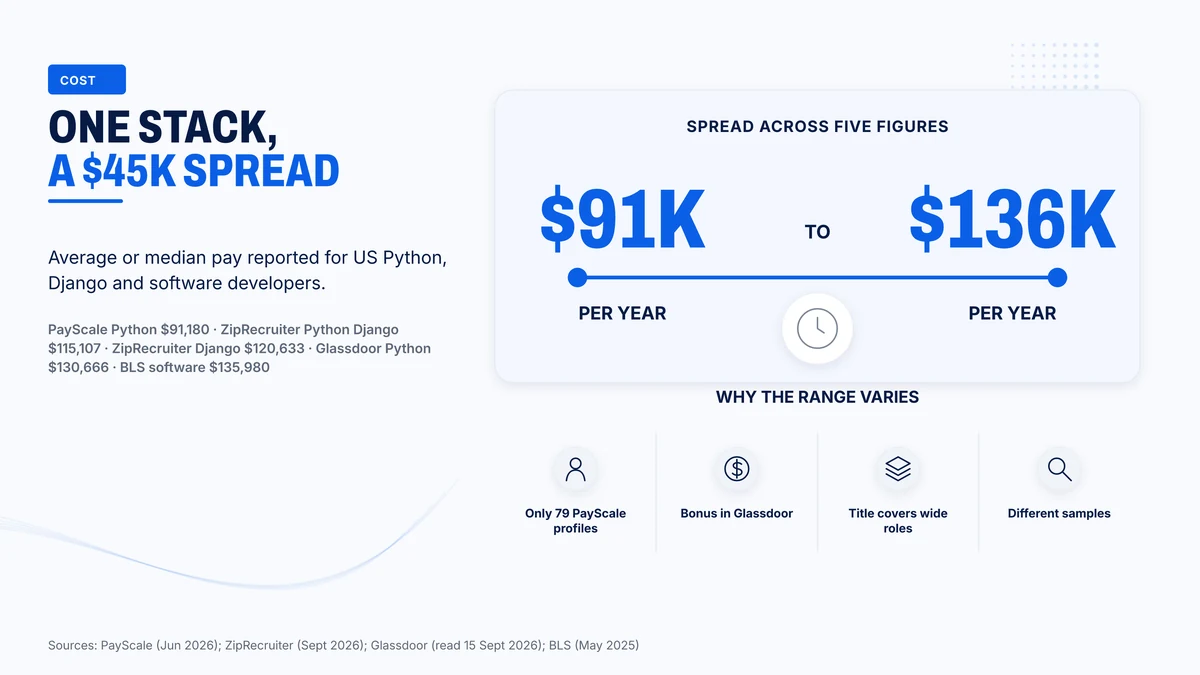
The $44,800 spread has plain causes. PayScale’s figure rests on 79 profiles. Glassdoor’s includes bonuses and other pay. And “Python developer” covers data analysts and scripting roles as well as engineers who own a production Django application.
Agency pricing starts higher than in many stacks. The median published minimum across the twenty firms is $25,000, seven start at $50,000 or more, and half report a most common project size of $50,000 or more (Clutch profiles, read 15 September 2026). The largest rate band is $50 to $99 an hour, published by eight firms.
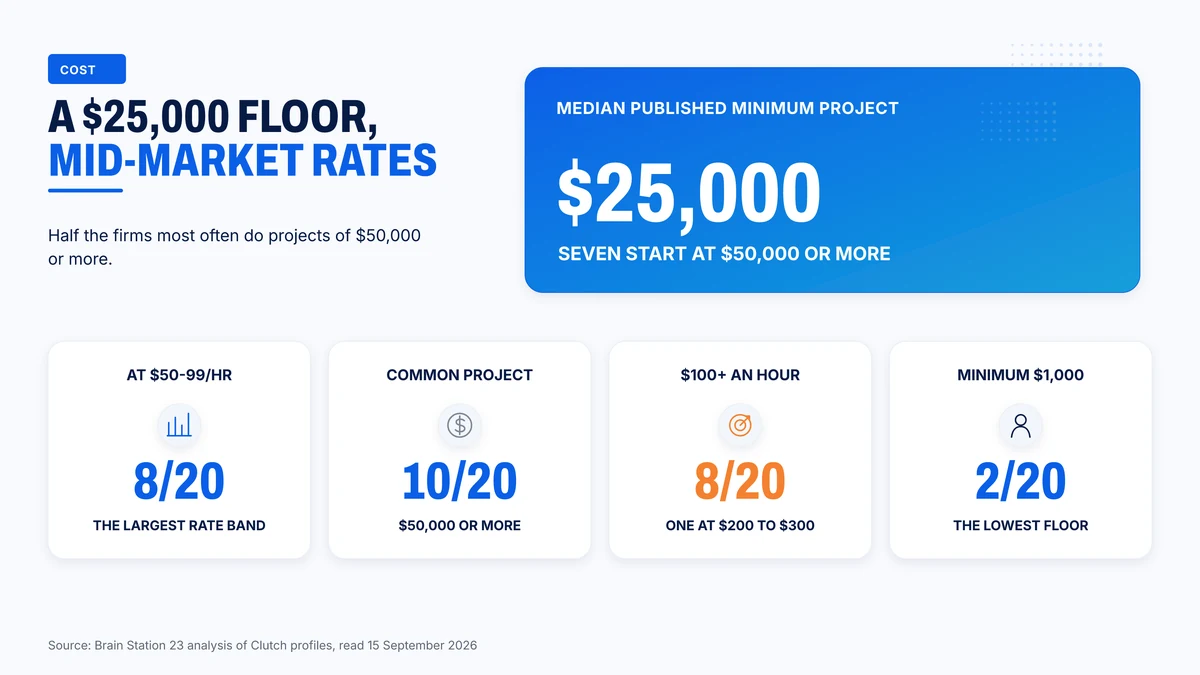
Django projects tend to be applications rather than brochure sites, which is why the floors are higher. Eight factors decide where a quote lands.
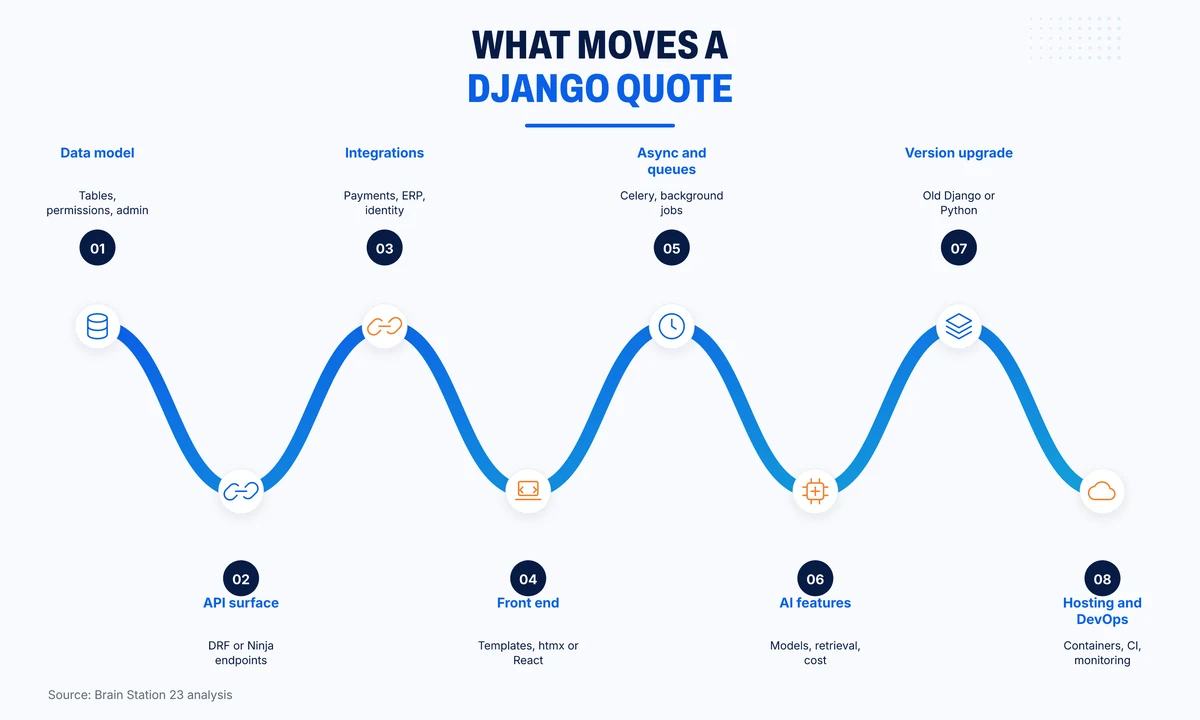
The data model comes first, because tables, permissions and the admin set the size of everything else. The API surface follows, whether built with Django REST framework or Django Ninja. Integrations with payments, ERP and identity providers carry the most unknowns. The front end can be server-rendered templates, htmx or a separate React application, and that choice changes team shape. Background jobs, AI features with their model and retrieval costs, version upgrades on older code, and hosting and DevOps complete the list. Ask each vendor to price these lines separately.
The Top 20 Django Development Companies in USA, compared
Clutch has no separate Django page, so we used Clutch’s US Python and Django developers directory, sorted by Clutch Rank and read on 15 September 2026. It lists 1,826 firms. The first row, Digis, was a paid placement, and we removed it. Firms 2 to 21 below are the next 20 in Clutch Rank order.
Brain Station 23 is placed first because we publish this article. We are US-headquartered, but Django is 8 percent of our published frameworks split, against a median of 27.5 percent for the twenty firms, so Clutch’s ranking did not place us in its top 20 and we are not claiming it did.
Overall ratings below run from 4.4 to 5.0, and nineteen of the twenty sit at 4.8 or above, so the stars barely separate these firms. The Django Focus column does: it shows Django as a share of each firm’s published frameworks split, with Python’s share of its languages alongside.
| # | Company | Best For | Team Size | Django Focus | Key Tech Stack | Industries Served | Locations |
|---|---|---|---|---|---|---|---|
| 1 | Brain Station 23 — brainstation-23.com | Adding cost-controlled engineers to an in-house Django team | 250 – 999 | Django 8% of frameworks; Python 14% of languages | Spring MVC, .NET, Flutter, Django, Python, Java | Retail, medical, telecoms, education, financial services | Springfield VA; Bangladesh, UAE, England, Malaysia, Germany |
| 2 | Caktus Group — caktusgroup.com | Django-only web and mobile builds with direct developer access | 10 – 49 | Django 100%; Python 80% | Django, Python, JavaScript, SQL | Not published | Durham NC |
| 3 | Six Feet Up — sixfeetup.com | Complex Python and AI systems for mid-market and enterprise teams | 10 – 49 | Django 60%; Python 70% | Django, Python, React, Node.js, Zope, TypeScript | IT, medical, education, energy, financial services | Fishers IN |
| 4 | Toptal — toptal.com | Hiring individual vetted developers quickly | 1,000 – 9,999 | Django 33%; Python 25% | .NET, Django, Ruby on Rails, Java, JavaScript, PHP | Arts, business services, consumer products, education, financial services | San Francisco |
| 5 | BairesDev — bairesdev.com | Large nearshore teams across many stacks | 1,000 – 9,999 | Django not listed; Python 30% | .NET, React Native, Angular, Flutter, PHP, Java, Python | IT, financial services, medical, advertising | San Francisco; Buenos Aires, Sao Paulo, Mexico City, Bogota, Barcelona |
| 6 | Suffescom Solutions — suffescom.com | Fintech and healthcare mobile and web apps on a lower hourly budget | 250 – 999 | Django 10%; Python 15% | Next.js, Node.js, React Native, .NET, Django, Kotlin | Financial services, medical, real estate, e-commerce | New York, Wilmington DE; Mohali, Dubai, London, Sydney |
| 7 | Vention — ventionteams.com | Scaling engineering capacity for mid-market product companies | 1,000 – 9,999 | Django 10%; Python 15% | .NET, React, Angular, Node.js, Django, Go | Advertising, education, financial services, food and beverage, IT | New York, San Francisco; London, Vienna, Vilnius, Berlin, Warsaw |
| 8 | INOXOFT — inoxoft.com | Fintech and education software with AI features | 50 – 249 | Django not listed; Python 35% | Node.js, React, Flutter, Python, JavaScript, TypeScript | Financial services, education, real estate, automotive | Newark DE; Wroclaw, Lviv |
| 9 | Crowdbotics — crowdbotics.com | Django and React Native apps with ongoing support | 50 – 249 | Django 50%; Python 40% | Django, React Native, Python, JavaScript, Heroku | Consumer products, business services, medical, arts | Berkeley CA |
| 10 | MeanPug Digital — meanpug.com | Law firms wanting Django software plus SEO and paid search | 10 – 49 | Django 80%; Python 30% | Django, React, Python, JavaScript, PHP | Legal, education | New York |
| 11 | Saritasa — saritasa.com | Custom software with AR, VR and AI alongside Django | 50 – 249 | Django 30% (joint largest); Python 20% | .NET, Django, Angular, Laravel, React, Python | Advertising, automotive, education, financial services, legal | Irvine, New York, Chicago, Manhattan Beach, Tampa |
| 12 | Arbisoft — arbisoft.com | Large education and hospitality platforms, including Wagtail | 250 – 999 | Django 16% (largest); Python 12% | Django, Wagtail, .NET, Angular, Flutter, React, Spring | Education, hospitality, medical, financial services | Plano TX; Lahore, Islamabad, Riyadh |
| 13 | Bright Bridge Web — brightbridgeweb.com | Small Django web and API builds on a modest budget | 10 – 49 | Django 80%; Python 50% | Django, React Native, Python, PHP, Heroku | Business services, education, IT, advertising, energy | Provo UT |
| 14 | Fusionbox — fusionbox.com | Django-only custom software for nonprofits, government and finance | 10 – 49 | Django 100%; Python 100% | Django, Python, Linux, UX strategy | Financial services, government, manufacturing, nonprofit | Denver |
| 15 | Culture Foundry — culturefoundry.com | Foundations and organisations migrating CMS platforms | 10 – 49 | Django 29%; Python 25% | React Native, Django, React, WordPress, Drupal, Wagtail | Business services, education, IT, medical, nonprofit | Seattle, Portland OR; Victoria BC |
| 16 | Imaginary Landscape — imagescape.com | Healthcare and nonprofit Django sites with hosting | 10 – 49 | Django 100%; Python 100% | Django, Python, ERP integration | Medical, nonprofit, financial services, gaming, retail | Evanston IL |
| 17 | FocusReactive — focusreactive.com | Headless CMS and Next.js sites with a Python back end | 10 – 49 | Django not listed; Python 15% | Next.js, React, Node.js, Sanity, Drupal, TypeScript | Advertising, business services, education, financial services | London, Warsaw; New York |
| 18 | HTMLPanda — htmlpanda.com | Small web builds on the lowest hourly budget | 250 – 999 | Django not listed; Python 25% | Laravel, Angular, React, PHP, JavaScript, Python | E-commerce, business services, IT, medical | Walpole MA |
| 19 | Scopic — scopicsoftware.com | Healthcare and manufacturing software with AI work | 250 – 999 | Django 5%; Python 10% | React, .NET, Node.js, React Native, Laravel, C++ | Medical, automotive, manufacturing, education | Marlborough MA |
| 20 | Idea Maker — ideamaker.agency | Small businesses wanting AI, web and mobile from one team | 10 – 49 | Django 20%; Python 100% | Vue, Django, Flutter, React, Node.js, Python | Financial services, medical, automotive, IT, legal | Irvine, Los Angeles |
| 21 | Beehive Software — beehivesoftware.com | Startups and small companies wanting a fast Python product team | 50 – 249 | Django 26%; Python 45% | React Native, Django, React, Python, TypeScript | Medical, IT, e-commerce, education, financial services | San Jose CA |
Team sizes, service splits, framework and language splits, industries and locations are from each firm’s published Clutch profile, read 15 September 2026. Caktus Group and Imaginary Landscape have not published full industry or client splits. “Best For” is our reading of that data. Engagement models and certifications are not published consistently across these profiles, so we have left them out rather than guess.
Profiles are grouped by the kind of buyer each firm suits, and the numbers match the table. Each caution comes from the Review Highlights Clutch publishes from the firm’s verified reviews. Certifications are self-published and unverified by us, and none of these Clutch profiles list ISO or SOC 2 credentials, which is why the profiles say to ask.
1. Brain Station 23
We publish this article and placed ourselves first, so read this entry as the publisher’s pick. Django is 8 percent of our published frameworks split and Python 14 percent of our languages, below the medians of the firms below; Spring MVC and .NET are larger for us. Most of our work, 60 percent, is engineers embedded in client teams, at a $25 to $49 band that only three firms below match or undercut. Where we help with the risks in this guide is process: ISO 27001 and SOC 2 Type II controls over access, change and patching. Our 21 reviews score Quality at 5.0 and Cost at 4.9, and reviewers have asked for tighter internal coordination. If you want a Django-first studio to design and own the product, choose from the firms below.
Founded: 2006
US Presence: Springfield VA
Company size: Clutch band 250 to 999; we publish 900+ engineers
Rating: 4.9 across 21 Clutch reviews, HQ Springfield, Virginia
- Adding cost-controlled engineers to an in-house Django team
- CMMI Level 3
- ISO 27001
- ISO 9001
- SOC 2 Type II (company-published)
- Staff augmentation
- Custom software development
- Python and Django engineering
- AI development
- Application modernisation
- Managed application support
- Retail
- Medical
- Telecoms
- Education
- Financial services
- Manufacturing
- Ask which engineers on the proposed team have shipped Django in production, and on which versions
For Django-first builds
2. Caktus Group
Caktus Group lists Django as its only framework and Python as 80 percent of its languages, and web development is half its services. Clutch’s summary puts projects at about $60,000 to $100,000, with rates between $140 and $160 an hour. Its three reviews rate it 5.0 and describe direct collaboration with developers, and one says it has no criticisms. Three reviews are too few to show a pattern, and the profile publishes neither a minimum nor an industry split.
Founded: 2007
US Presence: Durham NC
Company size: 10 to 49
- Django-only web and mobile builds with direct developer access
- Not published; ask directly
- Django web development
- Mobile app development
- Custom software
- UX strategy
- User research
- Agile delivery
- Not published on its profile; ask for sector references
- Ask for recent references, because the profile has three reviews
3. Six Feet Up
Django is 60 percent of Six Feet Up’s frameworks and Python 70 percent of its languages, and AI development is 30 percent of its services. Its $200 to $300 band is the highest on this list, with a $50,000 minimum. Its 26 reviews rate it 5.0 and credit technical knowledge and transparency. A few clients noted minor issues with work by junior developers, which senior team members then fixed. Agree in writing how code review works and who signs off each release.
Founded: 1999
US Presence: Fishers IN
Company size: 10 to 49
- Complex Python and AI systems for mid-market and enterprise teams
- Not published; ask directly
- Custom Django and Python software
- AI and machine learning development
- Data and BI consulting
- Web development
- Zope and Plone
- IT
- Medical
- Education
- Energy
- Financial services
- Retail
- Ask how senior engineers review work done by junior developers
10. MeanPug Digital
MeanPug Digital puts Django at 80 percent of its frameworks, but development is a minority of its services: SEO is 35 percent and pay per click 15. Legal is 90 percent of its industries. Its ten reviews rate it 5.0, and Clutch’s summary cites investments of $150,000 and over $200,000. Some projects needed deadline adjustments after time allocations were underestimated. It suits a law firm that wants software and marketing together, less so a pure engineering brief.
Founded: 2017
US Presence: New York
Company size: 10 to 49
- Law firms wanting Django software plus SEO and paid search
- Not published; ask directly
- Django web development
- Custom software
- SEO
- Pay per click
- Social media marketing
- Web design
- Legal
- Education
- Ask how time estimates are built and how often they are revised
13. Bright Bridge Web
Bright Bridge Web puts Django at 80 percent of its frameworks and Python at 50 percent of its languages, with Heroku as its main hosting platform. Its $1,000 minimum ties for the lowest here, and Clutch’s summary cites a comprehensive project of around $23,000. All ten reviews score 5.0 on every sub-score, which leaves little to compare. Reviewers credit communication and updates. Some suggested more design options and layout variety. Pair it with a designer if the interface matters.
Founded: 2014
US Presence: Provo UT
Company size: 10 to 49
- Small Django web and API builds on a modest budget
- Not published; ask directly
- Django web development
- API development
- Application support
- Mobile apps
- E-commerce
- UX and web design
- Business services
- Education
- IT
- Advertising
- Energy
- Financial services
- Ask to see several design directions before one is chosen
14. Fusionbox
Fusionbox lists Django as its only framework, Python as its only language and Linux as its only platform. Custom software is 70 percent of its services, and its $75,000 minimum is the highest published here. Clutch’s summary cites investments from $40,000 to over $1 million, and its ten reviews rate it 5.0, with Schedule lowest at 4.8. Nonprofits and education clients value its understanding of their sectors. Some clients suggested it take more risks in design.
Founded: 2001
US Presence: Denver
Company size: 10 to 49
- Django-only custom software for nonprofits, government and finance
- Not published; ask directly
- Custom Django software
- Python development
- UX strategy
- User research
- Usability testing
- Web development
- Financial services
- Government
- Manufacturing
- Business services
- Nonprofit
- Ask for design work that reflects current UX patterns, not only proven ones
16. Imaginary Landscape
Imaginary Landscape is the oldest firm here and lists Django and Python as its only framework and language. Clutch’s summary cites a $90,000 hospital website and a $30,000 annual hosting fee. Its five reviews rate it 4.9, but its Cost sub-score is 3.7, the lowest sub-score on this list. Some reviews ask for better documentation to ease project transitions. With five reviews, treat these signals as early, and get the hosting price for three years in writing.
Founded: 1995
US Presence: Evanston IL
Company size: 10 to 49
- Healthcare and nonprofit Django sites with hosting
- Not published; ask directly
- Django web development
- E-commerce
- Application testing
- UX and web design
- ERP integration
- Hosting
- Medical
- Nonprofit
- Financial services
- Gaming
- Retail
- Ask what documentation is delivered at handover and how hosting fees are set
For scaling engineering teams
4. Toptal
Toptal’s frameworks split is even: .NET 34 percent, Django 33 and Ruby on Rails 33. Small businesses are half its clients, and its most common reviewed project is under $10,000, despite a $50,000 profile minimum. Clutch’s summary cites costs from $1,300 to over $1 million. Its Cost sub-score is 4.5, and some clients found pricing higher than competitors while judging the quality worth it. The model suits filling a specific role more than owning a whole product.
Founded: 2010
US Presence: San Francisco
Company size: 1,000 to 9,999
- Hiring individual vetted developers quickly
- Not published; ask directly
- Freelance Django and Python developers
- Custom software
- AI development
- Mobile and web development
- Product design
- Arts and entertainment
- Business services
- Consumer products
- Education
- Financial services
- Compare the total hourly cost against a small agency team for the same scope
5. BairesDev
BairesDev does not list Django in its published frameworks, though Python is 30 percent of its languages, and its offices span Argentina, Brazil, Mexico, Colombia and Spain. Enterprises are half its clients. Clutch’s summary cites projects from $10,000 to over $5 million, and its 63 reviews rate it 4.9, with Cost lowest at 4.6. Reviewers value time-zone alignment. A few noted minor language barriers or a need for clearer explanation of technical concepts. Interview the individual engineers before they join.
Founded: 2009
US Presence: San Francisco
Company size: 1,000 to 9,999
- Large nearshore teams across many stacks
- Not published; ask directly
- Staff augmentation
- Web and custom software development
- AI development
- Application testing
- DevOps
- ERP consulting
- IT
- Financial services
- Medical
- Advertising
- Business services
- Ask for named engineers with Django production experience, since Django is not in its framework split
7. Vention
AI development is Vention’s largest service line at 20 percent, and Django is 10 percent of a frameworks split led by .NET and React. Mid-market companies are 60 percent of its clients. Its 102 reviews rate it 4.9, and Clutch’s summary puts projects at $25,000 to over $200,000. Reviewers credit how it scales resources. Some experienced early trouble finding the right skill match or with communication, which Vention then adjusted. Build a replacement clause into the contract.
Founded: 2002
US Presence: New York, San Francisco
Company size: 1,000 to 9,999
- Scaling engineering capacity for mid-market product companies
- Not published; ask directly
- AI development
- Custom software
- Application modernisation
- Cloud consulting
- DevOps
- Staff augmentation
- Advertising
- Education
- Financial services
- Food and beverage
- IT
- Medical
- Ask how quickly an engineer is replaced if the first skill match is wrong
12. Arbisoft
Arbisoft spreads its frameworks thinly, but Django is the largest at 16 percent, and Wagtail, the Django-based CMS, is 40 percent of its CMS work. Its most common reviewed project is $200,000 to $999,999, the largest band here, based on 14 reviews. Education is 40 percent of its industries. Its 36 reviews rate it 4.9 and credit QA and testing practices. Some clients found time-zone differences complicated coordination at times. Fix meeting overlap in the statement of work.
Founded: 2007
US Presence: Plano TX
Company size: 250 to 999
- Large education and hospitality platforms, including Wagtail
- Not published; ask directly
- Custom Django software
- Wagtail CMS builds
- Mobile app development
- Web development
- AI development
- QA and testing
- Education
- Hospitality
- Medical
- Financial services
- Ask for the overlap hours between its Pakistan-based team and your time zone
For product, AI and mobile builds
6. Suffescom Solutions
Suffescom Solutions has the most reviews on this list, 121, and all four sub-scores sit at 4.9. Mobile and web development are 40 percent of its services each, and Django is 10 percent of a wide frameworks split. Financial services and medical are 35 percent of its industries each, and its $25 to $49 band is among the lowest here. Some clients noted a lack of creative input, so bring your own product and design direction.
Founded: 2013
US Presence: New York, Wilmington DE
Company size: 250 to 999
- Fintech and healthcare mobile and web apps on a lower hourly budget
- Not published; ask directly
- Mobile app development
- Web development
- AI development
- Blockchain
- Django and Node.js back ends
- Financial services
- Medical
- Real estate
- E-commerce
- Education
- Ask who contributes product and design ideas, not only implementation
8. INOXOFT
INOXOFT’s frameworks are Node.js, React and Flutter; Django is not listed, although Python is 35 percent of its languages. Financial services is 40 percent of its industries. Its 74 reviews rate it 5.0, and Clutch’s summary cites projects from $2,300 to over $2 million, with a $25 to $49 band. Reviewers credit delivery and project management. Some wanted more design variations in the early stages. Treat it as a Python and AI shop first.
Founded: 2014
US Presence: Newark DE
Company size: 50 to 249
- Fintech and education software with AI features
- Not published; ask directly
- Custom software
- Web development
- AI consulting and development
- Python back ends
- Chatbots and machine learning
- Financial services
- Education
- Real estate
- Automotive
- IT
- Confirm a Django engineer is on the team, since Django is not in its framework split
9. Crowdbotics
Crowdbotics splits its frameworks evenly between Django and React Native and lists Heroku as its only platform. Application management and support is its largest service line at 30 percent. Its 42 reviews give it a 4.4 rating, the lowest here, with Schedule at 4.2. Clutch’s summary puts projects at $2,500 to over $60,000. Some clients raised initial delays and time management in early stages. Tie payments to delivered milestones.
Founded: 2016
US Presence: Berkeley CA
Company size: 50 to 249
- Django and React Native apps with ongoing support
- Not published; ask directly
- Application management and support
- Django and React Native app development
- Custom software
- Web development
- Low-code development
- Consumer products
- Business services
- Medical
- Arts and entertainment
- Financial services
- Ask for a dated plan for the first four weeks and how delays are reported
11. Saritasa
Saritasa ranks Django and .NET joint first at 30 percent of its frameworks, and AR and VR are 30 percent of its services. Its 106 reviews are the second most here and put its most common project at $50,000 to $199,999. Cost is its lowest sub-score at 4.6. Some clients experienced delays and budget overruns, often from scope changes or underestimated complexity. Clutch’s summary cites investments from $5,000 to over $1 million. Insist on a change-request process with estimates in writing.
Founded: 2005
US Presence: Irvine, New York, Chicago, Manhattan Beach, Tampa
Company size: 50 to 249
- Custom software with AR, VR and AI alongside Django
- Not published; ask directly
- Custom software
- AR and VR development
- AI development
- Mobile apps
- Django and .NET web development
- Advertising
- Automotive
- Education
- Financial services
- Legal
- Manufacturing
- Ask how scope changes are estimated and approved before work continues
19. Scopic
AI development and custom software are 30 percent of Scopic’s services each, and Django is 5 percent of a frameworks split led by React and .NET. Medical is 40 percent of its industries. Its 69 reviews rate it 4.8, with Schedule lowest at 4.7, and Clutch’s summary cites projects from $14,000 to over $1 million. Some clients experienced budget overruns or unexpected costs. It suits healthcare and industrial software more than a Django-specialist brief.
Founded: 2006
US Presence: Marlborough MA
Company size: 250 to 999
- Healthcare and manufacturing software with AI work
- Not published; ask directly
- AI development
- Custom software
- Web development
- Mobile apps
- Cloud consulting
- Medical
- Automotive
- Manufacturing
- Education
- Media
- Ask for a budget review at each milestone and how unexpected costs are flagged
20. Idea Maker
Idea Maker splits its services evenly across AI, custom software, mobile, web design and web development, and Python is its only listed language. Django is 20 percent of its frameworks. Small businesses are 65 percent of its clients, and Clutch’s summary puts projects at $15,000 to $50,000. Its 27 reviews rate it 4.9 and credit project management. One area noted for improvement is technical documentation, which could be simpler for non-technical users.
Founded: 2016
US Presence: Irvine, Los Angeles
Company size: 10 to 49
- Small businesses wanting AI, web and mobile from one team
- Not published; ask directly
- AI development
- Custom software
- Mobile apps
- Web design
- Django and Vue web development
- Financial services
- Medical
- Automotive
- IT
- Legal
- Manufacturing
- Ask for handover documentation written for non-technical staff
21. Beehive Software
Beehive Software is the youngest firm here, and Python is 45 percent of its languages, with Django at 26 percent of its frameworks. Its services are spread across eleven lines, including AI agents. All twelve reviews score 5.0 on every sub-score, and its most common reviewed project is under $10,000. Reviewers credit rapid delivery. One client suggested it could strengthen QA processes. Ask for test coverage figures in the proposal.
Founded: 2021
US Presence: San Jose CA
Company size: 50 to 249
- Startups and small companies wanting a fast Python product team
- Not published; ask directly
- Custom software
- AI agents and AI development
- DevOps
- Mobile and web development
- Application testing
- Medical
- IT
- E-commerce
- Education
- Financial services
- Ask how QA is staffed and what test coverage you receive
For content sites and front ends
15. Culture Foundry
Culture Foundry’s frameworks are led by React Native at 57 percent, with Django at 29, and its CMS work is 69 percent WordPress, 23 percent Drupal and 8 percent Wagtail. Clutch’s summary puts projects at $25,000 to $700,000, from small organisations to large foundations. Its 15 reviews score 5.0 on every sub-score and credit CMS migrations. Clutch lists no improvement area. It does not publish an hourly rate, so ask for one.
Founded: 2010
US Presence: Seattle, Portland OR
Company size: 10 to 49
- Foundations and organisations migrating CMS platforms
- Not published; ask directly
- Web development
- CMS migrations
- Wagtail
- WordPress and Drupal
- Digital strategy
- Web design
- Business services
- Education
- IT
- Medical
- Nonprofit
- Sports
- Ask whether your project will be built on Django or on WordPress, which is 69 percent of its CMS work
17. FocusReactive
FocusReactive’s frameworks are Next.js at 70 percent, React and Node.js; Django is not listed, and Python is 15 percent of its languages. It lists London first among its offices. Small businesses are 80 percent of its clients. Its 26 reviews rate it 4.9 and describe faster load times and SEO gains. Some clients wanted more proactive suggestions for site improvements. It suits a headless front end better than a Django back-end brief.
Founded: 2019
US Presence: London, Warsaw
Company size: 10 to 49
- Headless CMS and Next.js sites with a Python back end
- Not published; ask directly
- Web development
- Headless CMS builds
- Custom software
- Web design
- E-commerce
- Performance and SEO work
- Advertising
- Business services
- Education
- Financial services
- Media
- Confirm a Django engineer is available, since Django is not in its framework split
18. HTMLPanda
HTMLPanda publishes the lowest hourly band here, under $25, and ties for the lowest minimum at $1,000. Its frameworks are Laravel, Angular and React; Django is not listed, and Python is 25 percent of its languages. E-commerce is 50 percent of its services, and its most common reviewed project is under $10,000. All 45 reviews score 5.0 on every sub-score. One client suggested more communication methods. It fits small front-end work more than Django applications.
Founded: 2014
US Presence: Walpole MA
Company size: 250 to 999
- Small web builds on the lowest hourly budget
- Not published; ask directly
- Web development
- E-commerce builds
- Front-end development
- Low-code development
- Python and PHP work
- E-commerce
- Business services
- IT
- Medical
- Confirm who writes the Python, since Django is not in its framework split
What the twenty profiles show
We tallied the published data behind every profile. The result is not a ranking. It is a baseline for this Top 20 Django Development Companies in USA list, so a proposal far outside it stands out.
Django depth is uneven. Django’s share of each firm’s frameworks split runs from zero to 100 percent, with a median of 27.5 percent. Four firms do not list Django at all, and three list nothing else. Django is the largest framework for seven firms and ties for largest at two more (Brain Station 23 analysis of Clutch profiles, read 15 September 2026).
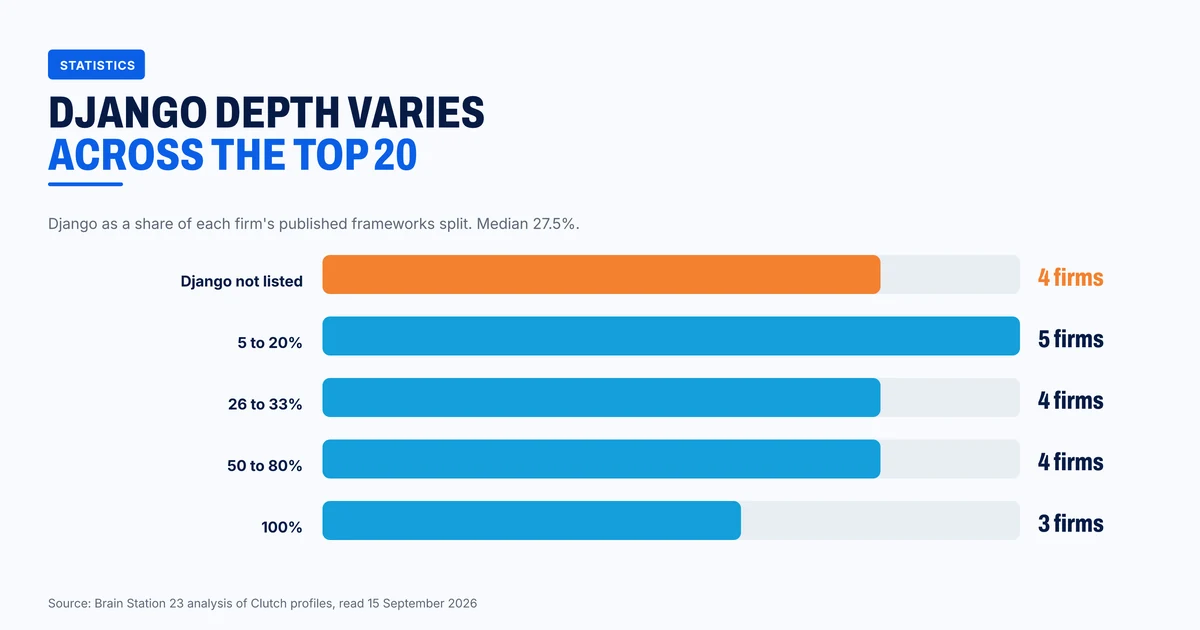
The specialists are small and thinly reviewed. Seven firms put Django at 50 percent or more of their frameworks. Six of them have 10 to 49 staff, five have ten reviews or fewer, and together they hold 106 of the list’s 855 reviews. Four generalist firms hold 47 percent.
Prices sit in the mid-market. Published minimums run from $1,000 to $75,000, with a median of $25,000. Eight firms publish $50 to $99 an hour, eight publish $100 or more, and ten report a most common project of $50,000 or more.
Cost is the weakest score. Five firms score identically on all four sub-scores. Of the other fifteen, Cost is the lowest or joint-lowest for eleven and Schedule for seven. Imaginary Landscape’s Cost score of 3.7 and Crowdbotics’ Schedule score of 4.2 are the lowest individual sub-scores.
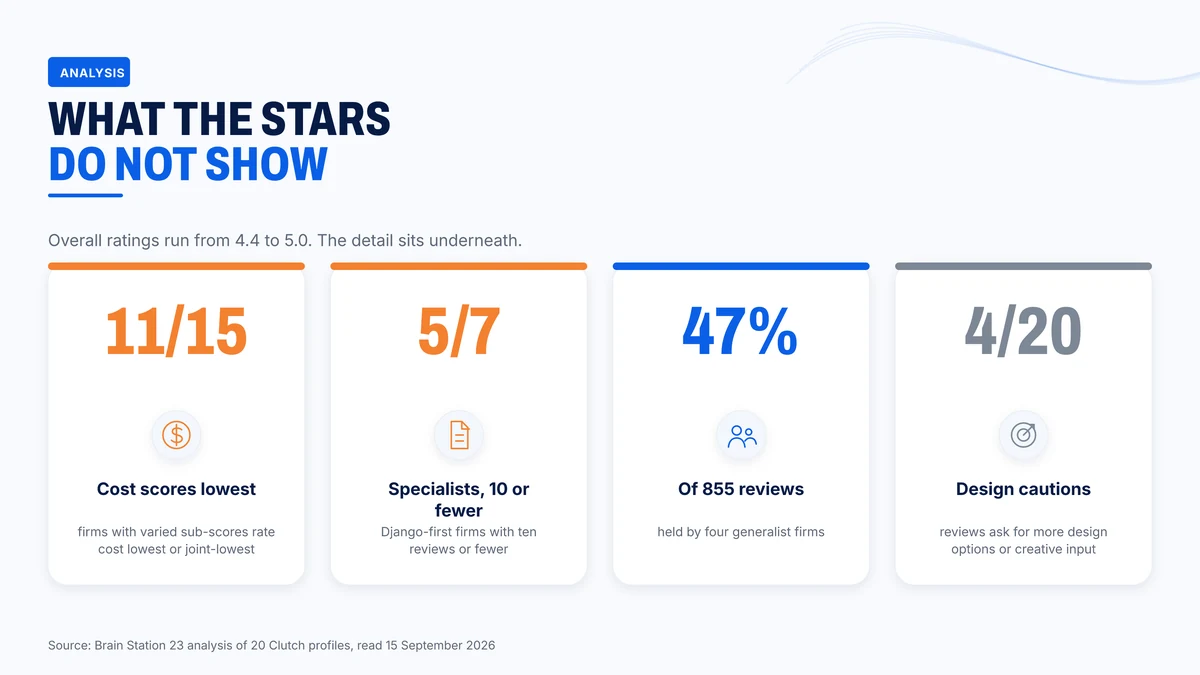
The cautions split three ways. Clutch’s review summaries flag timelines, estimates or budgets for four firms, communication, skill match or time zones for four, and design or creative input for four. Two have documentation cautions, and price, junior oversight, proactivity and QA come up once each. Two firms have no caution listed.
AI is now standard on the menu. Eleven of the twenty list an AI development service line. Seven list offices outside the US, in Latin America, Europe, South Asia, the Middle East, Australia and Canada.
How to shortlist a Django development company
Order the filters so the first one removes the most firms.
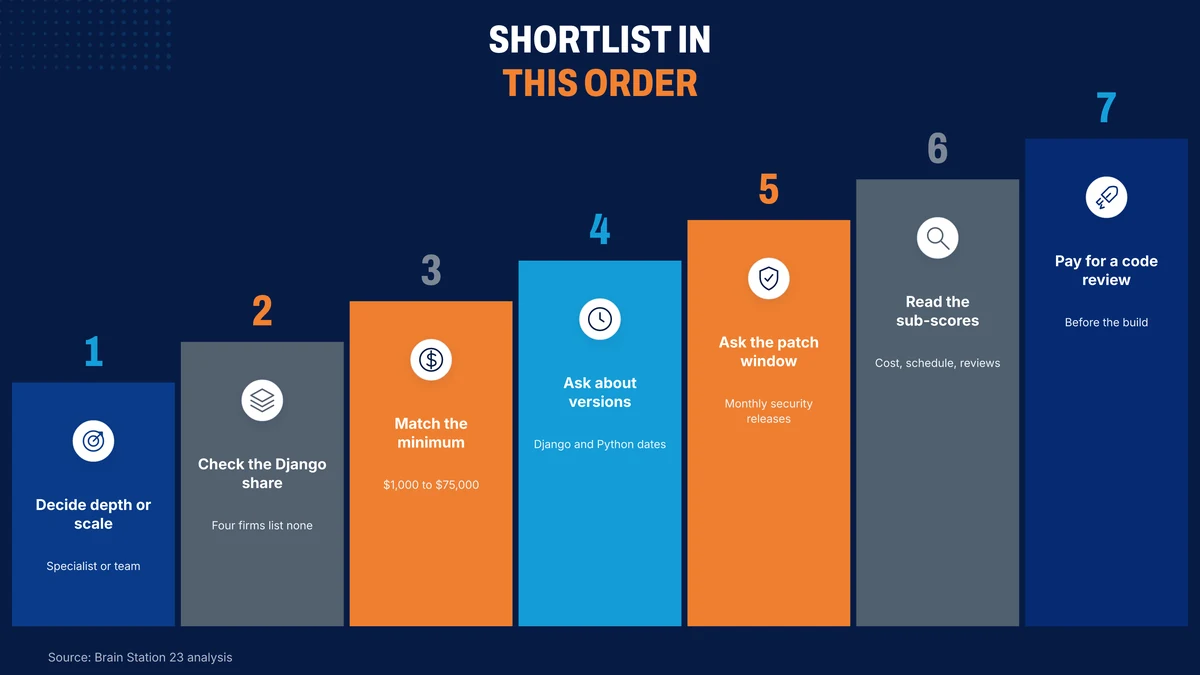
Step 1: Decide whether you need depth or scale. A Django-first studio suits an application you want designed and owned; a large firm suits adding several engineers to your own team.
Step 2: Check the Django share. Four firms here do not list Django in their frameworks. Ask any firm below 20 percent for Django projects from the last two years.
Step 3: Match your budget to the minimum. Published minimums run from $1,000 to $75,000, so this step removes much of the list.
Step 4: Ask which Django and Python versions they deliver on. A serious vendor starts new work on a supported release and has a plan for the next LTS.
Step 5: Ask about the patch window. Django shipped security releases in every month from February to August 2026. Ask how fast they reach production.
Step 6: Read the weak sub-scores and review counts. Cost is the lowest sub-score for eleven of the fifteen firms with varied scores, and five of the seven Django-first firms have ten reviews or fewer.
Step 7: Pay for a code review or discovery phase. A fixed-fee review of your codebase shows how the firm reads Django before you commit.
How to buy Django development: four engagement models
The engagement model decides who pays when the data model changes halfway through.
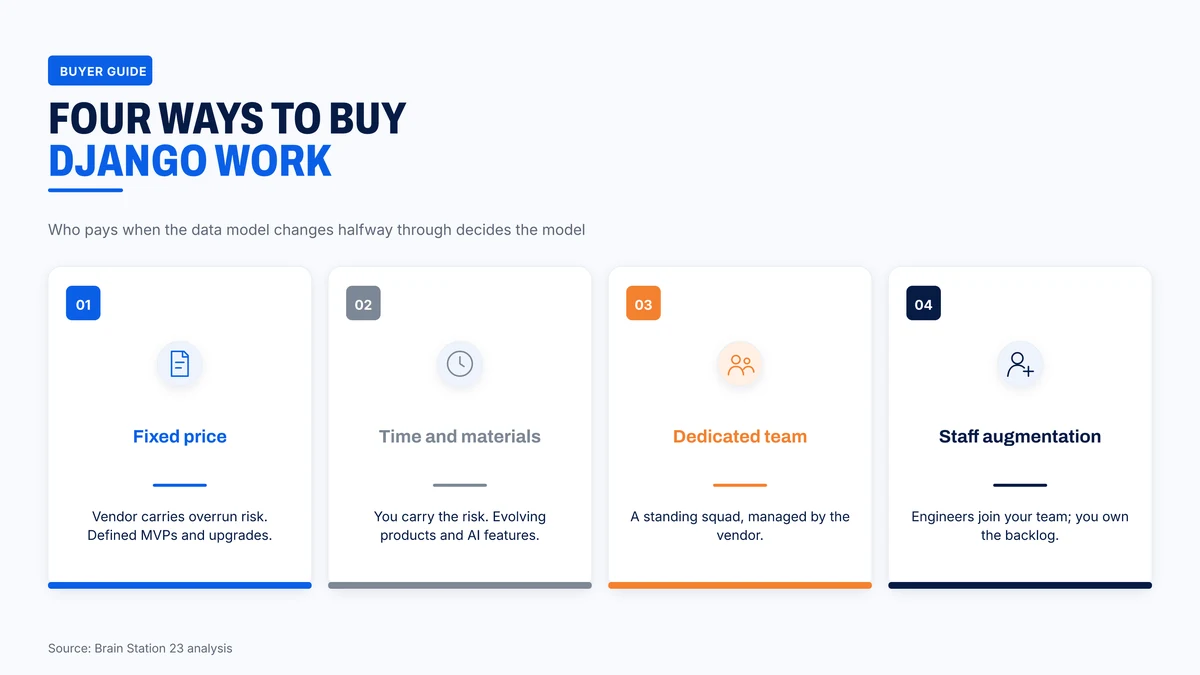
Fixed price moves overrun risk to the vendor, who prices it in. It suits a defined MVP or a version upgrade with good test coverage. It fails when requirements are still being discovered.
Time and materials keeps the risk with you. It suits evolving products and AI features whose scope is unclear. Cap each phase and review burn every week.
Dedicated team gives you a standing squad that the vendor manages. It suits a long product roadmap. It fails if the vendor rotates senior engineers off the team.
Staff augmentation adds engineers to your team. BairesDev, Vention, Toptal and Brain Station 23 publish staff augmentation lines. It fails when nobody in-house owns architecture and the backlog.
The technical question: keeping a Django application current
Most Django work is on applications that already exist. The order of the upgrade steps decides whether it is routine or a rewrite.
The steps, in the order that keeps them safest:
Step 1: Record versions and dates. Note the Django, Python and database versions in production, and the date each loses support (Django supported versions; Python Developer’s Guide).
Step 2: Build or repair the test suite. Upgrades without tests move bugs into production. Cover authentication, permissions, payments and the admin first.
Step 3: Pin and scan dependencies. List every package with its version, and check Django REST framework, Celery and other key packages for support of the target release.
Step 4: Clear deprecation warnings on the current version. Django raises deprecation warnings before it removes a feature, so fix them before changing versions.
Step 5: Move one LTS at a time. Go from 3.2 to 4.2 to 5.2, running the suite at each stop, rather than jumping several releases at once.
Step 6: Upgrade Python with it. Move to Python 3.12 or newer, which is supported to October 2028 or later (Python Developer’s Guide).
Step 7: Put the next date in the calendar. 5.2 LTS support ends in April 2028; plan the move to 6.2 LTS well before then.
Red flags: eight answers to walk away from
Some answers in a sales call should end it, or at least move a firm down the list.
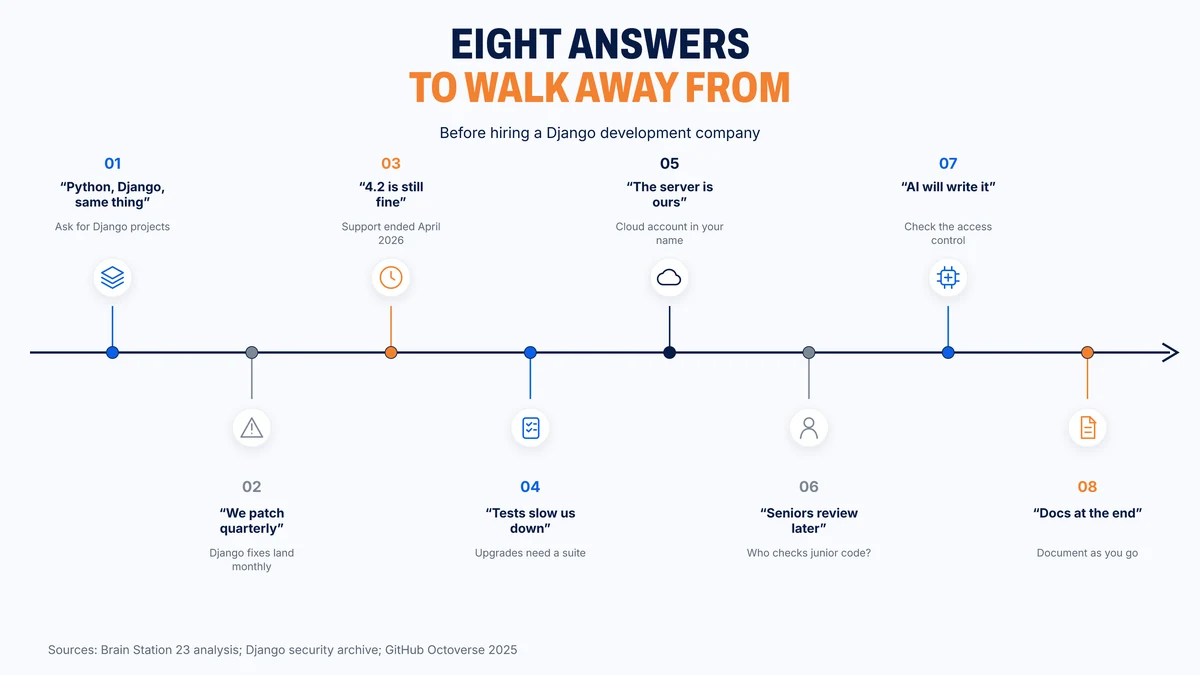
“Python, Django, it’s the same thing.” Ask for Django projects specifically, with the versions used.
“We apply patches quarterly.” Django shipped security fixes every month from February to August 2026.
“Django 4.2 is still fine.” Its extended support ended on 7 April 2026.
“Tests slow us down.” Without a test suite, every upgrade is a gamble.
“The server and database are on our account.” The cloud account, database and backups belong in your company’s name.
“Our seniors will review it later.” Ask who reviews junior code before it merges.
“AI will write most of the code.” GitHub reports that broken access control now leads the vulnerability types it sees in Python, and notes that AI-assisted coding sometimes scaffolds endpoints without the auth checks they need (GitHub Octoverse 2025).
“We’ll write the documentation at the end.” Two firms here have documentation cautions. Document as the work goes.
After launch: what the build quote leaves out
The list tells you who can build a Django application. This part covers what owners wish they had settled before the final invoice, and what recurs for as long as the application runs.
What you must own before the final invoice
The repository with its full history, not a zip, including migrations, fixtures and infrastructure code.
The cloud account, database and backups, under your company’s billing, with the agency added as a user you can remove.
Secrets and settings, including the SECRET_KEY, API keys and environment variables, stored in a vault you control and rotated at handover.
Domain, DNS and email sending accounts, in your name.
Third-party accounts, such as payment, error-monitoring, email and AI model providers, under your billing.
A runbook, covering deployments, migrations, background workers, scheduled jobs and how to restore from backup.
The bill that arrives after launch
The build quote covers the application. The rest recurs.
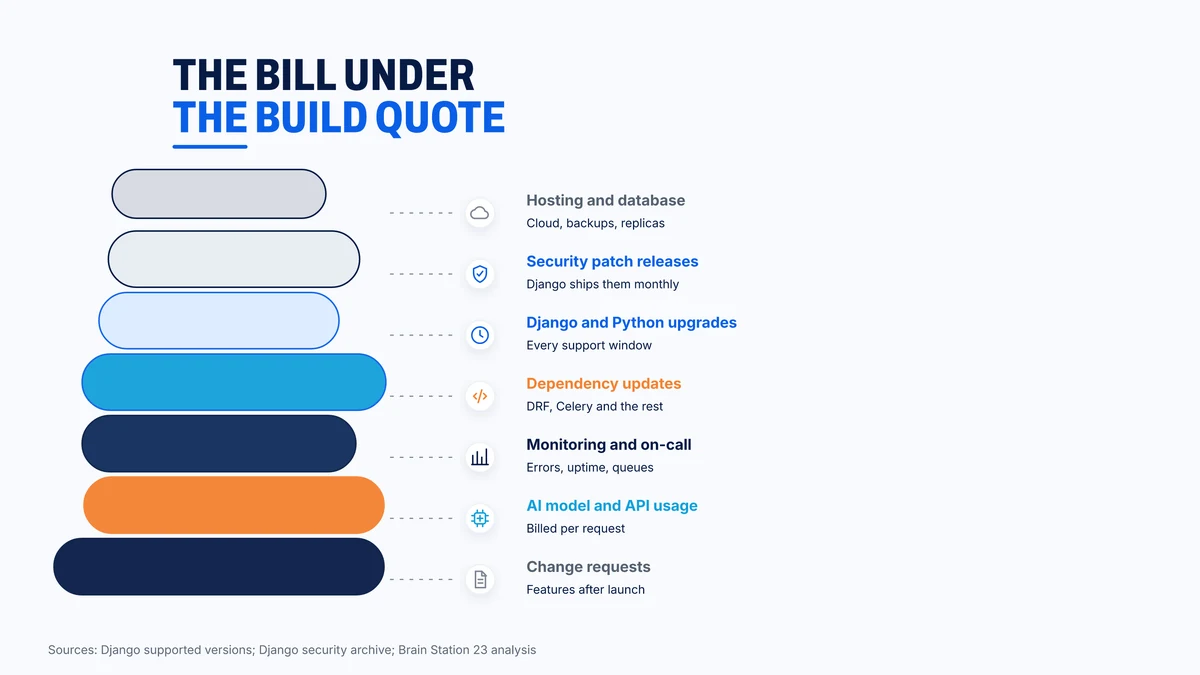
The recurring lines are hosting and the database, security patch releases, Django and Python upgrades at each support window, dependency updates, monitoring and on-call cover, AI model and API usage where the app calls a model, and change requests. Get the retainer price in writing before signing the build, and compare vendors on three years of cost.
Security is a recurring cost
Django’s own archive shows the workload rising. It lists 12 security issues fixed in 2025 and 28 fixed between February and August 2026, with security releases in every one of those seven months (Django security archive).
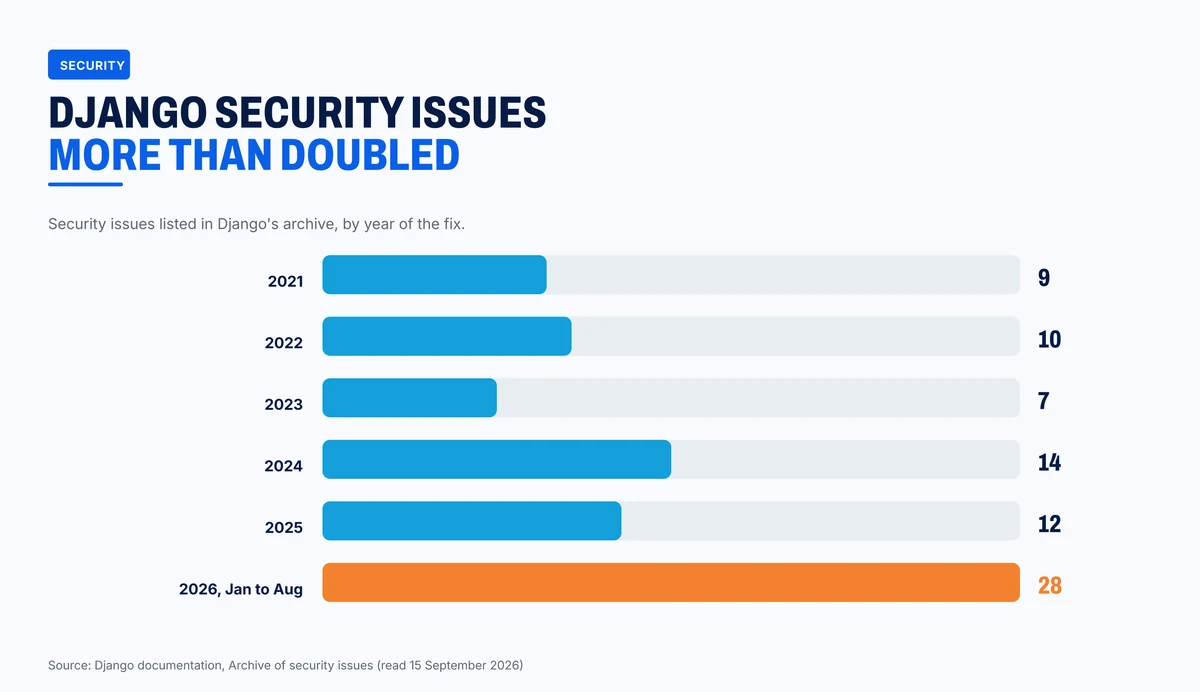
A monthly release cadence means a quarterly maintenance window leaves known flaws in production for weeks. The average US data breach cost a record USD 11.5 million in IBM’s 2026 report (IBM Cost of a Data Breach Report 2026). Ask vendors how many days a Django security release takes to reach production, who watches the Django security announcements, and how dependencies are scanned between releases.
Accessibility is legal exposure
Public-facing Django sites carry the same accessibility risk as any other. More than 5,000 digital accessibility lawsuits had been filed by the end of 2025 (UsableNet), and WebAIM found detected WCAG 2 failures on 95.9 percent of the top million home pages in 2026 (WebAIM Million 2026).
Name WCAG 2.2 AA in the contract rather than the word “accessible”. Test forms, the customer-facing admin screens and any htmx or JavaScript interactions with a keyboard and a screen reader.
Contract clauses that surface in month nine
These rarely come up in a sales call and often decide the relationship later. This is not legal advice; have your own counsel review any agreement.
IP assignment on payment, covering code, migrations, infrastructure scripts and design files.
Account ownership, naming the cloud account, database, domain, secrets vault and third-party services as yours.
Patch terms, stating how many days a Django or Python security release takes to reach production.
Version responsibility, stating who tracks Django and Python support dates and when they must warn you.
Code review and seniority, naming the minimum seniority of reviewers and who can merge to production.
Transition assistance, a fixed number of hours at an agreed rate if you move vendors.
Rate escalation caps, subcontracting disclosure, liability caps and insurance, and non-solicitation in both directions.
How to leave without losing the codebase
Confirm ownership of the repository, cloud account and secrets first. Record walkthroughs of the data model, background jobs, deployment pipeline and any AI integrations while relations are cordial.
On the last day, remove the agency’s repository, cloud and admin access, rotate the Django SECRET_KEY, database passwords and every API key, and revoke deploy keys and CI tokens.
Hire in-house or hire a Django development company
Start with the wage. ZipRecruiter puts a US Django developer at $120,633, and Glassdoor reports $130,666 in average total pay for a Python developer (ZipRecruiter, Glassdoor). A single hire at those figures costs more each year than the most common project size reported by ten of the twenty firms, before benefits.
Hire in-house when the application is the product, changes every week, and you can keep at least two engineers who know the data model.
Hire a Django development company for a new build, a version upgrade, an AI feature or a code review you cannot staff. Keep the repository and cloud accounts in your name so the choice stays reversible.
Combine the two when you have a lead engineer but need extra capacity or specialist help with upgrades, security or AI.
FAQ
How much do US Django development companies charge?
The twenty firms here publish hourly bands from under $25 to $300, and eight publish $50 to $99. Published minimum projects run from $1,000 to $75,000, with a median of $25,000 (Clutch).
Which Django version should a new project use?
A supported one with a long runway. Django 5.2 LTS has extended support to April 2028, and 6.2 LTS is planned for April 2027 with support to April 2030 (Django).
Is Django 4.2 still supported?
No. Extended support for Django 4.2 LTS ended on 7 April 2026, so it no longer receives security fixes (Django).
Which Python version does Django need?
Use a supported Python release. Python 3.10 reaches end of life in October 2026 and 3.11 in October 2027, while 3.12 is supported to October 2028 (Python Developer’s Guide). Check Django’s release notes for the Python versions each release supports.
How often does Django release security fixes?
Django’s archive lists 28 security issues fixed between February and August 2026, with a security release in each of those months, against 12 in all of 2025 (Django security archive).
What does a Django developer earn in the US?
ZipRecruiter reports $120,633 for a Django developer and $115,107 for a Python Django developer as of 14 September 2026 (ZipRecruiter). PayScale’s $91,180 Python developer figure rests on 79 profiles.
Is Django still popular?
Python is growing: GitHub counted 2.6 million Python contributors in 2025, up 48 percent in a year (GitHub Octoverse 2025). The Django Developers Survey drew about 4,600 respondents (Django Developers Survey 2025).
Do Django agencies also build AI features?
Most on this list do. Eleven of the twenty firms list an AI development service line on Clutch (Clutch profiles).
Conclusion
The data behind this Top 20 Django Development Companies in USA list says three things. Django depth is uneven: the median firm puts Django at 27.5 percent of its frameworks, and the true specialists are small and thinly reviewed. Prices sit in the mid-market, around a $25,000 median minimum. And reviewers mark cost lower than anything else.
Any of the twenty can ship a Django application. What decides the next three years is the calendar: which Django and Python versions it runs on, how fast each monthly security release reaches production, whether there are tests to make upgrades safe, and whether the repository, cloud account and secrets are in your name on the day you choose someone else.
Sources
- https://clutch.co/us/developers/python-django?sort_by=ClutchRank
- https://clutch.co/profile/brain-station-23
- https://www.djangoproject.com/download/
- https://docs.djangoproject.com/en/dev/releases/security/
- https://devguide.python.org/versions/
- https://lp.jetbrains.com/django-developer-survey-2025/
- https://github.blog/news-insights/octoverse/octoverse-a-new-developer-joins-github-every-second-as-ai-leads-typescript-to-1/
- https://survey.stackoverflow.co/2025/technology
- https://w3techs.com/technologies/details/pl-python
- https://www.payscale.com/research/US/Job=Python_Developer/Salary
- https://www.ziprecruiter.com/Salaries/Django-Developer-Salary
- https://www.ziprecruiter.com/Salaries/Python-Django-Developer-Salary
- https://www.glassdoor.com/Salaries/python-developer-salary-SRCH_KO0,16.htm
- https://www.bls.gov/ooh/computer-and-information-technology/software-developers.htm
- https://www.ibm.com/reports/data-breach
- https://blog.usablenet.com/ada-web-lawsuit-trends-2026
- https://webaim.org/projects/million/