
Six of the twenty highest-ranked web development firms in the United States publish no front-end framework at all.
That is the first thing the data behind this Top 20 Front End Development Companies in USA guide shows, and it follows from how the list had to be built. Clutch has no front-end category, so the twenty come from its US web developers directory of 17,665 firms, in Clutch Rank order with paid rows removed. Six of them are WordPress and design agencies. Three put React, Next.js or Angular at 90 percent or more of their framework split.
Both kinds can ship a good website. They ship different front ends.
The difference shows up in the browser. Only 48 percent of mobile websites passed all three Core Web Vitals in 2025 (HTTP Archive Web Almanac), and 95.9 percent of the top million home pages had detected WCAG 2 failures in 2026 (WebAIM). A framework badge fixes neither.
This guide measures each firm’s published front-end focus and prices the work. It then covers what a launch quote leaves out: whose accounts hold the design files and the CDN, what it costs to stay fast, and which contract clauses decide whether you can change agencies without starting again.
Key takeaways
- 6 of 20 of Clutch’s top-ranked US web developers list no front-end framework in their published split; all six build mainly on WordPress, Drupal or Webflow (Brain Station 23 analysis of Clutch profiles, read 14 September 2026).
- 35% is the median share of React, Next.js, Angular and Vue in the twenty firms’ framework splits; only three reach 90% or more (Clutch profiles).
- 48% of mobile websites had good scores on all three Core Web Vitals in July 2025, up from 44% a year earlier (HTTP Archive Web Almanac 2025).
- $89,372 to $110,412 is what salary sites report for the same US front-end developer title in 2026, a $21,040 spread (PayScale, ZipRecruiter).
- $25 to $300 an hour is the range of bands the twenty firms publish; nine sit under $100 and seven at $150 or more (Clutch profiles).
- CVSS 10.0 was the severity of the unauthenticated remote code execution flaw in React Server Components disclosed on 3 December 2025 (React).
- 95.9% of the top million home pages had detected WCAG 2 failures in 2026, with low-contrast text on 83.9% (WebAIM Million 2026).
- 13 of 17 firms whose Clutch sub-scores differ have Cost as their lowest or joint-lowest score (Clutch profiles).
Front-end work in 2026: most sites still miss the speed bar
Google grades the front end with three Core Web Vitals: how quickly the main content appears (Largest Contentful Paint, LCP), how quickly the page responds to a tap or click (Interaction to Next Paint, INP), and how much the layout jumps while loading (Cumulative Layout Shift, CLS). INP replaced First Input Delay as a Core Web Vital on 12 March 2024, and a good score means at least 75 percent of interactions respond in under 200 milliseconds (web.dev).
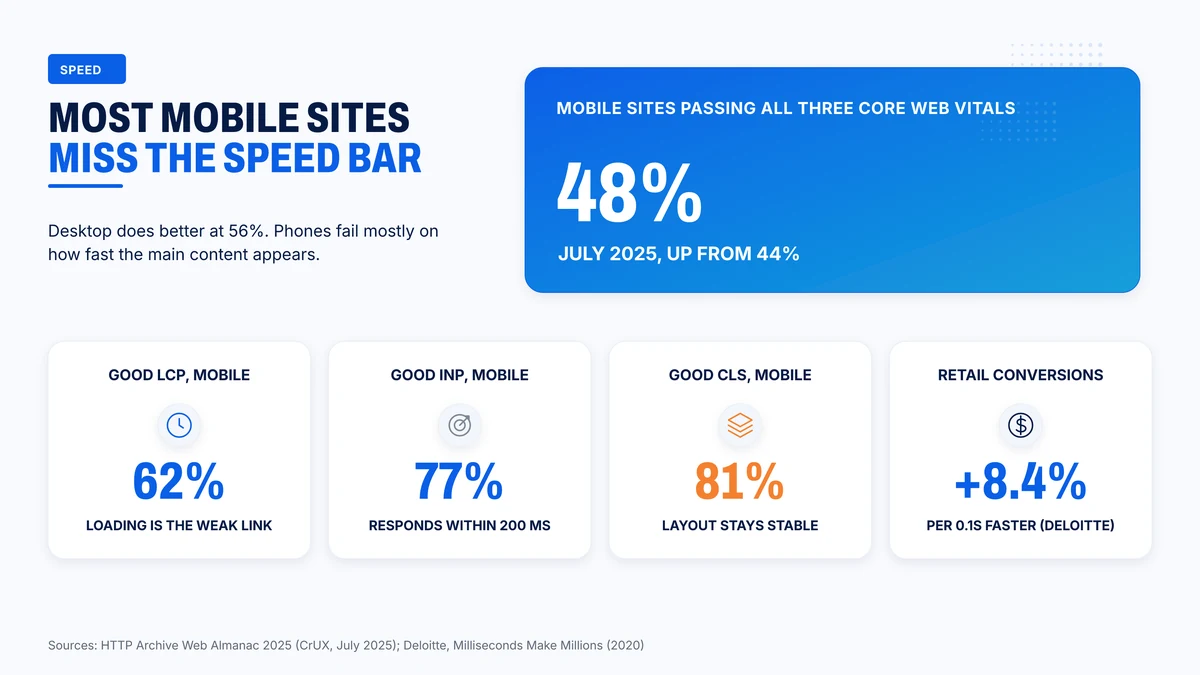
Pass rates are lower than most buyers assume. In July 2025, 48 percent of mobile websites had good scores on all three metrics, up from 44 percent in 2024, and 56 percent of desktop websites did (HTTP Archive Web Almanac 2025). Loading is the weak link on phones: 62 percent of mobile sites had a good LCP, against 77 percent for INP and 81 percent for CLS.
Page weight is part of the reason. The median mobile page in the 2024 crawl shipped 558 KB of JavaScript, and 206 KB of that, 44 percent, went unused during page load (HTTP Archive Web Almanac 2024). A phone downloads and parses those bytes before the visitor can do anything.
Slow pages cost revenue, not just scores. In Deloitte’s study of mobile sites in Europe and the US, a 0.1 second speed improvement lifted retail conversions by 8.4 percent and travel conversions by 10.1 percent (Deloitte, Milliseconds Make Millions). The study ran for four weeks in 2020, so read the size of the effect as directional.
Framework use is concentrated. In the 2025 Stack Overflow survey, 44.7 percent of respondents used React, 20.8 percent Next.js, 18.2 percent Angular and 17.6 percent Vue.js, while 23.4 percent still used jQuery and 43.6 percent wrote TypeScript (Stack Overflow Developer Survey 2025). A framework is a hiring decision as much as a technical one. It decides who can maintain the interface once the agency has gone.
So brief for outcomes the browser can measure. Put target LCP, INP and CLS values in the requirements, measured on real mobile visitors rather than a lab test, and ask each vendor how it would reach them with your content and your third-party scripts, not a demo page.
What front-end development costs in the US
Salary data for this role disagrees more than it does for most.
PayScale reports an average base salary of $89,372 for a front-end developer or engineer across 1,908 profiles (PayScale, updated 1 June 2026). Salary.com puts the average at $92,184 as of 1 September 2026, with the middle half earning $85,893 to $100,497 (Salary.com). The Bureau of Labor Statistics median for web developers was $92,650 in 2025 (BLS). ZipRecruiter reports $110,412 as of 14 September 2026 (ZipRecruiter).
That is a $21,040 gap for one job title.
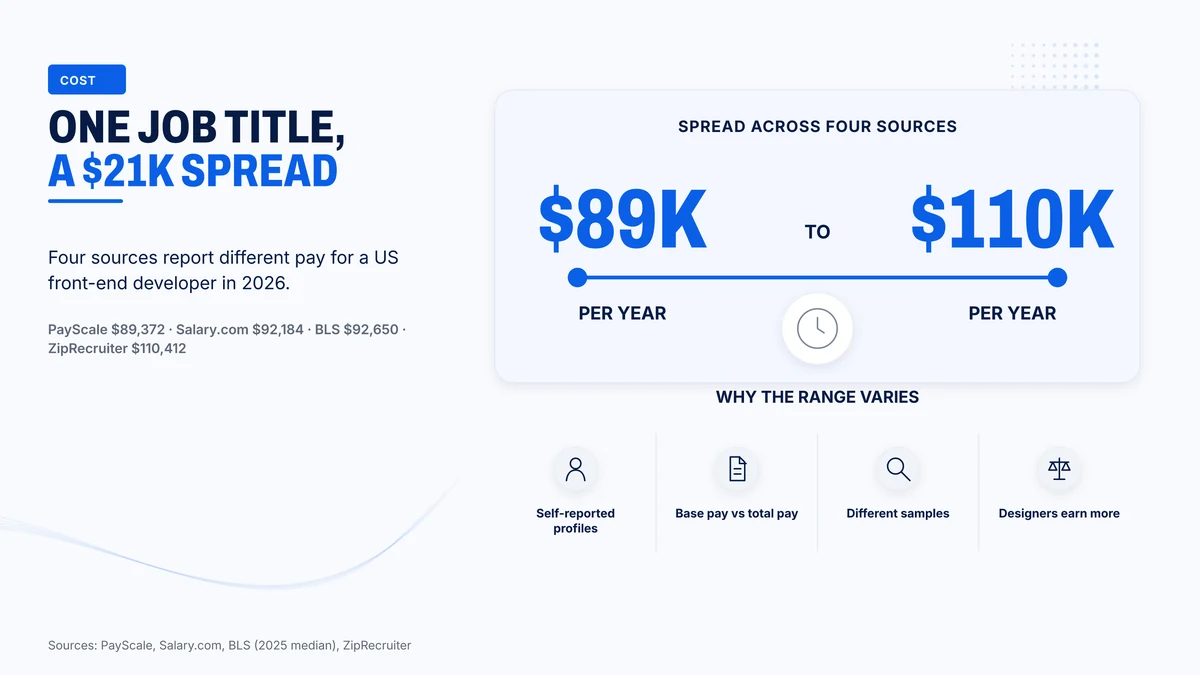
The samples plainly differ. ZipRecruiter’s 25th percentile, $104,000, sits above the average at every other source, and PayScale’s figure is base pay from self-reported profiles. Do not pick a winner. Use the spread to test whether a vendor’s rate assumptions are reasonable.
The title also hides two jobs. BLS reports a median of $104,000 for web and digital interface designers, $11,350 more than for web developers (BLS). A front-end quote that includes UX and visual design is buying the more expensive half of the work.
Agency pricing spreads further. The twenty firms below publish hourly bands from $25 to $49 up to $200 to $300 (Clutch profiles, read 14 September 2026). The low bands belong mostly to engineering firms with teams in Eastern Europe, India or Latin America. The top bands belong to US design and marketing agencies whose hour includes strategy, content planning and account management.
Eight factors decide most of the number.
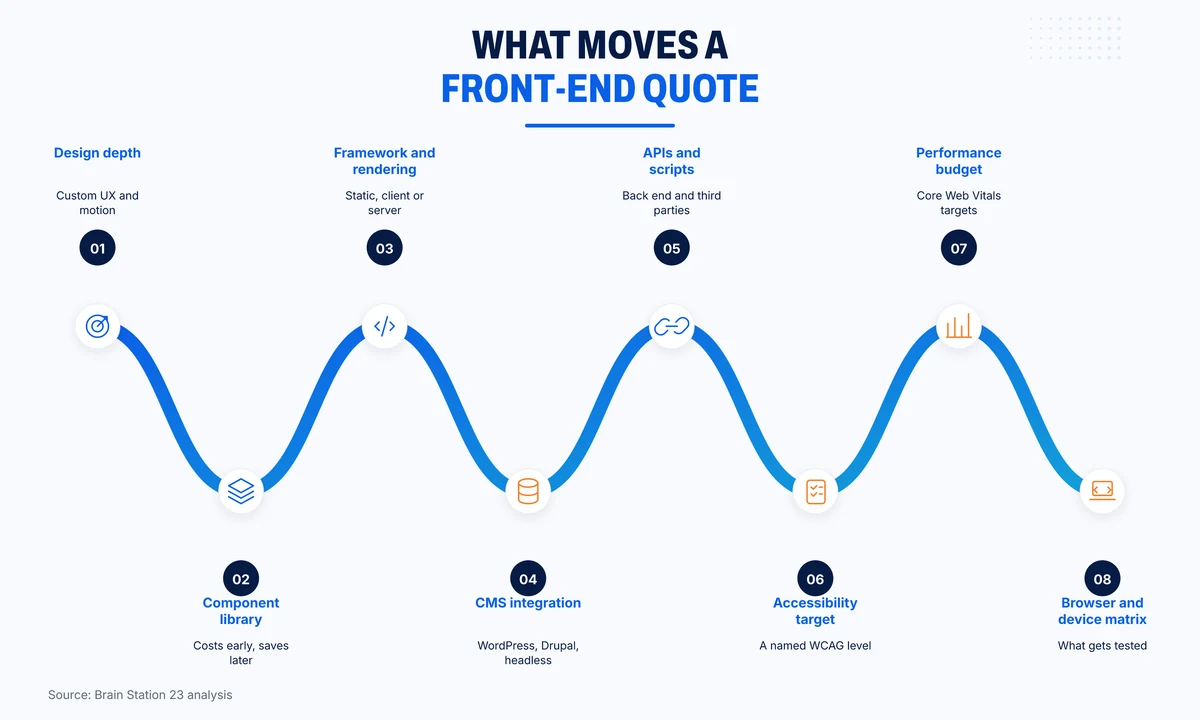
Design depth comes first, because custom interaction design and motion multiply build hours. A component library or design system costs more at the start and less on every later page. Framework and rendering choice follows: a server-rendered Next.js application is priced differently from a static marketing site. CMS integration, APIs and third-party scripts add scope. The accessibility standard and the performance budget are the two lines most often left out of a quote and added back as change requests. The browser and device matrix finishes the list. Ask every vendor to price those eight lines separately and the $40 and $200 quotes become comparable.
The Top 20 Front End Development Companies in USA, compared
Clutch has no front-end category or front-end focus filter, so we used its US web developers directory sorted by Clutch Rank, read on 14 September 2026. It lists 17,665 firms. Fifteen of the first 35 rows were paid placements, fourteen marked featured and one marked sponsor, and we removed all of them. Cleveroad appeared both as a paid row and in its organic position; we kept the organic position. Firms 2 to 21 below are the first 20 organic rows, in order.
Brain Station 23 is placed first because we publish this article. We are US-headquartered and Premier Verified on Clutch, but Web Development is not one of our published service lines and front-end frameworks are 16 percent of our framework split, so the directory’s ranking did not place us in its top 20 and we are not claiming it did.
Because the directory ranks web developers in general, we measured front-end focus ourselves: the combined share of React, Next.js, Angular, Vue and Gatsby in each firm’s published framework split. React Native is excluded because it builds mobile apps. Every overall rating sits between 4.8 and 5.0, so the stars do not separate these firms. The columns below do.
| # | Company | Best For | Team Size | Front-End Focus | Key Tech Stack | Industries Served | Locations |
|---|---|---|---|---|---|---|---|
| 1 | Brain Station 23 — brainstation-23.com | Adding Angular or Vue engineers to a front-end team you already lead | 250 – 999 | 16% (Angular, Vue); staff augmentation 60% | Java, Spring, .NET, Flutter, Angular, Vue, Node.js | Retail, medical, telecoms, education, financial services | Springfield VA; Bangladesh, UAE, England, Malaysia, Germany |
| 2 | Cleveroad — cleveroad.com | Education products that need web, mobile and TypeScript front ends from one large team | 250 – 999 | 30% (Next.js, Vue, Gatsby); TypeScript 30% of languages | TypeScript, .NET, Flutter, Next.js, Vue, Gatsby | Education, financial services, IT, insurance, medical | New York; Kharkiv, Dnipro, Krakow |
| 3 | Suffescom Solutions — suffescom.com | Fintech and healthcare apps where mobile and web launch together | 250 – 999 | 35% (Next.js, Angular, React, Vue) | Next.js, Node.js, React Native, Angular, Laravel, Kotlin | Financial services, medical, real estate, e-commerce | New York, Wilmington DE; Mohali, Dubai, London, Sydney |
| 4 | FocusReactive — focusreactive.com | Headless CMS and Next.js sites for small businesses | 10 – 49 | 90% (Next.js 70%, React 20%) | Next.js, React, TypeScript, Sanity, Shopify | E-commerce, media, financial services, education | London; Warsaw, New York |
| 5 | INOXOFT — inoxoft.com | Fintech and edtech web apps on React at a low rate band | 50 – 249 | 35% (React) | React, Node.js, TypeScript, Python, Flutter | Financial services, education, real estate, automotive | Newark DE; Wroclaw, Lviv |
| 6 | BairesDev — bairesdev.com | Enterprises adding nearshore engineers across several stacks at once | 1,000 – 9,999 | 30% (Angular, React, Vue) | .NET, React Native, Angular, React, Vue, PHP, Java | IT, financial services, medical, advertising | San Francisco; Buenos Aires, Sao Paulo, Mexico City, Bogota, Barcelona |
| 7 | Scopic — scopicsoftware.com | Healthcare and manufacturing software with a web front end beside AI work | 250 – 999 | 32% (React, Angular) | React, .NET, Node.js, React Native, C++ | Medical, automotive, manufacturing, education | Marlborough MA |
| 8 | Social Driver — socialdriver.com | Healthcare and nonprofit organisations redesigning a WordPress, Drupal or Webflow site | 10 – 49 | None listed | WordPress, Drupal, Webflow | Medical, nonprofit | Washington DC, Detroit, Bellingham, Kansas City, Chicago |
| 9 | Urban Insight — urbaninsight.com | Cultural and nonprofit organisations wanting a Drupal site with React components | 10 – 49 | 100% (React, alongside Drupal) | Drupal, React, PHP, WordPress | Arts and entertainment, nonprofit, education, government | Los Angeles |
| 10 | Swovo — swovo.com | Healthcare web and mobile apps from a small Colorado team | 10 – 49 | 25% (React) | React, Node.js, React Native, Ruby on Rails, TypeScript | Medical, financial services, energy, legal | Boulder, Denver |
| 11 | Lounge Lizard — loungelizard.com | Mid-market brands wanting a WordPress site, branding and marketing from one agency | 50 – 249 | None listed | WordPress, PHP, JavaScript | E-commerce, financial services, education, real estate | New York plus ten US offices |
| 12 | Bilberrry — bilberrry.com | Government, nonprofit and enterprise web platforms from a small senior team | 10 – 49 | 60% (React 53%, Angular 7%) | React, Node.js, WordPress, Adobe Experience Manager | Government, nonprofit, consumer products, education | Seattle |
| 13 | Collective42 — collective42.com | Mid-market companies wanting design, development and search marketing together | 10 – 49 | 50% (Next.js, React) | Next.js, React, Node.js, WordPress | Manufacturing, medical, business services, home services | Encinitas CA |
| 14 | Five Jars — fivejars.com | Nonprofits and education groups running Drupal sites | 10 – 49 | 40% (Next.js, React) | Drupal, Next.js, React, Laravel, Symfony | Nonprofit, education, arts and entertainment, medical | Brooklyn, Arlington VA; Warsaw |
| 15 | The Frontend Company — thefrontendcompany.com | Product teams that need a front-end specialist for React, Next.js or Angular | 10 – 49 | 100% (React 45%, Next.js 30%, Angular 25%) | React, Next.js, Angular, TypeScript | Financial services, advertising, IT, medical | Covina CA |
| 16 | Jahnel Group — jahnelgroup.com | Companies running Angular or Java web apps on AWS and Adobe Experience Manager | 50 – 249 | 45% (Angular 23%, React, Vue) | Angular, React, Vue, Java, Spring, Adobe Experience Manager | Business services, financial services, gaming, education | Schenectady, New York |
| 17 | Vincit — vincit.com | Consumer and retail brands building React and Next.js products with a strategy phase | 250 – 999 | 40% (React, Next.js) | React, Next.js, Node.js, React Native, TypeScript | Arts and entertainment, e-commerce, consumer products, retail | Irvine CA |
| 18 | LLT Group — llt-group.com | Manufacturers and B2B firms wanting a design-led WordPress website | 10 – 49 | None listed (.NET only) | WordPress, .NET, JavaScript, PHP | Manufacturing, business services, medical, logistics | Naperville IL, Los Angeles |
| 19 | Orbit Media Studios — orbitmedia.com | Mid-market B2B companies wanting a WordPress site built around conversion and content | 50 – 249 | None listed | WordPress, HubSpot, Drupal | Business services, manufacturing, education, financial services | Chicago |
| 20 | Freshy — freshysites.com | Small and mid-sized businesses wanting a WordPress site on a modest budget | 50 – 249 | None listed | WordPress, PHP, HTML5, jQuery | Business services, manufacturing, legal, nonprofit | Binghamton, Syracuse |
| 21 | HUEMOR — huemor.rocks | Construction and manufacturing companies wanting a WordPress site with branding | 10 – 49 | None listed | WordPress, PHP, JavaScript, Drupal | Construction, manufacturing, business services, contracting | Pittsburgh |
Team sizes, framework and language splits, industries and locations are from each firm’s published Clutch profile, read 14 September 2026. Front-End Focus is our calculation: the combined share of React, Next.js, Angular, Vue and Gatsby in the published framework split. “Best For” is our reading of that data. Engagement models and certifications are not published consistently across these profiles, so we have left them out rather than guess.
Profiles are grouped by the kind of buyer each firm suits, and the numbers match the table. Each caution comes from the Review Highlights that Clutch publishes from the firm’s verified reviews. Certifications are self-published and unverified by us; Clutch profiles do not carry ISO or CMMI certifications, which is why most profiles say to ask.
1. Brain Station 23
We publish this article and placed ourselves first, so read this entry as the publisher’s pick. The data does not flatter us on focus. Web Development is not one of our published Clutch service lines, and Angular and Vue together are 16 percent of our framework split, against a median of 35 percent for the twenty firms below. React, listed by thirteen of them, is absent from ours. Staff augmentation is 60 percent of what we sell, and only Cleveroad, Suffescom and INOXOFT match our $25 to $49 band. Our ISO 27001 and SOC 2 Type II controls apply to the dependency and account risks covered after the list. Reviewers score our Quality at 5.0 and have asked for tighter internal coordination. If you need a studio to own the design and the build, choose from the firms below.
Founded: 2006
US Presence: Springfield VA
Company size: Clutch band 250 to 999; we publish 900+ engineers
Rating: 4.9 across 21 Clutch reviews, HQ Springfield, Virginia
- Adding Angular or Vue engineers to a front-end team you already lead
- CMMI Level 3
- ISO 27001
- ISO 9001
- SOC 2 Type II (company-published)
- Staff augmentation
- Angular and Vue front ends
- E-commerce storefronts
- Application modernisation
- Managed application support
- Dedicated teams
- Retail
- Medical
- Telecoms
- Education
- Financial services
- Hospitality
- Ask for the front-end portfolio of the named engineers, not of the company
For front-end specialists and React-first builds
15. The Frontend Company
The Frontend Company is the only firm here whose Clutch description claims a single focus on front-end technologies and design, and its data agrees: every framework it lists is a front-end one, and JavaScript and TypeScript are its only languages. Staff augmentation is a quarter of its services. Its most common reviewed project is under $10,000, though one engagement ran to $200,000 or more. The caution Clutch records is onboarding: a client suggested the two sides learn each other’s processes earlier.
Founded: 2016
US Presence: Covina CA
Company size: 10 to 49
- Product teams that need a front-end specialist for React, Next.js or Angular
- Not published; ask directly
- React
- Next.js and Angular interfaces
- TypeScript
- UI and UX design
- Usability testing
- Front-end staff augmentation
- Financial services
- Advertising
- IT
- Medical
- Agree in week one how both teams’ processes and tools will fit together
4. FocusReactive
Next.js is 70 percent of FocusReactive’s framework split, the largest single-framework share on the list, and Sanity leads its CMS work. Small businesses make up 80 percent of its clients. London is its first-listed office, with New York one of three, so check working hours. Its 26 reviews mention timeliness most. Clutch’s summary says the team responds well to requests but could suggest optimisations more proactively. It suits a buyer with a clear brief for a headless site.
Founded: 2019
US Presence: London
Company size: 10 to 49
- Headless CMS and Next.js sites for small businesses
- Not published; ask directly (Clutch lists Next.js and React under “Certified in”)
- Next.js and React builds
- Headless CMS with Sanity
- Shopify storefronts
- Web design
- E-commerce
- Custom software
- E-commerce
- Media
- Financial services
- Education
- IT
- Medical
- Ask which performance and SEO improvements they would propose without being asked
12. Bilberrry
Bilberrry pairs a React-heavy framework split, 53 percent, with enterprise CMS work in WordPress and Adobe Experience Manager. Enterprises and mid-market companies each make up half its clients, unusual for a team under 50. Reviewers credit its responsiveness after launch and the performance and SEO gains that followed. The improvement Clutch lists is tooling: some clients wanted a fuller client-facing project management system. It fits a public-sector or enterprise buyer modernising an AEM or WordPress front end.
Founded: 2010
US Presence: Seattle
Company size: 10 to 49
- Government, nonprofit and enterprise web platforms from a small senior team
- Not published; ask directly
- React and Node.js web applications
- WordPress and Adobe Experience Manager builds
- API development
- Web design
- Staff augmentation
- Government
- Nonprofit
- Consumer products
- Education
- Financial services
- Manufacturing
- Ask which client-facing tool will hold tickets, decisions and files during the build
9. Urban Insight
React is the only framework Urban Insight lists, which gives it a 100 percent front-end share, but PHP is 70 percent of its languages and Drupal 78 percent of its CMS work. Read it as a Drupal studio that builds interfaces in React. It advertises website packages from $7,500 alongside a $50,000 project minimum. Its 37 reviews score 5.0 for Quality and Schedule. The gap reviewers name is design time: a few wanted more hours for refinement.
Founded: 2000
US Presence: Los Angeles
Company size: 10 to 49
- Cultural and nonprofit organisations wanting a Drupal site with React components
- Not published; ask directly
- Drupal and WordPress builds
- React components
- UX strategy
- Usability testing
- User research
- Digital strategy
- Arts and entertainment
- Nonprofit
- Business services
- Education
- Financial services
- Government
- Ask how many design hours the proposal includes for refinement
For web applications where the front end meets the product
5. INOXOFT
React and Node.js take 35 percent each of INOXOFT’s frameworks, with TypeScript at 30 percent of its languages. It is one of three firms here at $25 to $49 an hour, and its most common reviewed project is under $50,000. Financial services is 40 percent of its work. Communication is its top review mention. The caution is design breadth: some clients wanted more layout options early. If visual exploration matters, write the number of design directions into the statement of work.
Founded: 2014
US Presence: Newark DE
Company size: 50 to 249
- Fintech and edtech web apps on React at a low rate band
- Not published; ask directly
- React front ends
- Node.js
- TypeScript
- Flutter
- Custom software
- AI features
- Financial services
- Education
- Real estate
- Automotive
- IT
- Ask for two or three layout directions before design sign-off
7. Scopic
Scopic lists AI Development and Custom Software ahead of Web Development, which is 25 percent of its services. React leads its frameworks at 22 percent, and C++ appears in its languages, a sign of desktop and imaging work. Medical is 40 percent of its industries. Project management is its most frequent review mention, and Schedule is its lowest sub-score. Clutch’s summary records budget overruns or unexpected costs for some clients, so put regular budget reviews into the plan.
Founded: 2006
US Presence: Marlborough MA
Company size: 250 to 999
- Healthcare and manufacturing software with a web front end beside AI work
- Not published; ask directly
- React and Angular front ends
- Node.js
- .NET
- React Native
- AI development
- Cloud consulting
- Medical
- Automotive
- Manufacturing
- Education
- Media
- Ask how often the budget is reviewed and how an overrun is flagged
10. Swovo
Swovo spreads its frameworks evenly, with React, Node.js, React Native and Ruby on Rails at 25 percent each, and TypeScript is a quarter of its languages. Medical is half its industries, and it is one of five firms with a $50,000 minimum. Its clients split almost exactly into thirds by company size. Reviews score 5.0 overall. The caution is cost: some projects ran past early budget expectations, and clients asked for budget conversations sooner. It suits health products that need web and mobile together.
Founded: 2017
US Presence: Boulder, Denver
Company size: 10 to 49
- Healthcare web and mobile apps from a small Colorado team
- Not published; ask directly
- React and Node.js web apps
- React Native
- TypeScript
- UX research and usability testing
- AI features
- Staff augmentation
- Medical
- Financial services
- Consumer products
- Energy
- Legal
- Ask for a budget and timeline check at every milestone
16. Jahnel Group
Angular is Jahnel Group’s leading framework at 23 percent, with React and Vue at 11 each, and Java matches JavaScript at 30 percent of its languages. It is the only firm here with gaming among its top industries, at 20 percent. With 18 reviews it has the smallest review base on the list, so weigh its 5.0 rating accordingly. Clutch notes one client wanted proactive risk plans when resources ran short. It suits an enterprise Angular estate with a Java backend.
Founded: 2012
US Presence: Schenectady, New York
Company size: 50 to 249
- Companies running Angular or Java web apps on AWS and Adobe Experience Manager
- Not published; ask directly
- Angular front ends
- React and Vue
- Java and Spring
- Adobe Experience Manager
- AWS
- UX research
- Business services
- Financial services
- Gaming
- Education
- Manufacturing
- Medical
- Ask for a written plan covering what happens when a team member is unavailable
17. Vincit
Vincit leads with custom software at 45 percent, with web at 30 and mobile at 25, and React and Next.js make up 40 percent of its frameworks. Its $150 to $199 band and $50,000 minimum sit near the top of the list, and its Cost sub-score of 4.5 is the lowest of the twenty. Reviewers credit thorough discovery and integration work. Clutch’s summary says some clients wanted potential issues spotted earlier. It fits a brand that wants a consultative start and has budget for it.
Founded: 2007
US Presence: Irvine CA
Company size: 250 to 999
- Consumer and retail brands building React and Next.js products with a strategy phase
- Not published; ask directly
- React and Next.js front ends
- Node.js
- React Native
- Discovery and consulting
- API and systems integration
- Arts and entertainment
- E-commerce
- Consumer products
- Media
- Retail
- Financial services
- Ask how the team raises risks before they turn into issues
For larger teams and lower rate bands
2. Cleveroad
Cleveroad spreads its front-end frameworks thinly: Gatsby, Next.js and Vue take 10 percent each, behind .NET at 30. TypeScript, at 30 percent of its languages, is the stronger front-end signal. Education is half its industry mix. Across 81 reviews the most frequent mention is high-quality work, and Clutch credits its testing process. The recorded caution is money: some clients said cost estimates could be more precise. It suits an edtech buyer wanting web and mobile from one team more than a brand site where design leads.
Founded: 2011
US Presence: New York
Company size: 250 to 999
- Education products that need web, mobile and TypeScript front ends from one large team
- Not published; ask directly
- TypeScript front ends
- Next.js
- Vue and Gatsby builds
- Custom web applications
- QA and testing
- Staff augmentation
- Education
- Financial services
- IT
- Insurance
- Medical
- E-commerce
- Ask for a line-item estimate and the process for approving changes to it
3. Suffescom Solutions
Suffescom splits its service mix evenly between mobile and web at 40 percent each, and its framework list is the widest here, from Next.js to Vue. It carries 121 reviews, the most of the twenty, with timeliness mentioned 53 times. The weakness Clutch’s summary records matters for front-end work: clients said the team delivered to specification but offered little creative input. Buyers arriving with approved designs will get the most from it. Buyers who want the agency to shape the interface should test that in a paid discovery phase.
Founded: 2013
US Presence: New York, Wilmington DE
Company size: 250 to 999
- Fintech and healthcare apps where mobile and web launch together
- Not published; ask directly
- Next.js
- Angular
- React and Vue front ends
- React Native apps
- Web applications
- AI features
- Blockchain
- Financial services
- Medical
- Real estate
- E-commerce
- Education
- Logistics
- Ask who proposes UX improvements, and budget design time for it
6. BairesDev
BairesDev is the only firm here with more than 1,000 staff, and Web Development is 15 percent of a service mix spread across ten lines. Half its clients are enterprises, and its $50,000 minimum is the joint highest on the list. Reviewers point to fast staffing and Latin American time zones that overlap with US hours. Clutch notes occasional language barriers and a need for clearer explanation of technical concepts. It suits a company with its own front-end lead that needs capacity, not a buyer looking for a design studio.
Founded: 2009
US Presence: San Francisco
Company size: 1,000 to 9,999
- Enterprises adding nearshore engineers across several stacks at once
- Not published; ask directly
- Staff augmentation
- React
- Angular and Vue front ends
- React Native
- Manual testing
- DevOps
- IT
- Financial services
- Medical
- Advertising
- Business services
- Consumer products
- Confirm how technical decisions are written down and shared across teams
For nonprofit, healthcare and mission-driven sites
8. Social Driver
Social Driver publishes no front-end framework. Its build work runs on WordPress, Drupal and Webflow, and it lists only two sectors, medical and nonprofit, split evenly. Enterprises are 45 percent of its clients, and its $150 to $199 band reflects a design and strategy team. Its 76 reviews lead on communication and project management. Clutch notes that some clients had early communication problems over scope and expectations, which were resolved quickly. Choose it for a mission-driven website redesign rather than a custom web application.
Founded: 2011
US Presence: Washington DC, Detroit, Bellingham, Kansas City, Chicago
Company size: 10 to 49
- Healthcare and nonprofit organisations redesigning a WordPress, Drupal or Webflow site
- Not published; ask directly
- Web design
- WordPress development
- Drupal
- Webflow
- Low-code builds
- Digital strategy
- Medical
- Nonprofit
- Agree scope and expectations in writing before design starts
14. Five Jars
Five Jars is a Drupal-first studio: Drupal is half its CMS work and PHP 40 percent of its languages, with Next.js and React at 20 percent each beside Laravel and Symfony. Nonprofit and education together make up 55 percent of its industries. It scores 4.9 on all four sub-scores across 32 reviews. Clutch’s summary records occasional time zone delays in communication or issue resolution. It suits a mission-driven organisation with an established Drupal estate.
Founded: 2017
US Presence: Brooklyn, Arlington VA
Company size: 10 to 49
- Nonprofits and education groups running Drupal sites
- Not published; ask directly
- Drupal development
- Next.js and React
- Laravel and Symfony
- Web design
- AI features
- Mobile apps
- Nonprofit
- Education
- Arts and entertainment
- Medical
- Legal
- Confirm the overlap hours with the part of the team based in Warsaw
For design-led and marketing websites
13. Collective42
Collective42 sells design and development at 35 percent each, with SEO and paid search making up the other 30. Next.js and React take half its framework split, and WordPress leads its CMS work. It is the only firm of the twenty whose Clutch summary reports no significant areas for improvement, and it scores 5.0 on Schedule, Cost and Willing to Refer. Its most common project is $10,000 to $49,999. Because marketing sits in the same contract, confirm the ad and analytics accounts are yours.
Founded: 2017
US Presence: Encinitas CA
Company size: 10 to 49
- Mid-market companies wanting design, development and search marketing together
- Not published; ask directly
- Web design
- Next.js and React builds
- WordPress
- SEO
- Paid search
- UX
- Manufacturing
- Medical
- Business services
- Consumer products
- Financial services
- Home services
- Ask who will own the SEO, analytics and ad accounts after the build
11. Lounge Lizard
Founded in 1998, Lounge Lizard is the oldest firm here and lists eleven US offices. WordPress is its only CMS, and it publishes neither a front-end framework nor an hourly rate. Web design and development take 45 percent each of its services. Its most common reviewed project is under $10,000, well below this list’s typical project. Schedule is its lowest sub-score. Clutch’s summary notes requests for fuller training materials and occasional communication lapses after launch, so price support separately.
Founded: 1998
US Presence: New York plus ten US offices
Company size: 50 to 249
- Mid-market brands wanting a WordPress site, branding and marketing from one agency
- Not published; ask directly
- Web design
- WordPress development
- Branding
- SEO
- E-commerce
- UX design
- E-commerce
- Financial services
- Education
- Real estate
- Manufacturing
- Telecoms
- Ask what training and post-launch support the fee includes
18. LLT Group
LLT Group publishes the highest band on the list, $200 to $300 an hour, while its most common reviewed project is $10,000 to $49,999. Web design is 45 percent of its services, WordPress is its only CMS, and .NET is its only framework. Manufacturing leads its industries at 30 percent. Its 89 reviews, the second highest count here, are strong on communication. Clutch’s summary also records timeline slips and communication breakdowns tied to personnel changes, so ask about team continuity.
Founded: 2010
US Presence: Naperville IL, Los Angeles
Company size: 10 to 49
- Manufacturers and B2B firms wanting a design-led WordPress website
- Not published; ask directly
- Web design
- WordPress development
- E-commerce
- .NET development
- SEO
- Branding
- Manufacturing
- Business services
- Medical
- Logistics
- Consumer products
- Ask who replaces a named team member if staff change mid-project
19. Orbit Media Studios
Orbit Media divides its services evenly between SEO, web design and web development, with conversion optimisation and HubSpot work alongside. WordPress is 90 percent of its CMS focus, and it names no front-end framework. Mid-market companies are 65 percent of its clients, and its $50,000 minimum is among the highest here. Its 36 reviews score 5.0. The caution is content: clients wanted more upfront guidance on the copy and assets they must supply, so put the content deadline first in the plan.
Founded: 2001
US Presence: Chicago
Company size: 50 to 249
- Mid-market B2B companies wanting a WordPress site built around conversion and content
- Not published; ask directly
- WordPress development
- Web design
- SEO
- Conversion optimisation
- HubSpot integration
- Landing page testing
- Business services
- Manufacturing
- Consumer products
- Education
- Financial services
- Medical
- Agree who writes the content, and when it is due
20. Freshy
Freshy has the lowest minimum on the list at $5,000, though its $150 to $199 band sits in the top tier. WordPress is its only CMS and PHP 60 percent of its languages, with jQuery listed beside JavaScript. Its most common reviewed project is under $10,000, and its 19 reviews score 4.9 on every measure. Clutch notes that one client found the first designs linear and received more engaging alternatives quickly. It fits a straightforward business website.
Founded: 2011
US Presence: Binghamton, Syracuse
Company size: 50 to 249
- Small and mid-sized businesses wanting a WordPress site on a modest budget
- Not published; ask directly
- WordPress development
- Web design
- Technical SEO
- Local search
- Mobile optimisation
- Business services
- Manufacturing
- Legal
- Nonprofit
- Government
- Medical
- Ask to see more than one design direction before choosing
21. HUEMOR
HUEMOR serves an unusual niche: construction and manufacturing account for 40 percent of its industries, and mid-market companies for 80 percent of its clients. WordPress is 90 percent of its CMS work, and it publishes no front-end framework. It has 72 reviews, and its most common reviewed project is $50,000 to $199,999. Schedule is its lowest sub-score at 4.6, and Clutch’s summary records early communication and timeline problems that the team then addressed. Get the first month’s plan in writing.
Founded: 2011
US Presence: Pittsburgh
Company size: 10 to 49
- Construction and manufacturing companies wanting a WordPress site with branding
- Not published; ask directly
- Web design
- WordPress development
- Branding
- Technical SEO
- UX strategy
- E-commerce
- Construction
- Manufacturing
- Business services
- Contracting
- Medical
- Ask for the launch timeline and the meeting rhythm for the first month
What the twenty profiles show
We tallied the published data behind every profile. None of it is a ranking. It shows what normal looks like, so an out-of-line quote stands out.
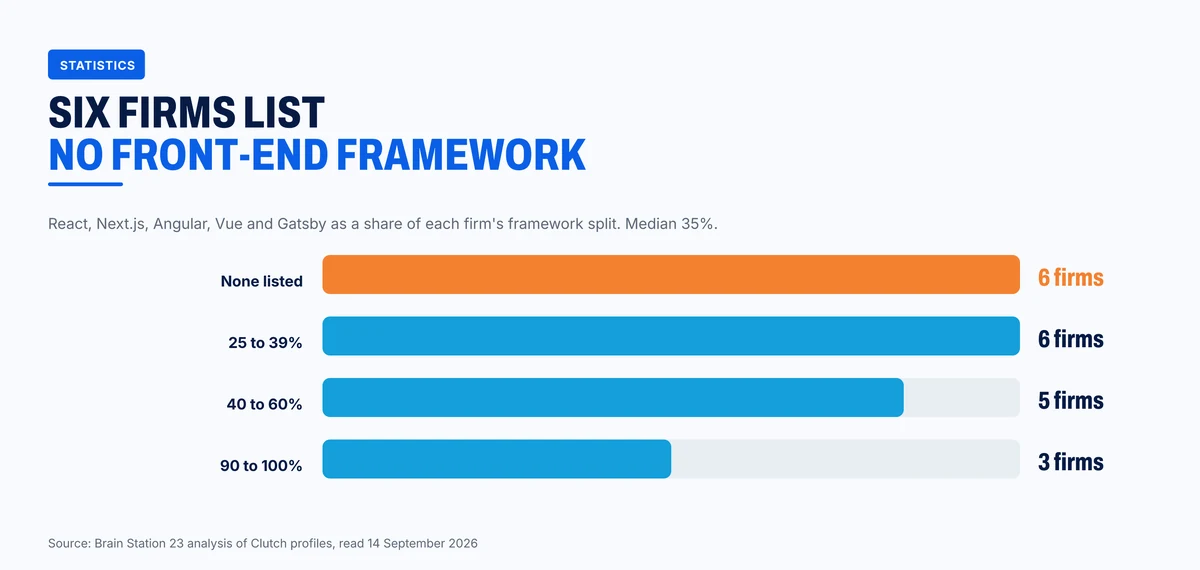
Front-end depth varies from none to total. The combined share of React, Next.js, Angular, Vue and Gatsby in each firm’s framework split runs from 0 to 100 percent, with a median of 35 percent. Six firms list none: Social Driver, Lounge Lizard, LLT Group, Orbit Media, Freshy and HUEMOR. Three reach 90 percent or more: The Frontend Company, Urban Insight and FocusReactive (Brain Station 23 analysis of Clutch profiles, read 14 September 2026).
React dominates, and WordPress is almost as common. Thirteen firms list React, seven Next.js, six Angular and four Vue. Seven list TypeScript. Twelve list WordPress, and for six of them it is 80 percent or more of their CMS work. This Top 20 Front End Development Companies in USA list therefore holds two markets: application front ends in React or Angular, and marketing websites on a CMS. Decide which you are buying before you read a single review.
Rates split into two tiers. Nine firms publish a band under $100 an hour, and seven publish $150 or more. Lounge Lizard publishes no rate. Minimums run from $5,000 to $50,000, with a median of $25,000, and twelve firms report $50,000 to $199,999 as their most common project size.
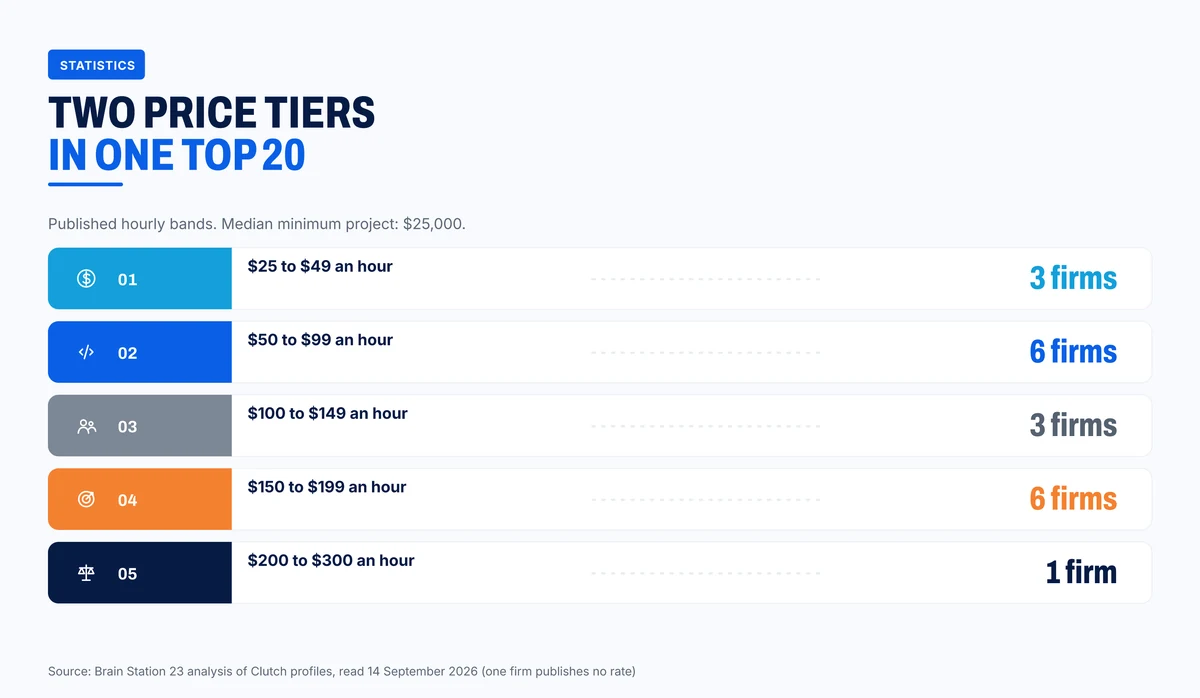
The top tier is almost entirely US design and marketing agencies: Social Driver, Urban Insight, Orbit Media, Freshy, HUEMOR and Vincit at $150 to $199, and LLT Group above them. Five of the six firms with offices outside the US, in Eastern Europe, India or Latin America, publish bands under $100.
Cost is the weak score. The twenty profiles carry 1,020 reviews between them, with a median of 36.5 per firm. Overall ratings run from 4.8 to 5.0. Suffescom, Five Jars and Freshy score identically on all four sub-scores. Of the other seventeen, Cost is the lowest or joint-lowest for thirteen, and Schedule is the lowest for Scopic, Lounge Lizard and HUEMOR.
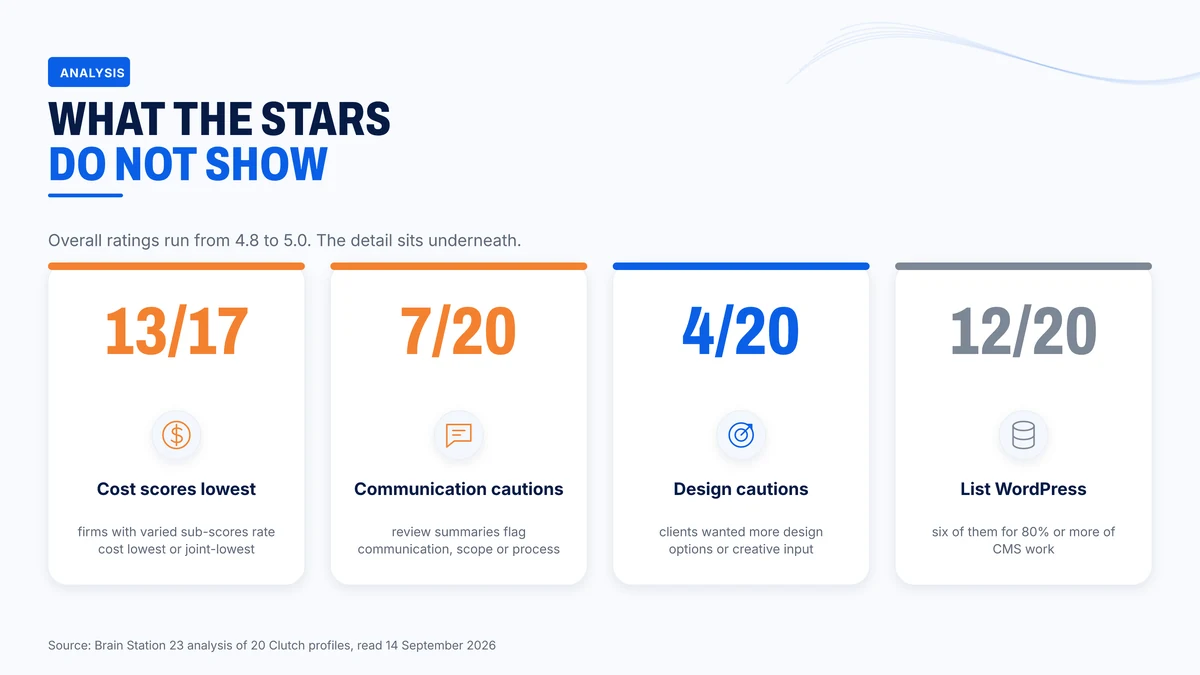
The cautions are about talking, designing and budgeting. Clutch’s review summaries flag communication, scope or process for seven firms, design breadth or creativity for four, budgets or estimates for three, and proactivity or risk planning for three. Collective42 is the only firm with no improvement area listed.
Most are small. Fifteen of the twenty have fewer than 250 staff, and ten have fewer than 50. Six list offices outside the US, and FocusReactive lists London first.
How to shortlist a front-end development company
Order the filters so the first one removes the most firms. The expensive conversations then happen with three vendors, not twenty.
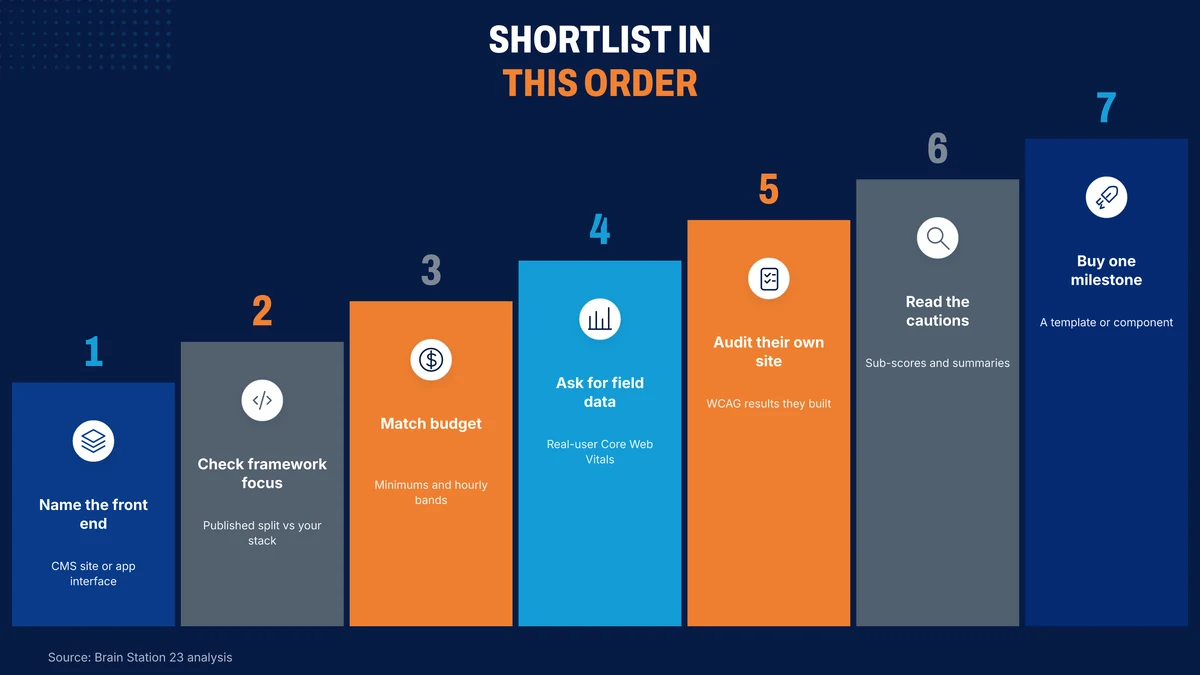
Step 1: Name the kind of front end. A marketing site on a CMS and an application interface in React or Angular point to different halves of this list. That one decision removes six to ten firms.
Step 2: Compare framework focus with your stack. Prefer firms whose published split includes the framework you run or plan to run, and ask how many engineers on the proposed team have shipped it.
Step 3: Match budget to minimums and bands. A $25,000 budget rules out the five firms with $50,000 minimums. A $100 an hour ceiling rules out ten.
Step 4: Ask for field performance data. Request Core Web Vitals from real users on two sites the firm launched, not a lab score from a page it chose.
Step 5: Ask for an accessibility audit of their own work. A firm that cannot show WCAG results for a site it built will not produce them for yours.
Step 6: Read sub-scores and review cautions. Cost and Schedule scores, and the improvement areas Clutch summarises, tell you more than a 4.9.
Step 7: Buy a small milestone. A paid discovery, a single page template or one component shows how the team designs, codes and communicates before you commit the whole budget.
How to buy front-end development: four engagement models
The engagement model decides who pays when the design changes, and on front-end work the design always changes.
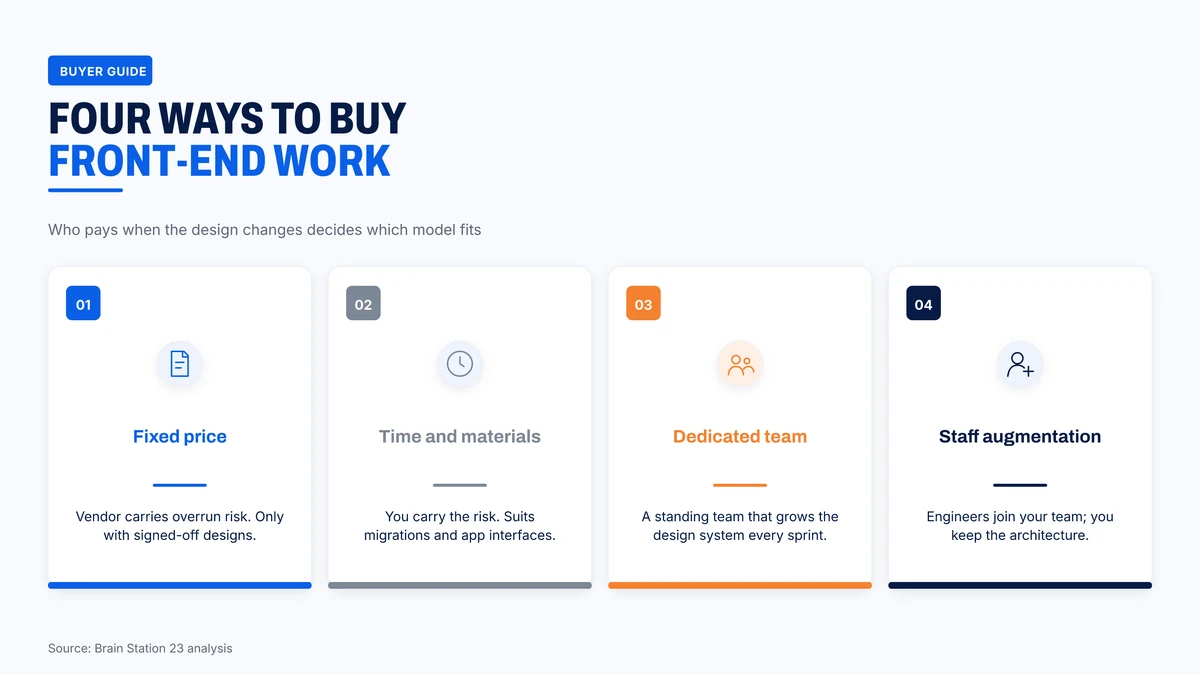
Fixed price moves overrun risk to the vendor, who prices it in. It suits a website or a set of templates where designs are approved before the build starts. It fails when stakeholders are still arguing about the homepage.
Time and materials keeps the risk with you in exchange for flexibility. It suits application interfaces, framework migrations and performance work, where the scope becomes clear only once the code is open. Review hours weekly and cap each phase.
Dedicated team gives you a standing group on a monthly fee. It suits a product with a design system that needs new components every sprint. Ask for named designers and engineers and a replacement clause.
Staff augmentation adds front-end engineers to a team you already run, and you keep control of the architecture. The Frontend Company, BairesDev, Swovo, Bilberrry, Jahnel Group, Cleveroad and Brain Station 23 all publish staff augmentation as a service line. It fails when nobody in-house owns code review and the component library.
The technical question: moving an older front end forward
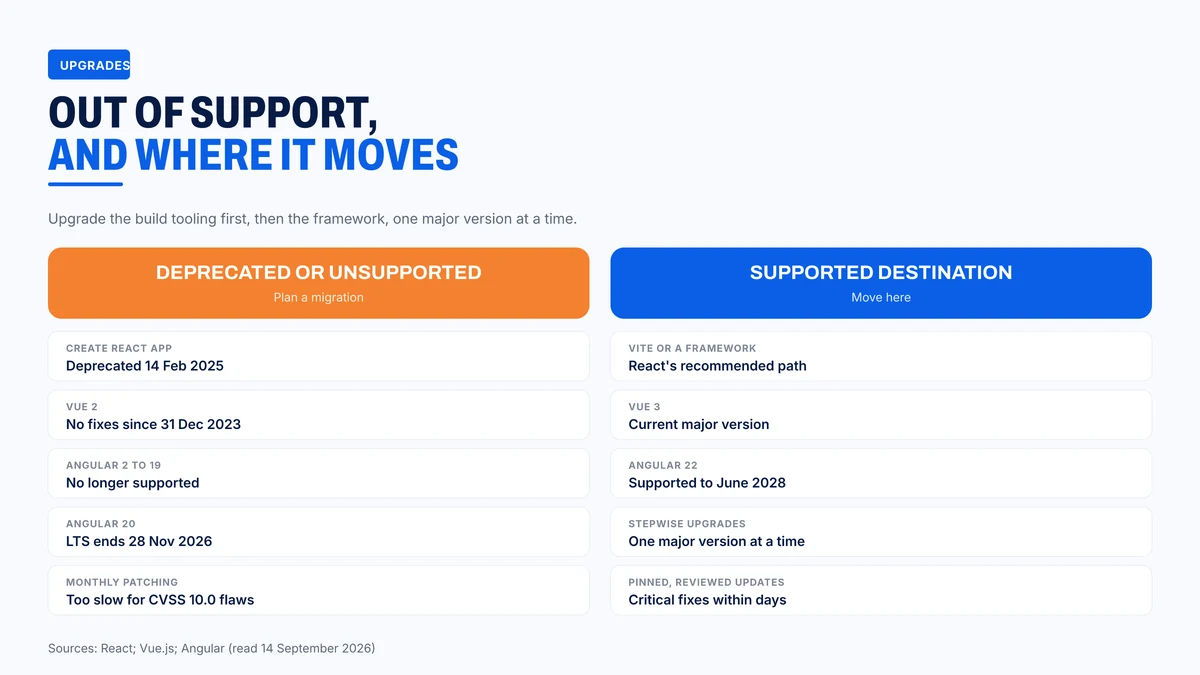
Most front ends in production were started with tools that have since been deprecated or dropped from support, and the order of the upgrade decides its cost.
React deprecated Create React App for new apps on 14 February 2025 and told existing apps to move to a framework or to a build tool such as Vite, Parcel or RSBuild (React). Vue 2 has received no updates, security fixes included, since 31 December 2023 (Vue). Angular states that versions 2 to 19 are no longer supported; long-term support for Angular 20 ends on 28 November 2026, and Angular 22, released on 3 June 2026, is supported to June 2028 (Angular).
Rendering is the other decision. Moving from client-side rendering to server rendering with Next.js or React Server Components usually improves loading, which is where mobile sites fail most. It also puts front-end code on a server, with a server’s security obligations, as the React and Next.js vulnerabilities in the security section below show.
The steps, in the order that keeps them cheapest:
Step 1: Measure before you touch anything. Record real-user LCP, INP and CLS and an accessibility baseline, so the migration can prove it helped.
Step 2: Inventory the stack. List the framework and build tool versions, every npm dependency and every third-party script, including tags added through a tag manager.
Step 3: Replace the build tooling. Moving off Create React App or an old webpack setup first lets the rest of the upgrade use current packages.
Step 4: Upgrade one major version at a time. Angular supports stepwise upgrades; jumping several majors in one release multiplies the breakage.
Step 5: Extract a component library. Shared buttons, forms and navigation, with design tokens, stop the same accessibility and performance bugs recurring on every page.
Step 6: Migrate route by route. Ship each migrated area behind the existing URLs instead of launching a new front end in one weekend.
Step 7: Put budgets in CI. Fail the build when JavaScript size, a Core Web Vitals proxy or an automated accessibility check falls below the agreed threshold, and diarise the next framework upgrade.
Red flags: eight answers to walk away from
Some answers in a sales call should end it, or at least move a firm down the list.
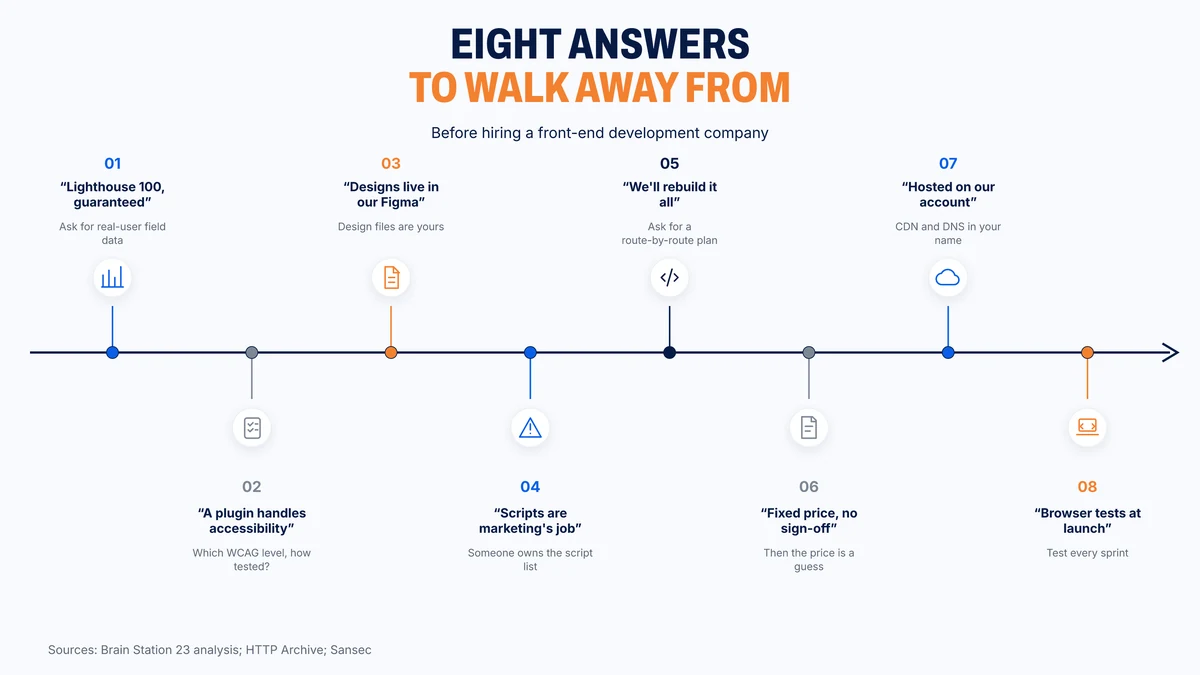
“We guarantee a Lighthouse score of 100.” A lab score on a test page says little about real mobile visitors. Ask for field data.
“Accessibility is handled by a plugin.” Ask which WCAG version and level, and how it is tested with a screen reader.
“The designs live in our Figma workspace.” Design files are part of what you pay for. They belong in yours.
“Third-party scripts are marketing’s problem.” When the polyfill.io domain changed hands, more than 100,000 sites embedding it began serving malicious code (Sansec). Someone must own the script list.
“We will rebuild everything on the newest framework.” Ask for a route-by-route migration plan first.
“A fixed price is fine without signed-off designs.” Then the price is a guess, and the change requests will prove it.
“We host it on our account.” The CDN, DNS and hosting belong under your billing.
“Cross-browser testing happens before launch.” Testing belongs in every sprint, on the devices your analytics say people use.
After launch: what the build quote leaves out
The list tells you who can build the interface. This part covers the eighteen months after launch, which is where most of the regret in review data shows up.
What you must own before the final invoice
The repository with its full commit history, in an organisation account you control, not a zip file at handover.
The design files and design system, in your own design tool workspace, with the component library and its documentation.
Domain, DNS, CDN and hosting accounts, under your billing, with the agency added as users rather than owners.
CMS and platform licences, such as Adobe Experience Manager, Sanity or Webflow, contracted in your name so updates and support do not stop when the agency leaves.
Analytics, tag manager and consent tools, plus a written inventory of every third-party script and who is allowed to add one.
A runbook that explains how to build, deploy, roll back and clear the CDN cache.
The bill that arrives after launch
A build quote covers the build. The rest recurs.
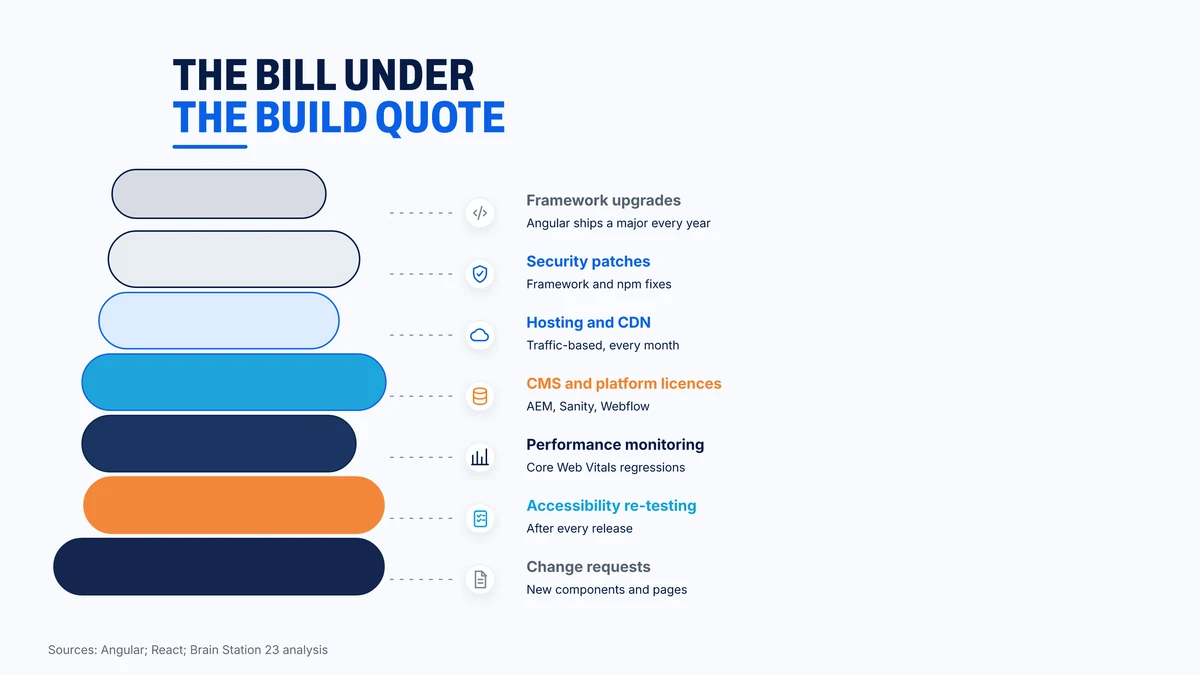
The recurring lines are framework and dependency upgrades, security patches, hosting and CDN, CMS and platform licences, performance monitoring, accessibility re-testing after each release, design system upkeep and change requests. Angular alone ships a major version every year with 24 months of total support (Angular), so a front end left alone for two years is out of support. Get the recurring number in writing before signing, and compare vendors on three years of cost, not the launch invoice.
Security is a recurring cost
The front end used to be static files. It no longer is. On 3 December 2025, React disclosed CVE-2025-55182, an unauthenticated remote code execution flaw in React Server Components rated CVSS 10.0, fixed in versions 19.0.1, 19.1.2 and 19.2.1 (React). Earlier in 2025, a Next.js middleware bypass, CVE-2025-29927, affected self-hosted applications on versions 12 to 15 until patches shipped on 17 and 18 March (Vercel).
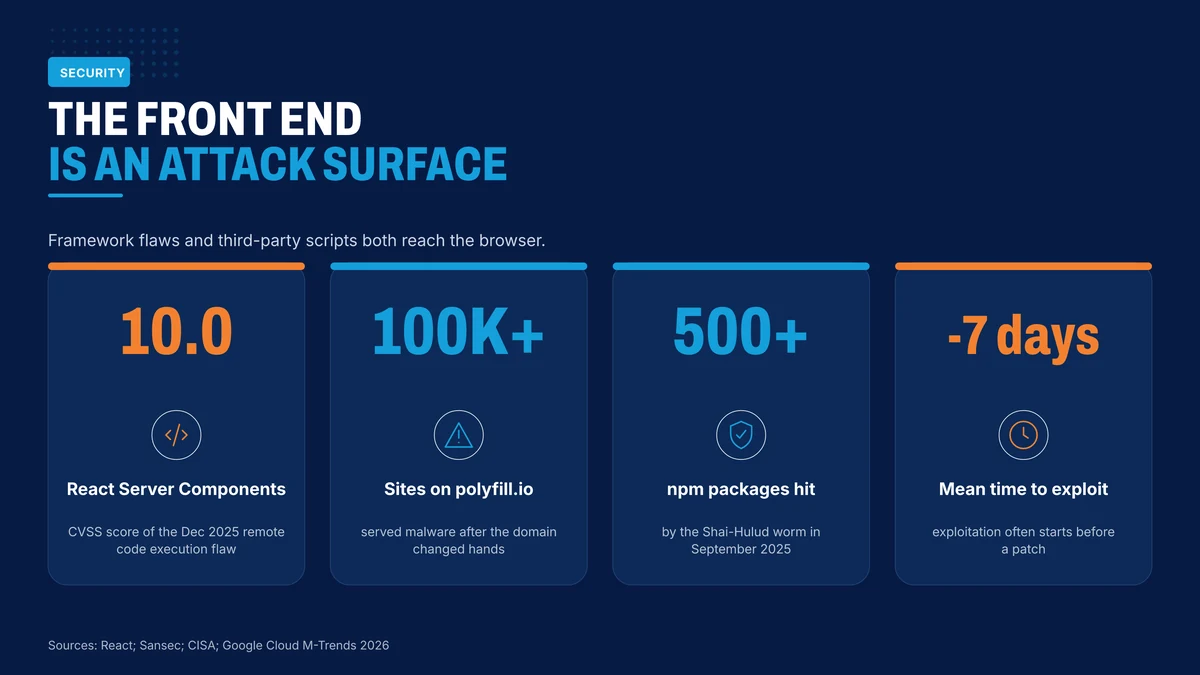
The supply chain around the code is exposed too. The Shai-Hulud worm compromised more than 500 npm packages in September 2025 and stole GitHub tokens and cloud keys; CISA told organisations to pin dependencies, rotate developer credentials and require phishing-resistant multifactor authentication (CISA). The polyfill.io domain was sold in February 2024, and by June more than 100,000 sites embedding its script were serving malware to mobile visitors (Sansec).
Speed of response is the part a maintenance agreement has to cover. Google Cloud’s M-Trends 2026 put the mean time to exploit at minus seven days, meaning exploitation often starts before a patch exists (Google Cloud). A monthly patch window does not meet that. Ask vendors how quickly a critical framework fix reaches production, how dependencies are pinned, and who reviews third-party scripts.
Accessibility is legal exposure
The interface is where accessibility claims land. WebAIM found detected WCAG 2 failures on 95.9 percent of the top million home pages in 2026, up from 94.8 percent, averaging 56.1 errors per page (WebAIM Million 2026). The most common failures are front-end basics: low-contrast text on 83.9 percent of pages, missing image alternative text on 53.1 percent and missing form labels on 51 percent.
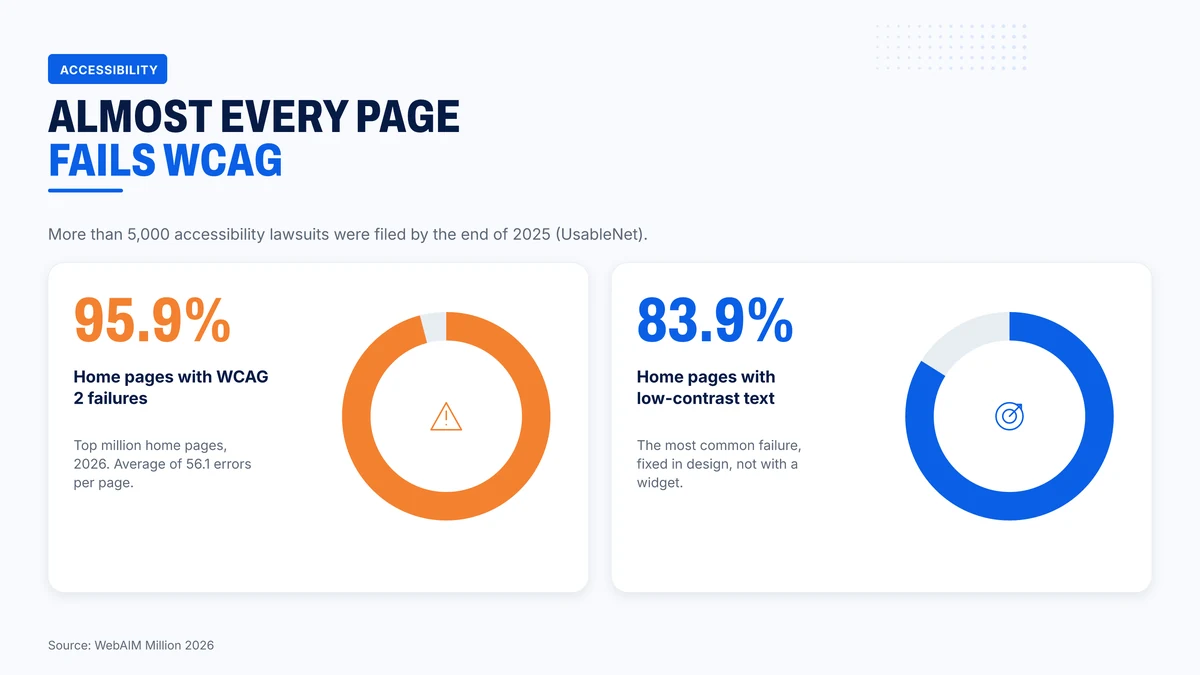
The legal side has numbers behind it. More than 5,000 digital accessibility lawsuits were filed by the end of 2025, and 46 percent of federal cases involved repeat defendants (UsableNet). State and local government sites must meet WCAG 2.1 AA under the ADA Title II rule, from 26 April 2027 for entities serving 50,000 people or more and 26 April 2028 for smaller ones (US Department of Justice).
Write a named standard such as WCAG 2.2 AA into the contract instead of the word “accessible”. Require manual screen reader checks on key journeys as well as automated scans, and treat overlay widgets with scepticism: a script on top of the page does not fix the markup underneath.
Contract clauses that surface in month nine
These rarely come up in a sales call and often decide the relationship later. This is not legal advice; have your own counsel review any agreement.
IP assignment on payment, not on final acceptance, covering code, design files and the component library.
Account ownership, naming the repository, design workspace, CDN, hosting, domain and CMS licences as yours.
Acceptance criteria, with Core Web Vitals thresholds measured on real users and a named accessibility standard.
Upgrade scope, stating which framework versions a retainer keeps you on and how fast critical patches are applied.
Transition assistance, a fixed number of hours at an agreed rate if you move to another vendor.
Rate escalation caps, subcontracting disclosure, liability caps and insurance, and non-solicitation in both directions.
How to leave without losing the codebase
Confirm ownership of the repository, design files, CDN, hosting, domain and CMS licences first. Trigger the transition hours while relations are still cordial, and record walkthroughs of the build, deployment and release process, including how the component library is published.
On the last day, remove the departing team from every account, revoke deployment and npm tokens, rotate API keys, and review the tag manager for scripts nobody on your side added.
Hire in-house or hire an agency
Start with the wage. BLS reports a median of $92,650 for US web developers and $104,000 for web and digital interface designers, and projects about 13,600 openings a year across the two occupations to 2035 (BLS). Add benefits, recruiting and the time a hire takes to learn your product.
Hire in-house when the interface is the product, changes every sprint, and you can keep at least two people who know the component library well.
Hire an agency for a website, a redesign, a framework migration or a burst of design work you need for months rather than years. Keep every account in your name so the decision stays reversible.
Combine the two when you have a front-end lead but not enough hands. Staff augmentation or a dedicated team adds capacity while the architecture stays with you.
FAQ
How much do US front-end development companies charge per hour?
The twenty firms here publish bands from $25 to $49 up to $200 to $300 an hour. Nine sit under $100 and seven at $150 or more, and the median minimum project is $25,000 (Clutch). The high bands mostly belong to US design and marketing agencies.
What does a front-end developer earn in the US?
It depends on the source. PayScale reports $89,372 (PayScale), BLS a $92,650 median for web developers, and ZipRecruiter $110,412 (ZipRecruiter). Interface designers earn a $104,000 median (BLS).
Should I choose React, Angular or Vue?
React has the largest talent pool: 44.7 percent of developers used it in the 2025 Stack Overflow survey, against 18.2 percent for Angular and 17.6 percent for Vue (Stack Overflow Developer Survey 2025). Thirteen of the twenty firms here list React. Choose the framework your future maintainers can hire for.
Should Core Web Vitals go in the contract?
Yes, as acceptance criteria measured on real users. Only 48 percent of mobile websites had good scores on all three metrics in July 2025 (HTTP Archive Web Almanac 2025), so a vendor promising “fast” without numbers is promising nothing measurable.
Is it safe to keep running Vue 2 or a Create React App project?
Is a WordPress agency a front-end development company?
It can be the right one for a marketing site. Six of the twenty top-ranked firms here build mainly on WordPress or similar platforms and list no front-end framework (Clutch). For an application interface in React or Angular, choose a firm whose framework split shows it.
Who should own the design files and the CDN account?
You should. Design files, the component library, the CDN, DNS and hosting are part of the product. If the agency’s account holds them, leaving means rebuilding access before you can change a line, and rotating every credential the old team could reach.
Do accessibility overlay widgets make a site compliant?
They do not fix the markup underneath. The most common failures, such as low-contrast text on 83.9 percent of home pages and missing form labels on 51 percent, sit in the code and design (WebAIM Million 2026). Name WCAG 2.2 AA in the contract and test with a screen reader.
Conclusion
The data behind this Top 20 Front End Development Companies in USA list says three things. Clutch ranks web developers, not front-end specialists, and the twenty range from firms with no front-end framework to firms that do nothing else. Rates split between engineering teams under $100 an hour and US design agencies at $150 or more, while salary sources for the same role disagree by $21,040. And reviewers score cost lowest far more often than quality.
Any of the twenty can launch an interface. What decides the next three years is what surrounds it: whether it passes Core Web Vitals for real mobile visitors, whether the framework it runs is still supported, and whether your organisation holds the design files, the repository, the CDN and every key on the day you decide to move on.
Sources
- https://clutch.co/us/web-developers?sort_by=ClutchRank
- https://clutch.co/profile/brain-station-23
- https://almanac.httparchive.org/en/2025/performance
- https://almanac.httparchive.org/en/2024/javascript
- https://web.dev/blog/inp-cwv-launch
- https://www.deloitte.com/ie/en/services/consulting/research/milliseconds-make-millions.html
- https://survey.stackoverflow.co/2025/technology
- https://www.bls.gov/ooh/computer-and-information-technology/web-developers.htm
- https://www.payscale.com/research/US/Job=Front_End_Developer_%2F_Engineer/Salary
- https://www.salary.com/research/salary/standard/front-end-developer-salary
- https://www.ziprecruiter.com/Salaries/Front-End-Developer-Salary
- https://react.dev/blog/2025/02/14/sunsetting-create-react-app
- https://react.dev/blog/2025/12/03/critical-security-vulnerability-in-react-server-components
- https://vercel.com/blog/postmortem-on-next-js-middleware-bypass
- https://angular.dev/reference/releases
- https://v2.vuejs.org/lts/
- https://sansec.io/research/polyfill-supply-chain-attack
- https://www.cisa.gov/news-events/alerts/2025/09/23/widespread-supply-chain-compromise-impacting-npm-ecosystem
- https://cloud.google.com/blog/topics/threat-intelligence/m-trends-2026
- https://webaim.org/projects/million/
- https://blog.usablenet.com/ada-web-lawsuit-trends-2026
- https://www.ada.gov/resources/2024-03-08-web-rule/