
Whose Java runtime will your application run on, and who pays for it?
It is not a field on any vendor profile, and it rarely comes up in a first call. It should, because Oracle sells its Java SE subscription per employee, at list prices starting at $15 per employee per month, and counts the whole organisation rather than the servers. Premier Support for Java 17 ends this month on Oracle’s own roadmap.
That is why a Top 20 Java Development Companies in USA list has to go past languages and hourly rates. Every firm below can write Java. What separates them for a buyer is whether they will tell you which JDK they deploy, which version they are moving you to, and whose name is on the licence.
Most enterprises have already started asking. In Azul’s 2026 survey of 2,039 Java professionals, 81% had migrated, were migrating or planned to migrate at least part of their Oracle Java estate to another OpenJDK distribution.
This guide covers the twenty firms, what Java work costs, and the upgrade path from 8, 11 and 17. It also covers the questions that surface after the contract: who holds the runtime licence, what the maintenance retainer should include, and how to leave a vendor with your code and your build pipeline intact.
Key takeaways
- 18% is the median share Java takes in the published language splits of the twenty firms; only KnubiSoft puts it above 30% (Brain Station 23 analysis of Clutch profiles, read 14 September 2026).
- 4 of 20 firms list Spring in their framework split, the framework most enterprise Java runs on (Clutch profiles).
- 12 of 13 firms whose four Clutch sub-scores differ have Cost as the lowest or joint-lowest score (Clutch profiles).
- September 2026 is the end of Oracle Premier Support for Java 17, and Oracle JDK 17 updates since October 2024 are no longer under a permissive licence (Oracle).
- 81% of organisations in Azul’s 2026 survey have moved, are moving or plan to move at least part of their Oracle Java to another OpenJDK distribution, and 21% have been audited (Azul).
- $92,254 to $117,931 is what three salary sites report for the same US Java developer role in 2026 (PayScale, ZipRecruiter).
- 29.4% of developers in the 2025 Stack Overflow survey used Java, and 14.7% used Spring Boot (Stack Overflow Developer Survey 2025).
- June 2026 was the end of open source support for Spring Boot 3.5, the last 3.x line (Spring).
Java in 2026: a fixed release train and a licensing question
Java is not fading. In the 2025 Stack Overflow Developer Survey, 29.4% of respondents had done extensive work in Java over the past year, and 14.7% in Spring Boot (Stack Overflow Developer Survey 2025). Azul’s 2026 survey found 62% of organisations now use Java to code AI functionality (Azul).
What has changed is the calendar around it. Oracle designates Java 8, 11, 17, 21 and 25 as long-term support releases and “intends to make future LTS releases every two years”, with Java 29 planned for September 2027 (Oracle). In between, a non-LTS release ships every six months: JDK 27 reaches general availability on 15 September 2026 (OpenJDK).
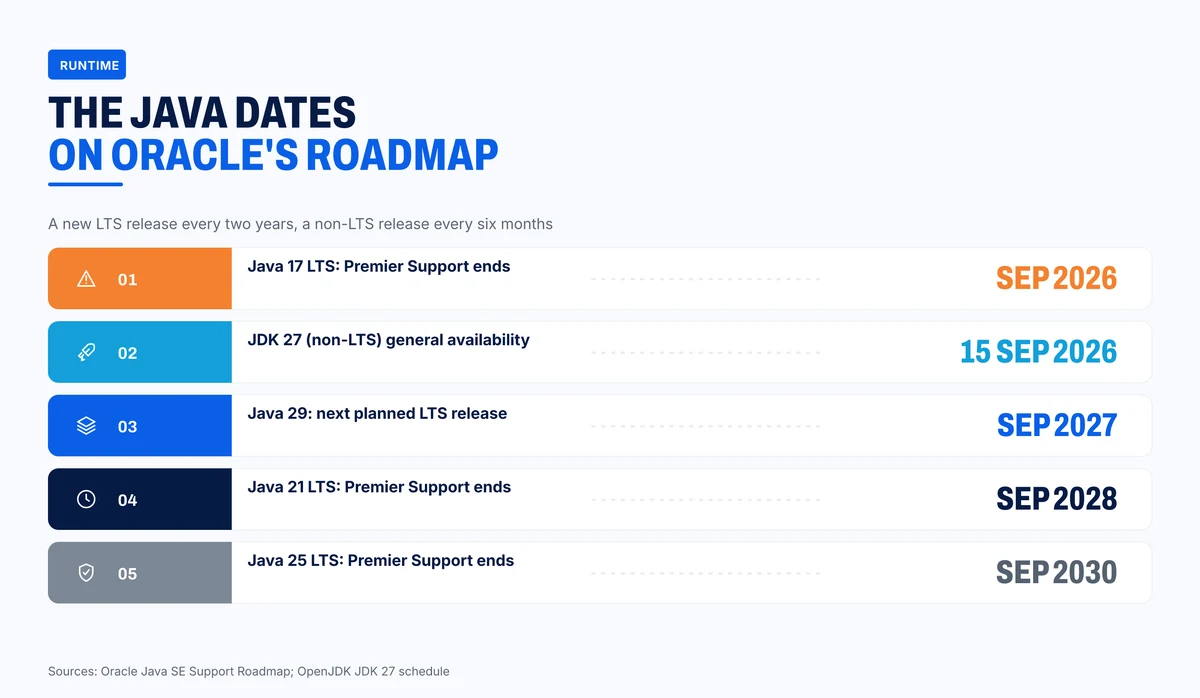
For Java 17 the dates carry a licensing twist. Oracle says public updates to Java 17 through September 2024 were under a permissive licence, and updates released from 15 October 2024 fall under the Java SE OTN licence instead; users wanting a permissively licensed Oracle JDK “should move to Oracle JDK 25 or later” (Oracle).
That is the backdrop to the migration numbers. In Azul’s survey, 92% of respondents were concerned about Oracle Java pricing, 63% intend to migrate their entire Java estate, and 21% had already faced an Oracle Java audit (Azul). Azul sells a competing Java runtime, so read its survey as an interested party’s research, but the Oracle roadmap it responds to is public.
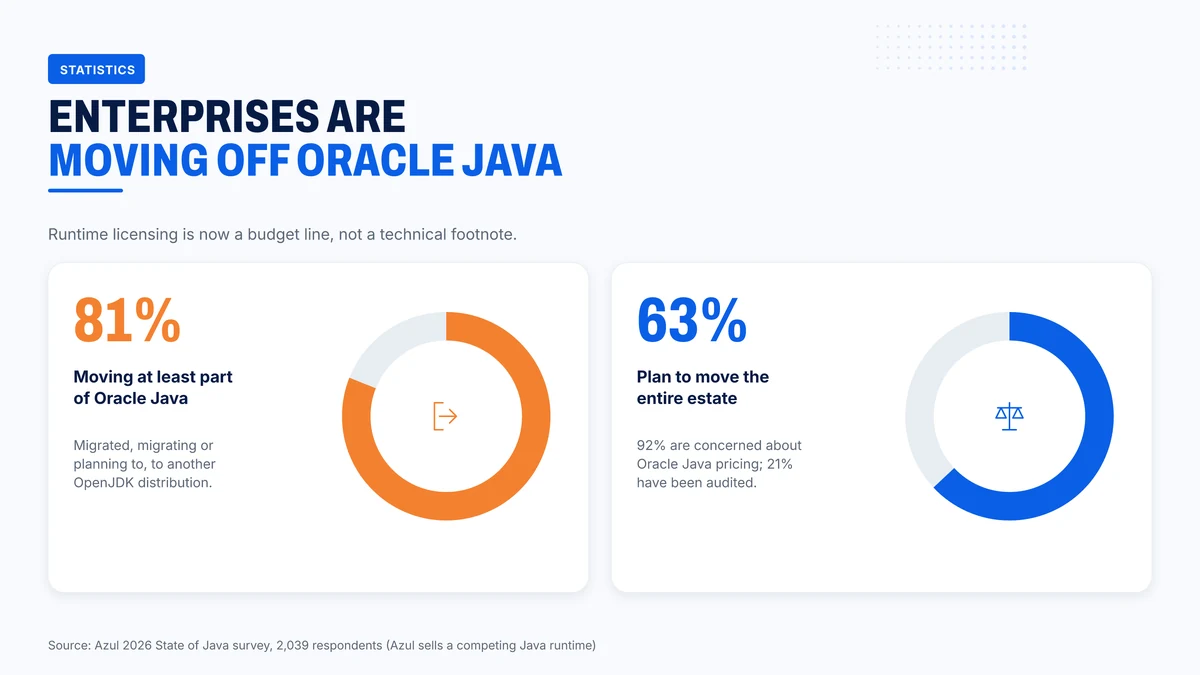
For a buyer, this turns a technical choice into a budget line. Brief any vendor on the JDK distribution it will deploy and who licenses it, before discussing features.
What Java development costs in the US
Salaries anchor agency rates, and they disagree by more than most buyers expect.
PayScale puts the average base for a US Java developer at $92,254 across 402 profiles (PayScale, updated 30 March 2026). Salary.com reports $105,995 as of 1 September 2026, with the middle half earning $95,744 to $114,518 (Salary.com). ZipRecruiter reports $117,931 as of 14 September 2026 (ZipRecruiter).
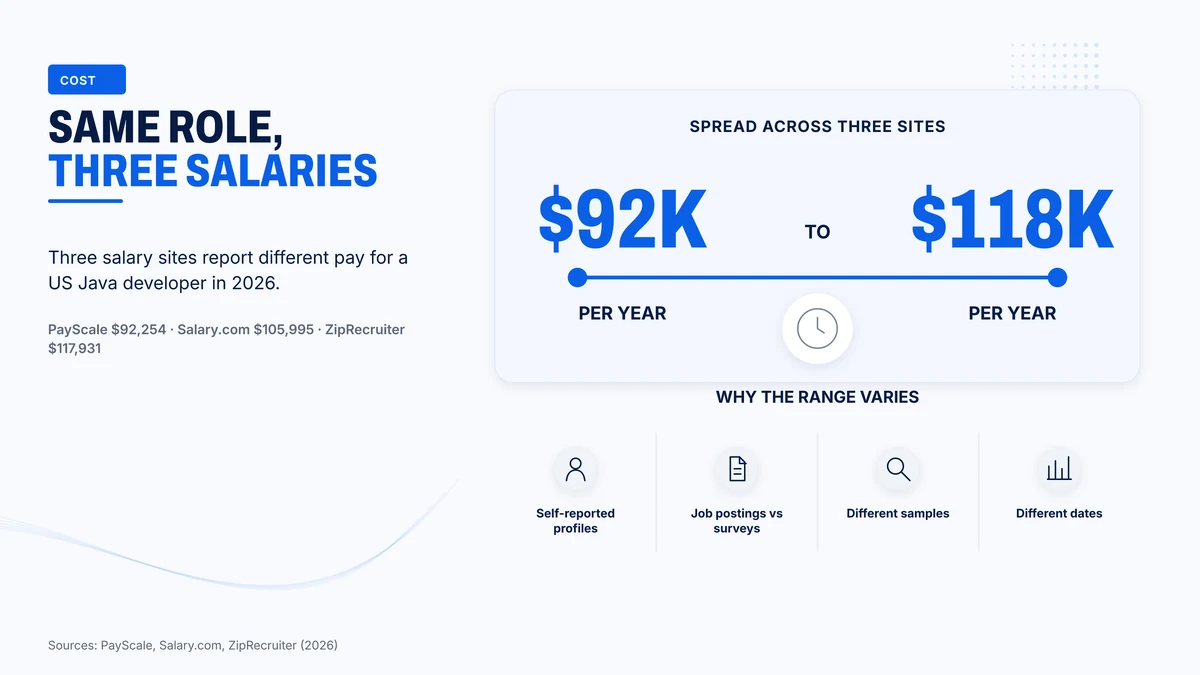
That is a $25,677 spread for one job title, and each site uses a different sample, method and date. The Bureau of Labor Statistics median for all software developers was $135,980 in May 2025 (BLS), above all three, which is a reminder that a senior Java engineer on an enterprise system sits well above the averages.
What moves a Java quote is rarely the language itself. Eight factors do most of the work.
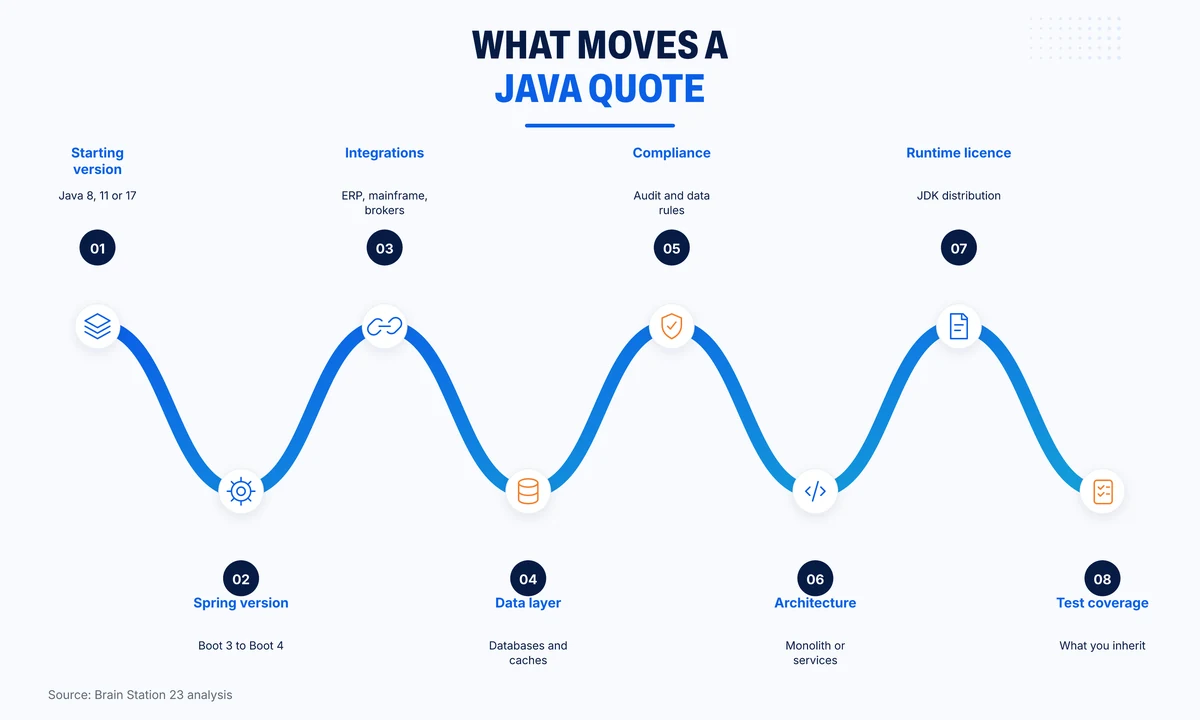
The starting Java version comes first: a Java 8 estate needs more work than one already on 17. The Spring version follows, since moving to Spring Boot 4 brings its own changes. Integrations with ERPs, mainframes and message brokers set much of the timeline. The data layer, compliance and audit needs, and the choice between a monolith and microservices add their own scope. Runtime licensing and the test coverage you inherit finish the list. Ask each vendor to price those lines separately, and a $30 quote and a $140 quote become comparable.
The Top 20 Java Development Companies in USA, compared
Firms 2 to 21 below are the top 20 by Clutch Rank on Clutch’s US Java developers directory, read on 14 September 2026. Clutch lists 2,071 firms there. The first row on the page is a paid featured placement, which we left out, and we took the next 20 in Clutch Rank order.
Brain Station 23 is placed first because we publish this article. We are US-headquartered and Premier Verified on Clutch, and Spring is 30 percent of our published framework split, but Java is 14 percent of our language split, below the list’s median, and the directory’s ranking did not place us in its top 20. We are not claiming it did.
Every overall rating below sits between 4.8 and 5.0, so the stars cannot separate these firms. The columns are decision columns instead.
| # | Company | Best For | Team Size | Java Focus | Key Tech Stack | Industries Served | Locations |
|---|---|---|---|---|---|---|---|
| 1 | Brain Station 23 — brainstation-23.com | Adding cost-controlled Java and Spring engineers to a team you already run | 250 – 999 | 14% of languages; Spring 30% of frameworks | Java, Spring, .NET, Python, Angular, Flutter | Retail, medical, telecoms, education, financial services | Springfield VA; Bangladesh, UAE, England, Malaysia, Germany |
| 2 | BairesDev — bairesdev.com | Enterprises adding nearshore Java engineers in US time zones | 1,000 – 9,999 | 30% | Java, PHP, Python, .NET, React Native | IT, financial services, medical, advertising | San Francisco; Buenos Aires, Sao Paulo, Mexico City, Bogota |
| 3 | Toptal — toptal.com | Buyers who want to hand-pick individual senior freelancers | 1,000 – 9,999 | 25% | Java, JavaScript, PHP, Python, .NET, Django | Arts and entertainment, business services, consumer products, education | San Francisco (remote network) |
| 4 | Vention — ventionteams.com | Enterprises modernising a mixed Java and .NET estate with a large team | 1,000 – 9,999 | 20% | Java, Go, JavaScript, .NET, React, Angular | Education, financial services, medical, retail | New York; London, Vienna, Vilnius, Berlin, Warsaw |
| 5 | Jahnel Group — jahnelgroup.com | Mid-market firms wanting a New York team for Java web platforms and AI | 50 – 249 | 30% | Java, JavaScript, Spring, Angular, React | Business services, financial services, gaming, education | Schenectady NY, New York |
| 6 | Curotec — curotec.com | Mid-market companies wanting a product team across PHP, JavaScript and Java | 50 – 249 | 20% | PHP, JavaScript, Java, Python, Laravel | Advertising, education, IT, manufacturing, medical | Philadelphia, Newtown Square PA |
| 7 | Gigster — gigster.com | Enterprises buying AI-assisted builds on a large budget | 250 – 999 | 15% | C#, C++, Java, PHP, Python, React | Automotive, consumer products, education, financial services | Austin |
| 8 | UplineSoft — uplinesoft.com | Teams adding low-cost engineers across many languages quickly | 250 – 999 | 10% | Kotlin, Java, C#, C++, React Native, Rails | IT, financial services, e-commerce, consumer products | New York |
| 9 | Mojo Trek — mojotrek.com | Enterprises modernising customer-facing Java and .NET systems | 50 – 249 | 30% | Java, C#, JavaScript, Spring, .NET, Angular | E-commerce, food and beverage, financial services, medical, retail | Chicago, New York |
| 10 | Zco Corporation — zco.com | Mobile-first products with Java in the stack from a long-established firm | 250 – 999 | 16% | Java, C#, JavaScript, PHP, Swift, React Native | Business services, consumer products, gaming, manufacturing | Nashua NH, Boston, New York |
| 11 | KnubiSoft — knubisoft.com | Fintech and edtech teams wanting Java-first engineers at a low band | 50 – 249 | 60% | Java, Python, Spring, .NET, Django | Financial services, education, medical, logistics | New York; Warsaw, Kyiv |
| 12 | Velvetech — velvetech.com | Enterprise .NET and CRM work with some Java | 250 – 999 | 10% | C#, .NET, JavaScript, Java, C++ | Business services, education, energy, financial services, legal | Sunny Isles Beach FL, Chicago |
| 13 | Motomtech — motomtech.com | IT companies wanting a low-rate mobile and web team with Java in the mix | 50 – 249 | 10% | Swift, Java, JavaScript, React Native, Angular | IT, advertising, business services | South Jordan UT |
| 14 | Suffescom Solutions Inc — suffescom.com | Fintech and healthcare apps on a tight hourly budget | 250 – 999 | 10% | Kotlin, Python, Java, Next.js, Node.js | Financial services, medical, real estate, e-commerce | New York, Wilmington DE; Mohali, Dubai, London |
| 15 | Fulcrum — fulcrum.rocks | Health and SaaS startups wanting mobile apps with a Java backend at a low band | 50 – 249 | 25% | JavaScript, Java, Swift, React Native, Node.js | Medical, IT, business services, education | Sheridan WY; Warsaw, Kyiv |
| 16 | Dualboot Partners — dualbootpartners.com | Mid-market companies with $200,000-plus AI and platform programmes | 250 – 999 | 10% | Java, Go, Kotlin, Python, Ruby, React Native | Financial services, manufacturing, medical, construction | Charlotte NC; Montevideo |
| 17 | Perpetual — perpetualny.com | Brands wanting UX-led web platforms with a Java or Node.js backend | 50 – 249 | 20% | Java, JavaScript, Python, Node.js, React | IT, advertising, financial services, media, medical | New York |
| 18 | NIX — nix-united.com | Enterprises wanting a large team across cloud, AI and security | 1,000 – 9,999 | 10% | Java, Go, Kotlin, Python, .NET, React | Automotive, education, medical, IT, manufacturing | Tampa, Boston |
| 19 | NewAgeSysIT — newagesysit.com | Small and mid-sized companies wanting mobile and web apps on a low budget | 250 – 999 | 20% | Swift, Java, Objective-C, Node.js, CodeIgniter | GPS and navigation, medical, consumer products, education | Princeton NJ |
| 20 | AppMakers USA — appmakersla.com | Small businesses building mobile apps with an AI layer | 50 – 249 | 10% | JavaScript, Python, Java, Flutter, Swift | Education, financial services, gaming, hospitality, media | Los Angeles, New York |
| 21 | Origami Studios — origamistudios.us | Businesses automating manual workflows with AI | 50 – 249 | 10% | JavaScript, Swift, C#, Java, Kotlin, Node.js | Business services, consumer products, education, financial services | Parsippany NJ |
Team sizes, Java focus (Java share of each firm’s published programming language split), frameworks, industries and locations are from each firm’s published Clutch profile, read 14 September 2026. “Best For” is our reading of that data. Engagement models and certifications are not published consistently across these profiles, so we have left them out rather than guess.
Profiles are grouped by the kind of buyer each firm suits, and the numbers match the table. Each caution comes from the Review Highlights Clutch publishes from that firm’s verified reviews, where one exists. Certifications are self-published and unverified by us, and Clutch profiles do not carry ISO or CMMI certifications, which is why the profiles say to ask.
1. Brain Station 23
We publish this article and put ourselves first, so read this as the publisher’s pick, not a ranking. The data cuts both ways. Spring is 30 percent of our published framework split, more than any firm below, yet Java is 14 percent of our language split, under the 18 percent median, because most of what we sell is engineers embedded in client teams. Our $25 to $49 band is the lowest published here, shared by eight of the twenty. Our CMMI Level 3, ISO 27001 and SOC 2 Type II processes apply to the upgrade and supply chain work covered later. Our 21 reviews score Quality at 5.0 and Cost at 4.9, and reviewers have asked for better internal coordination. If you need a team working entirely in US time zones, call someone else.
Founded: 2006
US Presence: Springfield VA
Company size: Clutch band 250 to 999; we publish 900+ engineers
Rating: 4.9 across 21 Clutch reviews, HQ Springfield, Virginia
- Adding cost-controlled Java and Spring engineers to a team you already run
- CMMI Level 3
- ISO 27001
- ISO 9001
- SOC 2 Type II (company-published)
- Staff augmentation
- Java and Spring backends
- Enterprise app modernisation
- Custom software
- E-commerce platforms
- Dedicated teams
- Retail
- Medical
- Telecoms
- Education
- Financial services
- Hospitality
- Ask which JDK distribution the team will deploy and who holds that licence
For Java-first backend teams
2. BairesDev
BairesDev ranks first on this directory. Java is 30 percent of its language split, behind PHP, and half its clients are enterprises. Its profile describes more than 4,000 engineers across Latin America, and its minimum is $50,000. Reviewers highlight staff augmentation and recruitment. Clutch notes occasional minor language barriers, not seen as a significant obstacle, and its Cost sub-score of 4.6 is among the lowest here. It suits large Java teams that want capacity in their own time zone rather than a boutique.
Founded: 2009
US Presence: San Francisco
Company size: 1,000 to 9,999
- Enterprises adding nearshore Java engineers in US time zones
- Not published; ask directly
- Staff augmentation
- Java
- PHP and Python backends
- .NET
- Application testing
- DevOps
- ERP integration
- IT
- Financial services
- Medical
- Advertising
- Business services
- Ask how technical questions are escalated when a language barrier slows a discussion
3. Toptal
Toptal is a talent network rather than an agency: its profile describes more than 20,000 vetted professionals, and Java shares 25 percent of its language split with JavaScript, PHP and Python. It bills $100 to $149 an hour. Its Cost sub-score of 4.5 is the lowest on this list, and Clutch’s summary says some clients found pricing higher than competitors, though justified by quality. It suits buyers with their own technical lead who want to add named senior individuals.
Founded: 2010
US Presence: San Francisco (remote network)
Company size: 1,000 to 9,999
- Buyers who want to hand-pick individual senior freelancers
- Not published; ask directly
- Vetted freelance Java
- JavaScript
- PHP and Python developers
- Custom software
- AI and mobile development
- Product design
- Arts and entertainment
- Business services
- Consumer products
- Education
- Financial services
- Confirm who owns architecture, code review and continuity when individual freelancers change
5. Jahnel Group
Java and JavaScript each take 30 percent of Jahnel Group’s language split, and Spring appears in its frameworks. It is based in Schenectady and New York, and bills $100 to $149 an hour on an 18-review sample rated 5.0. Clutch’s summary records one client asking for proactive risk mitigation plans when resource availability issues arise. It suits mid-market companies that want an East Coast Java team and are willing to agree a continuity plan in writing.
Founded: 2012
US Presence: Schenectady NY, New York
Company size: 50 to 249
- Mid-market firms wanting a New York team for Java web platforms and AI
- Not published; ask directly
- Web development
- Custom software
- Java and JavaScript backends
- Spring
- Cloud consulting
- AI development
- Business services
- Financial services
- Gaming
- Education
- Manufacturing
- Medical
- Ask how the team plans for staff availability gaps on a long engagement
9. Mojo Trek
Mojo Trek splits its languages between Java and C# at 30 percent each, with Spring and .NET in its frameworks, and describes building and modernising revenue-generating systems. Enterprise and mid-market clients make up 90 percent. It ranks eighth on three Clutch reviews, all rated 5.0, so the sample is thin. Clutch’s summary notes some clients would appreciate lower costs, while seeing the price as justified. It suits enterprise modernisation buyers who will check references directly.
Founded: 2017
US Presence: Chicago, New York
Company size: 50 to 249
- Enterprises modernising customer-facing Java and .NET systems
- Not published; ask directly
- Custom software
- Java and C# modernisation
- Spring
- .NET
- Angular and React front ends
- Managed services
- E-commerce
- Food and beverage
- Financial services
- Medical
- Retail
- Ask for references, because the Clutch sample is three reviews
11. KnubiSoft
KnubiSoft is the most Java-focused firm on this list: Java is 60 percent of its language split, and Spring 22 percent of its frameworks. Financial services is 40 percent of its industries, and it bills $25 to $49 an hour from New York with offices in Warsaw and Kyiv. It holds a 4.8 rating across 36 reviews, but its profile page showed no review summary or sub-scores when we read it. It suits fintech teams that want dedicated Java engineers and will check references.
Founded: 2012
US Presence: New York
Company size: 50 to 249
- Fintech and edtech teams wanting Java-first engineers at a low band
- Not published; ask directly
- Java and Spring backends
- IT staff augmentation
- Custom software
- Python and Django
- AI development
- UX design
- Financial services
- Education
- Medical
- Supply chain and logistics
- Ask for two recent client references, since the profile shows no review summary
For scale, staff augmentation and nearshore
4. Vention
Vention has 102 Clutch reviews and spreads its work widely: enterprise app modernisation is 15 percent of services, and Java shares 20 percent of its languages with Go and ASP.NET. Its profile claims more than 3,000 developers. Clutch’s summary credits competitive pricing and flags early friction in matching the right skills for some clients. It suits enterprises modernising several stacks at once, not buyers wanting a Java specialist.
Founded: 2002
US Presence: New York
Company size: 1,000 to 9,999
- Enterprises modernising a mixed Java and .NET estate with a large team
- Not published; ask directly
- Enterprise app modernisation
- Java
- Go and .NET backends
- AI development
- Cloud and DevOps
- Staff augmentation
- Education
- Financial services
- Medical
- Retail
- Logistics
- Interview the proposed Java engineers yourself before the start date
8. UplineSoft
UplineSoft is the youngest firm here and splits its work between custom software and staff augmentation at 60 and 40 percent. Its language list is long, from Kotlin to Delphi and ColdFusion, with Java at 10 percent. It publishes a $5,000 minimum and $25 to $49 an hour, and its 70 reviews score 5.0 on every sub-score. Clutch’s caution is onboarding, with clients suggesting more structure at the start. It suits teams needing engineers in niche or legacy languages alongside Java.
Founded: 2020
US Presence: New York
Company size: 250 to 999
- Teams adding low-cost engineers across many languages quickly
- Not published; ask directly
- Custom software
- IT staff augmentation
- Java
- Kotlin
- C# and C++ engineers
- React Native and Rails
- Legacy languages
- IT
- Financial services
- E-commerce
- Consumer products
- Manufacturing
- Agree a written onboarding plan for the first two weeks
14. Suffescom Solutions Inc
Suffescom has the most Clutch reviews on this list, 121, and scores 4.9 on every sub-score. Java is 10 percent of its language split, behind Kotlin and Python, and mobile and web development are 80 percent of its services. Financial services and medical each take 35 percent of its industries. Reviewers most often call it timely. Clutch’s caution is creativity: it delivers to spec, but some clients wanted more innovation. It suits buyers with a finished specification and a tight budget.
Founded: 2013
US Presence: New York, Wilmington DE
Company size: 250 to 999
- Fintech and healthcare apps on a tight hourly budget
- Not published; ask directly
- Mobile and web development
- Kotlin and Java
- Python
- Next.js and Node.js
- AI development
- Blockchain
- Financial services
- Medical
- Real estate
- E-commerce
- Education
- Ask who will propose design and product ideas, not only implement a specification
16. Dualboot Partners
Dualboot publishes a $75,000 minimum, the highest here, does not publish an hourly rate, and its most common project size in reviews is $200,000 to $999,999. Java is one of ten languages at 10 percent each. AI consulting and development together make up 35 percent of its services, with locations in Charlotte and Montevideo. Clutch’s caution is timeline estimation, which some clients felt could be more accurate. It suits mid-market programmes with real budgets and a need for AI alongside platform work.
Founded: 2018
US Presence: Charlotte NC
Company size: 250 to 999
- Mid-market companies with $200,000-plus AI and platform programmes
- Not published; ask directly
- AI consulting and development
- Custom software
- Application management
- DevOps
- Cybersecurity
- Java
- Go and Kotlin backends
- Financial services
- Manufacturing
- Medical
- Arts and entertainment
- Construction
- Ask for a timeline estimate with named assumptions, and revisit it after discovery
18. NIX
NIX describes more than 3,000 professionals, and Java is one of seven languages at 10 percent. Cybersecurity and cloud consulting sit alongside development in its service mix. It does not publish a minimum. Its sub-scores are among the lowest here, with Schedule and Cost at 4.6. Clutch’s summary describes one past project with site crashes and delayed development that hurt client satisfaction. It suits enterprises wanting one large vendor across cloud, security and development, with a closely managed start.
Founded: 1994
US Presence: Tampa, Boston
Company size: 1,000 to 9,999
- Enterprises wanting a large team across cloud, AI and security
- Not published; ask directly
- Custom software
- AI development
- IT staff augmentation
- Cloud consulting
- Cybersecurity
- Java
- Go and Kotlin engineering
- Automotive
- Education
- Medical
- IT
- Manufacturing
- Ask how the team stabilises a system in the first month, with named checkpoints
For custom software and regulated industries
6. Curotec
Custom software is 60 percent of Curotec’s services, and Laravel leads its frameworks at 50 percent, with Java at 20 percent of its languages. Mid-market and enterprise clients make up all of its client base. It has 19 reviews rated 4.9. Clutch’s summary notes some clients wanted more proactivity in completing tasks and more attention to detail in design iterations. It suits mid-market companies with a PHP-heavy estate that also runs some Java services.
Founded: 2010
US Presence: Philadelphia, Newtown Square PA
Company size: 50 to 249
- Mid-market companies wanting a product team across PHP, JavaScript and Java
- Not published; ask directly
- Custom software
- Web development and design
- PHP and Laravel
- JavaScript
- Java and Python backends
- Advertising
- Education
- IT
- Manufacturing
- Media
- Medical
- Agree how task status and design iterations will be reviewed each week
7. Gigster
Gigster ranks sixth on two Clutch reviews, the fewest on this list, and publishes the highest hourly band here at $300 or more, with a $50,000 minimum. Its profile describes an AI-first engineering method, and AI development is 35 percent of its services. Java shares 15 percent of its language split with five other languages. Its profile shows no review summary. It suits enterprises with a large budget who will do their own diligence on delivery.
Founded: 2014
US Presence: Austin
Company size: 250 to 999
- Enterprises buying AI-assisted builds on a large budget
- Not published; ask directly
- AI development
- Custom software
- Enterprise app modernisation
- Mobile apps
- Java
- C#
- C++ and Python engineering
- Automotive
- Consumer products
- Education
- Financial services
- Government
- Hospitality
- Ask for enterprise references, because the Clutch sample is two reviews
12. Velvetech
Velvetech is a .NET firm first, with .NET at 62 percent of its frameworks and Java at 10 percent of its languages, plus a CRM consulting line at 20 percent. Its 22 reviews rate 5.0, with Schedule at a perfect 5.0. Clutch’s summary credits competitive rates and notes a few cases where the team’s urgency did not match what the client expected. It suits enterprises whose Java sits next to a larger .NET and CRM estate.
Founded: 2004
US Presence: Sunny Isles Beach FL, Chicago
Company size: 250 to 999
- Enterprise .NET and CRM work with some Java
- Not published; ask directly
- Custom enterprise software
- CRM consulting and integration
- .NET and C#
- Mobile apps
- IoT development
- Java
- Business services
- Education
- Energy
- Financial services
- Legal
- Medical
- Agree priorities and escalation rules at kickoff so the pace matches your expectations
17. Perpetual
UX and UI design is 30 percent of Perpetual’s services, and Java is 20 percent of its languages, with Node.js leading its frameworks. It bills $100 to $149 an hour, and its 97 reviews rate 4.9, though Cost is 4.6. Clutch’s summary names product management, with some clients wanting a more proactive approach. It suits brands that value design quality and can provide their own product ownership.
Founded: 2012
US Presence: New York
Company size: 50 to 249
- Brands wanting UX-led web platforms with a Java or Node.js backend
- Not published; ask directly
- UX and UI design
- Web development
- Low-code builds
- Custom software
- Java
- JavaScript and Python backends
- Mobile apps
- IT
- Advertising
- Financial services
- Media
- Medical
- Real estate
- Ask who acts as product manager and how backlog decisions are made
21. Origami Studios
AI is 35 percent of Origami Studios’ services, and Java is 10 percent of a broad language list led by JavaScript. It publishes $25 to $49 an hour and a $10,000 minimum from New Jersey, and its 62 reviews rate 5.0. Clutch’s one caution is documentation, with clients wanting technical documents delivered earlier. It suits companies replacing manual processes with automated systems where the internal team will maintain the code.
Founded: 2013
US Presence: Parsippany NJ
Company size: 50 to 249
- Businesses automating manual workflows with AI
- Not published; ask directly
- Custom software
- AI systems and automation
- Java
- Kotlin and JavaScript backends
- Flutter apps
- .NET and Django
- Business services
- Consumer products
- Education
- Financial services
- IT
- Manufacturing
- Ask for technical documentation with each milestone, not at the end
For mobile-led products with a Java layer
10. Zco Corporation
Zco is the oldest firm on this list, founded in 1989, and mobile is 40 percent of its work. Java shares 16 percent of its language split with four other languages. It bills $25 to $49 an hour. It is also the only firm here whose Schedule score sits below its Cost score. Clutch’s summary names documentation and long-term planning as the areas to improve. It suits companies that want an app and the Java services behind it from one New England vendor.
Founded: 1989
US Presence: Nashua NH, Boston, New York
Company size: 250 to 999
- Mobile-first products with Java in the stack from a long-established firm
- Not published; ask directly
- Mobile apps
- Custom software
- Java
- C# and PHP backends
- React Native and Node.js
- AR and VR
- Staff augmentation
- Business services
- Consumer products
- Gaming
- Manufacturing
- Medical
- Write documentation deliverables and a long-term roadmap into the statement of work
13. Motomtech
Motomtech’s frameworks are led by React Native at 48 percent, and Java is 10 percent of its languages, so it sits on this list more as a mobile and web firm. IT companies are 70 percent of its industries. It bills $25 to $49 an hour, and its 92 reviews score 5.0 on every sub-score. Clutch’s one improvement area is flexibility in adopting external frameworks. It suits software companies wanting an affordable team for apps with a modest Java component.
Founded: 2018
US Presence: South Jordan UT
Company size: 50 to 249
- IT companies wanting a low-rate mobile and web team with Java in the mix
- Not published; ask directly
- Custom software
- UX and UI design
- Mobile and web apps
- React Native
- Java and Swift
- AWS and Azure platforms
- IT
- Advertising
- Business services
- Ask whether the team will work with the libraries and frameworks your engineers already use
15. Fulcrum
Java is 25 percent of Fulcrum’s language split, behind JavaScript, and React Native leads its frameworks. AI development is 35 percent of its services. It is listed under Sheridan, Wyoming, with Warsaw and Kyiv in its locations, and bills $25 to $49 an hour. Medical work is 40 percent of its industries. Clutch’s caution is cost estimation, with gaps between initial estimates and final costs. It suits health startups wanting apps, AI features and a Java backend from one low-rate team.
Founded: 2018
US Presence: Sheridan WY
Company size: 50 to 249
- Health and SaaS startups wanting mobile apps with a Java backend at a low band
- Not published; ask directly
- AI product engineering
- Custom software
- React Native and Flutter apps
- Java and JavaScript backends
- Staff augmentation
- Medical
- IT
- Business services
- Education
- E-commerce
- Ask for an estimate that separates fixed scope from assumptions
19. NewAgeSysIT
NewAgeSysIT pairs custom software with mobile development at 30 percent, and Java is 20 percent of its languages, behind Swift. GPS and navigation is its joint-largest industry. It publishes a $5,000 minimum and $25 to $49 an hour, and its 21 reviews rate 5.0, with Cost at 4.7. Clutch’s caution is quality assurance, noting occasional testing oversights before delivery. It suits location and mobile products on a small budget, provided the buyer reviews testing.
Founded: 1994
US Presence: Princeton NJ
Company size: 250 to 999
- Small and mid-sized companies wanting mobile and web apps on a low budget
- Not published; ask directly
- Custom software
- Mobile apps
- Swift
- Java and Objective-C
- Node.js and CodeIgniter
- IT staff augmentation
- GPS and navigation
- Medical
- Consumer products
- Education
- Logistics
- Ask to see the test plan and who signs off each release before delivery
20. AppMakers USA
AppMakers USA is a mobile agency on a Java list: Flutter is 100 percent of its frameworks, and Java is 10 percent of its languages. Its profile describes more than 60 experts. Its 101 reviews score 5.0 on every sub-score, and Clutch’s summary reports that most clients named no significant areas for improvement. It bills $100 to $149 an hour. It suits small businesses building a Flutter app that needs a backend, not companies modernising an enterprise Java estate.
Founded: 2014
US Presence: Los Angeles, New York
Company size: 50 to 249
- Small businesses building mobile apps with an AI layer
- Not published; ask directly
- Mobile app development
- AI development
- Custom software
- Flutter apps
- JavaScript
- Python and Java backends
- UX strategy
- Education
- Financial services
- Gaming
- Hospitality
- Media
- Medical
- Confirm how much of your system would be written in Java versus JavaScript or Python
What we found in the top 20
We tallied the published data behind all twenty profiles. None of it is a ranking. It shows what normal looks like, so you can spot a quote that is out of line.
Java is usually one language among several. Its share of each firm’s language split runs from 10 to 60 percent, with a median of 18 percent. Eight firms put it at 10 percent, and only KnubiSoft goes above 30 (Brain Station 23 analysis of Clutch profiles, read 14 September 2026).
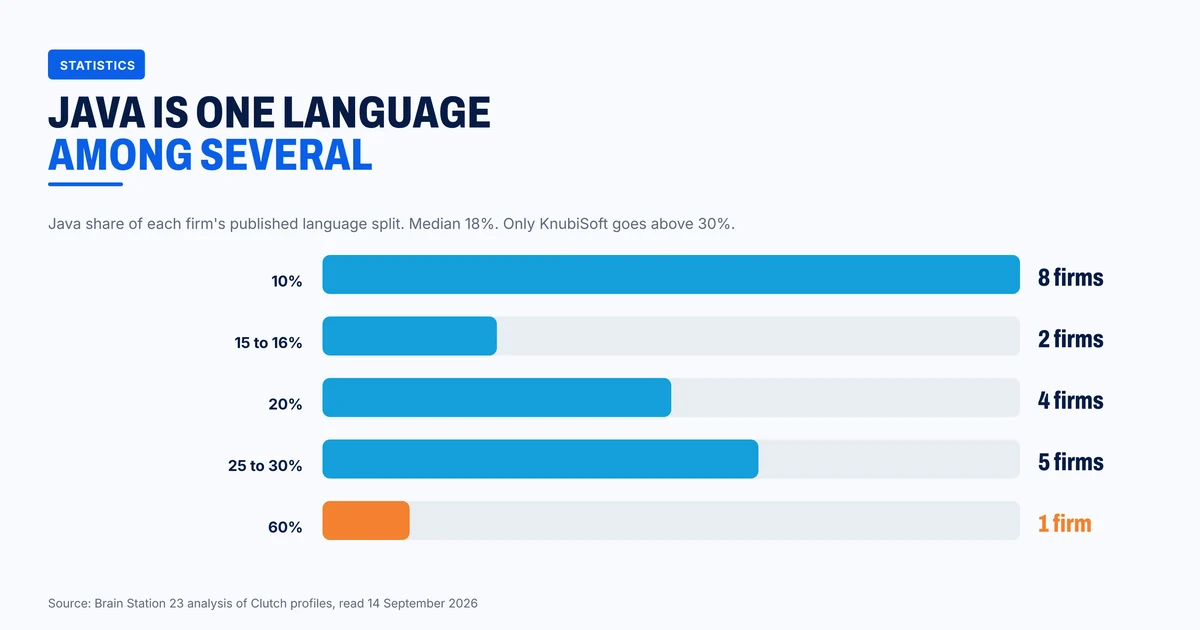
Spring barely appears. Only four of the twenty list Spring in their framework split: Jahnel Group, Mojo Trek, KnubiSoft and Velvetech. Four firms, AppMakers USA, UplineSoft, Motomtech and Fulcrum, are led by Flutter or React Native. A firm on this Top 20 Java Development Companies in USA list may rank on mobile or web reviews, so ask for Java systems it has built and still maintains.
These are larger firms than most directories surface. Eleven of the twenty report 250 or more staff, and four report 1,000 or more. Eight publish a $25 to $49 hourly band, six $50 to $99, four $100 to $149, and Gigster $300 or more. Minimums run from $5,000 to $75,000, with a median of $25,000.
Cost is the weak score. Every overall rating sits between 4.8 and 5.0. KnubiSoft’s profile showed no sub-scores, and six firms score identically on all four. Of the remaining thirteen, Cost is the lowest or joint-lowest for twelve; only Zco, where Schedule is lowest, breaks the pattern.
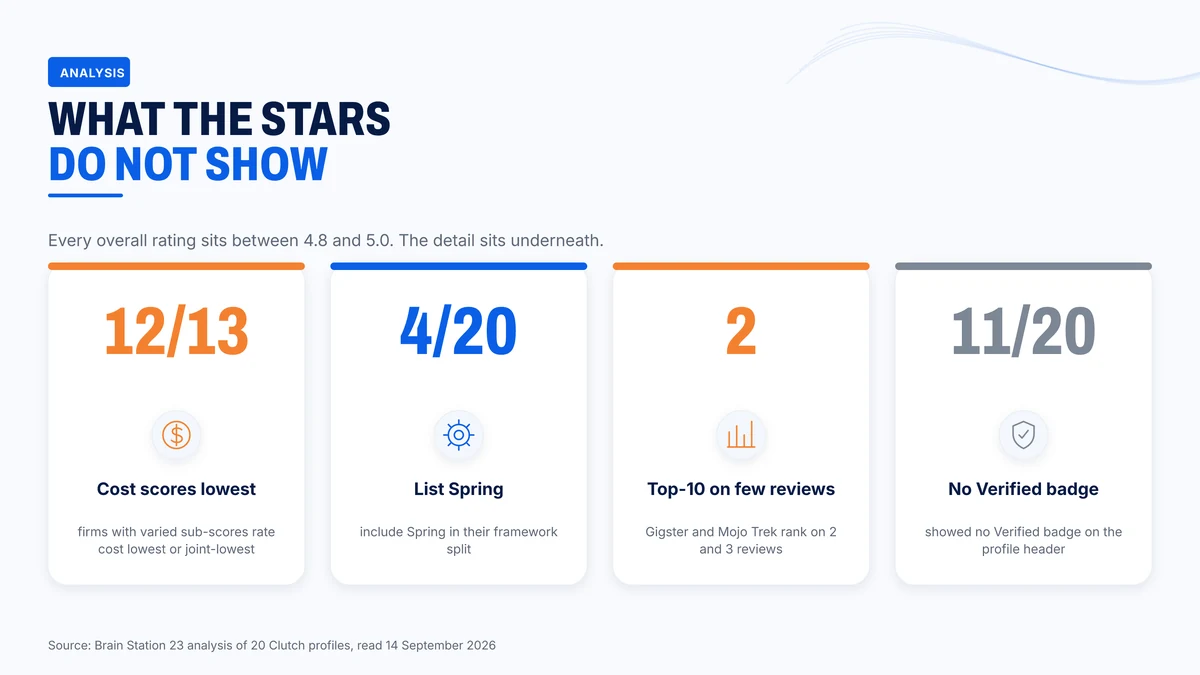
Some rankings rest on very few reviews. Gigster ranks sixth on two reviews and Mojo Trek eighth on three. Across the list, reviews run from 2 to 121 with a median of 54.5.
The cautions are about process, not code. The improvement areas in Clutch’s summaries fall into three groups: cost, estimates and timelines for five firms; proactivity, product management or alignment for six; and communication, onboarding or documentation for five. NewAgeSysIT’s note on testing oversights and NIX’s past project with site crashes are the only two that touch delivered quality.
Badges and certifications are thin. Eleven of the twenty showed no Verified badge on their profile header. None lists a Java certification among its Clutch certifications.
How to shortlist a Java development company
Start with the filter that removes the most firms, and save the long calls for the few that remain.
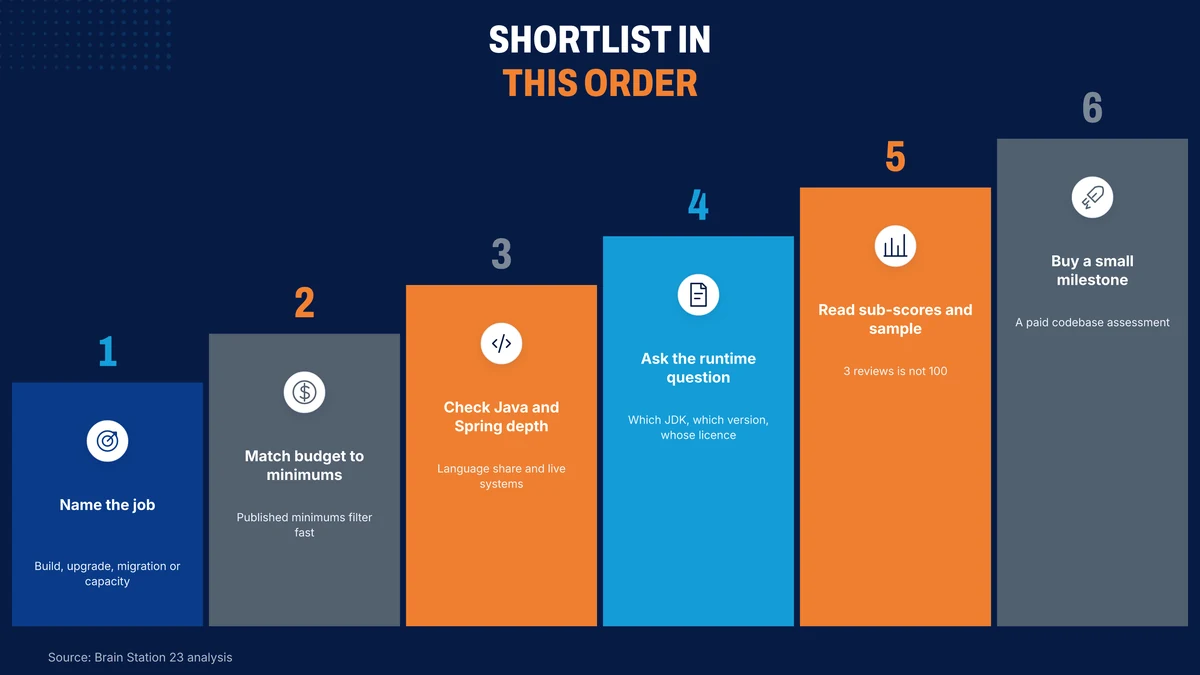
Step 1: Name the job. New build, Java version upgrade, Spring Boot migration, integration or staff augmentation. Each points at a different part of this list.
Step 2: Match budget to minimums. A $20,000 budget leaves the nine firms with minimums of $10,000 or less. A $60,000 budget still rules out Dualboot.
Step 3: Check Java and Spring depth. Prefer firms where Java takes a real share of the language split, and ask for Spring Boot systems they run in production today.
Step 4: Ask the runtime question. Which JDK distribution will they deploy, which version, and whose licence covers it?
Step 5: Read sub-scores and sample size. A 5.0 on three reviews is not the same signal as a 4.9 on 100.
Step 6: Buy a small milestone. A paid assessment of your current codebase shows how the team thinks before you commit a modernisation budget.
How to buy Java development: four engagement models
The engagement model decides who pays when scope moves, and in modernisation work scope nearly always moves.
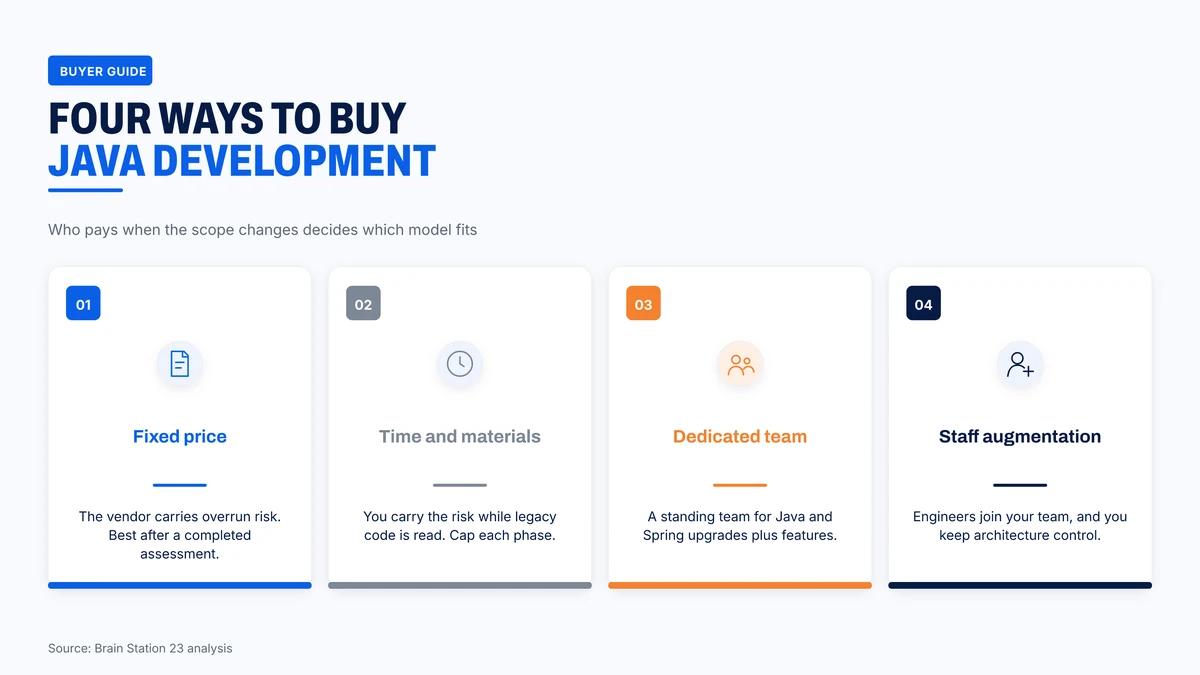
Fixed price puts overrun risk on the vendor, which prices that risk in. It suits a well-bounded service or a version upgrade with a completed assessment. It fails on legacy systems nobody has documented.
Time and materials puts the risk on you in exchange for flexibility. It suits discovery and modernisation where the code has to be read before it can be estimated. Cap each phase and review spend weekly.
Dedicated team gives you a standing group on a monthly fee. It suits a platform that needs regular Java and Spring upgrades plus features. Ask for named people and a replacement clause.
Staff augmentation adds engineers to your own team while you keep architecture and delivery control. UplineSoft, KnubiSoft, NIX and Brain Station 23 publish staff augmentation as a large share of their work. It fails if nobody in-house owns code review.
The technical question: upgrading from Java 8, 11 or 17
Most Java estates are not on a current release, and the upgrade path has an order.
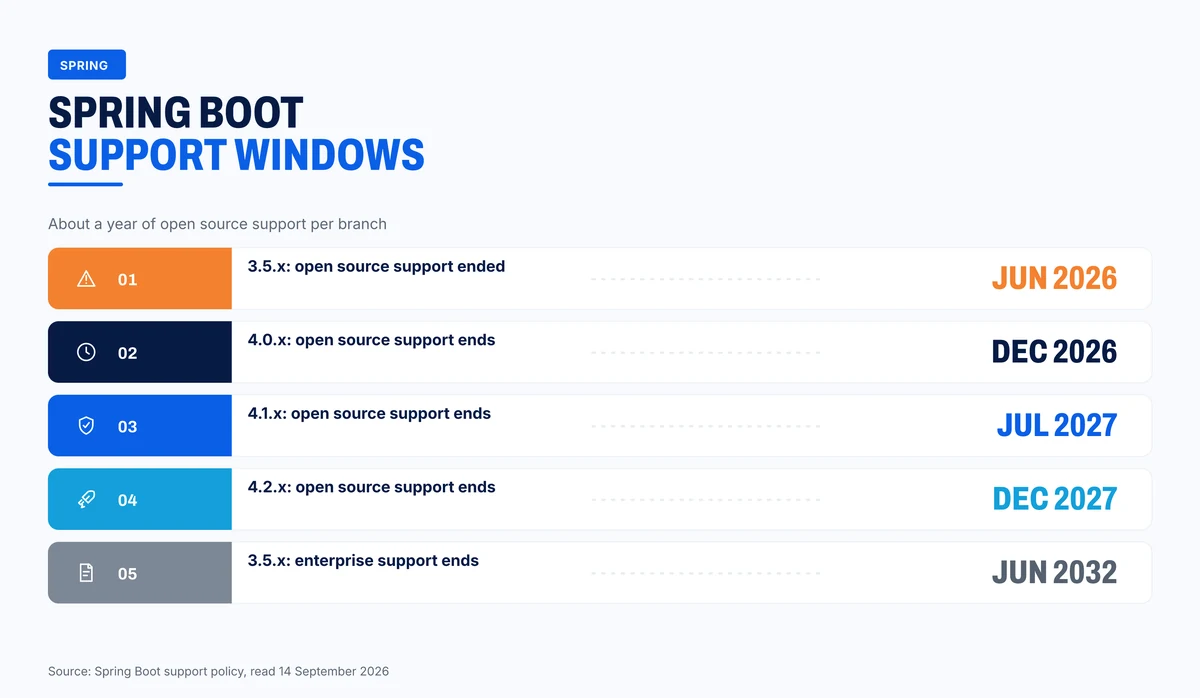
Java 17 loses Oracle Premier Support in September 2026, Java 21 in September 2028 and Java 25 in September 2030 (Oracle). On the framework side, open source support for Spring Boot 3.5 ended in June 2026 and for Spring Boot 4.0 runs to December 2026, while 4.1 is supported to July 2027 (Spring).
The steps, in the order that keeps them cheapest:
Step 1: Inventory runtimes and licences. Record the JDK vendor and version in every environment, including build servers and containers, and who licenses each.
Step 2: Choose the target LTS and distribution. Java 21 or 25 on a supported OpenJDK build, decided before any code changes.
Step 3: Upgrade build tools and dependencies. Maven or Gradle plugins and libraries first, so the Java change is not tangled with library changes.
Step 4: Move the runtime. Compile and test on the new JDK, fixing removed APIs and deprecated features.
Step 5: Upgrade Spring Boot. Step through supported branches rather than jumping several at once.
Step 6: Put the next date in the plan. With an LTS release every two years, budget the next upgrade now.
Red flags: eight answers to walk away from
Some answers should end a sales conversation, or at least move a firm down the list.
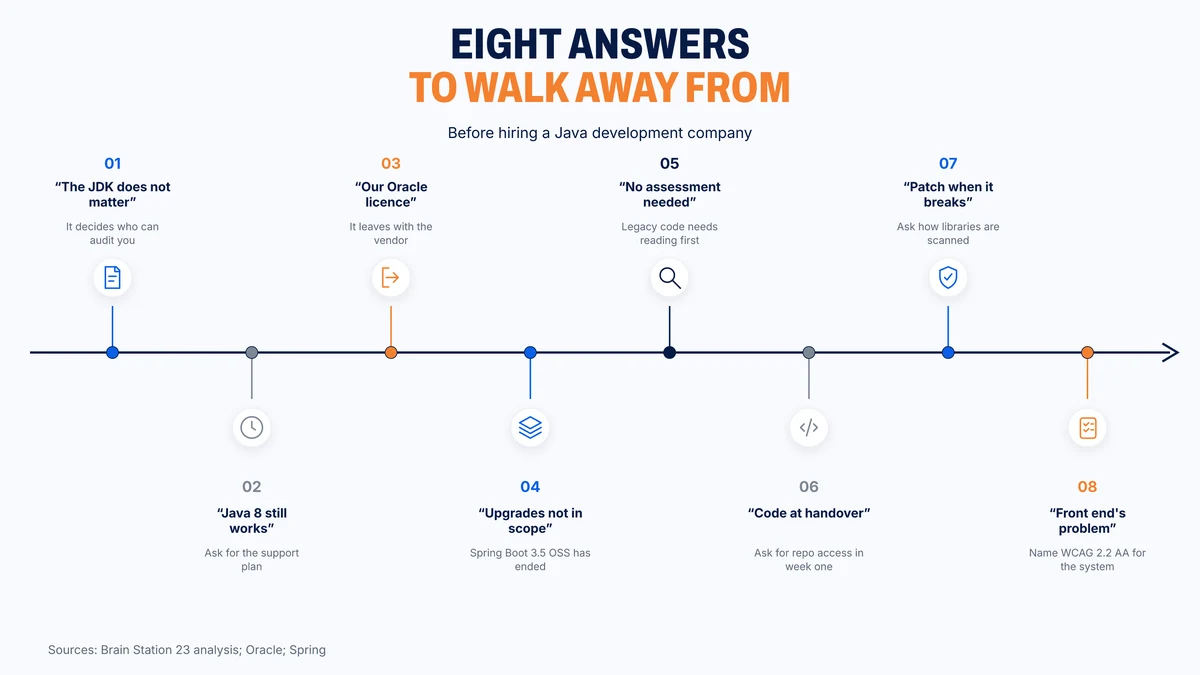
“The JDK does not matter.” It decides who you pay and who can audit you.
“We will stay on Java 8, it works.” Ask what the support and security plan is.
“We use our company’s Oracle licence.” That licence leaves with the vendor.
“Spring Boot upgrades are not in scope.” Open source support for 3.5 has already ended.
“No assessment needed.” A fixed price on undocumented legacy code is a guess.
“You get the code at handover.” Ask for repository access from week one.
“We update dependencies when something breaks.” Ask how they are scanned and reviewed.
“Accessibility is the front end’s problem.” Ask which standard, such as WCAG 2.2 AA, applies to the whole system.
After launch: what the build quote leaves out
The list tells you who can build or modernise the system. This section covers the eighteen months after it goes live, which is where most of the regret in reviews shows up.
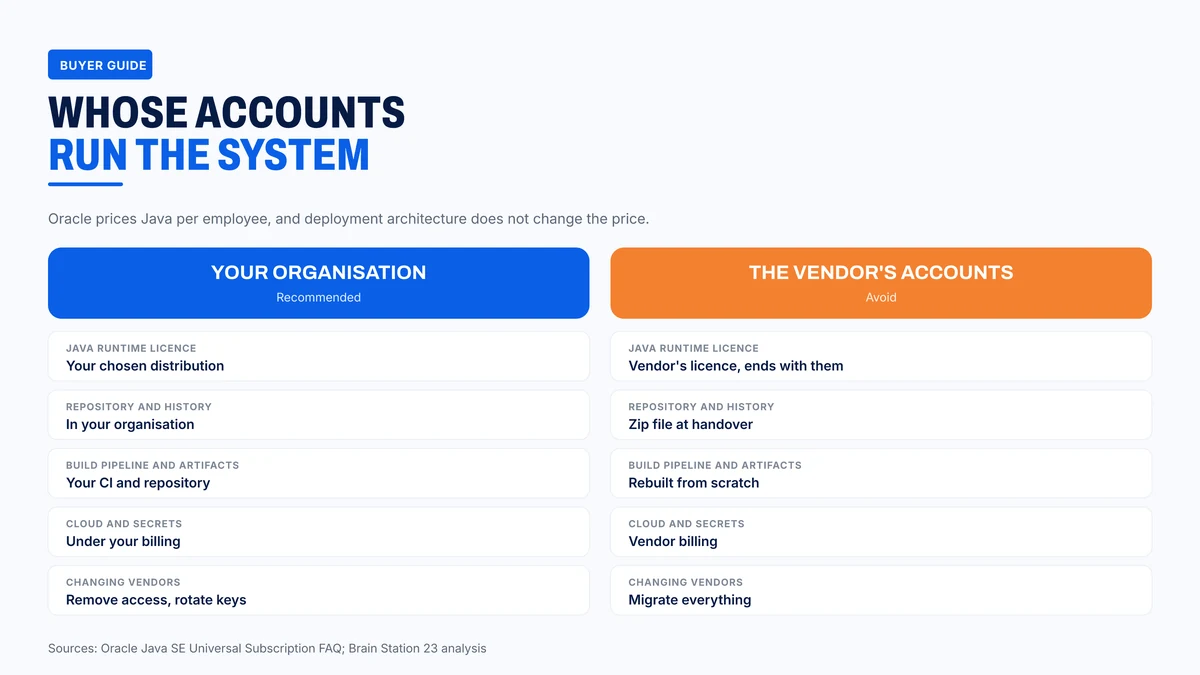
What you must own before the final invoice
The runtime licence or your chosen OpenJDK distribution, in your organisation’s name. Oracle’s Java SE Universal Subscription is sold per employee and “the underlying application architecture and deployment model does not affect pricing” (Oracle), so who holds it is a board-level cost question.
The repository with its full commit history, in an organisation account you control.
The build pipeline: Maven or Gradle configuration, CI/CD definitions, artifact repository and the credentials to publish to it.
Cloud and infrastructure accounts: hosting, databases, message brokers, secrets and infrastructure code.
Third-party licences and accounts, including commercial libraries and monitoring tools, plus a runbook to build, deploy and roll back.
The bill that arrives after launch
A build quote covers the build. Almost everything else recurs.
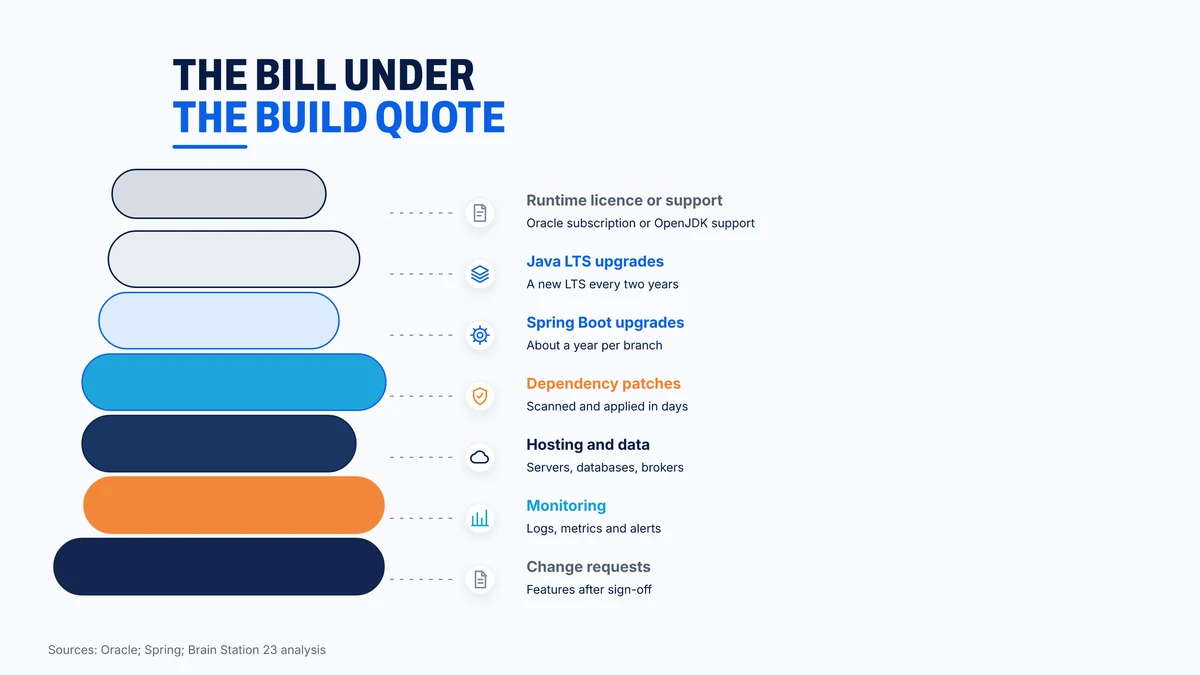
The recurring lines are the runtime subscription or support, Java LTS upgrades, Spring Boot upgrades, dependency updates and security patches, hosting and databases, monitoring, and change requests. Get the recurring number in writing before signing the build, and compare vendors on three years of total cost.
Security is a recurring cost
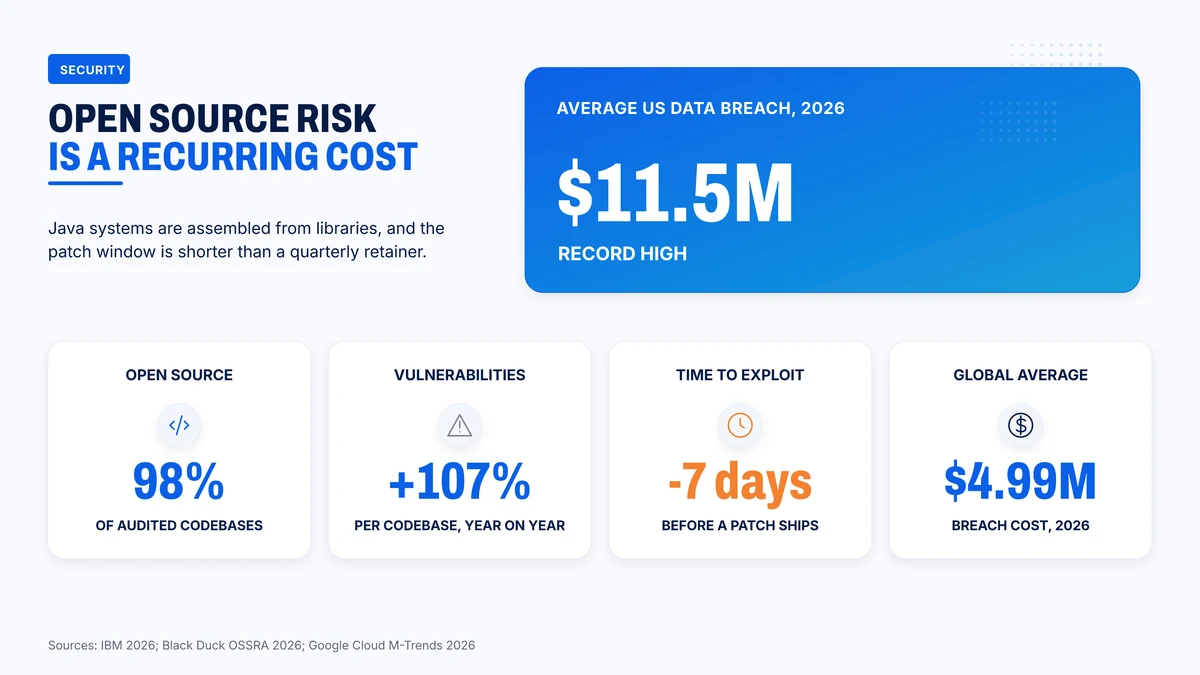
Java systems are built from open source. Black Duck found open source in 98% of the codebases it audited for its 2026 report, and the mean number of vulnerabilities per codebase jumped 107% on the previous year (Black Duck).
The window to act is short. Google Cloud’s M-Trends 2026 estimated the mean time to exploit at minus seven days, meaning exploitation routinely arrives before a patch is released (Google Cloud). A retainer that applies library patches quarterly does not cover that risk. And the average US data breach cost a record USD 11.5 million in IBM’s 2026 report (IBM Cost of a Data Breach Report 2026).
Ask vendors for a software bill of materials for each release, how dependencies are scanned in CI, and how fast a critical library fix reaches production, stated in days.
Accessibility is legal exposure
A Java backend usually sits behind a web front end, and that front end carries legal risk. WebAIM found detected WCAG 2 failures on 95.9% of the top million home pages in 2026, with an average of 56.1 errors per page (WebAIM Million 2026). More than 5,000 digital accessibility lawsuits were filed in 2025, and 46 percent of federal cases involved repeat defendants (UsableNet).
Write a named standard such as WCAG 2.2 AA into the contract for any user-facing part of the system, including server-rendered pages and generated documents, and treat overlay widgets sceptically.
Contract clauses that surface in month nine
These rarely come up in a sales call and often decide the relationship later. This is not legal advice; have your own counsel review any agreement.
IP assignment on payment, not on final acceptance.
Runtime and licence responsibility, naming the JDK distribution and who licenses it.
Upgrade scope, stating which Java and Spring Boot versions the retainer keeps you on.
Transition assistance, a fixed number of hours at an agreed rate if you move vendors.
Rate escalation caps and subcontracting disclosure.
Liability caps and insurance matched to your data, and non-solicitation in both directions.
How to leave without losing the codebase
Confirm ownership of the repository, build pipeline, artifact repository and cloud accounts first. Check that no runtime or library licence in production belongs to the vendor.
Trigger transition hours while relations are still cordial, and record walkthroughs of the build, deployment and rollback process. On the last day, remove the departing team from every account and rotate every secret, deployment key and database credential they could have seen.
Hire in-house or hire an agency
The honest comparison starts with the wage. The BLS median for software developers was $135,980 in May 2025 (BLS), and the three Java salary sites above range from $92,254 to $117,931, before benefits, recruiting and equipment.
Hire in-house when the Java system is core to the business, changes every sprint, and you can keep at least two engineers who know it deeply. Upgrades go faster with the original authors on staff.
Hire an agency for a bounded modernisation, a version upgrade, or skills you need for months rather than years. Keep the licences and accounts in your name so the choice stays reversible.
Combine the two when you have an architect but need capacity. Staff augmentation or a dedicated team adds engineers without handing over the design.
FAQ
How much do US Java development companies charge per hour?
Among the twenty firms here, 14 publish a band under $100 an hour, four publish $100 to $149, Gigster publishes $300 or more and Dualboot does not publish a rate. The median minimum project is $25,000 (Clutch).
Which Java version should a business application run?
A supported LTS release. Oracle lists Java 21 and 25 as LTS releases with Premier Support to September 2028 and September 2030, while Java 17 Premier Support ends in September 2026 (Oracle).
Do we need to pay Oracle to run Java?
How long does Spring Boot support each version?
About a year of open source support per branch. Spring Boot 3.5’s ended in June 2026, 4.0’s runs to December 2026, and 4.1’s to July 2027 (Spring). Enterprise support runs longer for customers who pay for it.
Why do Clutch ratings barely vary between these firms?
Every firm here rates between 4.8 and 5.0. The sub-scores are more revealing: Cost is the lowest or joint-lowest for 12 of the 13 firms whose sub-scores differ (Clutch). Check review counts too; two firms rank in the top ten on three reviews or fewer.
Is Java still a good choice for new projects?
Yes, for systems that need long support windows and a large hiring pool. 29.4% of developers in the 2025 Stack Overflow survey used Java (Stack Overflow Developer Survey 2025), and 62% of organisations in Azul’s survey use it to code AI functionality.
Who should hold the Java runtime licence?
Your organisation. A licence held by the vendor ends with the vendor relationship. Name the JDK distribution and the licence holder in the contract.
Is a Clutch Verified badge a sign of quality?
It is a sign of identity. Clutch says Verified providers have passed a credit check and had their business entity validated. Eleven of the twenty organic top-ranked firms here showed no Verified badge on their profile header (Clutch).
Conclusion
The data behind this Top 20 Java Development Companies in USA list points three ways. Java is usually one language among several, and Spring appears in only four framework splits. Most firms bill under $100 an hour. And reviewers rate cost lowest far more often than quality.
Any of the twenty can write the code. What decides the engagement is what surrounds it: which runtime it runs on and whose licence covers it, who prices the next Java and Spring Boot upgrade before support runs out, and whether you can walk away with the repository, the pipeline and the keys.
Sources
- https://clutch.co/us/developers/java?sort_by=ClutchRank
- https://clutch.co/profile/brain-station-23
- https://www.oracle.com/java/technologies/java-se-support-roadmap.html
- https://www.oracle.com/java/technologies/java-se-subscription-faq.html
- https://openjdk.org/projects/jdk/27/
- https://spring.io/projects/spring-boot#support
- https://www.azul.com/state-of-java-2026/
- https://survey.stackoverflow.co/2025/technology
- https://www.bls.gov/ooh/computer-and-information-technology/software-developers.htm
- https://www.payscale.com/research/US/Job=Java_Developer/Salary
- https://www.salary.com/research/salary/benchmark/java-developer-salary
- https://www.ziprecruiter.com/Salaries/Java-Developer-Salary
- https://www.blackduck.com/blog/ossra-2026-open-source-vulnerability-counts-doubled-year-over-year.html
- https://cloud.google.com/blog/topics/threat-intelligence/m-trends-2026
- https://www.ibm.com/reports/data-breach
- https://webaim.org/projects/million/
- https://blog.usablenet.com/ada-web-lawsuit-trends-2026