
Node.js 20 stopped receiving security fixes on 30 April 2026.
That date is on the Node.js release schedule, and it is not the last one this year. Node.js 24 moves from active support to maintenance on 20 October, and Node.js 22 reaches end of life on 30 April 2027. The project’s own guidance is blunt: “Production applications should only use Active LTS or Maintenance LTS releases” (Node.js).
So a Node.js backend written two years ago is probably already due for work, whether or not anyone has scheduled it. That changes what a buyer should ask a vendor. The firms on this Top 20 Node JS Development Companies in USA list all build with Node.js, but Node.js is a median of 23.5 percent of their published framework work (Clutch profiles, read 14 September 2026). Most of them sell it alongside React, .NET or Ruby on Rails.
The runtime is not the risk. 48.7 percent of developers in the 2025 Stack Overflow survey use it. The risk sits in the upgrade cycle, the npm dependency tree and the accounts nobody wrote into the contract. This guide covers the twenty firms and what the work costs, and then the part that decides the next three years: who owns the npm organisation, what recurs once the API is live, and how to change vendors without losing the codebase.
Key takeaways
- 23.5% is the median share Node.js takes in the published framework split of the twenty firms, and five firms put it at 10% (Brain Station 23 analysis of Clutch profiles, read 14 September 2026).
- 17 of 19 firms whose four Clutch sub-scores differ have Cost as their lowest or joint-lowest score (Clutch profiles).
- 19 of 20 firms list React in the same framework split as Node.js, so most proposals will arrive as full-stack JavaScript (Clutch profiles).
- 30 April 2027 is end of life for Node.js 22, a year after Node.js 20 lost support (Node.js Release schedule).
- $94,700 to $121,124 is what four salary sites report for the same US Node.js developer role, a spread of $26,424 (Salary.com, ZipRecruiter).
- 96.6% of the malicious open source packages Sonatype counted in Q2 2026 were on npm, and its cumulative log passed 1.8 million (Sonatype).
- 11 vulnerabilities, three rated high, were fixed in the Node.js security release of 29 July 2026 alone (Node.js).
- 95.9% of the top million home pages had detected WCAG 2 failures in 2026 (WebAIM).
Node.js in 2026: everywhere in the stack, on a fixed clock
Node.js is less a niche skill than a default. In the 2025 Stack Overflow Developer Survey, 48.7% of respondents to the web frameworks question used Node.js, ahead of React at 44.7%, Next.js at 20.8% and Express at 19.9% (Stack Overflow Developer Survey 2025). JavaScript itself was used by 66% of respondents and TypeScript by 43.6%.
On the public web, the footprint looks smaller. W3Techs reports that Node.js is used by 7.2% of websites whose web server it can identify (W3Techs). That is a crawl of visible web servers, and most Node.js work runs behind a proxy, in an API or inside an internal service, so treat it as a floor rather than a census.
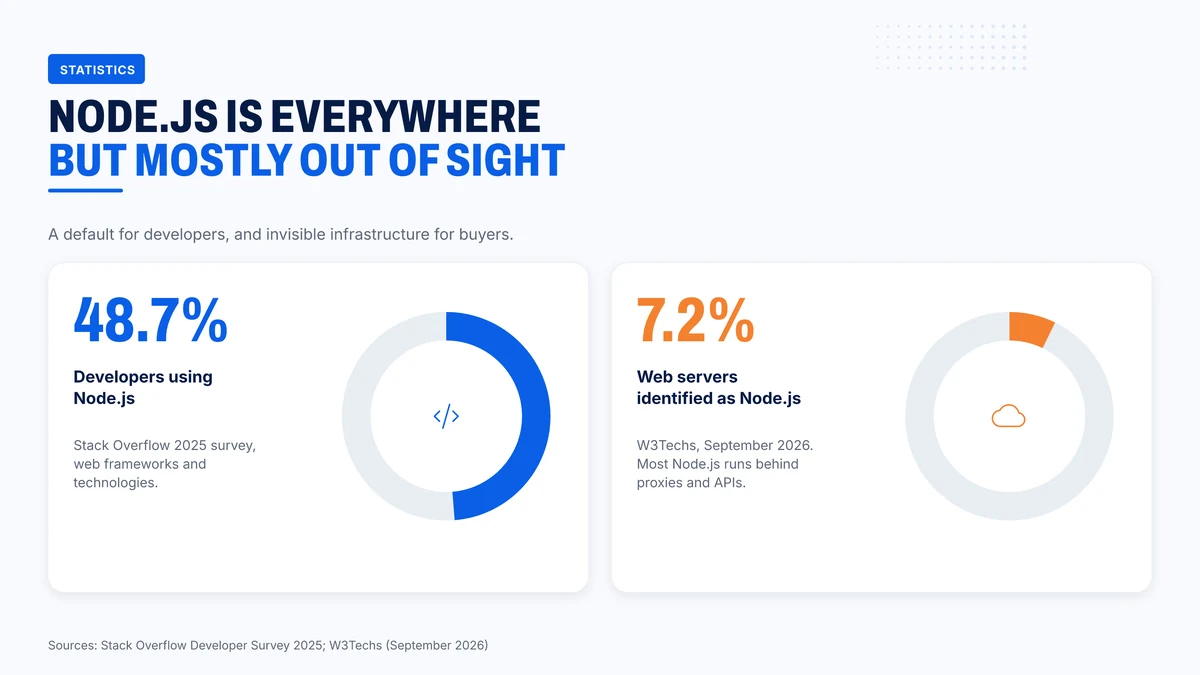
The gap between those two numbers is the useful part for a buyer. Node.js is mostly invisible infrastructure: the API behind a React front end, the job queue, the webhook handler, the service that talks to Stripe. Invisible infrastructure is the kind that gets built once and then left alone.
Node.js does not allow that. Even-numbered releases have had roughly three years of support, and the project is changing the cadence. “Starting with Node.js 27, the release cycle will be annual and every major version will move to LTS status after its six-month Current phase” (Node.js).
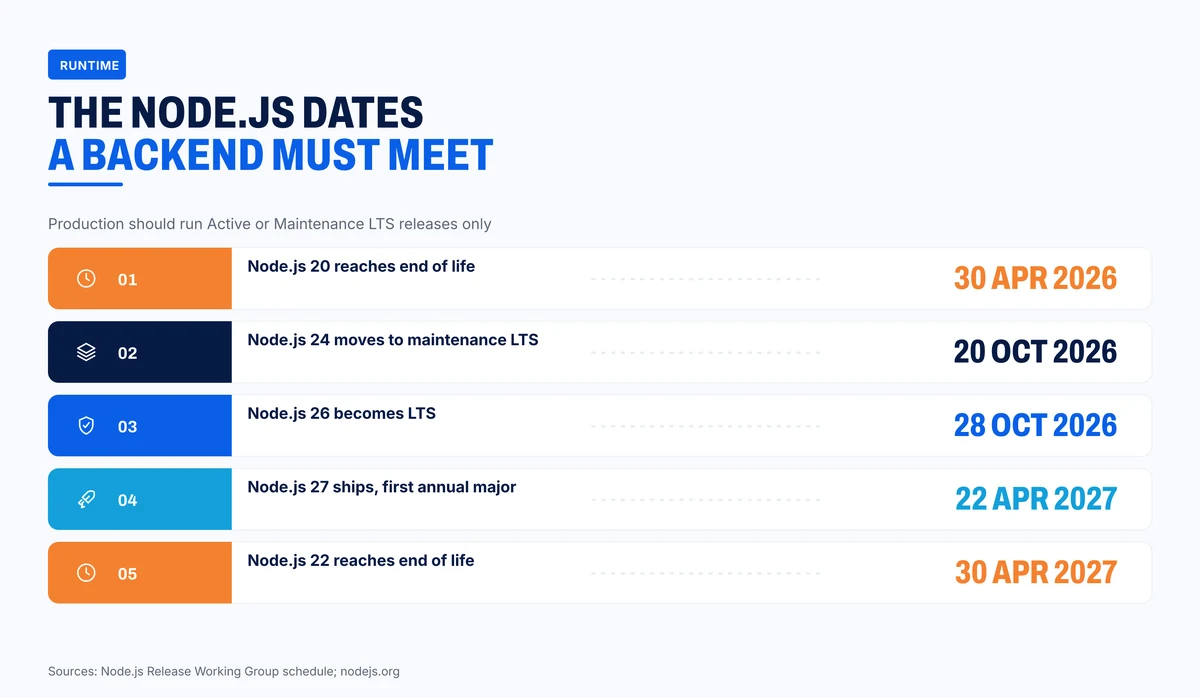
In practice, a Node.js backend needs a major runtime upgrade about every two years, and every upgrade pulls dependency updates behind it. Brief a vendor for that from the start and the upgrade becomes a line item. Leave it out and it arrives as an emergency.
What Node.js development costs in the US
Start with salaries, because they anchor every agency rate, and because the published figures do not agree.
Salary.com puts a US Node.js developer at $94,700 as of 1 September 2026 (Salary.com). PayScale reports an average base of $111k for the Node.js skill across 3,043 profiles (PayScale, updated 14 July 2026). Talent.com says $120,233 from 10,000 salaries (Talent.com). ZipRecruiter reports $121,124 as of 14 September 2026 (ZipRecruiter).
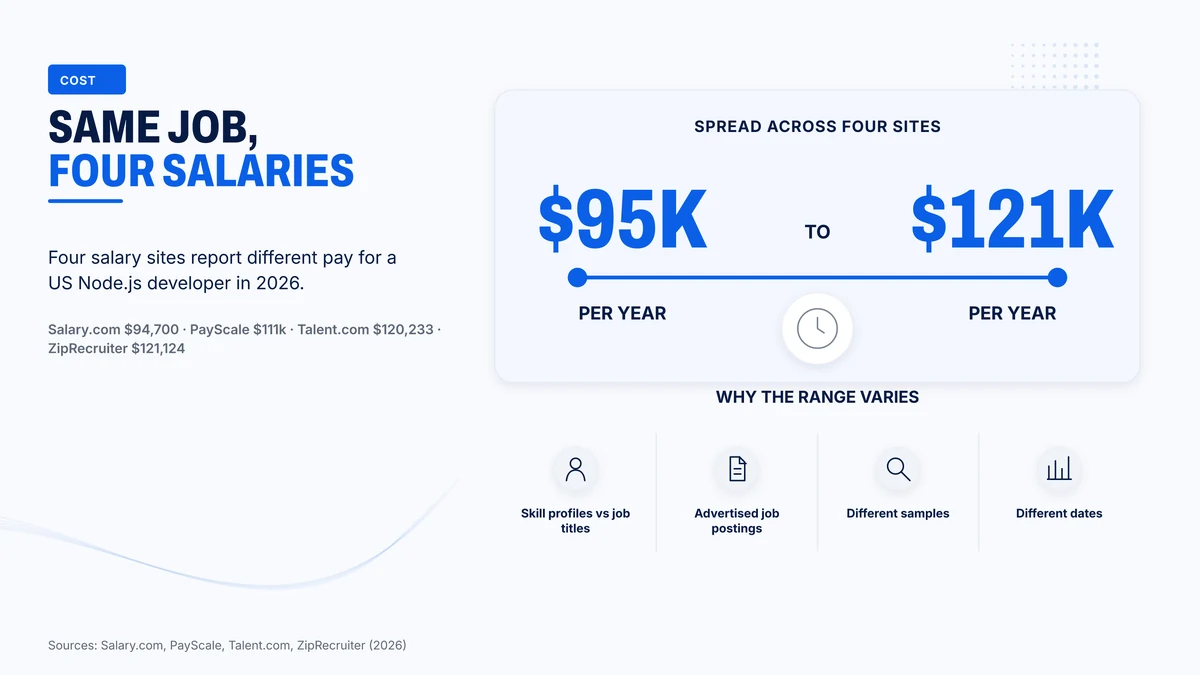
That is a $26,424 spread for one job title, and none of the four is wrong. PayScale groups people by a skill rather than a job title, and each site draws on a different sample, method and date. The Bureau of Labor Statistics does not break out Node.js, but its median for all software developers was $135,980 in May 2025 (BLS), above every aggregator.
So refuse a single number for “Node.js development.” What moves a quote is scope, and eight factors do most of the work.
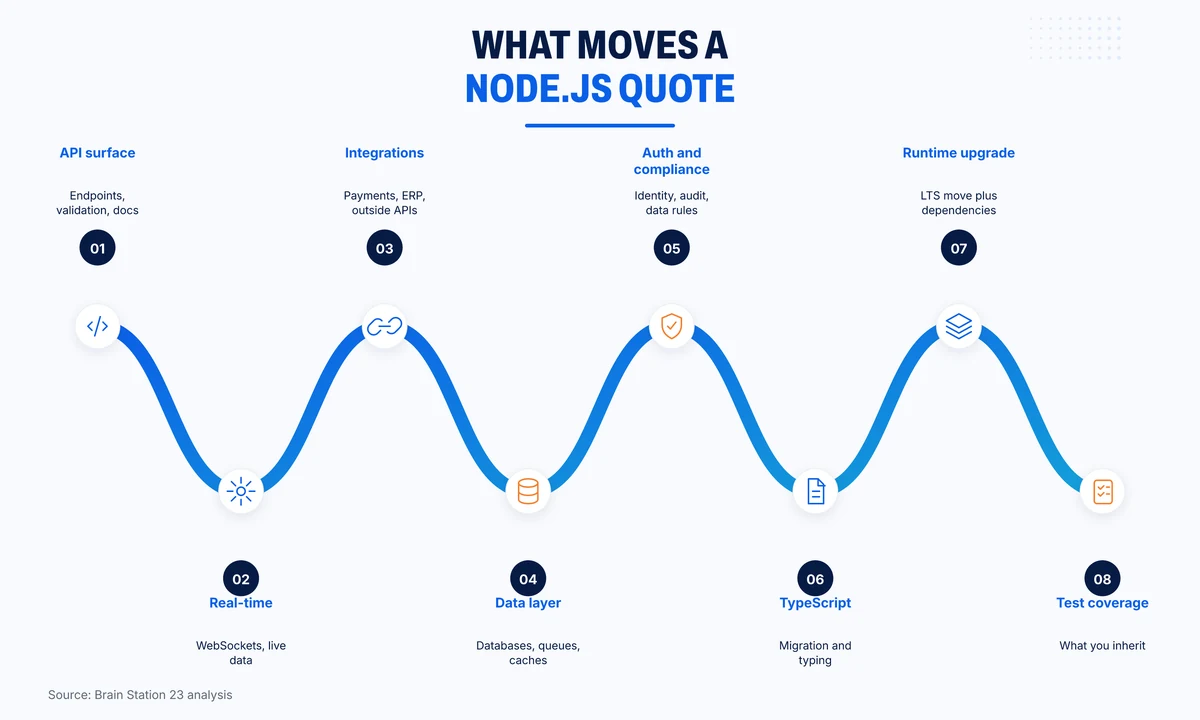
The size of the API surface comes first, since every endpoint needs validation, tests and documentation. Real-time features such as WebSockets, live dashboards or chat add state and scaling work. Third-party integrations follow, because a payments provider or ERP you do not control sets your timeline. The data layer matters: one Postgres database is a different job from event streams and caches. Authentication and compliance, a JavaScript-to-TypeScript migration, the runtime upgrade already due, and the test coverage you inherit finish the list. Ask every vendor to price those eight lines separately and the proposals become comparable.
The Top 20 Node JS Development Companies in USA, compared
Firms 2 to 21 below are the top 20 by Clutch Rank on Clutch’s US NodeJS developers directory, read on 14 September 2026. Clutch lists 2,900 firms on that page. One row at the top is a paid featured placement, so we left it out and took the next 20 in Clutch Rank order, which Clutch describes as its organic ranking based on reviews, awards and past work.
Brain Station 23 is placed first because we publish this article. We are US-headquartered and Premier Verified on Clutch, but Node.js is 8 percent of our published framework split and IT staff augmentation is 60 percent of our focus, so the directory’s ranking did not place us in its top 20 and we are not claiming it did.
Every overall rating below sits between 4.8 and 5.0, so ratings cannot separate these firms. The columns are decision columns instead.
| # | Company | Best For | Team Size | Node.js Focus | Key Tech Stack | Industries Served | Locations |
|---|---|---|---|---|---|---|---|
| 1 | Brain Station 23 — brainstation-23.com | Adding cost-controlled Node.js engineers to a team you already run | 250 – 999 | 8% of frameworks; 60% staff augmentation | Spring, .NET, Flutter, Node.js, Angular, Django, Laravel | Retail, medical, telecoms, education, financial services | Springfield VA; Bangladesh, UAE, England, Malaysia, Germany |
| 2 | Vention — ventionteams.com | Enterprises that need to scale a mixed JavaScript and .NET team quickly | 1,000 – 9,999 | 15% | .NET, React, Angular, Node.js, Django, Flutter | Education, financial services, medical, retail, logistics | New York; London, San Francisco, Vienna, Vilnius, Berlin, Warsaw |
| 3 | Atomic Object — atomicobject.com | Healthcare and logistics products that need a US-based team for years | 50 – 249 | 25% | Ruby on Rails, React Native, Node.js, React, TypeScript | Medical, logistics, automotive, insurance | Grand Rapids, Ann Arbor, Chicago, Raleigh |
| 4 | INOXOFT — inoxoft.com | Fintech and edtech web apps built Node.js-first at a low hourly band | 50 – 249 | 35% | Node.js, React, Flutter, TypeScript, Python | Financial services, education, real estate, automotive | Newark DE; Wroclaw, Lviv |
| 5 | BairesDev — bairesdev.com | Enterprises adding nearshore engineers in US time zones | 1,000 – 9,999 | 10% | .NET, React Native, Node.js, React, Angular, Vue | IT, financial services, medical, advertising | San Francisco; Buenos Aires, Sao Paulo, Mexico City, Bogota |
| 6 | Suffescom Solutions Inc — suffescom.com | Fintech and healthcare builds on a tight hourly budget | 250 – 999 | 15% | Next.js, Node.js, React Native, .NET, Laravel | Financial services, medical, real estate, e-commerce | New York, Wilmington DE; Mohali, Dubai, London, Sydney |
| 7 | Cleveroad — cleveroad.com | Edtech and AI products from a large Eastern European team | 250 – 999 | 10% | .NET, Flutter, Next.js, Node.js, Vue, TypeScript | Education, financial services, IT, insurance, medical | New York; Kharkiv, Dnipro, Krakow |
| 8 | Designli — designli.co | Non-technical founders who want a paid discovery phase first | 50 – 249 | 35% | Node.js, React Native, React, Swift, Kotlin | Consumer products, construction, education, energy | Greenville SC; San Francisco, Dallas, Buenos Aires, Mexico City |
| 9 | X-Team — x-team.com | Enterprise product teams adding remote Node.js and React engineers | 250 – 999 | 41% | React, Node.js, .NET, Go, Kotlin | IT, gaming, financial services, media | Austin; Hawthorn East, Australia |
| 10 | Scopic — scopicsoftware.com | Medical and manufacturing software with AI work alongside the web app | 250 – 999 | 17% | React, .NET, Node.js, React Native, Laravel, C++ | Medical, automotive, manufacturing, education | Marlborough MA |
| 11 | Bilberrry — bilberrry.com | Government, nonprofit and mid-market web platforms from a small senior team | 10 – 49 | 33% | React, Node.js, Angular, Laravel, JavaScript | Government, nonprofit, consumer products, education | Seattle |
| 12 | Codup — codup.co | B2B e-commerce wired into an ERP for manufacturers and distributors | 50 – 249 | 22% | Node.js, Next.js, React, Laravel, .NET, Shopify | E-commerce, manufacturing, electrical, HVAC, retail | Houston, Irvine; Dubai |
| 13 | Six Feet Up — sixfeetup.com | Python-led data and AI platforms with a Node.js layer | 10 – 49 | 10% | Django, Python, Node.js, React, TypeScript | IT, medical, education, energy, financial services | Fishers IN |
| 14 | Agency Partner Interactive — agencypartner.com | Healthcare, education and commerce brands that want web, app and growth work together | 50 – 249 | 10% | React, Next.js, Node.js, Angular, Flutter, Laravel | Medical, education, e-commerce, nonprofit | Plano TX |
| 15 | Goji Labs — gojilabs.com | Startups and scaleups launching a new product with design and strategy included | 50 – 249 | 15% | Ruby on Rails, React Native, Node.js, Flutter, React | Automotive, education, energy, financial services, gaming | Los Angeles, New York |
| 16 | Vincit — vincit.com | Mid-market consumer and retail brands on a JavaScript stack with SAP or Azure | 250 – 999 | 25% | Node.js, React, React Native, Next.js | Arts and entertainment, e-commerce, consumer products, media | Irvine CA |
| 17 | Swovo — swovo.com | Healthcare web and mobile apps from a small Colorado team | 10 – 49 | 25% | Node.js, React, React Native, Ruby on Rails, TypeScript | Medical, financial services, energy, legal | Boulder, Denver |
| 18 | FocusReactive — focusreactive.com | Headless CMS and Next.js content sites for small businesses | 10 – 49 | 10% | Next.js, React, Node.js, TypeScript | Advertising, business services, education, financial services | London; Warsaw, New York |
| 19 | Zco Corporation — zco.com | Mobile-first products with a Node.js backend from a long-established firm | 250 – 999 | 25% | React Native, Node.js, .NET, React, Flutter | Business services, consumer products, gaming, manufacturing | Nashua NH, Boston, New York |
| 20 | Origami Studios — origamistudios.us | Businesses automating manual workflows with AI on a Node.js backend | 50 – 249 | 25% | Node.js, Flutter, Next.js, .NET, Django | Business services, consumer products, education, financial services | Parsippany NJ |
| 21 | VAIRIX Software Development — vairix.com | Startups wanting a nearshore Node.js team in Uruguay | 50 – 249 | 40% | Node.js, React, React Native, Ruby on Rails | Business services, medical, real estate, retail | Boston; Montevideo |
Team sizes, Node.js focus (NodeJS share of each firm’s published framework split), frameworks, industries and locations are from each firm’s published Clutch profile, read 14 September 2026. “Best For” is our reading of that data. Engagement models and certifications are not published consistently across these profiles, so we have left them out rather than guess.
Profiles are grouped by the kind of buyer each firm suits, and the numbers match the table. Every profile carries a caution drawn from the Review Highlights Clutch publishes from that firm’s verified reviews. Certifications are self-published and unverified by us, and Clutch profiles do not carry ISO or CMMI certifications, which is why the profiles say to ask.
1. Brain Station 23
We publish this article and put ourselves first, so read this as the publisher’s pick, not a ranking. The honest gap is focus. Node.js is 8 percent of our published framework split, against a 23.5 percent median for the twenty firms below, because most of what we sell is engineers embedded in client teams. What we offer instead is price and security process: our $25 to $49 band is the lowest on this page, shared by five of the twenty, and our ISO 27001 and SOC 2 Type II controls speak to the supply chain risks covered later. We write IP assignment on payment, rate locks and replacement guarantees into contracts. Reviewers have asked us for better internal coordination. If you want a US-only team in your time zone, call someone else.
Founded: 2006
US Presence: Springfield VA
Company size: Clutch band 250 to 999; we publish 900+ engineers
Rating: 4.9 across 21 Clutch reviews, HQ Springfield, Virginia
- Adding cost-controlled Node.js engineers to a team you already run
- CMMI Level 3
- ISO 27001
- ISO 9001
- SOC 2 Type II (company-published)
- Staff augmentation
- Node.js and TypeScript APIs
- E-commerce backends
- Runtime and dependency upgrades
- Enterprise app modernisation
- Dedicated teams
- Retail
- Medical
- Telecoms
- Education
- Financial services
- Hospitality
- Ask how a Dhaka-based squad overlaps your working day and who the named US escalation contact is
For backends where Node.js is the core
4. INOXOFT
Node.js and React each take 35 percent of INOXOFT’s framework split, the joint third-highest Node.js share on this list, and financial services is 40 percent of its industry work. It publishes a $25 to $49 band with a Delaware address and offices in Poland and Ukraine. Reviewers mention communication and project management most. The pattern Clutch flags is design flexibility: some clients wanted more layout variations in the early stages. It suits buyers with a clear product spec more than those still exploring the interface.
Founded: 2014
US Presence: Newark DE
Company size: 50 to 249
- Fintech and edtech web apps built Node.js-first at a low hourly band
- Not published; ask directly
- Node.js APIs
- React front ends
- Flutter apps
- Custom web applications
- AI consulting and development
- TypeScript and Python
- Financial services
- Education
- Real estate
- Automotive
- IT
- Ask to see two or three design directions before the layout is locked
8. Designli
Designli pairs Node.js at 35 percent with React Native at 35 percent, a JavaScript stack from API to phone. Its profile is aimed at founders without a technical co-founder, and mobile is half its service mix. Reviewers praise communication and the quality of work. The caution in Clutch’s summary is timelines, which ran beyond initial estimates for some clients. It fits a founder who wants guidance through the first build, and suits less a team that already has its own product and engineering leads.
Founded: 2013
US Presence: Greenville SC
Company size: 50 to 249
- Non-technical founders who want a paid discovery phase first
- Not published; ask directly
- Node.js backends
- React Native apps
- React web apps
- MVP development
- UX and UI design
- Product strategy
- Consumer products
- Construction
- Education
- Energy
- Financial services
- Manufacturing
- Ask for a time estimate with a stated contingency, and plan for an overage on a large scope
11. Bilberrry
Bilberrry is one of the smallest firms here, and JavaScript is 70 percent of its language split, with Node.js at 33 percent of frameworks. Government and nonprofit together make up 30 percent of its industry work, unusual on a Node.js list. Its 36 reviews rate 5.0 overall. Clutch’s summary notes one improvement area: some clients wanted more client-facing project management tools to keep information in one place. It suits public-sector and mission-driven buyers with a web platform to maintain, and suits less a buyer needing a large team fast.
Founded: 2010
US Presence: Seattle
Company size: 10 to 49
- Government, nonprofit and mid-market web platforms from a small senior team
- Not published; ask directly
- Node.js and React web applications
- API development
- Custom software
- Web design
- Staff augmentation
- SEO and performance work
- Government
- Nonprofit
- Consumer products
- Education
- Financial services
- Manufacturing
- Ask which client-facing tool will hold tickets, decisions and documents during the build
17. Swovo
Swovo splits its frameworks evenly between Node.js, React, React Native and Ruby on Rails, and medical work is half its industry mix. It is the only firm of the twenty that Clutch lists as certified in NodeJS. Its sub-scores are near perfect, with Cost the lowest at 4.9. That matches Clutch’s caution: some projects exceeded initial budget expectations, and clients suggested earlier budget conversations. The $50,000 minimum rules out small experiments, so it suits funded healthcare products.
Founded: 2017
US Presence: Boulder, Denver
Company size: 10 to 49
- Healthcare web and mobile apps from a small Colorado team
- Not published; ask directly
- Node.js APIs
- React and React Native apps
- Ruby on Rails
- TypeScript
- UX and UI design
- AI development
- Medical
- Financial services
- Energy
- Legal
- Real estate
- Agree a budget review point in writing before the second milestone
21. VAIRIX Software Development
Node.js is 40 percent of VAIRIX’s framework split and JavaScript 60 percent of its languages, making it one of the most Node.js-focused firms here. It pairs a Boston address with an office in Montevideo, a city whose working day overlaps US time zones. It has 15 reviews, fewer than most on this list. The improvement area Clutch notes is documentation quality. It suits startups that want a nearshore JavaScript team and are prepared to specify handover documents up front.
Founded: 2010
US Presence: Boston
Company size: 50 to 249
- Startups wanting a nearshore Node.js team in Uruguay
- Not published; ask directly
- Node.js backends
- React and React Native
- Ruby on Rails
- IT staff augmentation
- Custom software
- Application testing
- Business services
- Medical
- Real estate
- Retail
- Consumer products
- Name the documentation you expect at each milestone in the statement of work
For scale, nearshore and staff augmentation
2. Vention
Vention has 102 Clutch reviews, second only to Suffescom here, and it spreads work thinly: no service line exceeds 20 percent, and Node.js is 15 percent of frameworks. Its profile claims more than 3,000 developers. Reviewers most often mention timeliness and quality. Clutch’s summary flags early friction for some clients in finding the right skill match, alongside communication barriers the firm then worked to fix. With a $50,000 minimum, it suits enterprise and mid-market buyers who need to add engineers fast, not small fixed builds.
Founded: 2002
US Presence: New York
Company size: 1,000 to 9,999
- Enterprises that need to scale a mixed JavaScript and .NET team quickly
- Not published; ask directly
- Node.js and React development
- .NET and Angular
- AI development
- Enterprise app modernisation
- Cloud and DevOps
- Staff augmentation
- Education
- Financial services
- Medical
- Retail
- Logistics
- E-commerce
- Interview the proposed engineers yourself before the start date
5. BairesDev
BairesDev’s profile describes more than 4,000 engineers across Latin America, and half its clients are enterprises. Node.js is 10 percent of its framework split, one slice of a very broad catalogue. Reviewers highlight staff augmentation and recruitment speed. Clutch notes occasional minor language barriers and a need for clearer explanation of technical concepts, though not as a significant obstacle. Its 4.6 Cost score is among the lowest here. It suits large teams that want capacity in their own time zone more than a specialist Node.js studio.
Founded: 2009
US Presence: San Francisco
Company size: 1,000 to 9,999
- Enterprises adding nearshore engineers in US time zones
- Not published; ask directly
- Staff augmentation
- Node.js and React
- .NET
- React Native
- DevOps
- Application testing
- ERP integration
- IT
- Financial services
- Medical
- Advertising
- Business services
- Ask how technical questions are escalated when a language barrier slows a discussion
7. Cleveroad
Education is half of Cleveroad’s industry split, and .NET at 30 percent outranks Node.js at 10 percent in its frameworks. It is also the only firm of the twenty that does not list React. It publishes a $25 to $49 band and a $10,000 minimum, with offices in Ukraine and Poland. Reviewers credit high-quality work and proactive communication. The caution in Clutch’s summary is estimation: some clients felt cost estimates could be more precise. It suits edtech buyers who want a large team at a low rate.
Founded: 2011
US Presence: New York
Company size: 250 to 999
- Edtech and AI products from a large Eastern European team
- Not published; ask directly
- Custom web applications
- Node.js and Next.js
- .NET
- Flutter apps
- AI agents and generative AI
- API development
- Education
- Financial services
- IT
- Insurance
- Medical
- E-commerce
- Ask for an estimate that separates known scope from assumptions
9. X-Team
X-Team has the highest Node.js share on this list at 41 percent, with React at 47 percent, and staff augmentation is 40 percent of its work. Enterprise clients make up 60 percent. It holds its rank on eight Clutch reviews, the fewest of the twenty, so the sample is thin. Reviewers praise engineering quality and fit with in-house teams. Its one noted gap is tooling: a client found email-based communication slow. It suits enterprises that run their own delivery and want Node.js engineers inside it.
Founded: 2006
US Presence: Austin
Company size: 250 to 999
- Enterprise product teams adding remote Node.js and React engineers
- Not published; ask directly
- Staff augmentation
- Node.js and React engineers
- .NET
- Go
- Cloud consulting
- Custom software
- IT
- Gaming
- Financial services
- Media
- Education
- Agree the tools for daily communication before the first engineer starts
10. Scopic
Scopic splits its work between AI, custom software and web development, and medical is 40 percent of its industry mix. Node.js is 17 percent of frameworks, behind React and .NET. Reviewers mention project management most often. Clutch’s summary reports mixed experiences on budget, with some projects running over or bringing unexpected costs, and suggests clearer initial estimates. Scopic is also one of two firms here whose lowest sub-score is Schedule rather than Cost. It suits small and mid-sized businesses that want AI features built into an existing product.
Founded: 2006
US Presence: Marlborough MA
Company size: 250 to 999
- Medical and manufacturing software with AI work alongside the web app
- Not published; ask directly
- Custom software
- React and Node.js web apps
- .NET
- React Native
- AI development
- Cloud consulting
- Medical
- Automotive
- Manufacturing
- Education
- Media
- Ask for a monthly budget review against the original estimate
For healthcare, regulated and US-based teams
3. Atomic Object
Medical work is 65 percent of Atomic Object’s industry split, and its profile describes an employee-owned team that is 100 percent US-based. Node.js is 25 percent of its frameworks, behind Ruby on Rails and React Native. At $150 to $199 an hour, it sits in the top rate tier here. Reviewers mention communication and project management most. Clutch’s caution is cost management: reviewers suggest clearer initial scoping to prevent budget overruns. It suits regulated products where an onshore team matters more than the rate.
Founded: 2001
US Presence: Grand Rapids, Ann Arbor, Chicago, Raleigh
Company size: 50 to 249
- Healthcare and logistics products that need a US-based team for years
- Not published; ask directly
- Custom software
- Node.js and Ruby on Rails backends
- React Native and React
- TypeScript
- Legacy modernisation
- AI integration
- Medical
- Supply chain and logistics
- Automotive
- Insurance
- Ask for a costed scoping phase in writing before the build starts
13. Six Feet Up
Six Feet Up is a Python firm first: Django is 60 percent of its frameworks and Node.js 10 percent. It publishes the highest band on the list at $200 to $300 an hour, with a $50,000 minimum, and describes itself as woman-owned. Its 26 reviews rate 5.0. Clutch notes minor issues with work by junior developers that senior staff then corrected. It is on a Node.js list for its JavaScript layer, so it fits a Python-heavy data or AI platform better than a pure Node.js API.
Founded: 1999
US Presence: Fishers IN
Company size: 10 to 49
- Python-led data and AI platforms with a Node.js layer
- Not published; ask directly
- Custom software
- Python and Django
- AI development
- Big data
- Node.js and React front ends
- AWS architecture
- IT
- Medical
- Education
- Energy
- Financial services
- Retail
- Ask which senior engineer reviews junior developers’ work, and how often
16. Vincit
Vincit’s frameworks are Node.js, React and React Native at 25 percent each, and its industry split leans to entertainment, commerce and media. It publishes $150 to $199 an hour and a $50,000 minimum. Its Cost sub-score of 4.5 is the lowest on this list. Reviewers credit project management and a consultative discovery process. Clutch’s summary adds that some clients wanted issues identified more proactively. It suits consumer brands that value strategy and integration with enterprise platforms, and fits less a price-led brief.
Founded: 2007
US Presence: Irvine CA
Company size: 250 to 999
- Mid-market consumer and retail brands on a JavaScript stack with SAP or Azure
- Not published; ask directly
- Custom software
- Node.js and React web development
- React Native apps
- Next.js
- SAP and Azure integration
- AI capabilities
- Arts and entertainment
- E-commerce
- Consumer products
- Media
- Retail
- Ask how potential risks will be raised before they become issues
19. Zco Corporation
Zco is the oldest firm here, founded in 1989, and mobile development is 40 percent of its work. Node.js is 25 percent of its frameworks, second only to React Native. It publishes $25 to $49 an hour. Reviewers mention timeliness and communication. Clutch’s summary names documentation and long-term planning as the areas to improve, and Schedule, not Cost, is its lowest sub-score. It suits companies that want an app and its API from one New England vendor.
Founded: 1989
US Presence: Nashua NH, Boston, New York
Company size: 250 to 999
- Mobile-first products with a Node.js backend from a long-established firm
- Not published; ask directly
- Mobile apps with Node.js backends
- React Native
- .NET
- React
- AR and VR
- Staff augmentation
- Business services
- Consumer products
- Gaming
- Manufacturing
- Medical
- Write the documentation deliverables and a long-term roadmap into the statement of work
For founders, commerce and content platforms
6. Suffescom Solutions Inc
Suffescom has the most Clutch reviews on this list, 121, and scores 4.9 on all four sub-scores. Financial services and medical each take 35 percent of its industry split. Node.js is 15 percent of a wide framework list that also includes Next.js and React Native. Its offices run from New York to Mohali, Dubai and Sydney. Reviewers most often call it timely. Clutch’s caution is creativity: it delivers to spec, but some clients wanted more design and innovation input. It suits buyers who arrive with a finished specification.
Founded: 2013
US Presence: New York, Wilmington DE
Company size: 250 to 999
- Fintech and healthcare builds on a tight hourly budget
- Not published; ask directly
- Web and mobile development
- Node.js and Next.js
- React Native
- AI development
- Blockchain
- .NET and Laravel
- Financial services
- Medical
- Real estate
- E-commerce
- Education
- Ask who will propose design and UX ideas, not only implement a specification
12. Codup
Codup is the clearest specialist here: e-commerce and manufacturing make up 60 percent of its industry split, and Node.js leads its frameworks at 22 percent. Its profile targets manufacturers and distributors connecting storefronts to ERPs. The most common project size in its reviews is under $10,000, the joint smallest on the list. Reviewers call it timely and communicative. Clutch notes timeline extensions and scope adjustments, often from outside factors. It suits B2B sellers whose problem is integration rather than a new product.
Founded: 2012
US Presence: Houston, Irvine
Company size: 50 to 249
- B2B e-commerce wired into an ERP for manufacturers and distributors
- Not published; ask directly
- B2B e-commerce platforms
- Node.js and Next.js
- Shopify
- Magento and WooCommerce integration
- ERP connectors
- Custom software
- E-commerce
- Manufacturing
- Electrical
- HVAC
- Retail
- Fix the scope and timeline assumptions in writing before integration work starts
14. Agency Partner Interactive
Agency Partner Interactive combines development with marketing, and its profile cites Google Partner status and Inc. 5000 recognition. Node.js is one of nine frameworks at 10 percent, and medical work is 40 percent of its industry split. It publishes $100 to $149 an hour. Reviewers mention timeliness and project management. Clutch’s summary flags communication and timelines, with occasional delays and periods of limited updates. It suits brands wanting one partner for a site, an app and the growth campaign, and fits less a deep API build.
Founded: 2010
US Presence: Plano TX
Company size: 50 to 249
- Healthcare, education and commerce brands that want web, app and growth work together
- Not published; ask directly
- Custom software
- Mobile apps
- AI development
- Web design and development
- React and Next.js
- WordPress
- Medical
- Education
- E-commerce
- Nonprofit
- Agree a weekly update cadence and a named project contact in the contract
15. Goji Labs
Goji Labs is a product studio: mobile is half its service mix, and Ruby on Rails leads its frameworks, with Node.js at 15 percent. Its 89 reviews rate 5.0, and communication is the most frequent mention. Clutch’s summary names budget and timeline management, with overruns often tied to evolving scope on complex projects. At $100 to $149 an hour, it suits founders who want strategy and design alongside the build and can fund the discovery that entails.
Founded: 2014
US Presence: Los Angeles, New York
Company size: 50 to 249
- Startups and scaleups launching a new product with design and strategy included
- Not published; ask directly
- Product strategy
- Mobile and web apps
- Ruby on Rails and Node.js backends
- React Native
- UX and UI design
- AI products
- Automotive
- Education
- Energy
- Financial services
- Gaming
- Medical
- Ask how scope changes are priced, and set a contingency before discovery ends
18. FocusReactive
FocusReactive is the youngest firm here and the most front-end specific: Next.js is 70 percent of its frameworks and Node.js 10 percent. Its profile lists partnerships with Sanity, Storyblok, Contentful, Payload and Hygraph. It is listed under New York but lists London first, with an office in Warsaw. Small businesses are 80 percent of its clients. Reviewers credit performance and SEO gains. Clutch suggests the team could be more proactive in recommending optimisations. It suits content-heavy sites, not backend-heavy APIs.
Founded: 2019
US Presence: London
Company size: 10 to 49
- Headless CMS and Next.js content sites for small businesses
- Not published; ask directly
- Next.js and React
- Headless CMS builds
- Node.js integrations
- Web design
- E-commerce
- Performance and SEO work
- Advertising
- Business services
- Education
- Financial services
- Media
- E-commerce
- Ask the team to propose improvements, not only deliver the tickets you raise
20. Origami Studios
Origami Studios has moved toward AI, which is now 35 percent of its service mix, and Node.js leads its frameworks at 25 percent. It publishes $25 to $49 an hour, from New Jersey. Its 62 reviews rate 5.0, and reviewers call the team timely and communicative. Clutch’s one caution is documentation, with clients wanting technical documents earlier. It suits companies replacing spreadsheets and manual steps with an automated system, especially where the internal team will maintain it later.
Founded: 2013
US Presence: Parsippany NJ
Company size: 50 to 249
- Businesses automating manual workflows with AI on a Node.js backend
- Not published; ask directly
- Custom software
- AI systems and automation
- Node.js backends
- Flutter apps
- Next.js
- .NET and Django
- Business services
- Consumer products
- Education
- Financial services
- IT
- Manufacturing
- Ask for technical documentation to be delivered with each milestone, not at the end
What we found in the top 20
We tallied the published data behind all twenty profiles. None of it is a ranking. It is a picture of what normal looks like on this Top 20 Node JS Development Companies in USA list, so you can tell when a quote is out of line.
Node.js is rarely the main event. Its share of each firm’s published framework split runs from 10 to 41 percent, with a median of 23.5 percent. Five firms put it at 10 percent, and only five put it at a third or more: X-Team, VAIRIX, INOXOFT, Designli and Bilberrry (Brain Station 23 analysis of Clutch profiles, read 14 September 2026).
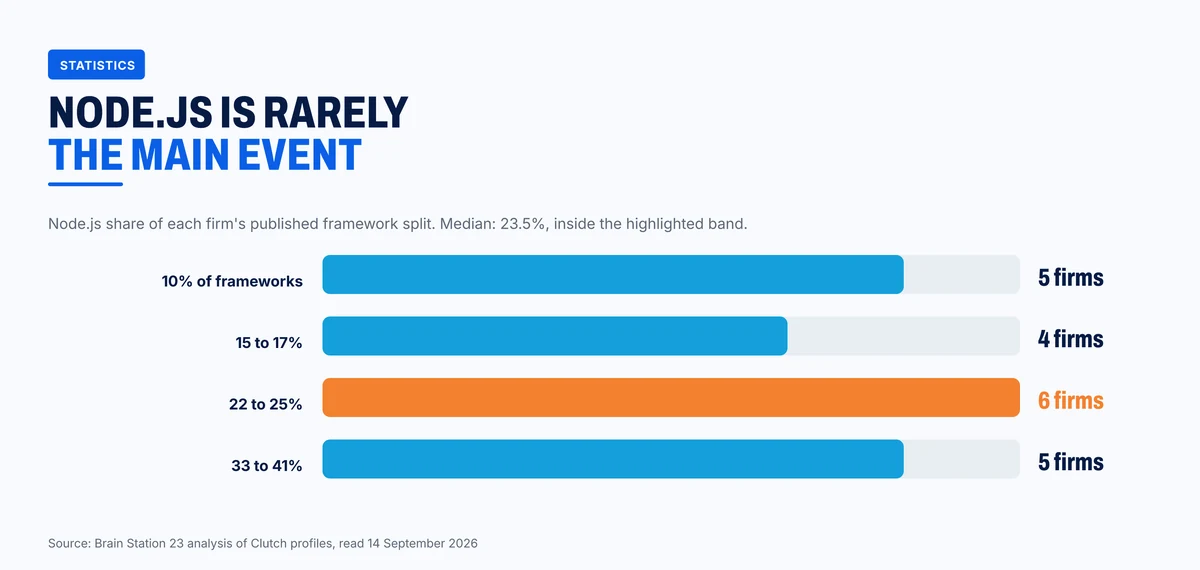
That is not a criticism. Node.js is usually one part of a stack, and 19 of the 20 firms list React beside it, 15 list React Native and nine list .NET. It does mean the directory label tells you little about depth. Ask for Node.js work specifically, and ask who on the proposed team has taken a production service through a major runtime upgrade.
Rates cluster low. Fifteen firms publish a band under $100 an hour: five at $25 to $49 and ten at $50 to $99. Two publish $100 to $149, two publish $150 to $199, and Six Feet Up publishes $200 to $300. The median band midpoint is $74.50. Minimums are $10,000 for seven firms, $25,000 for eight and $50,000 for five, a median of $25,000.
Most are small. Twelve of the twenty have fewer than 250 staff, and only Vention and BairesDev report 1,000 or more. Ten list a location outside the US, from Buenos Aires to Lviv to Montevideo, which is worth asking about whatever the directory address says.
Stars cannot separate them, but sub-scores can. Every overall rating sits between 4.8 and 5.0. Suffescom scores 4.9 on all four sub-scores. Of the other nineteen, Cost is the lowest or joint-lowest for seventeen; only Scopic and Zco, where Schedule is lowest, break the pattern. The median Quality score is 4.9 and the median Cost score 4.8.
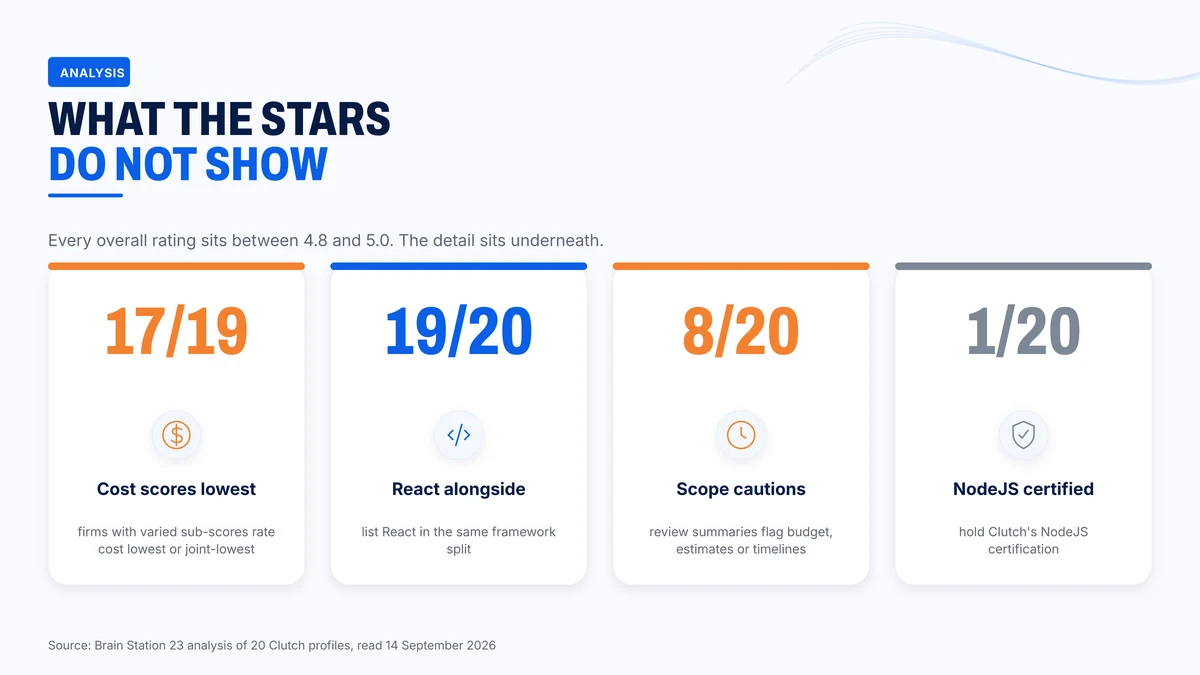
The cautions repeat. Clutch publishes a short summary of each firm’s verified reviews, and most include one improvement area. For eight of the twenty, it concerns budget, estimates or timelines. Three more concern documentation. Only one, Six Feet Up’s note on junior developer oversight, touches the code itself. The recurring complaints are about scope and handover, which are contract problems as much as engineering ones.
Clutch certifications are thin. Clutch lists service and technology certifications on each profile. Swovo is the only firm of the twenty certified in NodeJS. Six of the twenty carry no Verified badge.
One caveat about the data. Focus percentages are self-reported, and location fields can mislead: FocusReactive appears under New York on the US directory while its profile lists London first.
How to shortlist a Node.js development company
Order matters. Start with the filter that removes the most firms, and leave the expensive conversations for the few that remain.
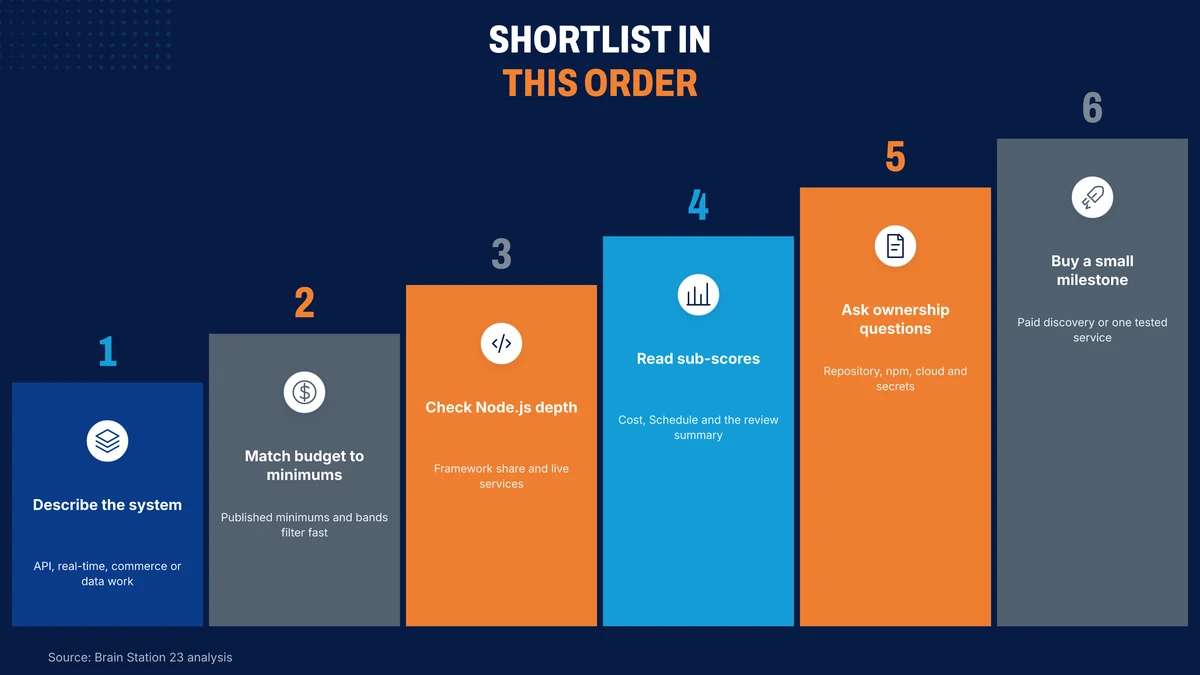
Step 1: Describe the system, not the language. An API for a mobile app, a real-time dashboard, an e-commerce integration and a data pipeline need different firms. Codup and FocusReactive are both on this list and would not bid on the same job.
Step 2: Match budget to published minimums and bands. A $30,000 project removes the five firms with $50,000 minimums. A $50 an hour ceiling leaves only the five firms publishing $25 to $49.
Step 3: Check depth where you need it. If Node.js is the heart of the system, prefer firms where it takes a real share of the framework split, and ask for two production Node.js services they still maintain.
Step 4: Read sub-scores and the review summary. Cost and Schedule tell you more than a 4.9. Read the improvement area in each firm’s review highlights, then ask the vendor about it directly.
Step 5: Ask the ownership questions. Who holds the repository, the npm organisation, the cloud account and the CI secrets? Firms that answer “you do, from day one” belong on the shortlist.
Step 6: Buy a small milestone first. A paid discovery sprint or a single service with tests and documentation shows how the team works before you commit the full budget.
How to buy Node.js development: four engagement models
The model decides who pays when the scope moves, and that matters more than the hourly band.
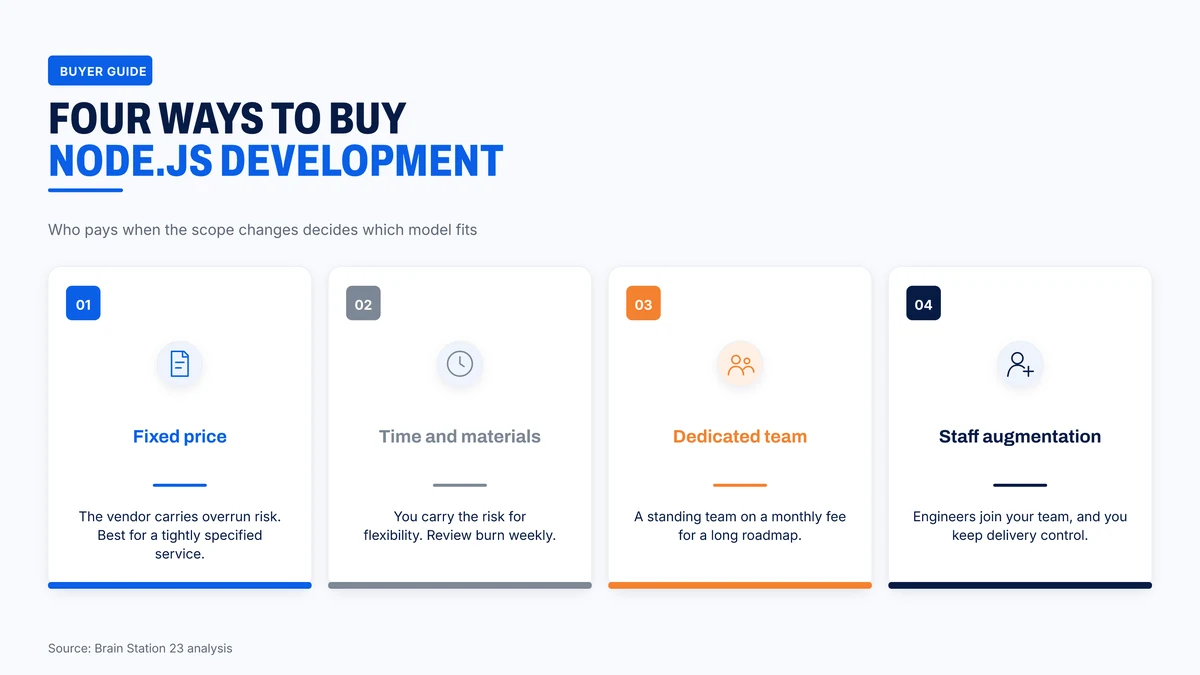
Fixed price puts overrun risk on the vendor, so the vendor prices that risk in. It works for a tightly specified service with clear acceptance tests. It fails when discovery is skipped, which is how eight review summaries on this list end up mentioning budgets or timelines.
Time and materials puts the risk on you in exchange for flexibility. It suits products still finding their shape. Review burn weekly against a written estimate, and cap each phase.
Dedicated team gives you a standing group on a monthly fee for a long roadmap. It suits a platform that will need upgrades, features and on-call support for years. Ask for named people and a replacement clause.
Staff augmentation adds engineers to your own team, and you keep delivery control. X-Team, VAIRIX and Brain Station 23 publish the largest staff augmentation shares on this page. It fails if nobody in-house owns architecture and code review.
The technical question: runtime upgrades and security releases
Every Node.js buyer inherits two cycles: the major version upgrade every couple of years, and security releases several times a year. A vendor should be able to explain how it handles both.
The security cycle is busier than most buyers expect. Node.js published security releases on 24 March, 18 June and 29 July 2026 (Node.js). The July release alone fixed 11 vulnerabilities, three rated high, five medium and three low. All 11 affected the 24.x and 26.x lines, and 10 affected 22.x (Node.js). One of the high-severity fixes addressed a Permission Model flaw that could grant broader filesystem access than configured.
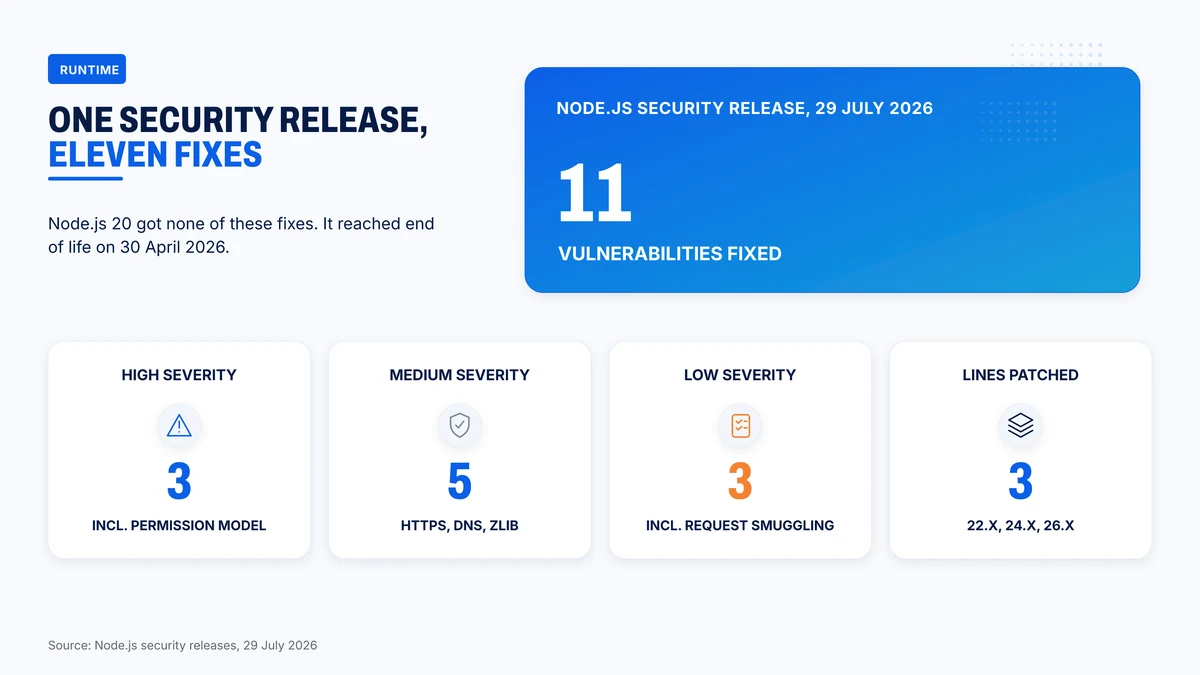
A backend still on Node.js 20 received none of those fixes, because the line reached end of life on 30 April 2026 (Node.js Release schedule).
The upgrade itself has an order, and the order is what keeps it cheap:
Step 1: Inventory. Record the Node.js version in every environment, including CI, containers and serverless functions, which often lag production.
Step 2: Dependencies first. Update packages on the current runtime, remove abandoned ones and fix audit findings, so the runtime change is not tangled with library changes.
Step 3: Test coverage. Add tests around the parts you are least sure of before touching the runtime.
Step 4: Upgrade in CI, then staging. Run the new version in the pipeline, fix deprecations, then deploy to staging under realistic load.
Step 5: Production with a rollback. Deploy behind a rollback plan, and watch memory and latency for a week.
Step 6: Schedule the next one. Put the next end-of-life date in the maintenance plan now. From Node.js 27, majors arrive annually (Node.js).
Red flags: eight answers to walk away from
Some answers in a sales call should end the conversation, or at least move the firm down the list.
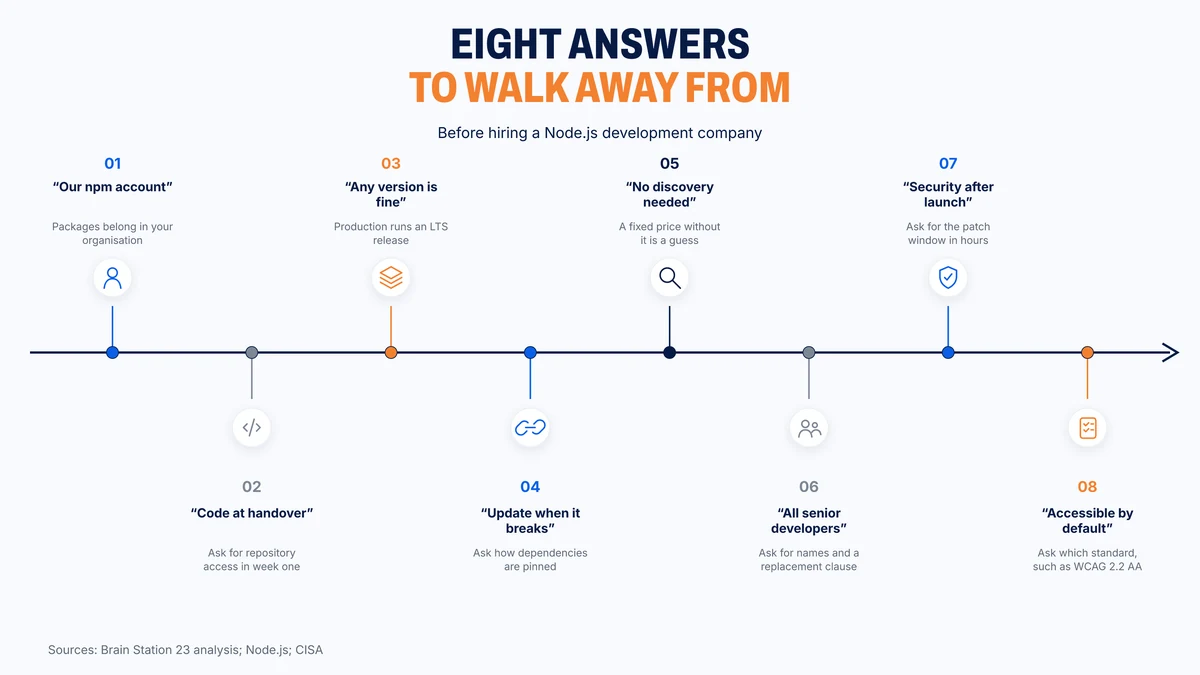
“We publish from our npm account.” Private packages and publishing rights belong in your organisation.
“You get the code at handover.” Ask for repository access from the first week.
“Any Node.js version is fine.” Production should run an LTS release, and the vendor should know which one.
“We update packages when something breaks.” Ask how dependencies are pinned, reviewed and updated.
“No discovery needed.” A fixed price without discovery is a guess, and the review summaries above show who pays for it.
“All our developers are senior.” Ask for names, CVs and a replacement clause.
“Security is handled after launch.” Ask for the emergency patch window in hours.
“Accessible by default.” Ask which standard, such as WCAG 2.2 AA, and how it is tested.
After launch: what the build quote leaves out
The list tells you who can build the service. This section covers the year and a half after it goes live, which is where most of the regret in reviews comes from.
What you must own before the final invoice
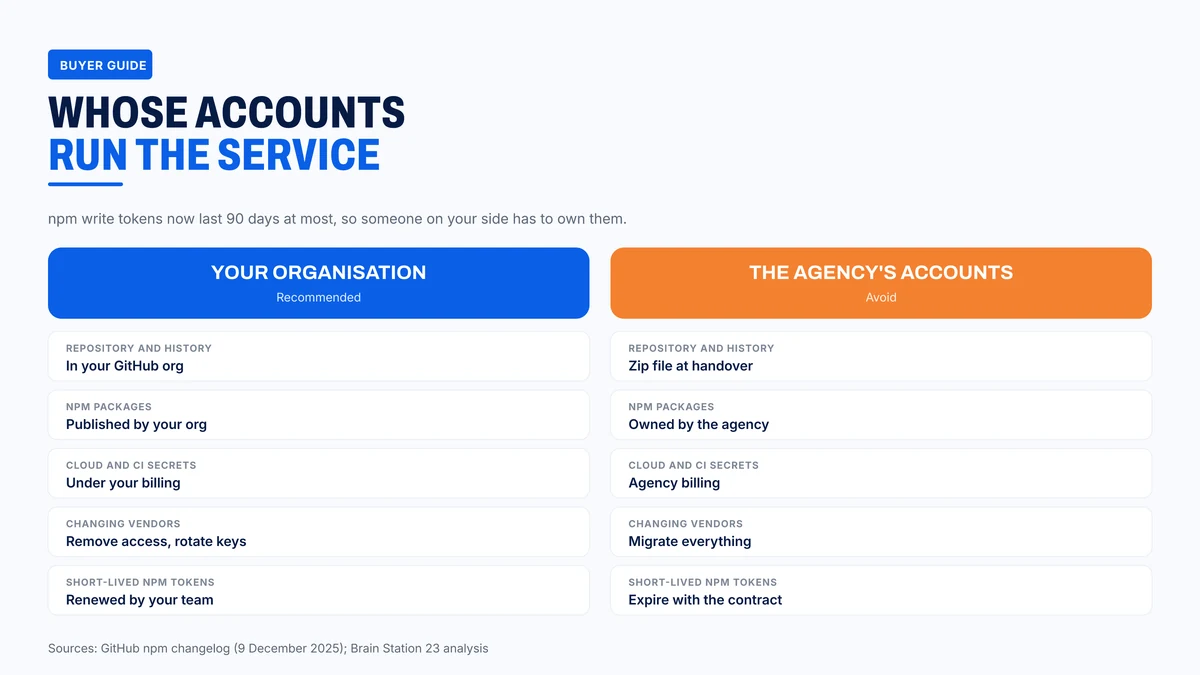
In Node.js work, ownership goes past the repository. The npm registry and the pipeline that publishes to it are part of your supply chain.
The repository with its full commit history, in a GitHub or GitLab organisation you control, not a zip file.
Your own npm organisation, if the project publishes private or public packages, with your staff as owners. npm permanently revoked all classic tokens on 9 December 2025; publishing now uses two-hour session tokens or granular write tokens limited to 90 days (GitHub). Tokens that short need an owner on your side.
The cloud account, CI/CD pipeline and secrets. Hosting, databases, container registry, environment variables and deployment keys, all under your billing relationship.
Third-party accounts: payments, email delivery, error monitoring, logging and any API keys the service depends on.
The lockfile, infrastructure code and a runbook that explains how to build, deploy and roll back without the original team.
The bill that arrives after launch
A build quote covers the build. Almost everything else recurs.
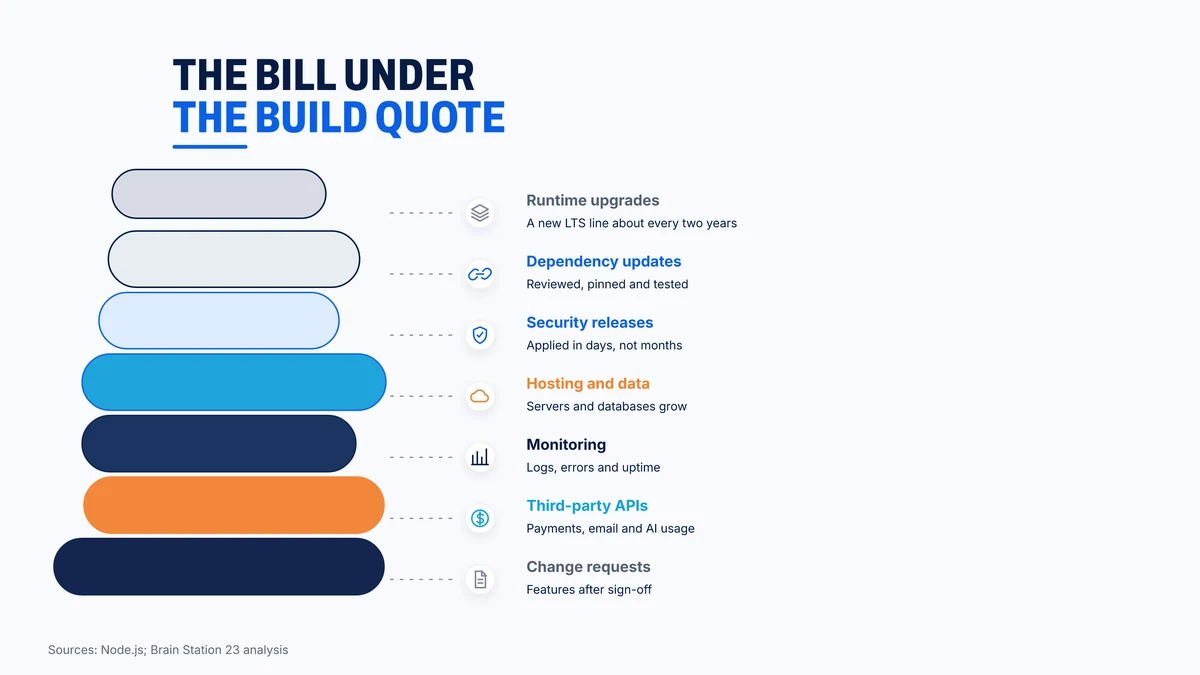
The recurring lines are runtime upgrades, dependency updates, applying security releases, hosting and database growth, monitoring and logging subscriptions, third-party API fees, accessibility review for any front end, and change requests. Get the recurring number in writing before you sign the build, and compare vendors on three years of total cost rather than the launch price.
Security is a recurring cost
The npm ecosystem is the most targeted software registry there is. Sonatype logged 1.8 million malicious packages by the end of Q2 2026, and npm accounted for 96.6% of the malicious package counts that quarter, including a Shai-Hulud wave affecting hundreds of npm packages in early June (Sonatype).
The original Shai-Hulud worm compromised more than 500 packages in September 2025. CISA told organisations to pin dependencies to known safe releases, rotate all developer credentials and require phishing-resistant multifactor authentication on developer accounts (CISA). Those are process controls, and they belong in a maintenance agreement.
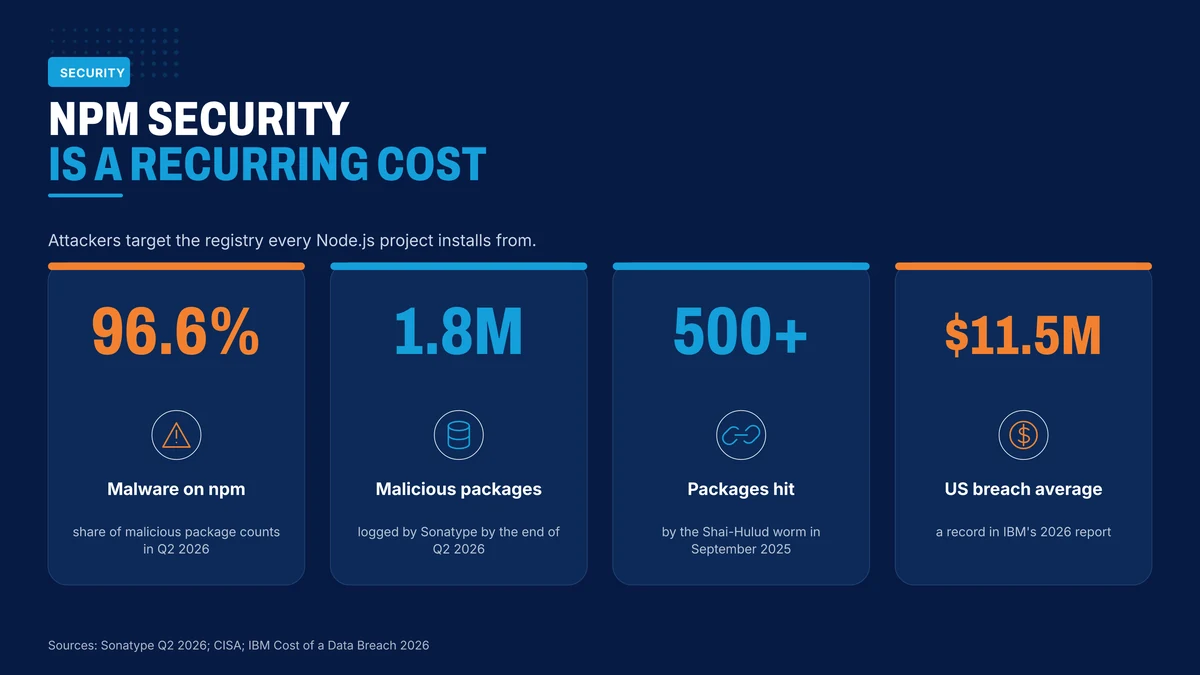
Timing makes it harder. Google Cloud’s M-Trends 2026 estimated the mean time to exploit at minus seven days, meaning exploitation routinely arrives before a patch is released (Google Cloud). A retainer that applies Node.js security releases in a monthly window does not cover that risk. And the average US data breach cost a record USD 11.5 million in IBM’s 2026 report (IBM Cost of a Data Breach Report 2026).
Ask vendors how they pin and review dependencies, whether install scripts run in CI, how quickly a high-severity Node.js release reaches production, and who holds the credentials a compromised package would try to steal.
Accessibility is legal exposure
A Node.js backend rarely faces an accessibility claim, but the React or Next.js front end most of these firms will build alongside it does. WebAIM found detected WCAG 2 failures on 95.9% of the top million home pages in 2026, an average of 56.1 errors per page (WebAIM Million 2026).
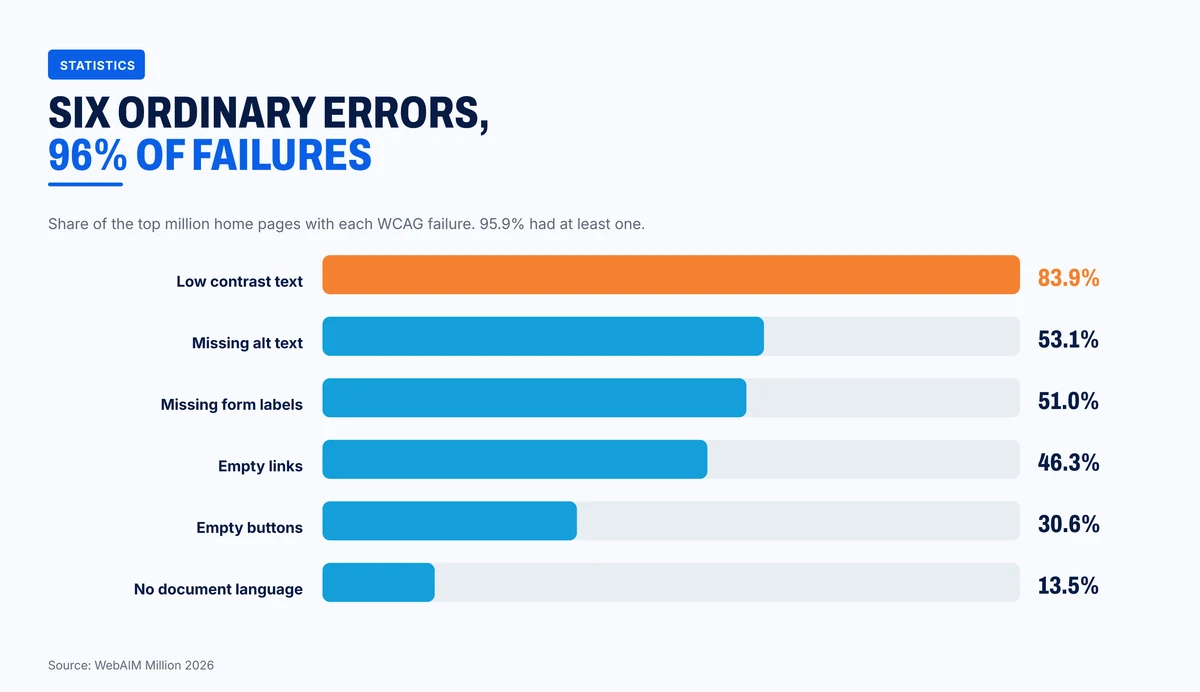
Every one of the six top failures is ordinary: low-contrast text, missing image alternative text, missing form labels, empty links, empty buttons and a missing document language. Together they make up 96% of detected errors. They are cheap to prevent in a build and expensive to defend in court. More than 5,000 digital accessibility lawsuits were filed in 2025, and 46 percent of federal cases involved repeat defendants (UsableNet).
Write a named standard such as WCAG 2.2 AA into the contract rather than the word “accessible”, and treat overlay widgets sceptically; UsableNet reports no meaningful drop in lawsuits against sites that use them.
Contract clauses that surface in month nine
These rarely come up in a sales call and often decide the relationship later. This is not legal advice; have your own counsel review any agreement.
IP assignment on payment, not on final acceptance, so a dispute over the last milestone cannot hold the code hostage.
Account ownership, naming the repository, npm organisation, cloud account and CI secrets as yours, with the agency working inside them.
Runtime and dependency upkeep, priced per year, with a named LTS policy and a stated window for high-severity security releases.
Transition assistance, a fixed number of hours at an agreed rate if you move to another vendor.
Rate escalation caps for multi-year work, and subcontracting disclosure, so you know where the code is written.
Liability caps and insurance that match the data your service handles, and non-solicitation in both directions.
How to leave without losing the codebase
Leaving is simple when the accounts were yours from day one, and slow when they were not.
Confirm ownership first: repository, npm organisation, cloud account, domain and every third-party key. Trigger your transition hours while relations are still cordial. Ask for recorded walkthroughs of the build, deployment and rollback process, and for the current dependency and runtime status in writing.
On the last day, remove the departing team from every organisation, revoke their npm and cloud tokens, and rotate every secret they could have seen, including database passwords and API keys. CISA’s advice after Shai-Hulud, to rotate all developer credentials, applies just as well to a vendor exit (CISA).
Hire in-house or hire an agency
The honest comparison starts with the wage. The BLS median for software developers was $135,980 in May 2025 (BLS), and the four Node.js salary sites above range from $94,700 to $121,124, before benefits, recruiting and equipment.
Hire in-house when the Node.js service is the product, you will change it every sprint, and you can keep at least two engineers who understand it. Runtime upgrades are easier when the people who wrote the code are still there.
Hire an agency when you need a first version quickly, the service supports a business rather than being one, or you need skills such as real-time architecture for a few months. Keep the accounts in your name so the choice stays reversible.
Combine the two when you have a technical lead but need capacity. Staff augmentation or a dedicated team adds engineers without handing over the architecture.
FAQ
How much do US Node.js development companies charge per hour?
Among the twenty firms here, 15 publish a band under $100 an hour, four publish $100 to $199, and one publishes $200 to $300. The median band midpoint is $74.50, and the median minimum project is $25,000 (Clutch).
Which Node.js version should a production app run?
An LTS release. Node.js says production applications should use only Active LTS or Maintenance LTS releases (Node.js). In September 2026 that means Node.js 24 or 22. Node.js 20 reached end of life on 30 April 2026, and Node.js 22 follows on 30 April 2027 (Node.js Release schedule).
How often does a Node.js backend need a major upgrade?
Plan for roughly every two years. Even-numbered releases have had about three years of support, and from Node.js 27 the project moves to one major release a year, each becoming LTS (Node.js). Budget each upgrade as a line item, with dependency updates included.
Why do Clutch ratings barely vary between these firms?
Every firm here rates between 4.8 and 5.0, so the stars cannot separate them. Read the sub-scores and the review summary instead: Cost is the lowest or joint-lowest score for 17 of the 19 firms whose sub-scores differ (Clutch).
Is npm safe to build on?
Who should own the npm organisation and publishing tokens?
Your organisation. Since npm revoked classic tokens on 9 December 2025, publishing uses two-hour sessions or granular write tokens capped at 90 days (GitHub). The agency should publish as a member of your organisation, not from its own account.
Should the same firm build the React front end and the Node.js API?
Often, yes. Nineteen of the twenty firms here list React alongside Node.js, so a full-stack JavaScript team is the default proposal (Clutch). Split the work only when one side needs a specialist, such as a headless CMS front end or a data-heavy backend.
Is a Clutch Verified badge a sign of quality?
It is a sign of identity. Clutch says Verified providers have passed a credit check and had their business entity validated. Six of the twenty organic top-ranked firms here carry no Verified badge (Clutch), so the badge and the ranking measure different things.
Conclusion
The data behind this Top 20 Node JS Development Companies in USA list points three ways. Node.js is a working part of almost every firm’s stack but the main focus of only a few. Rates cluster under $100 an hour. And the reviews agree on quality while flagging budgets, estimates and documentation.
Any of the twenty can write the service. What decides the engagement comes later: who owns the npm organisation and the cloud account, who prices the next runtime upgrade before Node.js 22 reaches end of life, and whether you can rotate every credential and walk away with everything you paid for.
Sources
- https://clutch.co/us/developers/nodejs?sort_by=ClutchRank
- https://clutch.co/profile/brain-station-23
- https://github.com/nodejs/Release
- https://nodejs.org/en/about/previous-releases
- https://nodejs.org/en/blog/vulnerability
- https://nodejs.org/en/blog/vulnerability/july-2026-security-releases
- https://survey.stackoverflow.co/2025/technology
- https://w3techs.com/technologies/details/ws-nodejs
- https://www.bls.gov/ooh/computer-and-information-technology/software-developers.htm
- https://www.salary.com/research/salary/position/node-js-developer-salary
- https://www.payscale.com/research/US/Skill=Node.js/Salary
- https://www.talent.com/salary?job=node+js+developer
- https://www.ziprecruiter.com/Salaries/Node-Js-Developer-Salary
- https://www.sonatype.com/blog/q2-2026-open-source-malware-index-attackers-abuse-developer-trust
- https://www.cisa.gov/news-events/alerts/2025/09/23/widespread-supply-chain-compromise-impacting-npm-ecosystem
- https://github.blog/changelog/2025-12-09-npm-classic-tokens-revoked-session-based-auth-and-cli-token-management-now-available/
- https://cloud.google.com/blog/topics/threat-intelligence/m-trends-2026
- https://www.ibm.com/reports/data-breach
- https://webaim.org/projects/million/
- https://blog.usablenet.com/ada-web-lawsuit-trends-2026