
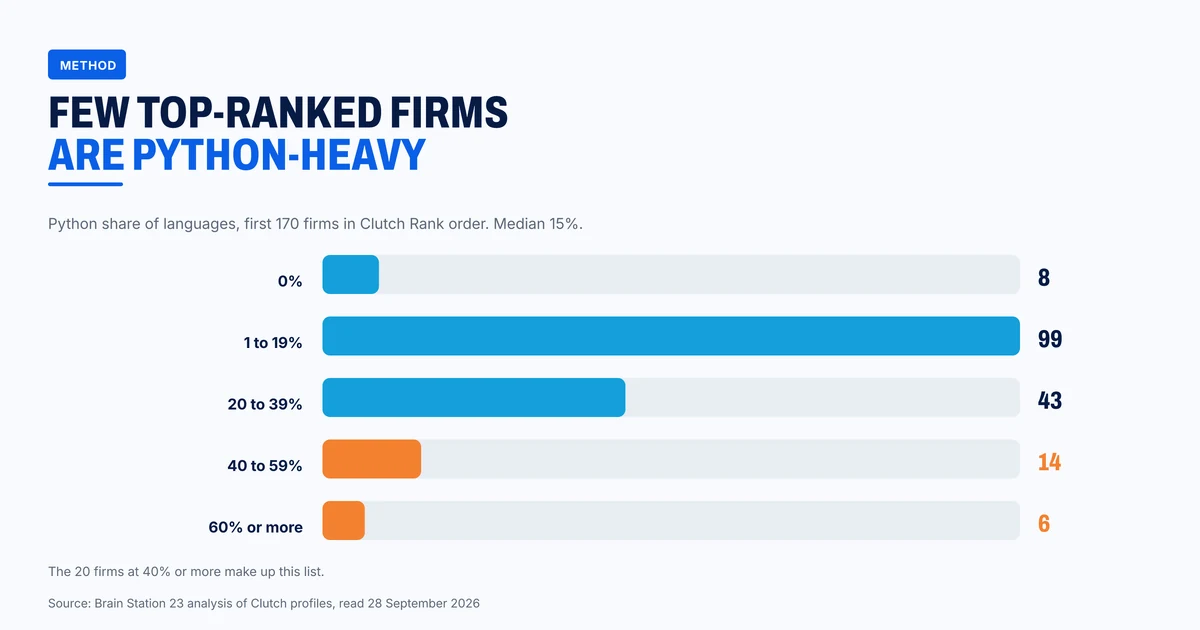
Clutch has no Python-only directory for the United States, and the top of its Python and Django directory is not especially Pythonic: its 20 highest-ranked firms put a median of 27.5 percent of their published languages on Python, and only seven go above 40 percent (Clutch). Many are broad agencies for which Python is one language among several. So we built this Top 20 Python Development Companies in USA list differently. We read the language split on the first 170 profiles in Clutch Rank order and kept the 20 highest-ranked firms that put Python at 40 percent or more. The result is a list of smaller, more specialised firms, and it arrives on a deadline: Python 3.10 reaches end of life in October 2026 (Python), and Django has published 26 security advisories so far this year, double its 2025 total (Django).
The ranking is still Clutch’s; the filter is ours.
This guide prices the work and sets out how to shortlist. It then covers what the build quote leaves out: the Python and Django upgrade calendar, the monthly security releases, and the cloud and data accounts that must be in your name.
Key takeaways
- 27.5% is the median Python share of languages among Clutch’s top 20 Python and Django firms; only 7 of those 20 put Python at 40 percent or more (Clutch).
- 20 of 170 of the highest Clutch-ranked firms put Python at 40 percent or more of their published languages, and those 20 make up this list (Clutch profiles).
- October 2026 is the end of life for Python 3.10; Python 3.15 is scheduled for 1 October 2026 (Python).
- 26 Django security advisories were published between February and August 2026, against 13 in all of 2025 (Django).
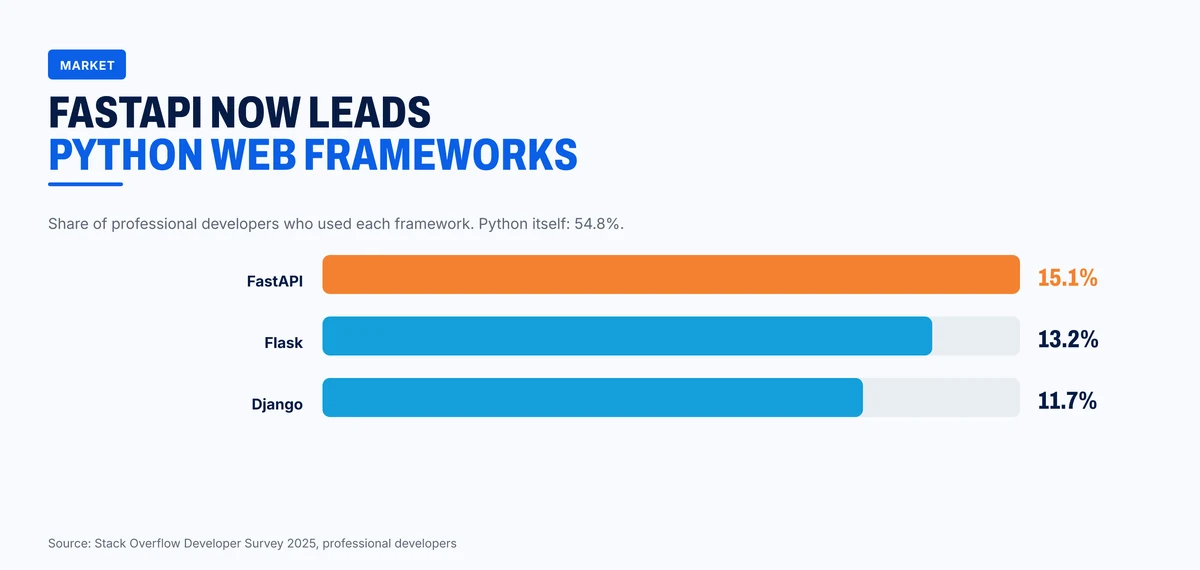
- 54.8% of professional developers used Python in 2025; among Python web frameworks, 15.1% used FastAPI, 13.2% Flask and 11.7% Django (Stack Overflow).
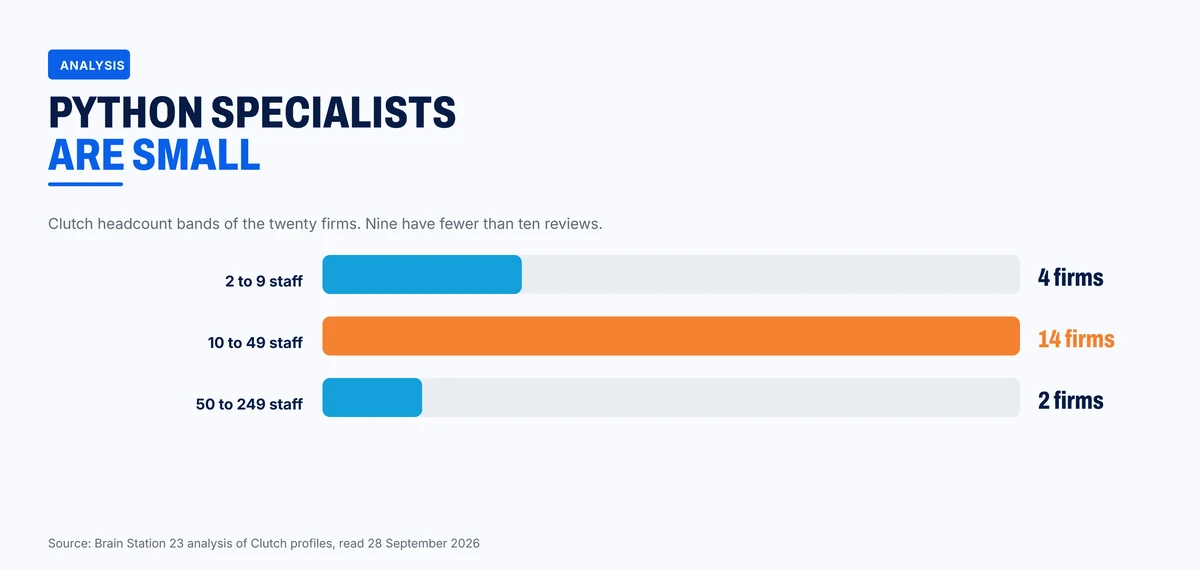
- 18 of 20 firms on this list have fewer than 50 staff, and 9 have fewer than ten Clutch reviews (Clutch profiles).
- 14 of 20 firms publish rates of $100 an hour or more, and the median minimum project is $10,000 (Clutch profiles).
- $102,000 to $135,980 is the spread between PayScale’s Python skill average and the BLS median for software developers (PayScale; BLS).
Python in 2026: the default language for data, AI and back ends
Python is one of the most used languages among professional developers. In Stack Overflow’s 2025 survey, 54.8 percent of professional developers had used it in the past year (Stack Overflow Developer Survey 2025). On GitHub, TypeScript overtook both Python and JavaScript in August 2025 to become the most used language (GitHub Octoverse).
It is not mainly a website language. W3Techs finds Python on 1.1 percent of the websites whose server-side language it can identify (W3Techs). Its weight is in APIs, data pipelines, machine learning and internal tools. That is why the web framework picture is split: among professional developers, FastAPI reached 15.1 percent in 2025, Flask 13.2 percent and Django 11.7 percent (Stack Overflow).
If your project is a content-heavy website on Django, our Django companies list ranks firms for that. This list is for buyers whose work is Python first: APIs, data, AI and custom applications.
Python runs on a yearly calendar. A new version ships every October and gets five years of support. Python 3.10 reaches end of life in October 2026, 3.11 in October 2027 and 3.12 in October 2028. Python 3.14, released on 7 October 2025, is supported until October 2030, and 3.15 is scheduled for 1 October 2026 (Python).
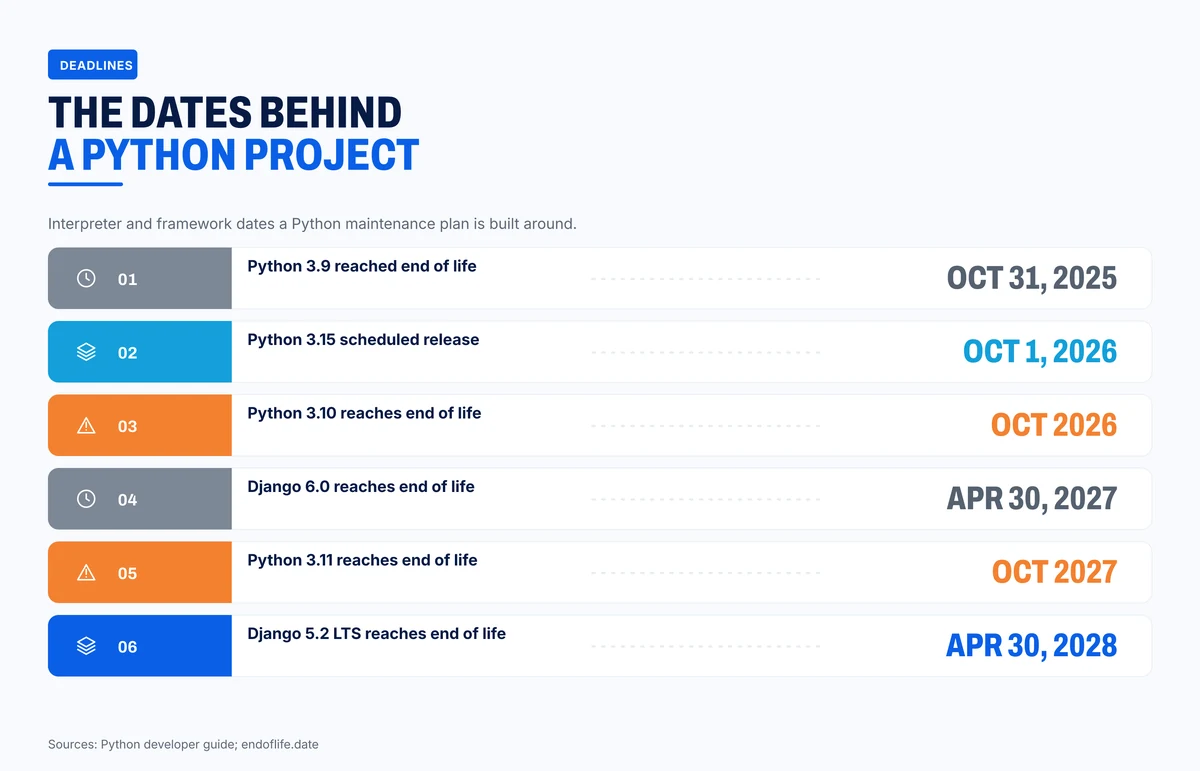
Django runs its own calendar on top. Django 5.2, the current long-term support release, is supported until 30 April 2028, and Django 6.0 until 30 April 2027. Django 6.1 shipped on 5 August 2026 (endoflife.date).
So a Python brief needs three answers before any firm is compared: what the Python is for (a web application, an API, a data pipeline or a model), which Python and framework versions it runs today, and who will move them before their support ends.
What Python development costs in the US
Pay figures for Python engineers spread by $33,980 across the two annual sources, with an hourly benchmark in between.
PayScale reports an average base salary of $102,000 for the Python skill, from 28,110 people, updated 14 July 2026 (PayScale). Indeed reports $62.27 an hour for a Python developer, from 1,700 job-posting salaries, updated 20 September 2026 (Indeed). The Bureau of Labor Statistics puts the median software developer at $135,980 in May 2025 (BLS).
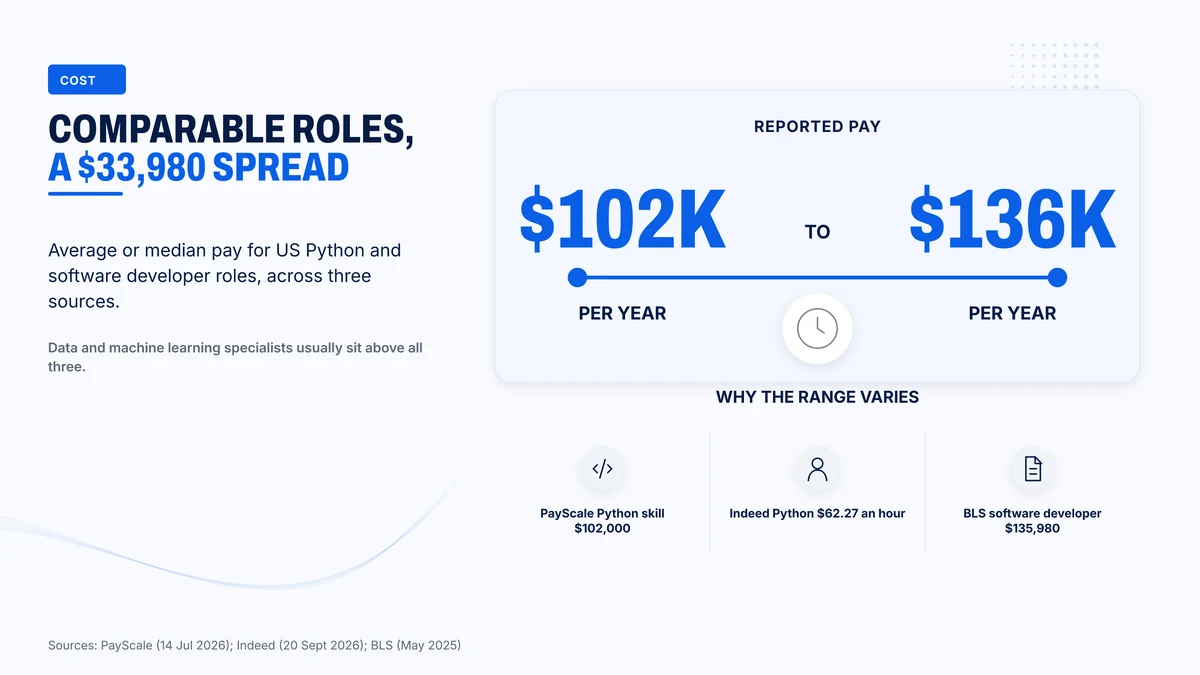
PayScale’s sample is large but self-reported and includes analysts and scientists who list Python as a skill. BLS covers all software developers. Indeed’s hourly figure comes from advertised pay. Specialist data and machine learning roles usually sit above all three.
Agency pricing on this list sits in the upper middle. Fourteen of the twenty firms publish $100 an hour or more, and four publish $200 to $300, the highest band on Clutch. The median minimum project is $10,000, from $1,000 to $75,000 (Clutch profiles, read 28 September 2026). Seven report a most common project of $10,000 to $49,999 and six one of $50,000 to $199,999.
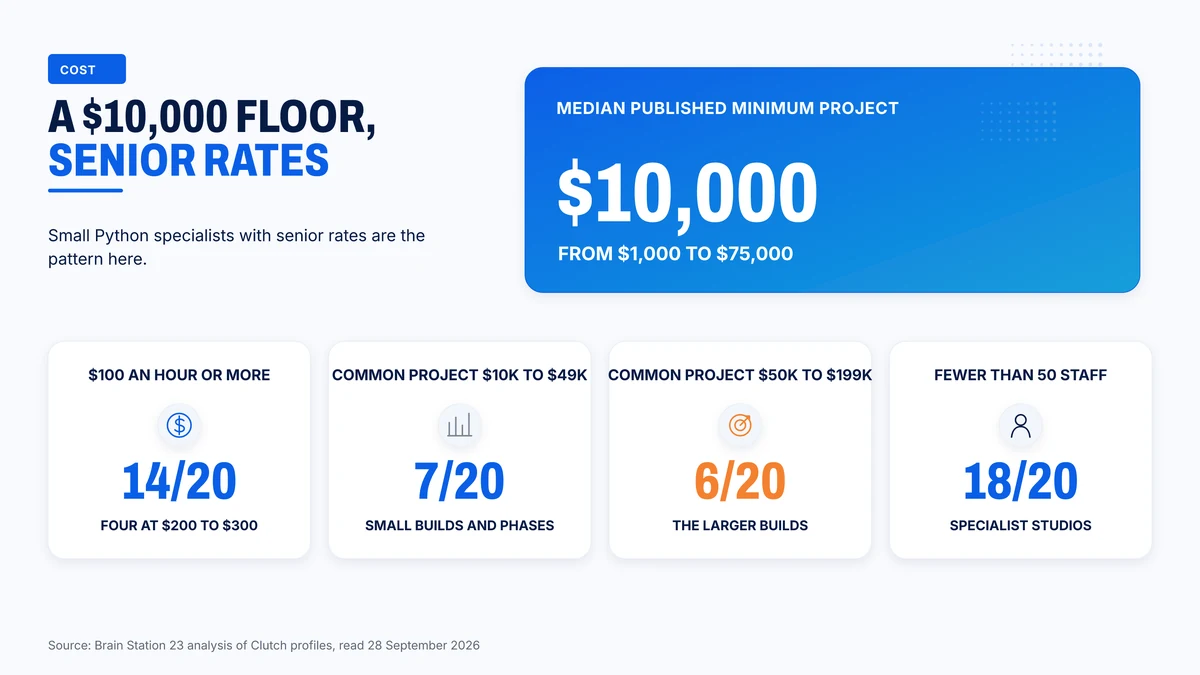
Small firms with senior rates are the pattern here. Six Feet Up, REVSYS, Ark Web Services and Lightmatter all publish $200 to $300 an hour with teams under 50. Eight factors decide where a Python quote lands.
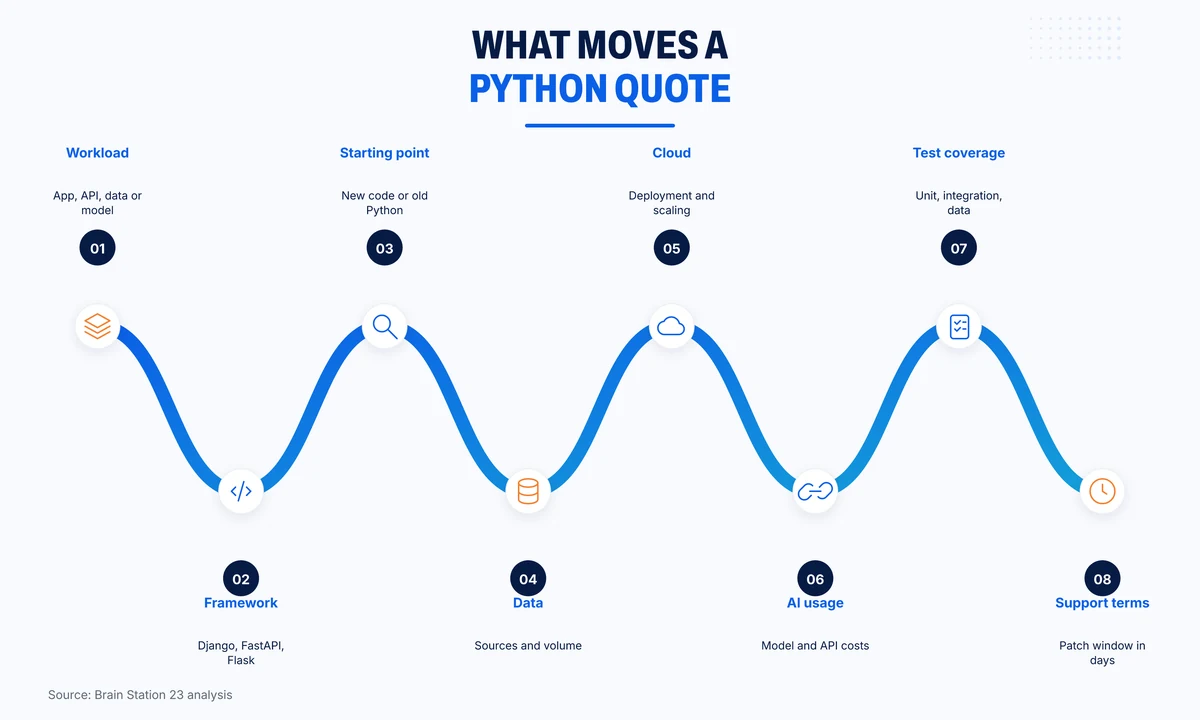
The workload comes first: a web application, an API, a data pipeline or a machine learning feature. Then the framework, Django, FastAPI or Flask; the starting point, new code or an upgrade of an older Python; data sources and volume; the cloud and deployment; model or AI API costs; test coverage; and the support terms. Ask every vendor to price infrastructure and any AI usage separately from the build.
The Top 20 Python Development Companies in USA, compared
We used Clutch’s directory of Python and Django developers in the United States, sorted by Clutch Rank and read on 28 September 2026. It lists 1,830 firms. Clutch has no Python-only US directory. We read the Programming and Scripting split on the first 170 profiles in Clutch Rank order and kept the 20 highest-ranked firms whose published split puts Python at 40 percent or more. They sit between positions 1 and 147. We skipped one paid “featured” row.
That rule has a limit worth stating: a language split is self-published, and four firms here are marketing or SEO agencies whose split happens to be heavily Python. We kept them because the rule is the rule, and grouped them separately so you can skip them.
Brain Station 23 is placed first because we publish this article. We are US-headquartered, and Python is 14 percent of our published Clutch languages, below this list’s 40 percent threshold, so we would not qualify under our own rule.
The Python Focus column shows Python’s share of each firm’s published languages, with Django’s share of its frameworks. The # column is this list’s position; each profile gives the firm’s Clutch Rank.
| # | Company | Best For | Team Size | Python Focus | Key Tech Stack | Industries Served | Locations |
|---|---|---|---|---|---|---|---|
| 1 | Brain Station 23 — brainstation-23.com | Adding Python engineers to an in-house team | 250 – 999 | Python 14% of languages; Django 8% of frameworks | Java, Spring, Python, Django, .NET, Flutter | Retail, medical, telecoms, education, financial services | Springfield VA; Bangladesh, UAE, England, Malaysia, Germany |
| 2 | Caktus Group — caktusgroup.com | Django web applications from a long-standing specialist | 10 – 49 | Python 80%; Django 100% | Python, Django, JavaScript | Not published | Durham NC |
| 3 | Six Feet Up — sixfeetup.com | Senior Python for complex software and AI | 10 – 49 | Python 70%; Django 60% | Python, Django, React, TypeScript, AI | IT, medical, education, energy, finance | Fishers IN |
| 4 | Crowdbotics — crowdbotics.com | App builds and support on Django and React Native | 50 – 249 | Python 40%; Django 50% | Django, React Native, Python, JavaScript, Swift | Consumer, business services, medical | Berkeley CA |
| 5 | Bright Bridge Web — brightbridgeweb.com | Small Django web and API projects | 10 – 49 | Python 50%; Django 80% | Python, Django, PHP, React Native | Business services, education, IT | Provo UT |
| 6 | Fusionbox — fusionbox.com | Custom Django software for regulated sectors | 10 – 49 | Python 100%; Django 100% | Python, Django | Finance, government, manufacturing | Denver |
| 7 | Imaginary Landscape — imagescape.com | Large Django web platforms for health and nonprofits | 10 – 49 | Python 100%; Django 100% | Python, Django | Medical, non-profit, finance, gaming | Evanston IL |
| 8 | Beehive Software — beehivesoftware.com | Small AI and full-stack builds on a budget | 50 – 249 | Python 45%; Django 26% | Python, Django, React, React Native, TypeScript | Medical, IT, e-commerce, education | San Jose CA |
| 9 | GenAI.Labs USA — genai-labs.io | Generative AI and agent builds | 10 – 49 | Python 40%; no Django | Python, Swift, C++, React Native | IT, business services, advertising | Los Angeles |
| 10 | Idea Maker — ideamaker.agency | Small businesses wanting AI features in a product | 10 – 49 | Python 100%; Django 20% | Python, Django, Vue.js, React, Flutter | Finance, medical, automotive, legal | Irvine, Los Angeles |
| 11 | Gearheart.io — gearheart.io | Mid-market Python and TypeScript product teams | 10 – 49 | Python 50%; Django 25% | Python, Django, Node.js, React, TypeScript | Business services, medical, finance | San Francisco; Tallinn |
| 12 | REVSYS — revsys.com | Expert Django consulting from a very small team | 2 – 9 | Python 65%; Django 89% | Python, Django, React, Rust | Business services, education, finance, media | Lawrence KS |
| 13 | Cuttlesoft — cuttlesoft.com | Custom and mobile software with a Python back end | 10 – 49 | Python 55%; Django 33% | Python, Django, React, React Native, Ruby on Rails | Consumer, IT, business services, education | Denver |
| 14 | hypersite — gethypersite.com | Small businesses wanting a Django site with SEO | 2 – 9 | Python 40%; Django 100% | Python, Django, PHP, TypeScript | Advertising, business services, consumer | Cumming, Atlanta GA |
| 15 | Galliot — galliot.us | Cloud, data and CRM work for health and finance | 10 – 49 | Python 40%; Ruby 25% | Python, Ruby, Java, Angular, Flutter, Django | Medical, finance, advertising, education | San Francisco |
| 16 | Ark Web Services — arkwebservices.com | Senior Django web development | 2 – 9 | Python 50%, PHP 50%; Django 64% | Python, Django, PHP, Vue.js | Not published | Charlotte NC |
| 17 | Momentic — momenticmarketing.com | SEO and content programmes with Python tooling | 2 – 9 | Python 50%; no Django | Python, JavaScript, jQuery | E-commerce, business services, consumer | Milwaukee |
| 18 | Integrity Resource Solution — integrityresourcesolution.com | Small web, e-commerce and SEO projects | 10 – 49 | Python 40%; no Django | Python, JavaScript, PHP, SQL | Finance, e-commerce, automotive, medical | Acworth GA |
| 19 | Lofty — hirelofty.com | Energy and GIS software on Django | 10 – 49 | Python 50%; Django 50% | Python, Django, React Native, Vue.js, Go | Energy, GIS and navigation | Fayetteville AR |
| 20 | Oak Theory — oaktheory.co | Brand, UX and AI consulting with web builds | 10 – 49 | Python 50%, JavaScript 50% | Python, JavaScript | Business services, consumer, energy, finance | Madison NJ, Smithtown NY |
| 21 | Lightmatter — lightmatter.com | Healthcare software and modernisation | 10 – 49 | Python 50%; Django 28% | Python, Django, React, SQL, Java | Medical, IT, e-commerce | New York |
Team sizes, language, framework and service splits, industries and locations are from each firm’s published Clutch profile, read 28 September 2026. “Best For” is our reading of that data. Engagement models and certifications are not published consistently across these profiles, so we have left them out rather than guess.
Profiles are grouped by buyer type, and the numbers match the table. Each caution comes from the Review Highlights that Clutch publishes from the firm’s verified reviews, or from its lowest sub-score where Clutch surfaced no complaint. Certifications are self-published and unverified by us. Where we cite reviews, we read the first page of reviews on each profile, up to eleven per firm.
1. Brain Station 23
We publish this article and placed ourselves first, so read this entry as the publisher’s pick. Python is 14 percent of our published Clutch languages and Django 8 percent of our frameworks, which is below the 40 percent rule we used for everyone else, so we would not make this list on our own filter. Our strength is staffing: 60 percent of our work is engineers embedded in client teams, at a $25 to $49 band, with a $10,000 minimum. That suits a company with its own Python lead who needs more engineers for an upgrade, a data pipeline or a backlog. Our ISO 27001 and SOC 2 Type II controls matter when engineers hold cloud and data access. Reviewers score Quality at 5.0, and some asked for tighter internal coordination.
Founded: 2006
US Presence: Springfield VA
Company size: Clutch band 250 to 999; we publish 900+ engineers
Rating: 4.9 across 21 Clutch reviews, HQ Springfield, Virginia
- Adding Python engineers to an in-house team
- CMMI Level 3
- ISO 27001
- ISO 9001
- SOC 2 Type II (company-published)
- Staff augmentation
- Custom software development
- Application modernisation
- Python
- Django
- Java and Spring
- .NET
- AI development
- Retail
- Medical
- Telecoms
- Education
- Financial services
- Hospitality
- Ask which engineers have moved a production service off Python 3.10 or an old Django release
For Python and Django specialists
2. Caktus Group
Caktus Group holds first place in Clutch’s Python and Django ranking, and it is a true specialist: Python is 80 percent of its languages and Django its only framework. All three of its reviews name Django. It does not publish a rate or minimum, and its most common project runs $50,000 to $199,999. Cost is its lowest sub-score at 4.8. Three reviews is a thin record for the top-ranked firm, so ask for references.
Founded: 2007
US Presence: Durham NC
Company size: 10 to 49
- Django web applications from a long-standing specialist
- Not published; ask directly
- Web development
- Mobile apps
- Custom software
- UX design
- Python
- Django
- Not published on Clutch
- Ask for references, because Clutch lists three reviews
6. Fusionbox
Fusionbox lists Python as its only language and Django as its only framework, and custom software is 70 percent of its services. Finance and government are 35 percent of its industries. It publishes a $150 to $199 band and a $75,000 minimum, the highest here, and four of its first-page reviews describe an upgrade or migration. It is Clutch-ranked 14th. Some clients suggested it could take more risks in design.
Founded: 2001
US Presence: Denver
Company size: 10 to 49
- Custom Django software for regulated sectors
- Not published; ask directly
- Custom software
- UX design
- Web development
- Python
- Django
- Financial services
- Government
- Manufacturing
- Business services
- Non-profit
- Ask to see recent design work if the interface matters to you
7. Imaginary Landscape
Imaginary Landscape lists Python and Django only, and founded in 1995 it is the oldest firm here. Medical and nonprofit work are half its industries, and its most common project is $200,000 to $999,999, the largest here. It publishes a $100 to $149 band with a $10,000 minimum. Its Cost sub-score of 3.7 across five reviews is the lowest on this list, so settle the budget in writing. It is Clutch-ranked 16th.
Founded: 1995
US Presence: Evanston IL
Company size: 10 to 49
- Large Django web platforms for health and nonprofits
- Not published; ask directly
- Web development
- E-commerce
- Application testing
- UX design
- Web design
- Python
- Django
- Medical
- Non-profit
- Financial services
- Gaming
- Retail
- Ask for a detailed cost breakdown, since Cost scores 3.7
5. Bright Bridge Web
Python is half of Bright Bridge Web’s languages, with PHP at 30, and Django is 80 percent of its frameworks. It publishes a $50 to $99 band with a $1,000 minimum, the lowest here, and its most common project is $10,000 to $49,999. All four sub-scores are 5.0 across ten reviews, and Clutch surfaced no recurring complaint. It is Clutch-ranked 13th.
Founded: 2014
US Presence: Provo UT
Company size: 10 to 49
- Small Django web and API projects
- Not published; ask directly
- Web development
- API development
- Application support
- Custom software
- E-commerce
- Mobile apps
- Python
- Django
- Business services
- Education
- IT
- Advertising
- Energy
- Confirm which of its Python and PHP engineers will work on your project
12. REVSYS
REVSYS is a small Django consultancy: Django is 89 percent of its frameworks and Python 65 percent of its languages, and cloud consulting is 15 percent of its services. It publishes a $200 to $300 band with a $5,000 minimum, which suits a short engagement with senior people. Its Clutch record is a single review, so its 5.0 rating says little on its own. It is Clutch-ranked 49th.
Founded: 2002
US Presence: Lawrence KS
Company size: 2 to 9
- Expert Django consulting from a very small team
- Not published; ask directly
- Web development
- Custom software
- Cloud consulting
- Python
- Django
- React
- Business services
- Education
- Financial services
- Media
- Energy
- Ask for references, because Clutch lists one review
13. Cuttlesoft
Python is 55 percent of Cuttlesoft’s languages, and custom software and mobile apps are 40 percent each of its services. It publishes a $150 to $199 band with a $25,000 minimum, and 60 percent of its clients are small businesses. Four of its first-page reviews name Python, and Clutch highlights its project management. Cost is its lowest sub-score at 4.7 across 20 reviews. It is Clutch-ranked 54th.
Founded: 2009
US Presence: Denver
Company size: 10 to 49
- Custom and mobile software with a Python back end
- Not published; ask directly
- Custom software
- Mobile apps
- Staff augmentation
- Web development
- Python
- Django
- React
- React Native
- Consumer products
- IT
- Business services
- Education
- Non-profit
- Ask for a line-item estimate, since Cost is its lowest sub-score
16. Ark Web Services
Ark Web Services splits its languages evenly between Python and PHP, and Django is 64 percent of its frameworks. Web development is its only listed service. It publishes a $200 to $300 band with a $50,000 minimum, a high floor for a team under ten. Its Clutch record is a single review, and it does not publish industries, so references and code samples matter more than the rating. It is Clutch-ranked 94th.
Founded: 2017
US Presence: Charlotte NC
Company size: 2 to 9
- Senior Django web development
- Not published; ask directly
- Web development
- Python
- Django
- PHP
- Vue.js
- Not published on Clutch
- Ask for references, because Clutch lists one review
19. Lofty
Lofty splits its services across custom software, mobile and web, with AI and data at 25 percent together. Energy is 35 percent of its industries and GIS 15, an unusual niche. Python is half its languages and Django half its frameworks. It publishes a $100 to $149 band with a $10,000 minimum. Its single review names Python and Django, and scores Cost at 4.5. It is Clutch-ranked 129th.
Founded: 2014
US Presence: Fayetteville AR
Company size: 10 to 49
- Energy and GIS software on Django
- Not published; ask directly
- Custom software
- Mobile apps
- Web development
- AI development
- BI and data
- Python
- Django
- Go
- Energy and natural resources
- GPS and GIS
- Other industries
- Ask for references, because Clutch lists one review
For AI, data and product teams
3. Six Feet Up
Six Feet Up has the strongest Python evidence here: nine of its eleven first-page reviews name Python, nine name Django and six mention AI. Python is 70 percent of its languages, and AI development is 30 percent of its services. It publishes a $200 to $300 band with a $50,000 minimum. Its sub-scores are 4.9 to 5.0 across 26 reviews. A few clients noted minor issues with work done by junior developers. It is Clutch-ranked second.
Founded: 1999
US Presence: Fishers IN
Company size: 10 to 49
- Senior Python for complex software and AI
- Not published; ask directly
- Custom software
- AI development
- BI and big data
- Web development
- Python
- Django
- React
- IT
- Medical
- Education
- Energy
- Financial services
- Ask how junior developers on your project are supervised
4. Crowdbotics
Crowdbotics pairs Django and React Native at 50 percent each of its frameworks, and application support is its largest service at 30 percent. It publishes a $50 to $99 band with a $10,000 minimum. Its 4.4 rating is the lowest here, with Schedule at 4.2 across 42 reviews, and none of its first-page reviews names Python. Some clients raised concerns about early delays and time management. It is Clutch-ranked eighth.
Founded: 2016
US Presence: Berkeley CA
Company size: 50 to 249
- App builds and support on Django and React Native
- Not published; ask directly
- Application support
- Custom software
- Mobile apps
- Web development
- Low-code development
- Django
- React Native
- Consumer products
- Business services
- Medical
- Arts
- Financial services
- Put early milestones and a delay process in the contract
8. Beehive Software
Beehive Software is the youngest firm here. Python is 45 percent of its languages, and seven of its ten first-page reviews name Python, with six mentioning AI and four data work. It publishes a $50 to $99 band with a $10,000 minimum, and its most common project is under $10,000. All four sub-scores are 5.0 across 12 reviews, and Clutch surfaced no recurring complaint. It is Clutch-ranked 19th.
Founded: 2021
US Presence: San Jose CA
Company size: 50 to 249
- Small AI and full-stack builds on a budget
- Not published; ask directly
- Custom software
- AI agents
- AI development
- DevOps
- Mobile apps
- Web development
- Python
- Django
- Medical
- IT
- E-commerce
- Education
- Financial services
- Ask for references on projects above $50,000, since its typical project is small
9. GenAI.Labs USA
GenAI.Labs is an AI shop: AI, generative AI and agents make up 80 percent of its services, and all eleven first-page reviews mention AI, though none names Python. Python is 40 percent of its languages. It publishes a $50 to $99 band with a $5,000 minimum, and 60 percent of its clients are small businesses. All four sub-scores are 5.0 across 26 reviews. It is Clutch-ranked 23rd.
Founded: 2015
US Presence: Los Angeles
Company size: 10 to 49
- Generative AI and agent builds
- Not published; ask directly
- AI development
- Generative AI
- AI agents
- Mobile apps
- Web development
- Python
- Swift
- C++
- IT
- Business services
- Advertising
- Education
- Financial services
- Ask for the model and API costs to be priced separately from the build
10. Idea Maker
Idea Maker lists Python as its only language, and splits its services evenly across five lines including AI. Six of its first-page reviews mention AI. It publishes a $100 to $149 band with a $25,000 minimum, and 65 percent of its clients are small businesses. Its sub-scores run 4.8 to 5.0 across 27 reviews, and Clutch surfaced no recurring complaint. It is Clutch-ranked 27th.
Founded: 2016
US Presence: Irvine, Los Angeles
Company size: 10 to 49
- Small businesses wanting AI features in a product
- Not published; ask directly
- AI development
- Custom software
- Mobile apps
- Web design
- Web development
- Python
- Django
- Vue.js
- Financial services
- Medical
- Automotive
- IT
- Legal
- Confirm the front-end stack, since its frameworks span Vue.js, React and Flutter
11. Gearheart.io
Python is half of Gearheart’s languages and TypeScript 30 percent, and Django and Node.js share its frameworks. Five of its first-page reviews name Django. It publishes a $50 to $99 band with a $50,000 minimum and builds from San Francisco and Tallinn. Cost is its lowest sub-score at 4.7 across 14 reviews. Some clients noted slower responses when the main contact was unavailable. It is Clutch-ranked 34th.
Founded: 2012
US Presence: San Francisco
Company size: 10 to 49
- Mid-market Python and TypeScript product teams
- Not published; ask directly
- Custom software
- AI agents
- API development
- Testing
- DevOps
- Application modernisation
- Staff augmentation
- Python
- Django
- Business services
- Medical
- Financial services
- Education
- Government
- Name a backup contact for when your main contact is away
15. Galliot
Galliot is a cloud and data firm first: cloud consulting is 30 percent of its services and BI 10. Python is 40 percent of its languages, with Ruby at 25 and Java at 20. Medical work is 30 percent of its industries. It publishes a $100 to $149 band with a $10,000 minimum. Cost is its lowest sub-score at 4.7 across nine reviews, and some clients had minor issues in the first weeks after launch. It is Clutch-ranked 85th.
Founded: 2018
US Presence: San Francisco
Company size: 10 to 49
- Cloud, data and CRM work for health and finance
- Not published; ask directly
- Cloud consulting
- Custom software
- Web development
- BI and big data
- CRM consulting
- Low-code development
- Python
- Ruby
- Medical
- Financial services
- Advertising
- Education
- Energy
- Plan a stabilisation period after launch
21. Lightmatter
Lightmatter is a healthcare specialist: medical work is 80 percent of its industries, and application modernisation is 20 percent of its services. Python is half its languages. It publishes a $200 to $300 band with a $50,000 minimum, yet its most common project is under $10,000. Cost is its lowest sub-score at 4.3 across six reviews, and Clutch noted no significant area for improvement. It is Clutch-ranked 147th.
Founded: 2013
US Presence: New York
Company size: 10 to 49
- Healthcare software and modernisation
- Not published; ask directly
- Custom software
- Application modernisation
- Mobile apps
- Web design
- Web development
- Python
- Django
- React
- Medical
- IT
- E-commerce
- Ask for a detailed cost estimate, since Cost scores 4.3
For marketing and SEO agencies with Python in the split
14. hypersite
hypersite lists Django as its only framework and Python at 40 percent of its languages, but SEO and web design are 55 percent of its services. It publishes a $100 to $149 band with a $5,000 minimum, and 80 percent of its clients are small businesses. Three reviews average 5.0, and none names Python. One client noted SEO was not fully integrated into the site build. It is Clutch-ranked 72nd.
Founded: 2009
US Presence: Cumming, Atlanta GA
Company size: 2 to 9
- Small businesses wanting a Django site with SEO
- Not published; ask directly
- SEO
- Web design
- Web development
- Conversion optimisation
- Digital strategy
- Python
- Django
- Advertising
- Business services
- Consumer products
- Financial services
- Food and beverage
- Put SEO requirements into the build specification
17. Momentic
Momentic is an SEO firm: search is 60 percent of its services and web development 10. Python is half its published languages, likely tooling for search and content work, and none of its first-page reviews names Python. It publishes a $150 to $199 band with a $5,000 minimum, and 40 percent of its clients are enterprises. Its sub-scores are 4.9 to 5.0 across 11 reviews. It is Clutch-ranked 102nd.
Founded: 2018
US Presence: Milwaukee
Company size: 2 to 9
- SEO and content programmes with Python tooling
- Not published; ask directly
- SEO
- Generative AI
- Digital strategy
- Web development
- Python
- JavaScript
- E-commerce
- Business services
- Consumer products
- Education
- Manufacturing
- Treat it as an SEO agency, not a Python development shop
18. Integrity Resource Solution
Integrity Resource Solution lists Python at 40 percent of its languages and no framework, and splits its services across web, e-commerce and marketing. It publishes a $100 to $149 band with a $5,000 minimum. Eight reviews average 4.9, and none names Python. One client wanted clearer explanations of the reports it received. It is Clutch-ranked 125th.
Founded: 2008
US Presence: Acworth GA
Company size: 10 to 49
- Small web, e-commerce and SEO projects
- Not published; ask directly
- Web development
- E-commerce
- SEO
- Graphic design
- Mobile apps
- Social media marketing
- Python
- PHP
- Financial services
- E-commerce
- Automotive
- Medical
- Retail
- Ask for plain-language reporting on results
20. Oak Theory
Oak Theory splits its languages evenly between Python and JavaScript, and its services across AI consulting, branding, UX and web design at 20 percent each. It publishes a $100 to $149 band with a $25,000 minimum. All four sub-scores are 4.8 or 4.9 across 18 reviews, and none of its first-page reviews names Python. One client suggested more direct time with the founders. It is Clutch-ranked 130th.
Founded: 2020
US Presence: Madison NJ, Smithtown NY
Company size: 10 to 49
- Brand, UX and AI consulting with web builds
- Not published; ask directly
- AI consulting
- Branding
- UX design
- Web design
- Web development
- AI development
- Python
- JavaScript
- Business services
- Consumer products
- Energy
- Financial services
- Gaming
- Agree how much founder time the engagement includes
What the twenty profiles show
Python-heavy firms sit below the top of the ranking. Among the 170 highest Clutch-ranked firms in the directory, the median puts Python at 15 percent of their languages. Only 20 reach 40 percent, and just six reach 60 percent (Brain Station 23 analysis of Clutch profiles, read 28 September 2026). The plain top 20 would have given you mostly general agencies.
Python specialists are small. Eighteen of the twenty have fewer than 50 staff, and four have fewer than ten. Nine have fewer than ten Clutch reviews, and three have one. The median review count is ten. That is the trade: deeper Python focus, thinner public evidence, so references and code samples carry more weight on this list than on most.
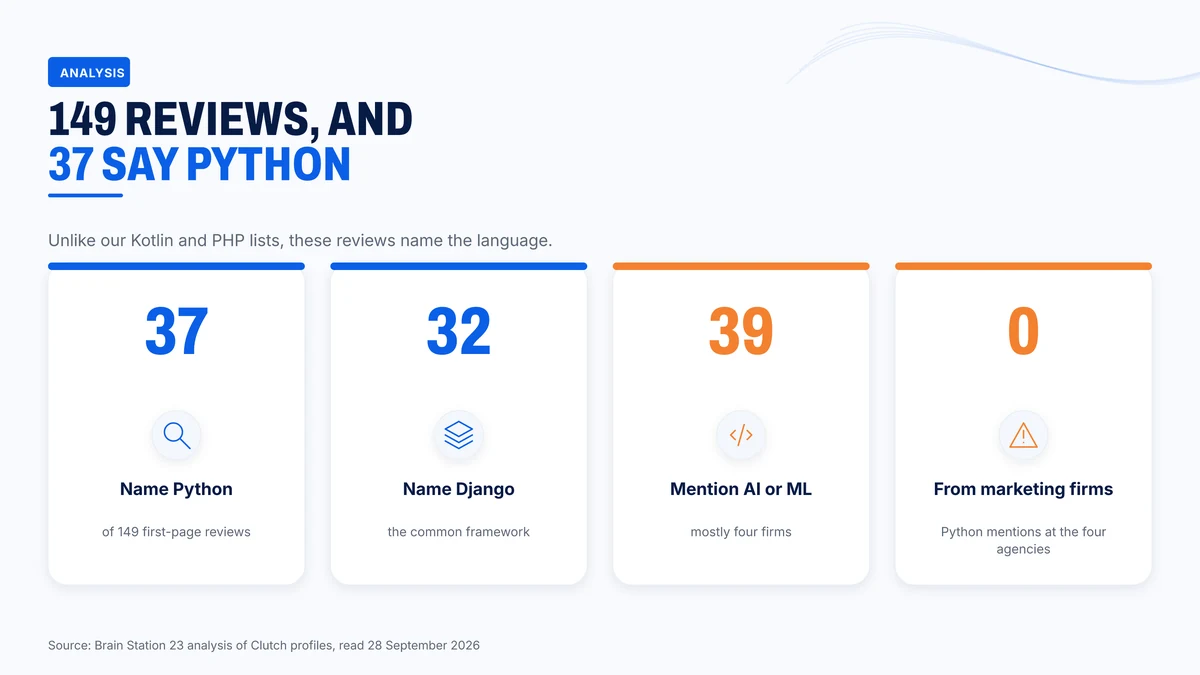
The reviews do mention Python here. Of 149 first-page reviews, 37 name Python and 32 name Django, far more than on our Kotlin or PHP lists. Thirty-nine mention AI or machine learning, mostly at Six Feet Up, Beehive Software, GenAI.Labs and Idea Maker. The four marketing agencies account for none of the Python mentions.
Cost is the weak sub-score again. Among the 15 firms whose sub-scores differ, Cost is the lowest or joint lowest for 11. Sixteen of the twenty list Django among their frameworks, and three list Python as their only language: Fusionbox, Imaginary Landscape and Idea Maker. This Top 20 Python Development Companies in USA list overlaps our Django list by eight firms.
How to shortlist a Python development company
Order the filters so the first one removes the most firms.
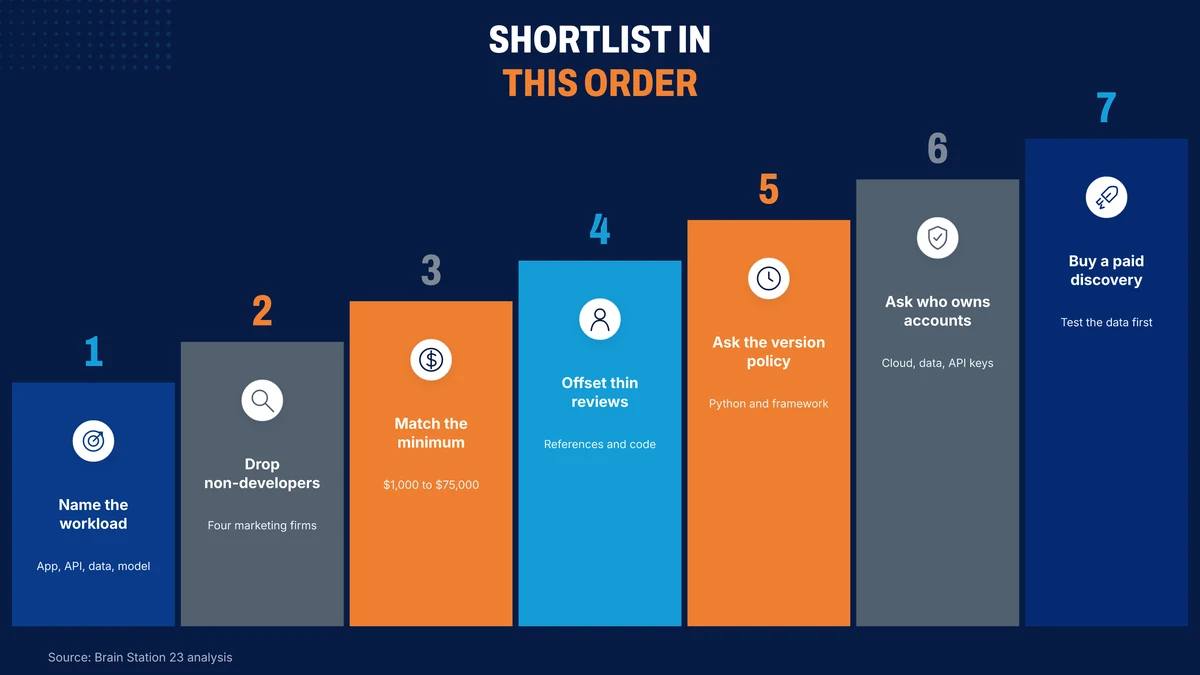
Step 1: Name the workload. A Django web application, a FastAPI service, a data pipeline and a machine learning feature need different firms. Start with the group that matches.
Step 2: Remove the firms that are not developers. Four firms here are marketing or SEO agencies. Unless you are buying marketing, skip them.
Step 3: Match your budget to the minimum. Minimums run from $1,000 to $75,000, and four firms charge $200 to $300 an hour.
Step 4: Compensate for thin reviews. Nine firms have fewer than ten reviews. Ask them for three references you can call and a code sample.
Step 5: Ask for the version policy. The answer should name the Python version, the framework version, and the date the service will leave Python 3.10 if it runs on it.
Step 6: Ask who owns the accounts. Cloud, data warehouse, model API keys and the repository should be in your name from day one.
Step 7: Buy a paid discovery. For data or AI work especially, a short fixed-fee phase that tests the data and the approach shows the real size of the job before you fund it.
How to buy Python development: four engagement models
The engagement model decides who pays when the data turns out messier than the estimate assumed.
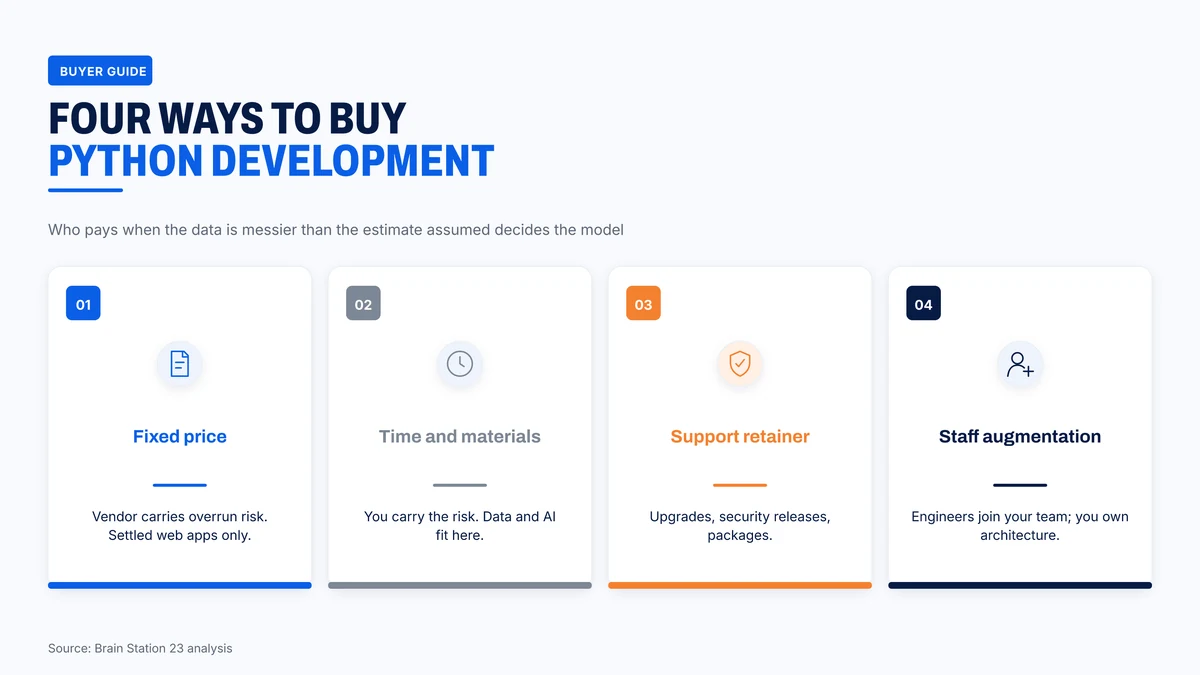
Fixed price moves overrun risk to the vendor, who prices it in. It suits a web application with settled requirements. It fails on data and AI work, where the answer depends on data nobody has examined yet.
Time and materials keeps the risk with you. It suits data pipelines, AI features and upgrades. Cap each phase and review burn every week.
Support retainer covers Python and framework upgrades, monthly Django security releases, dependency updates and a block of change requests.
Staff augmentation adds Python engineers to your team. Cuttlesoft, Gearheart.io and Brain Station 23 publish staff augmentation lines. It fails when nobody in-house owns the architecture and data decisions.
The technical question: keeping a Python stack supported
A Python service that has not been touched for two years is usually behind on the interpreter, the framework and dozens of packages at once. The order of the work decides whether it is a planned upgrade or a rewrite.
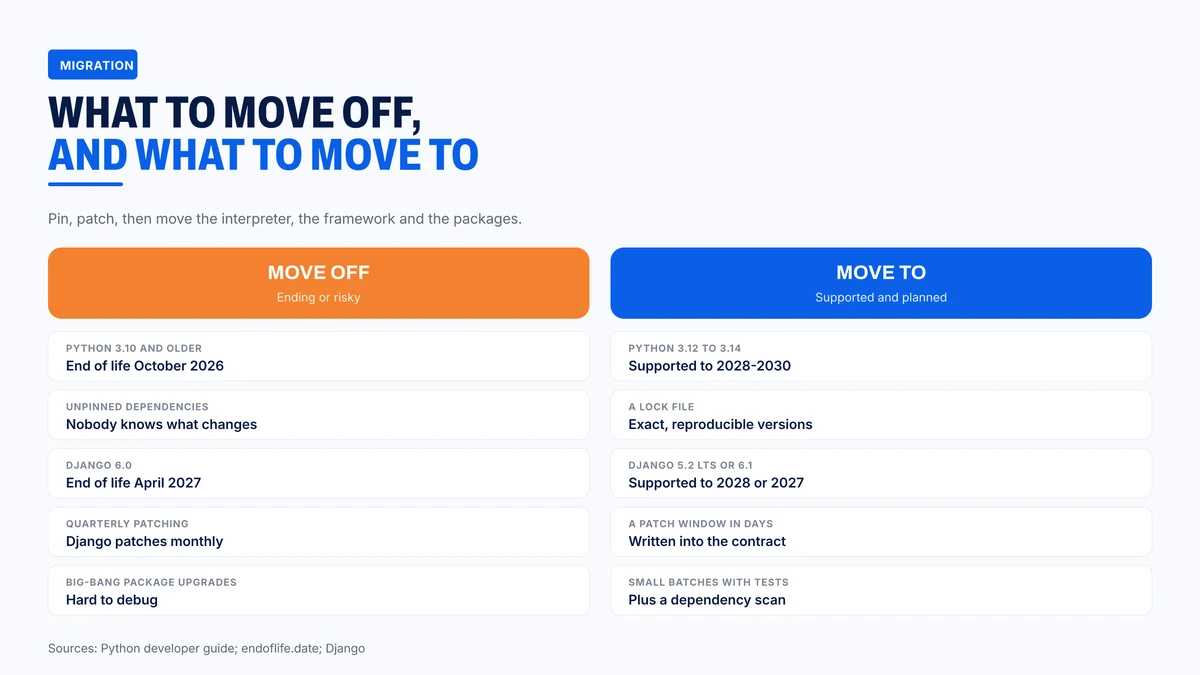
Step 1: Pin and record every dependency. A lock file with exact versions is the starting point. Without it, nobody can say what the upgrade will touch.
Step 2: Apply the current security releases. Django issued security releases every month from February to August 2026 (Django). Patch before upgrading.
Step 3: Move off Python 3.10. It reaches end of life in October 2026. Python 3.12 is supported until October 2028, 3.13 until October 2029 and 3.14 until October 2030 (Python).
Step 4: Move Django to a supported release. Django 5.2 LTS is supported until 30 April 2028 and 6.1 until 31 December 2027 (endoflife.date).
Step 5: Update the packages in small batches. Upgrade libraries a few at a time with tests between each, rather than all at once.
Step 6: Automate the checks. Run tests, type checks and a dependency vulnerability scan on every change, so the next upgrade is routine.
Step 7: Schedule the next round. A new Python ships every October and Django every eight months or so. Budget a version upgrade every year.
Red flags: eight answers to walk away from
Each of these answers should end the conversation, or at least change the contract.
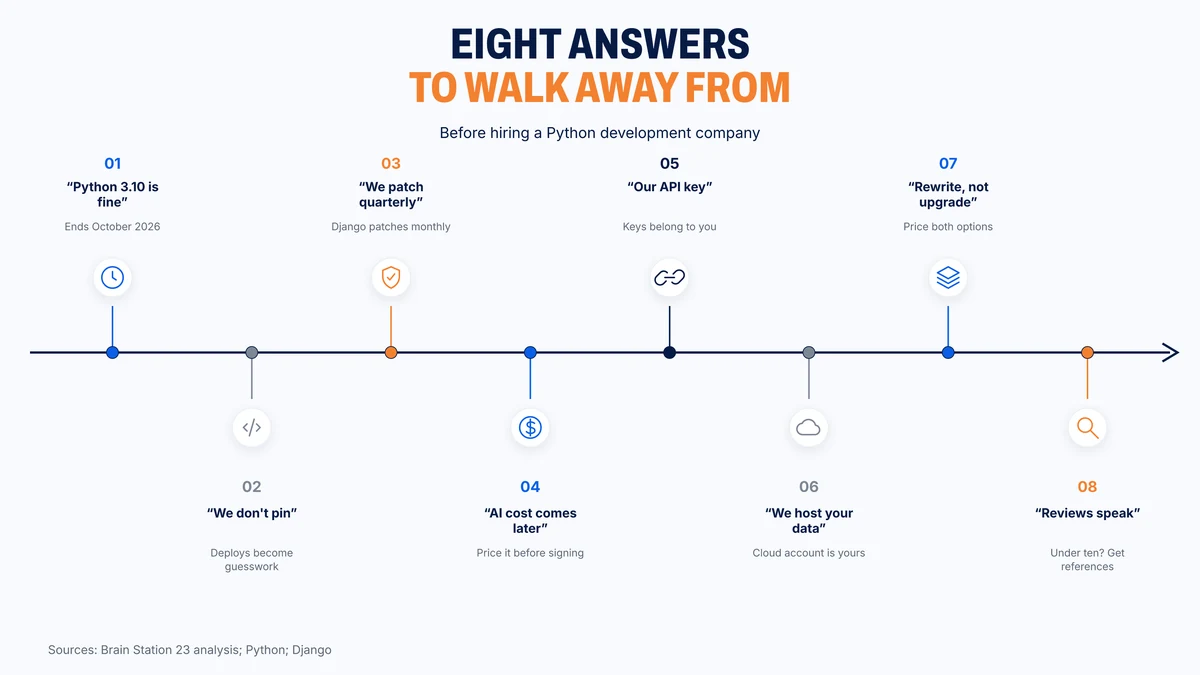
“Python 3.10 is fine.” It reaches end of life in October 2026 (Python).
“We don’t pin dependencies.” Then nobody knows what will change on the next deploy.
“We patch Django quarterly.” Django issued security releases every month from February to August 2026 (Django).
“We’ll know the AI cost after launch.” Ask for model and API costs per month before you sign.
“The model API key is on our account.” Keys, usage and billing should be yours.
“We host the data for you.” The cloud account and data warehouse should be in your name.
“We’ll rewrite it rather than upgrade.” Sometimes right, but ask for the cost of both.
“Our reviews speak for themselves.” With under ten reviews, ask for references and code instead.
After launch: what the build quote leaves out
This part covers what owners wish they had settled before the final invoice, and what recurs for as long as the software runs.
What you must own before the final invoice
The code repository with its full history, in your GitHub or GitLab organisation, with the lock file and a working test suite.
The cloud account, with billing in your name and the vendor added as a user you can remove.
Databases, data warehouses and storage buckets, created under your account, with backups you can restore.
Model and AI API keys, under your organisation’s account, with usage limits set.
Package registry and CI credentials, if the project publishes internal packages or runs scheduled jobs.
Environment configuration and secrets, in a vault you control.
Documentation of data flows and models, so the next team knows what feeds what.
A runbook, covering deployment, rollback, scheduled jobs, backups and incident contacts.
The bill that arrives after launch
A build quote covers the build. Ask for the recurring number before you sign, and compare vendors over three years.
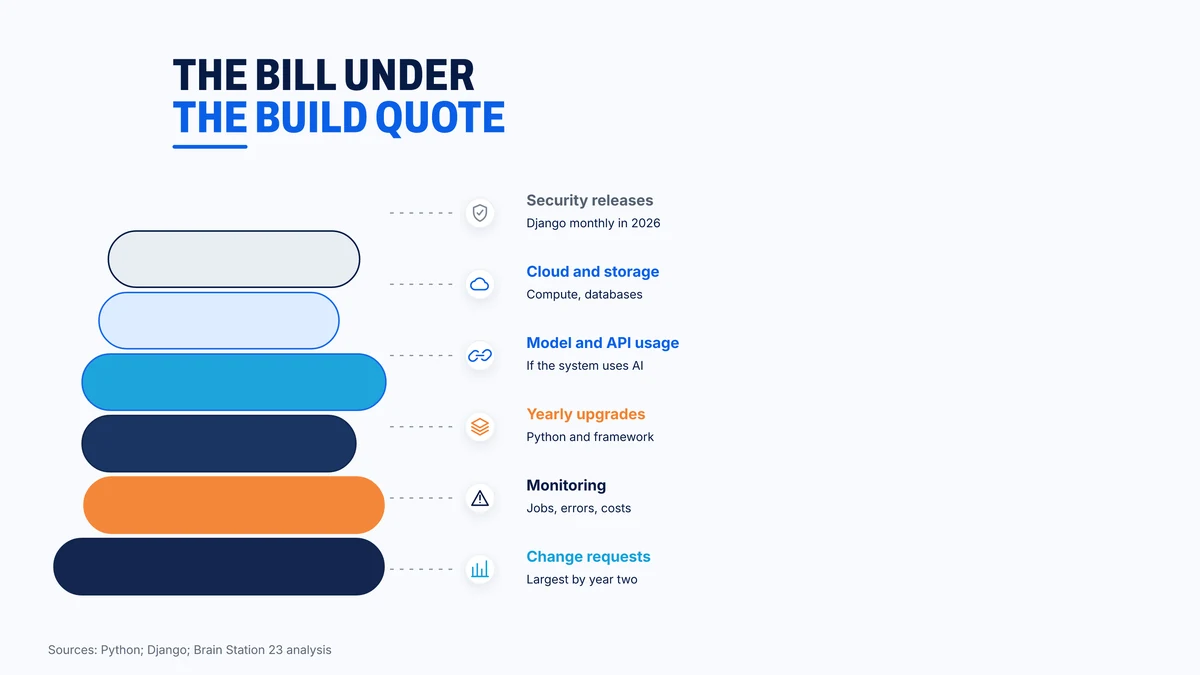
Security releases come first, then cloud and data storage, model and API usage if the system uses AI, the yearly Python and framework upgrade, and monitoring. For data and AI systems, compute and API usage can outgrow the maintenance fee, so ask for a monthly estimate with the build quote. Change requests usually outgrow everything else by year two.
Security is a recurring cost
Django published 26 security advisories between February and August 2026, twice its total for all of 2025, with releases every month in that period (Django). Each is fixed by a routine update, provided someone applies it.
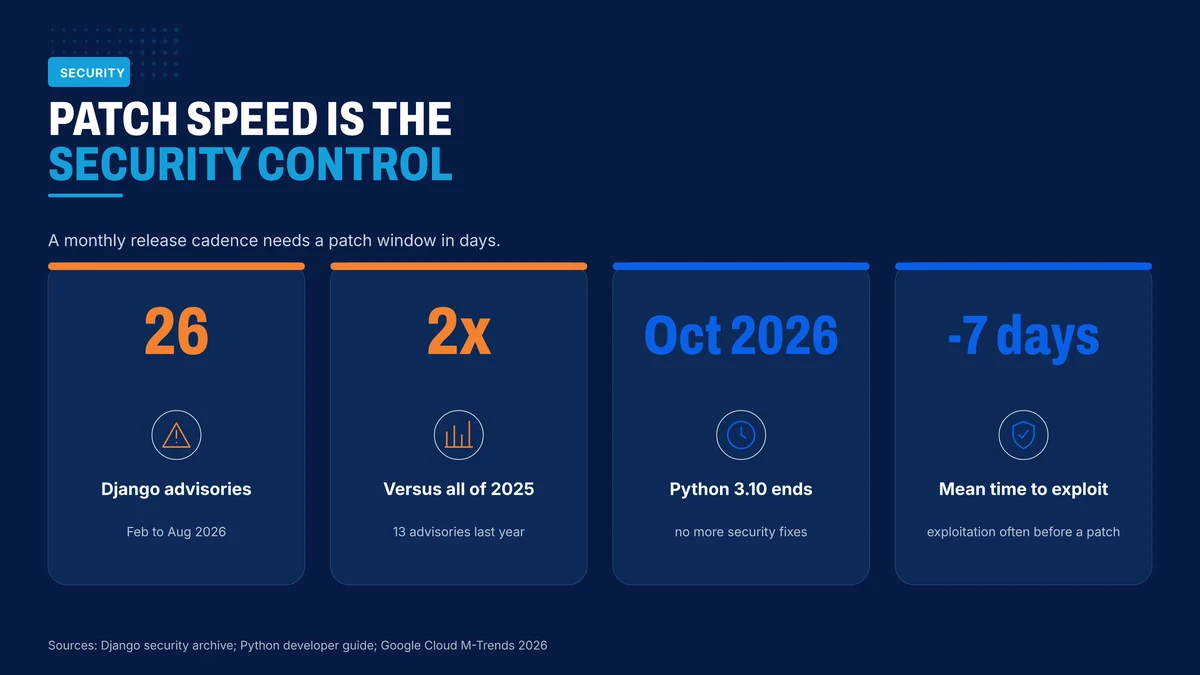
Google Cloud’s M-Trends 2026 estimated the mean time to exploit at minus seven days, meaning exploitation often arrives before a patch (Google Cloud). Write a patch window, in days, into the support agreement, and require a dependency scan in the build pipeline.
Accessibility is legal exposure
WebAIM found detected WCAG 2 failures on 95.9 percent of the top million home pages in 2026 (WebAIM Million 2026), and more than 5,000 digital accessibility lawsuits were filed in 2025 (UsableNet). If the Python system has a user interface, name WCAG 2.2 AA in the contract and put accessibility checks in the definition of done.
Contract clauses that surface in month nine
IP assignment on payment, not on final acceptance, including trained models and data transformations.
Transition assistance, a fixed number of hours at an agreed rate, available whether the relationship ends well or badly.
Rate escalation caps for the support period.
Subcontracting, named and approved in writing.
A patch window, in days, for critical and actively exploited vulnerabilities.
A version clause, naming the Python and framework versions the system must run on during the support term.
Non-solicitation in both directions, with a reasonable term.
This is general guidance, not legal advice. Have your own counsel review the contract.
How to leave without losing the codebase
Confirm, in writing, that the repository, cloud account, data stores and API keys are already yours. Trigger the transition hours while the relationship is still cordial. Ask the departing team to record walkthroughs of deployment, scheduled jobs, data pipelines and any upgrade in progress, and to deploy once in front of your staff.
On the last day, remove the departing team from every account, revoke their keys and tokens, and rotate every database password and API key they could have seen.
Hire in-house or hire a Python development company
The comparison starts with the wage. PayScale reports $102,000 for the Python skill and BLS $135,980 for software developers (PayScale; BLS). That is before benefits, recruiting and the time to hire, and data or machine learning specialists cost more.
Hire in-house when the Python system is your product or your data platform and changes every week. Knowing the data is the asset.
Hire an agency for a new application, a Python or Django upgrade, or a first AI feature with a clear end, with the accounts in your name and transition hours in the contract.
Mix the two when you have a technical lead but not enough engineers. Staff augmentation fills the gap, and your lead keeps the architecture and data decisions.
FAQ
Which companies are the top Python developers in the USA?
On this list, built from Clutch’s US Python and Django directory and filtered to firms that put Python at 40 percent or more of their languages, the five highest Clutch-ranked are Caktus Group, Six Feet Up, Crowdbotics, Bright Bridge Web and Fusionbox (Clutch).
How much do US Python development companies charge?
Fourteen of the twenty firms here publish $100 an hour or more, and four publish $200 to $300. Minimum projects run from $1,000 to $75,000, with a median of $10,000 (Clutch).
When does Python 3.10 reach end of life?
In October 2026. Python 3.11 follows in October 2027 and 3.12 in October 2028. Python 3.15 is scheduled for 1 October 2026 (Python).
Which Django version should a project use?
Django 5.2, the long-term support release, is supported until 30 April 2028. Django 6.1 shipped on 5 August 2026 and is supported until 31 December 2027 (endoflife.date).
Django, FastAPI or Flask?
Django suits full web applications with an admin and content, FastAPI suits APIs and services, and Flask suits small services. Among professional developers in 2025, 15.1 percent used FastAPI, 13.2 percent Flask and 11.7 percent Django (Stack Overflow).
Why are the firms on this list so small?
Firms that concentrate on Python tend to be specialist studios. Eighteen of the twenty here have fewer than 50 staff, while the largest general agencies list Python as one of many languages (Clutch).
How is this list different from a Django list?
It keeps only firms whose published languages are at least 40 percent Python, which brings in AI and data firms. It overlaps our Django companies list by eight firms.
Conclusion
The data behind this Top 20 Python Development Companies in USA list says three things. Clutch’s top-ranked Python and Django firms are mostly generalists, so we filtered for firms that put Python at 40 percent or more of their work. The firms that pass are small and specialised, with thin public review records, so references and code matter more than stars. And the stack is on a clock: Python 3.10 ends in October 2026, and Django is shipping security releases every month.
Any of the twenty can write Python. What decides the next three years is whether the interpreter, framework and packages stay supported, whether security releases land in days, and whether the cloud, data and API accounts are in your name when the work is done.
Sources
- https://clutch.co/us/developers/python-django?sort_by=ClutchRank
- https://clutch.co/profile/brain-station-23
- https://usa.brainstation-23.com/top-django-development-companies-in-usa/
- https://devguide.python.org/versions/
- https://endoflife.date/python
- https://endoflife.date/django
- https://docs.djangoproject.com/en/dev/releases/security/
- https://survey.stackoverflow.co/2025/technology
- https://github.blog/news-insights/octoverse/octoverse-a-new-developer-joins-github-every-second-as-ai-leads-typescript-to-1/
- https://w3techs.com/technologies/details/pl-python
- https://www.payscale.com/research/US/Skill=Python/Salary
- https://www.indeed.com/career/python-developer/salaries
- https://www.bls.gov/ooh/computer-and-information-technology/software-developers.htm
- https://cloud.google.com/blog/topics/threat-intelligence/m-trends-2026
- https://webaim.org/projects/million/
- https://blog.usablenet.com/ada-web-lawsuit-trends-2026