
“We handle the backend.” It is the most reassuring sentence a vendor can say on a first call, and it sounds like a specialism: the people who design the database, build the APIs and keep the servers patched.
The directory data does not back that up. Clutch has no backend category, so this Top 20 Backend Development Companies in USA list is built from its nearest one, API development. Of the 895 US firms listed there, 46 put half or more of their work into APIs, and only one of those 46 has a single client review (Clutch). The firms with the reviews are generalists. Fourteen of Clutch’s top 20 put API work at 10 percent of their services.
That does not make them weak at backend work. It means the label will not tell you who is strong at it. The stack, the reviews and the contract will.
Timing matters too. Python 3.10 loses security support in October 2026, .NET 8 and 9 on 10 November and PostgreSQL 14 on 12 November (Microsoft; PostgreSQL).
After the list, the guide covers what you should hold when the vendor leaves: the database, the cloud account and every API key.
Key takeaways
- 46 of 895 US firms in Clutch’s API development directory put half or more of their services into APIs, and 1 of those 46 has a client review (Clutch).
- 14 of 20 firms in Clutch’s API top 20 list API development at 10 percent of their services; the median share across the whole directory is 15 percent (Clutch).
- 6 support deadlines fall between 31 October and 31 December 2026: Python 3.10, .NET 8, .NET 9, PostgreSQL 14, PHP 8.2 and Spring Boot 4.0 open-source support (Python; PHP; endoflife.date).
- 31% of breaches in Verizon’s 2026 report started with an exploited software vulnerability, now the most common way in (Verizon DBIR 2026).
- 33% of organizations had an API security incident in the past year, and 19% are very confident their API inventory is accurate (Salt Security).
- $101,631 to $173,388 is the spread between four salary sites’ figures for a US backend developer in September 2026 (PayScale; Built In).
- 58.2% of professional developers used PostgreSQL in 2025, and 49.1% used Node.js (Stack Overflow).
- 15 of 17 firms here whose Clutch sub-scores differ score lowest, or joint lowest, on Cost (Clutch profiles).
Backend development in 2026: many stacks, one calendar
Most backend work is done by people who are not called backend developers. In Stack Overflow’s 2025 survey, 14.2 percent of respondents described their job as back-end developer, and 11.1 percent in the United States. Full-stack developers were 27 percent (Stack Overflow Developer Survey 2025). That is the first reason the vendor market has no clean backend category: the work is folded into full-stack and custom software teams.
There is no single backend stack. Among professional developers in 2025, 49.1 percent had used Node.js, 21.3 percent ASP.NET Core, 20.3 percent Express, 15.6 percent Spring Boot, 15.1 percent FastAPI, 11.7 percent Django and 9.3 percent Laravel (Stack Overflow). SQL was the most used language after JavaScript and HTML at 61.3 percent, ahead of Python at 54.8.
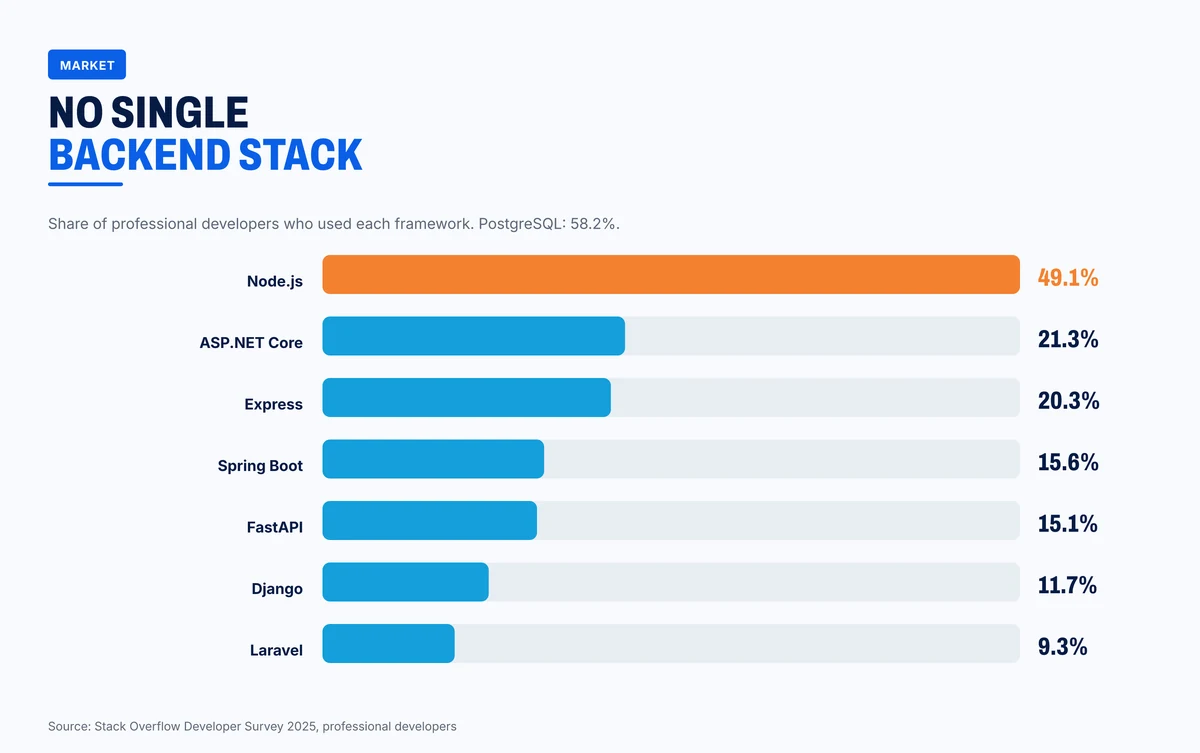
The database picture is more settled. PostgreSQL led at 58.2 percent of professional developers, then MySQL at 39.6, SQLite at 36.9, Microsoft SQL Server at 30.9, Redis at 30.7 and MongoDB at 24.3 (Stack Overflow). A vendor who is vague about the database is vague about the part of the system you will keep longest.
What runs websites is different again. PHP powers 69.8 percent of the sites whose server-side language W3Techs can detect, with Python at 1.1 percent (W3Techs). The gap is the point: a public website and an internal API are different workloads, and a firm that is strong at one may be ordinary at the other. If your backend is mostly one language, our Node.js, Java, Python and ASP.NET lists rank firms by that language.
APIs are now products, not plumbing. Postman’s 2025 survey of more than 5,700 developers and executives found 82 percent of organizations have adopted some level of API-first development, and 25 percent operate fully API-first. It also found 89 percent of developers use AI tools, but only 24 percent design APIs for AI agents to call (Postman).
The calendar is the part a buyer can act on. Backend stacks age in layers: the runtime, the framework and the database each have their own support dates, and several fall together at the end of 2026.
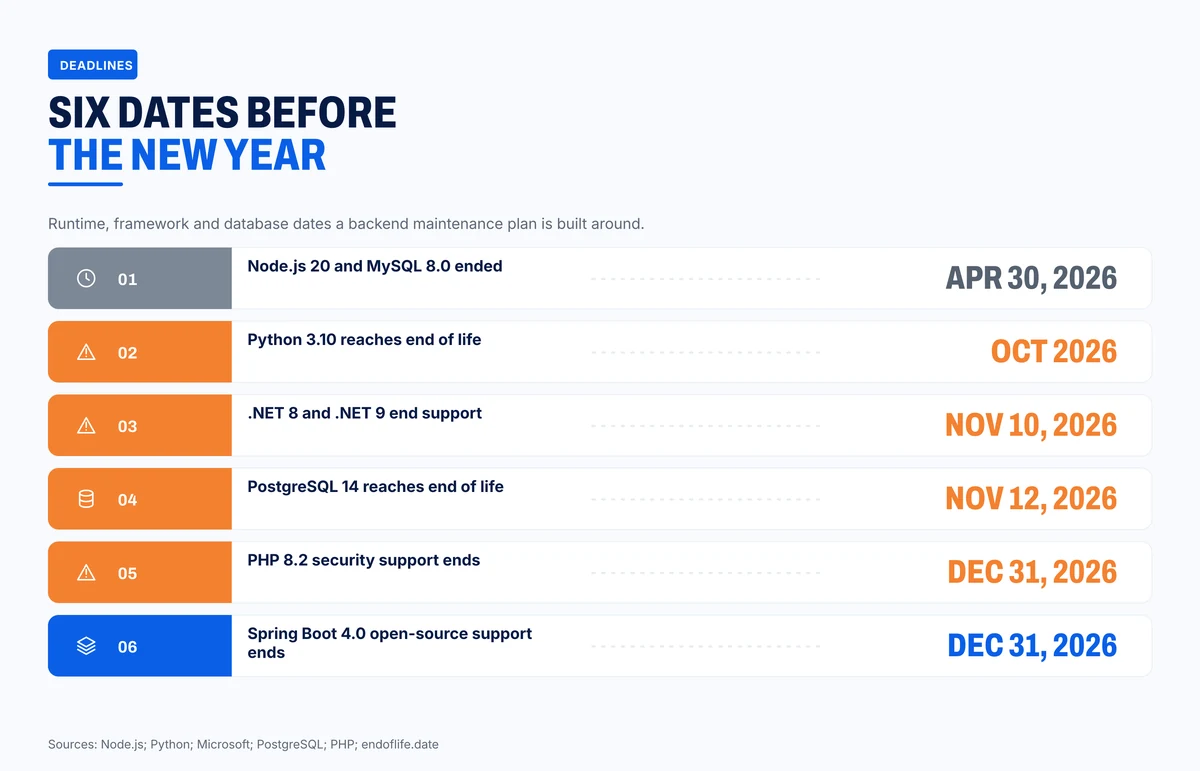
Node.js 20 and MySQL 8.0 both reached end of life on 30 April 2026 (Node.js; endoflife.date). Python 3.10 follows in October, .NET 8 and .NET 9 on 10 November, PostgreSQL 14 on 12 November, and PHP 8.2 security support on 31 December (PHP). Spring Boot 4.0’s open-source support also ends on 31 December (endoflife.date).
So a backend brief needs three answers before any firm is compared: what the backend is for (an API for your own apps, integrations with other systems, data processing or background jobs), which runtime, framework and database versions it runs today, and who will move each of them before support ends.
What backend development costs in the US
Four salary sites put a US backend developer between $101,631 and $173,388 in September 2026, a spread of $71,757 for the same job title.
PayScale reports an average of $101,631 for a back-end developer or engineer (PayScale). ZipRecruiter reports $120,086 (ZipRecruiter) and Glassdoor $122,535 (Glassdoor). Built In reports $173,388 in base salary and $223,712 in total compensation (Built In). The Bureau of Labor Statistics median for all software developers was $135,980 in May 2025 (BLS).
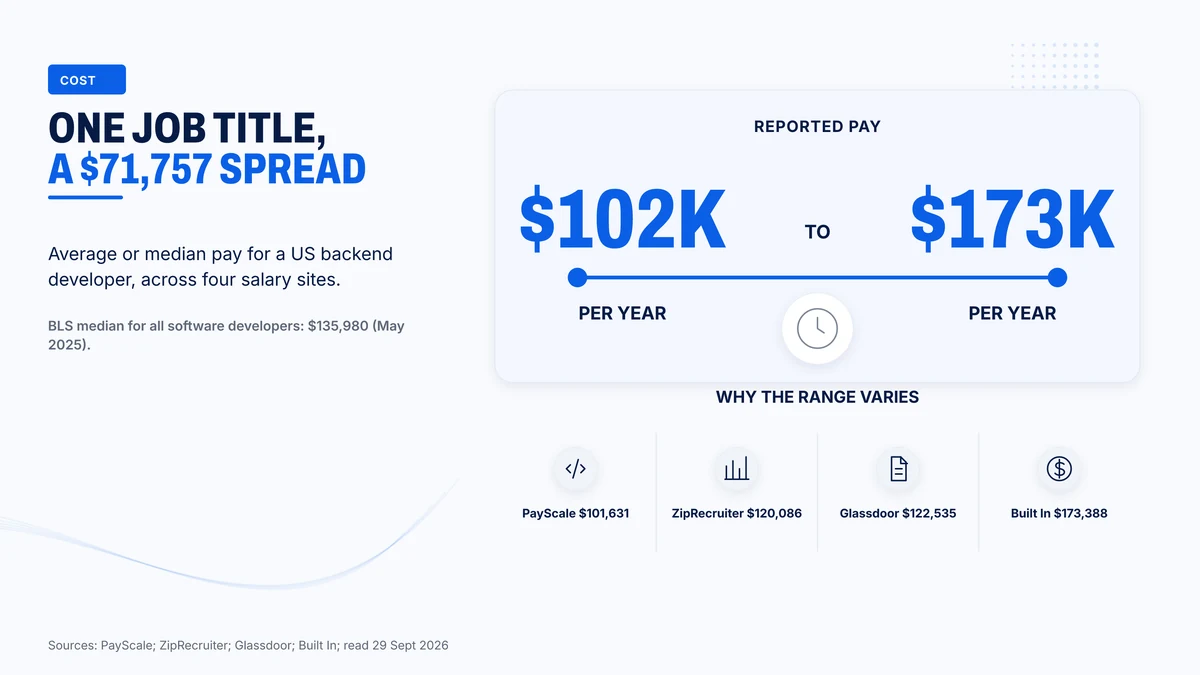
None of them is wrong. PayScale is self-reported base pay, Glassdoor mixes submitted salaries with job posts, and Built In leans towards technology employers in large cities. The spread is why a single “average backend cost” is not worth quoting. Ask what a rate includes instead.
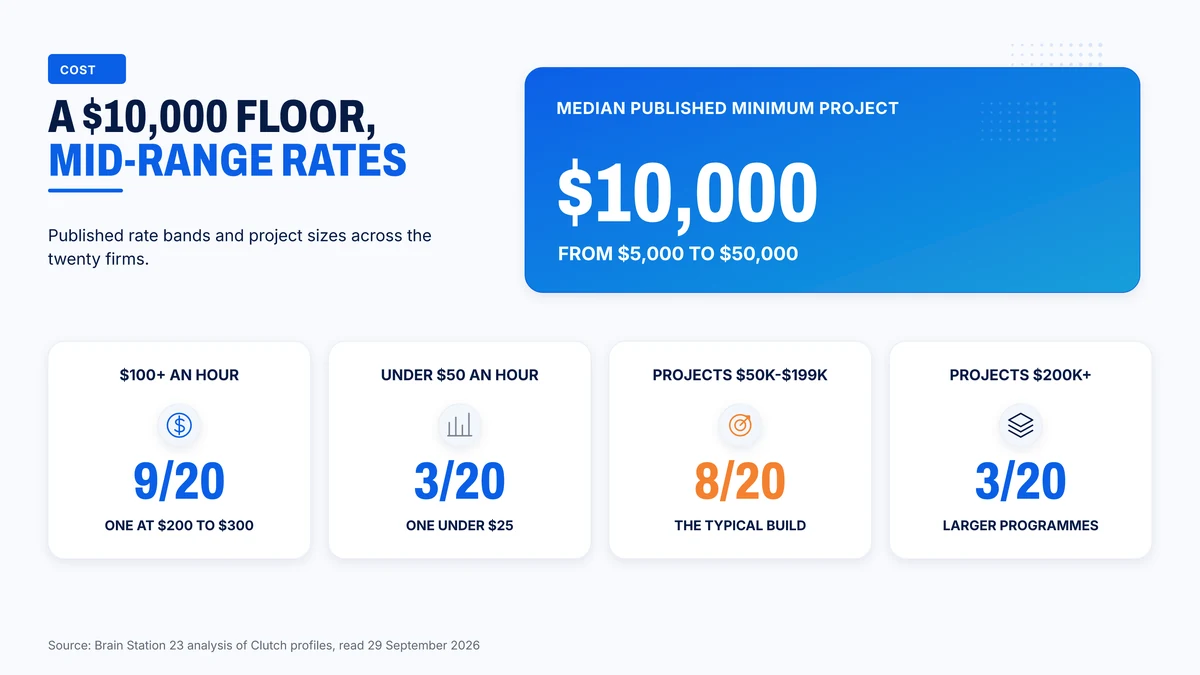
Agency pricing on this list sits in the middle. Nine of the twenty firms publish $100 an hour or more, one publishes $200 to $300, and three publish under $50. The median published minimum project is $10,000, from $5,000 to $50,000 (Clutch profiles, read 29 September 2026). Eight firms report a most common project of $50,000 to $199,999, and three report $200,000 to $999,999.
Eight factors decide where a backend quote lands.
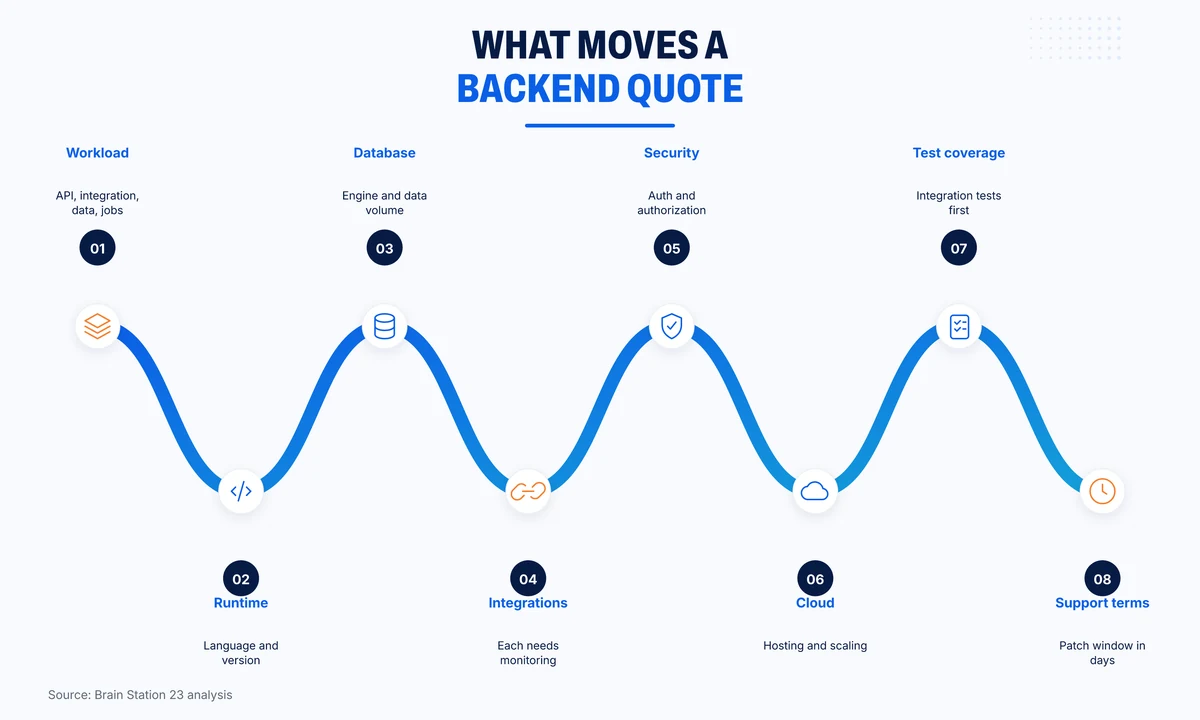
The workload comes first: an API for your own apps, integrations with other systems, data processing or scheduled jobs. Then the runtime and its version; the database and the volume of data; the number of third-party integrations, each of which needs error handling and monitoring; authentication and authorization, where most API security failures sit; cloud and hosting; test coverage; and the support terms. Ask every vendor to price hosting and third-party usage separately from the build, and to quote the integrations one by one.
The Top 20 Backend Development Companies in USA, compared
Clutch has no backend category, so we used its closest match, the directory of API developers in the United States, sorted by Clutch Rank and read on 29 September 2026. It lists 895 firms and carried no paid rows on any page when we read it. Firms 2 to 21 below are its top 20, in Clutch Rank order.
Brain Station 23 is placed first because we publish this article. We are US-headquartered and verified on Clutch, but our profile has no API development line, so we do not appear in this directory at all, and we are not claiming a ranking in it.
The API Focus column shows the share of services each firm assigns to API development, with its largest service line. The # column is this list’s position. Certifications are self-published and unverified wherever they appear.
| # | Company | Best For | Team Size | API Focus | Key Tech Stack | Industries Served | Locations |
|---|---|---|---|---|---|---|---|
| 1 | Brain Station 23 — brainstation-23.com | Adding backend engineers across Java, .NET, Python and Go | 250 – 999 | No API line; staff augmentation 60% | Java, Spring, .NET, Python, PHP, Go, Node.js | Retail, medical, telecoms, education, financial services | Springfield VA; Bangladesh, UAE, England, Malaysia, Germany |
| 2 | Sketch Development — sketchdev.io | Senior US-based teams for custom software and AWS work | 10 – 49 | API 10%; custom software 25% | Java, .NET, Node.js, Spring, Python, SQL, AWS | Financial services, medical, government, utilities | Webster Groves MO |
| 3 | BIX Tech — bixtech.ai | Python and data back ends with analytics attached | 50 – 249 | API 10%; AI and custom software 20% each | Python, Django, SQL, React, Node.js | Education, manufacturing, retail, business services | Miami FL |
| 4 | 26 Lines Of Code — 26loc.com | Django and API work at a mid-market rate | 50 – 249 | API 30%; custom software 30% | Python, Django, PHP, JavaScript, Flutter | Spread across 20 sectors | Miami FL, Cheyenne WY; Ukraine, Estonia |
| 5 | Bilberrry — bilberrry.com | Website rebuilds with APIs and platform integrations | 10 – 49 | API 10%; web development 40% | JavaScript, React, Node.js, PHP, Laravel | Government, non-profit, education, financial services | Seattle WA |
| 6 | Pell Software — pellsoftware.com | .NET APIs and integrations for small businesses | 10 – 49 | API 10%; custom software 70% | .NET, ASP.NET, C#, SQL | IT, manufacturing, energy, financial services, logistics | Denver CO |
| 7 | Twin Sun — twinsunsolutions.com | Rails back ends for product teams | 10 – 49 | API 10%; ten lines at 10% | Ruby on Rails, Flutter, React, Swift | Financial services, government, medical, e-commerce | Nashville TN |
| 8 | CoSpark — cospark.com | E-commerce back ends, integrations and site performance | 10 – 49 | API 10%; e-commerce 75% | WooCommerce, NetSuite integration, REST APIs | E-commerce | Irvine CA, Fredericksburg VA |
| 9 | Mystic Media — mysticmediasoft.com | Cloud and server migrations plus custom software | 10 – 49 | API 10%; ten lines at 10% | .NET, Node.js, Ruby on Rails, PHP, AWS, Google Cloud, Azure | Business services, education, gaming, retail | Draper UT |
| 10 | Red Hawk Technologies — redhawk-tech.com | .NET modernisation for mid-market healthcare and finance | 50 – 249 | API 10%; AI development 30% | .NET, ASP.NET, SQL, Flutter, Node.js | Medical, financial services, insurance, manufacturing | Wilder KY |
| 11 | Rocket Code — therocketcode.com | Fintech product builds at a low rate | 50 – 249 | API 10%; custom software and GenAI 20% each | Django, React, React Native, Kotlin, AWS, MongoDB | Financial services, medical, retail | Coral Gables FL, San Francisco CA; Mexico City |
| 12 | Gearheart.io — gearheart.io | Python and Node back ends for mid-market products | 10 – 49 | API 10%; custom software 20% | Python, Django, Node.js, TypeScript, React | Business services, medical, financial services | San Francisco CA; Kyiv, Tallinn |
| 13 | ObjectStyle — objectstyle.com | Java and Spring back ends and microservices | 50 – 249 | API 10%; custom software 20% | Java, Spring, REST APIs, AWS, React | IT, education, medical, business services | Fairfield CT; Warsaw |
| 14 | SmallCo. Inc — smallco.co | Custom databases and APIs for niche industries | 10 – 49 | API 25%; custom software 25% | REST and SOAP APIs, React Native, Node.js | Advertising, automotive, education, financial services, manufacturing | Miami FL |
| 15 | Tevpro — tevpro.com | Enterprise app and database modernisation in energy | 10 – 49 | API 15%; modernisation 15% | C#, ASP.NET, Python, SQL, Node.js, Google Cloud, AWS, Azure | Energy, IT, financial services, logistics | Houston TX |
| 16 | Ingage Partners — ingagepartners.com | Long-term enterprise teams for APIs and cloud | 50 – 249 | API 25%; cloud and custom software 25% each | Angular, React, Vue, SQL | IT, financial services, manufacturing, medical | Blue Ash OH |
| 17 | Launch by NTT DATA — launch.nttdata.com | Large product and IoT programmes with enterprise backing | 250 – 999 | API 10%; ten lines at 10% | Not published | Energy, financial services, retail, utilities | Plano TX |
| 18 | ISBX Corp — isbx.com | Node.js back ends for medical and consumer apps | 50 – 249 | API 10%; ten lines at 10% | Node.js, Java, C++, C# | Medical, consumer products, retail, media | Los Angeles CA |
| 19 | Pixel Appy — pixelappy.com | Small businesses needing app, CRM and web together | 50 – 249 | API 15%; custom software and mobile 25% each | React Native, SQL, Python, C#, TypeScript | Consumer products, food and beverage, gaming, medical | Austin TX |
| 20 | Hristov Development — hristovdevelopment.com | Small Node.js and Vue projects on a budget | 10 – 49 | API 10%; ten lines at 10% | Node.js, Vue, .NET, Python, SQL | Business services, financial services, IT, manufacturing | Chicago IL; Aguascalientes |
| 21 | JetBase — jetbase.io | Django, Node and Rails back ends at a low rate | 10 – 49 | API 10%; ten lines at 10% | Python, Django, Node.js, Ruby on Rails, AWS | Business services, education, logistics, IT | Sheridan WY; Wangford, England |
Team sizes, service splits, stacks, industries and locations are from each firm’s published Clutch profile, read 29 September 2026. “Best For” is our reading of that data. Founding years come from the same profiles; certifications are not published consistently, so they appear only in the profiles, marked where a firm states them.
1. Brain Station 23
We publish this article and placed ourselves first, so read this as the publisher’s entry. We are not in Clutch’s API directory: our profile has no API development line. What it shows is range across backend languages, with ASP.NET, Java and Python at 14 percent each, PHP 12 and Go 7, and Spring the largest framework at 30 percent. Sixty percent of our work is engineers embedded in client teams, at $25 to $49 an hour with a $10,000 minimum. Reviews describe a microservice e-commerce platform with real-time inventory sync, a legacy migration and .NET engineers added to a product team. ISO 27001 and SOC 2 Type II matter when engineers hold production database access. Reviewers score Quality 5.0; one asked for tighter internal coordination. If you need an onshore-only team, we are the wrong call.
Founded: 2006
US Presence: Springfield VA
Company size: Clutch band 250 to 999; we publish 900+ engineers
Rating: 4.9 across 21 Clutch reviews, HQ Springfield, Virginia
- Adding backend engineers across Java, .NET, Python and Go
- CMMI Level 3
- ISO 27001
- ISO 9001
- SOC 2 Type II (company-published)
- Staff augmentation
- Custom software
- Application modernisation
- Java and Spring
- .NET
- Python
- PHP and Laravel
- Go
- Node.js
- Retail
- Medical
- Telecoms
- Education
- Financial services
- Hospitality
- Ask for the named engineers and the written process for replacing one
For API and integration specialists
4. 26 Lines Of Code
26 Lines Of Code, which its reviews also call DTEAM, puts 30 percent of its services on APIs, the highest API share in Clutch’s top 20, level with custom software. Clutch’s review summary credits its Python and Django back ends, FastAPI services and custom connectors. It publishes $50 to $99 an hour with a $5,000 minimum, and 70 percent of its clients are small businesses. It is Clutch-ranked 3rd. One reviewer asked for faster support responses and more frequent updates; another wanted stronger product guidance.
Founded: 2017
US Presence: Miami FL, Cheyenne WY
Company size: 50 to 249
- Django and API work at a mid-market rate
- Not published; ask directly
- API development
- Custom software
- Web development
- Mobile apps
- Python
- Django
- PHP
- REST and webhook APIs
- 20 sectors at 5 percent each
- Ask about support response times and how often you will get updates
14. SmallCo. Inc
SmallCo., founded in 1991, is the oldest firm here, and API work is a quarter of its services, the joint second-highest share. Its reviews describe title information systems, databases and ONIX feeds for publishers, plus fleet and shipment systems. It publishes $200 to $300 an hour, the highest band here, and its most common project is $200,000 to $999,999. Cost scores 4.4. One client was billed for the time taken to answer an estimate request, and another reported slow ticket responses in the first two years.
Founded: 1991
US Presence: Miami FL
Company size: 10 to 49
- Custom databases and APIs for niche industries
- Not published; ask directly
- API development
- Custom software
- Mobile apps
- UX design
- Low-code development
- REST and SOAP APIs
- Advertising
- Automotive
- Business services
- Education
- Financial services
- Ask whether estimates and ticket triage are billable
16. Ingage Partners
Ingage Partners splits its services equally between API development, cloud and custom software at 25 percent each, and 60 percent of its clients are enterprises. One reviewer reported spending $7 million to $12 million with it over about eight years, a client-reported figure. Clutch’s summary notes it is employee-owned. It does not publish a rate. Cost scores 4.0, the lowest sub-score in this top 20, and clients said trained team members were moved to other projects.
Founded: 2011
US Presence: Blue Ash OH
Company size: 50 to 249
- Long-term enterprise teams for APIs and cloud
- Not published; ask directly
- API development
- Cloud consulting
- Custom software
- IT strategy
- UX design
- Staff augmentation
- IT
- Financial services
- Manufacturing
- Medical
- Ask how named engineers stay on your account
15. Tevpro
Tevpro, in Houston, puts API development and modernisation at 15 percent each, and enterprises are 60 percent of its clients. Energy is its largest industry at 25 percent, and its reviews include a database conversion for an energy company and a data-modelling web app built in C# and JavaScript. Its cloud work splits across Google Cloud, AWS and Azure. It publishes $100 to $149 an hour with a $5,000 minimum. It has eight reviews; one client found early communication weak before it improved.
Founded: 2016
US Presence: Houston TX
Company size: 10 to 49
- Enterprise app and database modernisation in energy
- Not published; ask directly
- API development
- Application modernisation
- Cloud consulting
- DevOps
- ERP integration
- C#
- ASP.NET
- Python
- SQL
- Energy
- IT
- Financial services
- Logistics
- Telecoms
- Set the communication rhythm in the first week
13. ObjectStyle
ObjectStyle is the Java firm in this top 20: Java is half its languages, Spring MVC 30 percent of its frameworks, REST 80 percent of its API work and AWS 70 percent of its cloud. It is the only firm here to list microservices architecture as a service line. Reviews describe backend work in Java, Perl and Python, and staff augmentation for a sports league. It publishes $50 to $99 an hour. It has four reviews, and one client noted the team is asleep during US evening events.
Founded: 2002
US Presence: Fairfield CT
Company size: 50 to 249
- Java and Spring back ends and microservices
- Not published; ask directly
- Custom software
- Application modernisation
- Microservices architecture
- API development
- Cloud consulting
- Java
- Spring
- REST APIs
- IT
- Education
- Medical
- Arts and entertainment
- Business services
- Confirm overlap hours with the Warsaw team
6. Pell Software
Pell Software is a .NET house: .NET is its only framework, and ASP.NET and C# make up 80 percent of its languages. Custom software is 70 percent of its services and APIs 10, and its reviews include API builds for a demolition firm and a sheet music platform. It scores 5.0 on Quality, Schedule and Willing to Refer across 30 reviews. It publishes $100 to $149 an hour with a $5,000 minimum. One project estimated at two to three months took about seven as scope grew.
Founded: 2019
US Presence: Denver CO
Company size: 10 to 49
- .NET APIs and integrations for small businesses
- Not published; ask directly
- Custom software
- API development
- Application modernisation
- Application integration
- ASP.NET
- C#
- SQL
- IT
- Manufacturing
- Business services
- Energy
- Financial services
- Logistics
- Get a phased estimate, since one project ran seven months against two to three
For Python, Node and data back ends
3. BIX Tech
BIX Tech is Miami-based, and its stack is plainly backend and data: Python 40 percent, JavaScript and SQL 30 each, with Django its main framework. API work is 10 percent of services, behind AI, custom software and BI. Reviews describe data platforms on ClickHouse, Qlik and Google BigQuery, several of them 2026 projects. It publishes $50 to $99 an hour with a $25,000 minimum. One reviewer said the first consultant was slow to drive decisions, and another asked for more documentation and knowledge transfer.
Founded: 2014
US Presence: Miami FL
Company size: 50 to 249
- Python and data back ends with analytics attached
- Not published; ask directly
- AI development
- Custom software
- BI and big data
- Staff augmentation
- API development
- Python
- Django
- SQL
- Education
- Manufacturing
- Retail
- Business services
- Financial services
- Ask who will drive technical decisions in the first month
12. Gearheart.io
Gearheart.io’s stack is backend-heavy: Python is 50 percent of its languages, and Django and Node.js each take a quarter of its frameworks. Its reviews describe CRM and risk management systems, including API integration into a client’s ERP. It lists offices in San Francisco, Kyiv and Tallinn. Its $50,000 minimum is the highest here, with a $50 to $99 band. One client waited a day for replies when the main contact was away, and another found requests implemented too literally.
Founded: 2012
US Presence: San Francisco CA
Company size: 10 to 49
- Python and Node back ends for mid-market products
- Not published; ask directly
- Custom software
- API development
- DevOps
- Application testing
- Modernisation
- Staff augmentation
- Python
- Django
- Node.js
- Business services
- Medical
- Financial services
- Education
- Government
- Name a backup contact for when your main one is away
21. JetBase
JetBase lists JavaScript, Python, Ruby and TypeScript at 25 percent each, and AWS is 80 percent of its cloud work. Its reviews name back-end work more often than most here: a Django upgrade, a cloud platform for IoT heating devices, Shopify APIs. It publishes $25 to $49 an hour with a $5,000 minimum and scores 5.0 on every sub-score. It is Clutch-ranked 20th. One client said a developer changed mid-project, and that the handover went well.
Founded: 2014
US Presence: Sheridan WY
Company size: 10 to 49
- Django, Node and Rails back ends at a low rate
- Not published; ask directly
- Custom software
- API development
- Cloud consulting
- IoT
- E-commerce
- Staff augmentation
- Django
- Node.js
- Ruby on Rails
- Business services
- Education
- Logistics
- IT
- Media
- Ask which office the engineers work from, since Clutch lists Wyoming and England
20. Hristov Development
Hristov Development, in Chicago with an office in Aguascalientes, Mexico, puts Node.js and Vue at 30 percent of its frameworks each. It publishes $25 to $49 an hour with a $5,000 minimum, and its most common project is under $10,000, among the smallest here. Its reviews describe custom web apps, integrations and staff augmentation. One client said the team is small and may need specialist roles as clients scale; another found early communication thin before it improved.
Founded: 2013
US Presence: Chicago IL
Company size: 10 to 49
- Small Node.js and Vue projects on a budget
- Not published; ask directly
- Custom software
- API development
- Cloud consulting
- E-commerce
- IT managed services
- Staff augmentation
- Node.js
- Vue
- .NET
- Business services
- Consumer products
- Financial services
- IT
- Manufacturing
- Ask how the team will cover roles it lacks as you grow
5. Bilberrry
Bilberrry has the most reviews in Clutch’s top 20, 36, with a 5.0 rating. Its work is mostly web: web development is 40 percent of services and API work 10, with JavaScript at 70 percent of languages and Node.js a third of its frameworks. Reviews describe rebuilt back ends, APIs and single sign-on alongside redesigns, and enterprise and mid-market clients make up all of its client base. It publishes $50 to $99 an hour and a $25,000 minimum. Clients asked for better-centralised project information and earlier production environments.
Founded: 2010
US Presence: Seattle WA
Company size: 10 to 49
- Website rebuilds with APIs and platform integrations
- Not published; ask directly
- Web development
- Custom software
- API development
- Staff augmentation
- React
- Node.js
- Laravel
- REST APIs
- Government
- Non-profit
- Consumer products
- Education
- Financial services
- Ask where project documents and decisions will live
18. ISBX Corp
ISBX Corp lists Node.js as its only framework, with Java 40 percent of its languages. Medical is 35 percent of its industries, and its most common project is $200,000 to $999,999. One client says ISBX took over software a previous team had failed to deploy in four years and put it into production within three months, a client-reported account. It publishes $150 to $199 an hour. Clients asked for more visibility into who does the work, and one project ran longer than wanted.
Founded: 2009
US Presence: Los Angeles CA
Company size: 50 to 249
- Node.js back ends for medical and consumer apps
- Not published; ask directly
- Custom software
- API development
- Application support
- Modernisation
- Mobile apps
- Web development
- Node.js
- Java
- Medical
- Consumer products
- Retail
- Media
- E-commerce
- Ask to meet the designers and developers directly
For .NET, Ruby and modernisation work
10. Red Hawk Technologies
Red Hawk Technologies, in Wilder, Kentucky, puts half its frameworks on .NET, and REST is 70 percent of its API work. Mid-market companies are 85 percent of its clients, and medical and financial services half its industries. Clutch’s summary credits it with modernising legacy systems. It publishes $150 to $199 an hour with a $10,000 minimum. The caution is budget: reviewers said it could forecast hours better, and one wanted to see a working model before so many hours were spent.
Founded: 2008
US Presence: Wilder KY
Company size: 50 to 249
- .NET modernisation for mid-market healthcare and finance
- Not published; ask directly
- AI development
- Application support
- Custom software
- Mobile apps
- API development
- ASP.NET
- .NET
- SQL
- REST APIs
- Medical
- Financial services
- Business services
- Insurance
- Manufacturing
- Ask for hour forecasts per milestone and a working build early
7. Twin Sun
Twin Sun spreads its services evenly across ten lines, API work among them, but Ruby leads its languages at 26 percent and Ruby on Rails is its main framework. Finance, government and medical make up 70 percent of its industries. It publishes $150 to $199 an hour and a $25,000 minimum, and its most common project runs $50,000 to $199,999. Reviewers praise its budget control; one said plainly it is not cheap, and another noted that an agency schedules several clients at once.
Founded: 2017
US Presence: Nashville TN
Company size: 10 to 49
- Rails back ends for product teams
- Not published; ask directly
- Custom software
- API development
- Application support
- Modernisation
- IoT
- Ruby on Rails
- Flutter
- React
- Financial services
- Government
- Medical
- E-commerce
- Consumer products
- Confirm the team’s availability against its other client schedules
9. Mystic Media
Mystic Media splits its services evenly across ten lines and lists ten languages at 10 percent each, so its profile does not show a specialism; its reviews do. Several describe server and cloud migrations finished ahead of schedule, database development and hardware integration. It does not publish a rate or minimum, and 55 percent of its clients are small businesses. It scores 4.9 on every sub-score across 28 reviews. One client said functionality should have been tested more closely at the start.
Founded: 2001
US Presence: Draper UT
Company size: 10 to 49
- Cloud and server migrations plus custom software
- Not published; ask directly
- Custom software
- API development
- Cloud consulting
- Modernisation
- IoT
- .NET
- Node.js
- Ruby on Rails
- PHP
- Business services
- Consumer products
- Education
- GIS
- Gaming
- Agree the test plan at the start
2. Sketch Development
Sketch Development holds first place in Clutch’s API ranking with API work at 10 percent of its services; custom software is 25 percent and four AI lines another 45. Its profile says clients work with 100 percent US-based senior developers, at $150 to $199 an hour. Its 23 reviews cluster around timely delivery, and its most common project runs $50,000 to $199,999. AWS is 70 percent of its cloud focus. Cost is its lowest sub-score at 4.8, and Clutch’s summary notes one client asking for lower rates.
Founded: 2015
US Presence: Webster Groves MO
Company size: 10 to 49
- Senior US-based teams for custom software and AWS work
- AWS and Atlassian partner (company-stated on Clutch)
- Custom software
- API development
- Cloud consulting
- AI development
- REST and SOAP APIs
- Java
- .NET
- Node.js
- Spring
- Financial services
- Medical
- Business services
- Government
- IT
- Ask for the rate card by role, since one client suggested lower rates
For product builds where the back end is one part
11. Rocket Code
Rocket Code lists Coral Gables, Mexico City and San Francisco, and publishes under $25 an hour, the lowest band in this top 20, with a $10,000 minimum. Financial services are half its industries. One review describes a payroll platform on AWS and MongoDB with third-party integrations and security testing. It has four reviews, and Quality at 4.5 is its lowest sub-score. Clients asked it to be clearer about whether it is a software factory or a staff augmentation firm, and wanted more support during a product takeover.
Founded: 2016
US Presence: Coral Gables FL, San Francisco CA
Company size: 50 to 249
- Fintech product builds at a low rate
- Not published; ask directly
- Custom software
- Generative AI
- API development
- Staff augmentation
- Django
- React
- AWS
- MongoDB
- Financial services
- Medical
- Retail
- E-commerce
- Ask whether you are buying a delivery team or staff augmentation
19. Pixel Appy
Pixel Appy scores 5.0 on every sub-score across 24 reviews, and every review on its first page is dated July to September 2026. Most describe websites, CRMs and apps for small businesses. React Native is 80 percent of its frameworks, SQL and Python its top languages, and API work 15 percent of its services. It publishes $100 to $149 an hour and a $25,000 minimum, though its most common project is $10,000 to $49,999. Clients suggested more interim progress updates.
Founded: 2018
US Presence: Austin TX
Company size: 50 to 249
- Small businesses needing app, CRM and web together
- Not published; ask directly
- Custom software
- Mobile apps
- API development
- Web development
- CRM development
- React Native
- Python
- SQL
- Consumer products
- Food and beverage
- Gaming
- Medical
- Utilities
- Ask for references from a project larger than yours
8. CoSpark
CoSpark, formerly AnnexCore, is an e-commerce firm: that line is 75 percent of its services and e-commerce all of its industries. API work is 10 percent. Its reviews cover WooCommerce and PayPal fixes, a NetSuite integration and server performance work. It publishes no language or framework split, so ask what it builds with. It charges $150 to $199 an hour with a $10,000 minimum. Cost is its lowest sub-score at 4.7, and one client wanted easier contact by phone.
Founded: 2009
US Presence: Irvine CA, Fredericksburg VA
Company size: 10 to 49
- E-commerce back ends, integrations and site performance
- Not published; ask directly
- E-commerce development
- API development
- Web development
- WooCommerce
- NetSuite integration
- Server performance tuning
- E-commerce (100 percent of its published split)
- Ask whether you get a phone line as well as tickets and email
17. Launch by NTT DATA
Launch by NTT DATA is the largest firm in this top 20, at 250 to 999 staff, and its first-page Clutch reviews, from 2021 and 2022, carry earlier names, Vectorform and Umvel. Its services spread across ten lines at 10 percent, and it publishes no languages or frameworks. Its most common project is $200,000 to $999,999, at $50 to $99 an hour. Cost scores 4.2. One reviewer described significant team turnover and slow knowledge spin-up during transitions.
Founded: 2023
US Presence: Plano TX
Company size: 250 to 999
- Large product and IoT programmes with enterprise backing
- Not published; ask directly
- API development
- Application testing
- Custom software
- DevOps
- IoT development
- Mobile apps
- Web development
- Energy
- Financial services
- Business services
- Retail
- Utilities
- Ask how knowledge transfers when team members rotate
What the twenty profiles show
API specialists exist, but almost nobody has reviewed them. Across all 895 firms in the directory, 378 put API development at 10 percent or less of their services, 380 at 15 to 20 percent, 91 at 25 to 45 percent, and 46 at half or more. Fifteen list APIs as their only service. Of those 46 API-heavy firms, one has any client review, and it has one (Brain Station 23 analysis of Clutch, read 29 September 2026). Clutch’s ranking rewards review evidence, so the firms at the top are broad agencies that do APIs among other things.
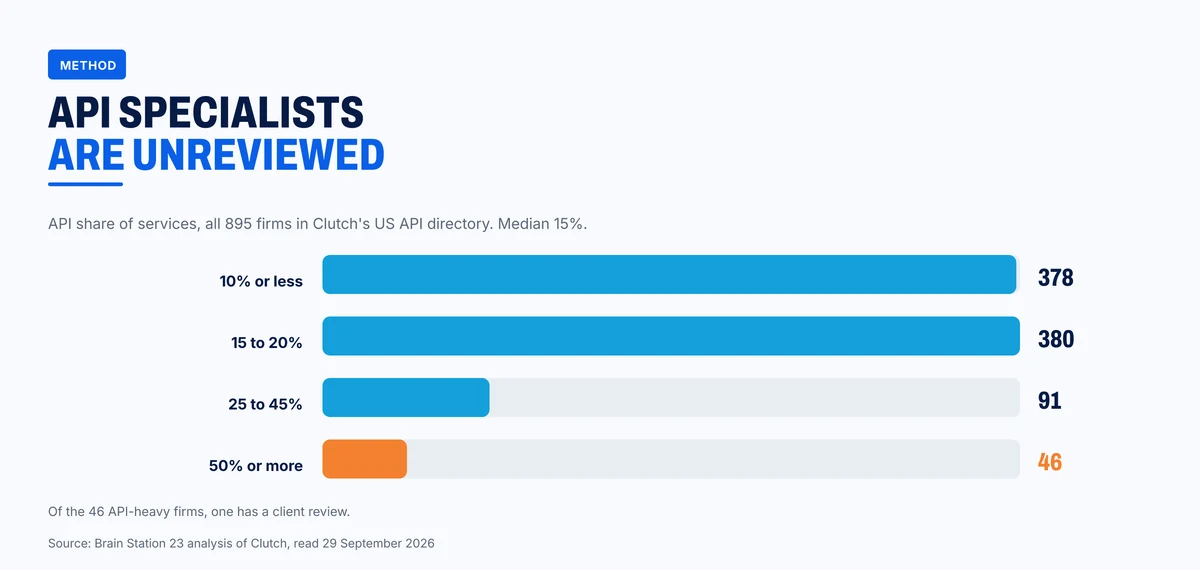
Reviews are the scarce thing. Of the 895 firms, 745 have no reviews at all, and only 29 have ten or more. The top 20 hold 360 reviews between them, a median of 14.5 each. Five have fewer than ten: Rocket Code, ObjectStyle, SmallCo., Tevpro and Ingage Partners.
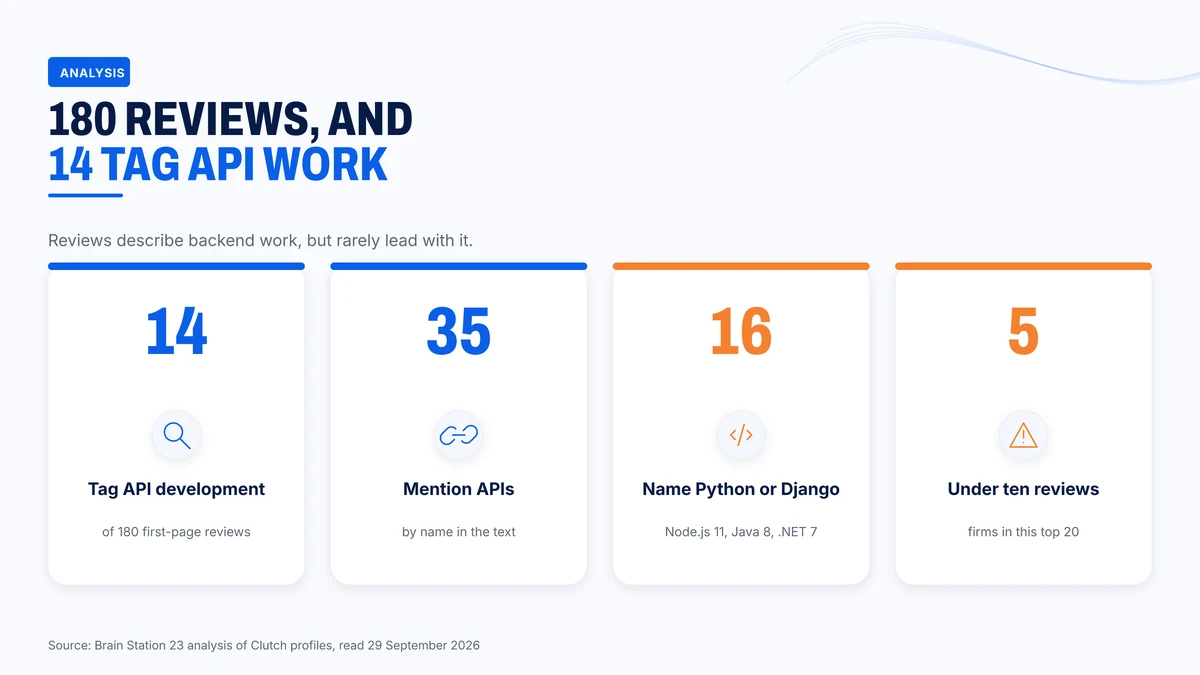
The reviews mention APIs, but rarely lead with them. We read the first page of reviews on each of the twenty profiles, 180 in all. Fourteen tag API development as a service delivered, 35 mention APIs by name and 35 mention back-end work. Where a language is named, Python or Django comes up in 16, Node.js in 11, Java in 8 and .NET in 7.
The firms are small, and most are US-only. Eleven of the twenty have 10 to 49 staff, eight have 50 to 249, and one, Launch by NTT DATA, has 250 to 999. Six list offices outside the United States, in Ukraine, Estonia, Poland, Mexico or England. Florida is home to four headquarters, and Texas and California to three each.
Cost is the weak sub-score. Of the 17 firms whose sub-scores differ, 15 score lowest, or joint lowest, on Cost. Ingage Partners at 4.0, Launch by NTT DATA at 4.2 and SmallCo. at 4.4 are the lowest. This Top 20 Backend Development Companies in USA list overlaps our Python list by only one firm, Gearheart.io, which says as much about how differently backend firms describe themselves as about the firms.
How to shortlist a backend development company
Order the filters so the first one removes the most firms.
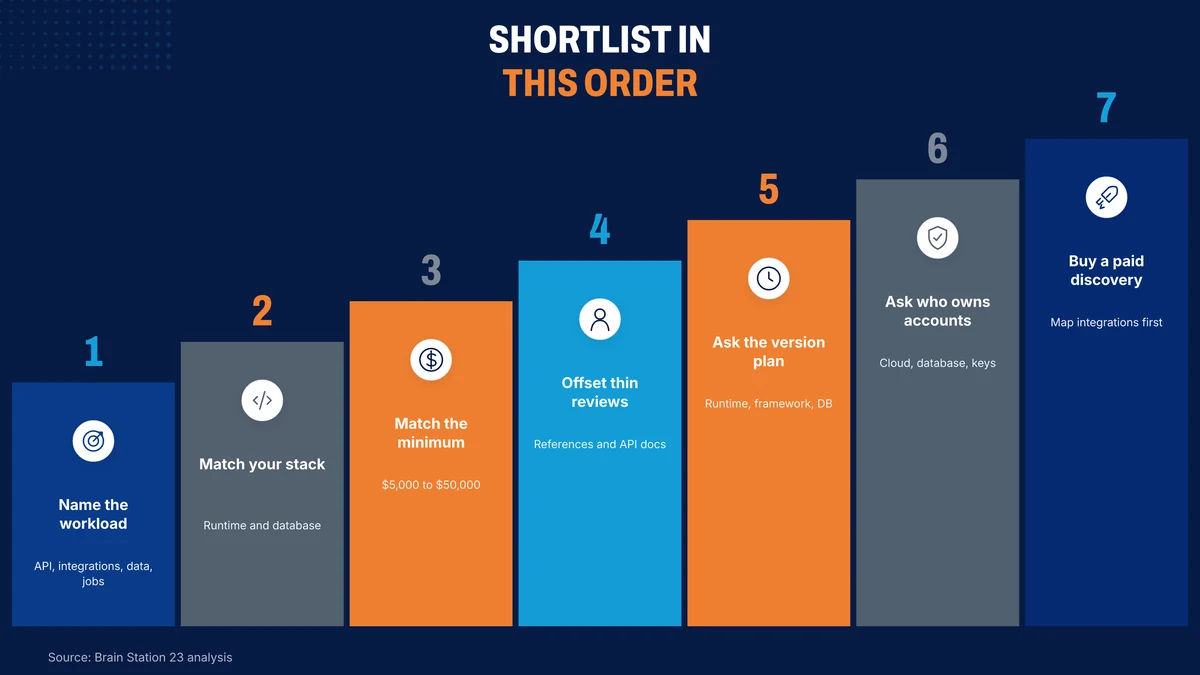
Step 1: Name the workload. An API for your own apps, integrations with other systems, data processing and background jobs need different strengths. Start with the group above that matches.
Step 2: Match the stack you already run. If your services are in .NET, a Rails shop will propose a rewrite. Filter on the runtime and database first; the Key Tech Stack column does most of this.
Step 3: Match your budget to the minimum. Minimums run from $5,000 to $50,000, and published rates from under $25 to $300 an hour.
Step 4: Compensate for thin reviews. Five firms here have fewer than ten reviews, and the API specialists in the wider directory have almost none. Ask for three references you can call and a sample of API documentation.
Step 5: Ask for the version plan. The answer should name the runtime, framework and database versions, and the dates each will move before support ends.
Step 6: Ask who owns the accounts. Cloud, database, API gateway, secrets manager and repository should be in your name from day one.
Step 7: Buy a paid discovery. A short fixed-fee phase that maps the integrations and the data model shows the real size of the job before you fund it.
How to buy backend development: four engagement models
The engagement model decides who pays when an integration turns out to be harder than its documentation promised.
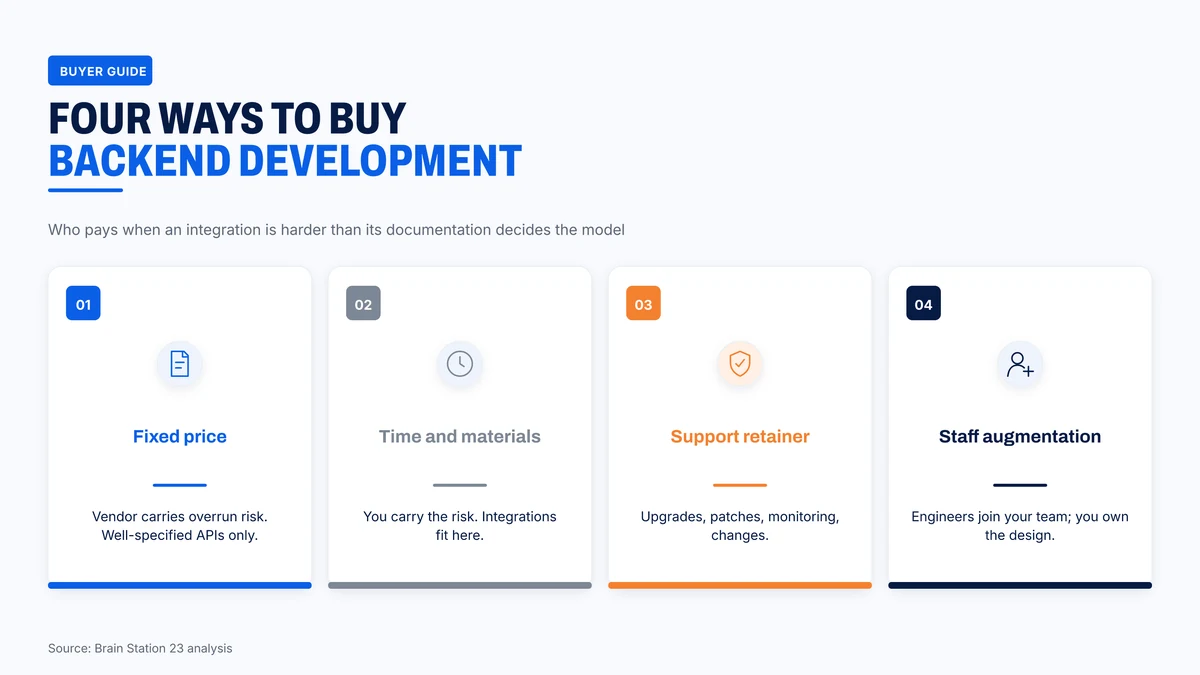
Fixed price moves overrun risk to the vendor, who prices it in. It suits a well-specified API with few external dependencies. It fails on integration-heavy work, where every third-party system is a surprise.
Time and materials keeps the risk with you. It suits integrations, migrations and anything touching a legacy database. Cap each phase and review burn every week.
Support retainer covers runtime and framework upgrades, security patches, database maintenance, monitoring and a block of change requests. It is the model most buyers forget to price.
Staff augmentation adds backend engineers to your team. BIX Tech, 26 Lines Of Code, Rocket Code, Gearheart.io, Hristov Development, JetBase, Bilberrry and Brain Station 23 publish staff augmentation work. It fails when nobody in-house owns the architecture and the data model.
The technical question: keeping a backend supported
A backend that has not been touched for two years is usually behind on the runtime, the framework, the database and dozens of packages at once. The order of the work decides whether it is a planned upgrade or a rewrite.
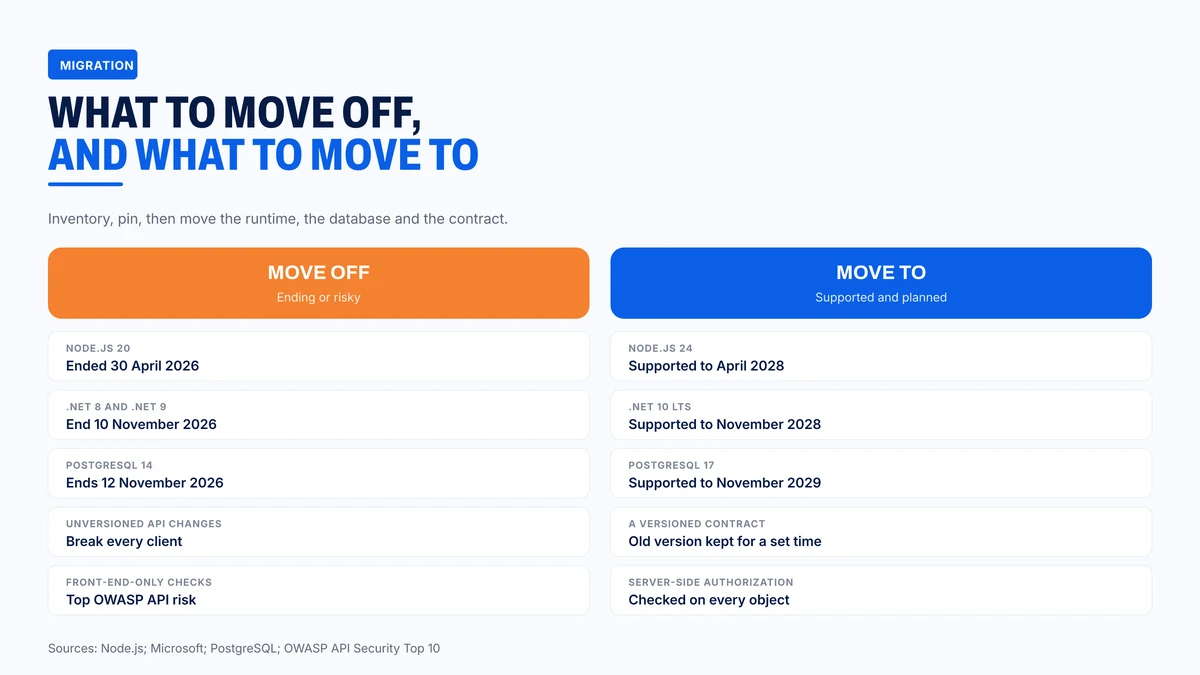
Step 1: Inventory the APIs. List every endpoint, who calls it and what data it returns. In Salt Security’s research, only 19 percent of organizations were very confident their API inventory was accurate, and 54 percent relied on developer documentation to find sensitive data exposure (Salt Security). You cannot upgrade what you have not found.
Step 2: Pin and test. Lock every dependency version and get the test suite passing on the current stack before you change anything. Integration tests against each third-party system matter more than unit tests here.
Step 3: Move the runtime. Node.js 20 is already out of support; Node.js 22 runs to 30 April 2027 and Node.js 24 to 30 April 2028 (Node.js). .NET 10, a long-term support release, runs to 14 November 2028 (Microsoft). Python 3.12 runs to October 2028 (Python).
Step 4: Move the database. PostgreSQL 14 ends on 12 November 2026; PostgreSQL 17 is supported to 8 November 2029 (PostgreSQL). A major-version database upgrade needs a rehearsal on a copy of production data and a written rollback.
Step 5: Version the API contract. Any change a client can see gets a new version, with the old one kept for a stated period. Fix authorization while you are there: broken object-level authorization is first on OWASP’s API Security Top 10 (OWASP).
The order matters because each step makes the next one testable. A runtime upgrade with no pinned dependencies and no integration tests fails in ways nobody can reproduce.
Red flags: eight answers to walk away from
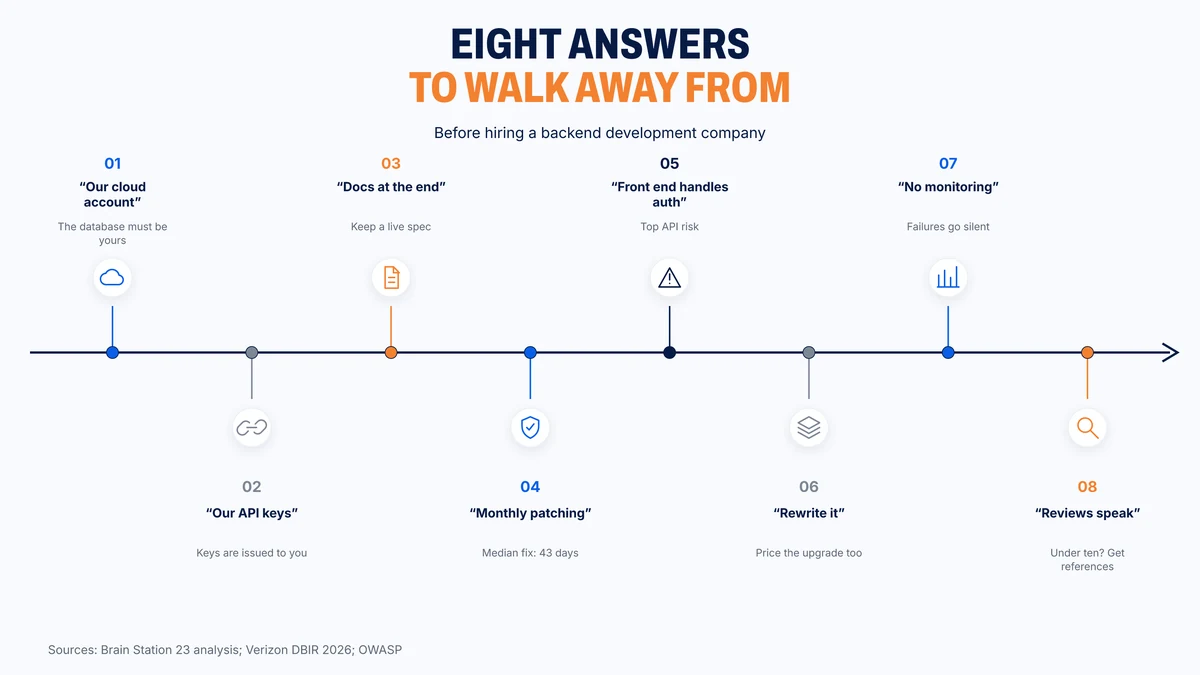
“The database lives in our cloud account.” Then you do not own your data in any practical sense. The account, and its billing, should be yours.
“We use our own API keys for the integrations.” Every payment, email, map and AI key should be issued to you.
“We’ll document the API at the end.” Documentation written after the fact describes what the team remembers, not what the code does. Ask for an OpenAPI specification that the build keeps current.
“We patch in the monthly window.” Verizon’s 2026 report puts the median time to fully patch a vulnerability at 43 days, and 31 percent of breaches now start with one (SecurityWeek on Verizon DBIR 2026).
“Authorization is handled by the front end.” It never is. OWASP lists broken authorization as the top API risk (OWASP).
“We’ll rewrite it in our stack.” Sometimes right, often convenient for the vendor. Ask for the price of an upgrade in the current stack alongside it.
“Monitoring isn’t in scope.” A backend without error tracking and alerting fails silently, and you find out from customers.
“Our reviews speak for themselves.” Five firms here have fewer than ten. References you can call carry more weight than a star rating.
After launch: what the build quote leaves out
This part covers what owners wish they had settled before the final invoice, and what recurs for as long as the backend runs.
What you must own before the final invoice
The code repository with its full history, in your GitHub or GitLab organisation, with the lock files, infrastructure code and a passing test suite. A zip file is not a repository.
The cloud account and the database, with billing in your name and the vendor added as a user you can remove. Backups should run to storage you control, and someone should have restored one.
Every third-party key and account: payment processors, email and SMS providers, maps, AI model APIs and any premium libraries, licensed to you rather than to the agency, because agency-wide licences stop the day the relationship does.
The secrets, stored in a secrets manager you own, not in the vendor’s password vault or a configuration file.
The API documentation, as a current OpenAPI or equivalent specification, plus the database schema and migration history.
A runbook: how to deploy, roll back, restore the database, rotate a key and respond to an outage.
The bill that arrives after launch
A build quote covers the build. What recurs afterwards is usually larger over three years.
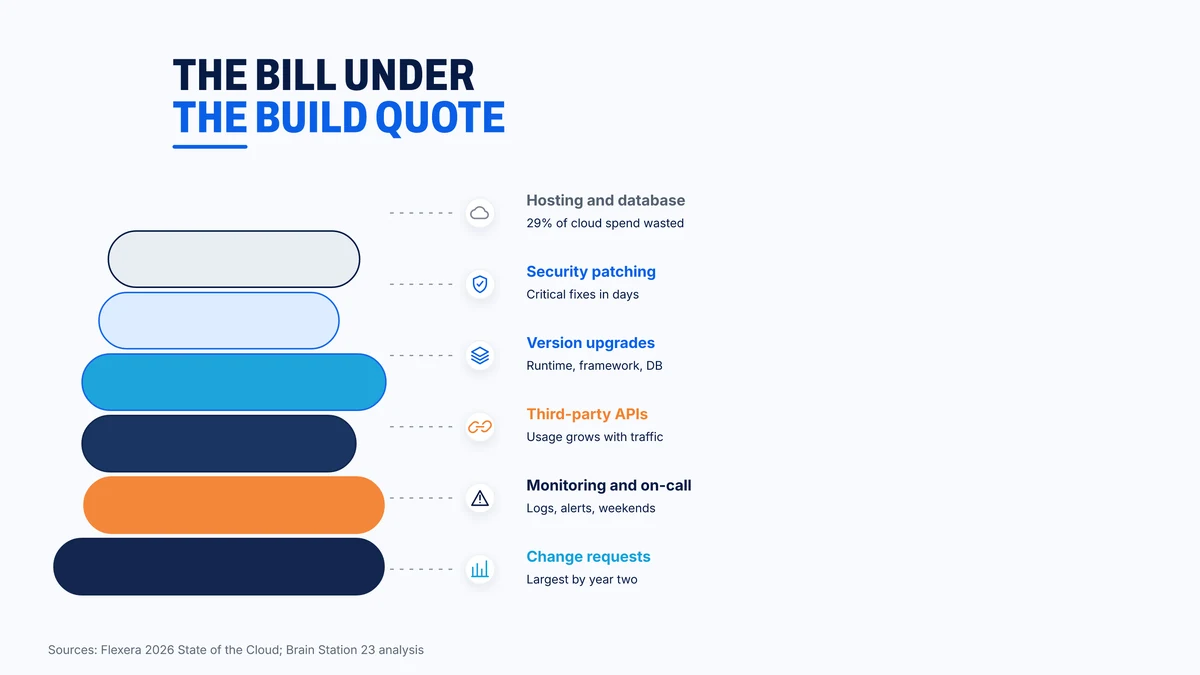
Hosting and database costs grow with traffic, and they are easy to waste: organizations estimate 29 percent of their cloud spend is wasted, the first rise in five years, according to Flexera’s 2026 survey of more than 750 cloud decision-makers (Flexera). Add security patching, runtime and database upgrades on the calendar above, third-party API usage, monitoring and on-call cover, and change requests, which are usually the largest line by year two. Get the recurring number before you sign the build, and compare vendors over three years rather than on the build alone.
Security is a recurring cost
Backend systems are where the data is, so they are where attackers go.
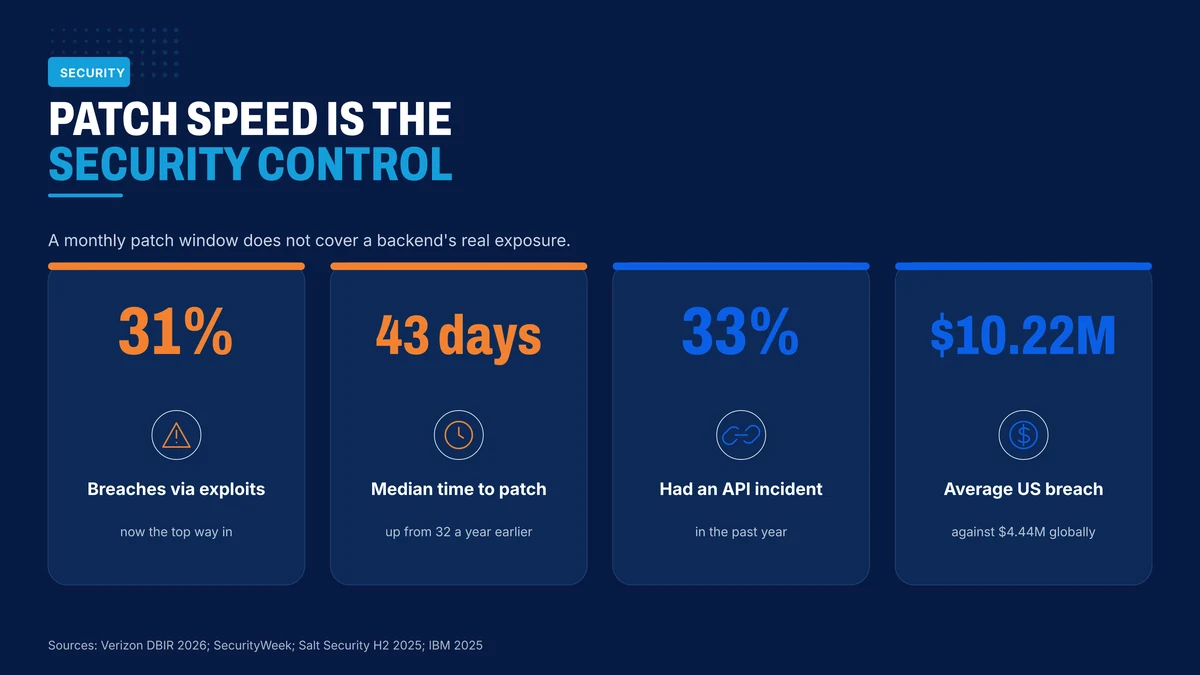
Exploited software vulnerabilities started 31 percent of the breaches in Verizon’s 2026 report, overtaking stolen credentials (Verizon DBIR 2026), and the median time to fully patch rose to 43 days (SecurityWeek). A third of organizations had an API security incident in the past year, and 80 percent lack continuous, real-time API monitoring (Salt Security). When a breach happens in the US, it costs an average of $10.22 million, against $4.44 million globally (IBM).
The argument that lands is simple. If the maintenance agreement applies patches in a monthly window, it does not cover the risk it claims to. Write a patch window in days for critical fixes into the contract, and ask who is watching the logs at the weekend.
Accessibility is legal exposure
A backend has no pages, but it feeds the ones that get sued. In 2026, 95.9 percent of the top million home pages had detectable WCAG failures, averaging 56.1 errors each (WebAIM), and 5,114 digital accessibility lawsuits were filed in the US in 2025, 45 percent of federal filings against companies sued before (UsableNet). If your vendor also builds the front end, name WCAG 2.2 AA in the contract rather than the word “accessible”, and make sure the API returns the text alternatives, labels and error messages the interface needs. Treat overlay widgets with scepticism.
Contract clauses that surface in month nine
IP assignment on payment, not on final acceptance, so ownership does not hinge on a sign-off that never comes.
Transition assistance: a set number of hours at an agreed rate to hand over to another team or to your own.
Rate escalation caps for the support term, and notice before any change.
Subcontracting: who is allowed to write your code, and where they are. Six firms here list offices outside the United States.
Data processing terms: where the database and backups sit, who at the vendor can reach production data, and how access is removed.
Liability cap and insurance that reflect what a breach of your data would cost.
Non-solicitation both ways, so neither side can hire the other’s key engineers during the contract.
This is not legal advice; have counsel review the contract.
How to leave without losing the backend
Confirm you hold the repository, cloud account, database, keys and secrets. Trigger the transition hours while relations are still cordial. Record walkthroughs of the deployment, the integrations and the data model. On the last day, rotate every credential the vendor could reach, including database passwords, API keys and cloud access, and remove their users.
Hire in-house or hire a backend development company
The Bureau of Labor Statistics median for software developers was $135,980 in May 2025, and employment is projected to grow 10 percent from 2025 to 2035 (BLS). Salary sites put a backend developer between $101,631 and $173,388 before benefits.
Hire in-house when the backend is the product and changes every week. One senior engineer who knows the data model is worth more than a larger outside team.
Hire an agency for a defined build, a migration or an integration project with an end date, where you need several skills for a few months.
Use staff augmentation when you have a technical lead but not enough engineers, and want to keep architecture decisions in-house.
FAQ
Which companies are the top backend developers in the USA?
Clutch has no backend category. In its US API development directory, the five highest Clutch-ranked firms on 29 September 2026 were Sketch Development, BIX Tech, 26 Lines Of Code, Bilberrry and Pell Software (Clutch).
How much do US backend development companies charge?
Nine of the twenty firms here publish $100 an hour or more, one publishes $200 to $300, and three publish under $50. Minimum projects run from $5,000 to $50,000, with a median of $10,000 (Clutch).
What does a backend developer earn in the US?
Which backend versions reach end of life in late 2026?
Python 3.10 in October, .NET 8 and .NET 9 on 10 November, PostgreSQL 14 on 12 November, and PHP 8.2 security support on 31 December (Microsoft; PostgreSQL; PHP). Node.js 20 and MySQL 8.0 ended on 30 April 2026.
Which backend stack should a new project use?
The one your team can support for five years. Among professional developers in 2025, 49.1 percent used Node.js, 21.3 percent ASP.NET Core and 15.6 percent Spring Boot, and 58.2 percent used PostgreSQL (Stack Overflow).
What is the biggest API security risk?
Broken object-level authorization, where an API returns records the caller should not see, is first on OWASP’s API Security Top 10 (OWASP). A third of organizations had an API security incident in the past year (Salt Security).
Why are there so few API specialists on this list?
Clutch ranks on review evidence, and API-heavy firms rarely have reviews: one of the 46 US firms that put half or more of their work into APIs has any (Clutch).
Conclusion
The data behind this Top 20 Backend Development Companies in USA list says three things. The backend label is not a specialism in the directory: firms that put most of their work into APIs are almost unreviewed, and the highest-ranked firms treat APIs as one service in ten. The useful signal is the stack and the reviews, which is why the groups above sort firms by what they build with. And the stack is on a clock, with Python 3.10, .NET 8 and 9, PostgreSQL 14 and PHP 8.2 all losing support before the end of 2026.
Any of the twenty can write an API. What decides the next three years is whether the runtime and database stay supported, whether critical patches land in days, and whether the database, cloud account and every key are in your name on the day the vendor leaves.
Sources
- https://clutch.co/us/developers/api?sort_by=ClutchRank
- https://clutch.co/profile/brain-station-23
- https://survey.stackoverflow.co/2025/developers
- https://survey.stackoverflow.co/2025/technology
- https://w3techs.com/technologies/overview/programming_language
- https://www.postman.com/state-of-api/2025/
- https://nodejs.org/en/about/previous-releases
- https://endoflife.date/mysql
- https://devguide.python.org/versions/
- https://dotnet.microsoft.com/en-us/platform/support/policy/dotnet-core
- https://www.postgresql.org/support/versioning/
- https://www.php.net/supported-versions.php
- https://endoflife.date/spring-boot
- https://www.payscale.com/research/US/Job=Back_End_Developer%2F_Engineer/Salary
- https://www.ziprecruiter.com/Salaries/Backend-Developer-Salary
- https://www.glassdoor.com/Salaries/backend-developer-salary-SRCH_KO0,17.htm
- https://builtin.com/salaries/us/back-end-developer
- https://www.bls.gov/ooh/computer-and-information-technology/software-developers.htm
- https://salt.security/press-releases/salt-security-report-shows-api-security-blind-spots-could-put-ai-agent-deployments-at-risk
- https://owasp.org/API-Security/editions/2023/en/0x11-t10/
- https://www.verizon.com/business/resources/reports/dbir/
- https://www.securityweek.com/verizon-dbir-2026-vulnerability-exploitation-overtakes-credential-theft-as-top-breach-vector/
- https://www.ibm.com/reports/data-breach
- https://www.flexera.com/about-us/press-center/flexera-finds-cloud-value-is-rising-while-ai-waste-grows
- https://webaim.org/projects/million/
- https://info.usablenet.com/2025-year-end-report-on-web-accessibility-lawsuits
- https://usa.brainstation-23.com/top-node-js-development-companies-in-usa/
- https://usa.brainstation-23.com/top-java-development-companies-in-usa/
- https://usa.brainstation-23.com/top-20-python-development-companies-in-usa/
- https://usa.brainstation-23.com/top-20-asp-net-development-companies-in-usa/